
Life, 1899-03-23 · page 6 of 20
Life — March 23, 1899 — page 6: what you’re looking at
What you’re looking at
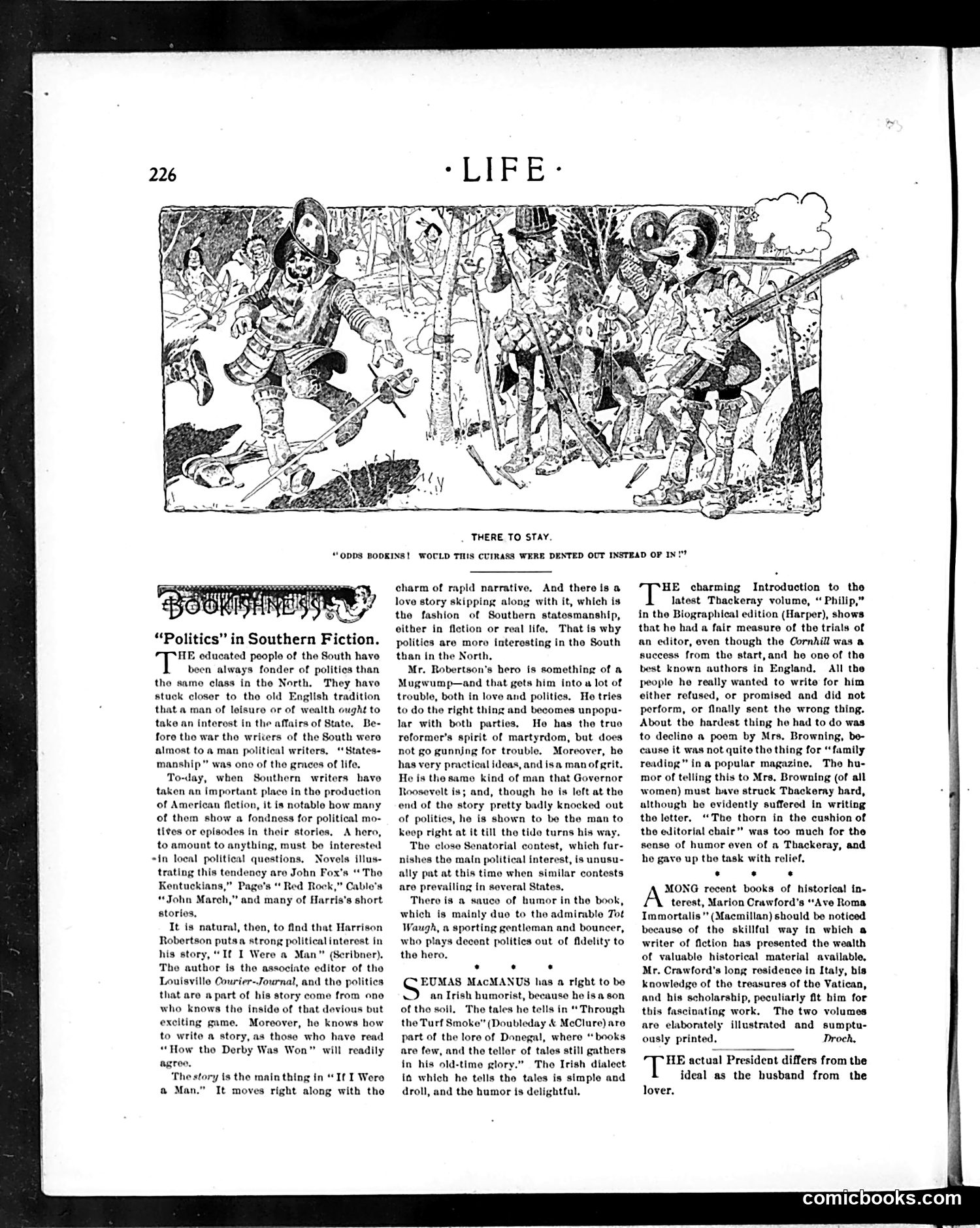
The cartoon's caption reads: "Odds bodkins! Would this cutlass were dented out instead of in it!" This appears to be satirical commentary on Southern political writing, specifically titled "Politics in Southern Fiction." The illustration depicts a chaotic colonial or frontier scene with multiple figures engaged in combat or conflict. The text discusses how educated Southern writers treat politics as more interesting than Northern counterparts, citing Harrison's "If I Were a Man" as an example where political themes drive the narrative. The satire critiques Southern literature's tendency to sensationalize political conflict through dramatic, violent imagery—suggesting that Southern writers inject overblown action and melodrama into political storylines for entertainment value, rather than addressing substantive political issues seriously.
📄 Transcribed text from this page (OCR, searchable)
Machine-transcribed from the original scan — historical spelling and the odd misread are preserved.
THERE TO STAY. “ODDS BODKINS! WOULD THIS CUIRASS WERE DENTED OUT INSTEAD OF IN !* “Politics” in Southern Fiction. HE educated people of the South have been always fonder of polities than the same class in the North, They havo stuck closer to tho old English tradition that a man of leisure or of wealth ought to take an interest in the affairs of State, Be- fore tho war tho writers of the South wero almost to a man political writers, tates- manship” was ono of the graces of life, To-day, when Southern writers havo taken an important place in the production of American fiction, it is notable how many of them show a fondness for political mo- tites or episodes in their stories, A hero, to amount to anything, must be interested sin local political questions, Novels illus trating this tendency are John Fox's ‘Tho Kentuckians,” Page's * Red Rock,” Cable's “John March,” and many of Harris's short stories, It is natural, then, to find that Harrison Robertson putsa strong political interest in his story, “If I Were a Man” (Scribner). The author is the associate editor of the Louisville Courier-Journal, and the politics that aro apart of his story come from ono who knows the inside of that devious but exciting game. Moreover, he knows how to write a story, as those who have read “How tho Derby Was Won” will readily agree. The story is the main thing in “If I Wero a Man.” It moves right along with tho charm of rapid narrative. And there is o love story skipping along with it, which is the fashion of Southern statesmanship, either in fiction or real life. That is why politics are moro interesting in the South than in the North, Mr. Robertson's hero is something of a Mugwump—and that gets him into a lot of trouble, both in love and politics. Ho tries to do the right thing and becomes unpopu- lar with both parties, He has the true reformer’s spirit of martyrdom, but does not go gunning for trouble. Moreover, he has very practical ideas, and isa man of grit. He is the samo kind of man that Governor Roosevelt is; and, though ho is left at the end of the story pretty badly knocked out of polities, he is shown to be the man to keop right at it till tho tide turns his way, The close Senatorial contest, which fur- nishes the matn political interest, is unusu- ally pat at this time when similar contests aro prevailing in soveral States, Thero is a sauce of humor in the book, which is mainly duo to the admirable Tot Waugh, a sporting gentleman and bouncer, who plays decont politics out of fidelity to the hero, . . . EUMAS MacMANUS has a right to bo an Irish humorist, because he isa son of tho soil. The tales he tells in “Through the Turf Smoke” (Doubleday & McClure) are. part of the lore of Donegal, where * books are few, and the teller of tales still gathers in his old-time glor; Tho Irish dialect ia which ho tells tho tales is simple and droll, and the humor is delightful. HE charming Introduction to the latest Thackeray volume, “Philip,” in tho Biographical edition (Harper), shows that ho had a fair measure of the trials of an editor, even though the Cornhill was a success from the start,and he one of the best known authors in England, All the people he really wanted to write for him either refused, or promised and did not perform, or finally sont the wrong thing. About the hardest thing he had to do was to declino a poom by Mrs. Browning, be- cause it was not quite tho thing for “family reading” in a popular magazine. The hu- mor of telling this to Mrs, Browning (of all women) must bave struck Thackeray hard, although be evidently suffered in writing tho letter, “The thorn in the cushion of the editorial chair" was too much for the sense of humor even of a Thackeray, and he gavo up the task with relief, . . . MONG recent books of historical in- terest, Marion Crawford's “Ave Roma Immortalis” (Macmillan) should be noticed because of tho skillful way in which o writer of fiction has presented the wealth of valuable historical material available, Mr. Crawford's long residence in Italy, bis knowledge of tho treasures of the Vatican, and his scholarship, peculiarly fit him for this fascinating work. The two volumes aro elaborately illustrated and sumptu- ously printed. Droch, HE actual President differs from the ideal as the husband from the lover. comicbooks.com