
A complete issue · 20 pages · 1899
Life — January 5, 1899
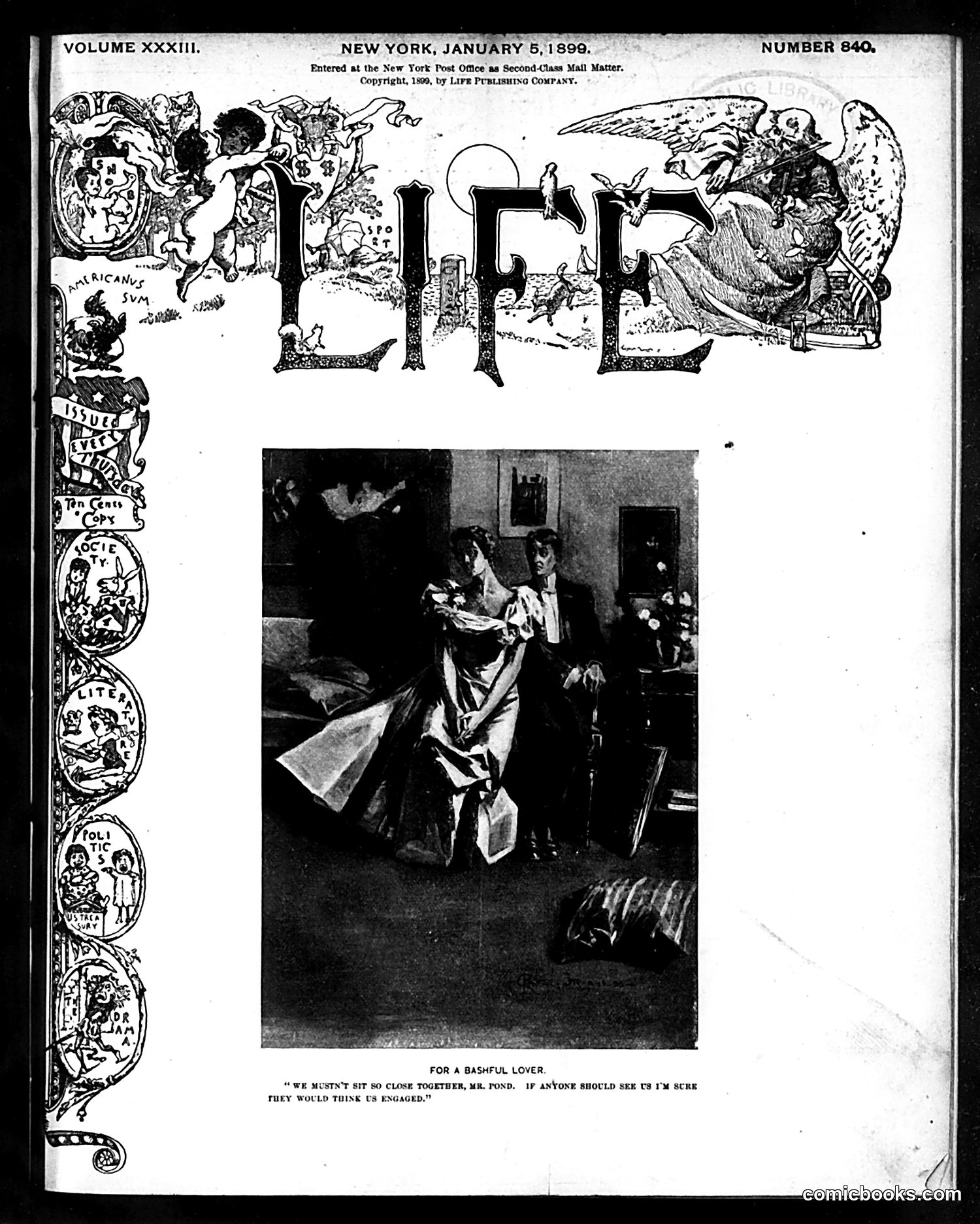
This page features a photograph captioned "For a Bashful Lover" with dialogue: "We mustn't sit so close together, Mr. Pond. If anyone should see us I'm sure they would think us engaged." The image shows a couple in an interior setting, appearing to sit at a modest distance from each other in an awkwardly formal pose—the apparent joke being that maintaining such conspicuous *distance* would actually suggest impropriety or engagement, contradicting the woman's stated concern. The satire mocks Victorian courtship etiquette and the absurd social rules governing public displays of affection between unmarried couples. The humor relies on the ironic contradiction between proper behavior and how observers might interpret it.
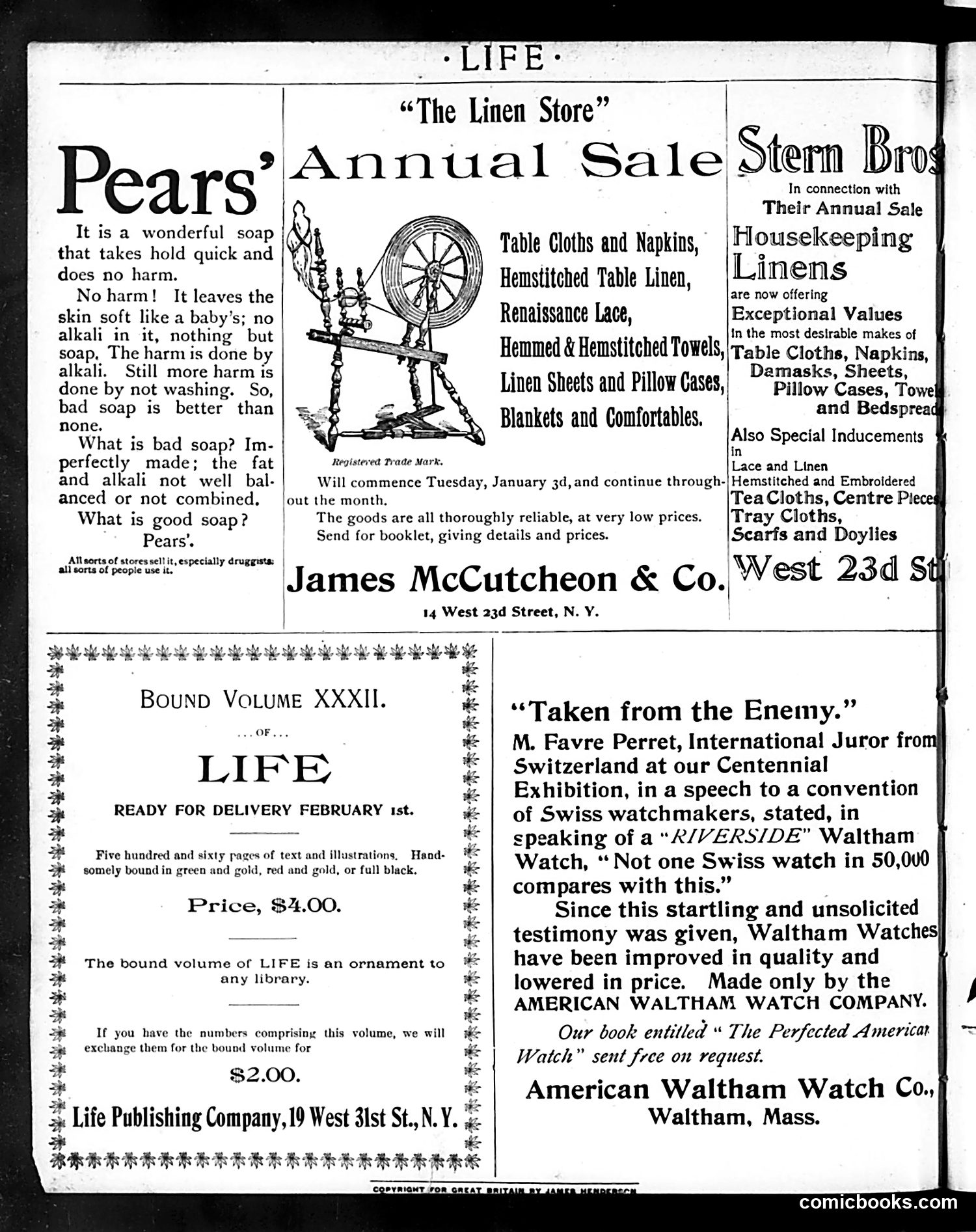
This page is **primarily advertising** with no political cartoons or satire visible. The ads include: - **Pears' Soap**: promotes the product's gentleness and purity, emphasizing it contains "nothing but soap" - **James McCutcheon & Co.**: announces a January linen sale featuring table cloths, napkins, towels, and sheets - **Stern Bros**: advertises housekeeping linens and lace goods - **Life Publishing Company**: promotes a bound volume of *Life* magazine (Volume XXXIII) available February 1st for $4.00 - **American Waltham Watch Co.**: features a testimonial from a Swiss watchmaker praising their "Riverside" watch The page reflects early-1900s consumer culture and magazine publishing practices. No satirical content or political commentary is apparent.
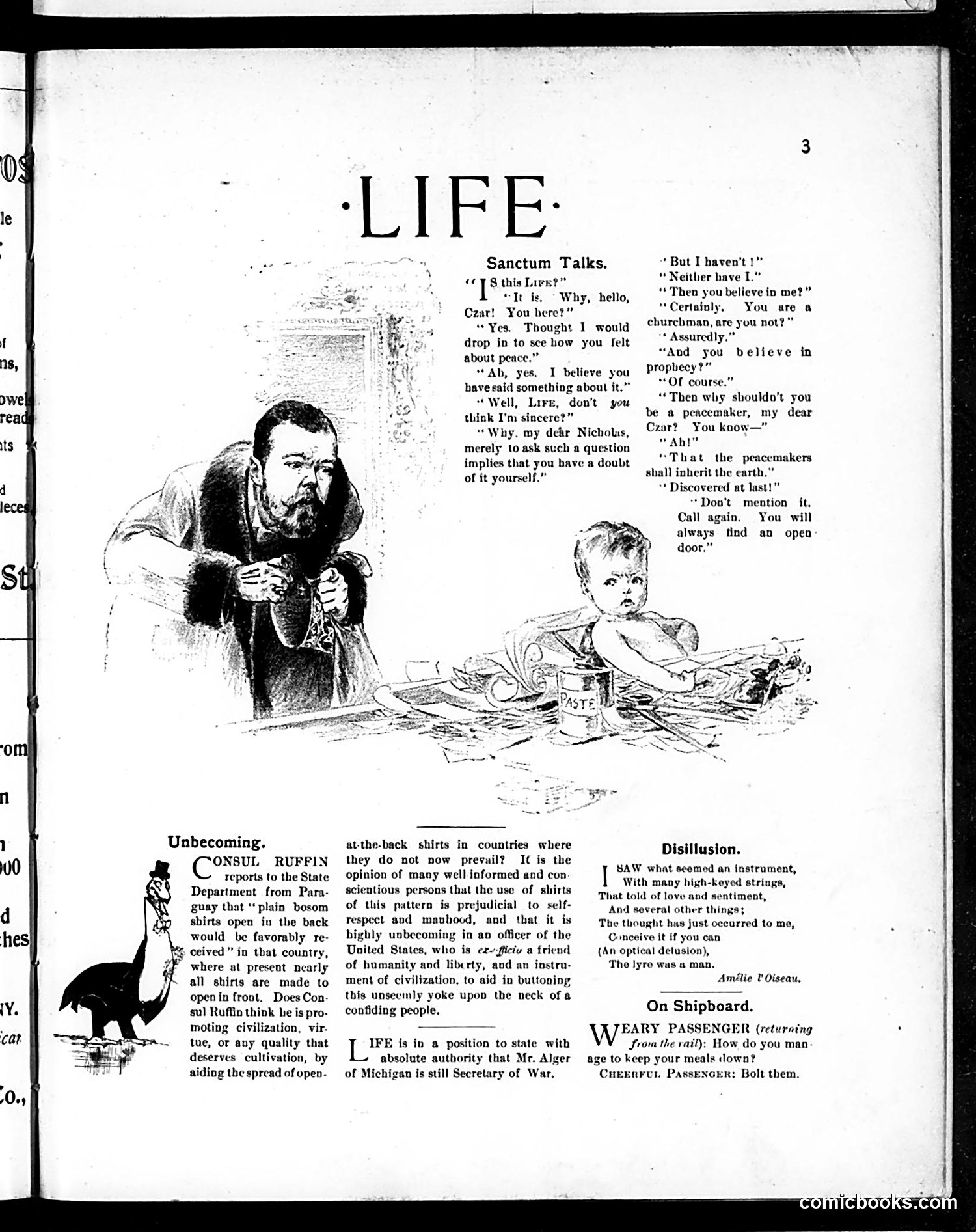
The top cartoon depicts two figures in dialogue: an older bearded man (labeled "Czar") and a younger character ("Life"). The Czar expresses skepticism about peace, while "Life" advocates for it and prophecy. The satire mocks the tension between cynical political realism and idealistic peacemaking rhetoric—a common theme in pre-WWI satire when Russia was involved in various conflicts. Below, three brief satirical pieces mock contemporary absurdities: poorly-designed shirts ("Unbecoming"), Mr. Alger's continued role as Secretary of War despite changing circumstances ("Disillusion"), and shipboard meal service ("On Shipboard"). These reflect Life magazine's typical criticism of government incompetence and social pretension.
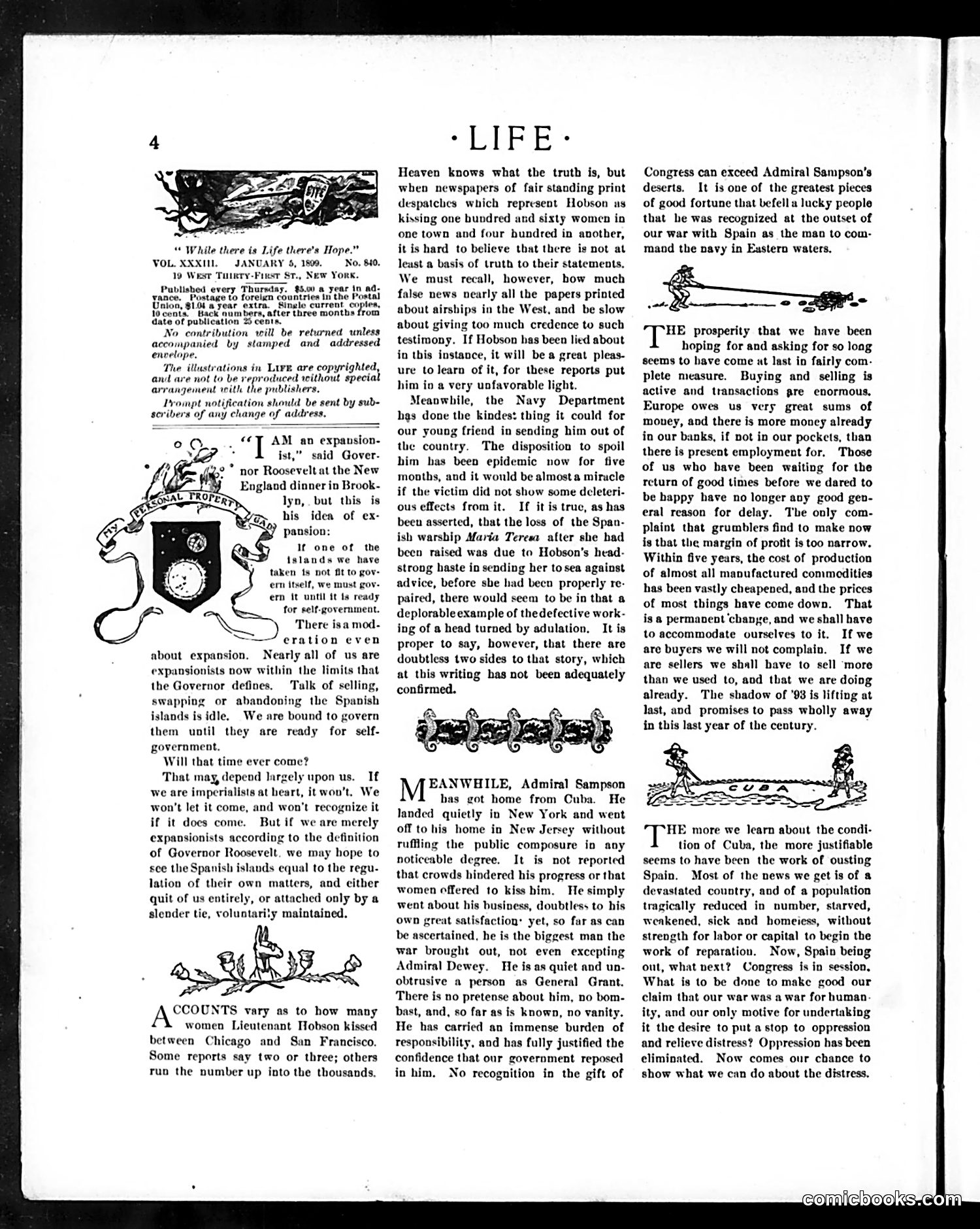
This page contains editorial commentary on American expansionism and Admiral Sampson's role in the Spanish-American War. The main cartoon shows **Governor Roosevelt** (identified in text) discussing imperial expansion, with the caption "I am an expansionist." The editorial debates whether the U.S. should retain Spanish territories acquired during the recent war. Roosevelt advocates expansion; the writer questions whether Americans truly support permanent territorial acquisition versus temporary military occupation. The text also discusses **Admiral Sampson's quiet return** from Cuba without public fanfare, noting his restraint contrasts with General Grant's prominence. The piece critiques Spain's weakened condition and debates America's moral obligation toward Cuban relief. The satire targets both expansionist ambitions and the contradictions in American imperial rhetoric.
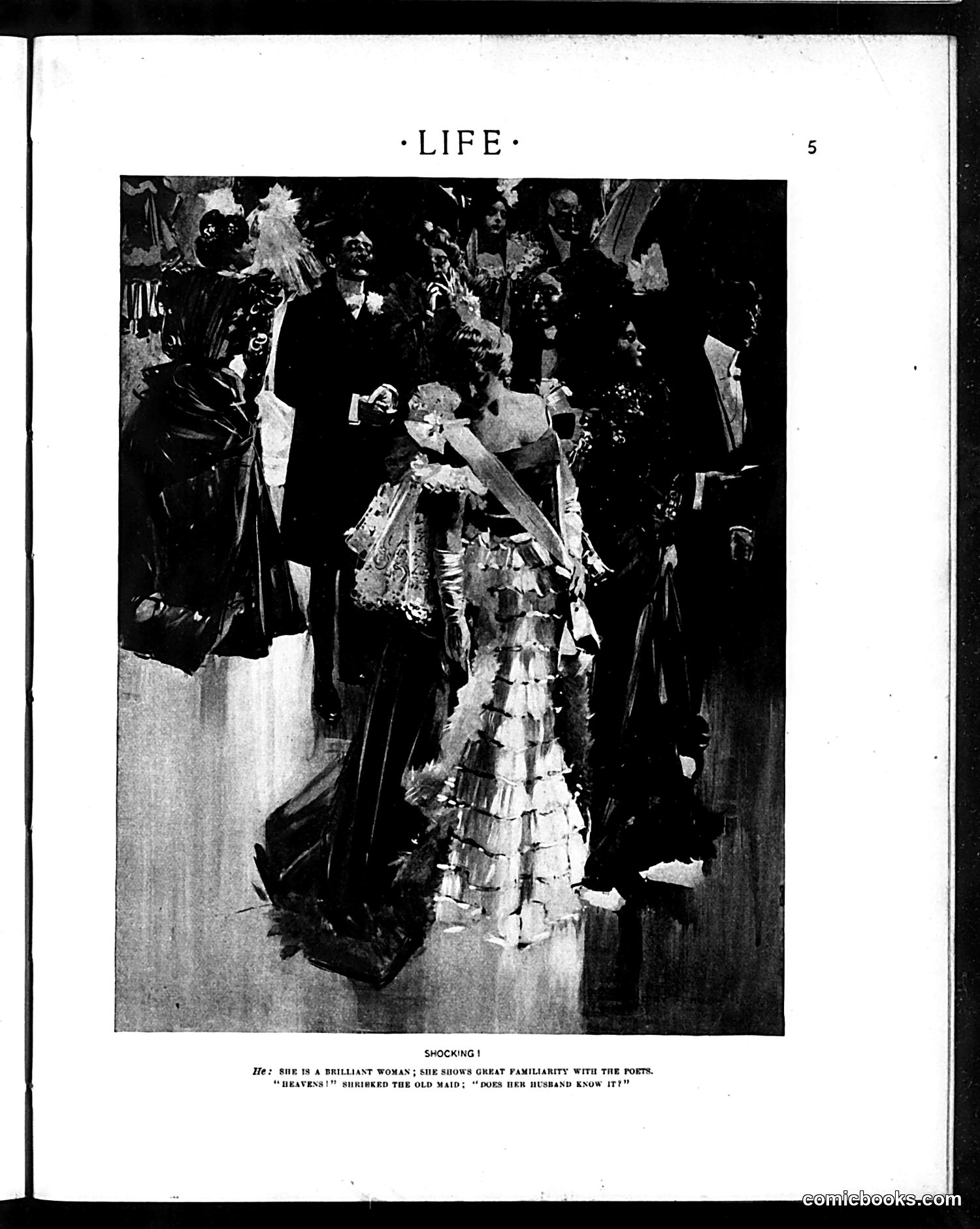
This page satirizes a woman of apparent high society or literary standing. The caption indicates she is "a brilliant woman" who "shows great familiarity with the poets" and references "Heavens!" and an "old maid," with a husband asking "Does her husband know it?" The satire targets the social contradiction of the era: educated, cultured women were often seen as threatening or inappropriate. The joke rests on the shock that a married woman would display intellectual independence and knowledge of literature—behavior considered unseemly or transgressive for respectable wives. The elaborate dress and formal gathering suggest upper-class pretension, which the magazine mocks by suggesting her intellectual pursuits are scandalous rather than admirable. The humor reflects early-20th-century anxieties about women's education and independence.
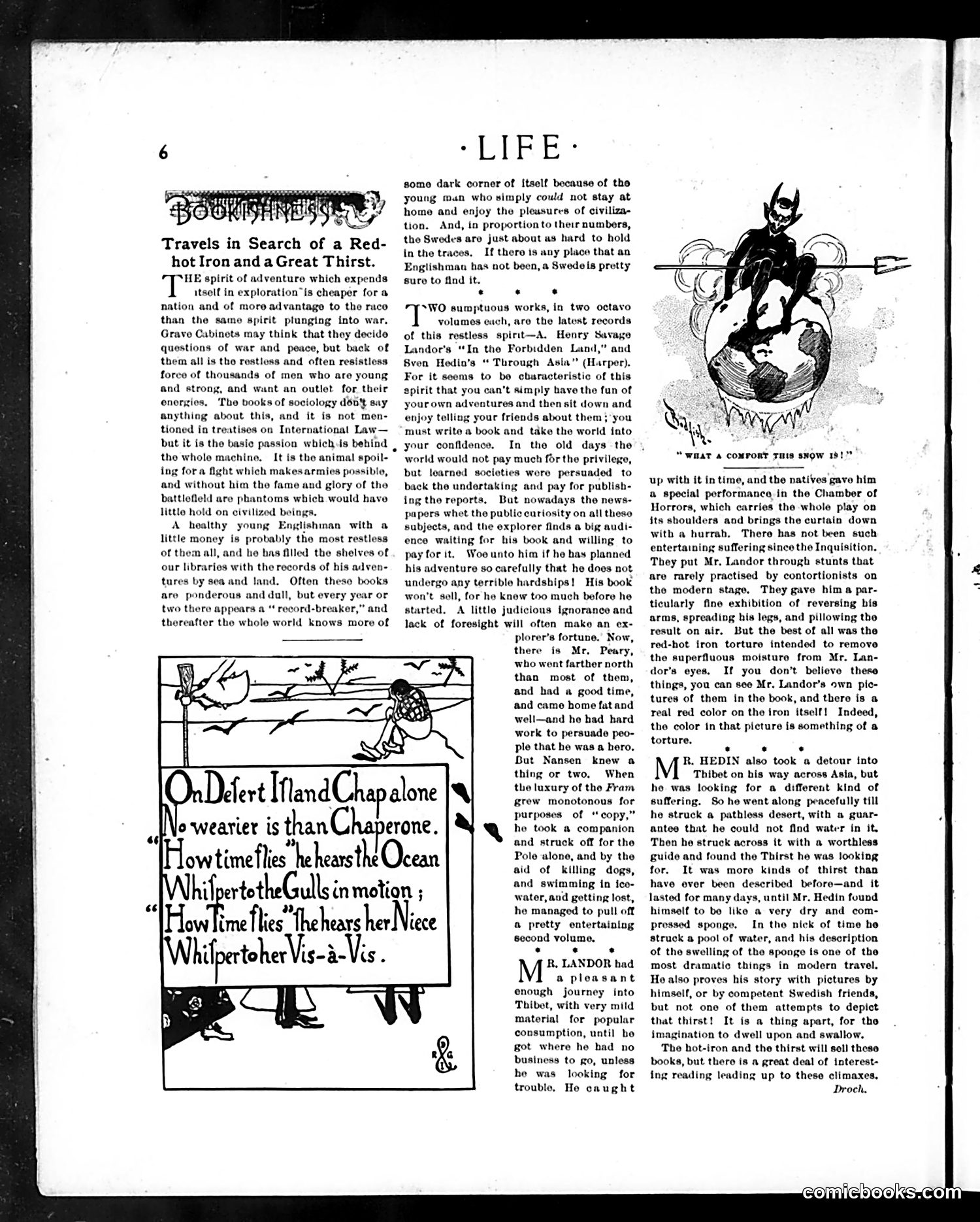
This page contains a **boxed poem/verse** (center-left) that appears to be a humorous maritime ditty about desert island life and isolation. The verse plays with repetitive phrasing about loneliness ("How time flies he hears the Ocean / Whilpertothe Gulls in motion"). The surrounding text discusses adventure travel narratives—specifically praising works by Henry Savage Landor and Bren Hedin about exploration. It mocks restless young men who seek glory through published travel accounts rather than genuine hardship. **The illustrations** show a figure in distress/exile (likely representing the adventure-seeker), and a demon-like figure in the upper right, suggesting the satirical tone about reckless adventurism. The satire targets **frivolous adventure tourism**—criticizing both the writers who sensationalize journeys and readers who seek vicarious thrills rather than substantive knowledge.
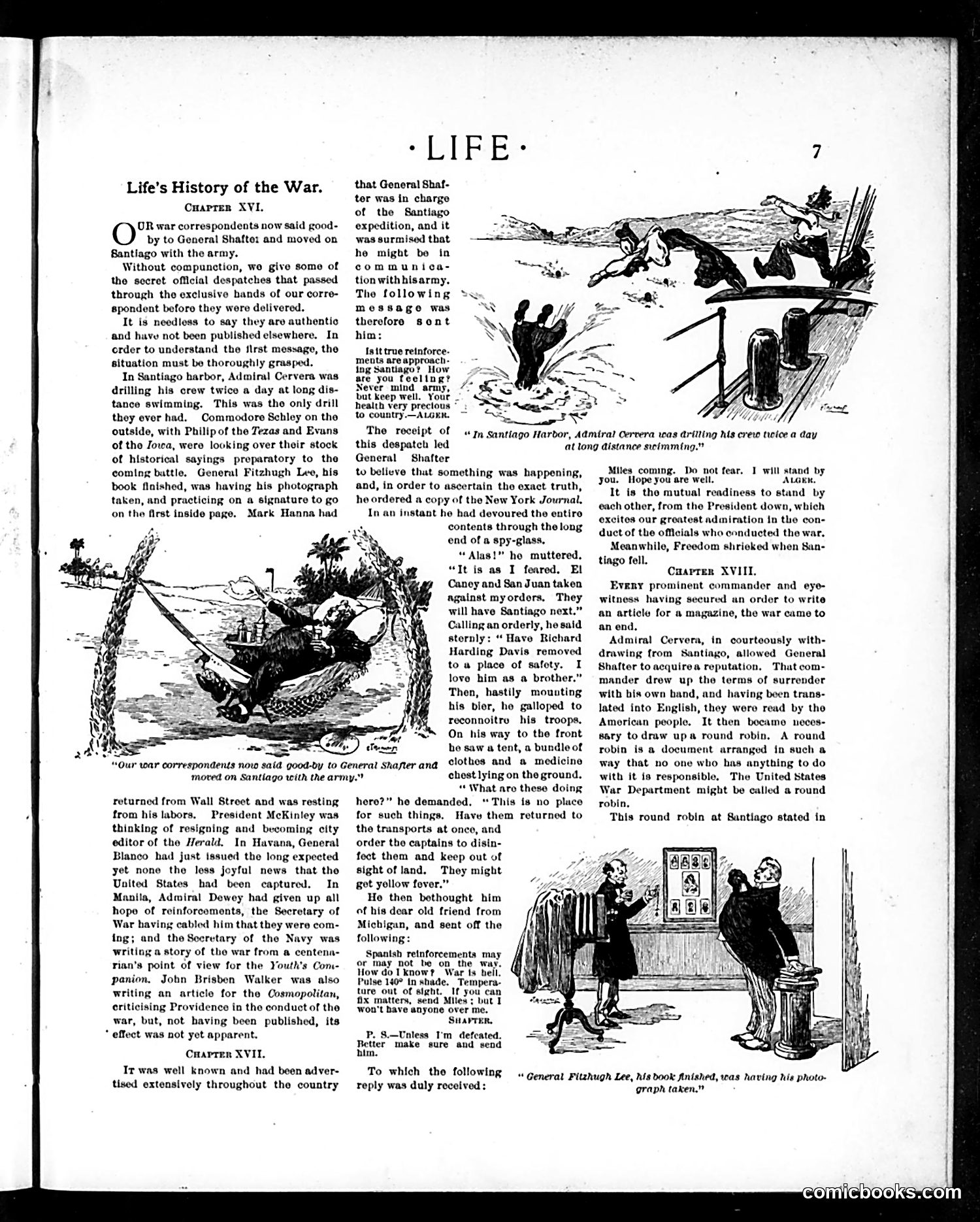
This page presents Chapter XVI of "Life's History of the War," a serialized account of the Spanish-American War. The two illustrations depict scenes from Santiago, Cuba during the conflict. The top cartoon shows Admiral Cervera's crew drilling at Santiago Harbor. The bottom illustration depicts General FitzHugh Lee with his book and photograph—Lee appears to be an officer documenting the war experience for publication. The narrative discusses General Shafter's Santiago expedition and includes dispatches between military officials. The text references President McKinley, Secretary of War, and Admiral Dewey, indicating this covers the war's political-military leadership. The satirical tone mocks bureaucratic tensions between civilian government and military commanders during the 1898 conflict, particularly regarding operational decisions and public documentation of events.
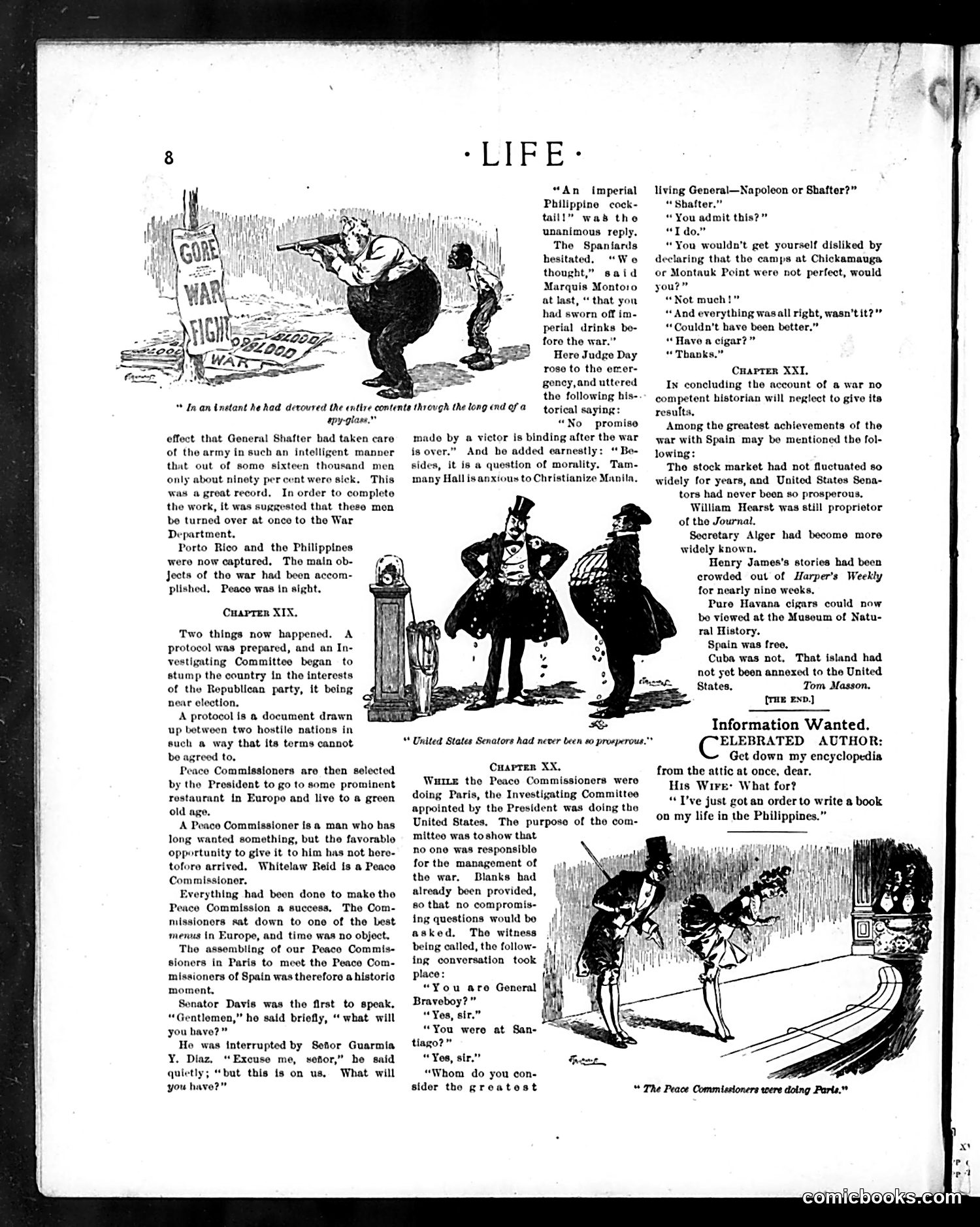
This page contains two satirical cartoons about the Spanish-American War and its aftermath. The **top cartoon** depicts General Shafter surveying war devastation. The text explains Shafter managed the war intelligently but was criticized for his methods, ultimately being reassigned to the War Department. The **bottom cartoon** shows U.S. Senators discussing peace negotiations. The caption reads "United States Senators had never been so prosperous," sarcastically commenting on how politicians profited from the war while Peace Commissioners negotiated in Paris. The text discusses Cuba's status (not yet annexed) and references Spain's loss. Overall, the page satirizes military leadership and political profiteering from the 1898 Spanish-American War, questioning whether war's human costs justified its benefits.
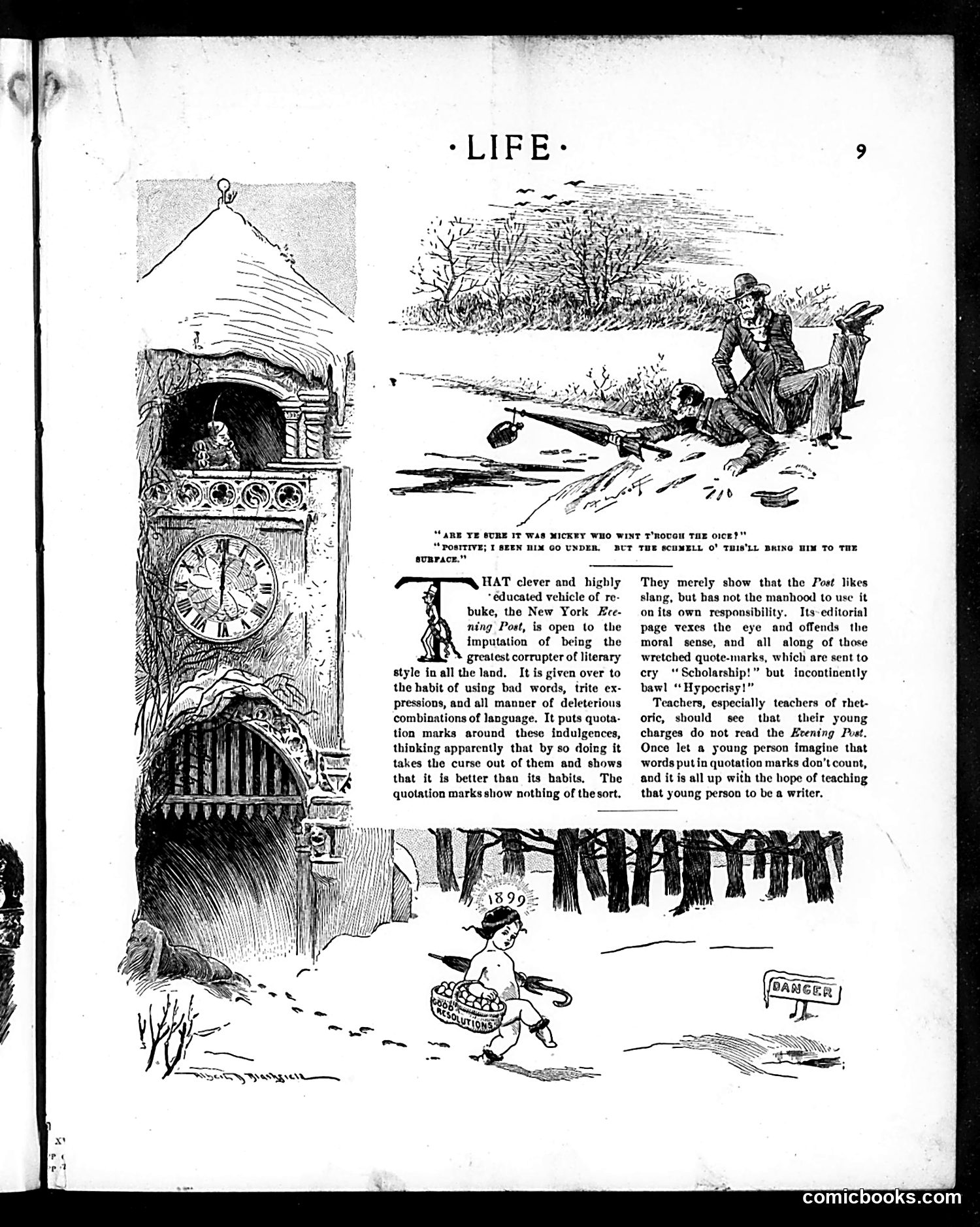
This page critiques the *New York Evening Post* for excessive use of quotation marks around words it deems improper. The large editorial illustration shows a grandfather clock—symbolizing tradition and authority—suggesting the Post positions itself as an arbiter of "correct" language. The cartoon above depicts two figures by a log, with dialogue suggesting someone was pushed underwater. The exact narrative is unclear, but it appears illustrative of the editorial's broader point. The text argues the *Evening Post* pedantically polices language and "bad words," using quotation marks to highlight perceived indulgences. The author contends this approach lacks genuine moral force—merely showing disapproval without addressing root problems. Teachers especially shouldn't rely on such superficial methods to influence young writers. The satire targets linguistic prescriptivism masquerading as moral instruction.
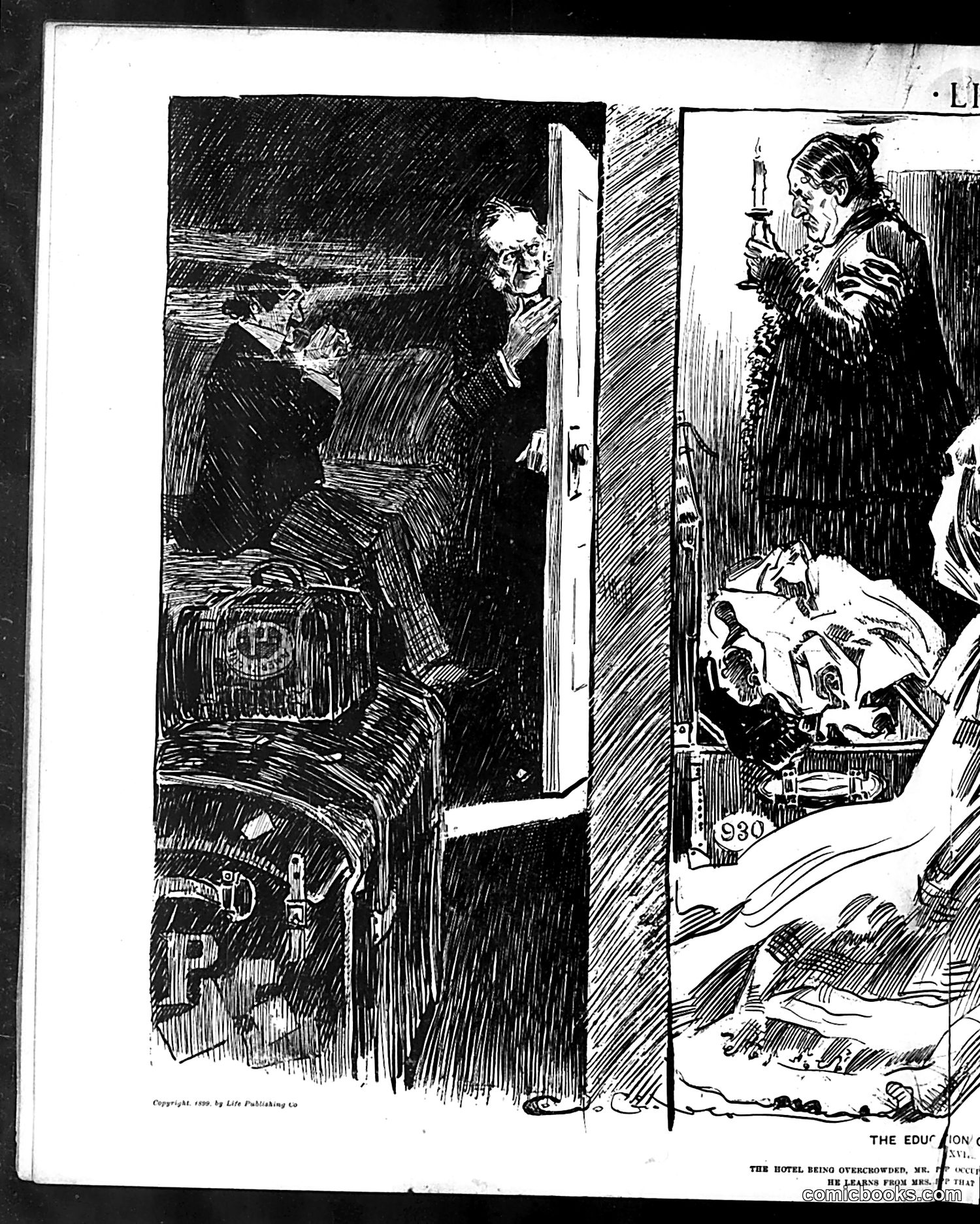
This page contains two illustrations depicting a hotel scene. The left panel shows two figures in what appears to be a cramped bedroom or sleeping area, with one person seated on a bed. The right panel shows a standing figure holding a candle in a doorway, observing a crowded room with multiple people in beds. The caption at bottom reads: "THE HOTEL BEING OVERCROWDED, MR. [unclear] LEARNS FROM MRS. [unclear] THAT HE LEARNS FROM MRS. [unclear] THAT..." This appears to be satirical commentary on hotel overcrowding—a common complaint in early 20th-century American life. The cartoon mocks the cramped, undignified accommodations guests endured during peak seasons. The humor relies on depicting the absurd conditions: multiple people crammed into inadequate sleeping spaces, highlighting the gap between hotel advertisements and actual guest experiences.
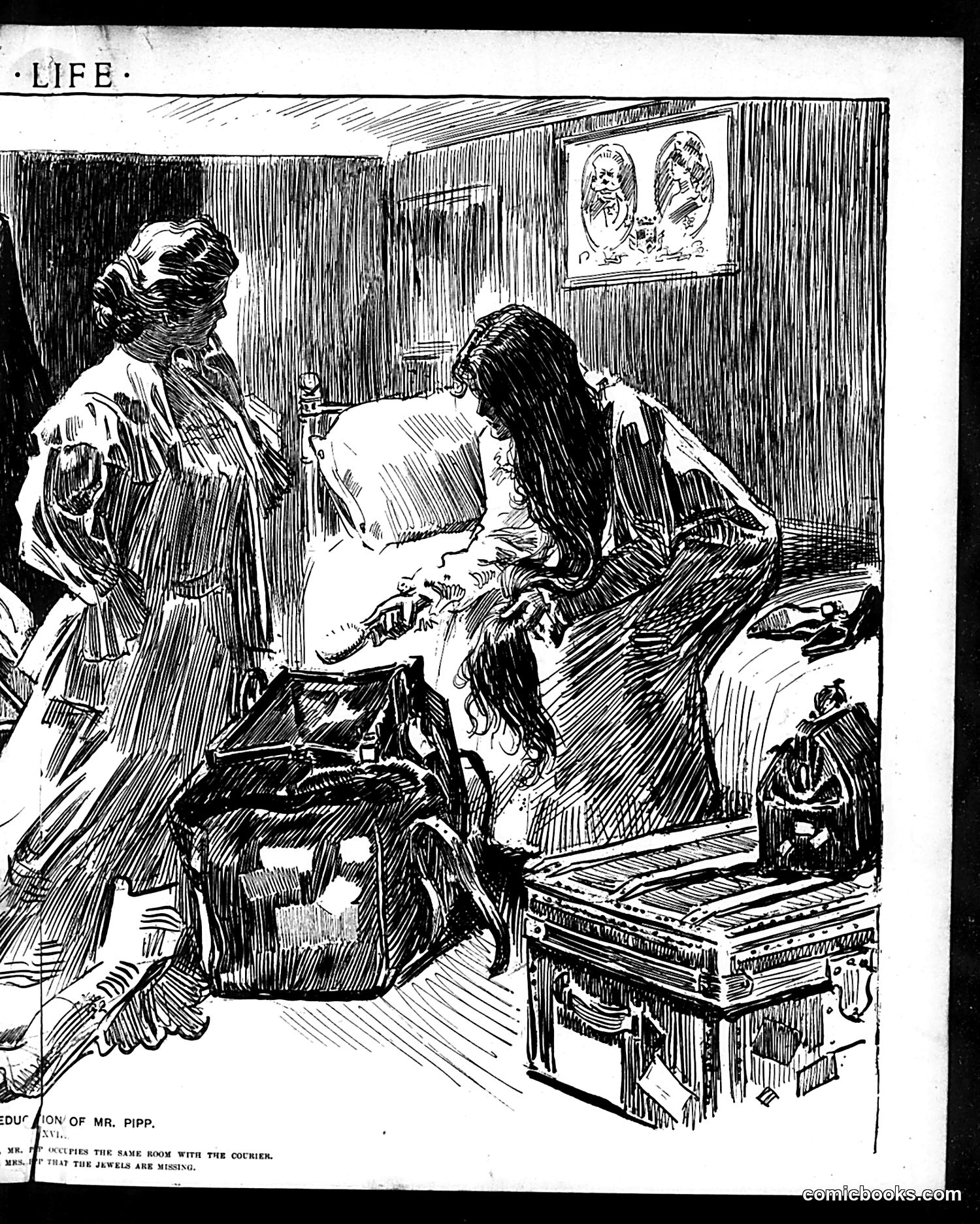
This appears to be an illustration from Life magazine depicting a domestic scene. The caption references "Mr. Pipp" and mentions that "the jewels are missing," suggesting a plot involving stolen jewelry. The scene shows two women in what appears to be a bedroom: one standing (dressed formally) and one seated on the bed. A man seems to occupy the same room with a courier, according to the partially legible caption. The sketch style and composition suggest this illustrates a narrative moment—likely from a serialized story or comic strip about a missing jewelry theft. Without being able to read the complete caption clearly, the specific identity of "Mr. Pipp" and the full satirical or narrative point remain unclear, though the scene appears designed to convey dramatic intrigue or scandal typical of early 20th-century magazine fiction.
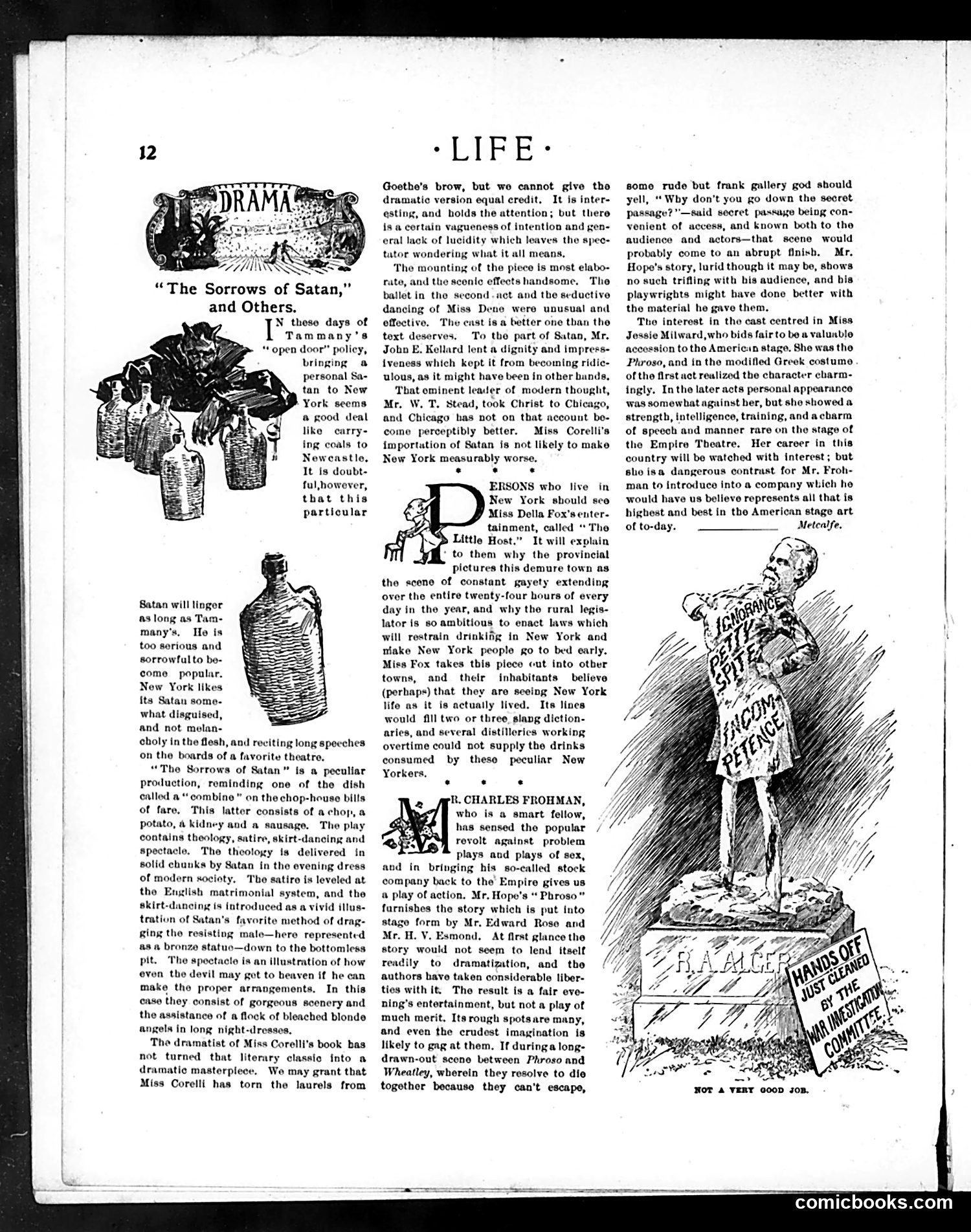
This page reviews theatrical productions, primarily critiquing "The Sorrows of Satan" and related plays. The left illustration shows a bottle labeled "Satan" with text explaining the play's themes about temptation and moral decline in modern society. The right cartoon depicts a figure labeled "Flammels Hands Off" being ejected or pushed away, likely satirizing either a playwright, producer, or actor's unwanted interference in theatrical affairs. The caption "Not a very good job" suggests criticism of someone's work or management. The text discusses Miss Corelli's dramatic adaptation and debates whether literary classics should be dramatized. References to Miss Della Fox's entertainment and New York drinking laws indicate the reviews address both artistic merit and contemporary social regulations affecting theatrical venues.
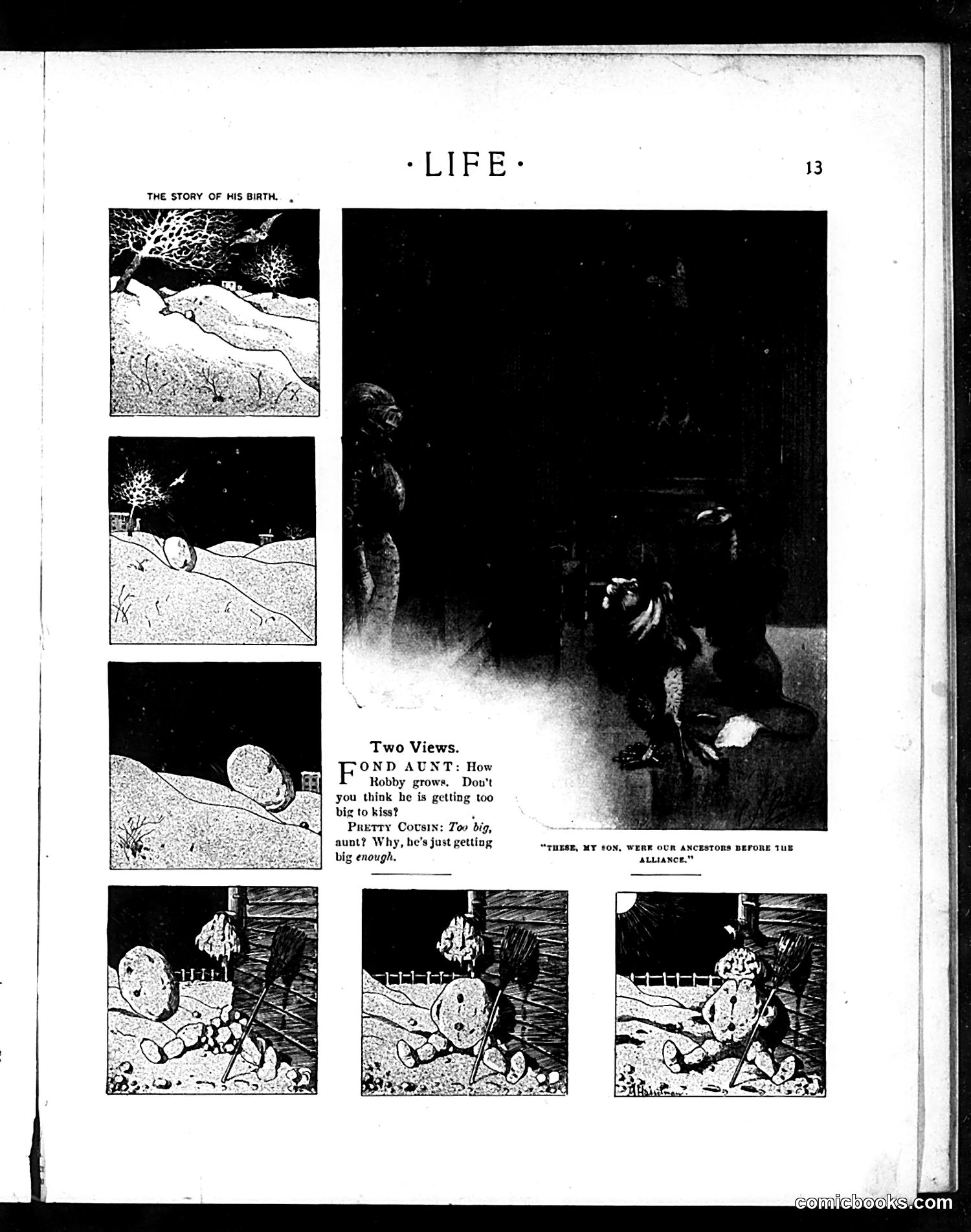
This page contains humorous domestic scenes rather than political satire. The top section shows "The Story of His Birth"—a series of illustrated panels depicting a child's growth, with animals (appears to be a hedgehog or similar creature) shown at progressive stages. The "Two Views" dialogue jokes about when a child becomes too old for kissing. An older aunt questions if young "Robby" is getting too large, while a younger cousin (suggesting flirtation or different values) suggests he's finally "big enough" to kiss—implying romantic rather than familial interest. The bottom caption references "ancestors before the Alliance," likely alluding to pre-modern courtship customs or family lineages, though the specific historical reference is unclear without additional context. The humor relies on generational attitudes toward appropriate physical affection and courtship conventions.
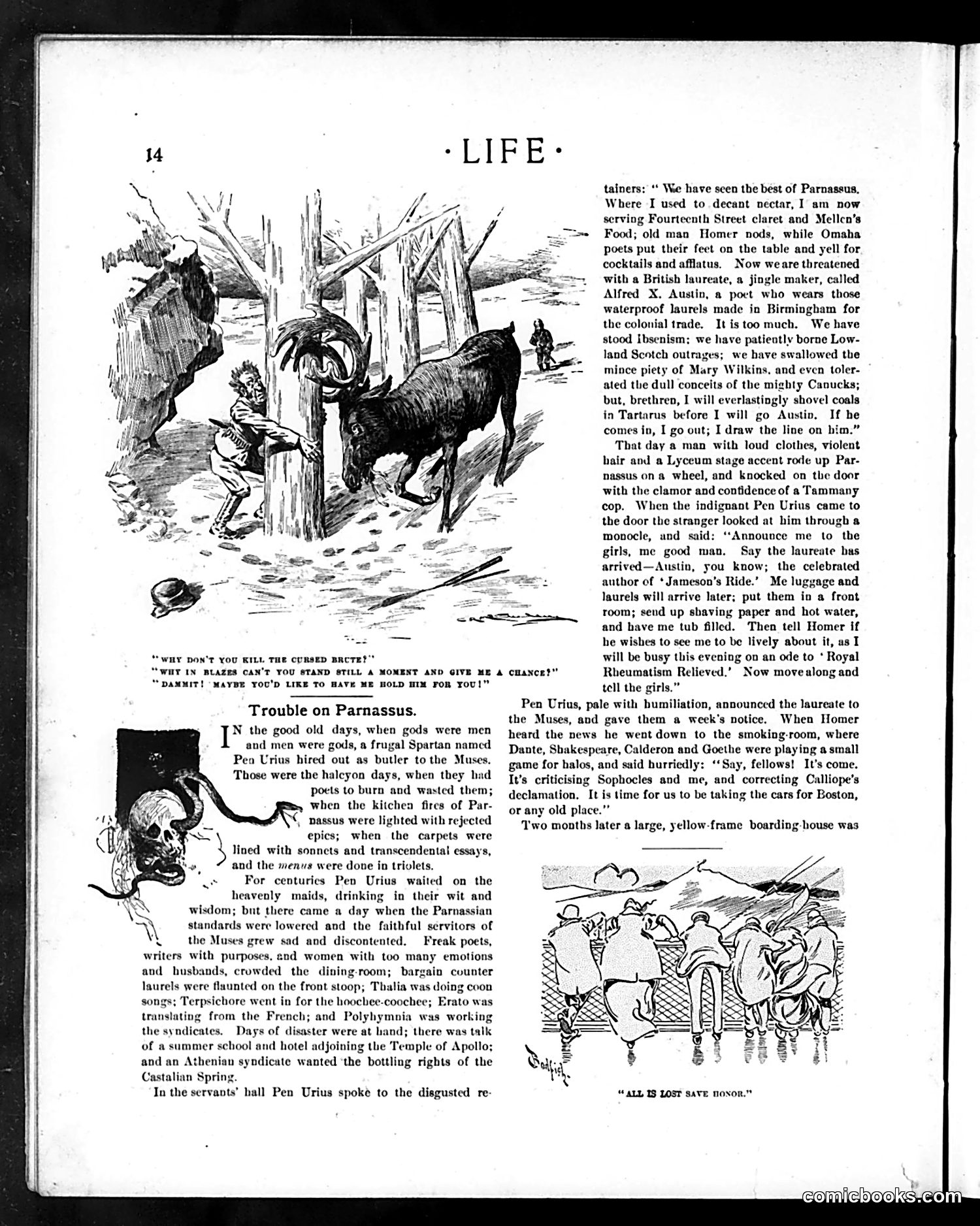
This satirical story mocks the degradation of American letters in the late 19th century. Mount Parnassus—the mythological home of the Muses and poetry—has become a boarding house filled with mediocre writers and commercial hacks. The protagonist, Pen Urius (a pun on "penury"), serves as butler to the Muses. He laments that great poets like Homer now coexist with "freak poets, writers with purposes, and women with too many emotions"—apparently targeting sentimental or didactic contemporary writers (likely including Mary Wilkins Freeman and others). The arrival of **Alfred X. Austin**, a British Poet Laureate, proves the final insult: an arrogant, poorly-dressed charlatan more concerned with comfort than art. The great literary giants—Homer, Dante, Shakespeare, Goethe—flee in disgust. The page satirizes American literary culture's commercialization, including vaudeville acts ("coon songs," "hoochee-coochee") and syndication, suggesting high art has been abandoned for popular entertainment and profit.
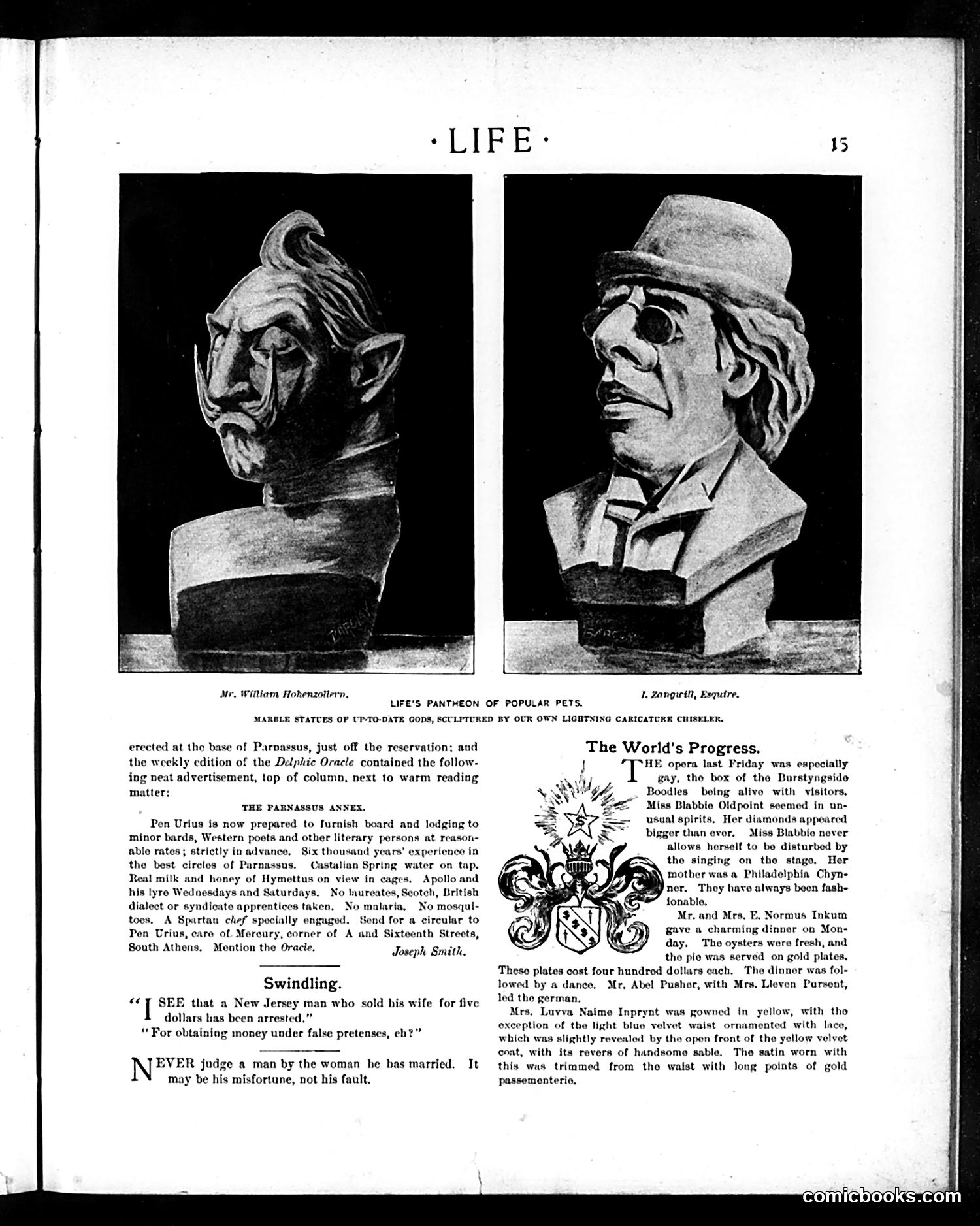
The page features two marble busts labeled "Mr. William Hohenzollern" and "I. Zangwill, Esquire," presented as "Life's Pantheon of Popular Pets"—a satirical "pantheon of up-to-date gods." Hohenzollern refers to Kaiser Wilhelm II of Germany, suggesting he was a contemporary figure of mockery. The second figure's identity is less certain but appears to be a public personality also worthy of caricature. The satire mocks the elevation of these individuals to god-like status despite their dubious merit. The exaggerated facial features in the caricatures emphasize their ridiculousness. The accompanying text contains unrelated satirical pieces: a humorous classifieds ad for "Pen Urius" offering lodging to minor poets, a joke about a New Jersey man selling his wife, and gossip about wealthy socialites ("Blabbie Oldpoint," "E. Normus Inkum") flaunting ostentatious wealth—typical Life magazine social satire targeting nouveau riche pretension.
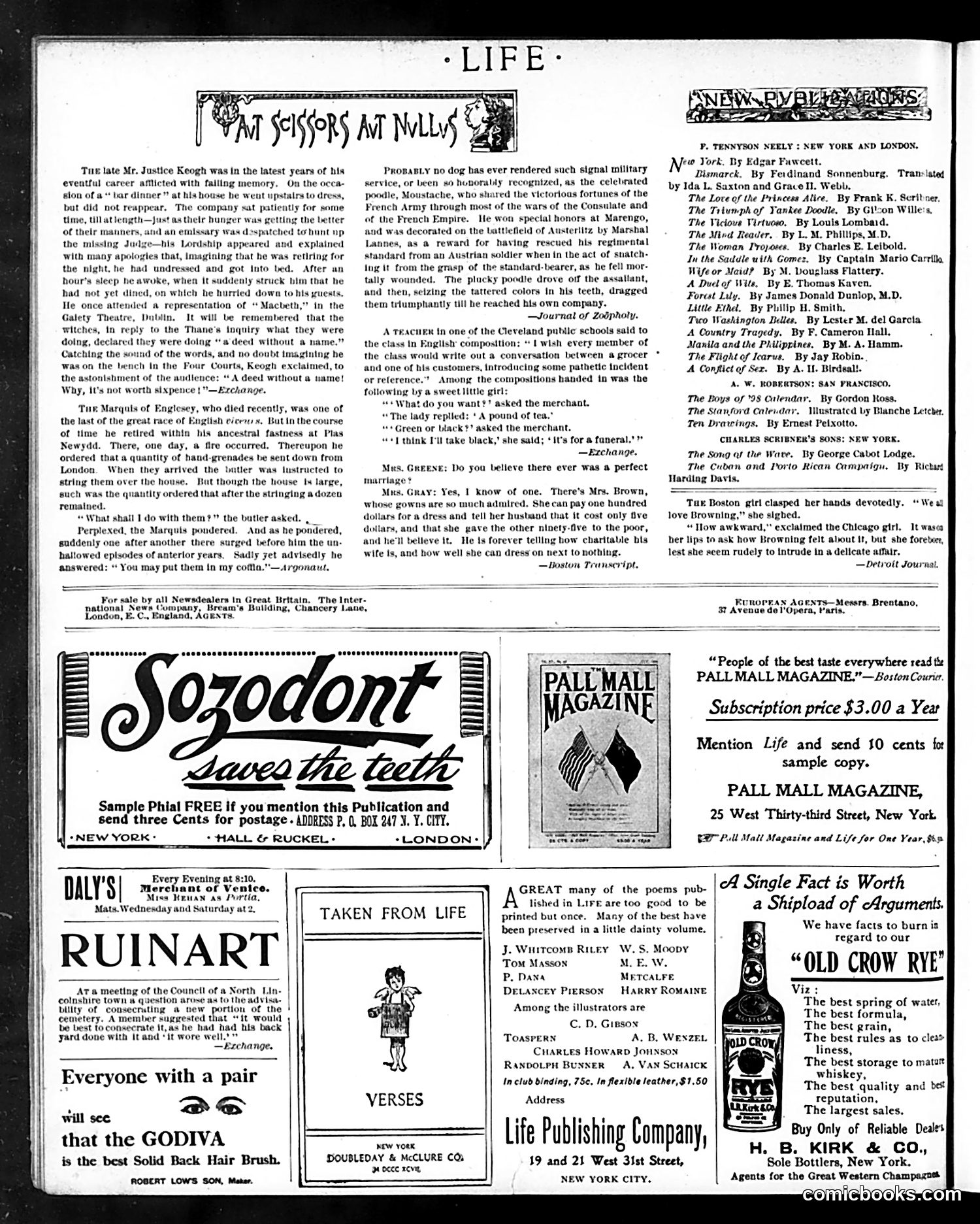
This page from *Life* magazine consists primarily of **humorous anecdotes and advertisements** rather than political cartoons. The text pieces are comic stories about public figures and ordinary people: 1. **Justice Keogh** — An Irish judge with failing memory who falls asleep at his own dinner party and later interrupts a Shakespeare performance, confusing the stage for a courtroom. 2. **The Marquis of Anglesey** — A Welsh aristocrat who, after ordering hand grenades to be strung across his house as fire prevention, darkly jokes about his past misdeeds when faced with extras. 3. **Moustache the Poodle** — A celebrated French military dog who rescued his regiment's standard during Napoleonic Wars. 4. **Schoolgirl Composition** — A naive young student innocently writes dialogue where a woman buys black tea "for a funeral." 5. **Perfect Marriage** — A joke about a wife who lies to her husband about dress costs while he praises her charity. These pieces exemplify *Life*'s satirical approach: poking gentle fun at the absent-minded elite, military pretension, and domestic humor.
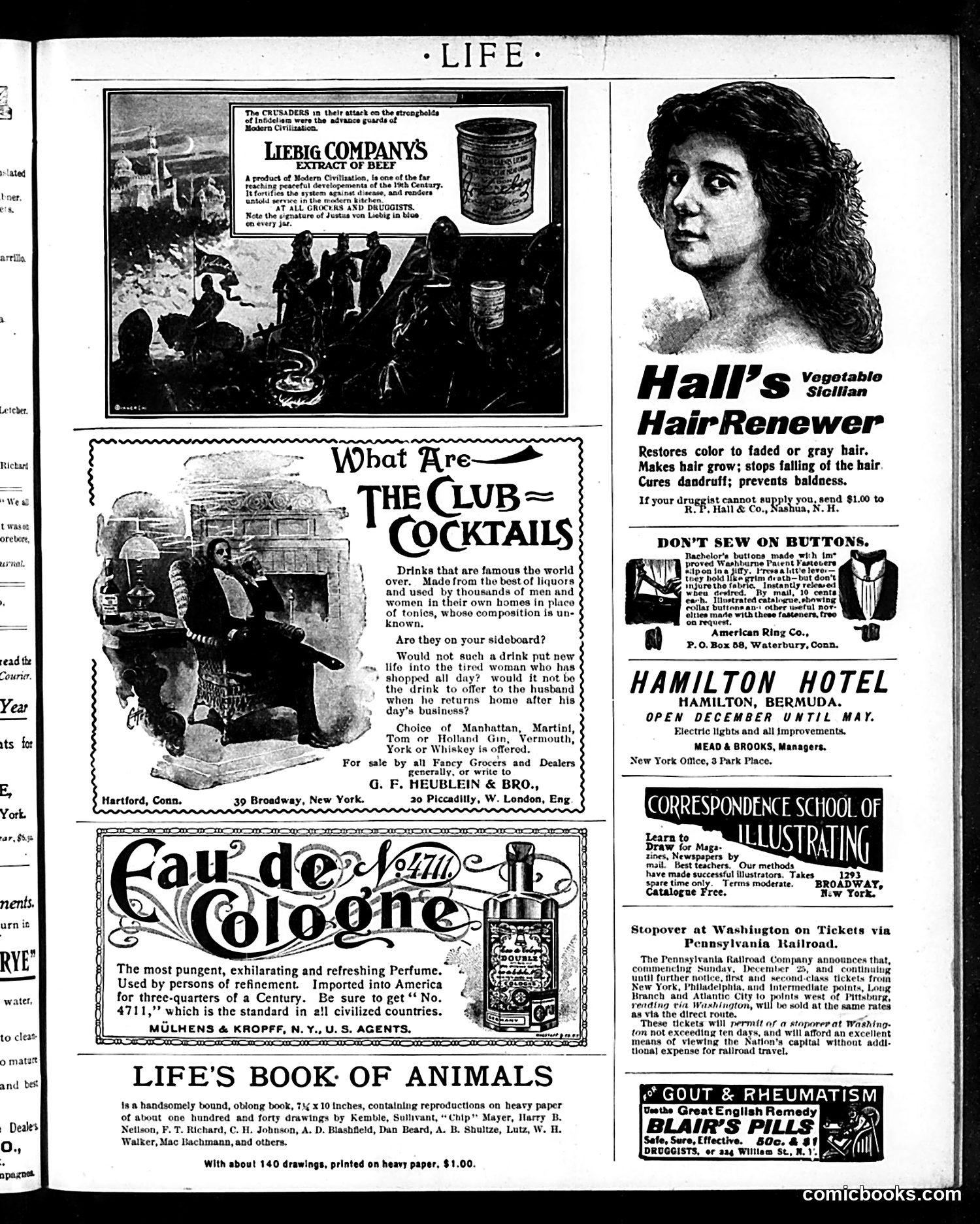
This page is primarily **advertisements** with one illustrated cartoon at top-left depicting "The Crusaders." The cartoon shows armed crusaders attacking a fortified position, captioned to equate historical crusades with "Modern Civilization"—specifically promoting Liebig Company's beef extract as a product of 19th-century progress. This reflects the era's association of commercial products with civilization itself. The remaining content is vintage advertising for period products: hair dye, cologne, cocktail recipes, correspondence art school, hotel accommodations, and patent fasteners. One ad promotes Pennsylvania Railroad stopover tickets to Washington D.C. **Historical context for modern readers**: This reflects Gilded Age advertising that linked consumer goods to social status and civilization. The "Crusaders" framing is jarring by today's standards—casually militaristic imagery used to sell meat extract. The hair-restoration and cocktail ads reveal period anxieties (gray hair, overwork) and casual attitudes toward alcohol as health tonic.
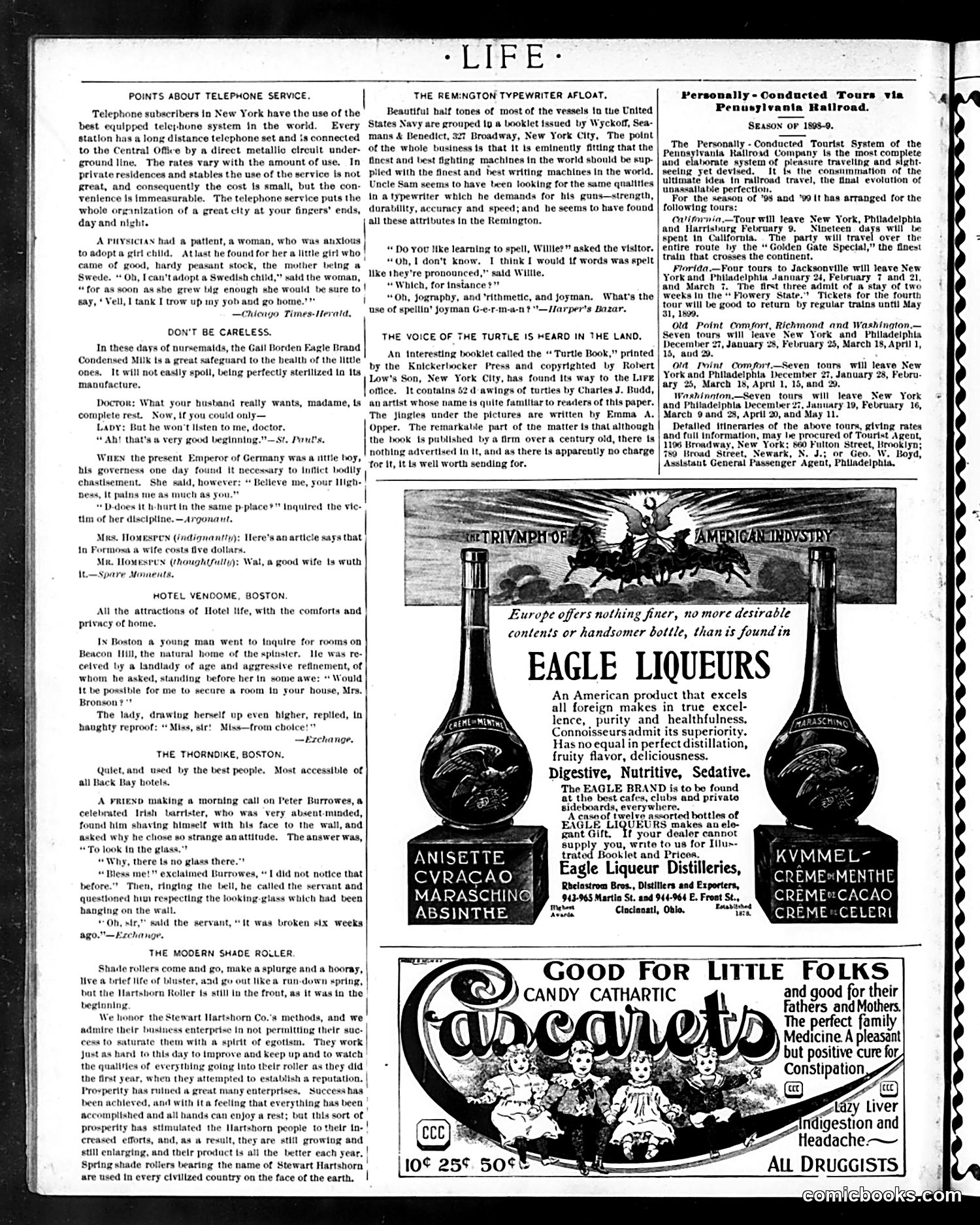
This Life magazine page is primarily **advertising and miscellaneous content** rather than political cartoons. The main visual elements are: 1. **Eagle Liqueurs advertisement** - prominently featuring bottles of various liqueurs (Anisette Curacao, Maraschino, Absinthe, and Kummel-Creme-Menthe), marketed as superior American products competing with European imports. 2. **Candy Cathartic advertisement** - promoting a children's laxative medicine as both pleasant-tasting and medicinal. The text column contains brief humorous anecdotes and observations about telephones, hotel service, and social etiquette—typical of Life's satirical commentary on contemporary American life—but these are general social humor rather than specific political satire requiring historical context.
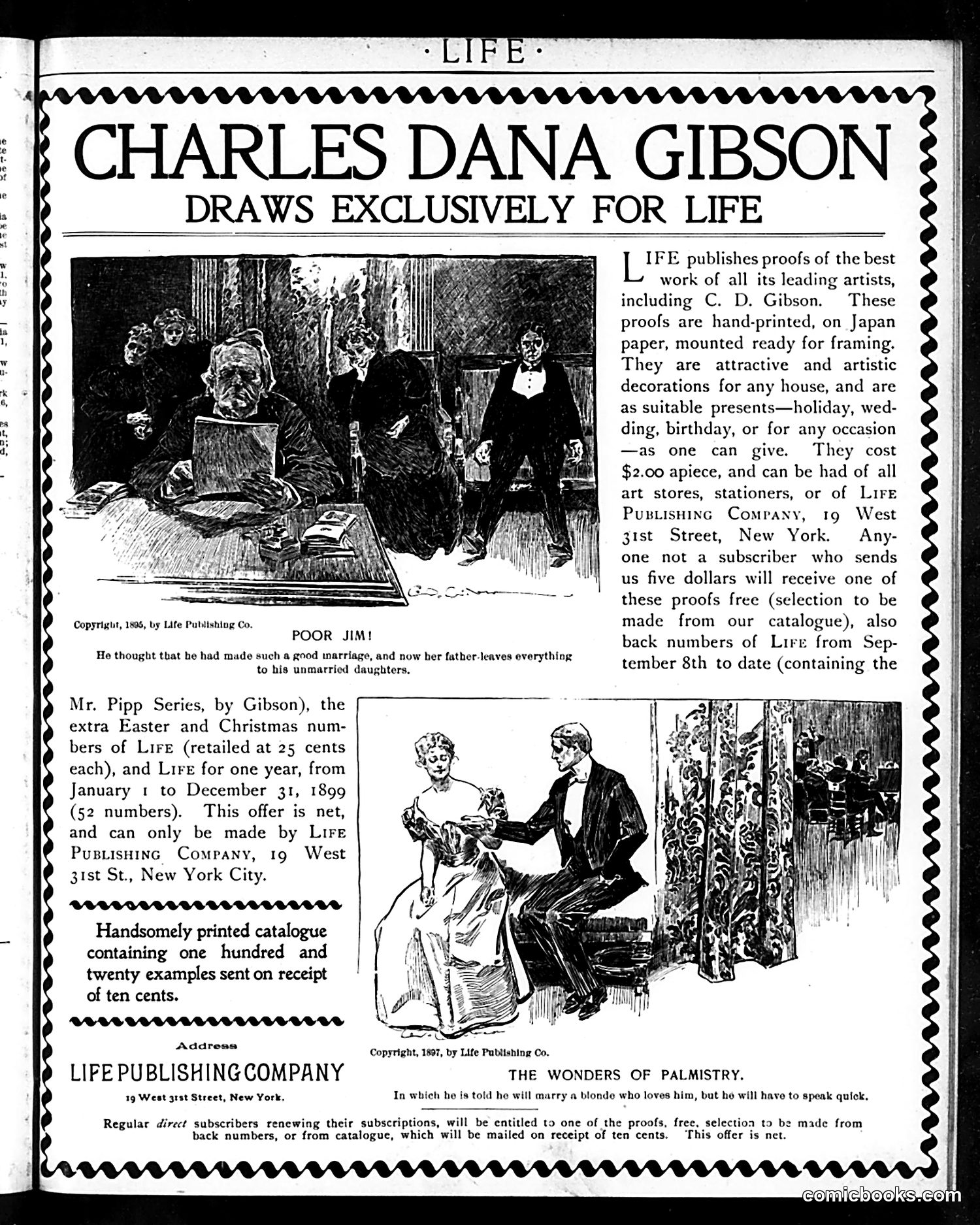
This is primarily an **advertisement** for Charles Dana Gibson's artwork available through Life Publishing Company, interspersed with sample cartoons. The two cartoons shown illustrate Gibson's signature style: 1. **"Poor Jim!"** depicts a domestic comedy: a man learns his wealthy father-in-law is leaving everything to his unmarried daughters instead of him—a satirical jab at fortune-hunting marriages and the precarious position of sons-in-law dependent on inheritance. 2. **"The Wonders of Palmistry"** shows a fortune teller predicting a man will marry "a blonde who loves him, but he will have to speak quick"—likely mocking the era's fascination with spiritualism and pseudoscience, while joking about male hesitation in romantic matters. Both cartoons reflect Gibson's popular social satire about marriage, class, and courtship—themes that resonated with Life's educated, middle-class readership. The advertisements emphasize that Gibson's proofs cost $2 each and are suitable as gifts.
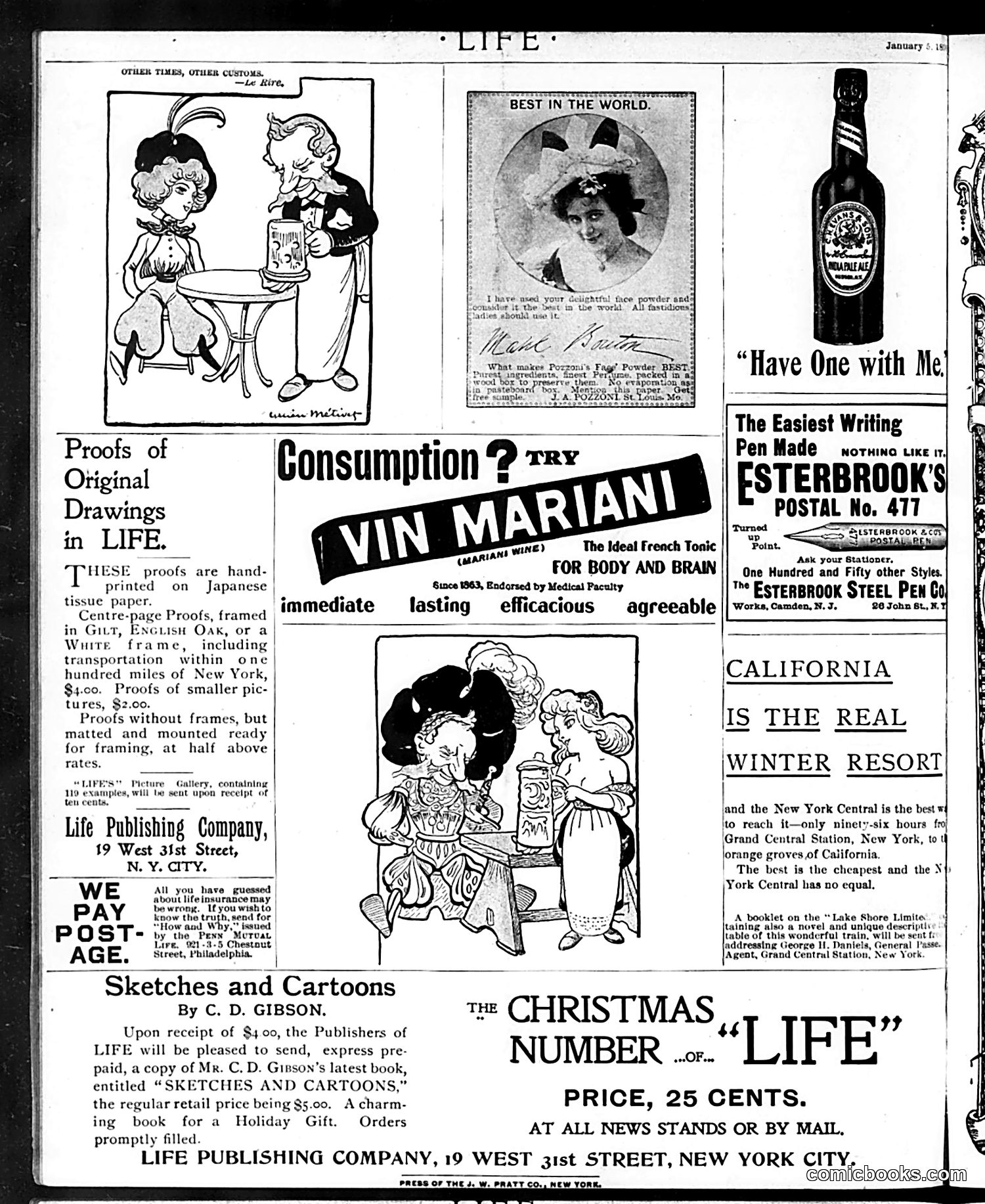
**The Main Cartoons:** The top-left cartoon titled "Other Times, Other Customs" shows a fashionably dressed woman with exaggerated features (large hat, corseted figure) serving a drink to a man. The joke concerns changing social norms—what was once scandalous (a woman serving a man alcohol, suggesting loose morality) is now apparently commonplace. The larger cartoon below depicts a rotund woman surrounded by children eating from a large bowl or pot. This appears to satirize large families or working-class domestic life, likely poking fun at consumption habits or domestic economics. **The Advertisements:** The page is primarily filled with period advertisements: Vin Mariani (a tonic wine marketed for health), Estherbrook pens, California winter resorts, and Life magazine's own promotional materials. These ads reflect early 20th-century consumer culture and health claims now considered dubious (the tonic wine especially). **Overall Context:** This is largely an advertising-driven page with light satirical commentary on contemporary social customs and consumer products typical of the era.