
Life, 1899-01-05 · page 6 of 20
Life — January 5, 1899 — page 6: what you’re looking at
What you’re looking at
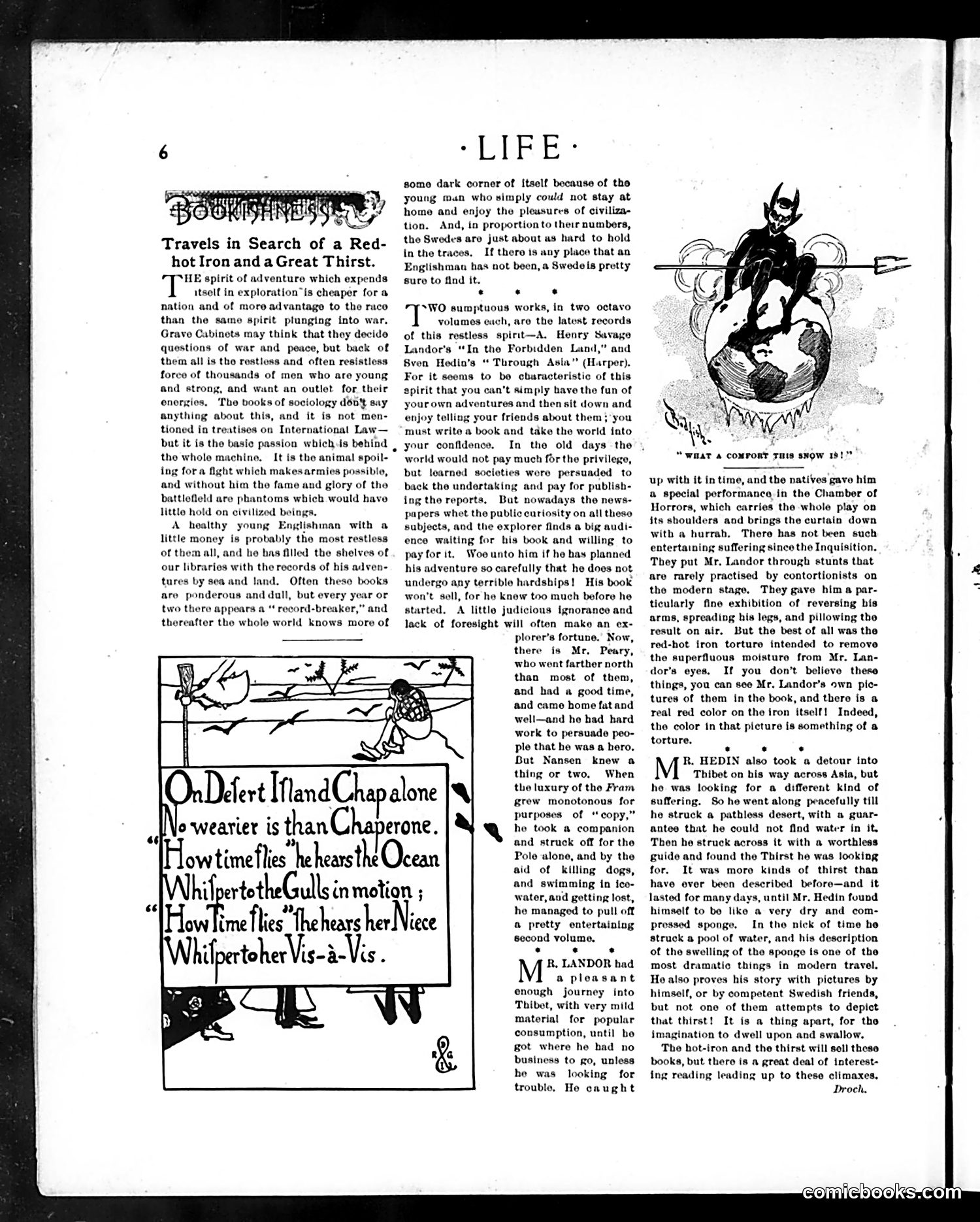
This page contains a **boxed poem/verse** (center-left) that appears to be a humorous maritime ditty about desert island life and isolation. The verse plays with repetitive phrasing about loneliness ("How time flies he hears the Ocean / Whilpertothe Gulls in motion"). The surrounding text discusses adventure travel narratives—specifically praising works by Henry Savage Landor and Bren Hedin about exploration. It mocks restless young men who seek glory through published travel accounts rather than genuine hardship. **The illustrations** show a figure in distress/exile (likely representing the adventure-seeker), and a demon-like figure in the upper right, suggesting the satirical tone about reckless adventurism. The satire targets **frivolous adventure tourism**—criticizing both the writers who sensationalize journeys and readers who seek vicarious thrills rather than substantive knowledge.
📄 Transcribed text from this page (OCR, searchable)
Machine-transcribed from the original scan — historical spelling and the odd misread are preserved.
Travels in Search of a Red- hot Iron anda Great Thirst. HE spirit of adventure which expends itself in exploration”is cheapér for a nation and of moro advantago to the raco than the same spirit plunging into war. Grave Cabinots may think that they decide questions of war and peace, but back of them all is tho restiess and often resistless force of thousands of men who are young and strong, and want an outlet for their onorgies. ‘The books of sociology dob say anything about this, and it is not men- tioned in treatises on International Law— but it is the basic passion whichis bebind tho whole machine. It is the animal spoil- ing fora fight which makes armies possible, and without him the fame and glory of tho battlefleld aro phantoms which would have little hold on civilized beings. A healthy young Englishman with a little money is probably the most restless of them all, and he has filled the shelves of our libraries with the records of his adven- tures by sea and land. Often theso books aro ponderous and dull, but every year or two there appears a “ record-breaker,” and thoreafter the whole world knows more of How tefl bch — Let inmotion ; Howlime lies’ epee ent is. «your confidence, In "thehears herNi LIE E somo dark corner of itself because of tho young man who simply could not stay at home and enjoy the pleasures of civiliza- tion. And, in proportion to their numbers, the Swedes are just about as hard to hold in the traces, If thero is any place that an Englishman has not been, a Swede is pretty sure to find it. . . . WO sumptuous works, in two octavo T volames each, are the latest records of this restless spirit—A. Henry Savage Landor’s “In the Forbidden Land,” and Sven Hedin’s “ Through Asia” (Harper). For it seems to be cburacteristic of this spirit that you can’t simply bave the fun of your own adventures and then sit down and enjoy telling your friends about them } you must write a book and take the world into the old days the world would not pay much for the privilege, but learned societies wore persuaded to back the undertaking and pay for publish- ing tho reports. But nowadays the news- papers whet tho public curiosity on alll theso subjects, and the explorer finds a big audi- ence waiting for his book and willing to pay for it. Woo unto him if he bas planned his adventure so carefully that he does not undergo any terrible hardships! His book won't sell, for he knew too much before he started. A little judicious ignorance and lack of foresight will often make an ex- plorer’s fortune. Now, there is Mr. Peary, who went farther north than most of them, and had a good time, and came home fat and well—and he had hard work to persuade peo- ple that he was a hero. But Nansen knew a thing or two, When the luxury of the Fram grew monotonous for purposes of ‘ copy,” he took a companion and struck off for the Pole lone, and by the aid of killing dogs, and swimming in ico- water, aud getting lost, he managed to pull off a pretty entertaining second volume, . . . R. LANDOR had a pleasant enough journey into Thibet, with very mild material for popular consumption, until bo got where he had no business to go, unless he was looking for trouble. He caught cece “waAT 4 COMPORT THs SNOW 18!” up with it in time, and the natives gave him & special performance in the Chamber of Horrors, which carries the whole play on its shoulders and brings the curtain down with a hurrah, Thero has not been such entertaining suffering since the Inquisition. They put Mr, Landor through stunts that fare rarely practised by contortionists on tho modern stage. They gave him a par- ticularly fine exhibition of reversing bis arms, spreading his legs, and pillowing tho result on air, But the best of all was the red-hot fron torture intended to remove the superfluous moisture from Mr. Lan- dor’s eyes. If you don’t believe theso things, you can see Mr, Landor’s own ple- tures of them in the book, and there is a real red color on the iron itself! Indeed, the color in that picture is something of a torture, . . . R. HEDIN also took a detour into Thibet on bis way across Asia, but ho was looking for a different kind of suffering. So he went along peacefully till he struck a pathless desert, with a guar- antee that he could not find water in it, Then he struck across it with a worthless guide and found the Thirst he was looking for. It was moro kinds of thirst than have over been described before—and it lasted for many days, until Mr, Hedin found himself to bo like a very dry and com- prossed sponge. In tho nick of time ho struck a pool of water, and his description of the swelling of the sponge is one of the most dramatic things in modern travel. He also proves his story with pictures by himself, or by competent Swedish friends, but not one of them attempts to depict that thirst! It is a thing apart, for tho imagination to dwell upon and swallow, Tho hot-iron and the thirst will soll these books, but thero is a great deal of interest- ing reading leading up to these climaxes. Droch,