
Life, 1899-01-05 · page 7 of 20
Life — January 5, 1899 — page 7: what you’re looking at
What you’re looking at
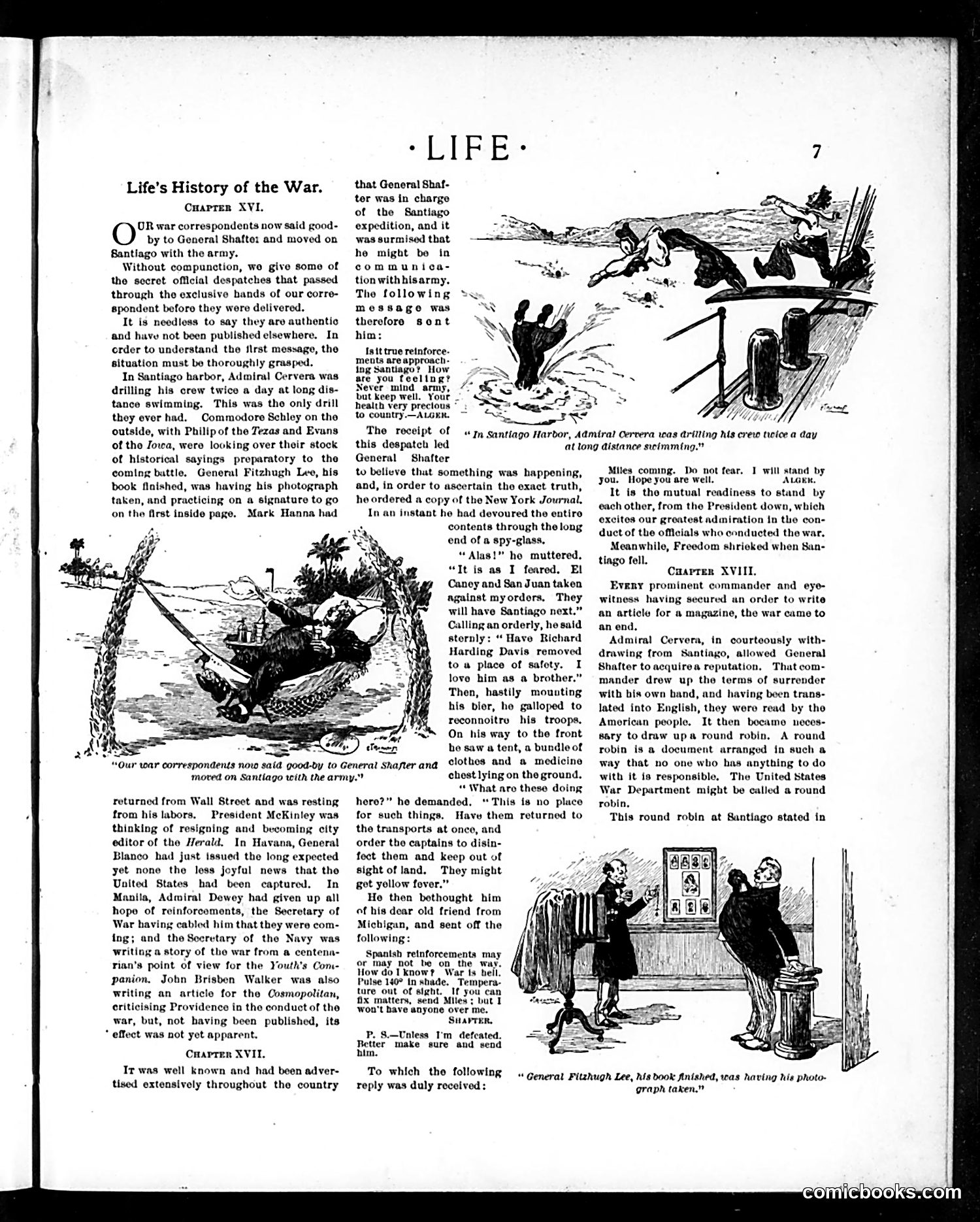
This page presents Chapter XVI of "Life's History of the War," a serialized account of the Spanish-American War. The two illustrations depict scenes from Santiago, Cuba during the conflict. The top cartoon shows Admiral Cervera's crew drilling at Santiago Harbor. The bottom illustration depicts General FitzHugh Lee with his book and photograph—Lee appears to be an officer documenting the war experience for publication. The narrative discusses General Shafter's Santiago expedition and includes dispatches between military officials. The text references President McKinley, Secretary of War, and Admiral Dewey, indicating this covers the war's political-military leadership. The satirical tone mocks bureaucratic tensions between civilian government and military commanders during the 1898 conflict, particularly regarding operational decisions and public documentation of events.
📄 Transcribed text from this page (OCR, searchable)
Machine-transcribed from the original scan — historical spelling and the odd misread are preserved.
Life’s History of the War. Cuarren XVI. OR war correspondents now said good- by to General Shafto: and moved on Santiago with the army. Without compunction, wo give some of the secret official despatches that passed through tho exclusive bands of our corre- spondent before they were delivered. It is needless to say they are authentic and have not been published elsewhere. In order to understand the first message, the situation must be thoroughly grasped. In Santiago harbor, Admiral Cervera was. drilling his crew twico a day at long dis- tance swimming. This was tho only drill they ever had. Commodore Schley on tho outside, with Philip of the Tezas and Evans of tho Jowa, wero looking over their stock of historical sayings preparatory to the coming battle. General Fitzhugh Lee, his book flaished, was having his photograph taken, and practicing on a signature to go on the first inside page. Mark Hanna had ~~ = “Our war correspondents now said good-by to General Shafter and moted on Santiago with the army.” returned from Wall Street and was resting from his labors. President McKinley was thinking of resigning and becoming city editor of the Herald, In Havana, General Blanco had just issued the long expected yet none the less joyful news that tho United States had been captured, In Manila, Admiral Dewey had given up all hope of reinforcomonts, the Secretary of War having cabled him that they were com- ing; and the Secretary of the Navy was writing a story of tho war from a centena- rian’s point of view for the Youth's Com- panion, Jobn Brisben Walker was also writing an article for the Cosmopolitan, criticising Providence in the conduct of the war, but, not having been published, its * effect was not yet apparent, Crarren XVII. Ir was well known and had been adver- tised extensively throughout the country “LIFES that Genoral Shaf- ter was in chargo of the Santiago expedition, and it was surmised that hoe might bo in communica- tion withhisarmy. Tho following messago was therefore sont him: Isittrue reinforce- ments are approach- ing Santiago? How are you feeling? Never mind arms, but keep well. Your _ health very prectous © to country.—ALGEK. The receipt of this despateb led General Shafter to believe that something was happening, and, in order to ascertain the exact truth, he ordered a copy of the New York Journal. In an instant ho had devoured the entire contents through the long end of a spy-glass, “Alas!” ho muttered. “It is as I feared. El Caney and San Juan taken against myordors, They will have Santiago next.” Calling an orderly, ho said sternly: “ Have Richard Harding Davis removed tow place of safety. I love him as a brother.” Then, hastily mounting his bler, ho galloped to reconnoitre his troops. On his way to the front ho saw a tent, a bundle of clothes and a medicine chost lying on the ground. “What aro these doing hero?” he demanded, “This is no place for such things. Have them returned to the transports at once, and order the captains to disin- fect them and keep out of sight of land, They might get yellow fover.” He then bethought him of his dear old friend from Michigan, and sent off the following: Spantsh reinforcements may or may not be on the way. How do I know? War ts bell. Pulse 140° In shade. Tempera: ture out of sight. “If you can OX matters, send Miles ; but I won't have anyone over me. Suarrer, —Unless I'm defeated. make sure and send To which tho following reply was duly received : “In Santiago Harbor, Admiral! Cervera was drilling his crew tieice a day at long distance swimming.” Miles coming. Do not fear. You, Hope you are well. It is tho mutual readiness to stand by each other, from the President down, which excites our greatest admiration in the con- duct of the officials who conducted the war. Meanwhile, Freedom shrieked when San- tingo fell. 1 will stand by Avagn. Cuarten XVIII. Every prominent commander and eyo- witness having secured an order to write an articls for a magazine, the war came to an end. Admiral Cervera, in courteously with- drawing from Santiago, allowed General Shafter to acquirea reputation. That com- mander drew up the terms of surrender with bis own band, and having been trans- lated into English, they wero read by tho American people, It then became ueces- sary to draw upa round robin, A round robin is a document arranged in such a way that no one who has anything to do with it {8 responsible, The United States War Department might be called a round robin, This round robin at Santiago stated in “ General Fitzhugh Lee, his book flnished, was having his photo- graph taken.”