
Life, 1899-01-05 · page 14 of 20
Life — January 5, 1899 — page 14: what you’re looking at
What you’re looking at
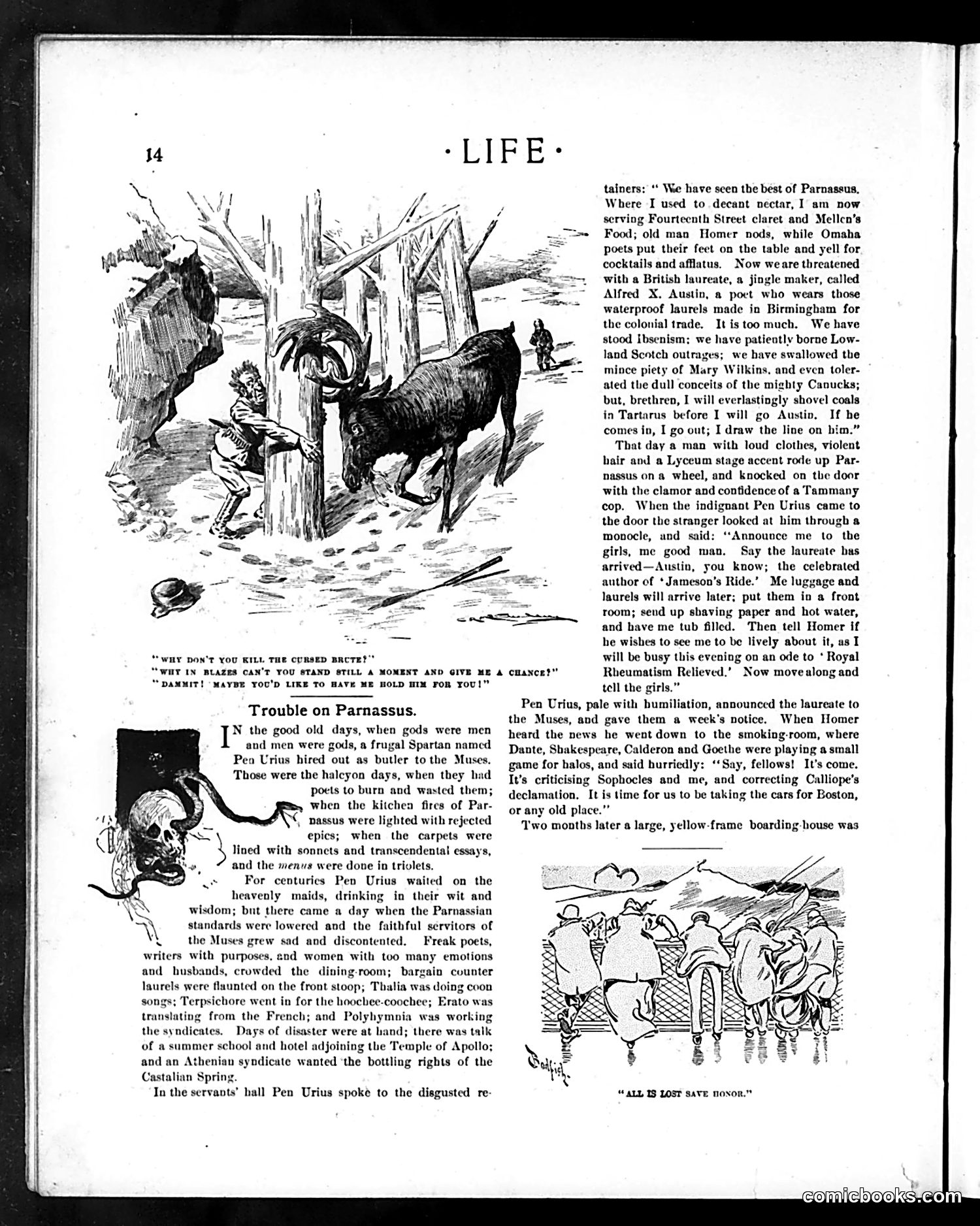
This satirical story mocks the degradation of American letters in the late 19th century. Mount Parnassus—the mythological home of the Muses and poetry—has become a boarding house filled with mediocre writers and commercial hacks. The protagonist, Pen Urius (a pun on "penury"), serves as butler to the Muses. He laments that great poets like Homer now coexist with "freak poets, writers with purposes, and women with too many emotions"—apparently targeting sentimental or didactic contemporary writers (likely including Mary Wilkins Freeman and others). The arrival of **Alfred X. Austin**, a British Poet Laureate, proves the final insult: an arrogant, poorly-dressed charlatan more concerned with comfort than art. The great literary giants—Homer, Dante, Shakespeare, Goethe—flee in disgust. The page satirizes American literary culture's commercialization, including vaudeville acts ("coon songs," "hoochee-coochee") and syndication, suggesting high art has been abandoned for popular entertainment and profit.
📄 Transcribed text from this page (OCR, searchable)
Machine-transcribed from the original scan — historical spelling and the odd misread are preserved.
“WHY DON'T YOU KILL THE CURSED BRCTET” “WHY IN BLAZES CAN'T YOU STAND STILL A MOMENT AND GIVE ME 4 cHAxcE?” “DAMMIT! “MAYBE YOU'D LIKE To HAVE ME HOLD HIM FoR You!" Trouble on Parnassus. lV the good old days, when gods were men and men were gods, a frugal Spartan named Peo Urius hired out as butler to the Muses. ‘Those were the halcyon days, when they had poets to burn and wasted them; r when the kitchen fires of Par- Na nassus were lighted with rejected epics; when the carpets were lined with sonnets and transcendental essays, and the menus were dove in trivlets. * For centurics Pen Urius waited on the heavenly maids, drinking in their wit and wisdom; but there came a day when the Parnassian standards were lowered and the faithful servitors of a the Muses grew sad and discontented. Freak poets, writers with purposes, end women with too many emotions and husbands, crowded the dining-rooi bargain counter laurels were flaunted on the front stoop; Thalia was doing coon songs; Terpsichore went in for the hoocbee-coochee; Erato was translating from the French; and Polyhymoia was working the syndicates. Days of disaster were at hand; there was talk of a summer school and hotel adjoining the Temple of Apollo; and an Athenian syndicate wanted ‘the bottling rights of the Castalian Spring. In the servants’ hall Pen Urius spoke to the disgusted re- * tainers: ‘* We have scen the best of Parnassus, Where I used to decant nectar, 1 am now serving Fourteenth Street claret and Mellcn’s Food; old man Homer nods, while Omaha poets put their feet on the table and yell for. cocktails and afflatus. Now weare threatened with a British laureate, a jingle maker, called Alfred X. Austin, a poct who wears those waterproof laurels made in Birmingham for the colonial trade. It is too much. We have stood Ibsenism; we have patiently borne Low- land Scotch outrages; we have swallowed the mince piety of Mary Wilkins, and even toler- ated the dull conceits of the mighty Canucks; but, brethren, I will everlastingly shovel coals in Tartarus before I will go Austin, If he comes in, I go out; I draw the line on him.” That day a man with loud clothes, violent hair and a Lyceum stage accent rode up Par- nassus on a wheel, and knocked on the door with the clamor and contidence of a Tammany cop. When the indignant Pen Urius came to the door the stranger looked at him through a monocle, und said: ‘“‘Announce me to the girls, me good man. Say the laureate bas arrived—Austin, you know; the celebrated author of *Jameson’s Ride.’ Me luggage and laurels will arrive later; put them in a front room; send up shaving paper and hot water, and have me tub filled. Then tell Homer if he wishes to see me to be lively about it, as T will be busy this evening on an ode to ‘ Royal Rheumatism Relieved.’ Now move along aod tell the girls.” Pen Urius, pale with humiliation, announced the laureate to the Muses, and gave them a week's notice. When Homer heard the news he went down to the smoking-room, where Dante, Shakespeare, Calderon and Goethe were playing a small game for halos, and suid hurriedly: ‘Say, fellows! It’s come. It’s criticising Sophocles and me, and correcting Calliope’s declamation, It is time for us to be taking the cars for Boston, or any old place.” ‘Two months later a large, yellow-frame boarding-house was “ALL IS LOST SAVE moor.”