
A complete issue · 20 pages · 1898
Life — November 24, 1898
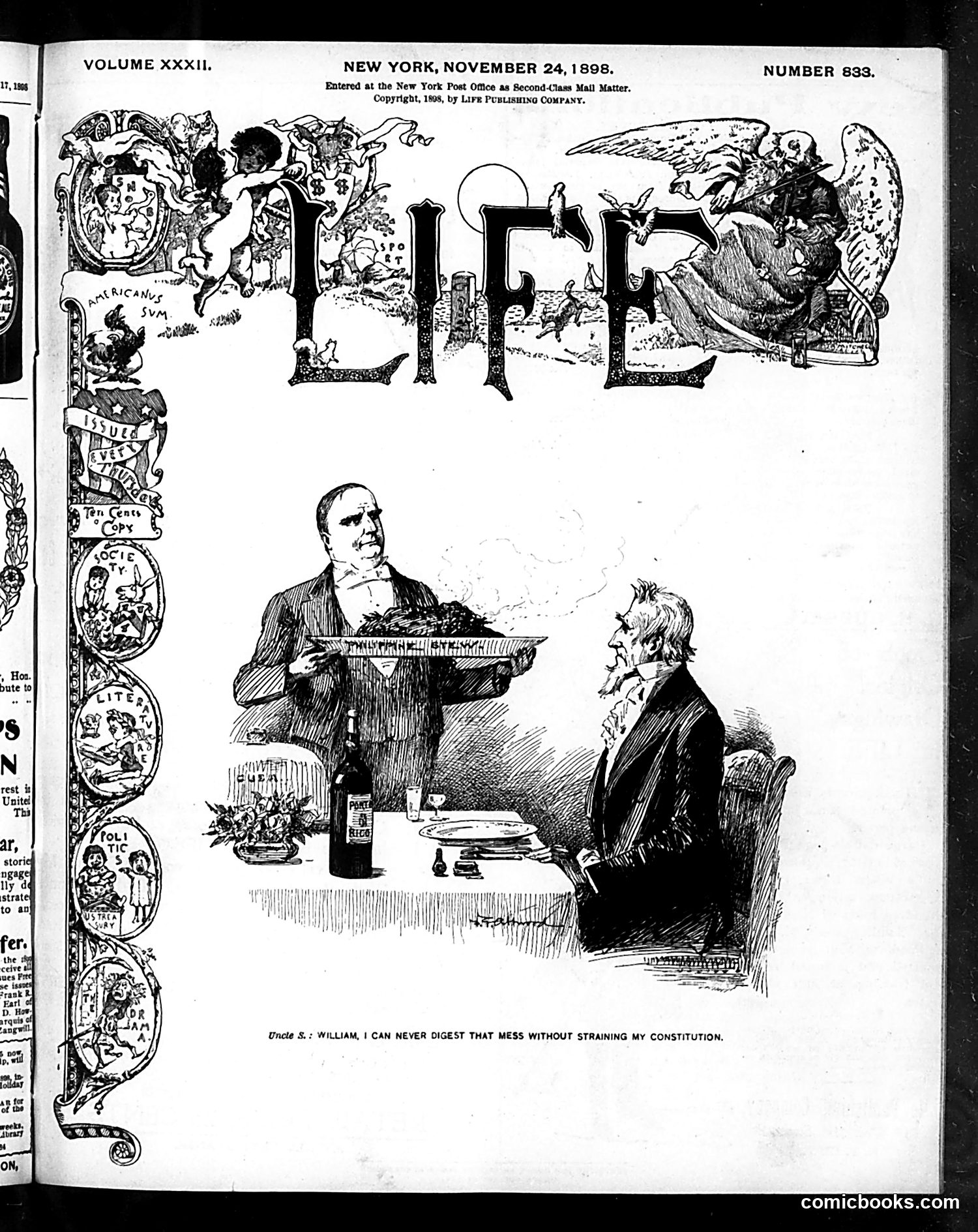
The main cartoon depicts two men at a dining table. The standing figure offers a large platter of food to a seated older gentleman, with the caption: "Uncle S.: 'WILLIAM, I CAN NEVER DIGEST THAT MESS WITHOUT STRAINING MY CONSTITUTION.'" This is political satire about American imperialism following the Spanish-American War (1898). "Uncle S." represents the United States; "William" likely refers to Kaiser Wilhelm II of Germany or another foreign power. The "mess" on the platter symbolizes territorial acquisitions or colonial spoils from the recent war—possibly referring to the Philippines, Guam, or Puerto Rico. The joke suggests America's constitutional system couldn't properly "digest" (absorb/govern) these new imperial possessions without constitutional strain or amendment.
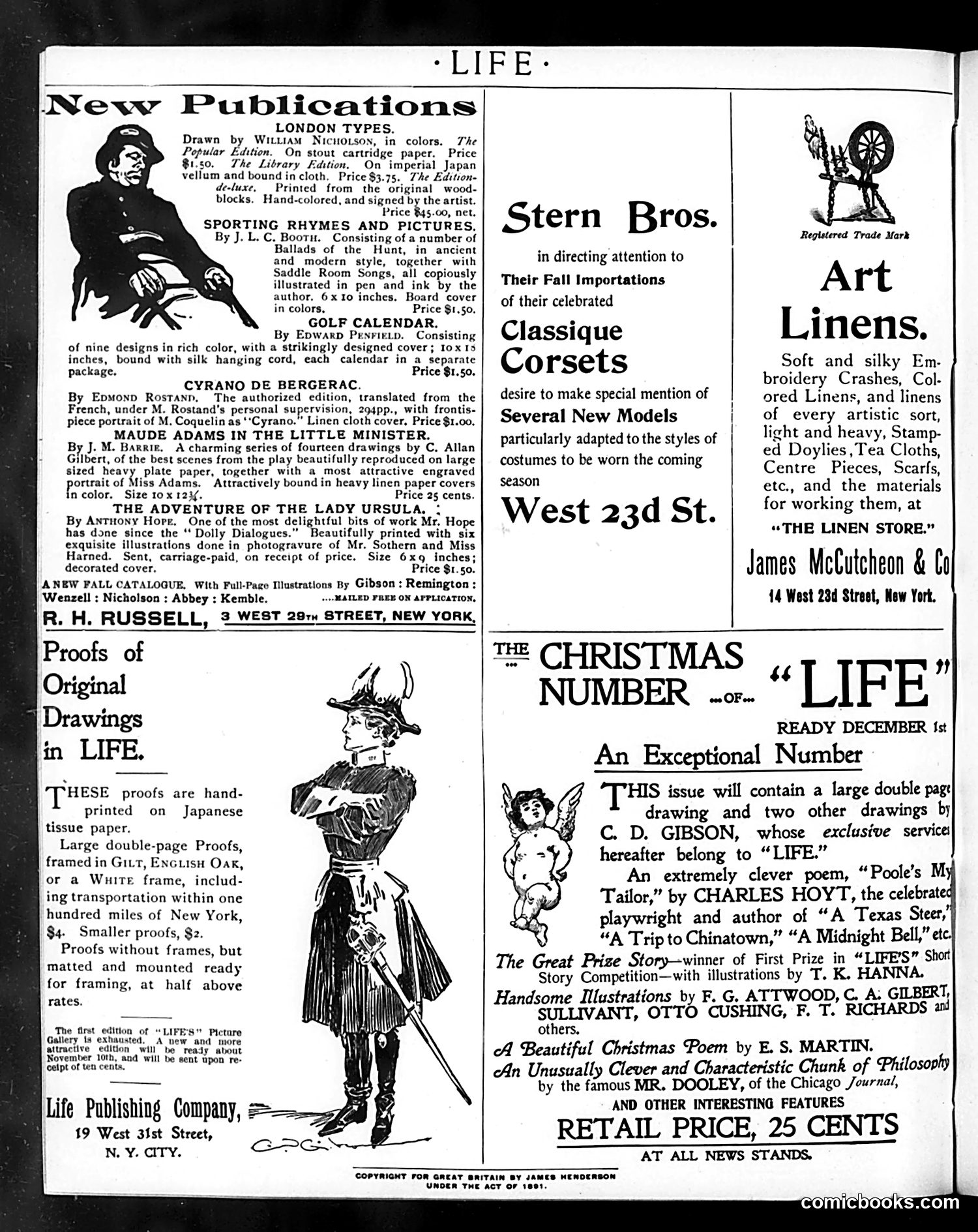
This page is primarily **advertising and announcements** rather than satirical content. The left side advertises new publications including books on London types, sporting rhymes, and a golf calendar. There's a notice about "Proofs of Original Drawings in LIFE" available for purchase on Japanese tissue paper. The center and right feature ads for Stern Bros. corsets and James McCutcheon & Co. linens. The bottom half announces **Life's Christmas issue** (ready December 1st), promoting contributions from illustrators and writers including Charles Hoyt and E.S. Martin, priced at 25 cents. The decorative illustrations—a caricatured figure in formal dress and a cherub—are typical period ornamentation, not political commentary. This is essentially a house advertisement promoting the magazine's upcoming special edition.
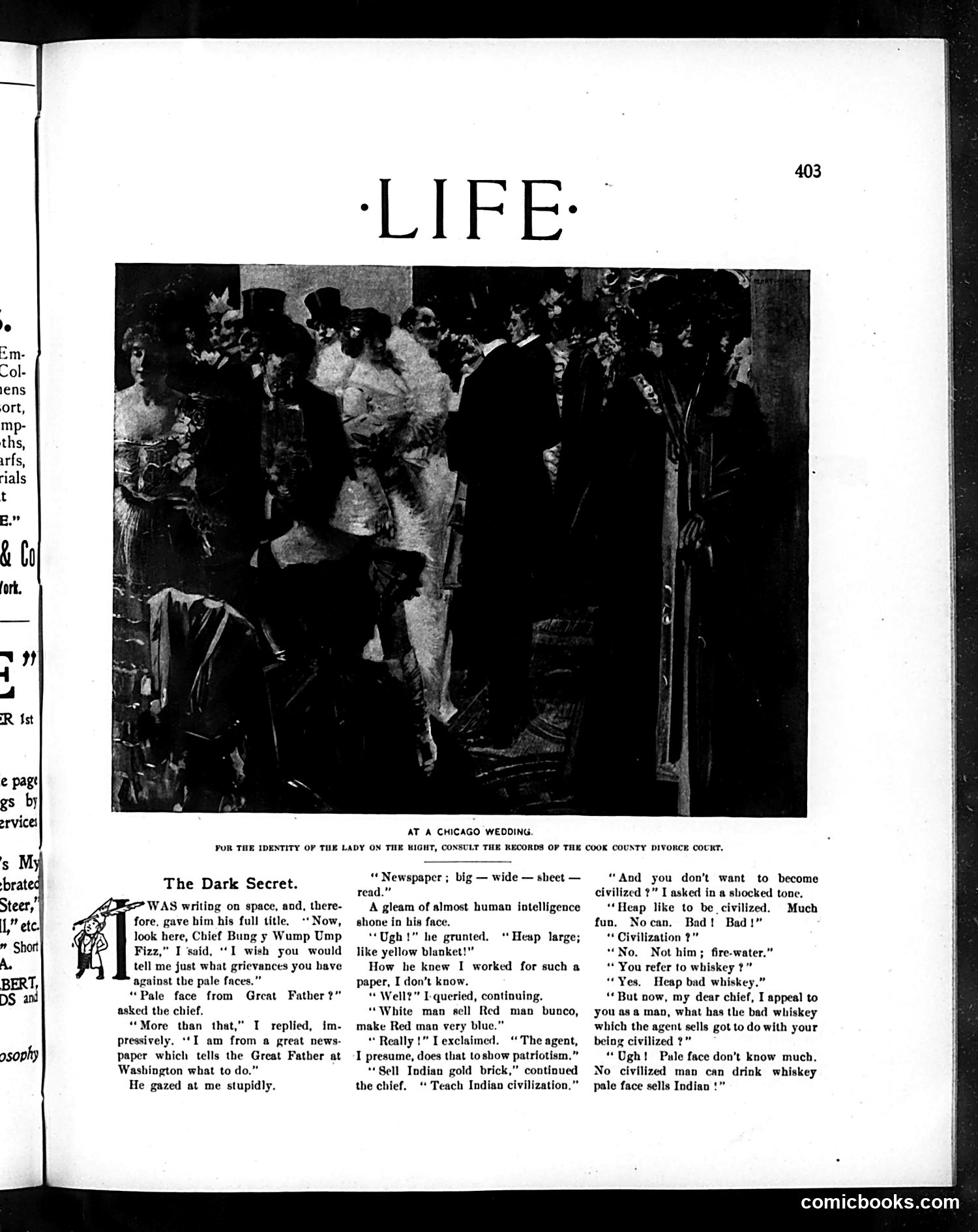
This satirical piece mocks racial and ethnic stereotypes of the era. A journalist claims to work for a "great newspaper which tells the Great Father at Washington what to do," suggesting satirical commentary on press influence. The dialog ridicules pseudo-intellectual racism through absurd exchanges: a Native American character is called "pale face" and "red man," while the journalist makes patronizing comments about "civilization" and "Indian gold brick." References to whiskey and degrading stereotypes appear throughout. The accompanying photograph shows "A Chicago Wedding," with a cryptic caption directing readers to "consult the records of the Cook County divorce court"—likely satirizing society marriages or infidelity. The overall piece mocks both racist attitudes and journalistic pretension of the period.
This page contains editorial commentary on race relations and American imperialism rather than cartoons. The text discusses the "negro question" in the American South, arguing against federal interference while cautioning that Southern racial violence threatens national cohesion. The article references recent "riots" in Pana and Virden, Illinois (labor disputes with racial dimensions) and discusses whether African Americans should migrate North or remain in the South. A second section criticizes a Democratic Club's "D—Croker" flag (likely referring to Richard Croker, Tammany Hall boss), suggesting it symbolizes machine politics and corruption. The final section discusses a governor-elect's comments to General Miles about military regulars versus volunteer soldiers—a Spanish-American War-era debate. The tone is sardonic, typical of Life's satirical approach to contemporary political tensions.
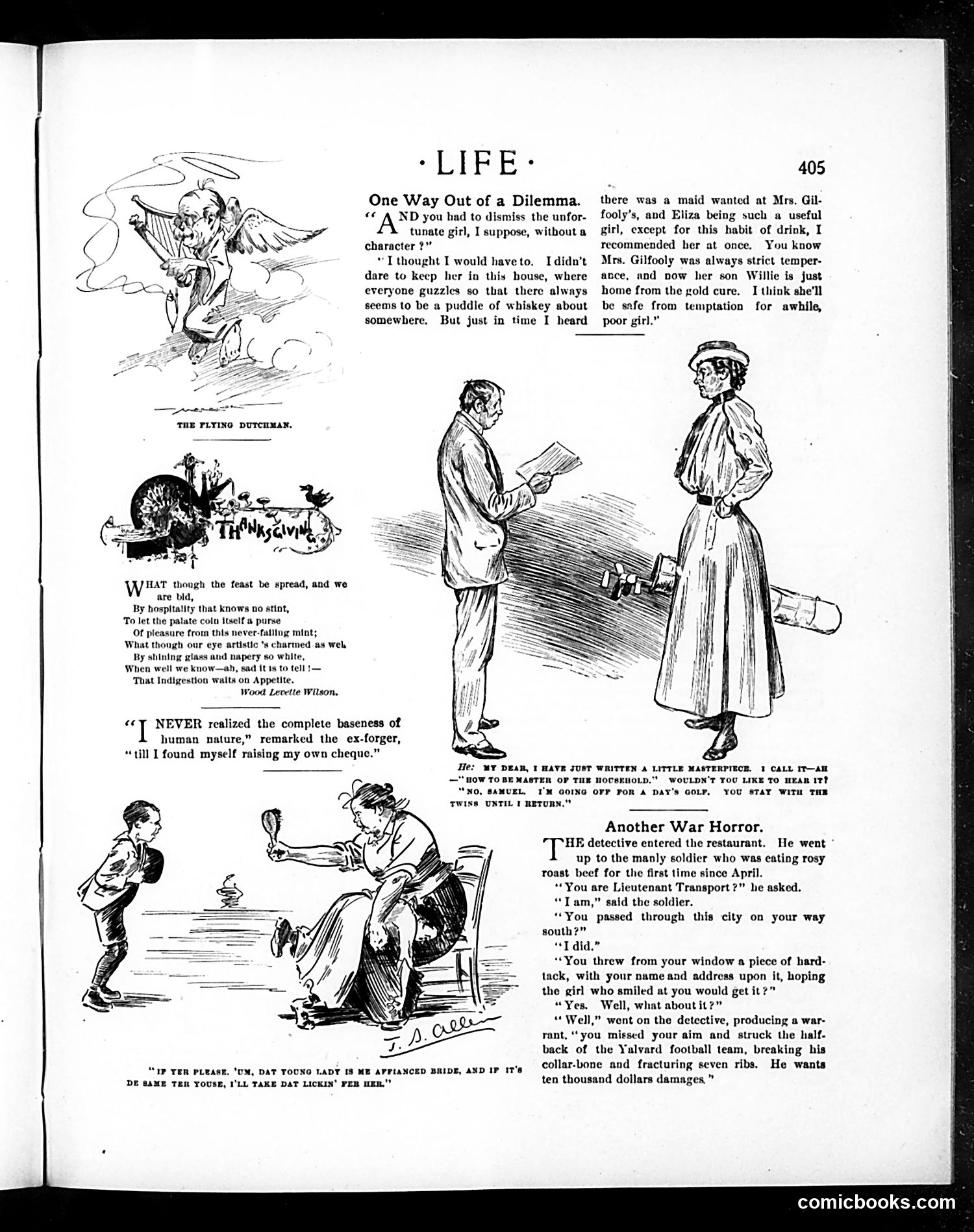
This page contains three distinct satirical pieces: 1. **"One Way Out of a Dilemma"**: A domestic humor piece about dismissing an alcoholic servant girl. The joke centers on the hypocrisy of a household where whiskey is plentiful yet the staff member is blamed for drinking. 2. **"The Flying Dutchman"** and **Thanksgiving poem**: A mythological reference with seasonal verse about hospitality and charity. 3. **"Another War Horror"**: A post-WWI military anecdote where a soldier is accused of throwing hardtack from a window, hitting a girl. The "horror" punchline involves the detective's absurd damage claim—satirizing both wartime hardship and litigious absurdity. The humor reflects early 20th-century class attitudes, alcohol culture, and post-war adjustment themes.
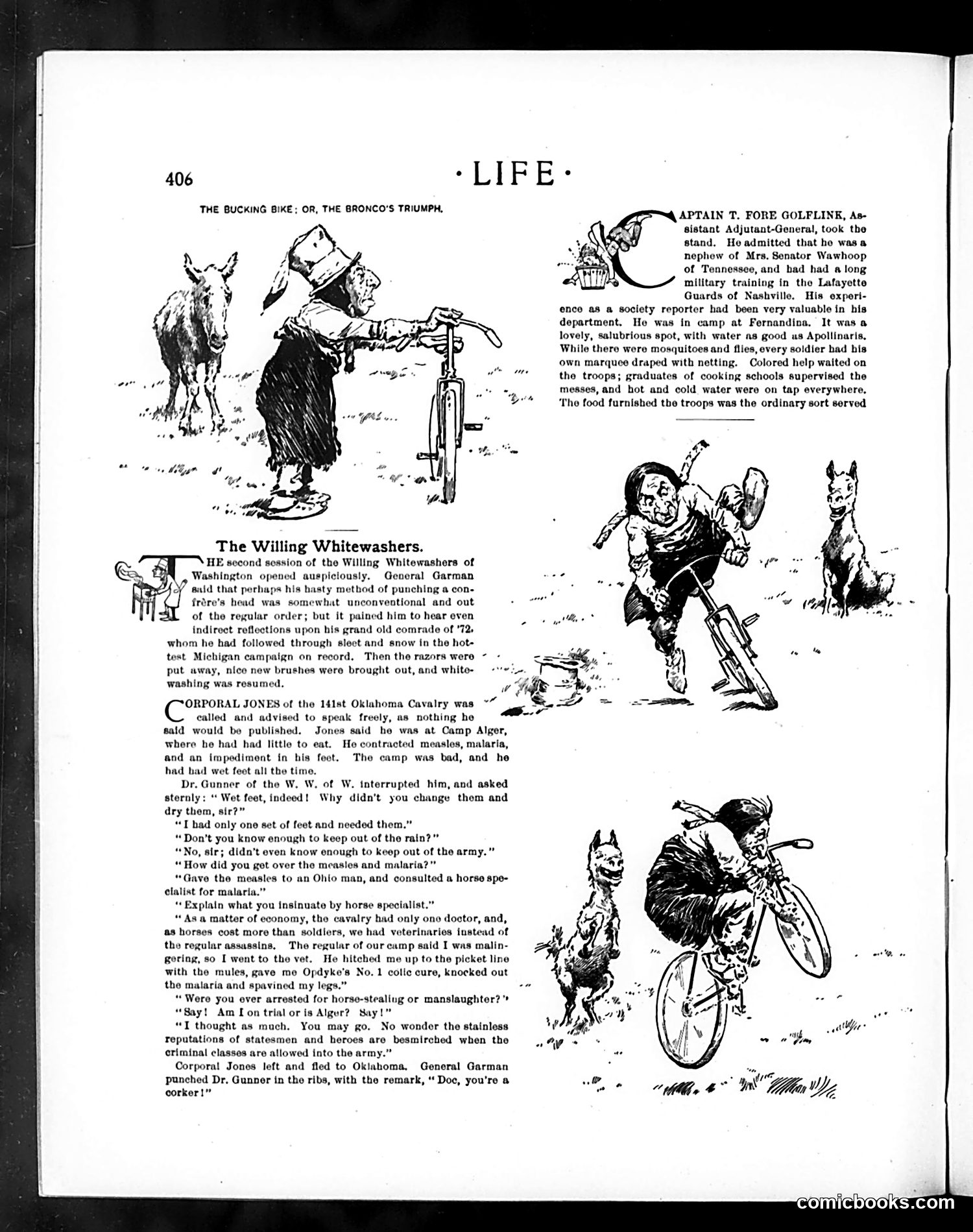
This page contains three humorous military anecdotes from what appears to be World War I era, illustrated with cartoons. **"The Bucking Bike"** shows a soldier on a bicycle being thrown by the vehicle like a bronco—a visual pun equating the bicycle with an untamed horse. **"The Willing Whitewashers"** mocks General Garman's unconventional punishment method (whitewashing) for soldiers, which the General later admits was overly harsh. **"Corporal Jones"** recounts a debate between Corporal Jones and Dr. Gunner about wet feet in camp. Jones challenges military authority by questioning why soldiers aren't given proper care. The humor derives from Jones's irreverent attitude toward military hierarchy and the absurdity of the situation. The cartoons satirize military inefficiency, poor camp conditions, and the disconnect between officers and enlisted men during wartime.
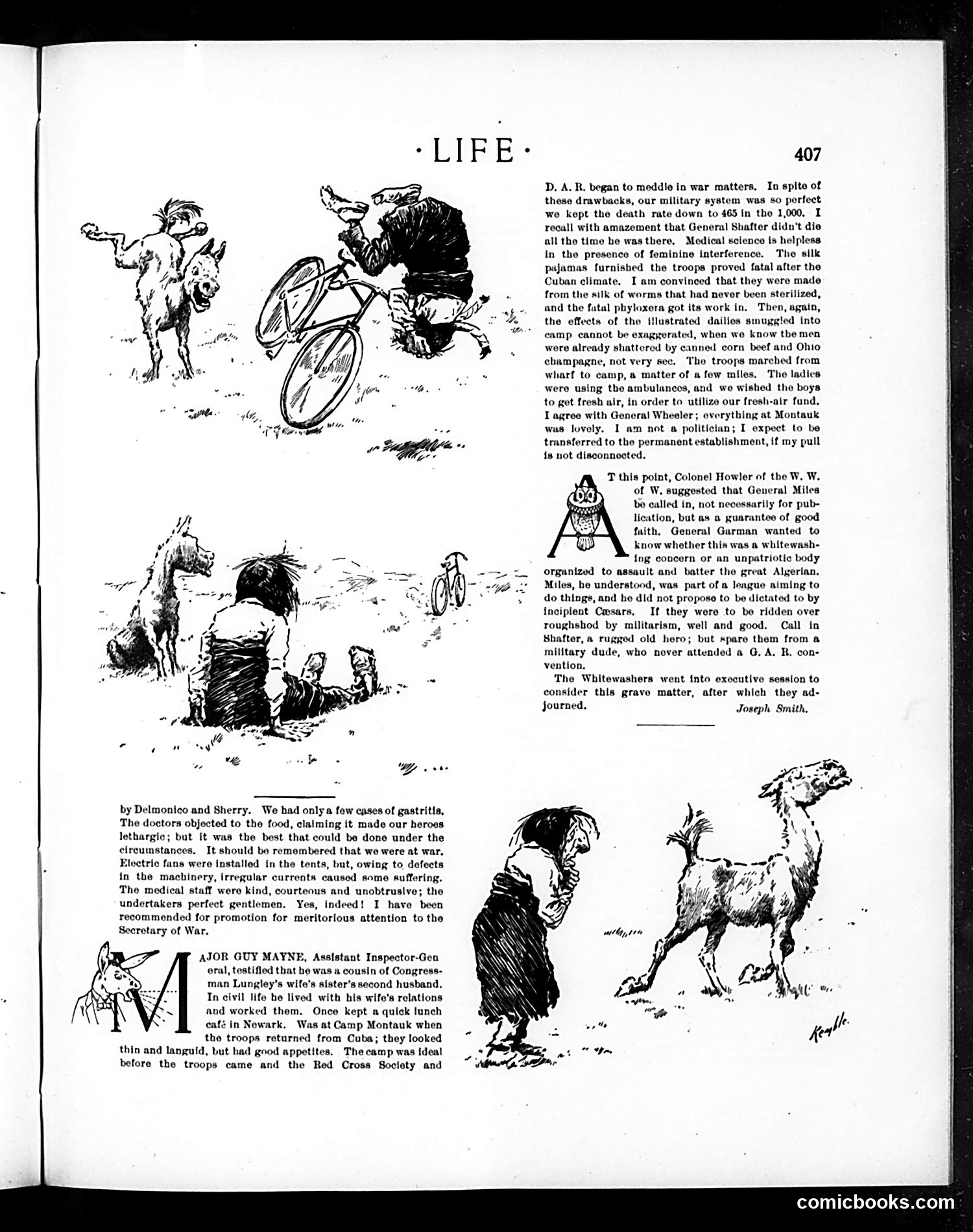
This page contains military-themed satirical illustrations and commentary from World War I era. The sketches depict soldiers with dogs and bicycles, apparently illustrating absurdities of military camp life and logistics. The text discusses General Shafter's health issues during Cuban operations and critiques military inefficiency—specifically mentioning silk pajamas issued to troops unsuited for the climate, and the problems of transporting fresh provisions by ambulance and wharf to distant camps. A notable anecdote concerns "Major Guy Mayne," identified as Assistant Inspector-General and Congressional relative, who apparently arranged favorable camp conditions including a private lunch café in Newark. The satire targets military bureaucracy, nepotism, and the gap between officers' comfort and enlisted men's harsh conditions during wartime operations.
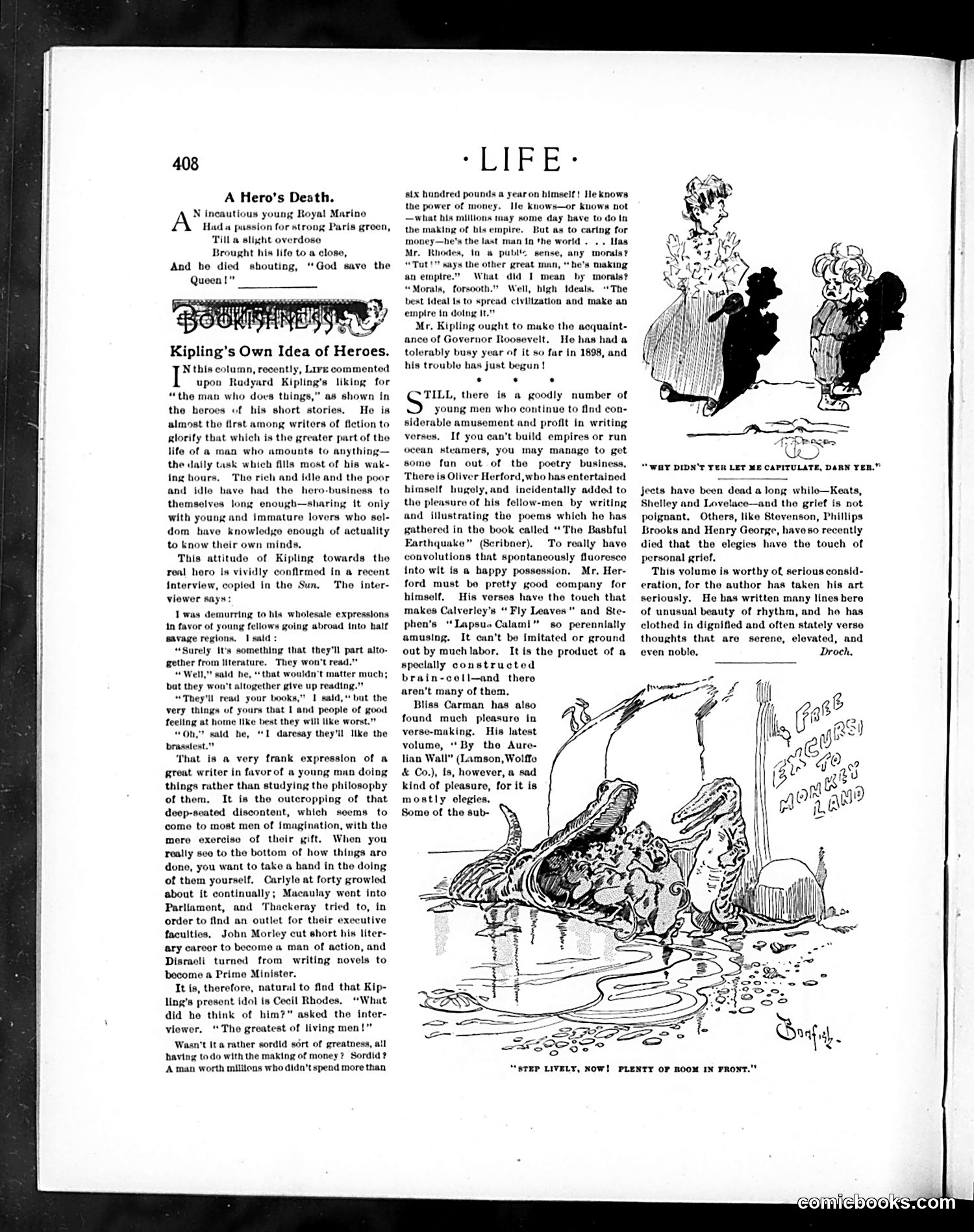
This page discusses literary figures and writing, specifically addressing Rudyard Kipling's definition of heroes as "men who do things." The text debates whether greatness requires grand ambitions or moral philosophy. **The cartoons** appear to be satirical illustrations of poets and writers, though the specific figures aren't clearly identified in the visible text. One shows what appears to be a domestic scene with the caption "Why didn't you let me capitulate, darned?" Another depicts figures near water with "Step lively, now! Plenty of room in front." The page critiques contemporary writers like Oliver Herford and Lilias Carman, discussing their verse-writing. The overall tone questions whether literary merit comes from serious intention or clever entertainment, reflecting period debates about literature's social purpose.
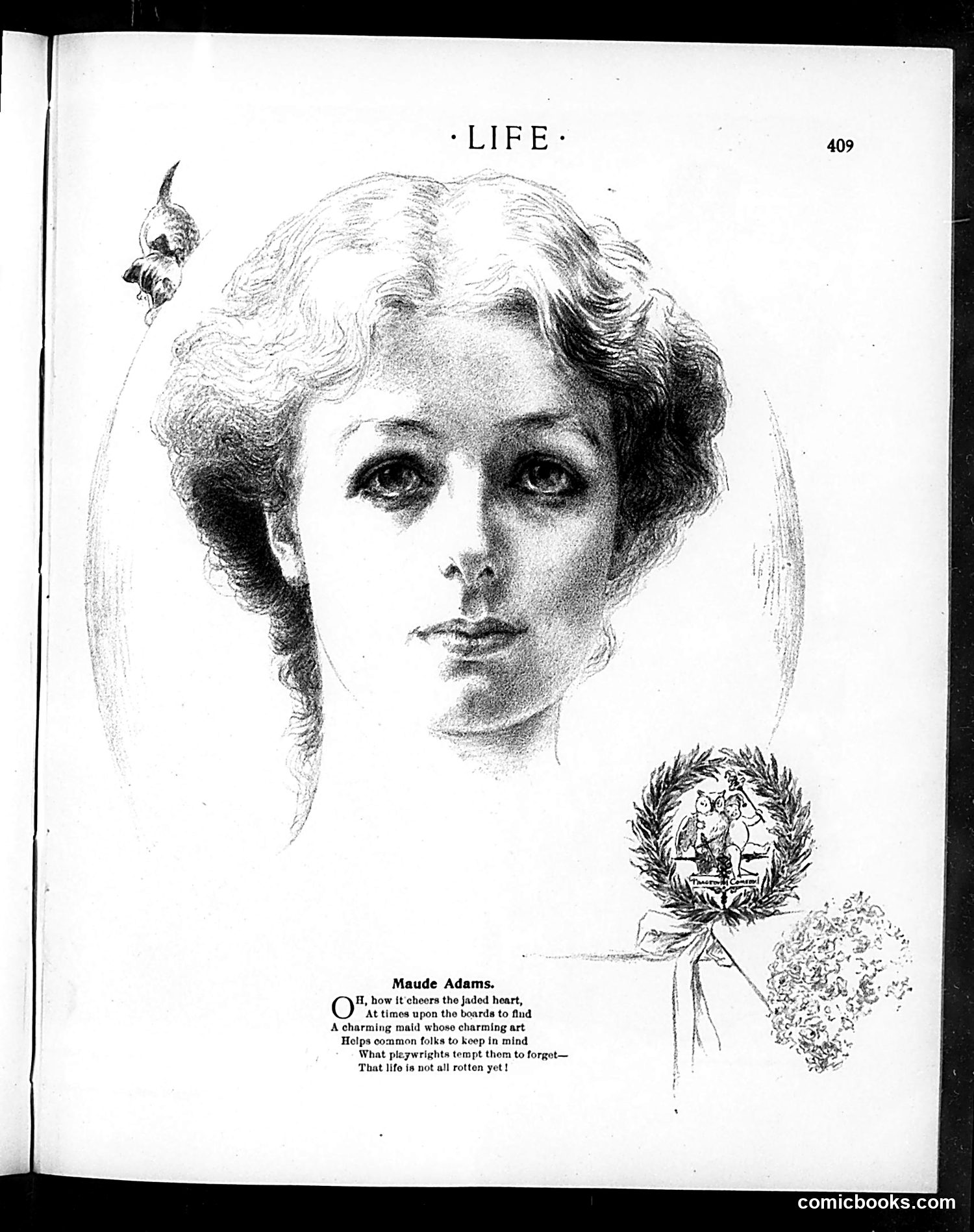
This page features a portrait of **Maude Adams**, a prominent actress of the early 20th century. The accompanying verse is complimentary, praising her as "a charming maid whose charming art / Helps common folk to keep in mind" and suggesting she represents idealized virtue ("What playwrights tempt them to forget— / That life is not all rotten yet!"). The small decorative emblems—appearing to show theatrical or classical imagery—suggest this is a tribute to her theatrical contributions. Rather than satirical, this appears to be a **laudatory feature**, celebrating Adams as a morally uplifting performer whose work reminds audiences of life's goodness during what may have been a cynical era. It's essentially promotional content honoring her artistic and cultural influence.
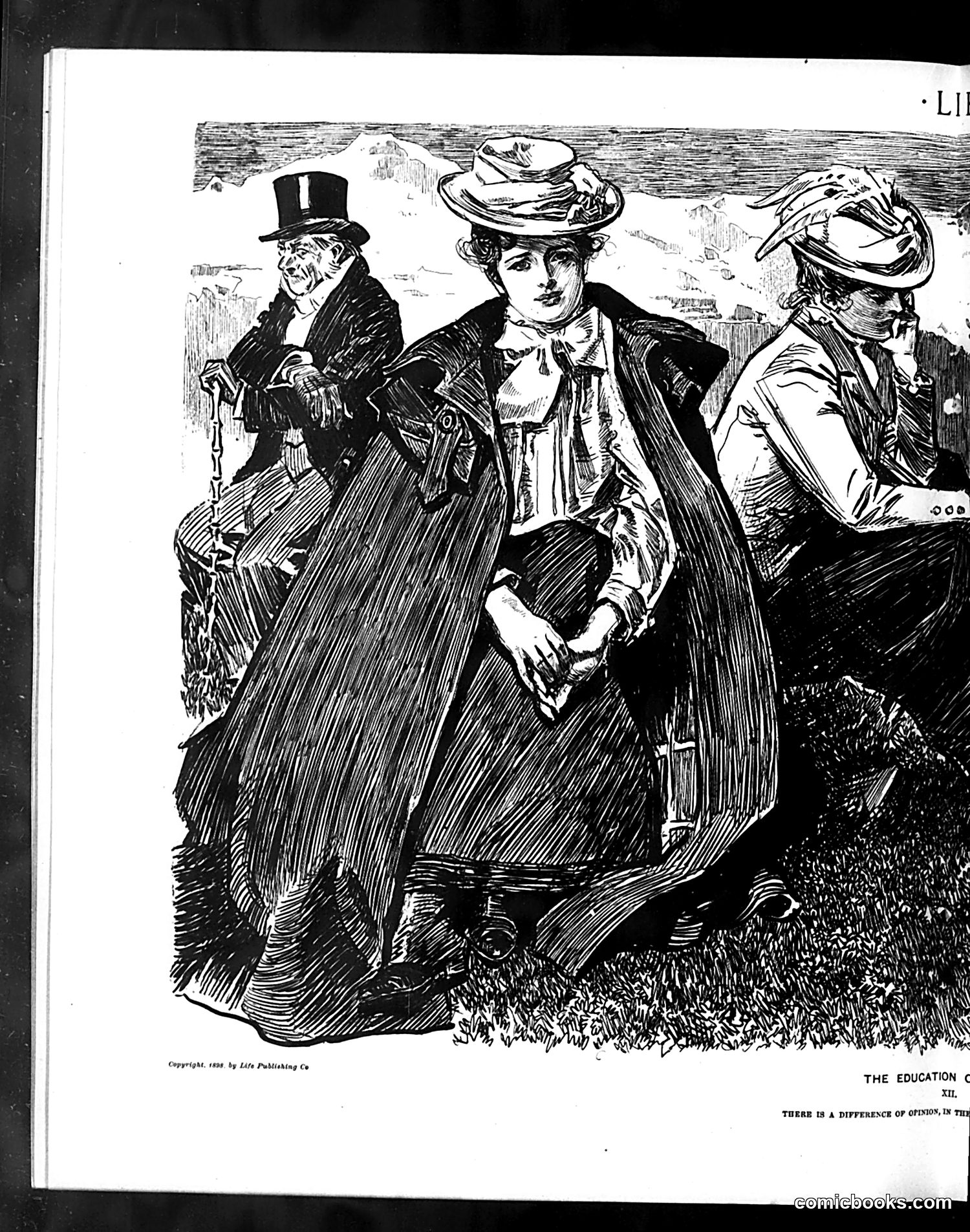
This page shows a satirical illustration titled "THE EDUCATION OF [text cut off]" with the caption "THERE IS A DIFFERENCE OF OPINION, IN THE..." The drawing depicts three figures in late 19th or early 20th-century dress walking together. The central figure is a well-dressed woman in an elaborate coat and hat, flanked by two men—one elderly in a top hat on the left, one younger on the right. The composition and grouping suggest a social commentary about competing influences or perspectives on a woman's upbringing or social role. The incomplete caption suggests the cartoon addresses disagreements among different groups about female education or social development—likely contrasting traditional male authority (the older gentleman) with modern viewpoints. The specific subject remains unclear without the full title and caption visible on this damaged page.
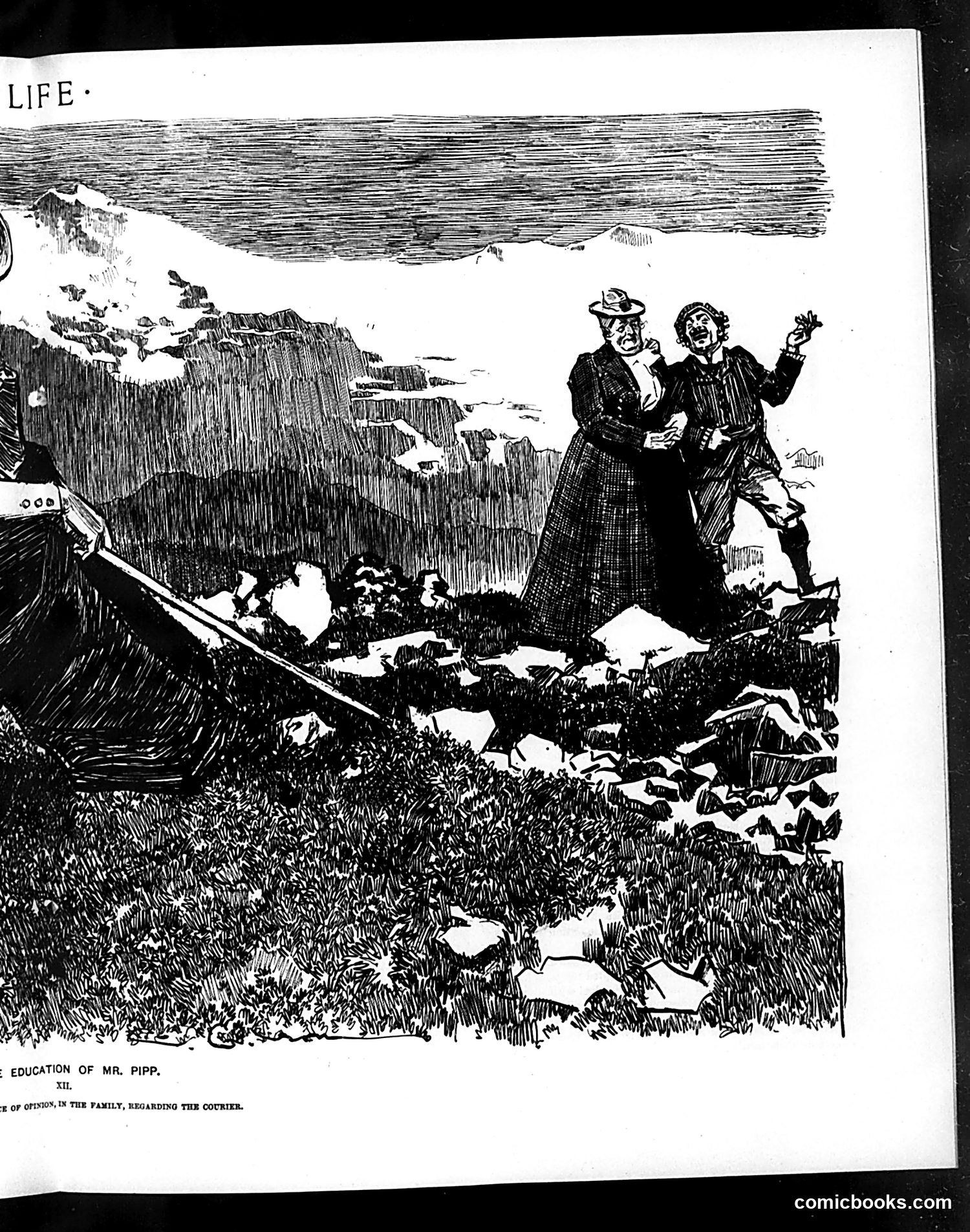
This page from *Life* magazine shows an illustration titled "The Education of Mr. Pipp" (subtitle partially visible: "...of opinion, in the family, regarding the courier"). The cartoon depicts two well-dressed figures in a mountainous landscape gesturing animatedly, appearing to be in heated discussion or argument. The style and composition suggest this is a serialized narrative or comic strip about a character named "Mr. Pipp" undergoing some form of education or experience. Without clearer context about who Mr. Pipp represents or what specific event this references, the exact satirical target remains unclear. The scene appears to mock social pretension or family disagreements, but the specific political or social reference the original audience would have understood is not evident from this page alone.
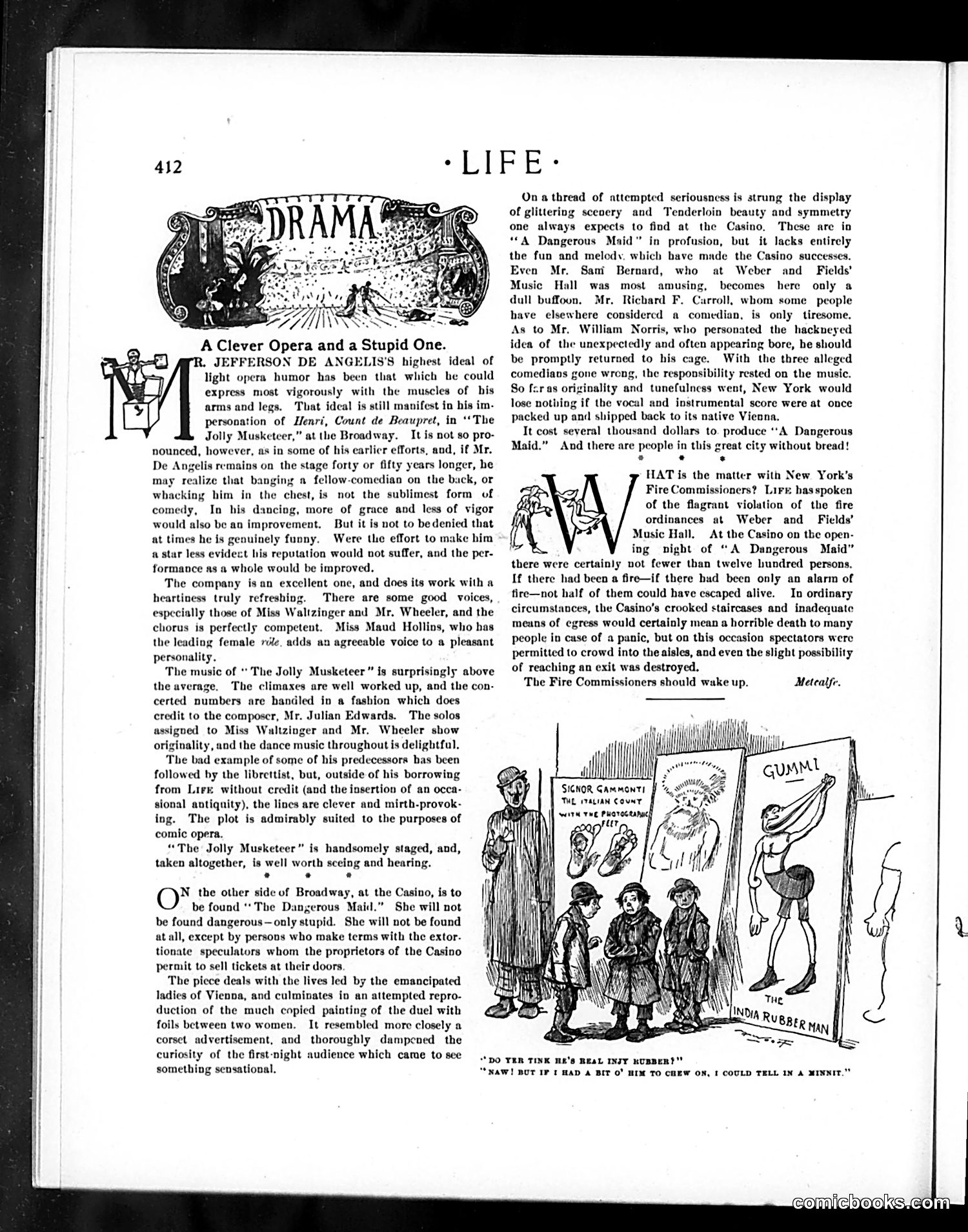
This page contains theater reviews discussing two Broadway productions: "The Jolly Musketeers" and "A Dangerous Maid" at the Casino theater. The cartoon at bottom shows visitors to what appears to be a dime museum or sideshow attraction. Signage visible includes "Sichor Samnonte," a "Gummi" attraction, and "The India Rubber Man." The joke caption reads: "Do yer think he's real live rubber?" / "Naw! But if I had a bit of him to chew on, I could tell in a minute." This satirizes curiosity-seekers at cheap entertainment venues who would test exhibits' authenticity through absurd means. The cartoon mocks both the dubious nature of such attractions and the gullible public attracted to them—typical of Life magazine's satirical approach to contemporary entertainment and consumer culture.
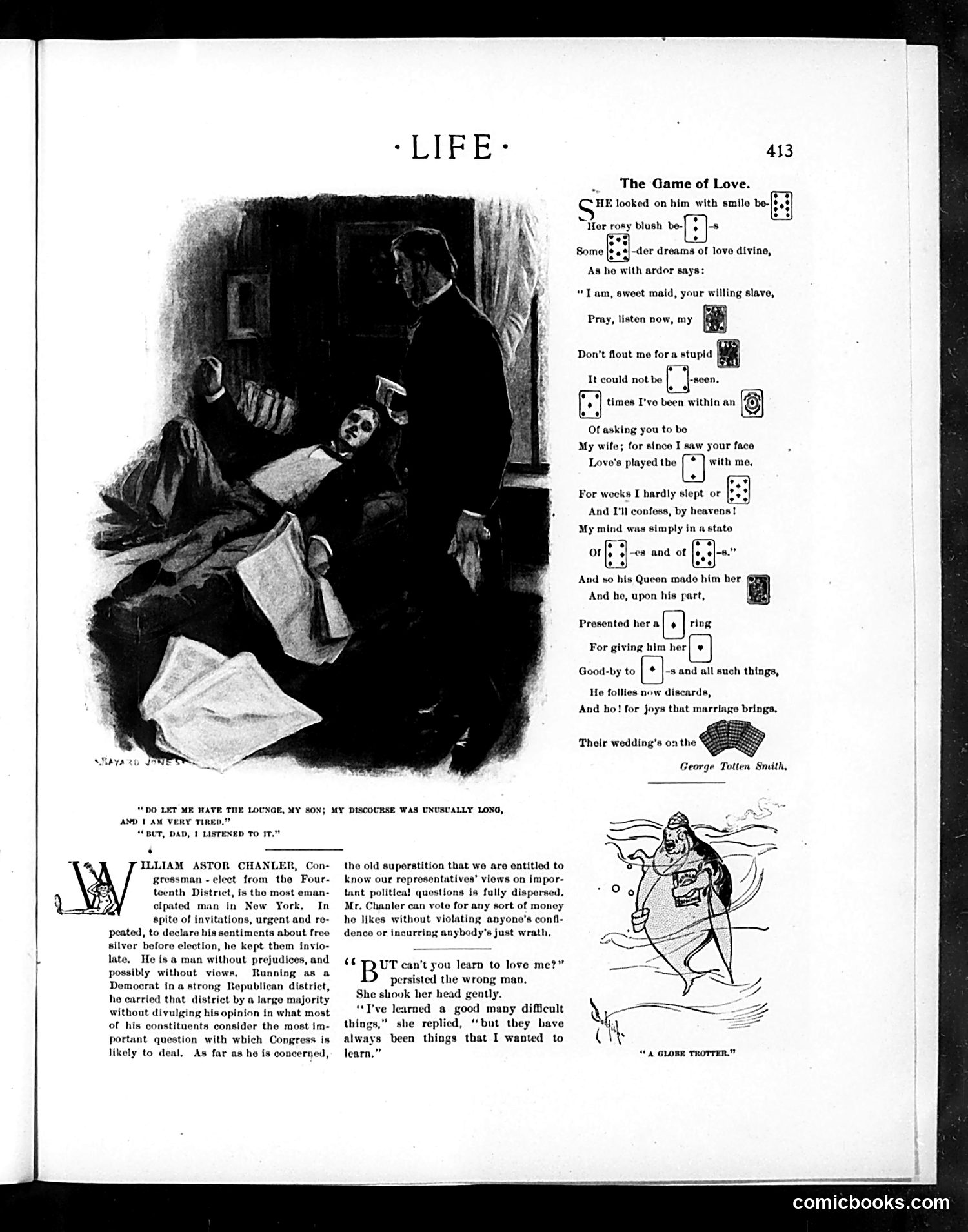
**Political Content (Top):** The page satirizes William Astor Chanler, a congressman-elect from New York's 14th District. The joke is that Chanler won his election despite refusing to publicly state his position on "free silver"—a major political controversy of the era. Life mocks the absurdity: he ran as a Democrat in a Republican district, won decisively, yet kept his views secret. The text argues this undermines the democratic principle that constituents deserve to know their representatives' positions before voting. **Romance Content (Bottom):** "The Game of Love" is a sentimental poem with card-suit illustrations, depicting a man's courtship of a woman who initially resists his advances. She eventually accepts his proposal and ring. The verse celebrates marriage and domestic life. **The Juxtaposition:** The page pairs political commentary about democratic accountability with light romantic verse—suggesting Life offers both serious satire and entertainment for readers.
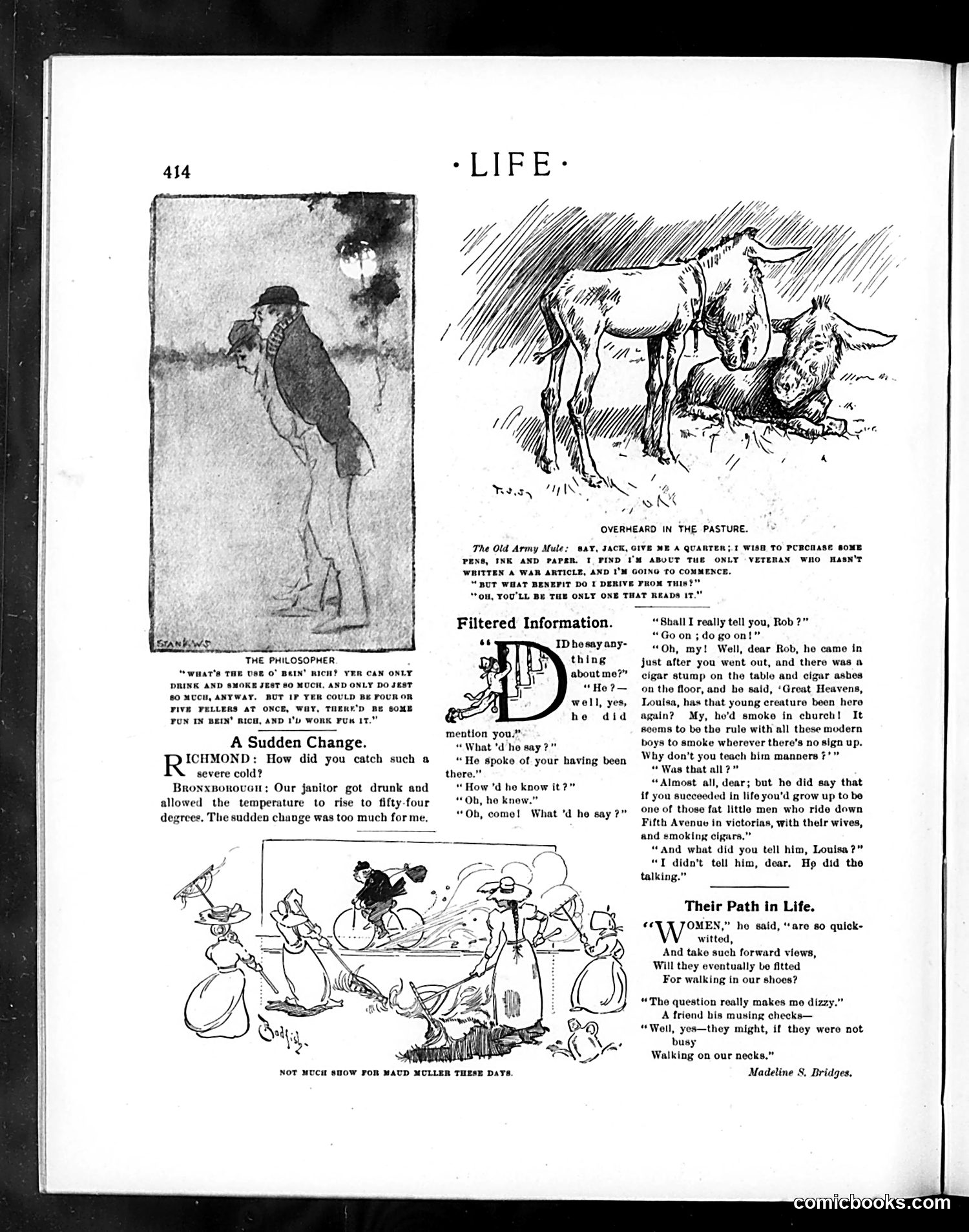
This page contains five separate satirical pieces typical of early 20th-century Life magazine humor: **"The Philosopher"** mocks working-class aspiration—a poor man fantasizes that wealth's only value would be experiencing multiple lives simultaneously, suggesting the wealthy's pleasures are repetitive and hollow. **"A Sudden Change"** ridicules upper-class hypochondria: a man catches cold from a mere five-degree temperature shift, implying excessive delicacy. **"Overheard in the Pasture"** uses an old army mule seeking funds to write a war article as satire on post-WWI memoir-writing—the joke being only the mule will read it, suggesting such veterans' accounts lack genuine audience interest. **"Filtered Information"** satirizes gossip distortion: a message passes through intermediaries until only trivial cigar-ash details remain, commenting on how rumors become diluted. **"Their Path in Life"** contains sharp gender satire: a man worries women's progress might lead to equality ("walking in our shoes"), but his friend retorts they're already dominant ("walking on our necks")—mocking anti-feminist anxiety about women's rising social power.
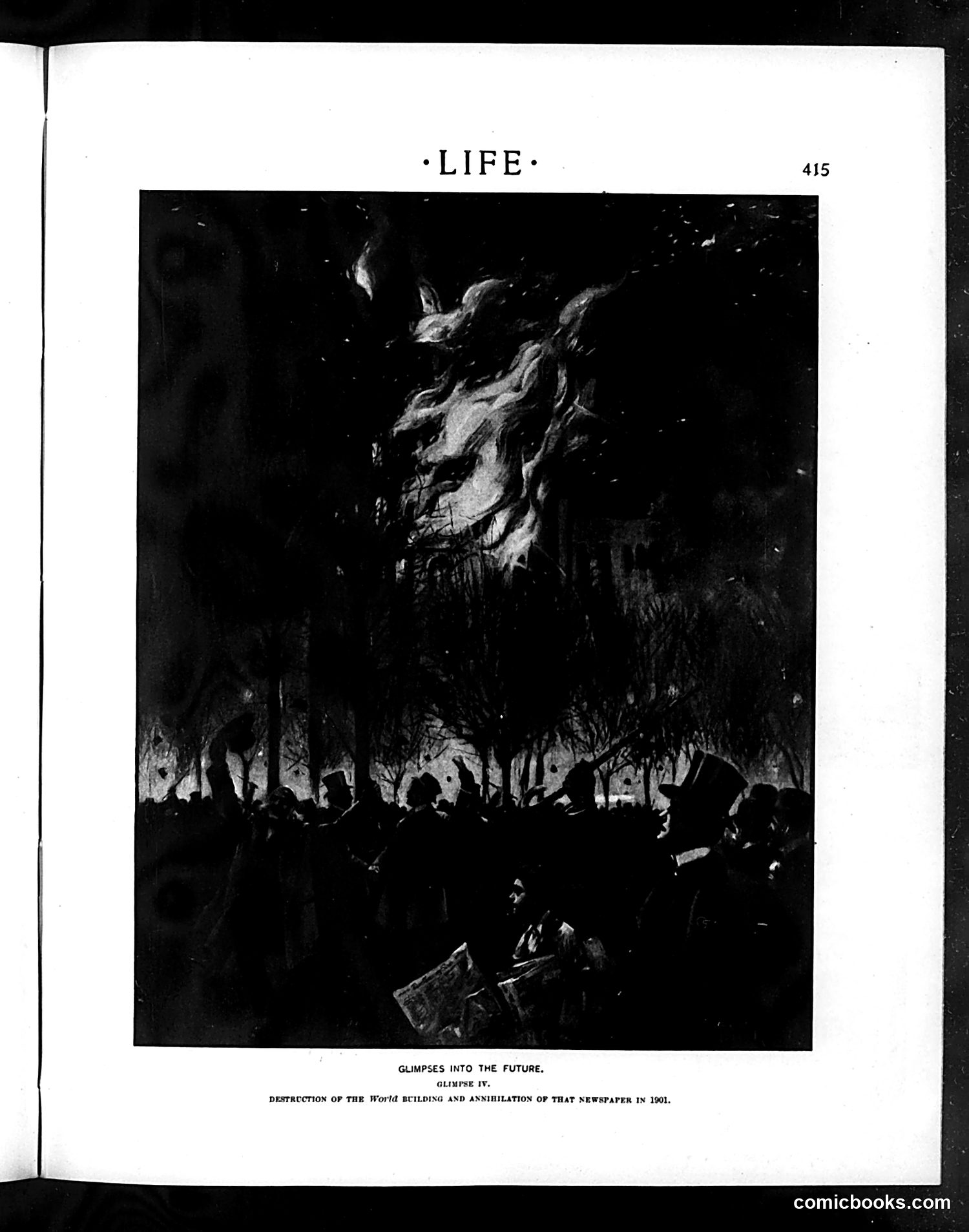
This satirical illustration depicts a catastrophic vision of the future, specifically the destruction of the World Building and the New York World newspaper in 1901. The image shows a massive explosion or fire consuming a tall building, with silhouetted crowds gathered below witnessing the destruction. The satire targets the World newspaper, likely criticizing its sensationalism, yellow journalism practices, or editorial positions. By imagining its complete annihilation, Life magazine mocks what it apparently viewed as the World's destructive influence on public discourse. The "glimpses into the future" framing suggests this is speculative satire—presenting a wished-for outcome as prophetic vision. This reflects intense media rivalries of the era, where competing publications engaged in sharp editorial attacks on each other's credibility and social impact.
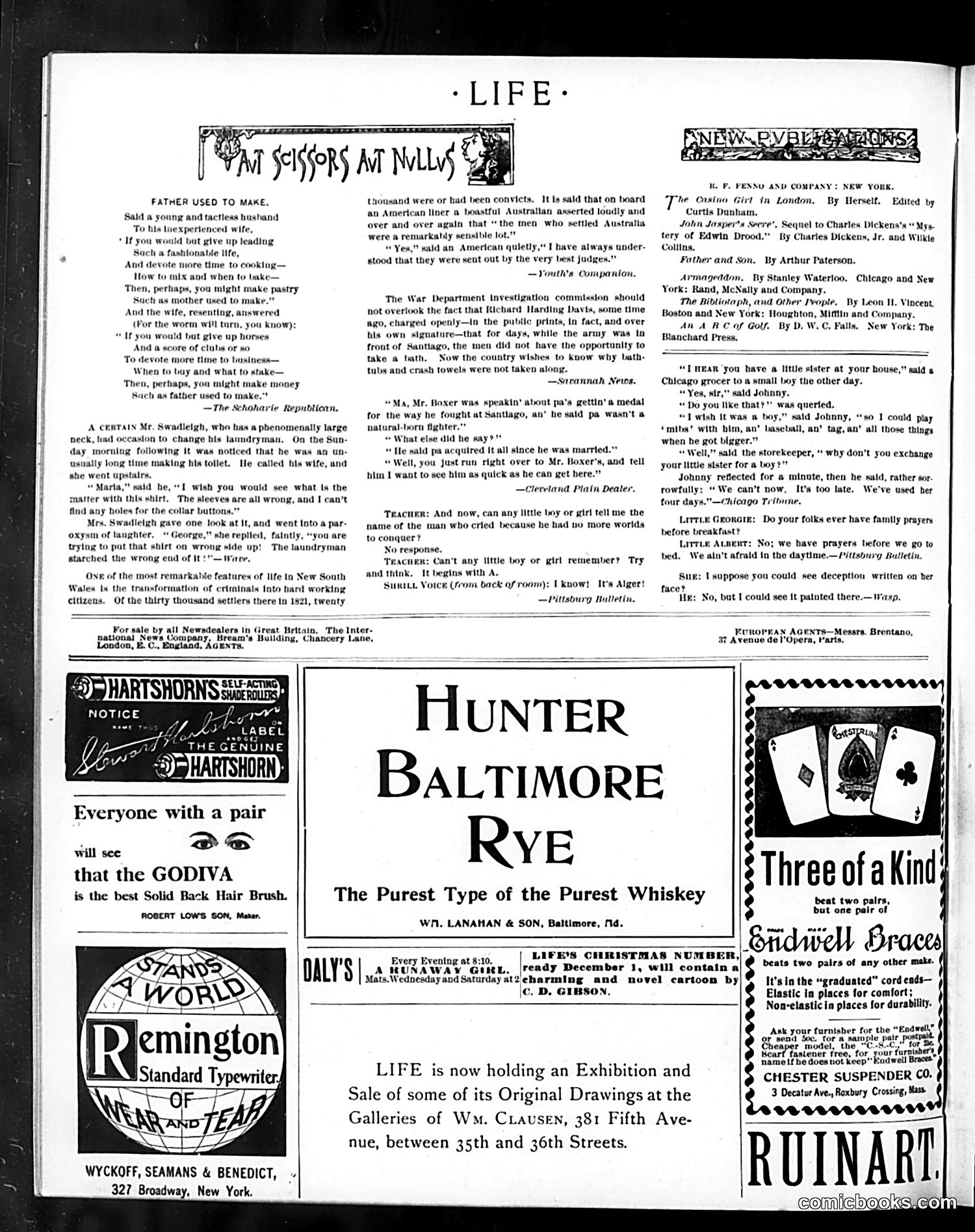
This page contains several **humorous anecdotes** rather than political cartoons, reflecting early 1900s gender dynamics and social attitudes: 1. **"Father Used to Make" / "Mother Used to Make"**: A husband criticizes his wife's cooking; she retorts that if *he* devoted more time to business instead of leisure, he'd earn money "such as father used to make." **Satire of marital criticism and gender role expectations.** 2. **The Laundry Shirt**: A man tries wearing a shirt inside-out, blaming his laundryman. **Gentle mockery of male incompetence.** 3. **Australian Convicts**: An Australian boasts his country's settlers were "remarkably sensible"; an American dryly replies they were "sent out by the very best judges"—**a joke that these were convicts judged by courts, not voluntary settlers.** 4. **Santiago Bath Anecdote**: References Richard Harding Davis's criticism that soldiers lacked bathing facilities during the Spanish-American War. **Commentary on military supply failures.** The page is primarily **advertising** (whiskey, typewriters, hair brushes) with light humor throughout.
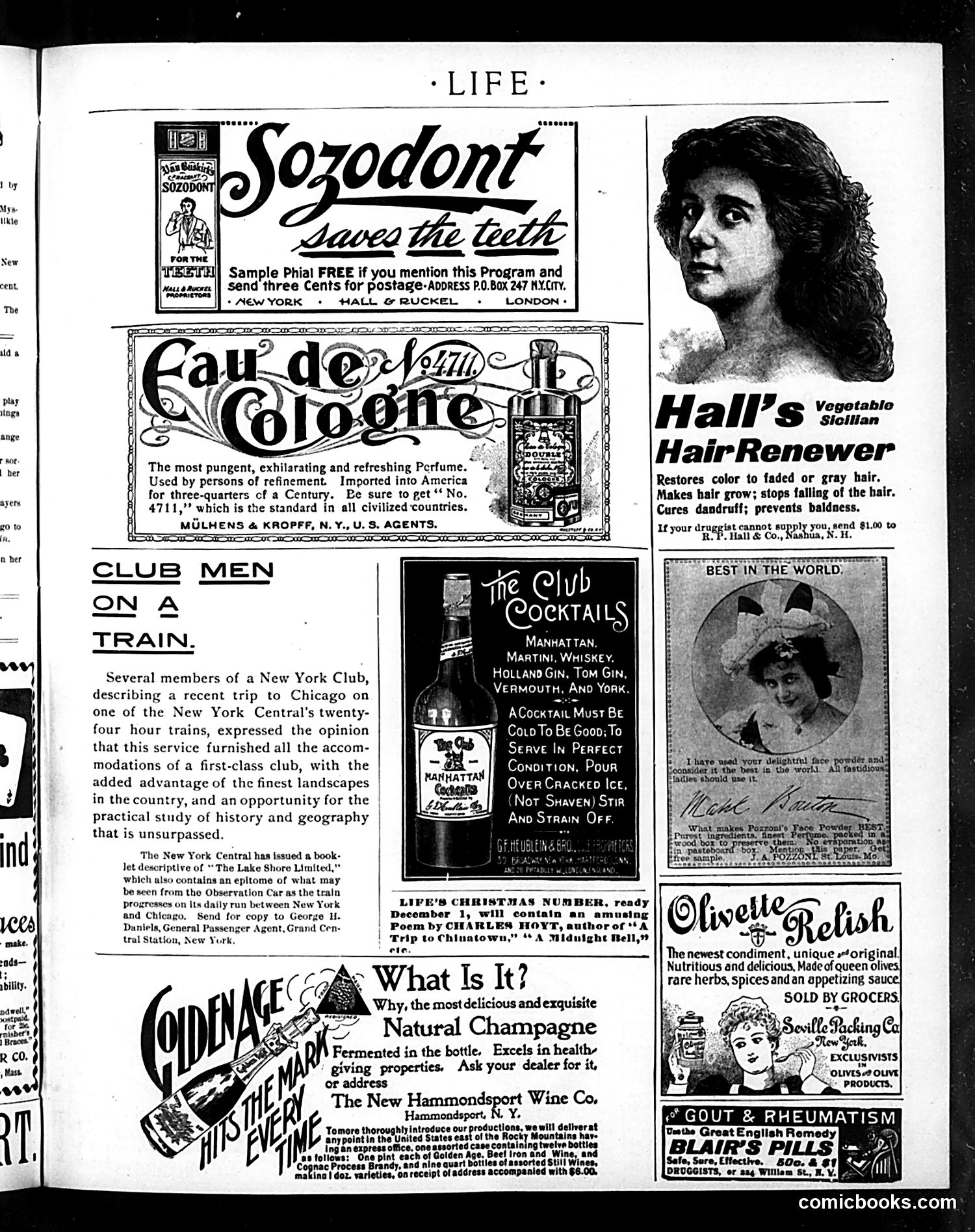
This page is primarily **advertisements**, not political satire or editorial cartoons. It's a commercial page from an early 1900s Life magazine showcasing period products. The ads include: - **Sozodont** toothpaste (offering free samples) - **Eau de Cologne** perfume (imported luxury item, "4711" brand) - **Hall's Hair Renewer** (hair restoration product with before/after imagery) - **The Club Cocktails** (pre-mixed drink advertisement) - **Olivette Relish** (condiment) - **Gidnace Champagne** (wine product) - **Blair's Pills** (patent medicine for gout and rheumatism) The editorial content includes a brief piece about New York Club members praising train travel accommodations, and an announcement about Life's upcoming Christmas issue featuring writer Charles Hoyt. There is **no political cartoon or satire** on this page—it's purely commercial and informational, representing typical early 20th-century magazine advertising practices, including patent medicines now considered dubious.
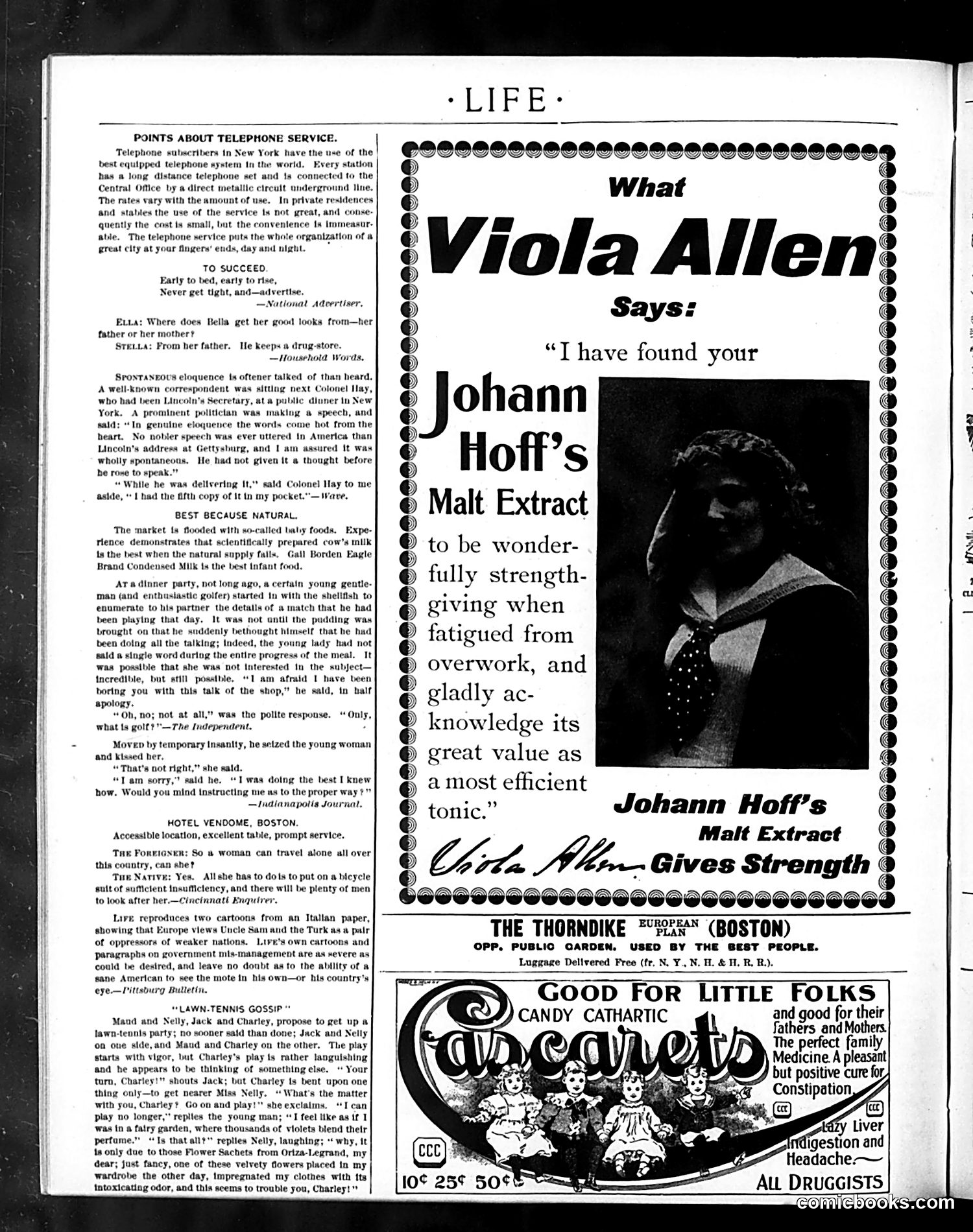
This page is primarily **advertising and humor content**, not political satire. The dominant feature is a large advertisement for **Johann Hoff's Malt Extract**, endorsed by actress **Viola Allen** (a prominent stage performer of the era). She testifies that the product strengthens her when fatigued from overwork—a typical patent medicine advertisement claim. The page contains several short humor pieces unrelated to each other: jokes about a druggist's daughter's looks, anecdotes about eloquence and golf bores, and a lawn-tennis gossip column. There's also a small hotel advertisement for Boston's Hotel Vendome. The only potentially political element mentioned in the OCR text references Life reprinting Italian political cartoons critical of American and Turkish oppression of weaker nations, but these cartoons aren't visible in the image provided. The page reflects early 20th-century Life magazine's mix of light entertainment, personal humor, and commercial endorsements.
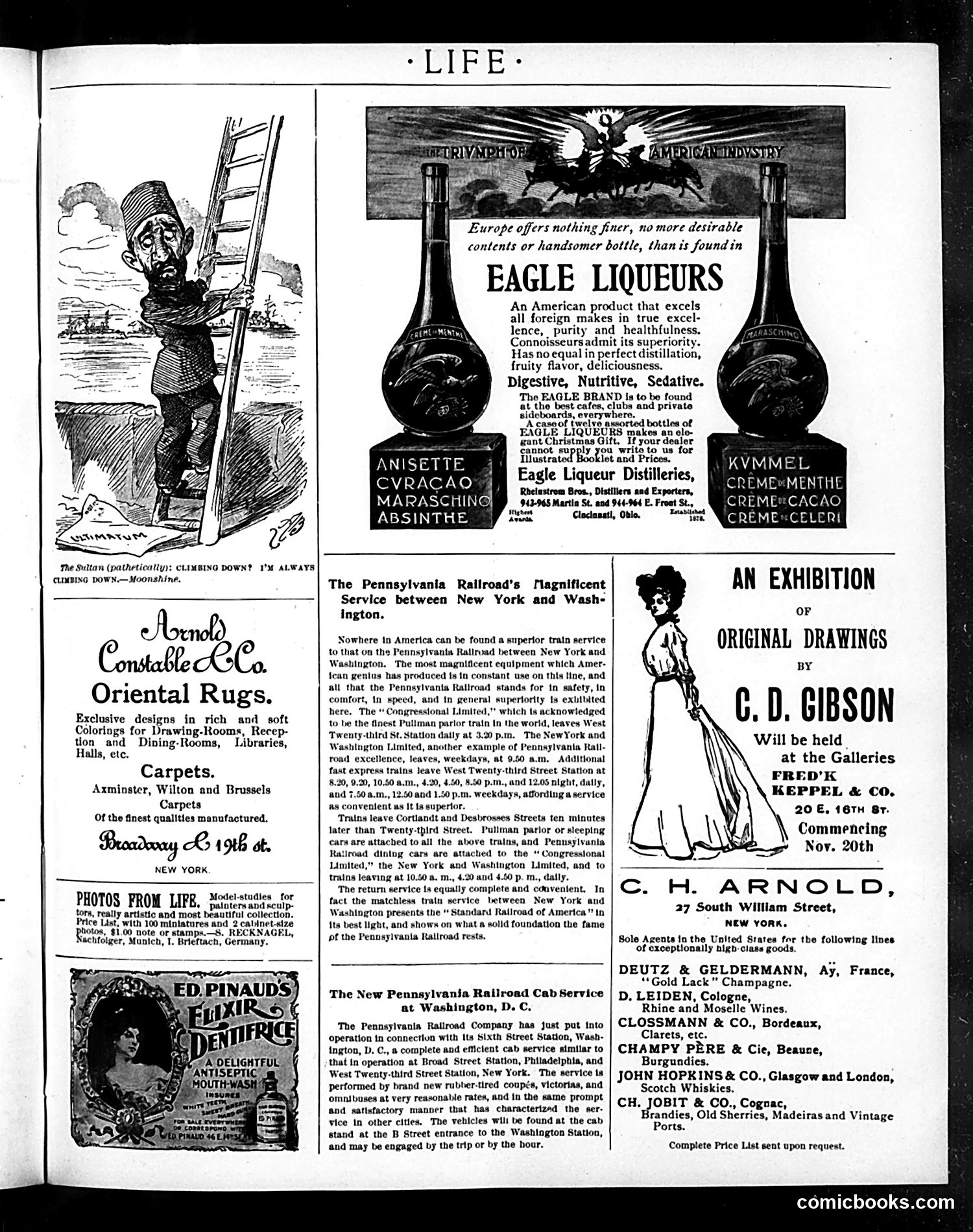
This page is primarily **advertising**, not political satire. The main cartoon—captioned "The Sultan (pathetically): CLIMBING DOWN? I'M ALWAYS CLIMBING DOWN"—appears to reference the **Ottoman Empire's declining international power** during the early 1900s. The figure depicts a Turkish leader perpetually descending a ladder, a visual metaphor for continuous loss of status and territory. "Moonshine" (the credit line) suggests this comments on the Sultan's weakness amid European imperialism. However, the cartoon occupies minimal space; the page is dominated by luxury advertisements: Eagle Liqueurs, Oriental Rugs, Pennsylvania Railroad service, and fine wines. These ads emphasize American industrial superiority and affluence—typical of *Life* magazine's advertising model during this prosperous pre-WWI era.
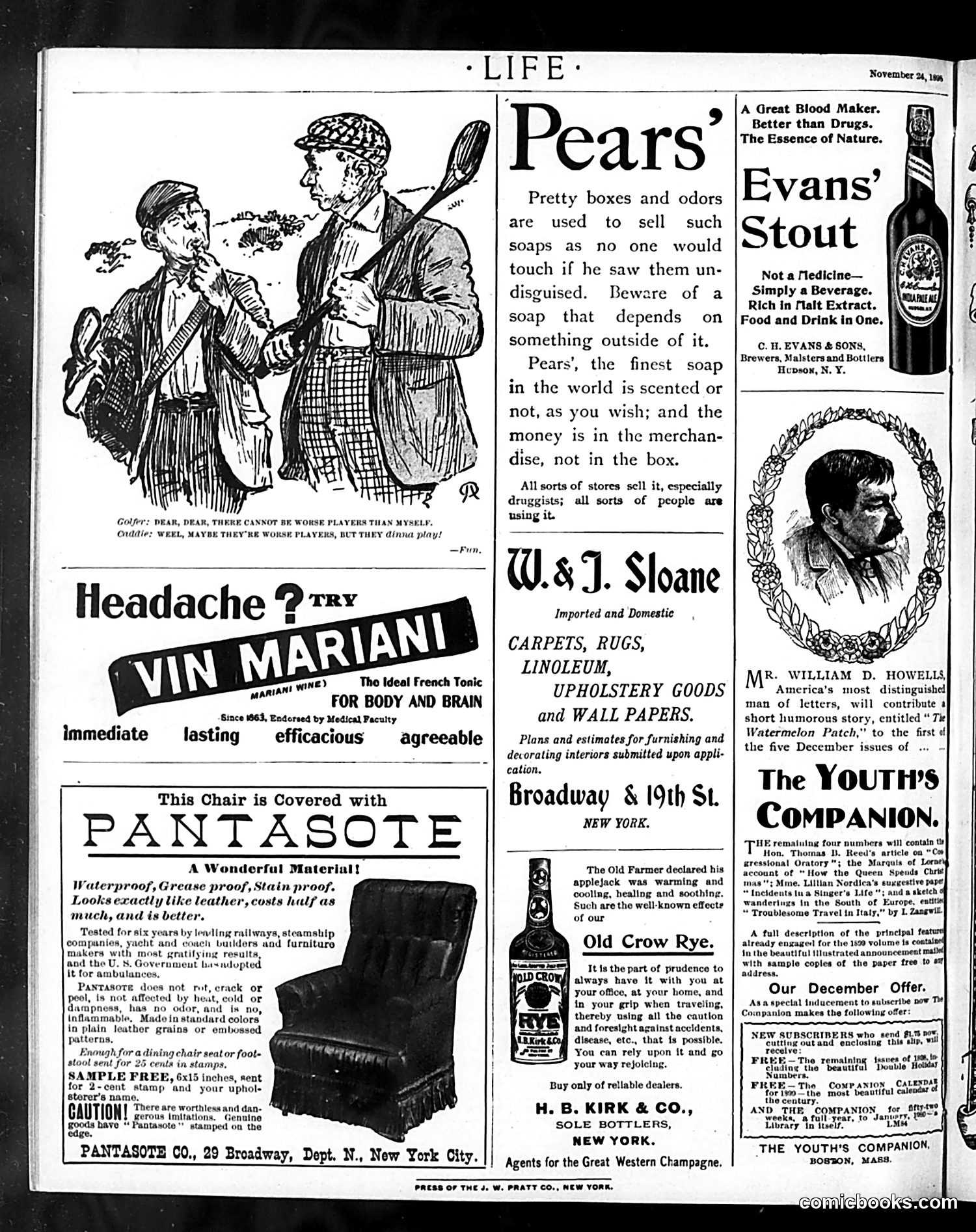
This page is primarily **advertising**, with one small cartoon at top left titled "Fun." The cartoon depicts two golfers. The first complains he's the worst player imaginable. The caddie replies that worse players exist—"but they dinna play!" (Scottish dialect: "don't play"). **The joke**: It's a mild satire on incompetent golfers. The implication is that truly terrible players wisely avoid the sport altogether, so the complainer—by actually playing—proves he's not the worst; he's merely bad enough to persist despite his obvious lack of skill. The humor relies on gentle self-deprecation and the caddie's dry observation. The remainder of the page consists entirely of period advertisements for soaps (Pears'), furniture materials (Pantasote), liquor (Vin Mariani tonic wine, Old Crow Rye), and magazine subscriptions (*Youth's Companion*). These ads reflect late-Victorian consumer culture and marketing strategies.