
Life, 1898-11-24 · page 8 of 20
Life — November 24, 1898 — page 8: what you’re looking at
What you’re looking at
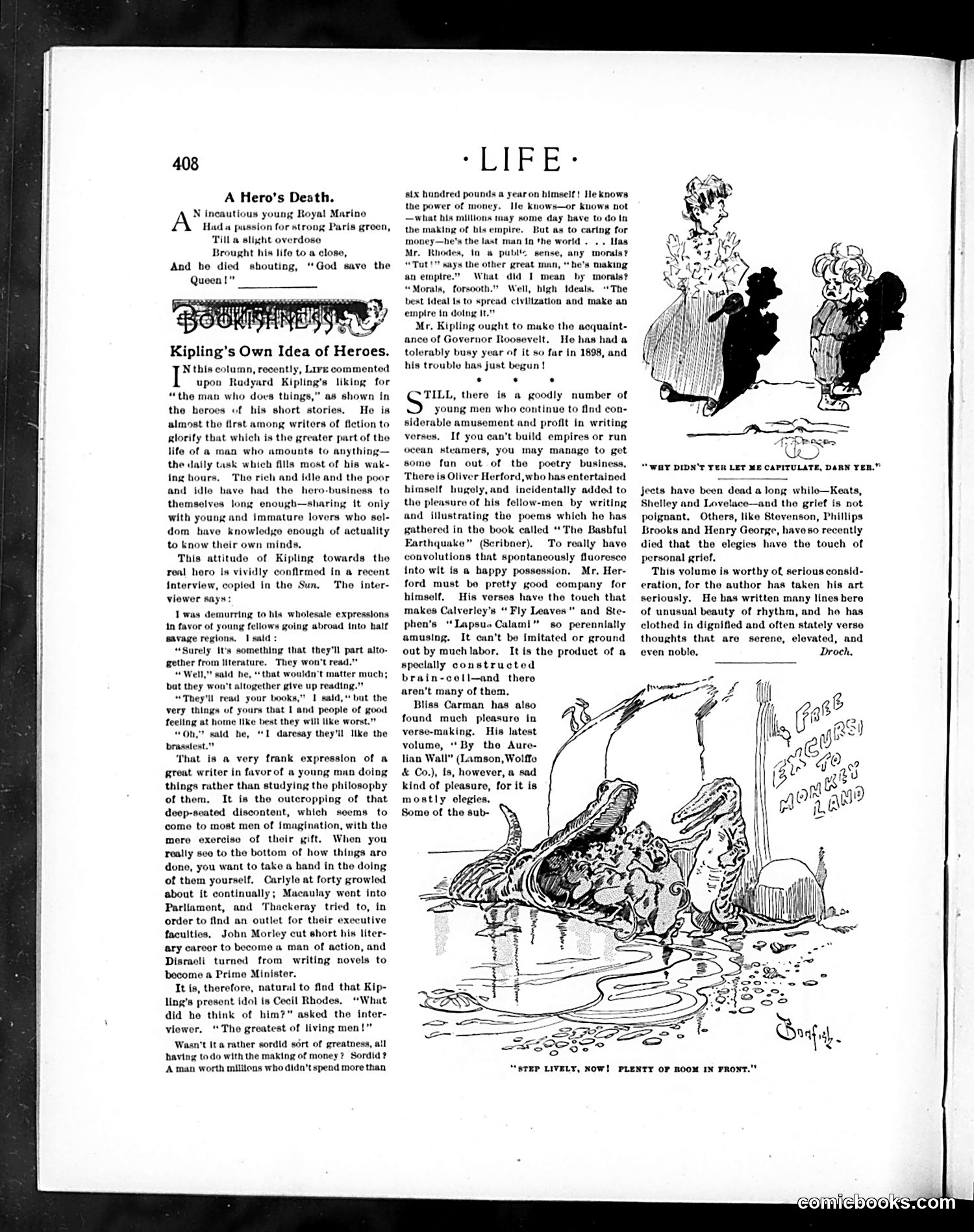
This page discusses literary figures and writing, specifically addressing Rudyard Kipling's definition of heroes as "men who do things." The text debates whether greatness requires grand ambitions or moral philosophy. **The cartoons** appear to be satirical illustrations of poets and writers, though the specific figures aren't clearly identified in the visible text. One shows what appears to be a domestic scene with the caption "Why didn't you let me capitulate, darned?" Another depicts figures near water with "Step lively, now! Plenty of room in front." The page critiques contemporary writers like Oliver Herford and Lilias Carman, discussing their verse-writing. The overall tone questions whether literary merit comes from serious intention or clever entertainment, reflecting period debates about literature's social purpose.
📄 Transcribed text from this page (OCR, searchable)
Machine-transcribed from the original scan — historical spelling and the odd misread are preserved.
408 A Hero's Death. AS incautious young Roya! Marino Had « passion for strong Paris green, Till a alight overdose Brought his life to a close, And be died shouting, “God save the Kipling’s Own Idea of Heroes. Nthis column, recently, Lrr commented upon Rudyard Kipling’s liking for “the man who does things,” a8 shown in the beroes of his short stories. He is almost the first among writers of fiction to glorify that which is the greater part of the life of a man who amounts to avything— the daily task which fills most of bis wak- ing hours. The rich and idle and the poor and idle have had the hero-business to themselves long enough—sharing it only with young and immature lovers who sol- dom have knowledge enough of actuality to know their own minds, This attitude of Kipling towards the real hero is vividly confirmed in a recent interview, copied in the Sun. The inter- viewer says I was demurring to his wholesale expressions In favor of young fellows going wbroad {nto half savage regions. I sald : “Surely {t's something that they'll part alto- gether from literature. They won't read * Well,” sald he, that wouldn't matter much; bat they won't altogether give up reading.” “They'll read your books,” I sald,‘ but the very things of yours that I and people of good feeling at home like best they will ike worst.” “On,” sald he, “1 daresay they'll like the brasstest."” ‘That is a very frank expression of a great writer in favor of a young man doing things rather than studying the philosopby of them. It is the outcropping of that deep-seated discontent, which seems to come to most men of Imagination, with the mere exercise of their gift. When you really see to the bottom of how things aro done, you want to take a band in the doing of them yourself. Carlyle at forty growled about it continually; Macaulay went into Parliamont, and Thackeray tried to, in order to find an outlet for their executive faculties, Jobn Morley cut short his liter- ary career to become a man of action, and Disraoli turned from writing novels to become a Prime Minister. It is, therefore, natural to flod that Kip- ling’s present idol is Cecil Rhodes, “What. did he think of him?” asked the inter- viewer. “The greatest of living men!” Wasn't Ita rather sordid sort of greatness, ail having todo with the making of money? Sordid? A man worth millions who dida’t spend more than LEE « six hundred pounds a yearon himself! He knows the power of money, He knows—or kuows not —Whiat his millions thay some day have to do tn the making of bis empire. But as to caring for money—he’s the last man in the world... Has Mr. Rhodes, In a publ'c sense, any morals? “Tut!” says the other great man, “he's making an empire.” What did I mean by morals? “Morals, forsooth.”” Well, high fdeals. “The bext {deal t4 to spread civilization and make an empire tn dotng It.” Mr. Kipling ought to make the acquaint- ance of Governor Roosevelt. He has had a tolerably busy year of it so far in 1898, and his trouble has just begun! . . . >TILL, there is a goodly number of young men who continue to find con- siderable amusement and profit in writing verses. If you can't build empires or run ocean steamers, you may manage to get some fun out of the poetry business, Thero is Oliver Herford,who has entertained himselt hugely, and incidentally added to the pleasure of his fellow-men by writing and illustrating the poems which he has gathered in the book called “The Basbful Earthquake” (Scribner). To really bavo convolutions that spontaneously fluoresce into wit is a happy possession, Mr, Her- ford must be pretty good company for himself, His vorses have the touch that makes Calverley’s “Fly Leaves” and 8te- phen’s “Lapsus Calami” so perennially amusing. It can't be imitated or ground out by much labor. It is the product of a specially constructed brain-coll—and thero aren't many of them, Bliss Carman has also found much pleasure in verse-making. His latest volume, “By the Aure- lian Wall” (Lamson, Wolffe & Co.), is, however, a sad kind of pleasure, for it is mostly olegies. Some of the sub- WHY DIDN'T YUN LET ME CAPITULATE, DARN YER.” jects have been dead a long whilo—Keats, Shelley and Lovelace—and the grief is not poignant. Others, like Stevenson, Phillips Brooks and Henry George, haveso recently died that the elegics have the touch of personal grief, This volume is worthy of serious consid- eration, for tho author has taken his art seriously, He bas written many lines hero of unusual beauty of rhythm, and ho has clothed in dignified and often stately verso thoughts that are serene, elevated, and even noble, Droch, “STEP LIVELY, NOW! PLENTY OF ROOM IN FRONT."*