
Life, 1898-11-24 · page 6 of 20
Life — November 24, 1898 — page 6: what you’re looking at
What you’re looking at
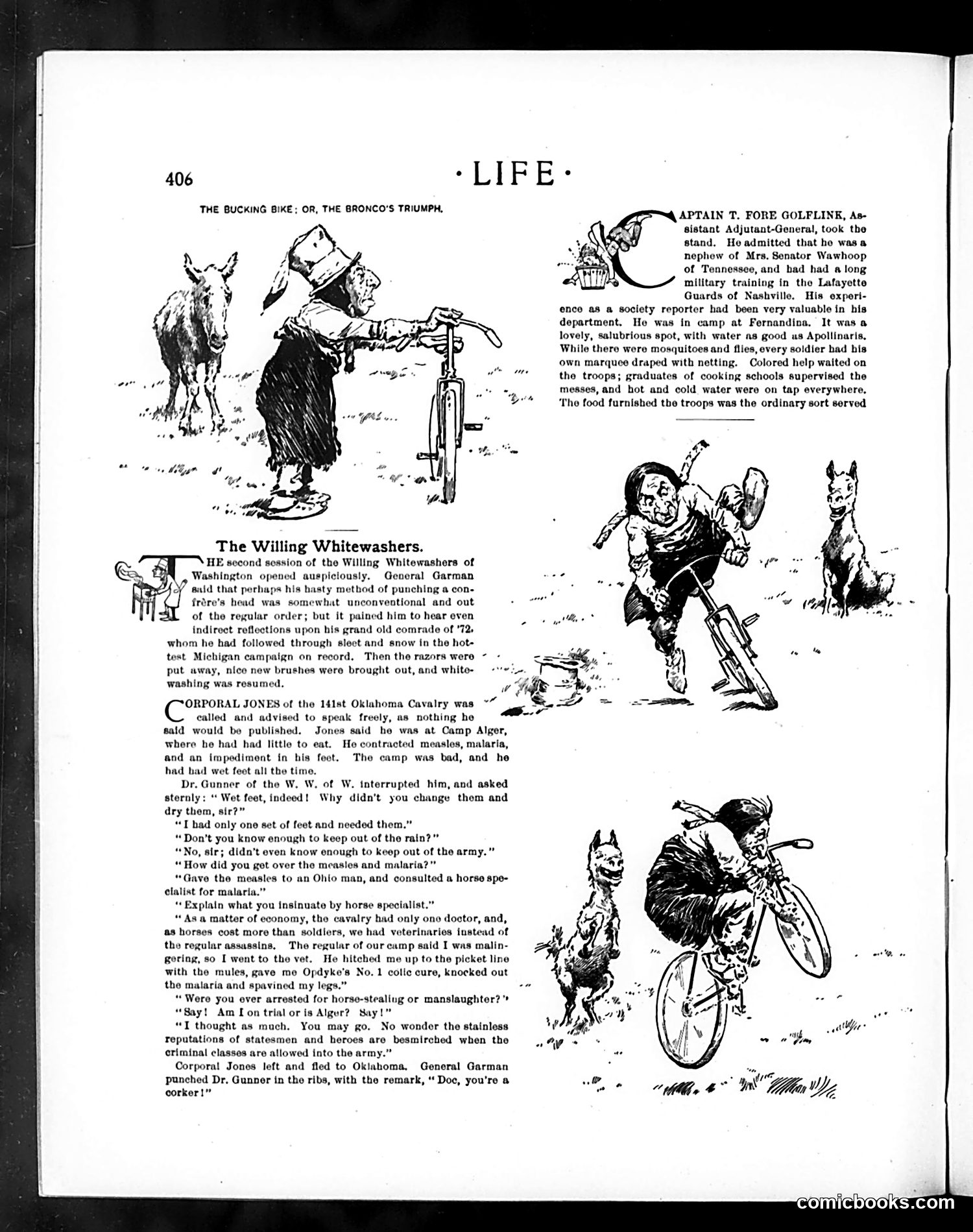
This page contains three humorous military anecdotes from what appears to be World War I era, illustrated with cartoons. **"The Bucking Bike"** shows a soldier on a bicycle being thrown by the vehicle like a bronco—a visual pun equating the bicycle with an untamed horse. **"The Willing Whitewashers"** mocks General Garman's unconventional punishment method (whitewashing) for soldiers, which the General later admits was overly harsh. **"Corporal Jones"** recounts a debate between Corporal Jones and Dr. Gunner about wet feet in camp. Jones challenges military authority by questioning why soldiers aren't given proper care. The humor derives from Jones's irreverent attitude toward military hierarchy and the absurdity of the situation. The cartoons satirize military inefficiency, poor camp conditions, and the disconnect between officers and enlisted men during wartime.
📄 Transcribed text from this page (OCR, searchable)
Machine-transcribed from the original scan — historical spelling and the odd misread are preserved.
406 THE BUCKING BIKE; OR, THE BRONCO'S TRIUMPH, The Willing Whitewashers. HE second session of the Willing Whitewashors of Washington opened auspiciously, General Garman said that perhaps his hasty method of punching a con- frdre’s head was somewhat unconventional and out of the regular order; but it pained him to hear even indirect reflections upon his grand old comrade of '72+ whom he had followed through slect and snow in the hot- test Michigan campaign on record, Then the razors wero put away, nice new brushes were brought out, and white- washing was resumed, ORPORAL JONES of the 141st Oklahoma Cavalry was called and advised to speak freely, as nothing he said would be published. Jones said he was at Camp Alger, where he had had little to eat. He contracted measles, malaria, and an impediment in his f The camp was bad, and he had bad wet feet all the time. Dr. Gunner of the W. W. of W. interrupted him, and asked sternly: “ Wet feet, indeed! Why didn’t you change thom and dry them, sir?” “T had only one set of feet and needed them.” “Don’t you know enough to keep out of the rain?” No, sir; didn’t even know enough to keep out of the army.” How did you get over the measies and malaria?” “Gave the measles to an Ohio man, and consulted a horse spe- clalist for malaria.” “Explain what you insinuate by horse specialist.” “Asa matter of economy, the cavalry had only ono doctor, and, as horses cost more than soldiers, we had veterinaries instead of the regular assassins, The regular of our camp said I was malin- goring, so I went to the vet. He hitched me up to the picket line with the mules, gave mo Opdyke’s No. 1 colle cure, knocked out the malaria and spavined my legs.” “Were you ever arrested for horse-stealing or manslaughter? * “Say! Am [on trial or is Alger? Say!” “TI thought as much. You may go. No wonder the stainless reputations of statesmen and beroes are besmirched when the criminal classes are allowed into the army.” Corporal Jones left and fled to Oklahoma, General Garman punched Dr. Gunner in the ribs, with the remark, ‘ Doc, you're a corker!" APTAIN T. FORE GOLFLINK, As- sistant Adjutant-General, took the stand. Ho admitted that ho was a nephew of Mrs, Senator Wawhoop of Tennessee, and bad had a long military training in the Lafayette Guards of Nashville. His oxperi- enco as a society reporter had been very valuable in his department. He was in camp at Fernandina, It was a lovely, salubrious spot, with water ns good us Apollinaris, While there wore mosquitoes and flies, every soldier had bis own marquee draped with netting. Colored help waited on the troops; graduates of cooking schools supervised the messes, and hot and cold water were on tap everywhere, ‘Tho food furnished the troops was the ordinary sort served “hl. 4° ‘Gln Wz