
A complete issue · 20 pages · 1898
Life — November 3, 1898
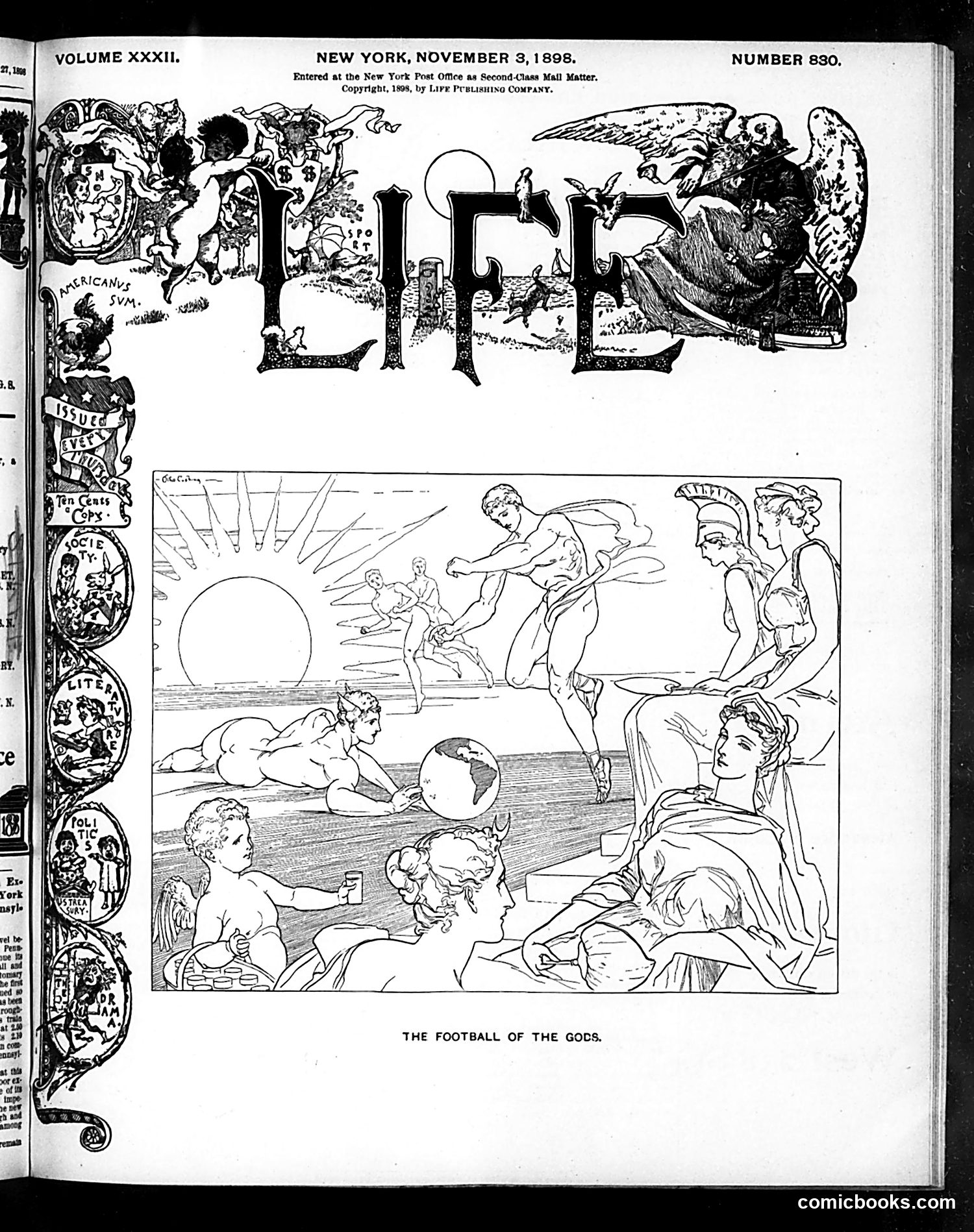
This Life magazine page from November 3, 1898, presents a satirical illustration titled "The Football of the Gods." The image depicts classical mythological figures—gods and goddesses—playing football on a beach at sunset, treating the sport as a casual recreational game. The satire appears to mock the era's obsession with football as entertainment, elevating its cultural importance by imagining even the gods engaging in it. This reflects the sport's explosive popularity in late-19th-century America, particularly college football. The decorative border on the left contains Life magazine's typical ornamental designs and mastheads. The illustration's classical style—placing modern sport within mythological contexts—was a common Victorian satirical device for commenting on contemporary society's values and preoccupations.
This page is primarily **advertising content** rather than satirical cartoons. It showcases luxury goods and services from the early 20th century, including: - Books (history and travel narratives) - Fine gloves from multiple retailers (Stern Bros., Arnold, Constable & Co.) - Wedding stationery and silver gifts from established firms like Gorham Manufacturing Company - Menswear from Broadway shops There is one brief editorial piece: "Club Men on a Train" describes New York Club members praising the NYC Central's express train service to Chicago, noting its first-class accommodations and scenic routes. **No political cartoons or social satire appear on this page.** It represents Life magazine's advertising-heavy format from this era, targeting affluent, urban readers interested in refined consumer goods.
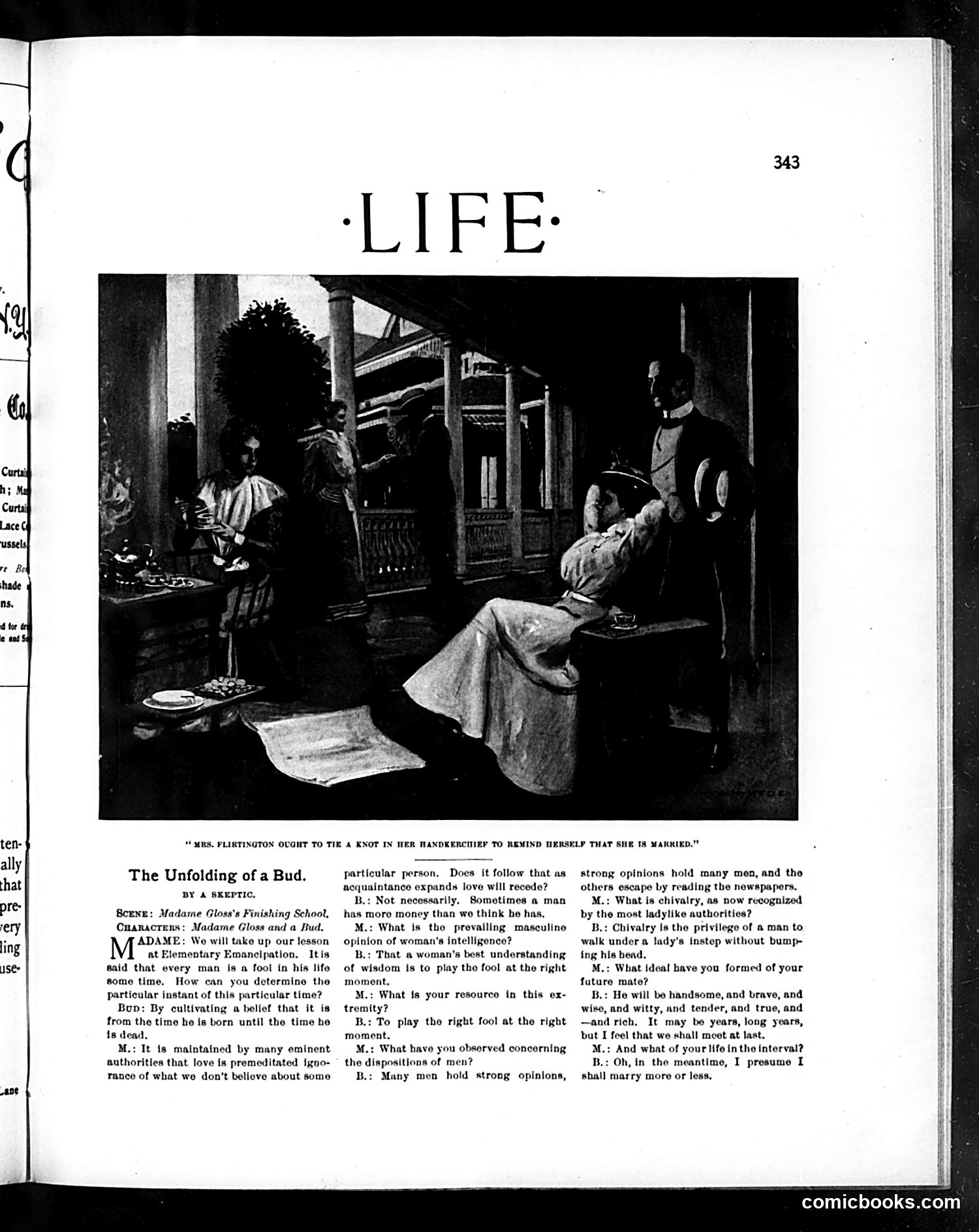
This is a satirical dialogue between a skeptic (H.) and a believer (M.) about love and marriage. The scene shows a woman being courted, with the caption indicating she's tying a knot in her handkerchief "to remind herself that she is married." The satire mocks romantic idealism: while M. defends love as noble and enduring ("it may be years, long years, but I feel that we shall meet at last"), H. responds cynically that she'll "marry more or less"—suggesting women forget or abandon marriages casually. The "bud unfolding" metaphor undercuts romantic growth, implying instead that female feelings bloom and wilt unpredictably. The piece critiques both sentimental views of love and, implicitly, women's constancy in marriage.
This page analyzes the 1912 U.S. presidential election, specifically the Independent/Progressive split. The text discusses Theodore Roosevelt's challenge to incumbent President Taft, and mentions the "John Jay Chapman Independents" supporting Rochester candidate Theodore Bacon for New York Governor. The cartoons (small illustrations scattered throughout) use animal imagery—appearing to show a bucking bronco and well-broken horse, likely representing Roosevelt as the untamed "Rough Rider" versus the controlled Taft. The satire critiques Roosevelt's outsider candidacy and the fracturing of the Republican Party. References to "things must be a darn sight worse before they are any better" mock Progressive optimism about reform, while the discussion of independent voter confidence reflects deep anxiety about the election's outcome and whether splitting conservative votes would benefit Democrats.
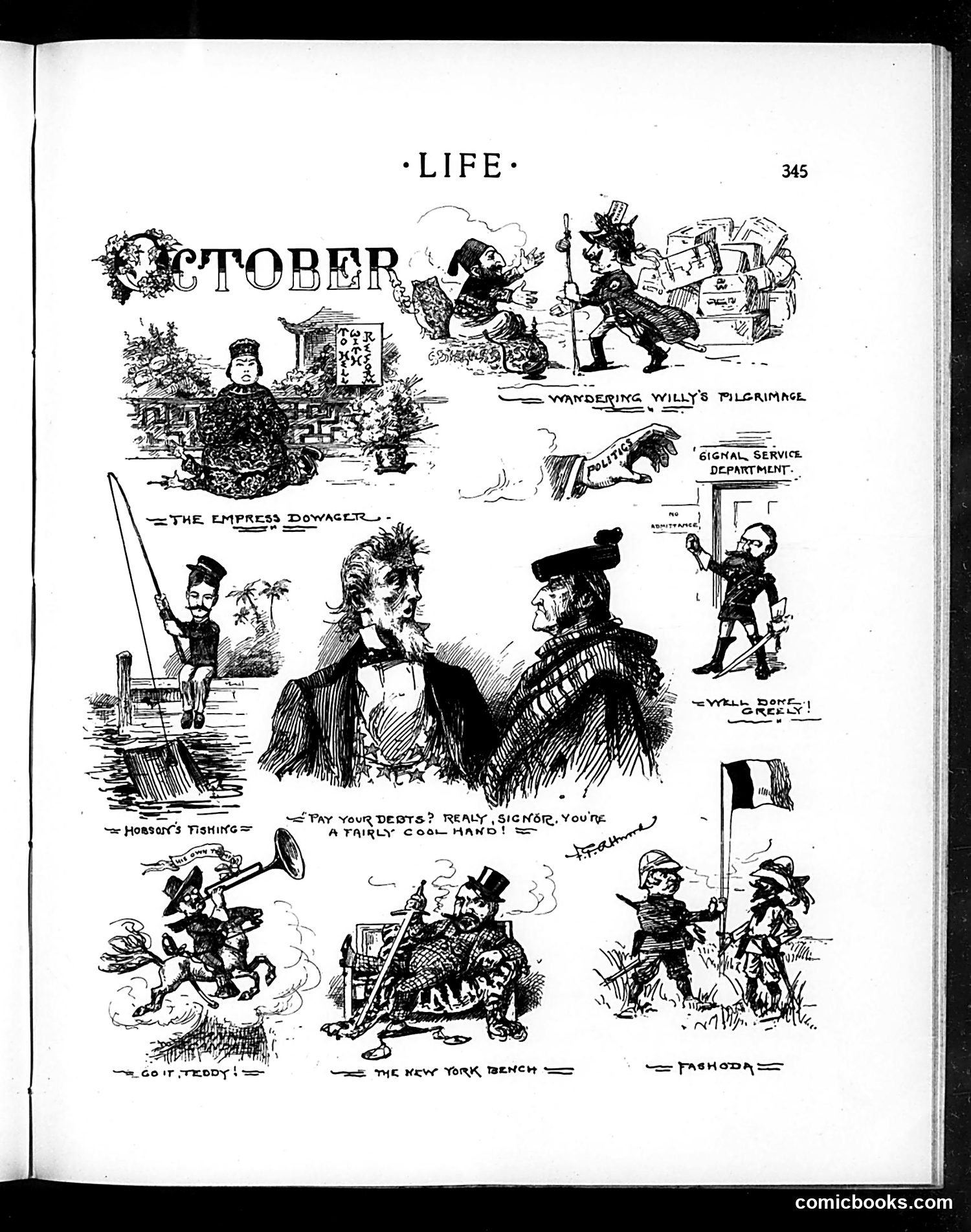
This satirical page features multiple political cartoons mocking contemporary figures and events. "The Empress Dowager" caricatures an authoritarian female figure. "Wandering Willy's Pilgrimage" depicts a character burdened with political baggage. "Horrors Fishing" shows a figure angling for something, likely representing political maneuvering. "The New York Bench" portrays judicial or political figures in discussion, with one saying "Pay your debts? Really, Signor, you've a fairly cool hand!" suggesting commentary on financial or diplomatic obligations. Other sketches include "Well Done, Crew!" and "Fashoda," the latter clearly referencing the 1898 Fashoda Incident between Britain and France over Sudan. "Go it, Teddy!" likely references Theodore Roosevelt. The cartoons employ exaggerated caricature typical of early-1900s satirical illustration to comment on international tensions, political corruption, and contemporary personalities.
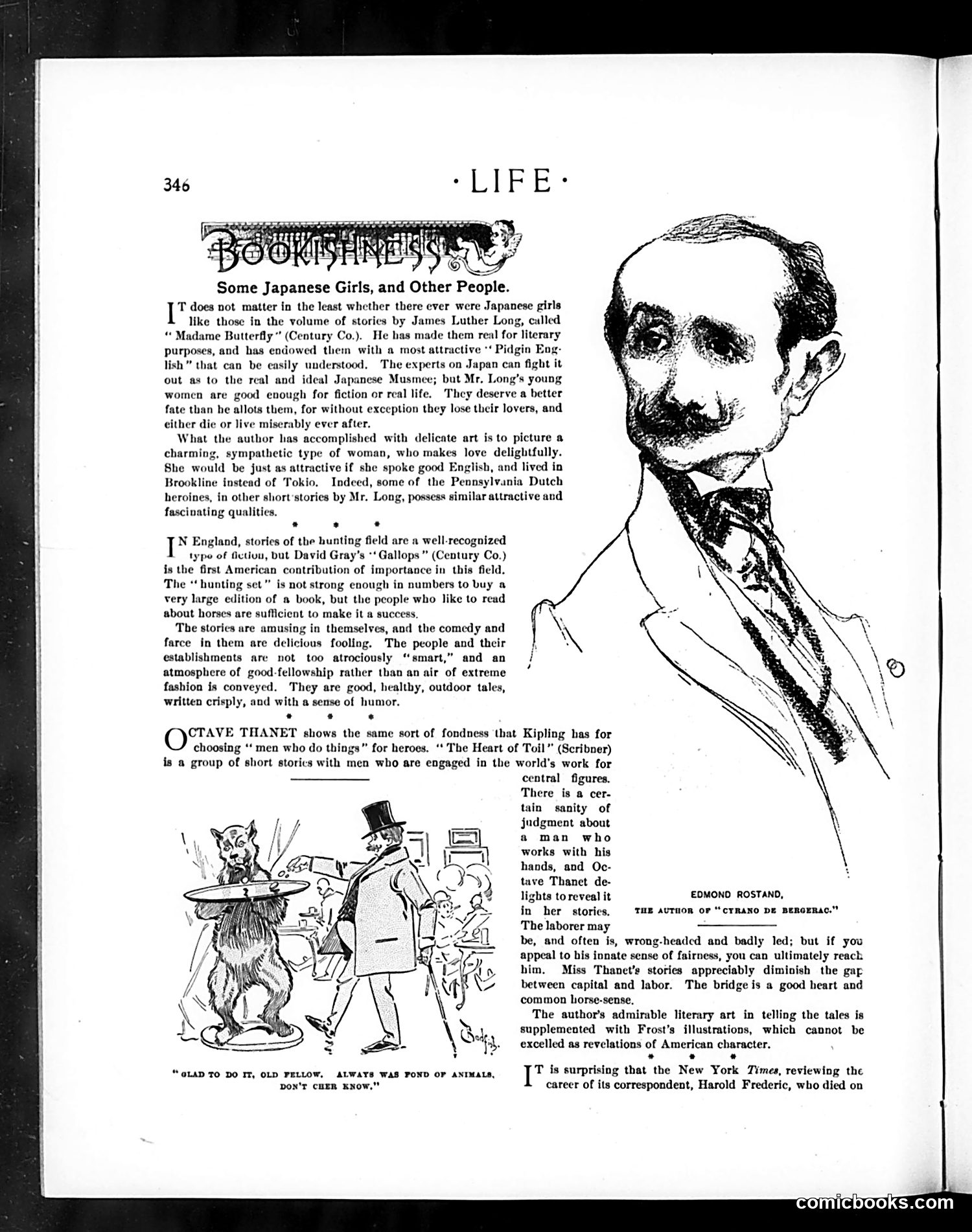
This page reviews recent books, including works by James Luther Long about Japanese girls and David Gray's hunting stories. The main illustration depicts **Edmond Rostand**, author of "L'Aiglon" (identified in caption), shown in a dignified portrait sketch. The cartoon below—showing a well-dressed man with a devil-like creature—illustrates a passage discussing **Octave Thanet's stories about laborers**. The satire appears to critique how Thanet portrays working-class characters: the devil figure likely represents misconceptions or unfair stereotypes about laborers, while the gentleman represents educated perspective. The text suggests Thanet appeals to fairness to bridge class divisions, making the cartoon's juxtaposition ironic—highlighting tension between capital and labor in contemporary American society.
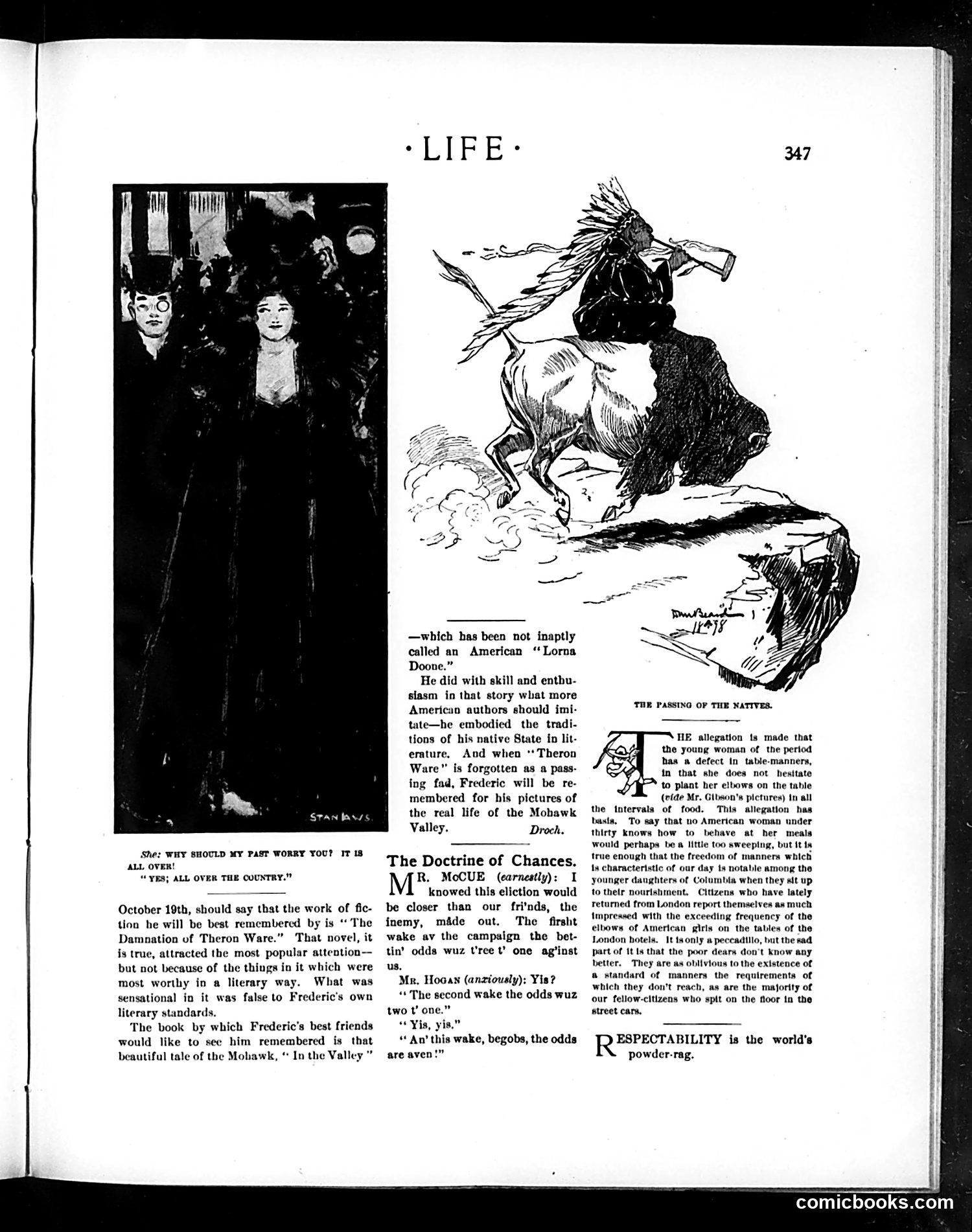
The page contains two distinct elements: **Left photograph**: Shows two women in dark formal attire with the caption "WHY SHOULD MY PAST WORRY YOU? IT IS ALL OVER! YES, ALL OVER THE COUNTRY." This appears to satirize contemporary anxieties about women's past behavior or reputation, likely referencing 1920s social concerns about changing female morality. **Right cartoon**: Titled "THE PASSING OF THE NATURES," depicts a figure riding a horse while looking through a telescope, suggesting obsolescence or irrelevance. The accompanying text discusses American literature and Frederic Remington's work depicting the Mohawk Valley. **Bottom section**: "The Doctrine of Chances" and "Respectability" offer social commentary on manners and propriety, addressing perceived declining standards among American youth and women. The overall tone mocks contemporary moral panic about changing social standards.
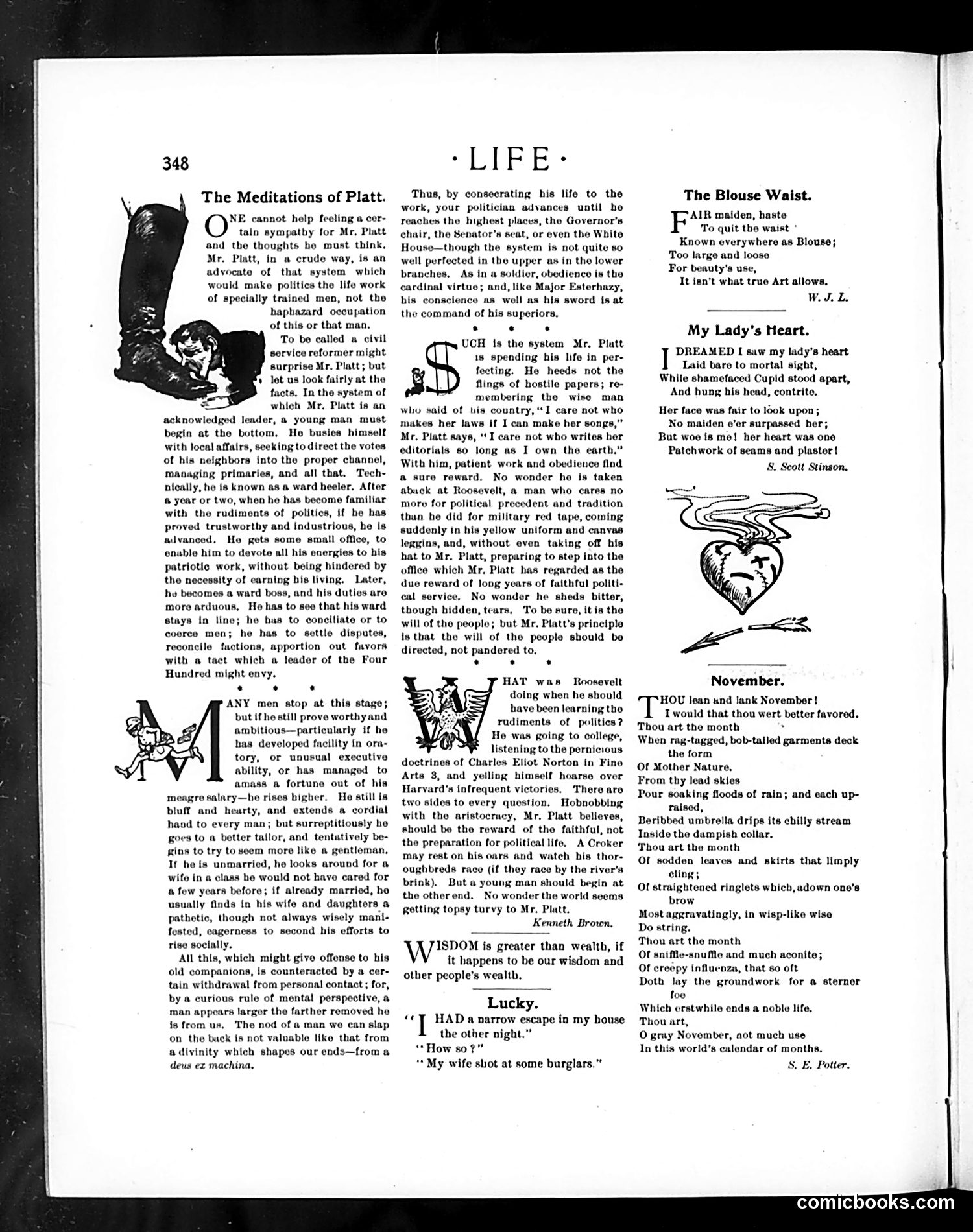
This page contains several distinct pieces: **"The Meditations of Platt"** - A satirical essay criticizing a political figure (likely U.S. Senator Thomas C. Platt, based on context) for abandoning military service to pursue politics. The text argues he's become a "ward boss" managing party favors and factions rather than serving the public interest. The accompanying cartoon depicts a disheveled figure, suggesting political corruption or moral compromise. **"The Blouse Waist"** - A brief poem mocking women's fashion, suggesting loose blouses are impractical. **"My Lady's Heart"** and **"November"** - Romantic and seasonal poetry, unrelated to satire. **"Lucky"** - A brief joke about escaping burglars. The page primarily targets political machine politics and crony favoritism of the Gilded Age era.
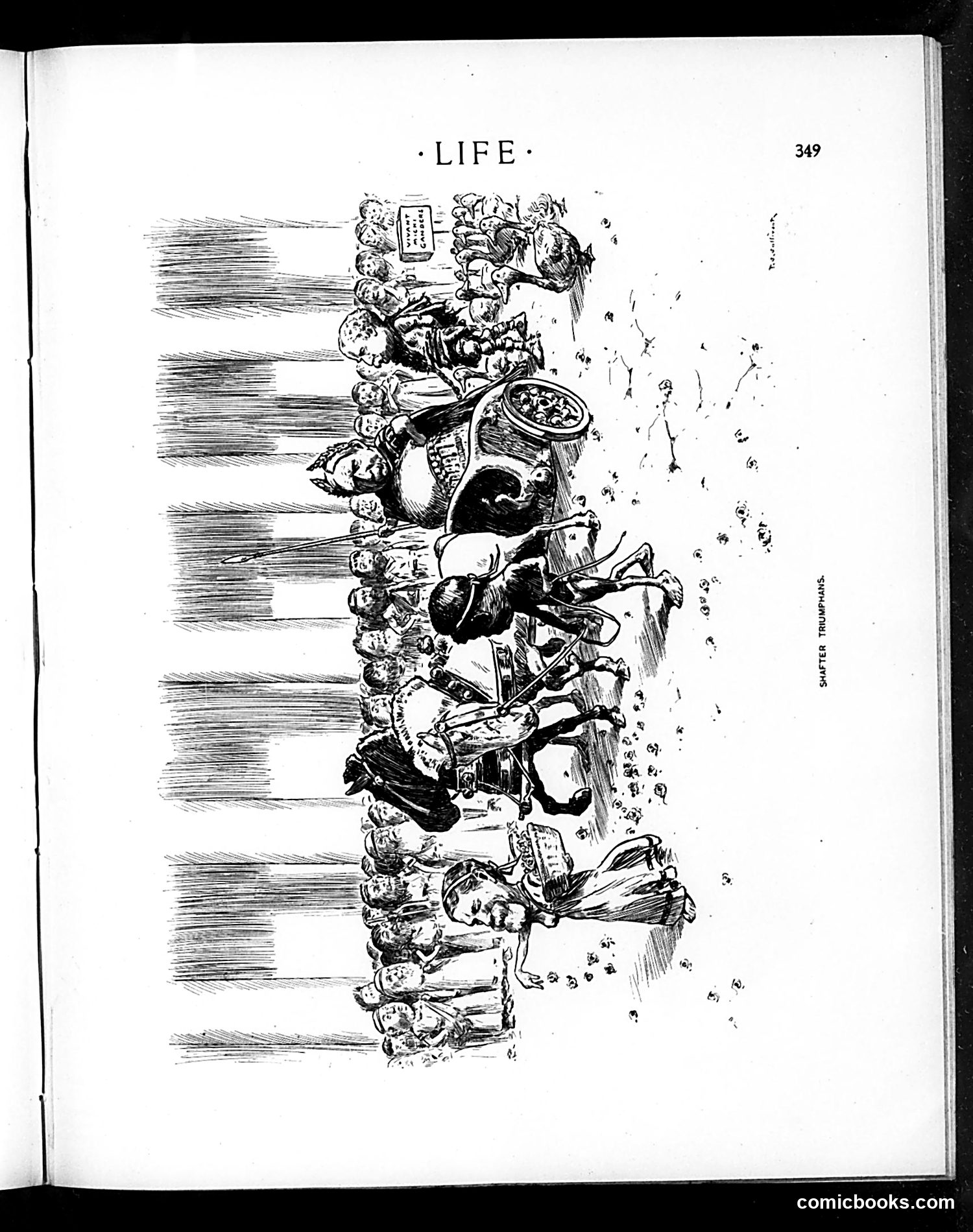
This page from *Life* magazine (page 349) contains a satirical cartoon rotated 90 degrees. The image depicts a chaotic procession or parade of figures viewed from the side, with numerous people stacked vertically along what appears to be a street or pathway marked by horizontal lines. The cartoon's exact political meaning is unclear without identifying the specific figures or reading any accompanying caption text that may be cut off or illegible in this image. The style suggests commentary on a contemporary social or political event—possibly a parade, procession, or gathering of some significance. The chaotic composition and exaggerated character depictions typical of *Life* magazine's satirical approach suggest social criticism, but the specific targets, date, and historical context remain uncertain from the image alone.
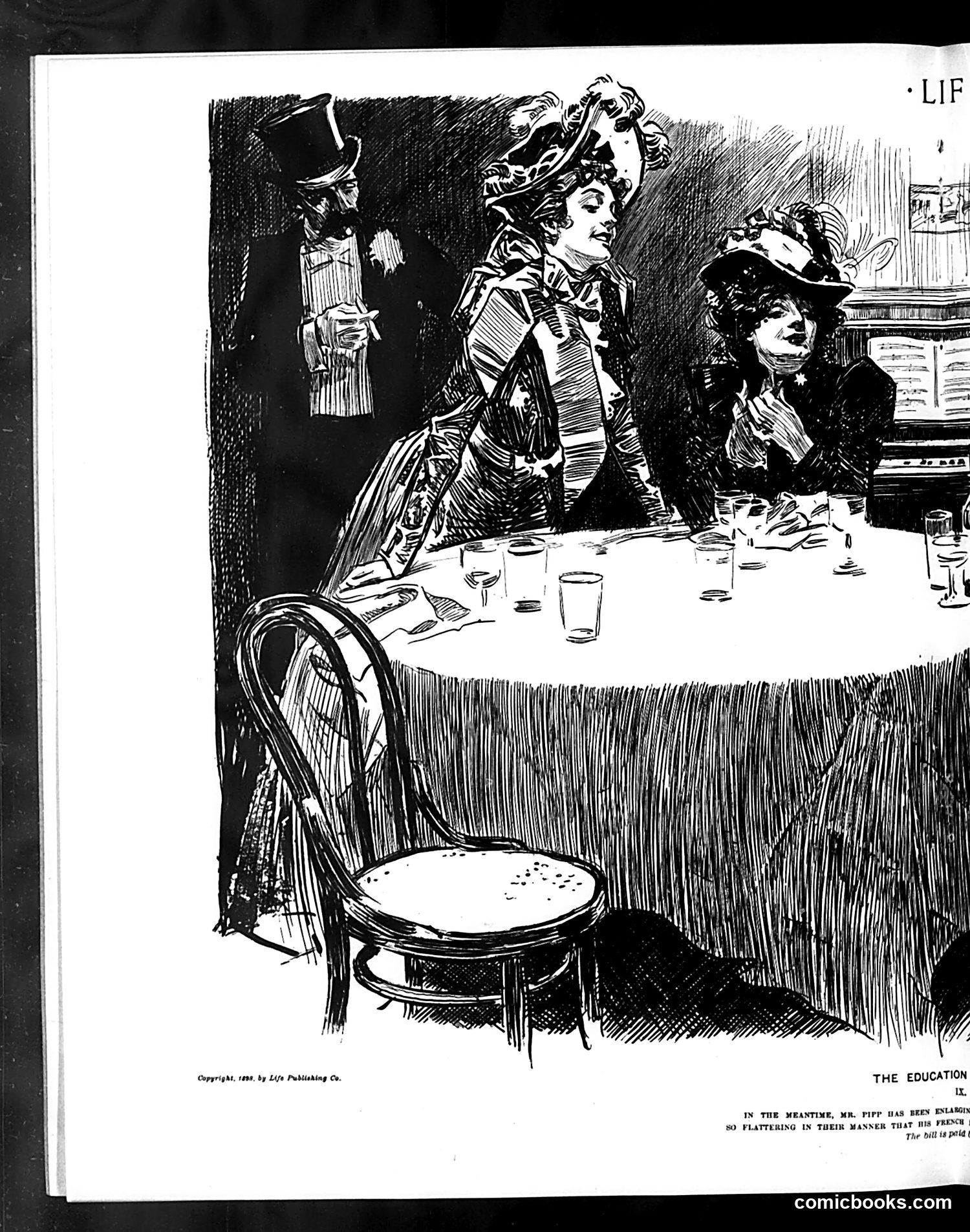
This illustration satirizes social climbing and pretension among the wealthy. The caption indicates "Mr. Fifi has been enjoying so flattering in their manner that his French [text cut off]." The scene depicts an elegant dinner party where a well-dressed man in military or formal attire (Mr. Fifi, likely a foreign dignitary or wealthy social climber) is being fawned over by society women in elaborate gowns. The empty chair in the foreground suggests someone's absence or exclusion from this exclusive gathering. The satire appears to mock how easily the upper classes are impressed by foreign affectation and pretense, readily "educating" themselves through flattery rather than genuine merit. The title "The Education" ironically suggests this shallow social maneuvering represents culture or refinement.
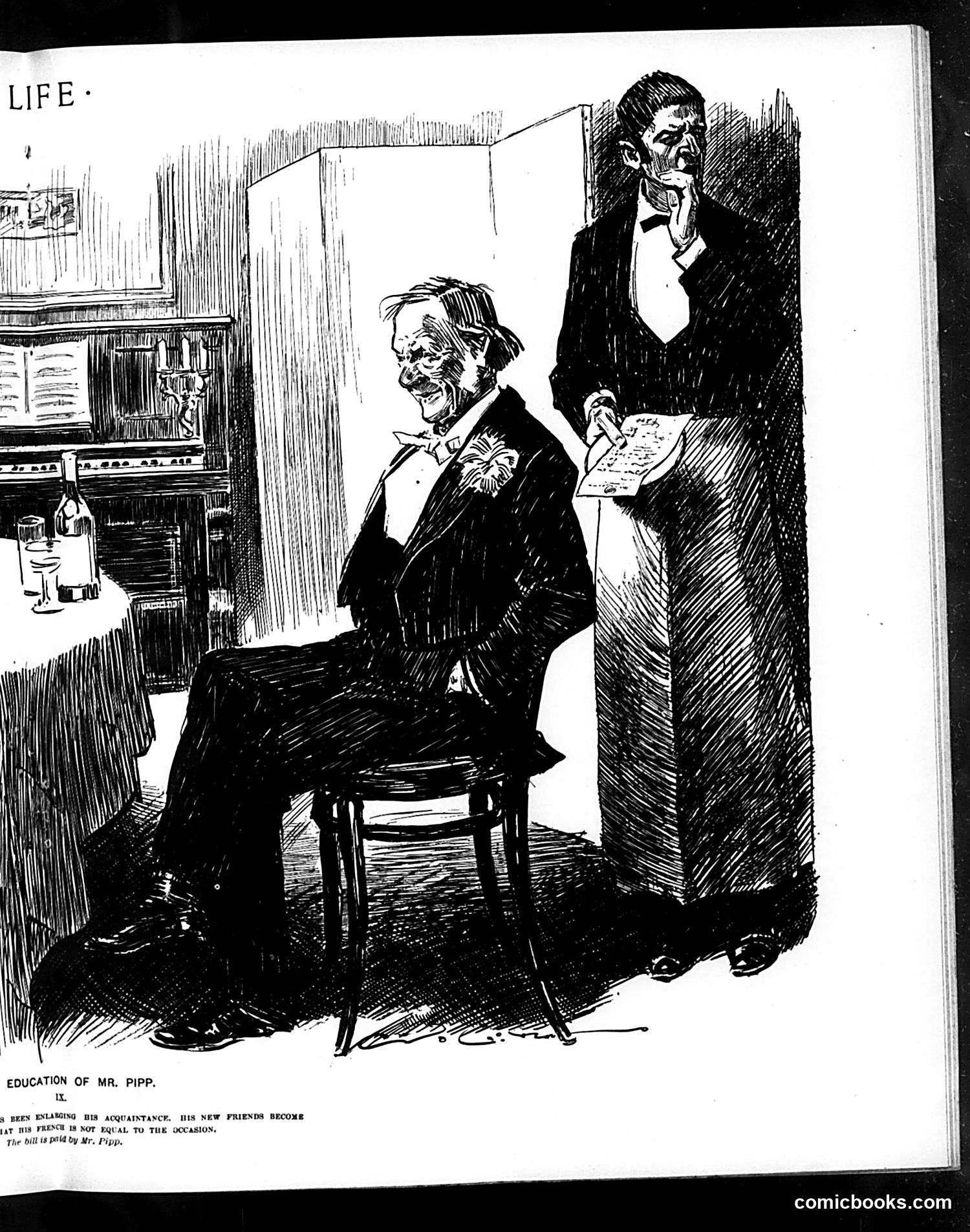
This is part II of a satirical series titled "Education of Mr. Pipp." The caption reads: "KEPT ASSURING HIS ACQUAINTANCE, HIS NEW FRIEND BECAME AT HIS FRIEND IS NOT EQUAL TO THE OCCASION. The bill is paid by Mr. Pipp." The cartoon depicts two well-dressed men in what appears to be an upscale establishment (visible piano and bottles on left). One man sits while another stands, appearing to conduct some kind of transaction or negotiation. The satire likely mocks Mr. Pipp as a naive or wealthy figure being taken advantage of—he's footing the bill while his "new friend" proves inadequate or unreliable for whatever occasion or purpose was intended. This reflects early 20th-century satire about social climbing, false friendships, and financial exploitation among the urban middle/upper classes.
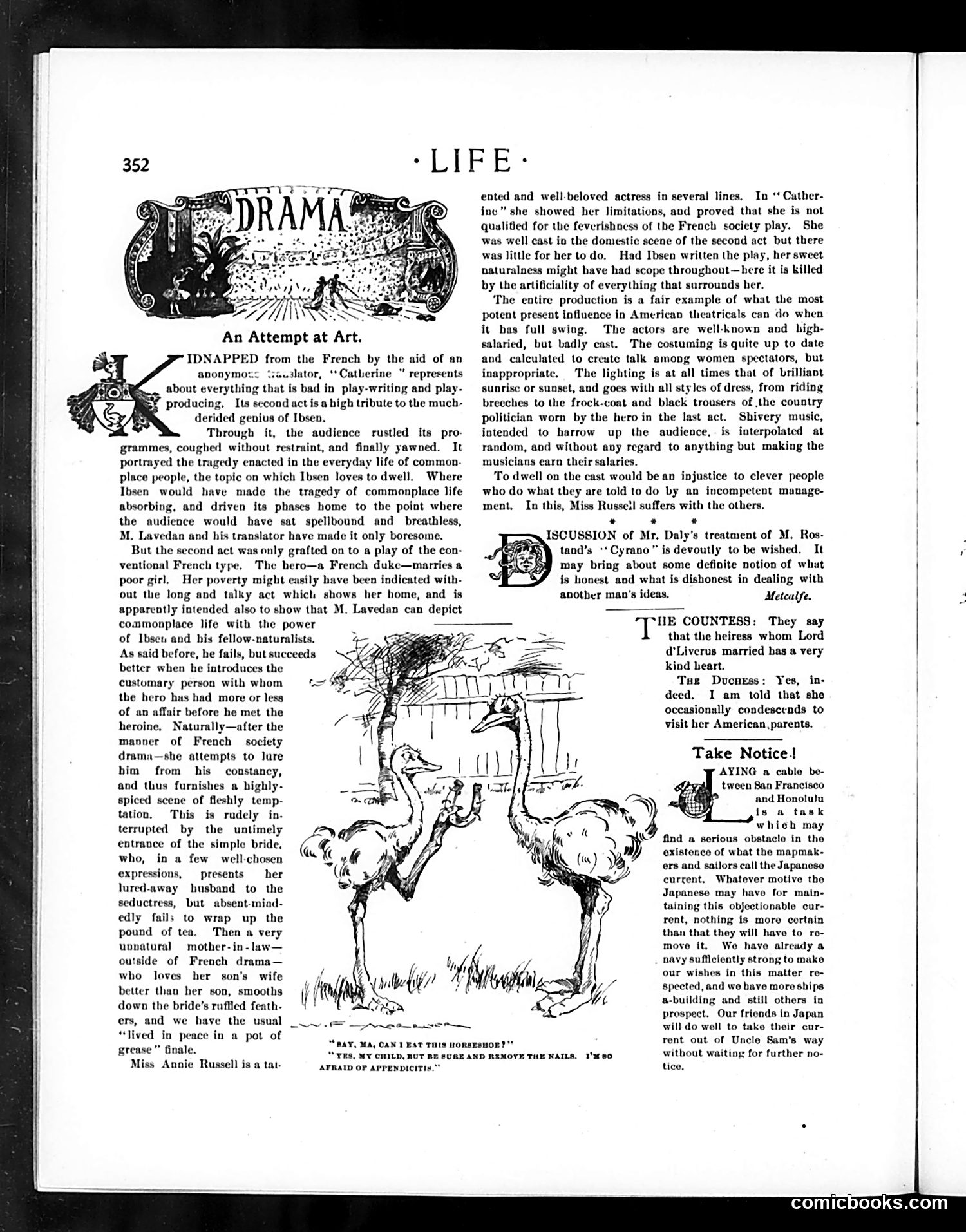
This page contains a theater review titled "An Attempt at Art," critiquing a French play adapted for American audiences. The main illustration shows two horses in an absurd, contorted position, captioned with dialogue about eating horseshoes and removing nails. The satire targets the pretentiousness of importing French theatrical conventions to America. The reviewer suggests the production is artificially avant-garde—the strange horse illustration exemplifies this absurdist aesthetic. The text criticizes the cast as "badly cast" and the overall production as overly concerned with creating avant-garde spectacle rather than meaningful drama. The accompanying notice about a San Francisco-Honolulu cable (right column) appears unrelated, discussing naval matters and Japanese relations. The core joke: American theaters uncritically imitate pretentious French drama, resulting in nonsensical productions.
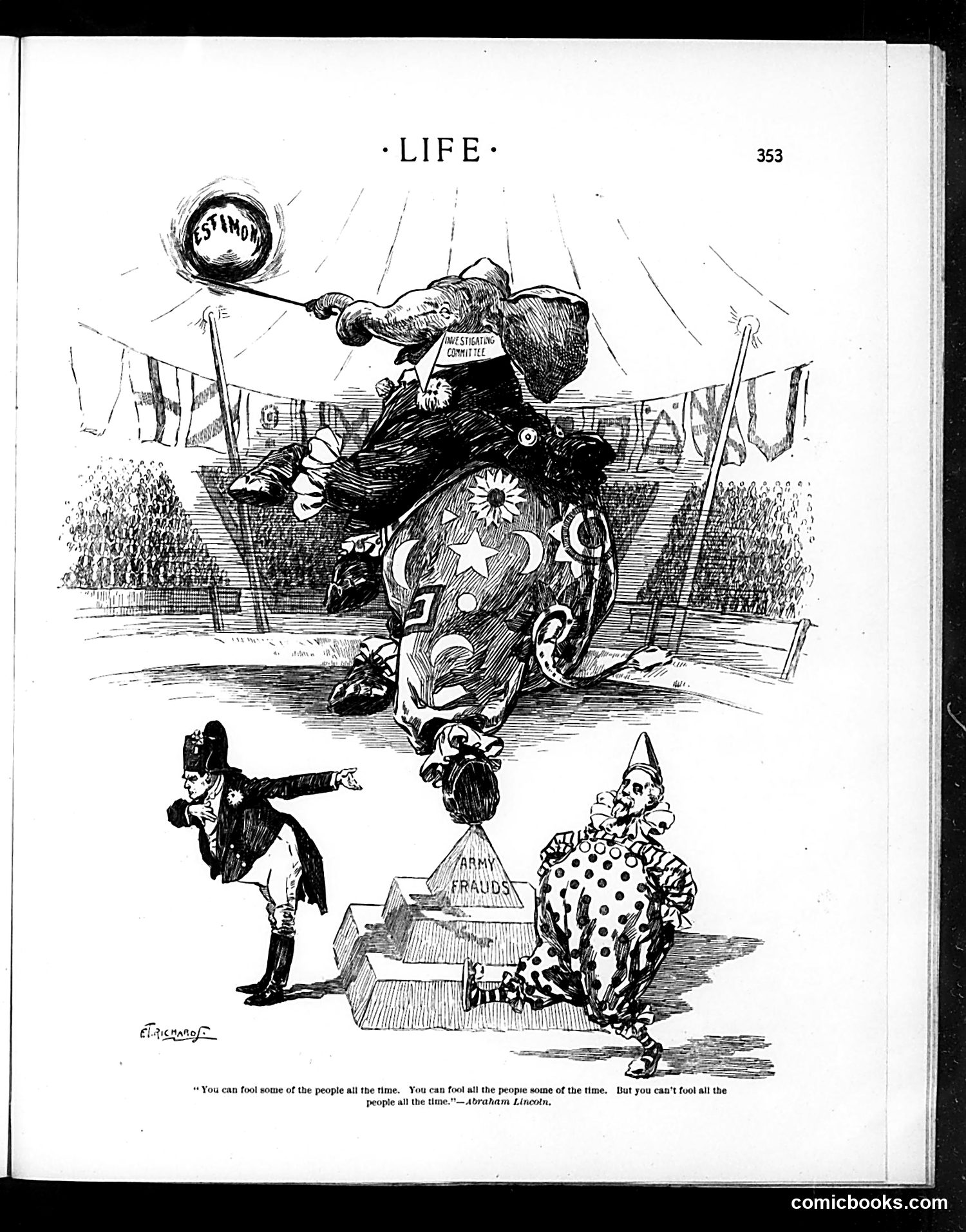
This Life magazine cartoon illustrates Lincoln's famous quotation about deception and public trust. The central figure—a portly man labeled "Investigating Committee" juggling a globe marked with a star and crescent (suggesting international/diplomatic matters)—represents government oversight attempting to expose fraud. Below, two figures embody different deceptive approaches: a military or authority figure pointing accusatorily (suggesting misdirection through authority), and a clown-costumed character representing fraudulent entertainment or trickery. The cartoon satirizes how various actors attempt to fool the public through different methods—official investigations, authoritarian claims, and outright deception—while the Lincoln epigraph suggests ultimate accountability. The layered composition suggests systemic corruption requiring scrutiny.
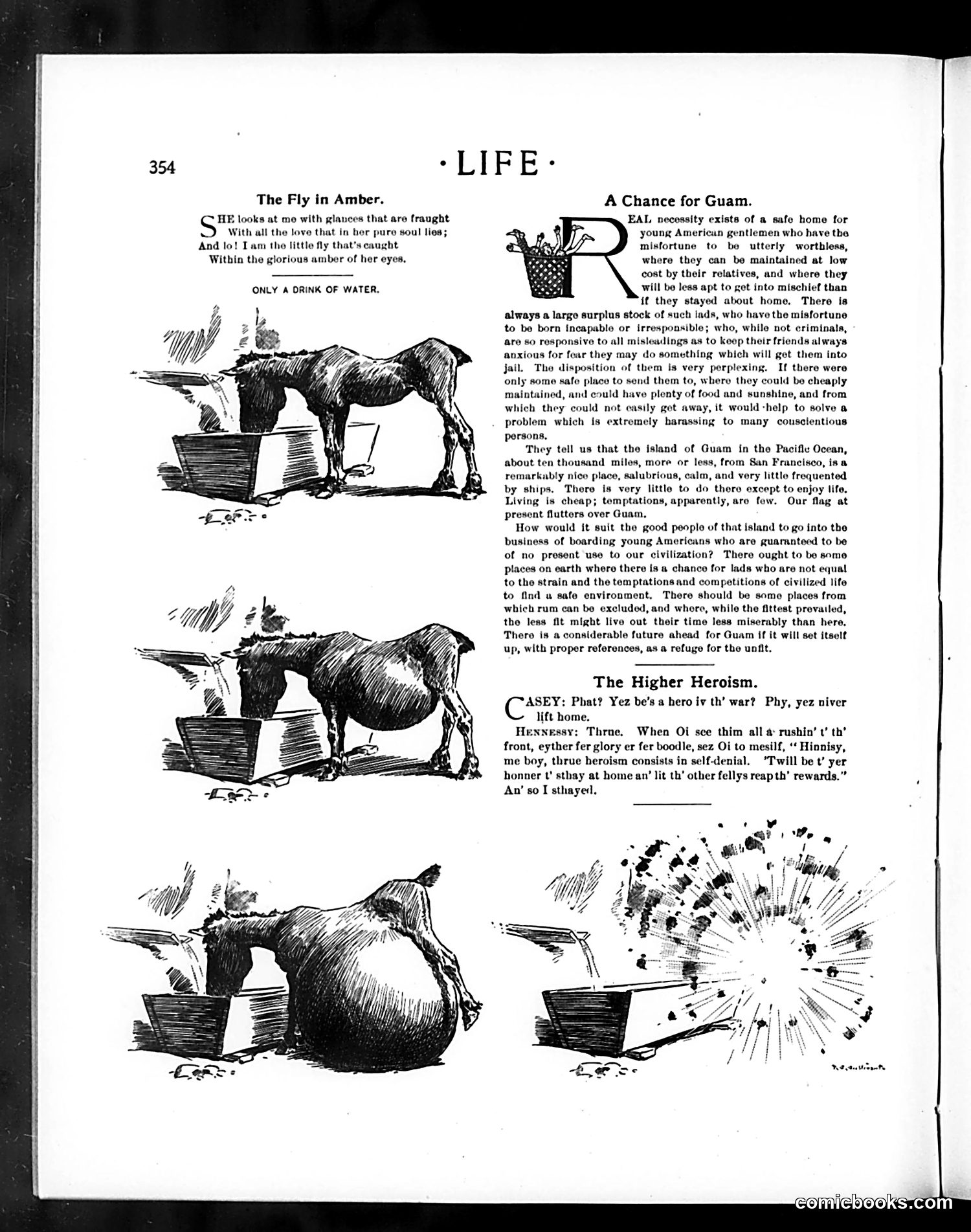
This page contains three distinct satirical pieces: **"The Fly in Amber"** (top left): A sentimental romantic poem with accompanying illustration of a horse drinking from a bucket. The juxtaposition of earnest verse about love with a mundane animal image creates gentle mockery of overwrought romantic poetry. **"A Chance for Guam"** (right column): Sharp social satire proposing Guam—a recently U.S.-acquired Pacific island—as a dumping ground for wealthy but "worthless" young American men. The piece sarcastically suggests exiling idle, irresponsible sons of the rich to this remote island where they'd be harmless and cheap to maintain. This mocks both America's imperial expansion and the upper-class problem of useless heirs. **"The Higher Heroism"** (bottom): A comic dialogue in Irish-accented dialect between two working-class men. One brags about being a war hero, but reveals his "heroism" consisted of staying home while others fought, claiming self-denial as virtue. The satire targets false patriotism and those who avoid military service while claiming moral superiority.
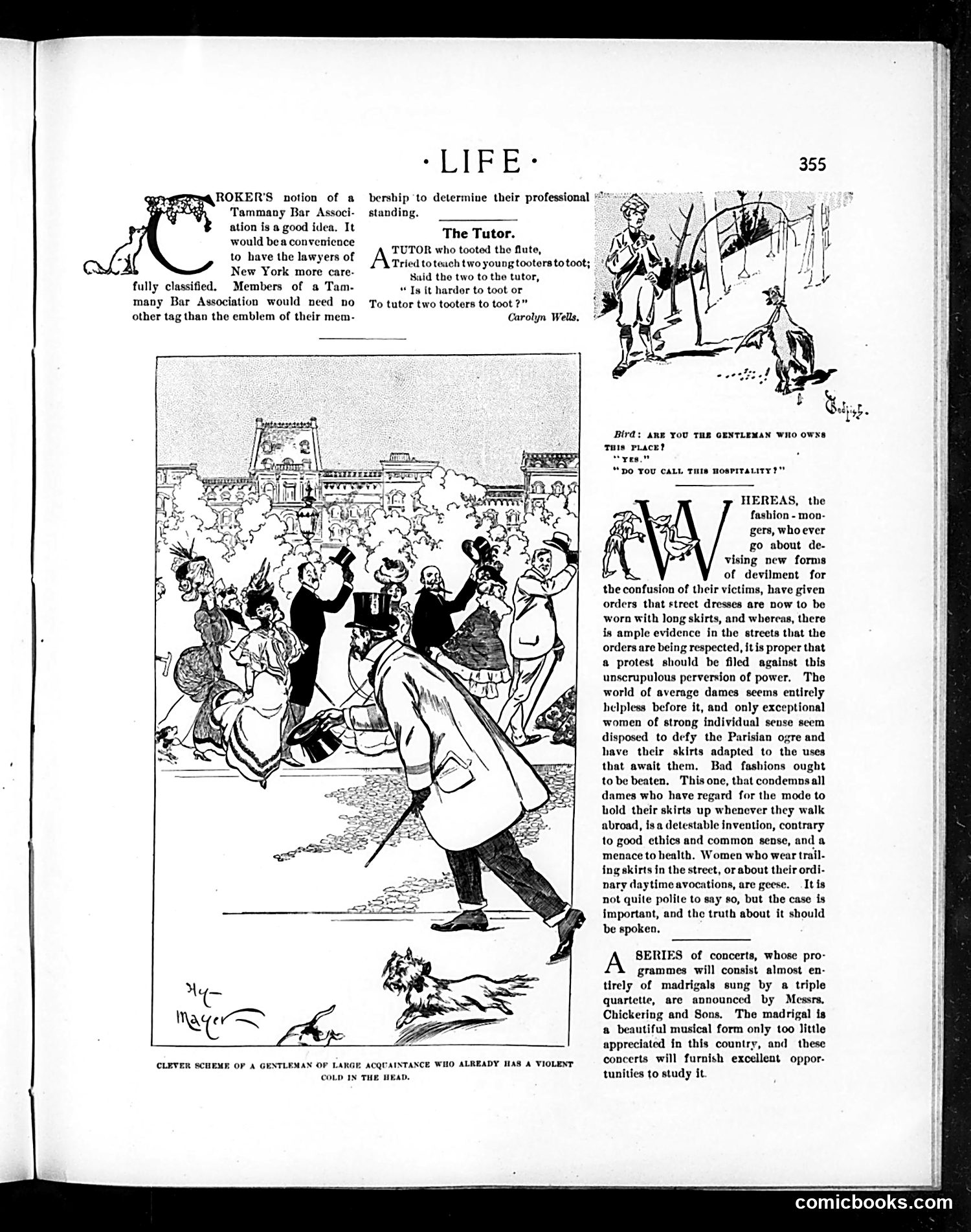
This page contains three distinct satirical pieces typical of early Life magazine: **Main Cartoon (bottom):** Depicts a gentleman with a "violent cold in the head" executing a "clever scheme" by sneezing on a crowded street gathering. The satire mocks inconsiderate public behavior during illness—a timeless social complaint about people spreading contagion. **Fashion Critique (center):** A formal protest against long trailing skirts that fashion designers ("Parisian ogre") have imposed on women. The author argues these impractical skirts are unhygienic, dangerous, and force women into undignified public posturing by constantly holding them up. This reflects early 20th-century debates over women's fashion and practical dress reform. **Upper Illustrations:** Include light humor about a tutor teaching "tooters to toot" (wordplay) and a bird questioning a man's "hospitality," likely unrelated comic vignettes. **Context:** The page satirizes fashion tyranny, public health inconsideration, and social absurdities of the era—issues Life regularly mocked through humor.
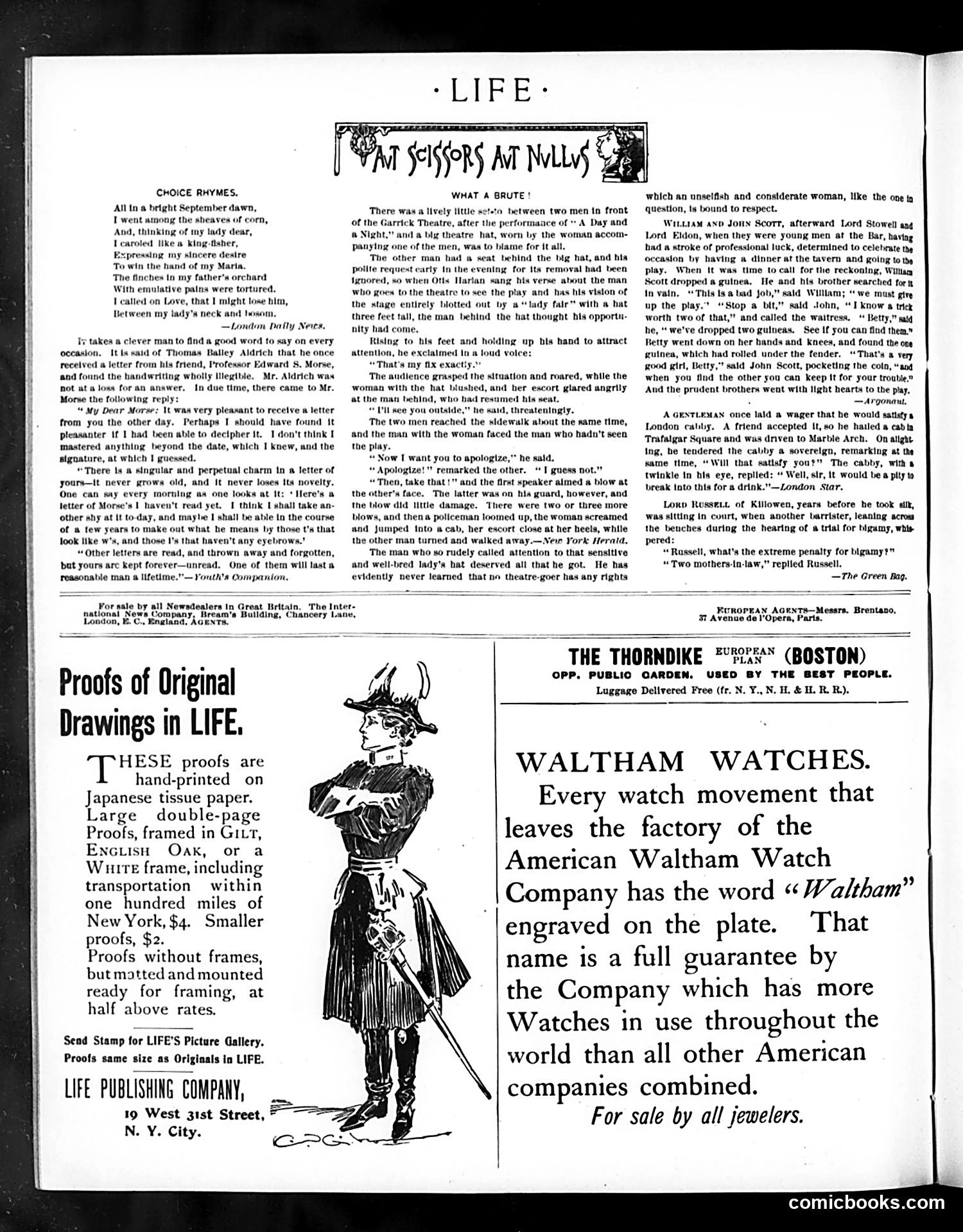
This page is primarily **advertising and literary content** rather than a political cartoon. The main illustrated feature, "Scissors at Nullus," is a humorous anecdote about theater etiquette. The story describes a confrontation between two men at the Garrick Theatre: one wore a large hat blocking the other's view during a performance. When actor Otis Harlan sang about such obstruction, the blocked patron loudly agreed ("That's my fix exactly"), embarrassing the hat-wearer. This escalated into a fistfight outside, with police intervention. **The satire targets**: Theater-goers' inconsiderate behavior (particularly women's oversized hats, a genuine historical annoyance) and class expectations. The final editorial comment mocks the hat-wearer's entitlement—"no theatre-goer has any rights"—sarcastically suggesting society favors those with money/status over others' reasonable comfort. The page also includes advertisements for Waltham Watches and Life Publishing's proofs of original drawings.
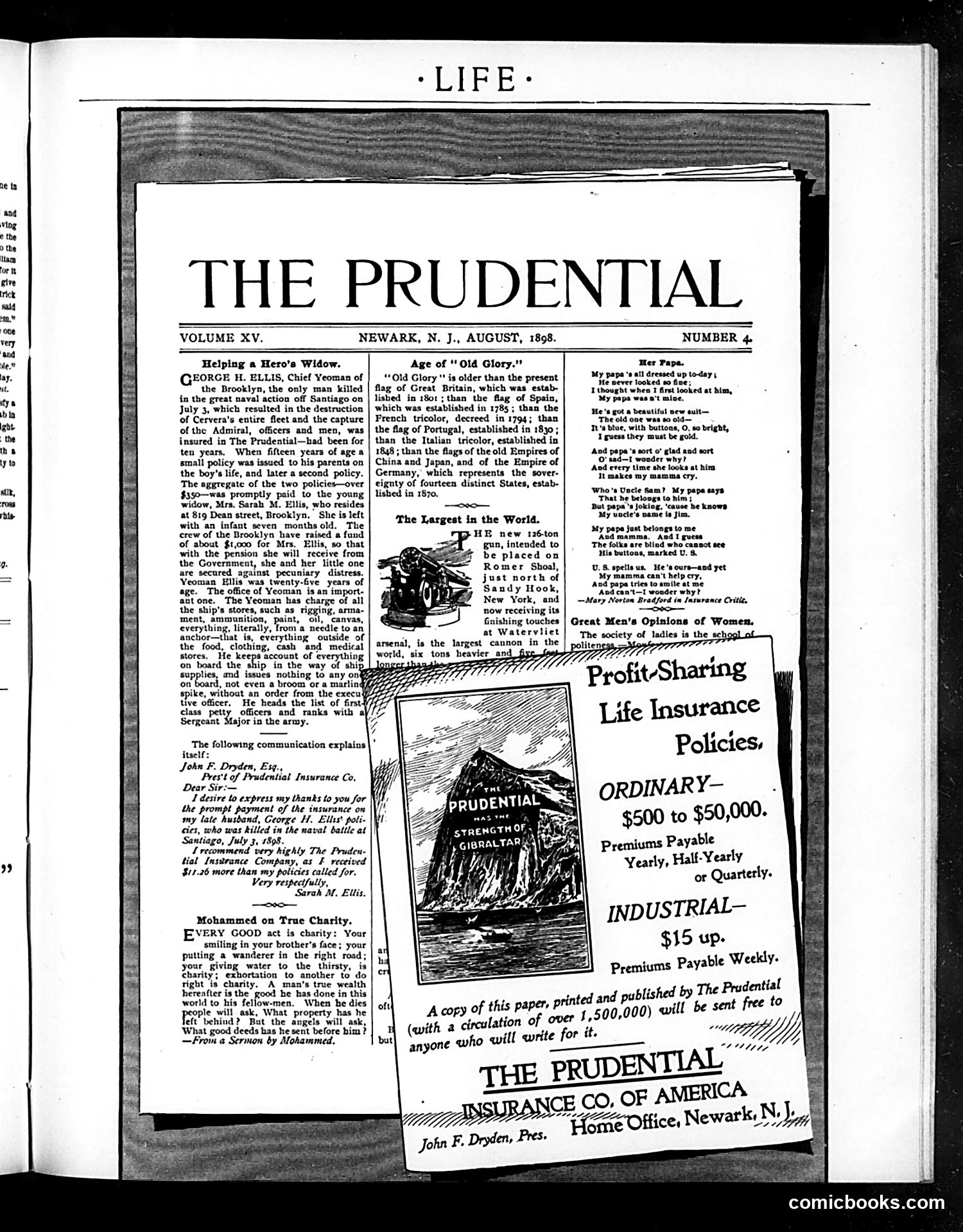
This is primarily an **advertisement page** for Prudential Insurance, disguised as editorial content in *Life* magazine (August 1898). The main article celebrates **George H. Ellis**, a naval officer killed in the Spanish-American War's Battle of Santiago (July 3, 1898). The Prudential uses his widow's story as marketing: Ellis had been insured for ten years, and the company promptly paid out $350+ to his young widow and infant son. This served dual purposes—appearing patriotic during wartime while demonstrating the insurance company's reliability. Supplementary content includes: - **"Age of Old Glory"**: Patriotic content noting the American flag predates other national flags - **"The Largest in the World"**: Technical article about a new 126-ton cannon at Sandy Hook, N.Y.—wartime-relevant material - **Mohammed quote on charity**: Unrelated filler - **Children's poem** ("My Papa"): Sentimental verse, possibly about a soldier's son The entire page exemplifies how American magazines blended advertising with patriotic Spanish-American War coverage to sell insurance and build brand loyalty during national fervor.
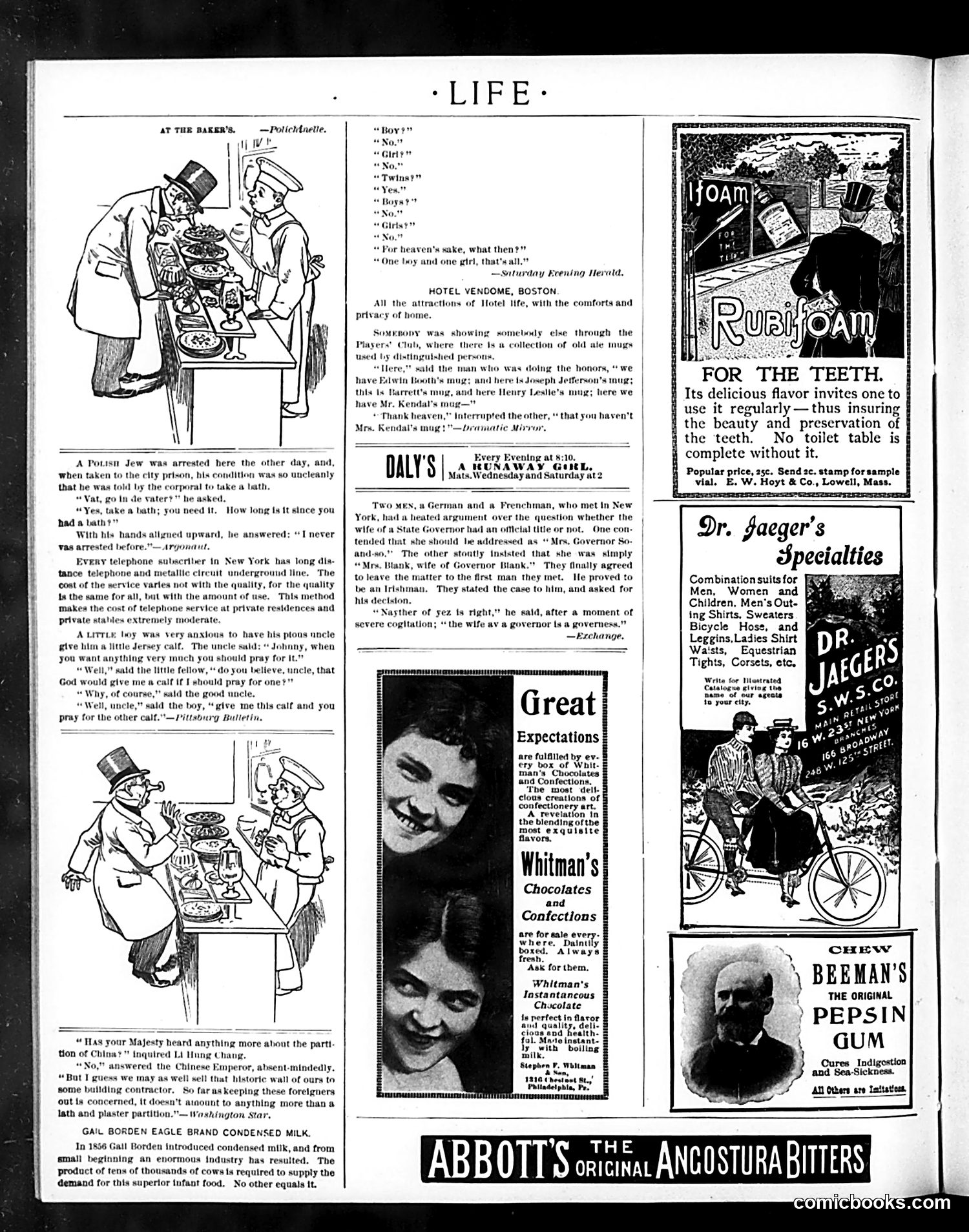
This page from *Life* magazine contains several humorous anecdotes satirizing immigrant behavior and social pretension, typical of early 20th-century American humor. **"At the Baker's"** ridicules a Polish Jewish immigrant's ignorance about bathing. The joke relies on ethnic stereotyping—portraying him as unclean and unfamiliar with hygiene, a common prejudice against Eastern European immigrants of this era. **The other cartoons** mock social climbing and confusion about titles: one depicts confusion over how to address a governor's wife (eventually settling on "governess"), and another shows a Chinese emperor indifferently comparing China's Great Wall to mere "lath and plaster"—satirizing both imperial irrelevance and Western dismantling of Chinese sovereignty during the colonial period. The page is primarily **advertisements** (Whitman's Chocolates, Dr. Jaeger's clothing, Abbott's Bitters, etc.), with humor serving to fill space between ads—standard for *Life's* format as a satirical weekly.
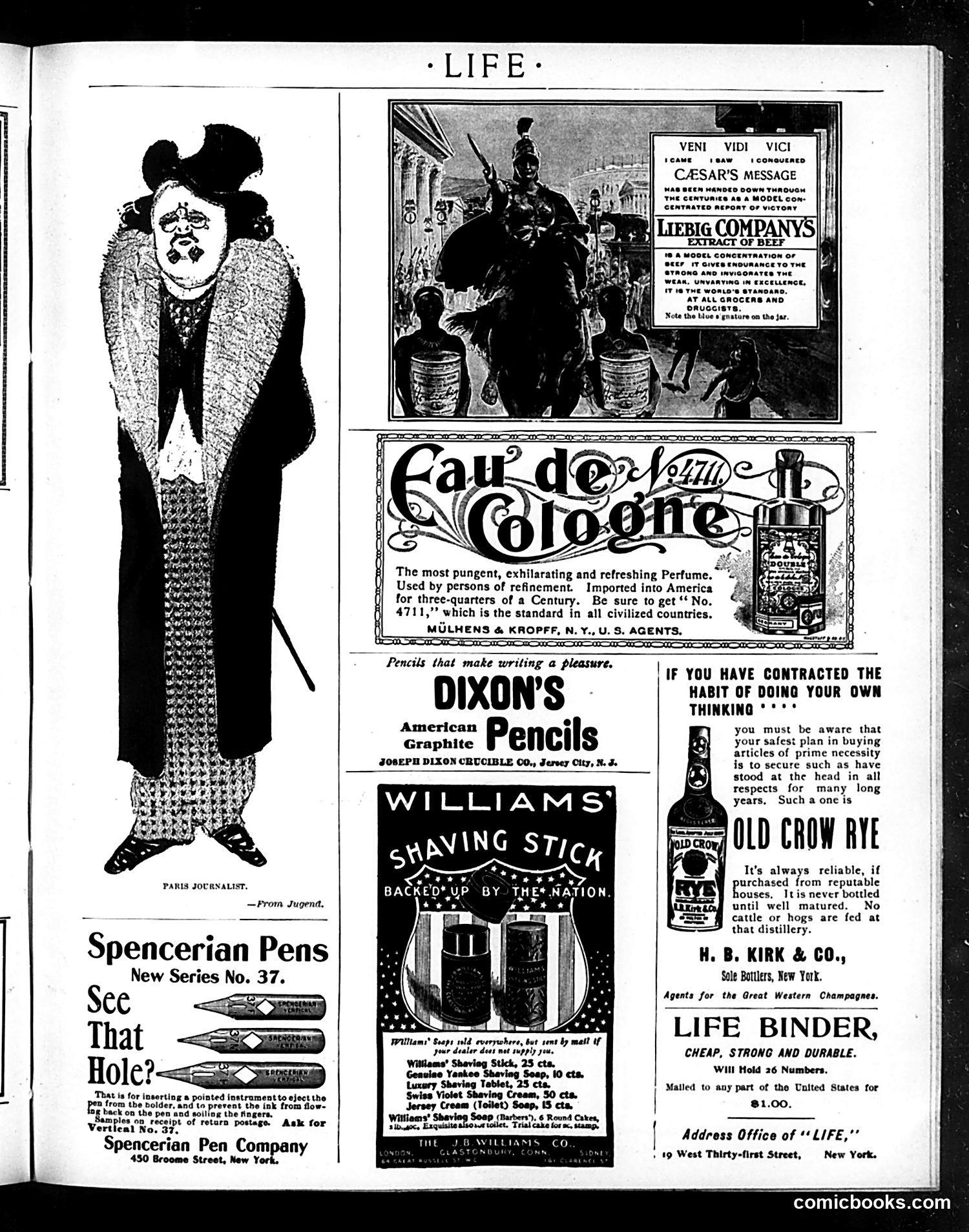
**Main Content:** The left side features a satirical illustration labeled "Paris Journalist" showing an exaggerated figure in elaborate period costume with heavy makeup and ornate clothing—a caricature of Parisian fashion or artistic pretension, likely mocking affected European aesthetics for American readers. **The Satire:** The page is primarily **advertising**, not editorial content. However, the juxtaposition is telling: absurd luxury products (French perfume "4711," fancy pens, shaving creams) surround the cartoon mocking European affectation. This suggests satire of American consumers' eagerness to purchase imported goods while aping foreign sophistication. **Historical Context:** Life magazine mixed humor with commerce. The "Paris Journalist" caricature likely pokes fun at Continental pretension—a common American satirical target in the early 20th century. The surrounding ads reinforce the joke: Americans buying European products to appear refined. The page reflects period attitudes toward European culture as simultaneously desirable yet ridiculous.
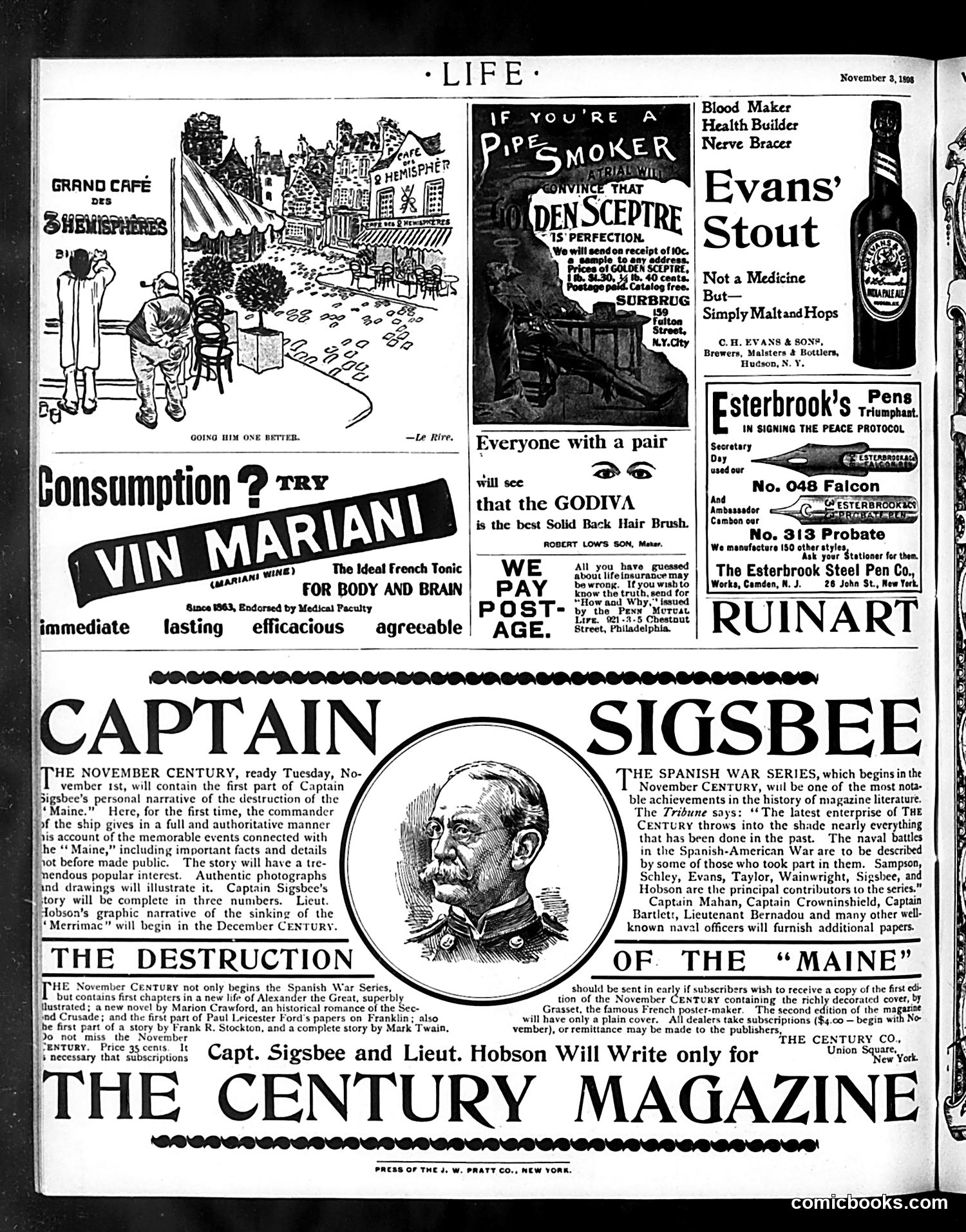
This page is primarily **advertising and promotional content** rather than satirical cartoons. The small cartoon titled "Going Him One Better" (upper left) depicts a café scene but lacks clear political meaning in this context. The dominant content advertises **The Century Magazine's** upcoming coverage of the Spanish-American War, specifically featuring firsthand accounts from Captain William T. Sigsbee (the USS *Maine* commander) and Lieutenant Richard Hobson, both naval heroes from the recent conflict. The *Maine's* destruction in February 1898 had triggered the war with Spain. The page emphasizes that prominent naval officers—Sampson, Schley, Evans, Taylor, Wainwright, Sigsbee, and Hobson—will contribute articles, positioning *The Century* as the authoritative source for war narratives. Surrounding ads (Vin Mariani tonic, Evans' Stout, pens) are typical period advertisements with exaggerated health claims. The overall page reflects 1898 America's intense interest in the Spanish-American War's military heroes and firsthand accounts.