
Life, 1898-11-03 · page 12 of 20
Life — November 3, 1898 — page 12: what you’re looking at
What you’re looking at
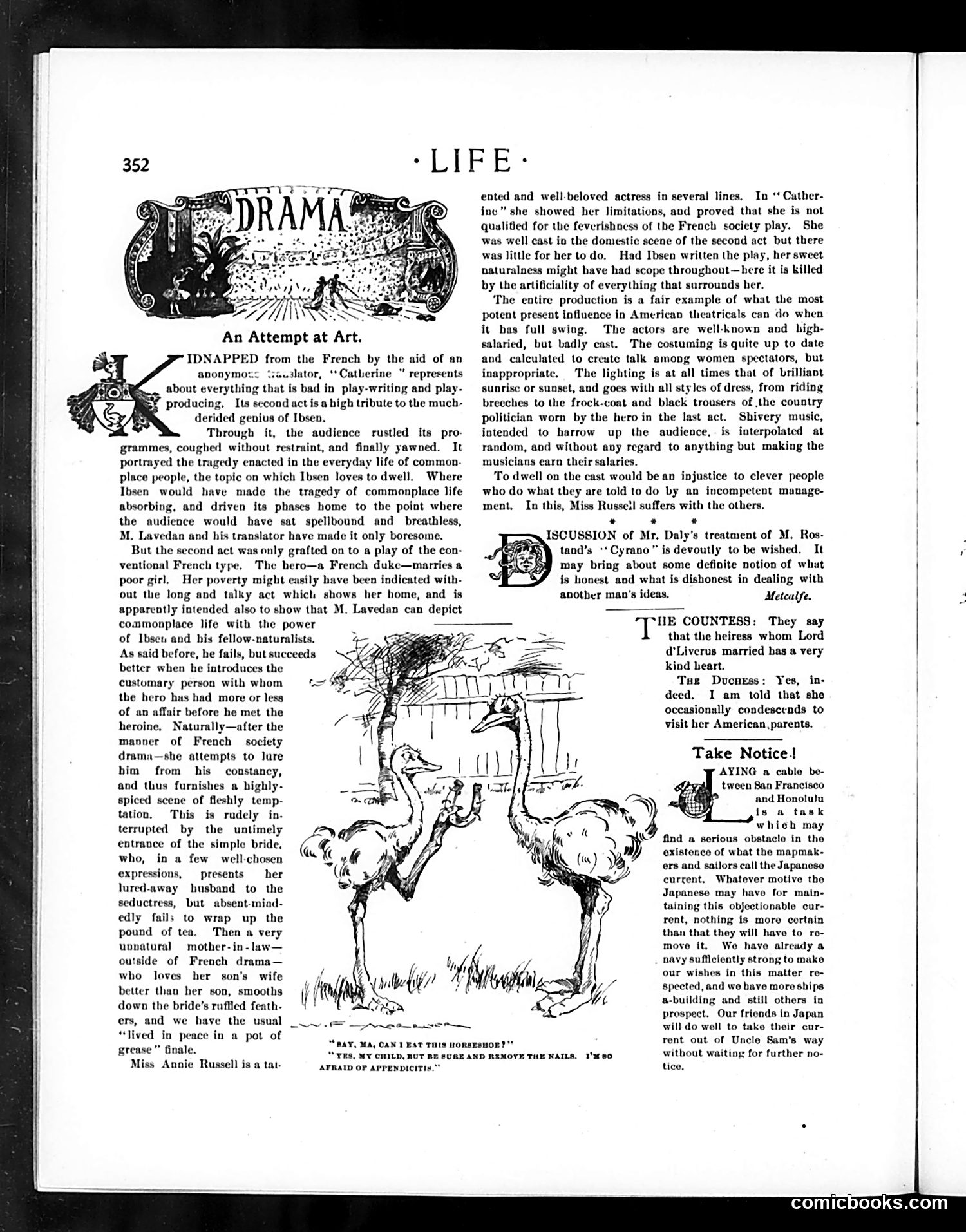
This page contains a theater review titled "An Attempt at Art," critiquing a French play adapted for American audiences. The main illustration shows two horses in an absurd, contorted position, captioned with dialogue about eating horseshoes and removing nails. The satire targets the pretentiousness of importing French theatrical conventions to America. The reviewer suggests the production is artificially avant-garde—the strange horse illustration exemplifies this absurdist aesthetic. The text criticizes the cast as "badly cast" and the overall production as overly concerned with creating avant-garde spectacle rather than meaningful drama. The accompanying notice about a San Francisco-Honolulu cable (right column) appears unrelated, discussing naval matters and Japanese relations. The core joke: American theaters uncritically imitate pretentious French drama, resulting in nonsensical productions.
📄 Transcribed text from this page (OCR, searchable)
Machine-transcribed from the original scan — historical spelling and the odd misread are preserved.
An Attempt at Art. IDNAPPED from the French by the aid of an anonymoz: ‘:aualator, ‘Catherine ” represents about everything that is bad in play-writing and play- producing. Its second act is a high tribute to the much- derided genius of Ibsen, Through it, the audience rustled its pro- grammes, coughed without restraint, and finally yawned. It portrayed the tragedy enacted in the everyday life of common. place people, the topic on which Ibsen loves to dwell. Where Ibsen would have made the tragedy of commonplace life absorbing, and driven its phases home to the point where the audience would have sat spellbound and breathless, M. Lavedan and bis translator have made it only boresome. But the second act was only grafted on to a play of the con- j ventional French type. The hero—a French duke—marries a i poor girl. Her poverty might easily have been indicated with- | j out the long and talky act which shows her home, and is apparently intended also to show that M. Lavedan can depict | commonplace life with the power of Ibsen and his fellow-naturalists. As said before, he fails, but succeeds better when he introduces the customary person with whom the hero has had more or less of an affair before he met the heroine. Naturally—after the manner of French society drama—she attempts to lure | him from his constancy, and thus furnishes a highly- spiced scene of fleshly temp- tation, This is rudely in- terrupted by the untimely entrance of the simple bride, who, in a few well-chosen expressions, presents her lured-away husband to the seductress, but absent-mind- edly fail; to wrap up the pound of tea, Then a very upnatural —mother-in-law— outside of French drama— who loves her son's wife better than her son, smooths down the bride’s ruffled feath- ers, and we have the usual “lived in peace in a pot of grease” finale, Miss Annie Russell is a tat- AYRAID OF APPENDICITIS.”” “LTP IE * ee MA, CAN 1 EAT THIS HORSESHOE?” MY CHILD, BUT BE SUE AND REMOVE THE NAILS. 1° 60 ented and well-beloved actress in several lines. In ‘*Cuather- ine” she showed her limitations, and proved that she is not qualified for the feverishocss of the French society play. She was well cast in the domestic scene of the second act but there was little for her todo, Had Ibsen written the play, her sweet naturalness might have had scope throughout—here it is killed by the artificiality of everything that surrounds her. The entire production is a fair example of what the most potent present influence in American theatricals can de when it bas full swing. The actors are well-known and bigh- salaried, but badly cast. The costuming is quite up to date and calculated to create talk among women spectators, but inappropriate, The lighting is at all times that of brilliant sunrise or sunset, and goes with all styles of dress, from riding breeches to the frock-coat and black trousers of the country politician worn by the hero in the last act. Shivery music, intended to harrow up the audience, is interpolated at random, and without any regard to anything but making the musicians earn their salaries. To dwell on the cast would be an injustice to clever people who do what they are told todo by an incompetent manage- ment. In this, Miss Russeil suffers with the others. * * * ISCUSSION of Mr. Daly's treatment of M. Ros- tand’s “Cyrano” is devoutly to be wished. It may bring about some definite notion of whut is honest and what is dishonest in dealing with another man’s ideas. Metcalfe. TE COUNTESS: They say that the heiress whom Lord d’Liverus married bas a very kind heart. Tuk Ducness: Yes, in- deed. I am told that she occasionally condescends to visit her American. parents. Take Notice! AYING a cable be- tween San Francisco and Honolulu is a task which may find a serious obstacle in the existence of what the mapmak- ers and sailors call the Japanose current. Whatever motive the Japanese may havo for main- taining this objectionable cur- rent, nothing Is more certain than that they will have to ro- move it, Woe have already a navy suficiently strong to make our wishes in this matter ro- spected, and wo have more ships a-building and still others in prospect. Our friends in Japan will do well to take their cur- rent out of Uncle Sam’s way without waiting for further no- tice. comicbooks.com