
Life, 1898-11-03 · page 6 of 20
Life — November 3, 1898 — page 6: what you’re looking at
What you’re looking at
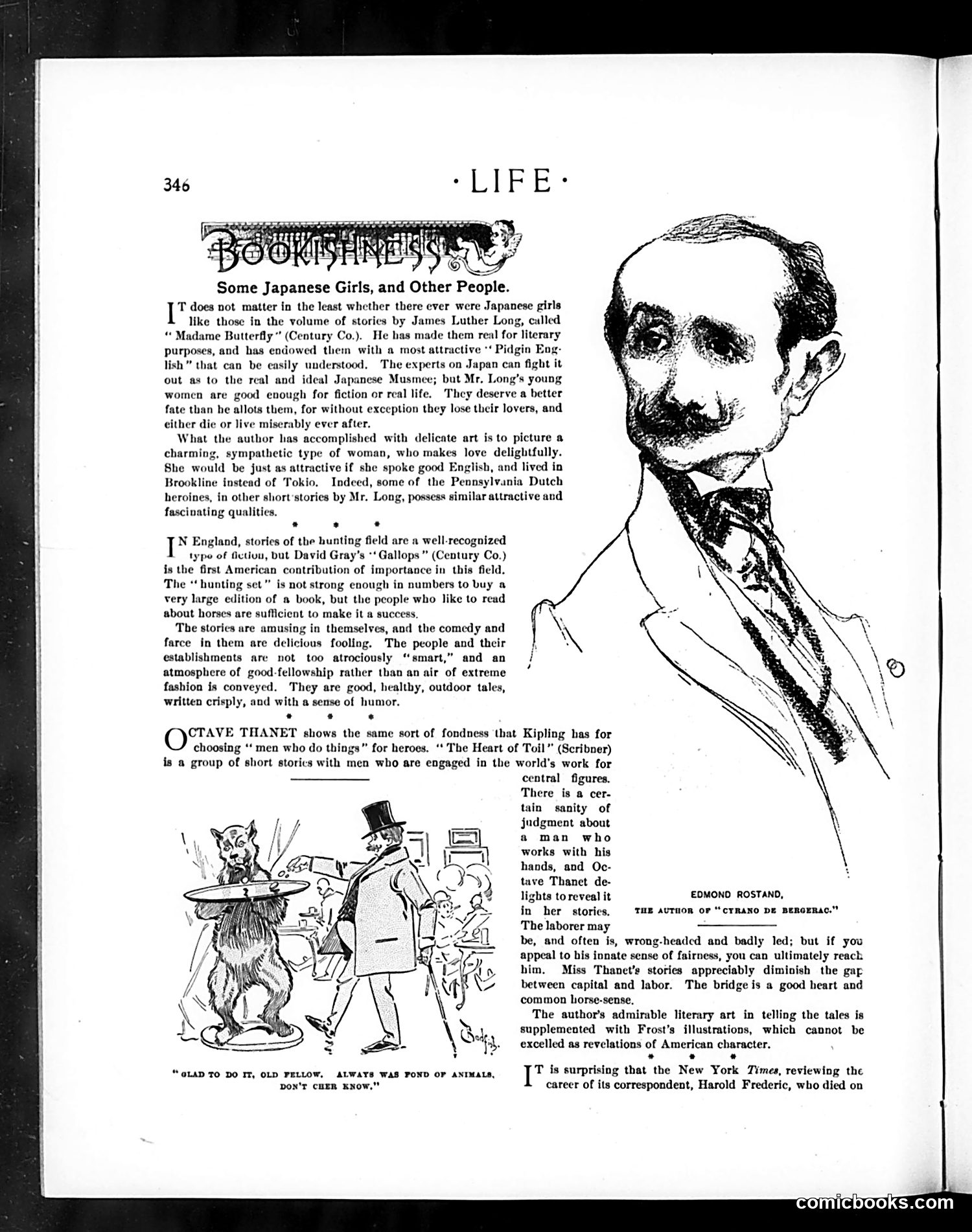
This page reviews recent books, including works by James Luther Long about Japanese girls and David Gray's hunting stories. The main illustration depicts **Edmond Rostand**, author of "L'Aiglon" (identified in caption), shown in a dignified portrait sketch. The cartoon below—showing a well-dressed man with a devil-like creature—illustrates a passage discussing **Octave Thanet's stories about laborers**. The satire appears to critique how Thanet portrays working-class characters: the devil figure likely represents misconceptions or unfair stereotypes about laborers, while the gentleman represents educated perspective. The text suggests Thanet appeals to fairness to bridge class divisions, making the cartoon's juxtaposition ironic—highlighting tension between capital and labor in contemporary American society.
📄 Transcribed text from this page (OCR, searchable)
Machine-transcribed from the original scan — historical spelling and the odd misread are preserved.
OW] r People. T does not matter in the least whether there ever were Japanese girls like those in the volume of stories by James Luther Long, culled “ Madame Butterfly” (Century Co.). He has made them real for literary purposes, and has endowed them with a most attractive “‘ Pidgin Eng: lish” that can be easily understood. The experts on Japan can fight it out as to the real and ideal Japanese Musmee; but Mr. Long’s young women are good enough for fiction or real life. They deserve a better fate than he allots them, for without exception they lose their lovers, and either die or live miserably ever after, What the author has accomplished with delicate art is to picture a charming, sympathetic type of woman, who makes love delightfully. She would be just as attractive if she spoke good English, and lived in Brookline instead of Tokio, Indced, some of the Pennsylvania Dutch heroines, in other short’stories by Mr. Long, possess similar attractive and fascinating qualities. * * * I N England, stories of the hunting field are a well-recognized type of Outivu, but David Gray’s ** Gallops ” (Century Co.) is the first American contribution of importance in this field. The “hunting set” is not strong enough in numbers to buy a very large edition of a book, but the people who like to read about horses are sufticient to make it a success, The stories are amusing in themselves, and the comedy and farce in them are delicious fooling. The people and their establishments are not too atrociously “smart,” and an atmosphere of good-fellowship rather than an air of extreme fashion is conveyed. They are good, healthy, outdoor tales, written crisply, and with a sense of humor. . * . CTAVE THANET shows the same sort of fondness that Kipling has for choosing ‘‘ men who do things” for heroes. ‘* The Heart of Toil” (Scribner) is a group of short storics with men who are engaged in the world's work for —$—$ central figures. There is a cer- tain sanity of judgment about a man who works with his hands, and Oc- tave Thanet de- lights to reveal it EDMOND ROSTAND, in her stories, | TH avrnor or “crmaNo De BenozRac.” The laborer may ————— be, and often is, wrong-headed and badly led; but if you appeal to bis innate sense of fairness, you can ultimately reach him. Miss Thanet’s stories appreciably diminish the gap between capital and labor. The bridge is a good heart and common horse-sense, The author’s admirable literary art in telling the tales is supplemented with Frost’s illustrations, which cannot be excelled as revelations of American character. * . * is surprising that the New York Times, reviewing the career of its correspondent, Harold Frederic, who died on “GLAD 70 DO IT, OLD FELLOW, ALWAYS WAS FOND OF ANIMALS, [* DON'T CHER KNOW,"