
Life, 1898-11-03 · page 4 of 20
Life — November 3, 1898 — page 4: what you’re looking at
What you’re looking at
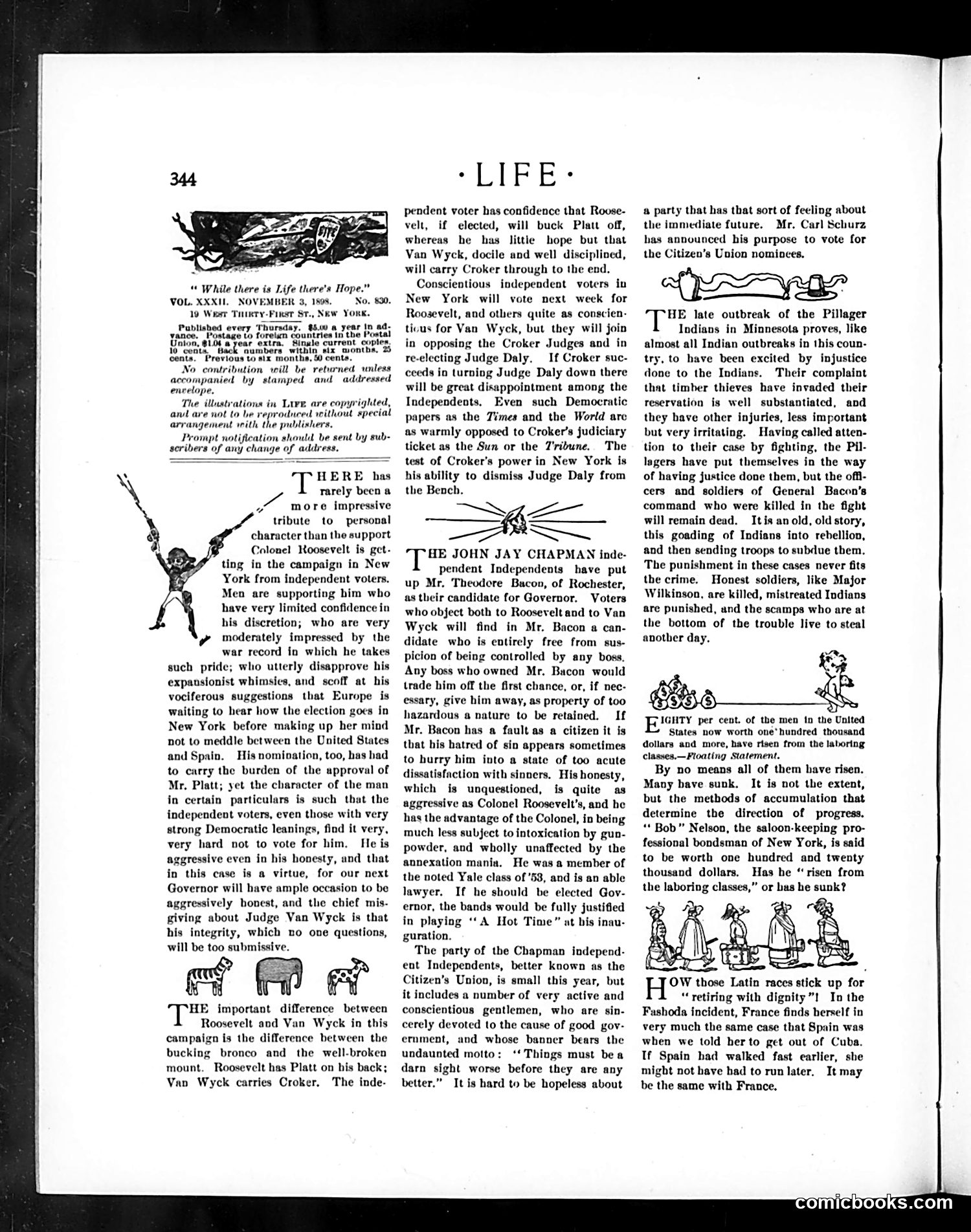
This page analyzes the 1912 U.S. presidential election, specifically the Independent/Progressive split. The text discusses Theodore Roosevelt's challenge to incumbent President Taft, and mentions the "John Jay Chapman Independents" supporting Rochester candidate Theodore Bacon for New York Governor. The cartoons (small illustrations scattered throughout) use animal imagery—appearing to show a bucking bronco and well-broken horse, likely representing Roosevelt as the untamed "Rough Rider" versus the controlled Taft. The satire critiques Roosevelt's outsider candidacy and the fracturing of the Republican Party. References to "things must be a darn sight worse before they are any better" mock Progressive optimism about reform, while the discussion of independent voter confidence reflects deep anxiety about the election's outcome and whether splitting conservative votes would benefit Democrats.
📄 Transcribed text from this page (OCR, searchable)
Machine-transcribed from the original scan — historical spelling and the odd misread are preserved.
“ While there is VOL. XXXII. NOVE ife there's Hope.” 3, 1898, No, 830. w YORK. Published ev: huraday. $5.00 a year In ad- vance. "Postage 10 forein countries 1n the Postal Union, 8104 a Fare extra. Single current copes: 10 centa Back aumbers within six months, cents. Previous to six months, 00 cents. No contribution will be returned unless accompanied by stamped and addressed envelope. The illustrations in Lrve are copyrighted, anil are not to he reproduced without special arrangement with the publishers. Prompt notification should be sent by sub- seribers of any change of address. HERE has rarely been a more impressive tribute to personal character than the support Colonel Koosevelt is get- ting in the campaign in New York from independent voters. Men are supporting him who have very limited confidence in his discretion; who are very ~ moderately impressed by the war record in which he takes such pride; who utterly disapprove his expansionist whimsics, and scoff at his vociferous suggestions that Europe is waiting to hear how the election goes in New York before making up her mind not to meddle between the United States and Spain. His nomination, too, has had to carry the burden of the approval of Mr, Platt; yet the character of the man in certain particulars is such that the independent voters, even those with very strong Democratic leanings, find it very, very hard not to vote for him. He is aggressive even in his honesty, and that in this case is a virtue, for our next Governor will have ample occasion to be aggressively honest, and the chief mis- giving about Judge Van Wyck is that his integrity, which no one questions, will be too submissive. ey re important difference between Roosevelt and Van Wyck in this campaign is the difference between the bucking bronco and the well-broken mount. Roosevelt has Platt on his back; Van Wyck carries Croker. The inde- Ke a -LIFE: pendent voter has confidence that Roose- velt, if elected, will buck Platt off, whereas he has little hope but that Van Wyck, docile and well disciplined, will carry Croker through to the end, Conscientious independent voters in New York will vote next week for Roosevelt, and others quite as conscien- tious for Van Wyck, but they will join in opposing the Croker Judges and in re-electing Judge Daly. If Croker suc- ceeds in turning Judge Daly down there will be great disappointment among the Independents, Even such Democratic papers as the Times and the World are as warmly opposed to Croker’s judiciary ticket as the Sun or the Tribune. The test of Croker’s power in New York is his ability to dismiss Judge Daly from the Bench, = — HE JOHN JAY CHAPMAN inde- pendent Independents have put up Mr. Theodore Bacon, of Rochester, as their candidate for Governor. Voters who object both to Roosevelt and to Van Wyck will find in Mr. Bacon a can- didate who is entirely free from sus- picion of being controlled by any boss, Any boss who owned Mr. Bacon would trade him off the first chance, or, if nec- essary, give him away, as property of too hazardous a nature to be retained. If Mr. Bacon has a fault as a citizen it is that bis hatred of sin appears sometimes to hurry him into a state of too acute dissatisfaction with sinners. His honesty, which is unquestioned, is quite as aggressive as Colonel Roosevelt’s, and he has the advantage of the Colonel, in being much less subject to intoxication by gun- powder, and wholly unaffected by the annexation mania. He was a member of the noted Yale class of 53, and is an able lawyer. If he should be elected Gov- ernor, the bands would be fully justified in playing ‘A Hot Time” ut bis inau- guration. The party of the Chapman independ- ent Independents, better known as the Citizen’s Union, is small this year, but it includes a number of very active and conscientious gentlemen, who are sin- cerely devoted to the cause of good gov- ernment, and whose banner bears the undaunted motto: ‘Things must bea darn sight worse before they are any better.” It is hard to be hopeless about a party that has that sort of feeling about the immediate future. Mr, Carl Schurz has announced his purpose to vote for the Citizen’s Union nominces, f(Pearar HE late outbreak of the Pillager Indians in Minnesota proves, like almost all Indian outbreaks in this coun- try, to have been excited by injustice done to the Indians. Their complaint that timber thieves have invaded their reservation is well substantiated, and they have other injuries, less important but very irritating. Having called atten- tion to their case by fighting, the Pil- lagers have put themselves in the way of having justice done them, but the offl- cers and soldiers of General Bacon’s command who were killed in the fight will remain dead. It is an old, old story, this goading of Indians into rebellion, and then sending troops to subdue them. The punishment in these cases never fits the crime. Honest soldiers, like Major Wilkinson, are killed, mistreated Indians are punished, and the scamps who are at the bottom of the trouble live to steal another day, 3 IGHTY per cent. of the men tn the United States now worth one‘ hundred thousand dollars and more, have risen from the laboring classes,—Floating Statement. By no means all of them have risen. Many bave sunk. It is not the extent, but the methods of accumulation that determine the direction of progress, “ Bob” Nelson, the saloon-keeping pro- fessional bondsman of New York, is said to be worth one hundred and twenty thousand dollars. Has he “risen from the laboring classes,” or bas he sunk? In the “retiring with dignity ”! Fashoda incident, France finds herself in very much the same case that Spain was when we told herto get out of Cuba. Tf Spain had walked fast earlier, she might not have had to run later. be the same with France, It may