
Life, 1898-11-03 · page 8 of 20
Life — November 3, 1898 — page 8: what you’re looking at
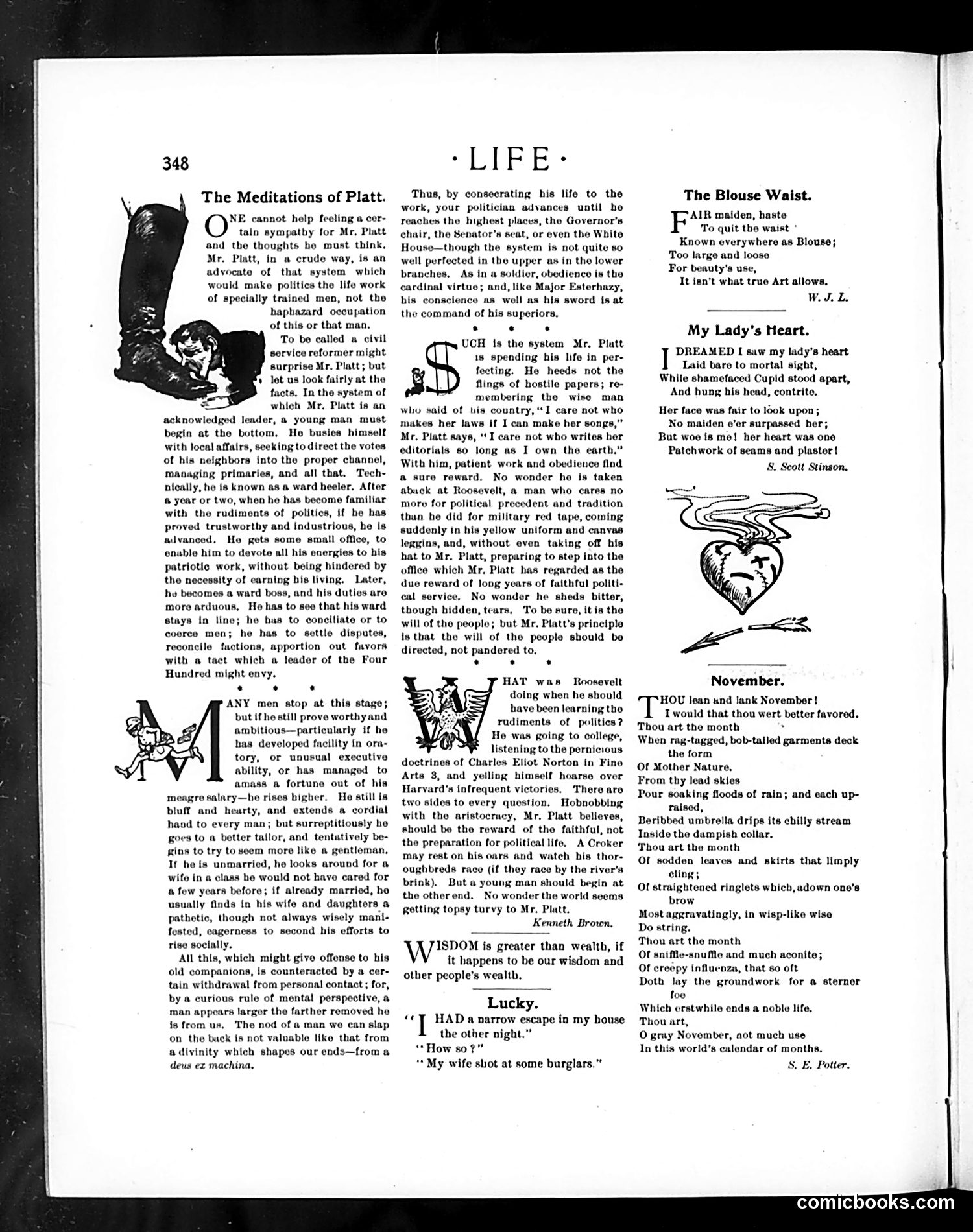
What you’re looking at
This page contains several distinct pieces: **"The Meditations of Platt"** - A satirical essay criticizing a political figure (likely U.S. Senator Thomas C. Platt, based on context) for abandoning military service to pursue politics. The text argues he's become a "ward boss" managing party favors and factions rather than serving the public interest. The accompanying cartoon depicts a disheveled figure, suggesting political corruption or moral compromise. **"The Blouse Waist"** - A brief poem mocking women's fashion, suggesting loose blouses are impractical. **"My Lady's Heart"** and **"November"** - Romantic and seasonal poetry, unrelated to satire. **"Lucky"** - A brief joke about escaping burglars. The page primarily targets political machine politics and crony favoritism of the Gilded Age era.
📄 Transcribed text from this page (OCR, searchable)
Machine-transcribed from the original scan — historical spelling and the odd misread are preserved.
The Meditations of Platt. NE cannot help feeling a cer- tain sympathy for Mr. Platt and the thoughts he must think, Mr. Platt, in a crude way, is an advocate of that system which would make politics the life work of specially trained men, not the hapbazard occupation of this or that man. To be called a civil service reformer might surprise Mr. Platt; but let us look fairly at the facts. In the system of which Mr. Platt is an acknowledged leader, a young man must begin at the bottom, He busies himself with local affairs, seeking to direct the votes of his neighbors into the proper channel, managing primaries, and all that, Tech- nically, he is known as a ward heeler. After & year or two, when he has become familiar with the rudiments of politics, if be has proved trustworthy and industrious, he is advanced. He gets some small office, to enable him to devote all his energies to his patriotic work, without being hindered by the necessity of earning bis living. Later, he becomes a ward boss, and his duties are more arduous, He has to see that his ward stays in line; he hus to conciliate or to coerce men; he has to settle disputes, reconcile factions, apportion out favors with a tact which a leader of the Four Hundred might envy. . . . ANY men stop at this stage; but ifhe still prove worthy and ambitious—particularly if ho has developed facility In ora- tory, or unusual executive ability, or has managed to amass a fortune out of his mongro salary—he rises higher, He still is bluff and hearty, and extends a cordial hand to every man; but surreptitiously he goes to a better tailor, and tentatively be- gins to try to seem more like a gentleman, If he is unmarried, he looks around for a wife in a class he would not have cared for a few years before; if already married, ho usually finds in his wife and daughters a pathetic, though not always wisely mani- fested, eagerness to second his efforts to rise socially. All this, which might give offense to his old companions, is counteracted by a cer- tain withdrawal from personal contact ; for, by a curious rule of mental perspective, a man appears larger the farther removed ho is from us, The nod of a man wo can slap on the back is not valuable like that from adivinity which shapes our ends—from a deus ex machina, » LIFE = Thus, by consecrating his life to the work, your politician advances until ho reaches the highest places, the Governor's chair, the Senator's seat, or even the White House—though the system is not quite so well perfected in the upper as in the lower branches, As in a soldier, obedience is the cardinal virtue; and, like Major Esterhazy, his conscience as well as his sword is at the command of his superiors, . eo oe UCH 1s the system Mr, Platt 18 spending bis life in per- fecting. He heeds not tho & flings of hostile papers; re- membering the wise man who said of is country, «I care not who makes her laws if I can make her songs,” Mr. Platt says, “I care not who writes hor editorials so long as I own the earth.” With him, patient work and obedience find @ suro reward. No wonder ho is taken aback at Roosevelt, a man who cares no more for political precedent and tradition than he did for military red tape, coming suddenly in his yellow uniform and canvas legging, and, without even taking off his hat to Mr. Platt, preparing to step into the office which Mr, Platt has regarded as the due reward of long years of faithful politi- cal service. No wonder he sheds bitter, though bidden, tears, To be sure, itis the will of the peoplo; but Mr. Platt’s principle fs tbat the will of the people should bo directed, not pandered to, * . HAT was Roosevelt doing when he should have been learning tho rudiments of politics? He was going to college, listening to the pernicious doctrines of Charles Eliot Norton in Fino Arts 3, and yelling bimself hoarse over Harvard's infrequent victories, There aro two sides to every question, Hobnobbing with the aristocracy, Mr, Platt believes, should be the reward of tho faithful, not the preparation for political life. A Croker may rest on bis oars and watch his thor- oughbreds race (if they race by the river's brink). But a young man should begin at the otherend. No wonder the world seems getting topsy turvy to Mr, Platt, Kenneth Brown. ISDOM is greater than wealth, if it happens to be our wisdom and other people's wealth. Lucky. «¢7 HAD a narrow escape in my house the other night.” “How so?” “My wife shot at some burglars.” The Blouse Waist. AIR maiden, haste To quit the waist * Known everywhere as Blouse; Too large and loose For beauty’s use, It ien't what true Art allows, W.J. Le My Lady's Heart. DREAMED I saw my lady's heart Laid bare to mortal sight, While shamefaced Cupid stood apart, And hung bis head, contrite. Her face was fair to look upon; No maiden e'or surpassed her; But woe is me! her heart was one Patchwork of seams and plaster! 8, Scott Stinson, November. HOU lean und lank November! I would that thou wert better favored, Thou art the month . When rag-tagged, bob-talled garments deck the form Of Mother Nature. From thy lead skies Pour soaking floods of rain; and each up- raisod, Beribbed umbrella drips its chilly stream Inside the dampish collar, Thou art the month Of sodden leaves and skirts that limply cling; Of straightened ringlets which, adown one's brow Most aggravatingly, in wisp-like wise Do string. Thou art the month Of sniffte-snuffle and much aconite; Of creepy influenza, that 80 oft Doth lay the groundwork for a sterner foo Which erstwhile ends a noble life. Thou art, O gray November, aot much use In this world’s calendar of months. S. E. Potter, comicbooks.com