
A complete issue · 20 pages · 1898
Life — October 13, 1898
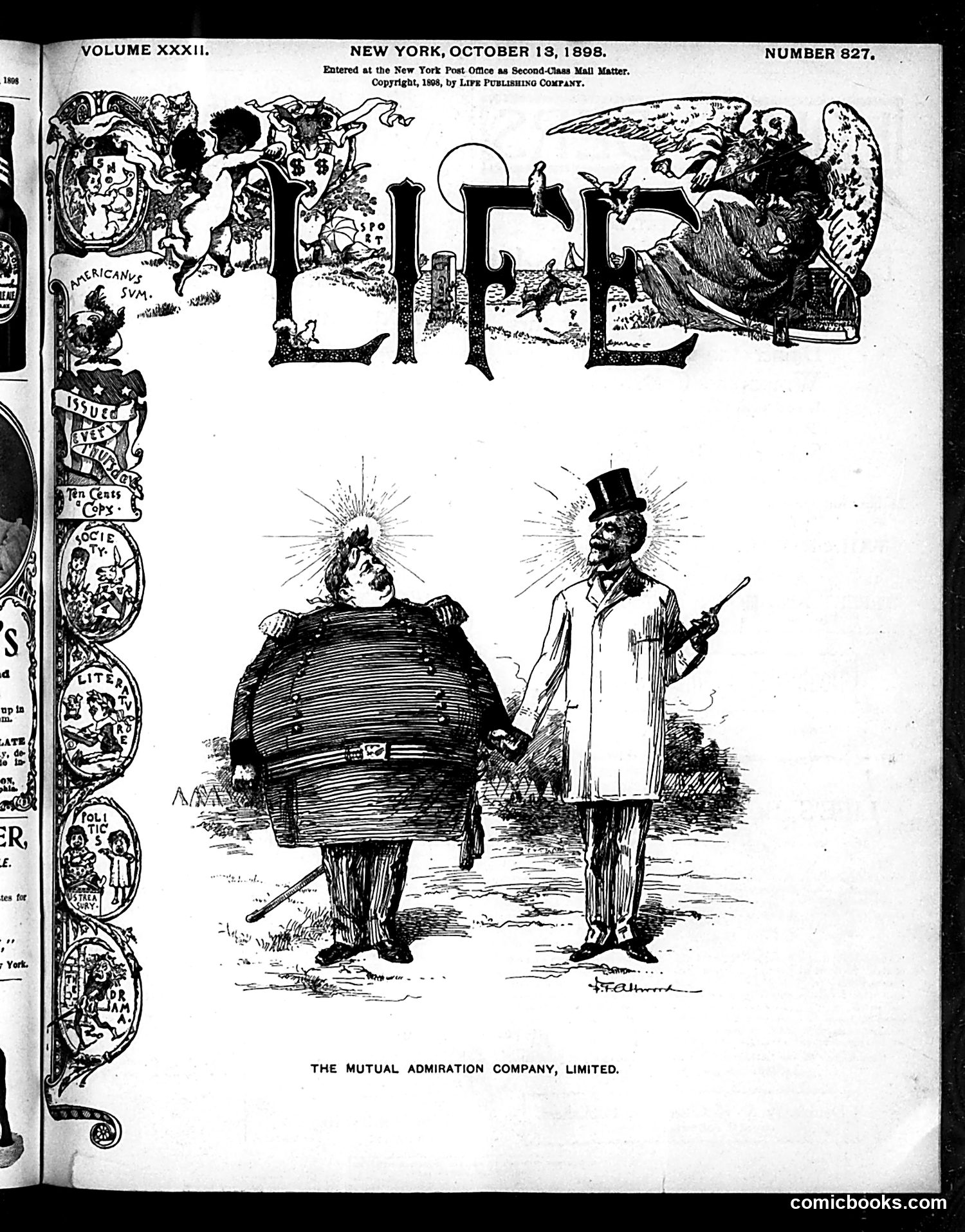
This 1898 *Life* magazine cartoon satirizes two figures with halos gazing at each other in mutual admiration. The caption "The Mutual Admiration Company, Limited" suggests they represent public figures engaged in reciprocal praise or flattery rather than genuine substance. The halo imagery is ironic—typically denoting saintliness—here mocking their self-regard. One figure wears a top hat and holds what appears to be a revolver or weapon, suggesting possible political or military authority. Without clearer identifying details, I cannot definitively name the specific figures referenced. However, the satire targets the phenomenon of prominent individuals publicly praising one another for political or social gain, implying their admiration is cynical rather than authentic.
This page is primarily **advertising**, not satire or political commentary. It contains commercial advertisements for high-end retailers from the early 1900s: - **Hollanders**: Fashion models for women's clothing (costumes, gowns, wraps) - **Arnold Constable & Co.**: Fall dress fabrics and Scottish cloth - **Louise & Co.**: Millinery services - **W. & J. Sloane**: Fine carpets and furniture - **Stern Bros.**: Women's fashions and accessories - **Doubleday & McClure Co.**: Promotional material for "Life's Book of Animals," a humorous illustrated volume The only visual content is a small illustration labeled "Verses" from Doubleday & McClure showing a child figure—this appears promotional, not satirical. There are **no political cartoons** on this page; it's a standard period advertising section from *Life* magazine.
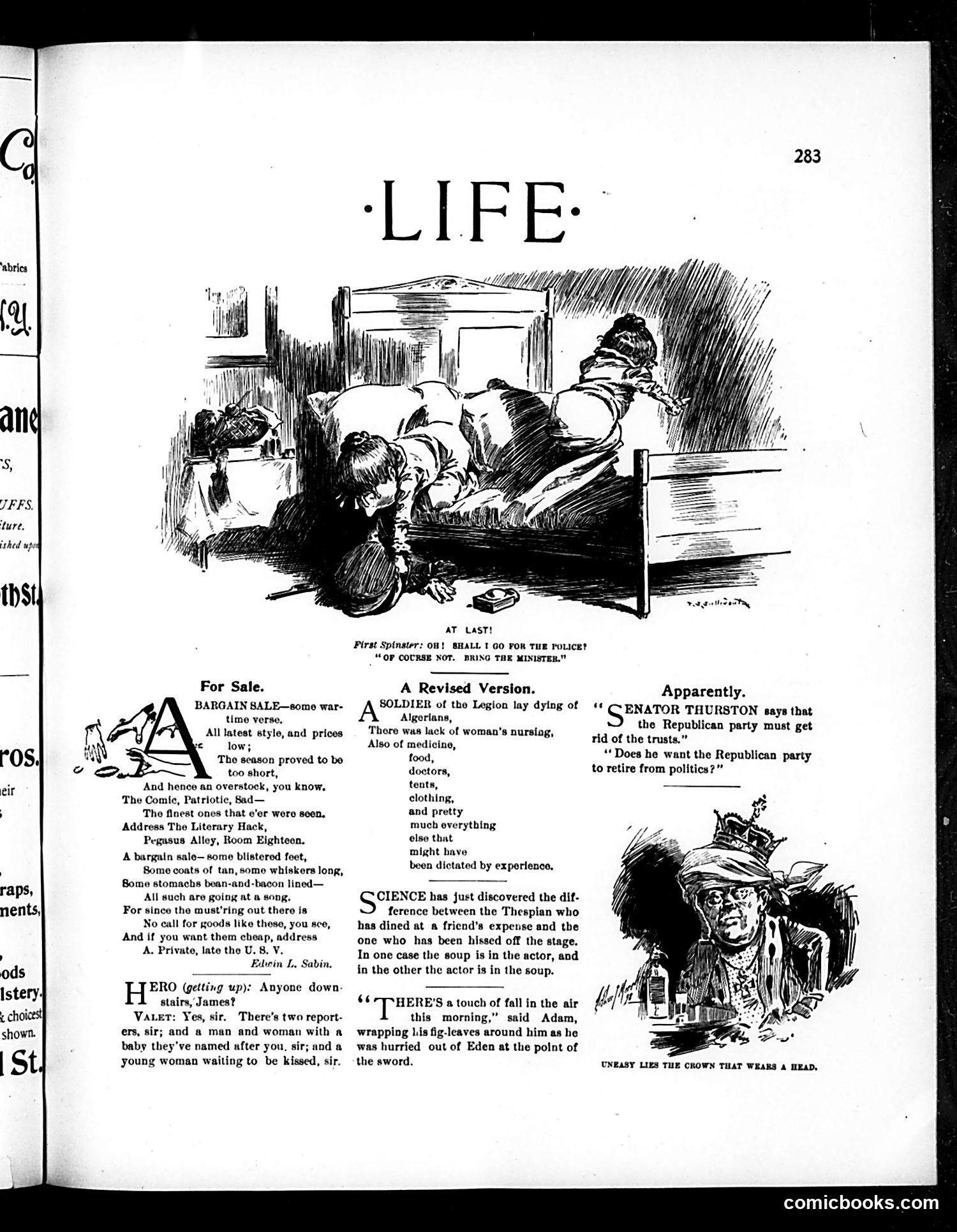
The main cartoon depicts a bedroom scene captioned "AT LAST!" with a spinster saying "Oh! Shall I go for the police? Of course not. Bring the minister!"—satirizing the desperation of unmarried women to secure husbands by any means. Below are three short humor pieces. "A Revised Version" mocks a soldier's dying request, replacing romantic sentiment with mundane necessities. "Hero" contains a joke about mistaken identity regarding babies and potential suitors. The final item references Senator Thurston and Republican party politics, though the specific context is unclear without additional historical detail. The right illustration shows a crowned figure, possibly representing Unary, with text about crown-wearing, though its meaning requires more context. Overall, the page satirizes romantic desperation, military sentimentality, and contemporary politics.
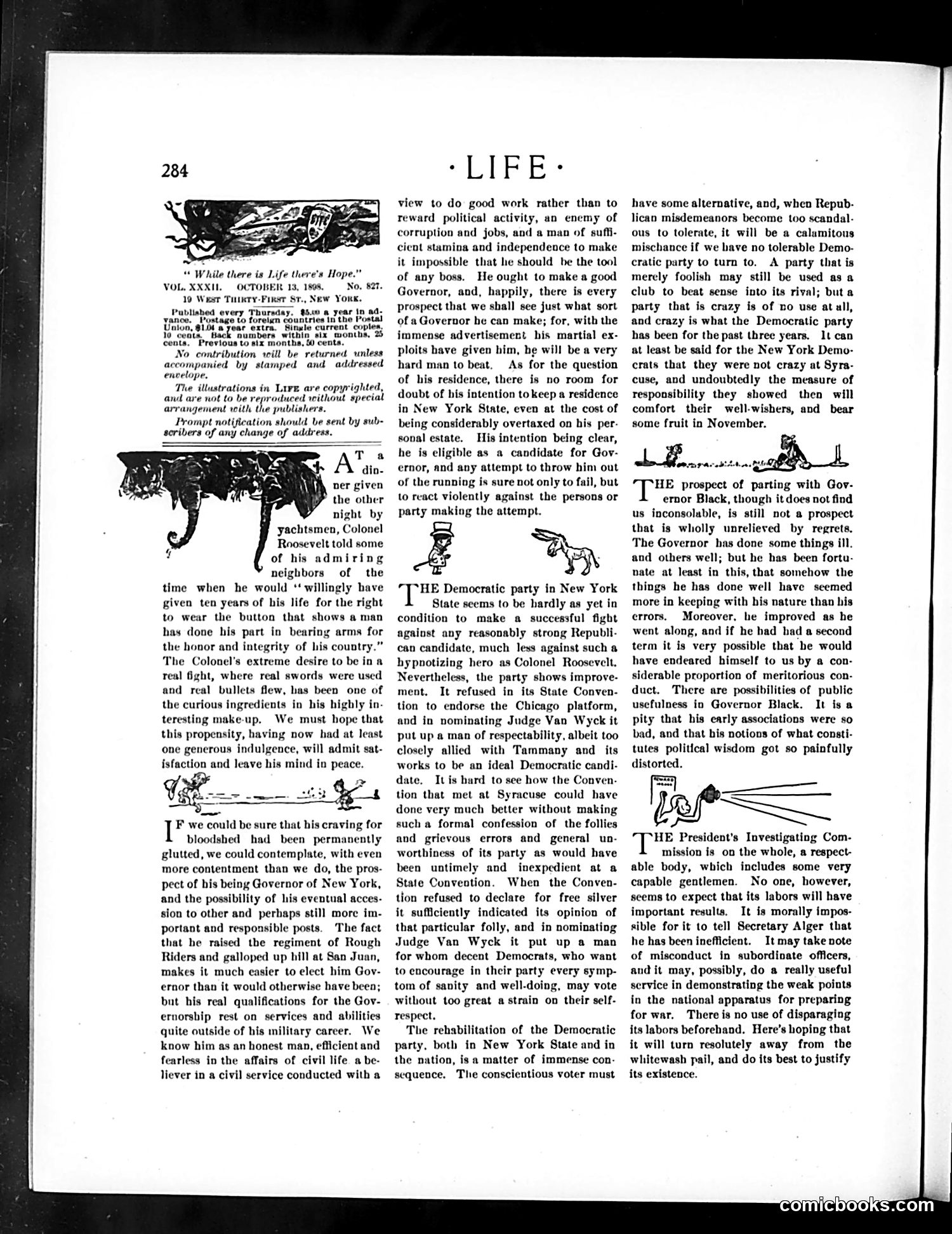
This editorial page discusses New York State politics, specifically Governor Theodore Roosevelt's potential candidacy and the Democratic Party's response. The cartoons appear to satirize political maneuvering around the 1906 elections. The text criticizes the Democratic Party's weaknesses—particularly their nomination of Judge Van Wyck and their embrace of the Chicago platform on free silver, described as outdated "folly." The author argues the party shows some improvement but remains hampered by poor judgment and association with Tammany Hall. The cartoons (though small and difficult to interpret with certainty) appear to mock the various political figures and their positions through animal caricatures, a common satirical technique in Life magazine during this era. The overall message criticizes Democratic Party missteps while acknowledging some progress.
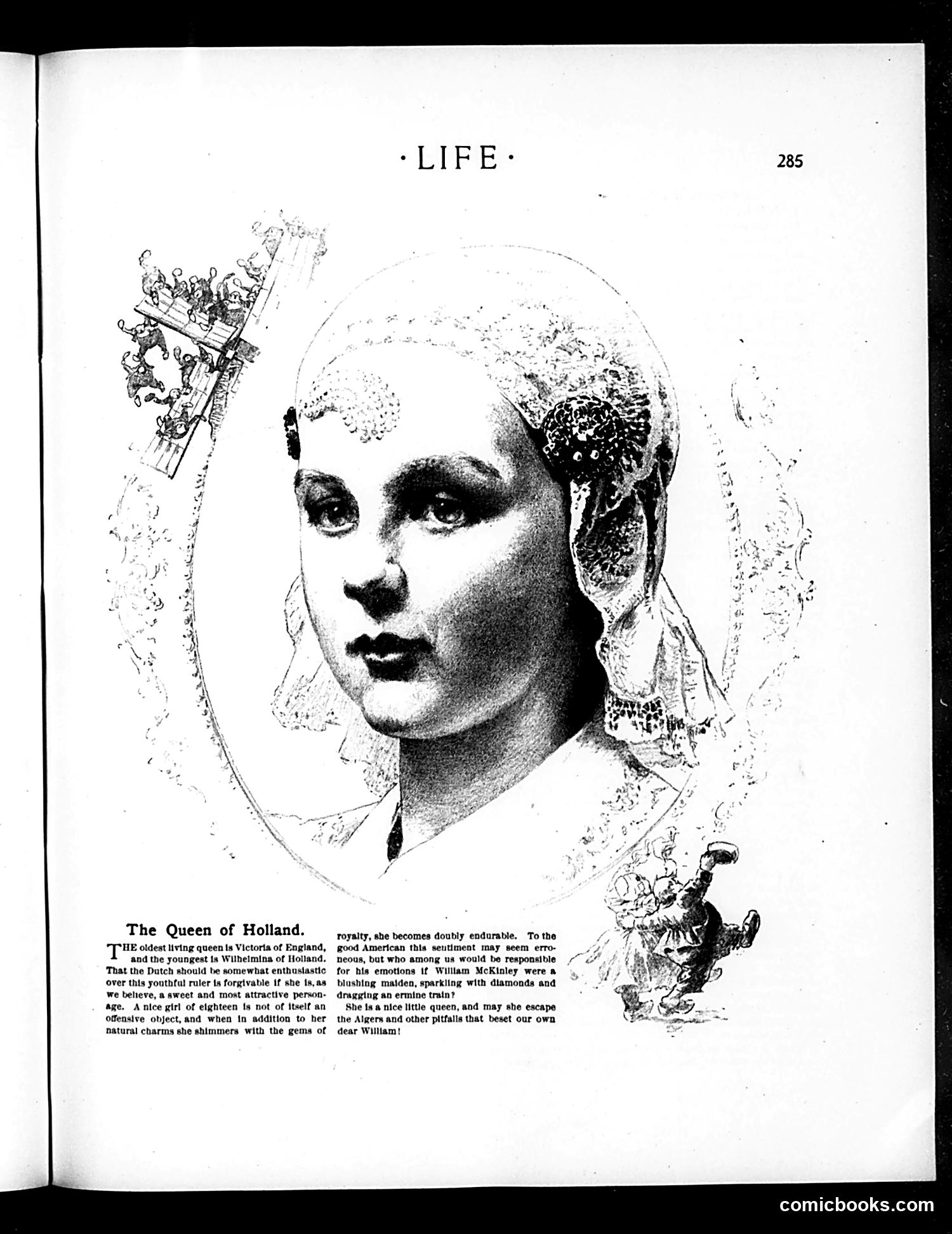
This page features a portrait of **Wilhelmina of the Netherlands**, identified as "the Queen of Holland." The satirical text praises her as England's and America's "friend," calling her "sweet and most attractive personality." However, the satire appears critical: the text sarcastically suggests that while she's "doubly endearing" to Americans, the piece questions the emotional sincerity of those around her—specifically referencing **William McKinley** as a "blushing maiden" with "sparkling diamonds," mocking his romantic or sentimental character. The decorative vignettes around the portrait (showing figures and scenes) likely reinforce the satirical tone about royalty and international relations during this period.
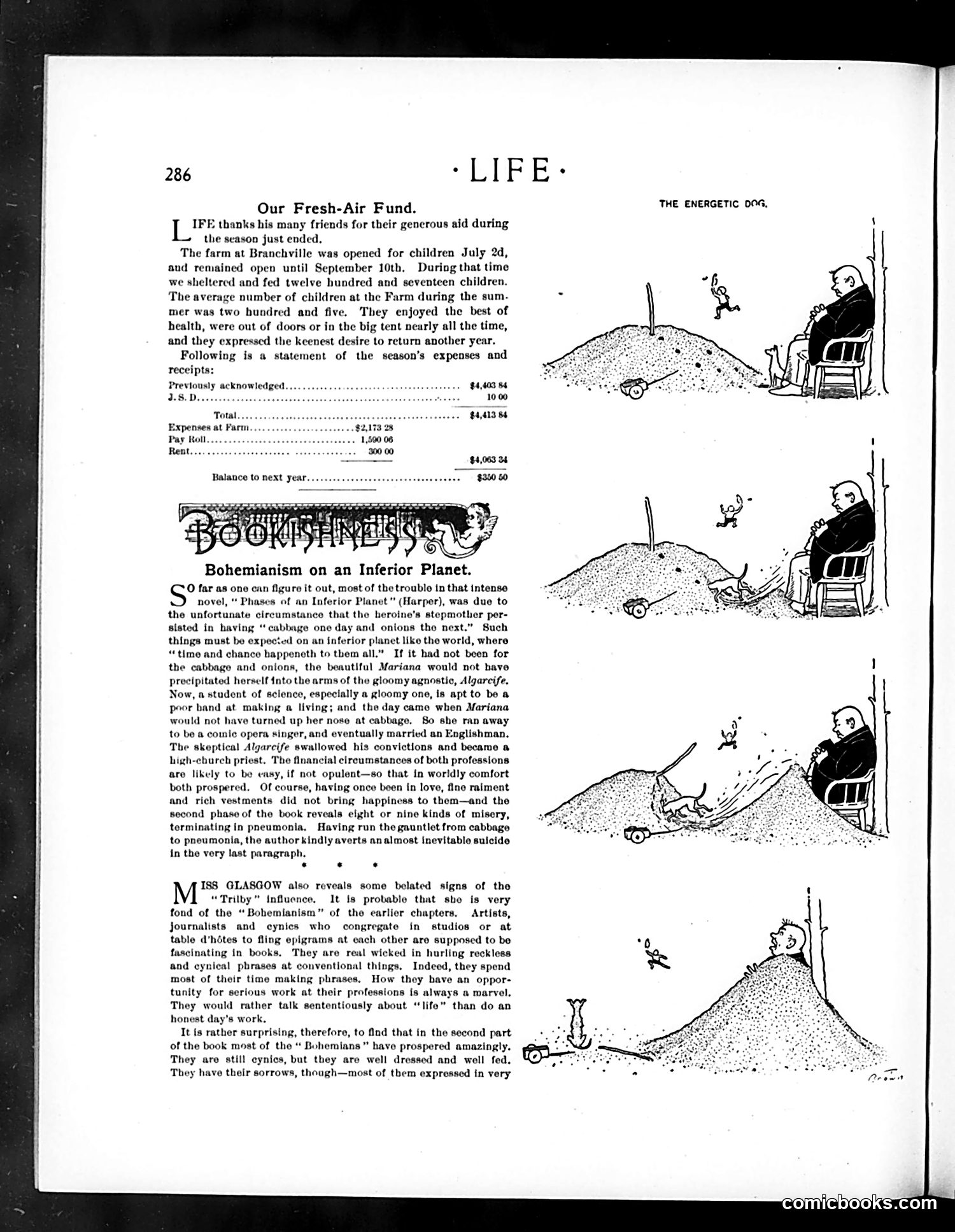
This comic strip (right side) depicts a man in a chair repeatedly throwing a stick for a small dog to fetch. The humor lies in the ironic reversal of effort: while the dog energetically bounds after each stick, the man grows progressively more exhausted sitting in his chair. Each panel shows the man more slumped and tired, while the dog remains equally vigorous. The satire likely comments on wasted human energy or futility—the man exerts himself through indirect means (throwing) while delegating the actual work to the dog, yet paradoxically becomes more exhausted than his supposedly laboring pet. It's a visual joke about the absurdity of certain human endeavors or perhaps commentary on inefficient effort.
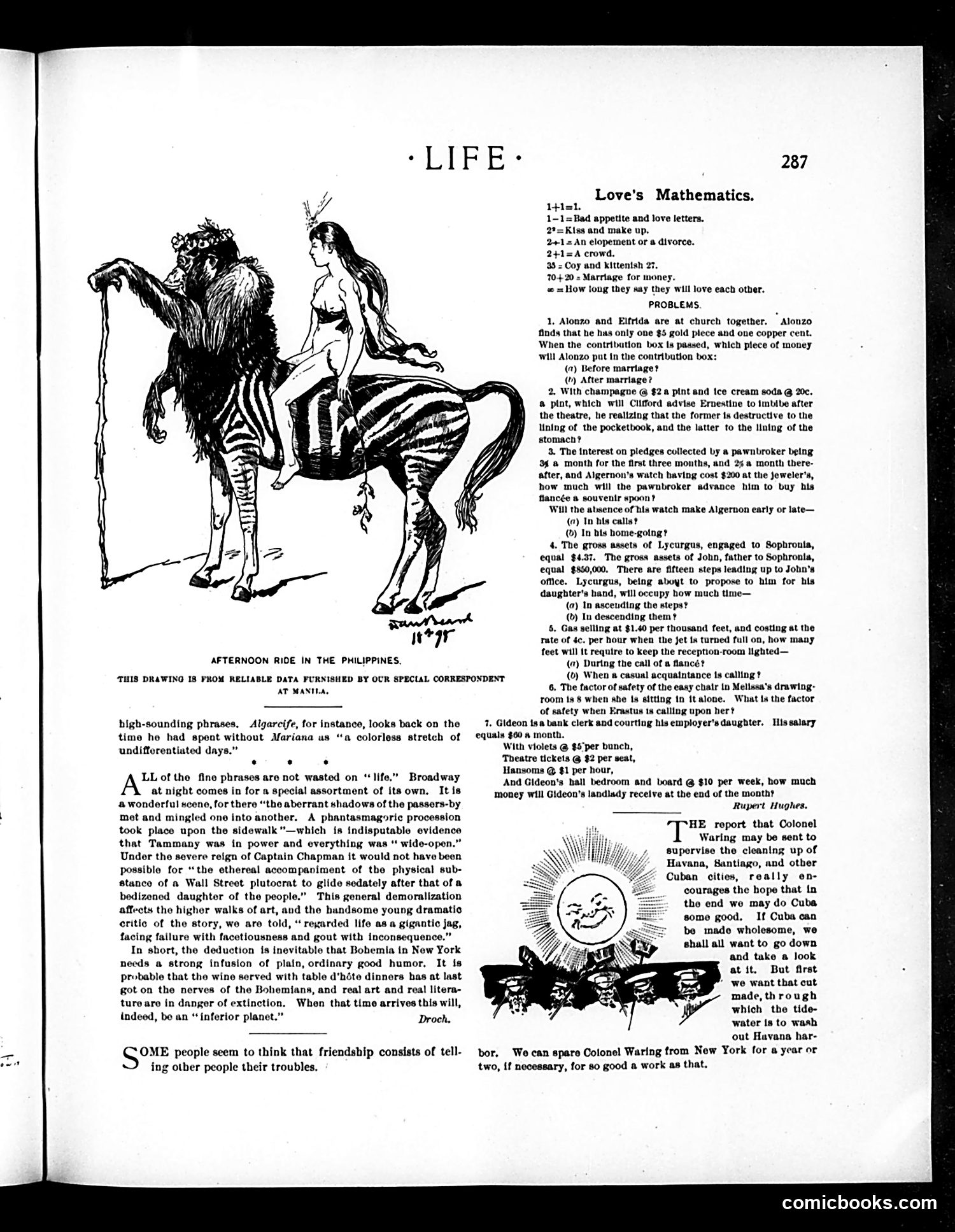
This cartoon depicts a woman riding a zebra-striped creature (possibly representing a mule or hybrid animal) alongside a crowned, ape-like figure. The caption notes this drawing comes "from reliable data furnished by our special correspondent at Manila." The satire likely mocks American colonial attitudes toward the Philippines, which the U.S. had recently acquired following the Spanish-American War (1898). The grotesque, crowned figure probably caricatures Filipino leadership or indigenous populations, reflecting racist depictions common in early 1900s American satirical media. The absurd "afternoon ride" imagery satirizes romanticized or exaggerated reports from colonial territories. The overall tone suggests skepticism about official accounts emerging from the Philippines campaign.
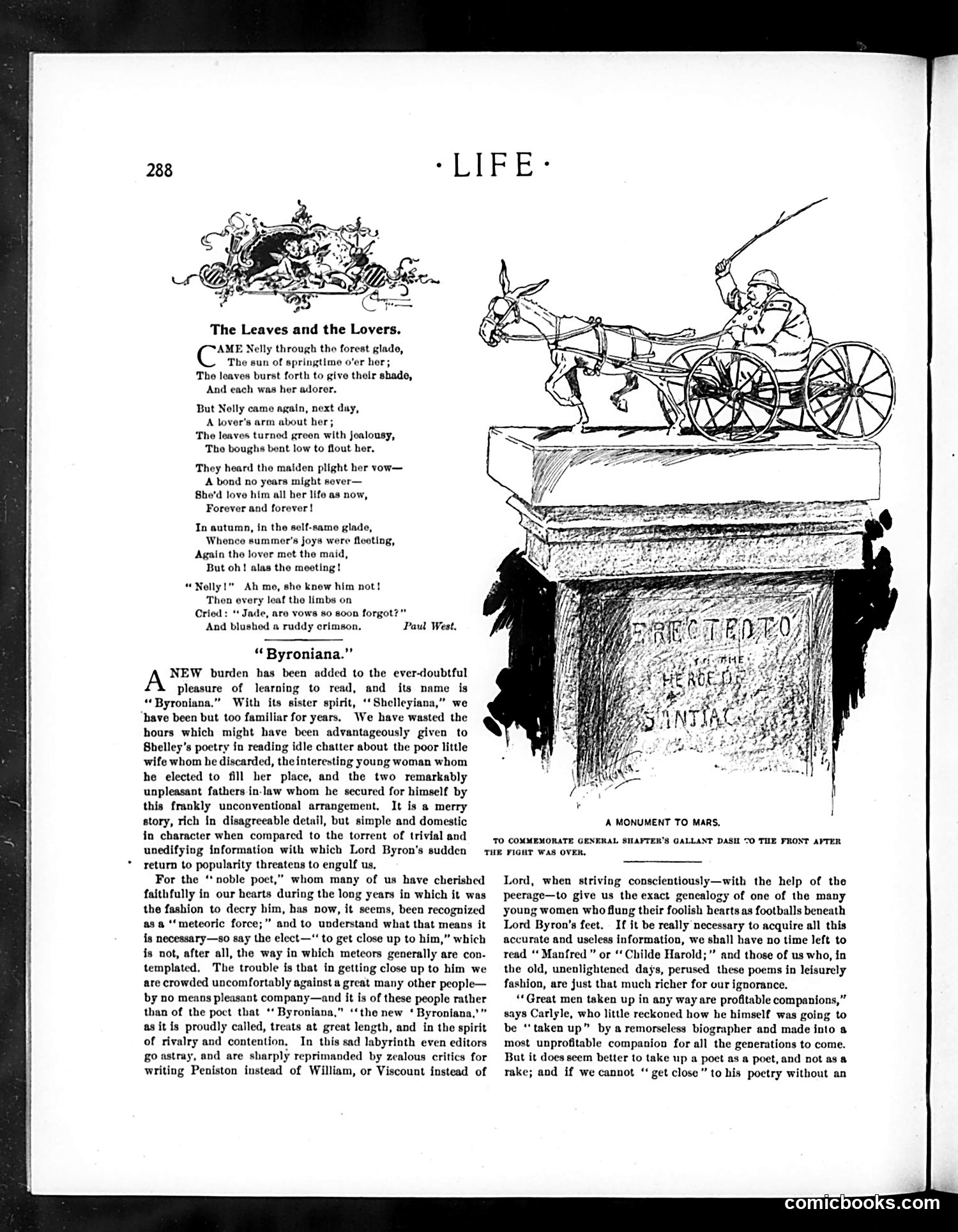
The main illustration shows a chariot driver whipping donkeys pulling a cart—a classical reference to Mars, the Roman god of war. The monument's inscription reads "ERECTED TO THE HEROES" with additional text referencing "SHAFTER'S GALLANT DASH" and concluding "THE FIGHT WAS OVER." This appears to be political satire regarding General Shafter's military campaign, likely referencing the Spanish-American War (1898). The cartoon seems critical, comparing Shafter's leadership to an incompetent charioteer driving stubborn animals—suggesting bungled military execution despite ultimate victory. The accompanying text discusses "Byroniana," treating Byron's poetry seriously rather than satirizing it, so the cartoon constitutes the page's primary satirical content.
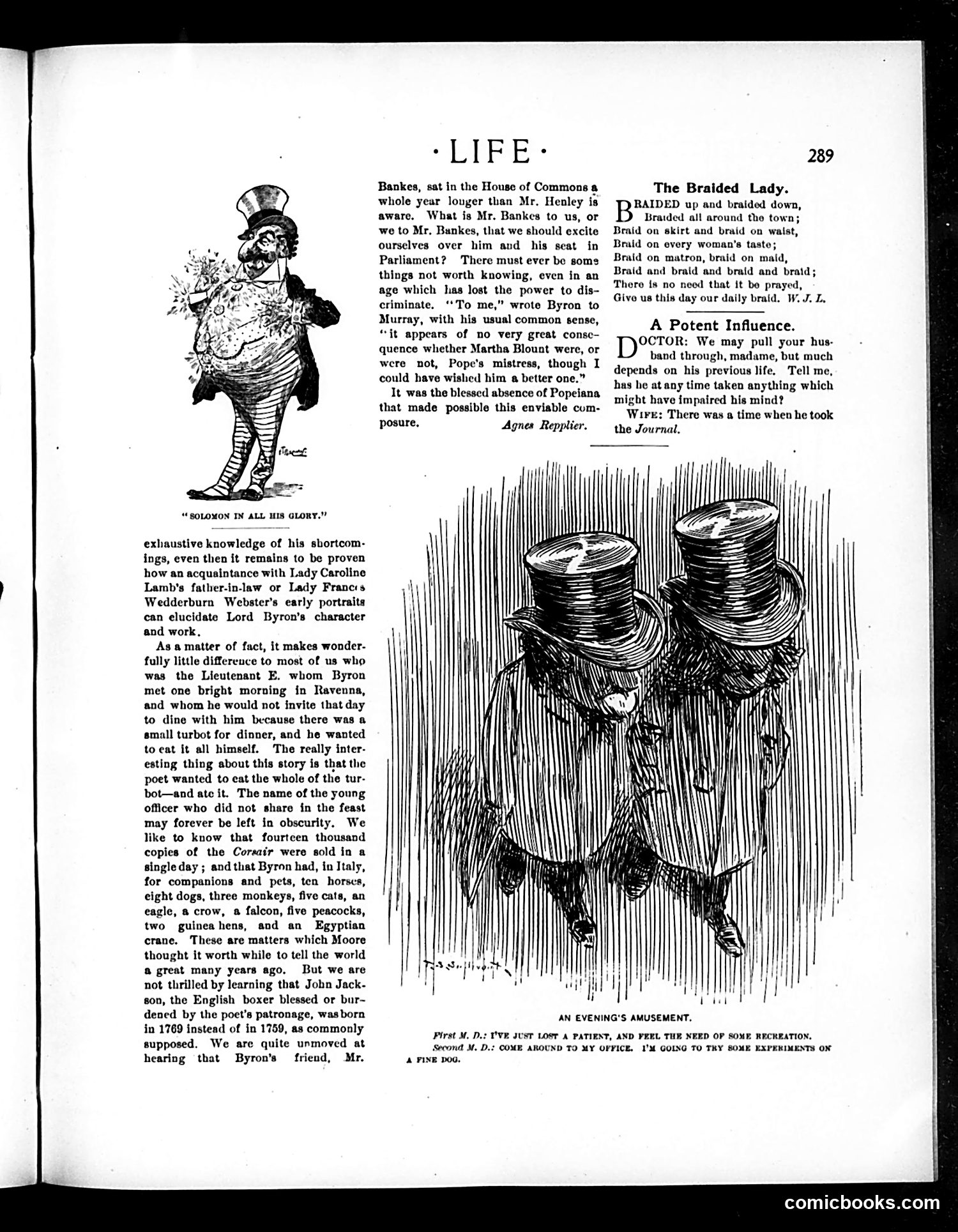
The main cartoon depicts a rotund, elaborately dressed man labeled "SOLOMON IN ALL HIS GLORY," likely a satirical caricature of a contemporary public figure (the specific identity isn't clear from the page alone). The accompanying text discusses Lord Byron's social standing and anecdotes about his life—particularly regarding his seat in Parliament and his social circle. It references Byron's acquaintance with various figures and details about a dinner invitation he rejected. The page also includes two brief comic exchanges: "The Braided Lady" (a humorous poem about braiding) and "A Potent Influence" (a doctor-patient joke about reading newspapers). The other illustration shows two figures in what appears to be an office setting, captioned "AN EVENING'S AMUSEMENT." The satire targets social pretension and notable figures of the period through caricature and wit.
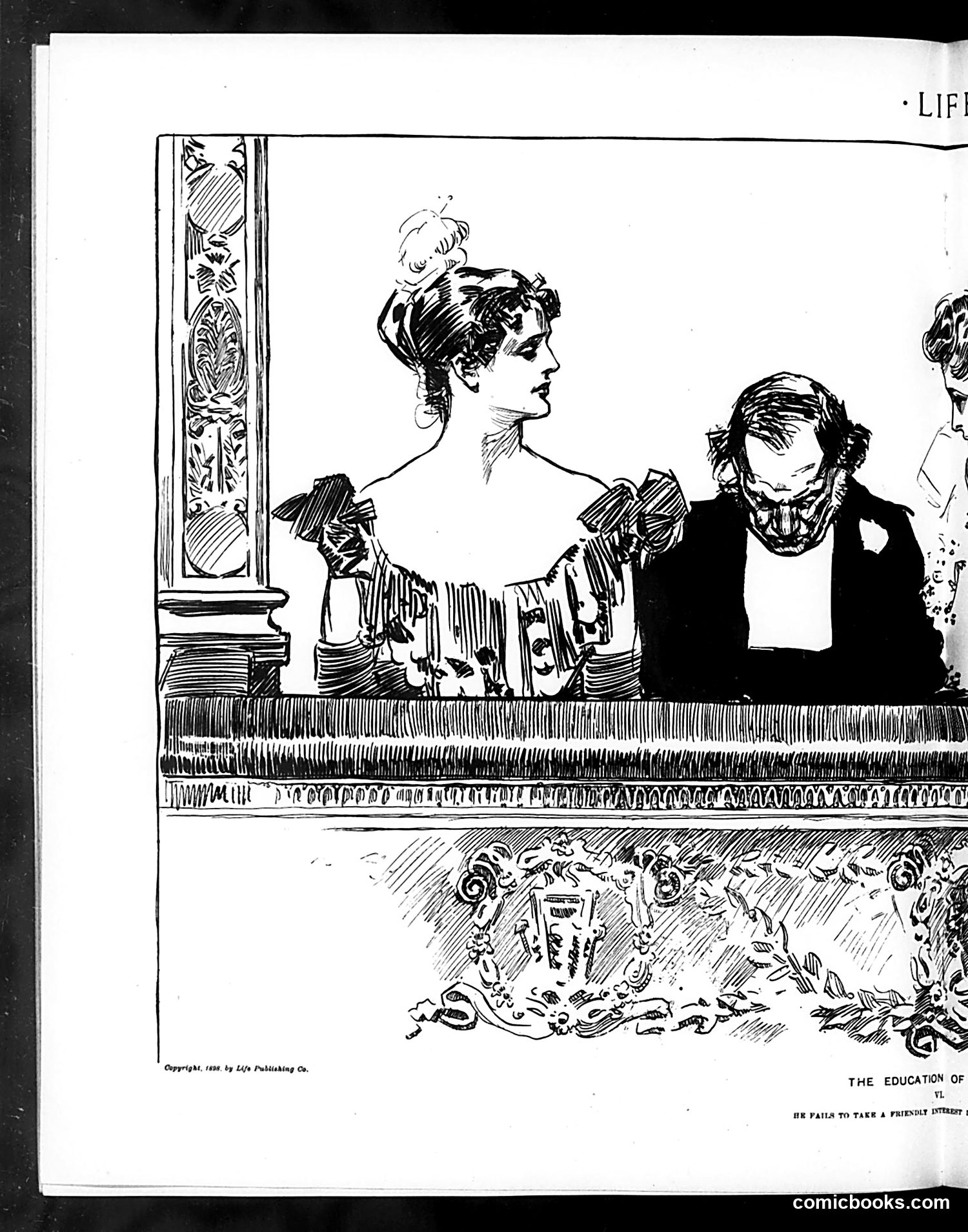
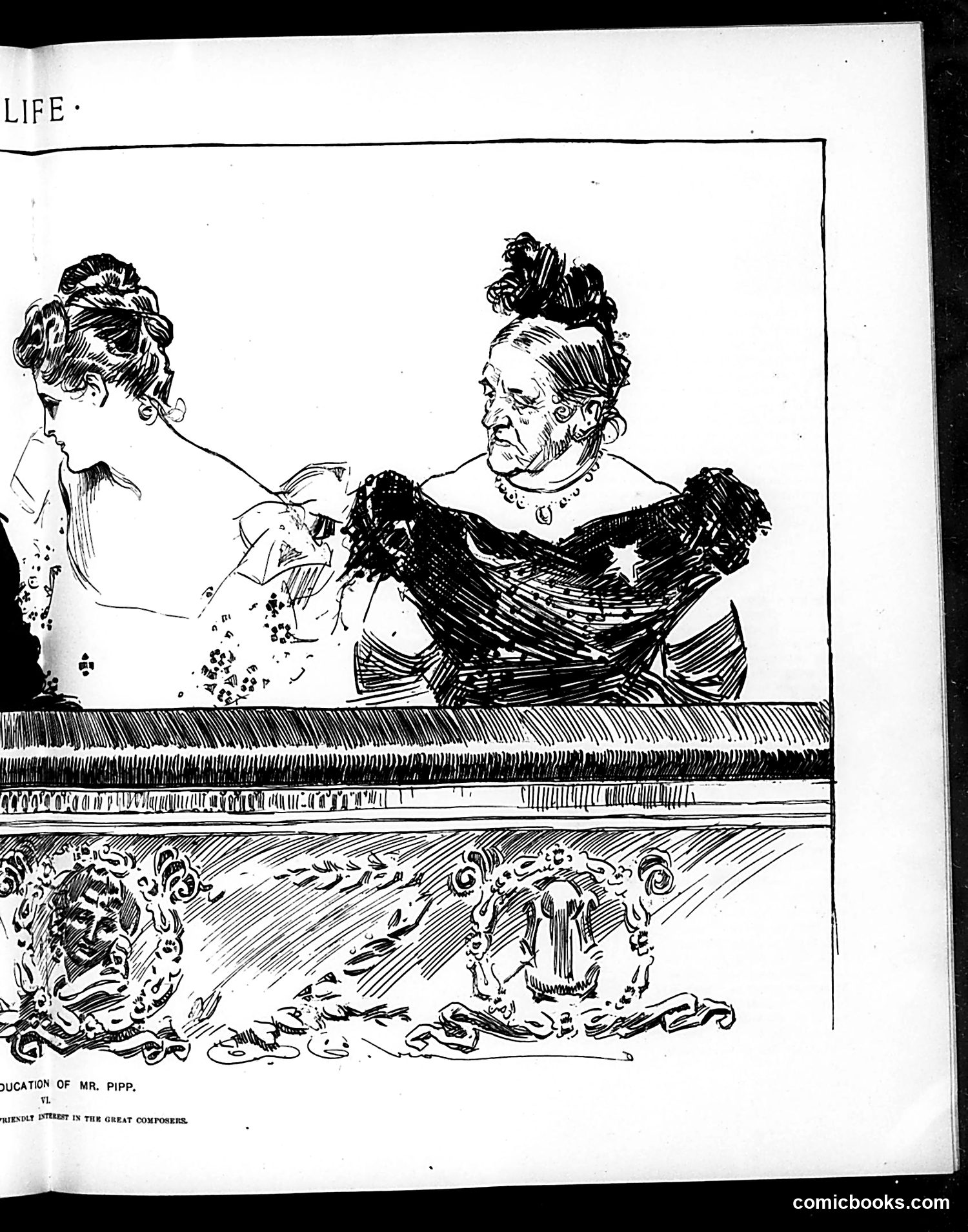
This page from *Life* magazine shows an illustration titled "THE EDUCATION OF [unclear]" with a subtitle beginning "HE FAILS TO TAKE A FRIENDLY INTEREST." The cartoon depicts a social scene in what appears to be an elegant interior (indicated by ornate architectural details). A well-dressed woman in formal attire with an elaborate hairstyle stands prominently, while a man in evening wear appears distracted or disengaged. A small child is also present. The satire appears to target parental or social responsibilities—specifically mocking a father or male figure who neglects to show genuine interest in his child's upbringing or education. The "education" referenced in the title likely refers to the child's social and moral development, which requires engaged parental attention. The cartoon critiques the indifference of privileged men to family duties.
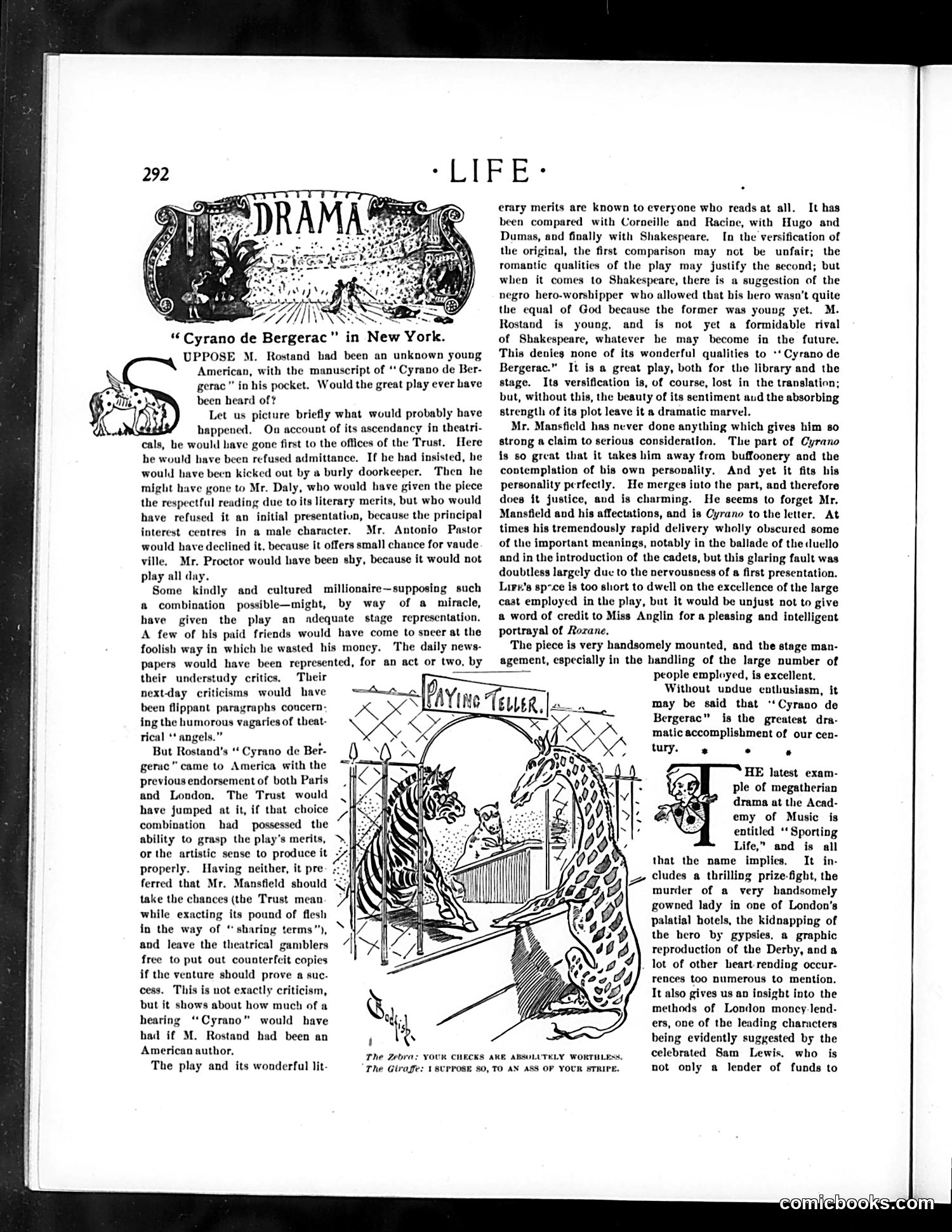
This page reviews theatrical productions. The main article discusses "Cyrano de Bergerac" in New York, praising actor Richard Mansfield's performance as matching Shakespeare's greatness. The text notes the play's French origin and literary merit, though criticizing some staging choices. The illustration depicts a scene from "Sporting Life," another play reviewed here, showing what appears to be a horse and jockey in an elaborate theatrical set. The caption references checking "cheeks" and "worthless" goods—likely satirizing either melodramatic action or the play's quality. The page exemplifies *Life* magazine's role as a cultural arbiter, offering both serious dramatic criticism and humorous commentary on New York theater circa the 1890s.
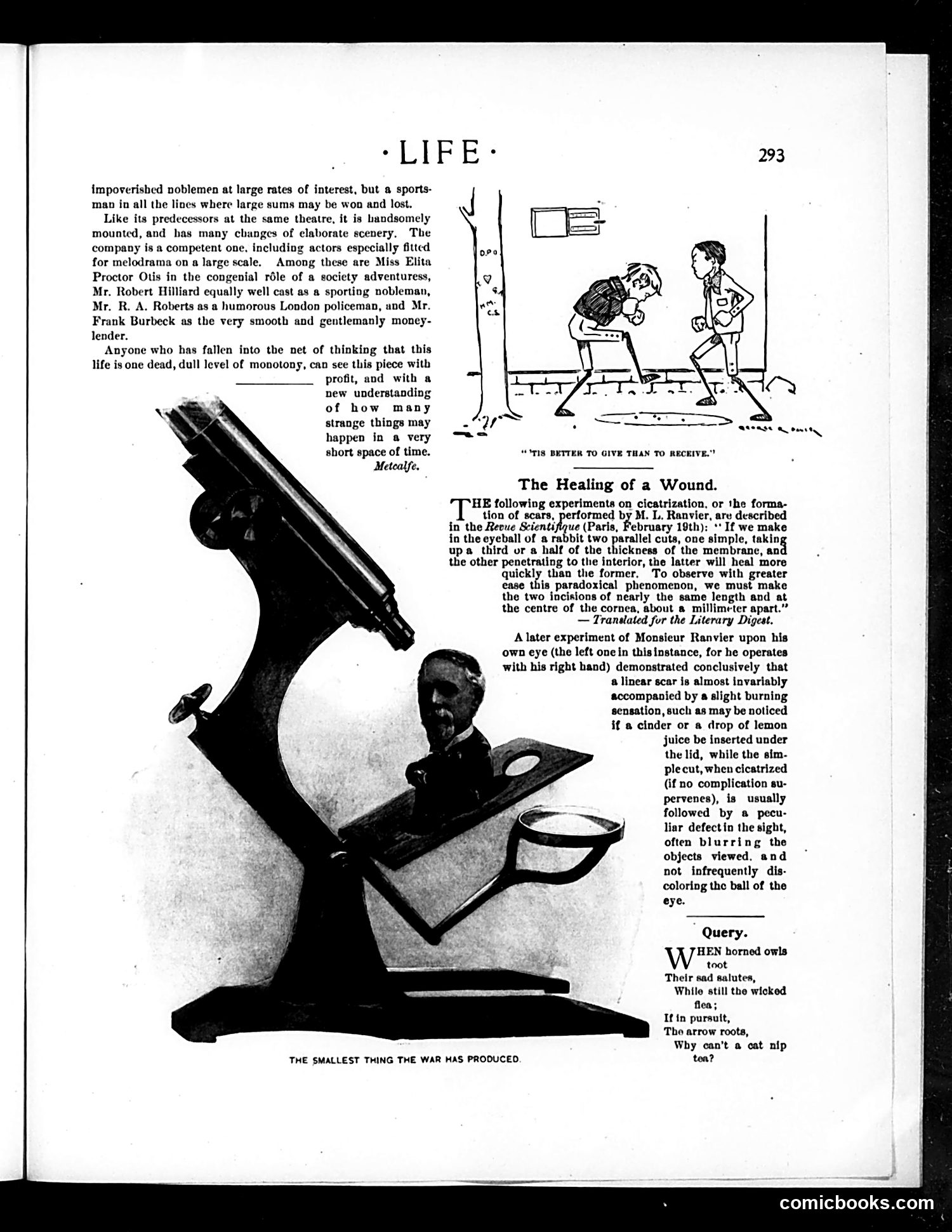
This page from Life magazine contains three distinct items: **Top Cartoon**: "It's Better to Give Than to Receive" depicts a child receiving a spanking from an adult—a domestic discipline scene. The caption inverts the Biblical maxim about generosity into commentary on corporal punishment. **Main Image**: "The Smallest Thing the War Has Produced" shows a microscope examining what appears to be a tiny military artifact or shell casing. This references World War I, satirizing the war's industrial scale by focusing on its smallest physical output—likely a miniature munitions piece or souvenir. **Scientific Article**: "The Healing of a Wound" discusses medical experiments by French scientist M. L. Ranvier on how different types of eye injuries heal differently, extracted from scientific journals. **Bottom Section**: "Query" is a nonsensical rhyming poem playing with words (horned owls, arrow roots, cat nip) for humorous effect. The page blends satire, scientific content, and wordplay—typical of Life's eclectic editorial approach combining social commentary with lighter fare.
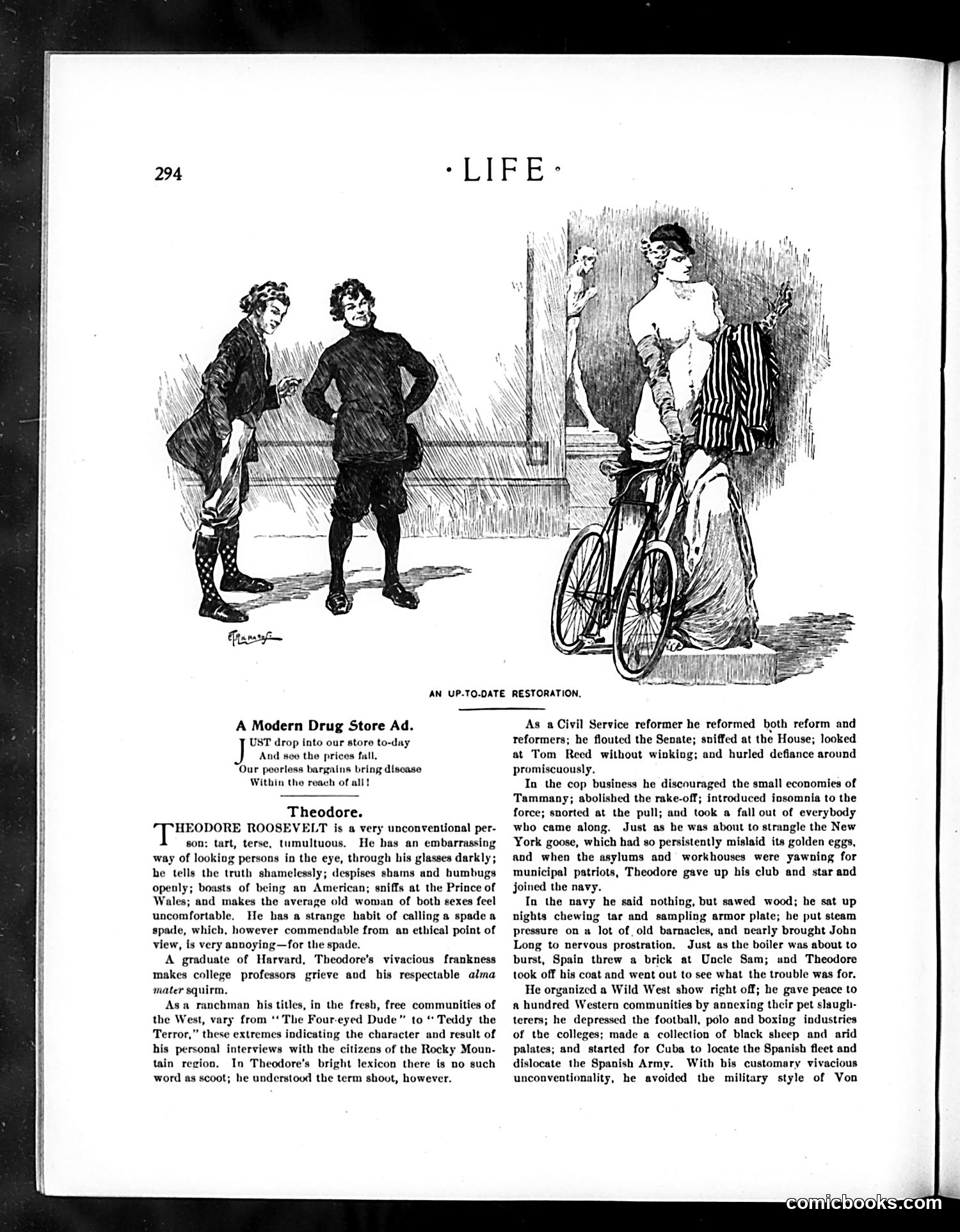
This is a satirical profile of Theodore Roosevelt, the prominent political figure. The two cartoons illustrate Roosevelt's famously blunt, unconventional personality through exaggerated scenarios. The page mocks Roosevelt's aggressive reformism across multiple roles: as Civil Service reformer (defying Congress), NYC Police Commissioner (dismantling Tammany Hall corruption), and naval officer (pushing military modernization). The text uses sarcastic praise—calling his truth-telling "embarrassing" and "annoying"—to critique his combative style. The drug store ad parody at top jokes that Roosevelt's reforms make previously inaccessible solutions suddenly "within reach of all"—likening his shake-ups to commercial bargains. The cartoons show Roosevelt's characteristic bluntness offending or confusing others (women and officials), capturing Life's satire: Roosevelt was refreshingly direct but socially jarring to Gilded Age sensibilities. The reference to his upcoming Spanish-American War involvement suggests this predates 1898.
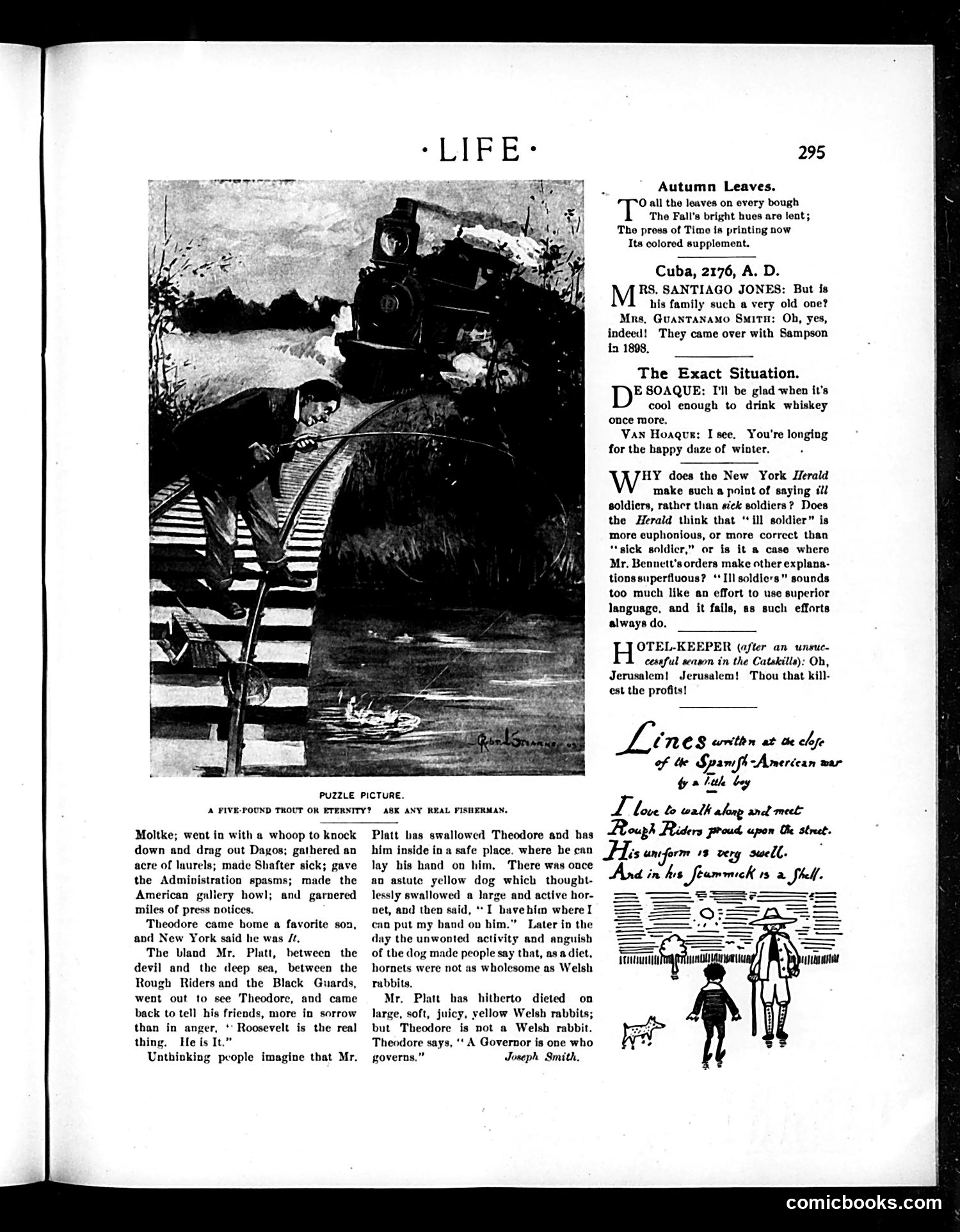
This page contains **political satire about Theodore Roosevelt's return from the Spanish-American War** (1898). The main "puzzle picture" shows a **locomotive**, captioned "A Five-Pound Trout or Eternity?" — a visual metaphor comparing Roosevelt to something deceptively small but internally powerful and dangerous. The accompanying text mocks **Boss Thomas Platt** (New York Republican political boss), who believed he'd "swallowed" and controlled the popular war hero Roosevelt. Life compares Platt to a foolish yellow dog that swallowed a hornet thinking it could control it — suggesting Roosevelt, though seemingly "contained," will prove uncontrollable and damaging from within. The hornet's "unwonted activity and anguish" mirrors how Roosevelt will torment those who think they've tamed him. The satire suggests Roosevelt is no docile "Welsh rabbit" for Platt to digest, but a genuinely dangerous political force that will cause problems for the establishment figures attempting to manipulate him. The page's other brief humorous items are minor satirical notes about war terminology and hotel seasons.
This page contains two satirical pieces critiquing gender relations and social hypocrisy in late 19th-century America. **"A la Mode"** mocks a woman's unfashionable dress through a suitor's complaints about her garish color combinations and ostentatious plumage—satirizing both women's fashion excess and men's superficial judgments. **"Scissors at Nullys"** (the main narrative) presents a working-class domestic scene where Mr. Cleburn returns home unemployed and claims robbery after drinking away wages at the saloon. His wife's patient resignation highlights the era's gender dynamics: women kept busy with unpaid household labor while men blamed circumstance for joblessness, yet squandered money on alcohol. The story criticizes male irresponsibility and the hypocrisy of men seeking "pleasant firesides" while undermining them through vice. The final piece jokes about ancient Egyptian love letters written on bricks, using this as a vehicle to mock modern romantic conventions and legal disputes over breach-of-promise suits—contemporary scandals involving jilted women suing suitors. All three pieces satirize social pretension, romantic delusion, and class anxieties of the period.
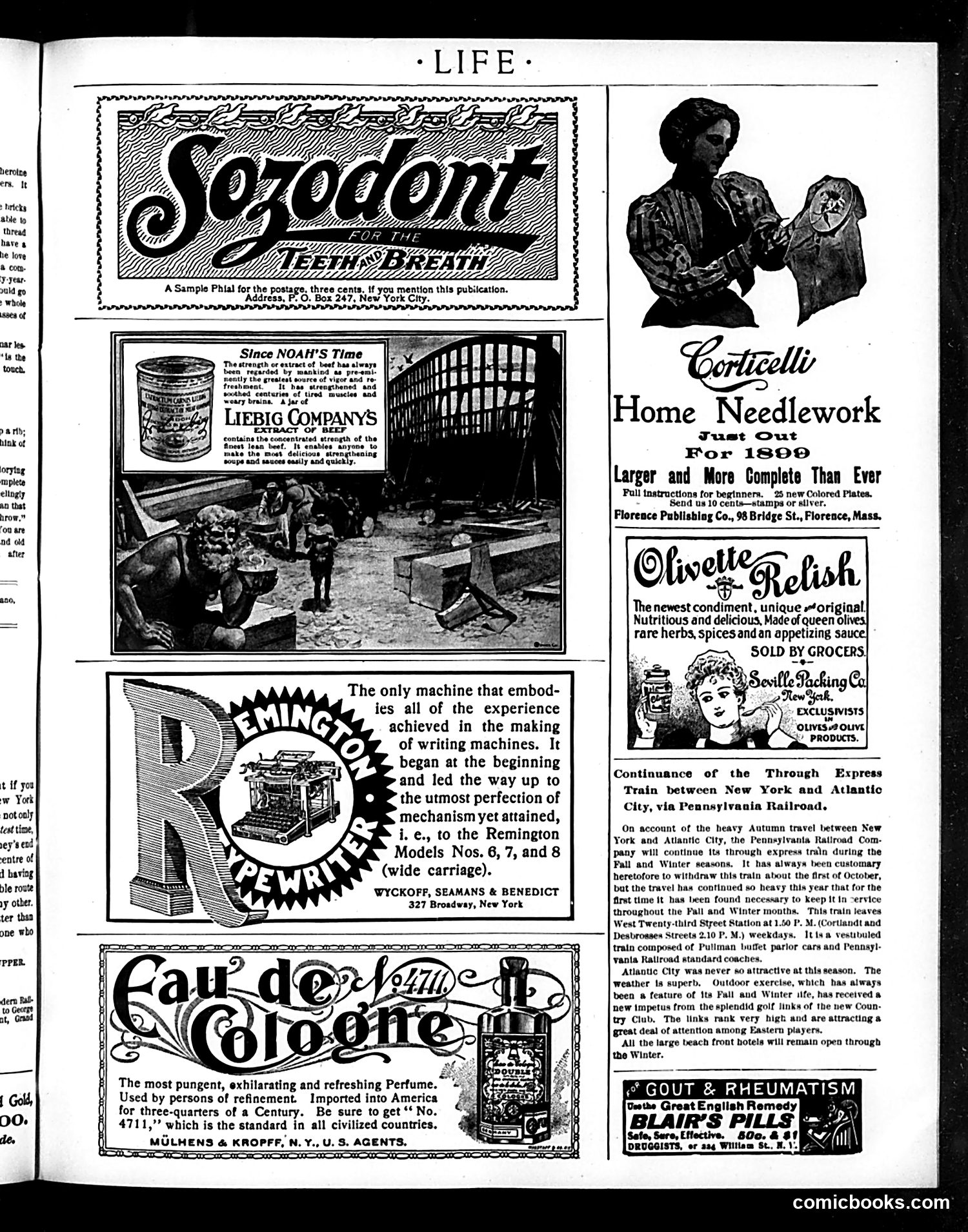
This is primarily an **advertising page**, not a satirical cartoon. The page contains multiple product advertisements typical of early 1900s magazines: - **Sozodont** (tooth powder) - **Corticelli Home Needlework** instruction books - **Olivette Relish** (food condiment) - **Remington Typewriter** (emphasizing its evolutionary superiority in design) - **Eau de Cologne** perfume - **Blair's Pills** (patent medicine for gout and rheumatism) There is one **documentary image** showing what appears to be a Liebig Company extract production facility with workers, illustrating manufacturing processes. The ads reflect **late 19th/early 20th-century consumer culture**: emphasis on refinement and gentility, imported European goods as status symbols, patent medicines (now largely discredited), and emerging office technology. The typewriter ad notably frames the machine as the culmination of technological progress "since the beginning." This page documents period advertising rather than political satire.
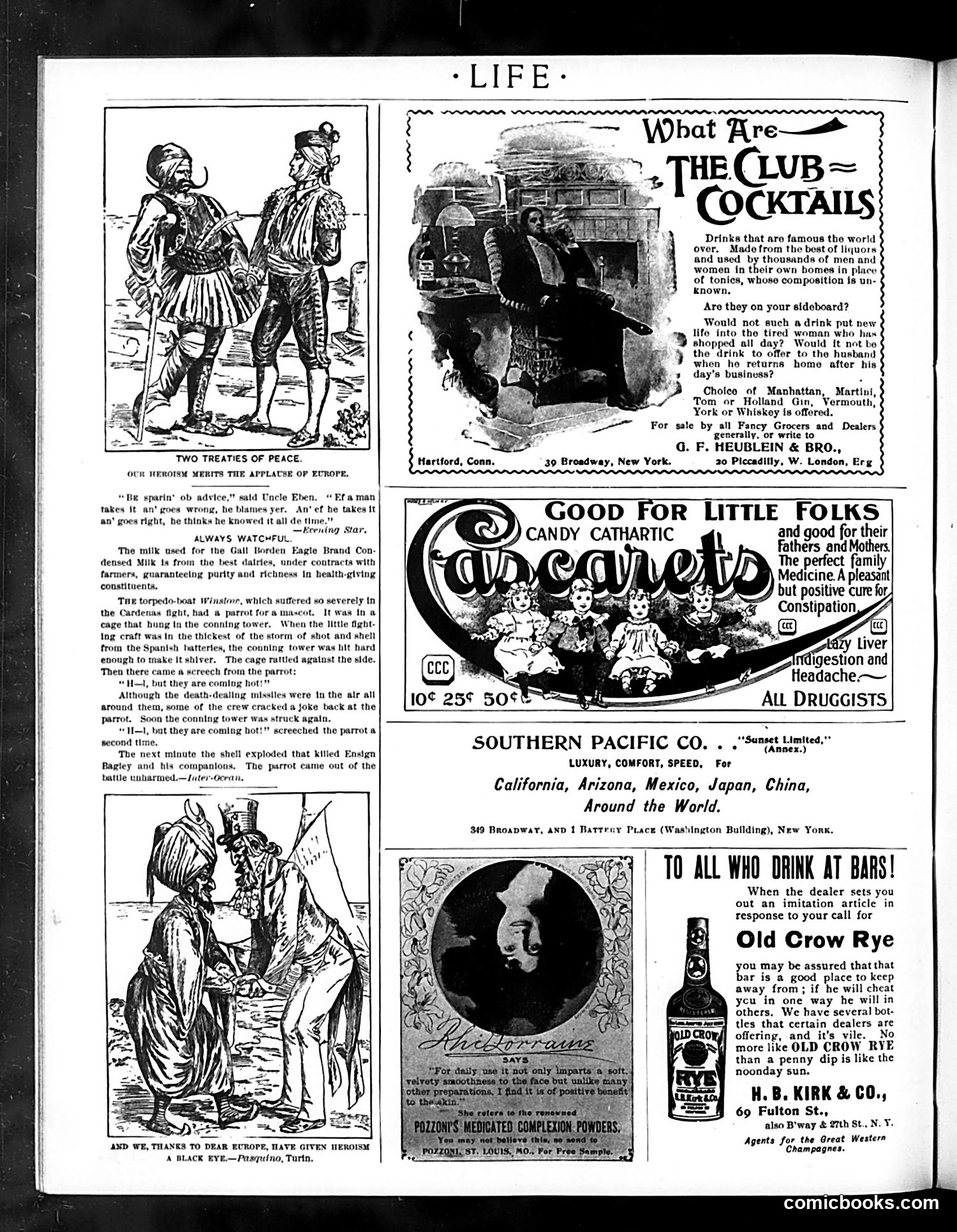
This page from *Life* magazine contains two editorial cartoons satirizing American foreign policy during the Spanish-American War era. **Top cartoon ("Two Treaties of Peace"):** Shows two figures in military/diplomatic dress shaking hands. The caption suggests this depicts peace negotiations, likely referencing treaties ending the Spanish-American War. The satire appears to mock American claims of heroism, suggesting the agreements represent compromised outcomes rather than clear victories. **Bottom cartoon:** Depicts a naval scene with a parrot in a ship's conning tower during battle. The text describes the USS *Winston* under Spanish fire; the parrot repeatedly squawks "Hi-t, but they are coming hot!" until a shell kills Ensign Bagley and others nearby. The final caption, "AND WE, THANKS TO DEAR EUROPE, HAVE GIVEN HEROISM A BLACK EYE," suggests *Life* is sarcastically criticizing American military conduct or outcomes as shameful. The page is otherwise filled with period advertisements for cocktails, candy, patent medicines, and rail travel—typical of the era.
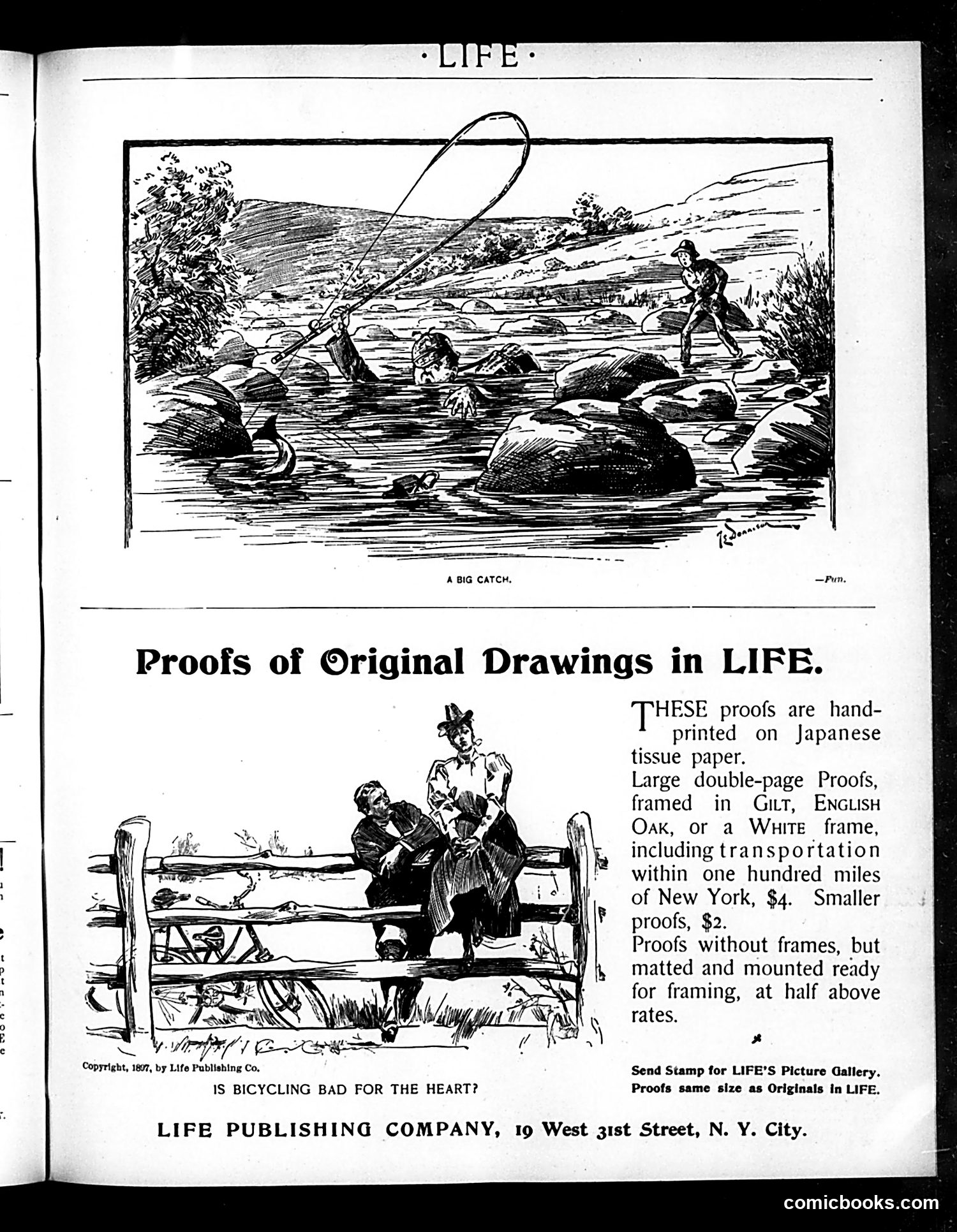
This page is primarily **advertising** for Life Publishing Company's art proofs, not political satire. The top cartoon, titled "A Big Catch," depicts a fishing scene: a man in Victorian-era clothing attempts to land what appears to be a large fish using a net, while other figures observe from the water and shore. The humor appears to be gentle—likely playing on the struggle of landing a difficult catch or possibly a romantic/social mishap (the figures' poses suggest comedy). The bottom cartoon, "Is Bicycling Bad for the Heart?", shows a couple on a bicycle together on a fence—visual wordplay suggesting romantic "heartfelt" implications of close physical proximity while cycling. Both are typical late-19th-century humor: lighthearted domestic and recreational scenes with mild innuendo. The page exists primarily to sell framed reproductions of Life's original artwork.
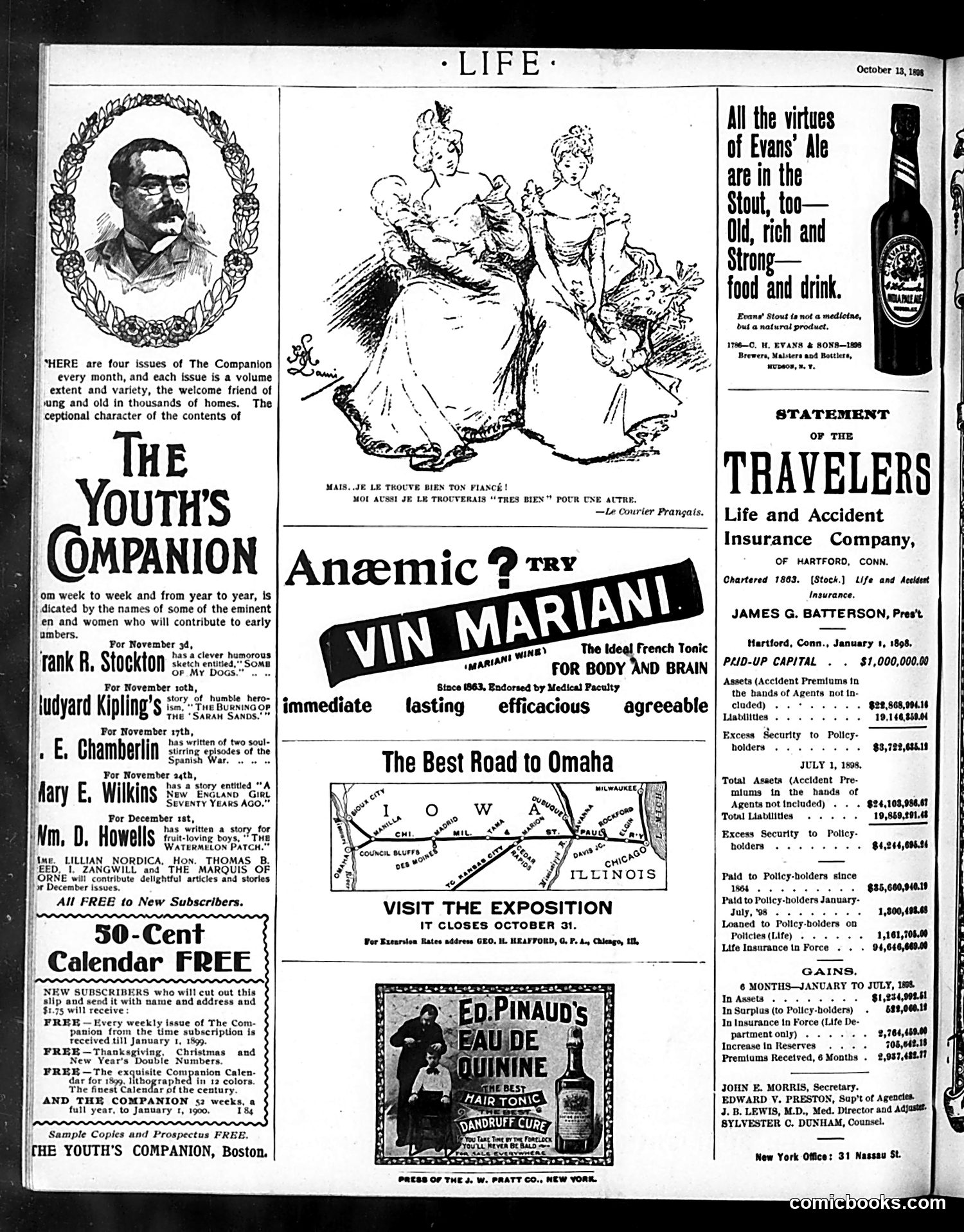
This page is primarily **advertising and subscription promotions** rather than satirical content. The central **cartoon** shows three women in period dress, with a French caption joking about a woman's fiancé being more suitable for someone else—a lighthearted commentary on romantic preferences, likely referencing contemporary French social attitudes. The bulk of the page promotes **The Youth's Companion** magazine with subscription offers and promised contributions from notable writers like Rudyard Kipling and Mary E. Wilkins. Other advertisements include Vin Mariani (a French tonic wine marketed as health-giving), Evans' Ale and Stout (beverages advertised for their nutritional properties), and Pinaud's Eau de Quinine hair tonic. There's also a small map promoting the 1898 **World's Columbian Exposition** in Chicago, which closed October 31. The **Travelers Insurance Company** financial statement occupies the right column, showing assets and policyholder payments.