
Life, 1898-10-13 · page 12 of 20
Life — October 13, 1898 — page 12: what you’re looking at
What you’re looking at
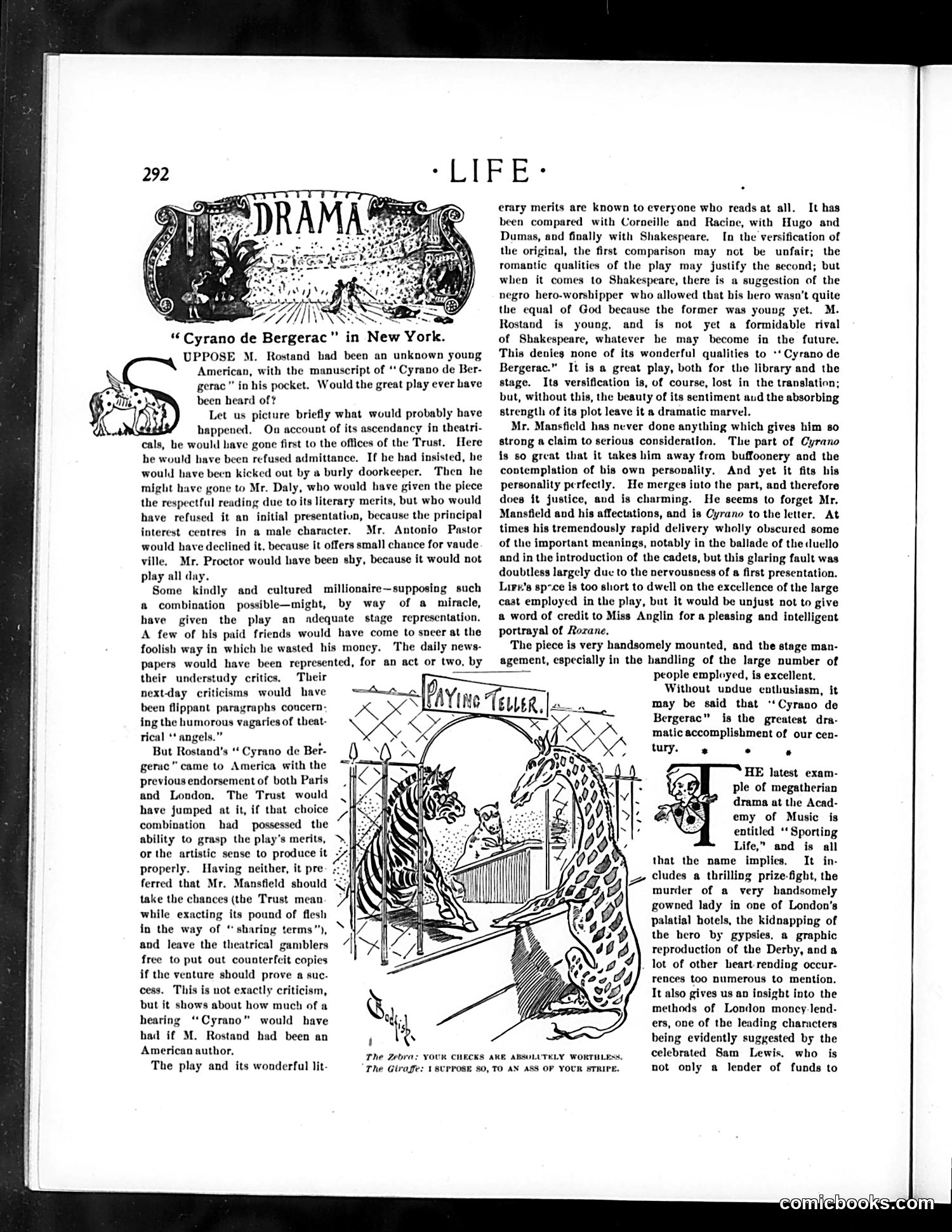
This page reviews theatrical productions. The main article discusses "Cyrano de Bergerac" in New York, praising actor Richard Mansfield's performance as matching Shakespeare's greatness. The text notes the play's French origin and literary merit, though criticizing some staging choices. The illustration depicts a scene from "Sporting Life," another play reviewed here, showing what appears to be a horse and jockey in an elaborate theatrical set. The caption references checking "cheeks" and "worthless" goods—likely satirizing either melodramatic action or the play's quality. The page exemplifies *Life* magazine's role as a cultural arbiter, offering both serious dramatic criticism and humorous commentary on New York theater circa the 1890s.
📄 Transcribed text from this page (OCR, searchable)
Machine-transcribed from the original scan — historical spelling and the odd misread are preserved.
«LIP E- “Cyrano de Bergerac” in New York. UPPOSE M. Rostand bad been an unknown young American, with the manuscript of ‘* Cyrano de Ber- gerac” in his pocket. Would the great play ever have been heard oft Let us picture briefly what would probably have happened. On account of its ascendancy in theatri- cals, he would have gone first to the offices of the Trust. Here he would have been refused admittance. If be had insisted, he would have been kicked out by a burly doorkeeper. Then he might have gone to Mr. Daly, who would have given the piece the respectful reading due to its literary merits, but who would have refused it an initial presentation, because the principal interest centres in a male character. Mr. Antonio Pastor would have declined it, because it offers small chance for vaude ville, Mr. Proctor would have been shy, because it would not play all day. Some kindly and cultured millionaire—supposing such a combination possible—might, by way of a miracle, have given the play an adequate stage representation. A few of his paid friends would have come to sneer at the foolish way in which he wasted his moncy. The daily news- papers would have been represented, for an act or two, by their understudy critics, Their next-day criticisms would have been flippant paragraphs concern. ing the humorous vagaries of theat- tical ** angels.” . But Rostand’s “Cyrano de Ber- gerac” came to America with the previous endorsement of both Paris and London. The Trust would have jumped at it, if that choice combination had possessed the ability to grasp the play's merits, or the artistic sense to produce it properly. Having neither, it pre ferred that Mr. Mansfield should take the chances (the Trust mean. while exacting its pound of flesh in the way of “ sharing terms”), and leave the theatrical gamblers free to put out counterfeit copies if the venture should prove a suc- cess. This is not exactly criticism, but it shows about how much of a hearing “Cyrano” would have had if M. Rostand had been an American author, The play and its wonderful lit- ' The Zebre The Gt YOUR CHECKS ARE ABSOLUTELY WORTHLESS, SUPPOSE $0, TO AN ASS OP YOUR STRIPE. erary merits are known to everyone who reads at all. It has been compared with Corneille and Racine, with Hugo and Dumas, and finally with Shakespeare. In the versification of the original, the first comparison may not be unfair; the romantic qualities of the play may justify the second; but when it comes to Shakespeare, there is a suggestion of the negro hero-worshipper who allowed that bis hero wasn’t quite the equal of God because the former was young yet. M. Rostand is young, and is not yet a formidable rival of Shakespeare, whatever he may become in the future. This denies none of its wonderful qualities to ** Cyrano de Bergerac.” It is a great play, both for the library and the stage. Its versification is, of course, lost in the translation; but, without this, the beauty of its sentiment aud the absorbing strength of its plot leave it a dramatic marvel. Mr. Mansfield has never done anything which gives him 80 strong a claim to serious consideration. The part of Cyrano is so great that it takes him away from buffoonery and the contemplation of bis own personality, And yet it fits his personality perfectly. He merges into the part, and therefore does it justice, and is charming. He seems to forget Mr. Mansfield and his affectations, and is Cyrano to the letter. At times his tremendously rapid delivery wholly obscured some of the important meanings, notably in the ballade of the duello and in the introduction of the cadets, but this glaring fault was doubtless largely duc to the nervousness of a first presentation. Lirr’s sp-ce is too short to dwell on the excellence of the large cast employed in the play, but it would be unjust not to give a word of credit to Miss Anglin for a pleasing and intelligent portrayal of Roxane. The piece is very handsomely mounted, and the stage man- agement, especially in the handling of the large number of cs people employed, is excellent. Without undue enthusiasm, it may be said that “Cyrano de Bergerac” is the greatest dra- matic accomplishment of our cen- ° . HE latest exam- ple of megatherian drama at the Acad- emy of Music is entitled ‘Sporting Life,” and is all that the name implies. It in- cludes a thrilling prize-fight, the murder of a very handsomely gowned lady in one of London's palatial hotels, the kidnapping of the hero by gypsies, a graphic reproduction of the Derby, anda lot of other heart-rending occur- rences too numerous to mention, It also gives us an insight into the methods of London moncy-lend- ers, one of the leading characters being evidently suggested by the celebrated Sam Lewis, who is not only a lender of funds to