
Life, 1898-10-13 · page 8 of 20
Life — October 13, 1898 — page 8: what you’re looking at
What you’re looking at
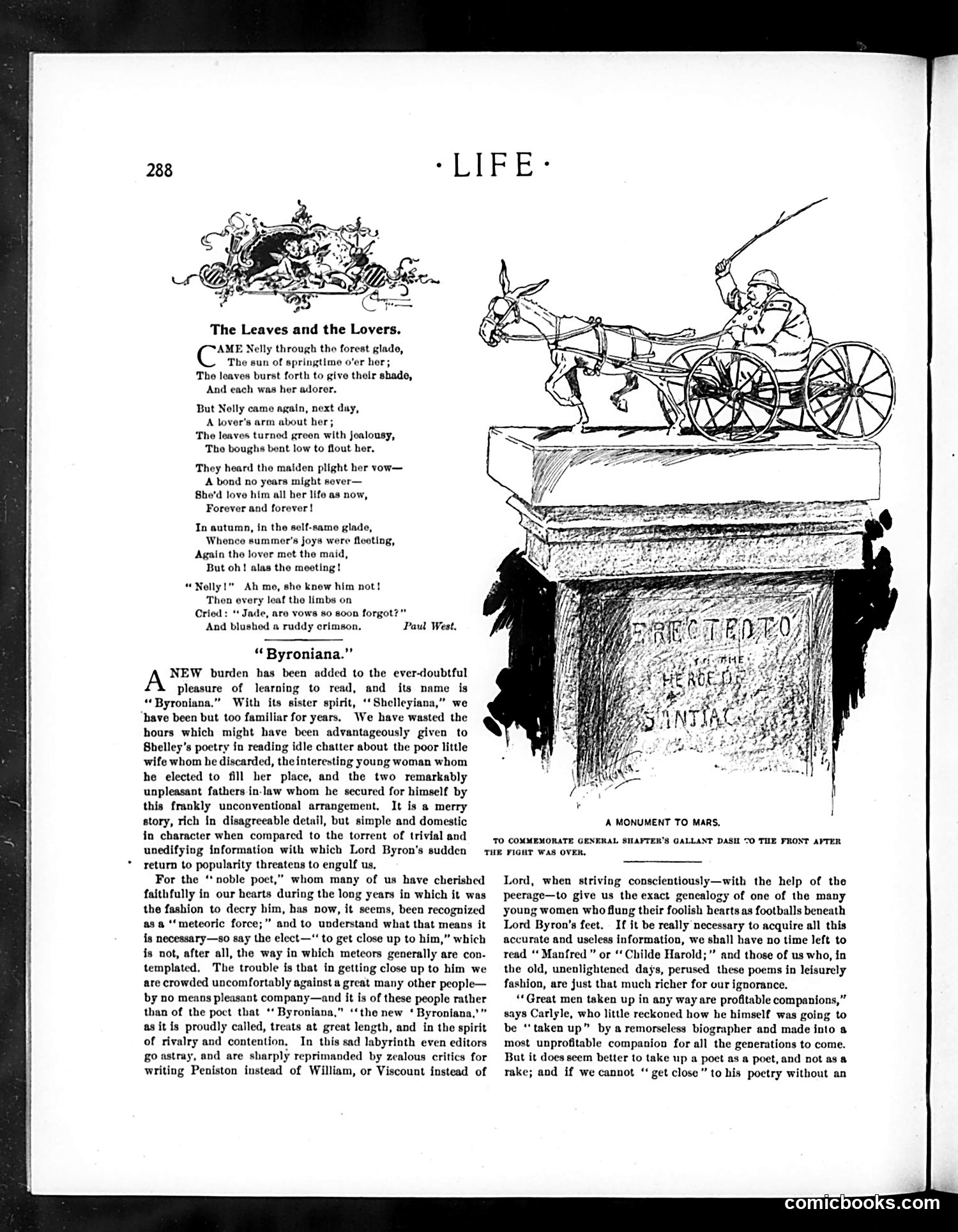
The main illustration shows a chariot driver whipping donkeys pulling a cart—a classical reference to Mars, the Roman god of war. The monument's inscription reads "ERECTED TO THE HEROES" with additional text referencing "SHAFTER'S GALLANT DASH" and concluding "THE FIGHT WAS OVER." This appears to be political satire regarding General Shafter's military campaign, likely referencing the Spanish-American War (1898). The cartoon seems critical, comparing Shafter's leadership to an incompetent charioteer driving stubborn animals—suggesting bungled military execution despite ultimate victory. The accompanying text discusses "Byroniana," treating Byron's poetry seriously rather than satirizing it, so the cartoon constitutes the page's primary satirical content.
📄 Transcribed text from this page (OCR, searchable)
Machine-transcribed from the original scan — historical spelling and the odd misread are preserved.
The Leaves and the Lovers. AME Nelly through the forest glade, ‘The sun of springtime o'er her; The leaves burst forth to give their shade, And each was her adorer. But Nelly came again, next duy, A lover's arm about her; The leaves turned green with jealousy, The boughs bent low to flout her. They heard tho maiden plight her vow— ‘A bond no years might sever— Bho'd love him all her life as now, Forever and forever! In autumn, in the self-same glade, Whenco summor’s joys were fleoting, Again the lover met the maid, But oh! alas the meeting! “Nelly!” Ah mo, she knew him not! Thon every leat the limbs on Cried : “Jade, aro vows 80 soon forgot?” And blushed a ruddy crimson, Paul West. “ Byroniana.” NEW burden has been added to the ever-doubtful pleasure of learning to read, and its name is “Byroniana.” With its sister spirit, ‘‘Shclleyiana,” we have been but too familiar for years, We have wasted the hours which might have been advantageously given to Bhelley’s poetry in reading idle chatter about the poor little wife whom he discarded, the interesting young woman whom he elected to fill her place, and the two remarkably unpleasant fathers. in-law whom he secured for himself by this frankly unconventional arrangement. It is a merry story, rich In disagreeable detail, but simple and domestic in character when compared to the torrent of trivial and unedifying information with which Lord Byron's sudden return to popularity threatens to engulf us, For the ‘noble poet,” whom many of us have cherished faithfully in our hearts during the long years in which it was the fashion to decry him, has now, it seems, been recognized asa ‘‘meteoric force;” and to understand what that means it is necessary—so say the elect—“‘ to get close up to him,” which is not, after all, the way in which meteors generally are con- templated. The trouble is that in getting close up to him we are crowded uncomfortably against a great many other people— by no means pleasant company—and it is of these people rather than of the poct that ‘‘ Byroniana,” ‘‘the new ‘ Byroniana,’” as itis proudly called, treats at great length, and in the spirit of rivalry and contention, In this sad labyrinth even editors go astray, and are sharply reprimanded by zealous critics for writing Peniston instead of William, or Viscount instead of ‘A MONUMENT TO MARS, TO COMMEMORATE GENERAL SIAPTER'S GALLANT DASIL 70 TUE FRONT AFTER THE FIGHT WAS OVER. Lord, when striving conscientiously—with the help of the Peerage—to give us the exact gencalogy of one of the many young women who flung their foolish hearts as footballs beneath Lord Byron's feet. If it be really necessary to acquire all this accurate and useless information, we shall have no time left to read “ Manfred” or ‘Childe Harold;” and those of us who, in the old, unenlightened days, perused these poems in leisurely fashion, are just that much richer for our ignorance. “*Great men taken up in any way are profitable companions,” says Carlyle, who little reckoned how he himself was going to be ‘‘taken up” by a remorseless biographer and made into a most unprofitable companion for all the generations to come. But it does seem better to take up a poet as a poet, and not asa rake; and if we cannot “‘ get close” to his poetry without an comicbooks.com