
Life, 1898-10-13 · page 4 of 20
Life — October 13, 1898 — page 4: what you’re looking at
What you’re looking at
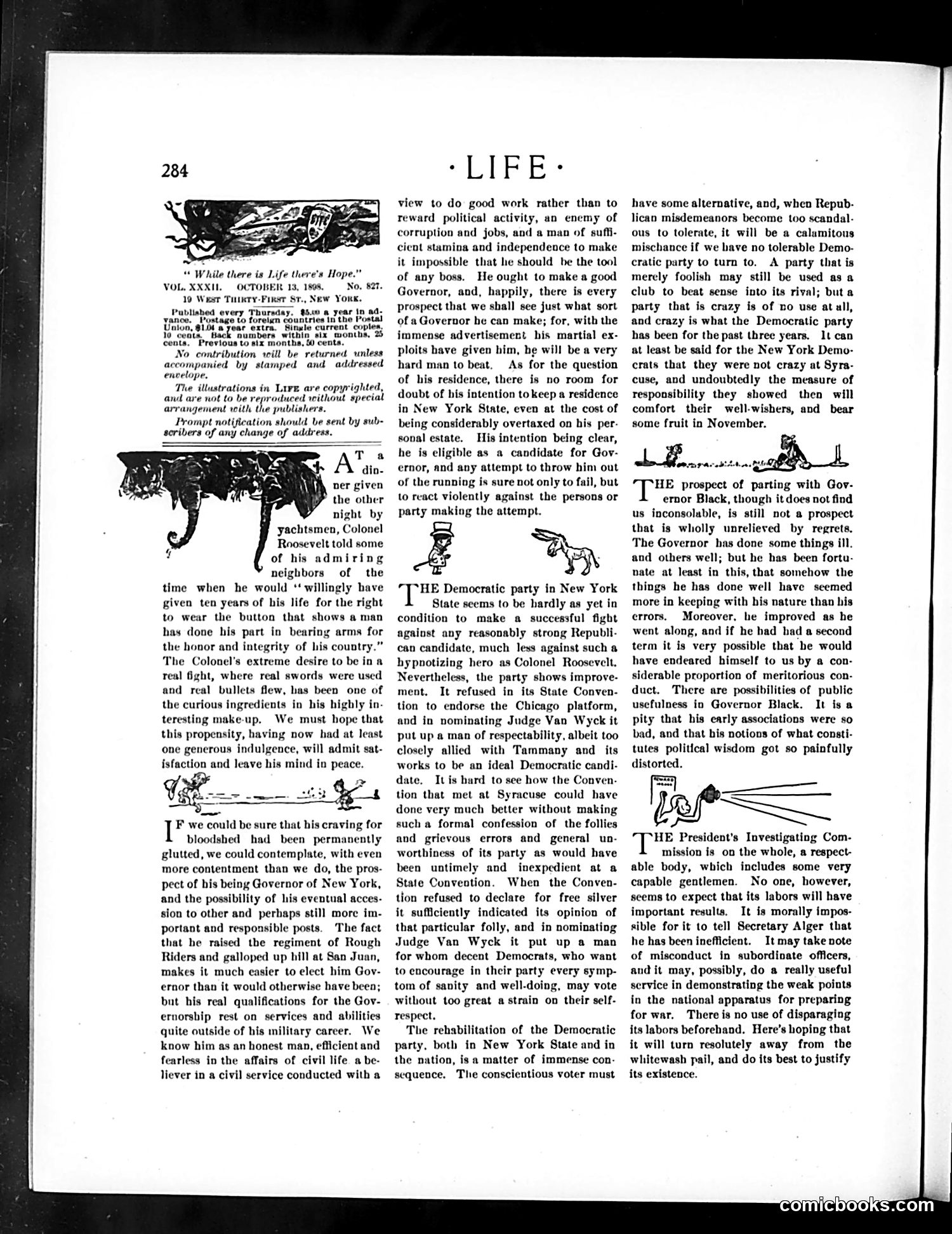
This editorial page discusses New York State politics, specifically Governor Theodore Roosevelt's potential candidacy and the Democratic Party's response. The cartoons appear to satirize political maneuvering around the 1906 elections. The text criticizes the Democratic Party's weaknesses—particularly their nomination of Judge Van Wyck and their embrace of the Chicago platform on free silver, described as outdated "folly." The author argues the party shows some improvement but remains hampered by poor judgment and association with Tammany Hall. The cartoons (though small and difficult to interpret with certainty) appear to mock the various political figures and their positions through animal caricatures, a common satirical technique in Life magazine during this era. The overall message criticizes Democratic Party missteps while acknowledging some progress.
📄 Transcribed text from this page (OCR, searchable)
Machine-transcribed from the original scan — historical spelling and the odd misread are preserved.
While there is Life there's Hope.” VOL, XXXIL- OCTOBER 13, 1898, No, 827. 19 West Tuk. New You«. Published every ‘Thureday, $5.0 @ year in ad. age Lo foreign countries in the Postal 01 a year extra. Sinule current coples, Back numbers within six months, 25 conte. Previous to six months, @ cents. No contribution will be returned unless accompanied by stamped and addressed envelope. The illustrations in Lire are copyrighted, and are not to be reproduced without special arrangement with the publishers. Prompt notification should be sent by sub- scribers of any change of address. Ta din- ner given the other night by yachtsmen, Colonel Roosevelt told some of his admiring neighbors of the time when he would ‘ willingly bave given ten years of his life for the right to wear the button that shows a man has done his part in bearing arms for the honor and integrity of his country.” The Colonel's extreme desire to be ina real fight, where real swords were used and real bullets flew, has been one of the curious ingredients in his highly in- teresting make-up. We must hope that this propensity, having now had at least one generous indulgence, will admit sat- isfaction and leave his mind in peace. af. F we could be sure that bis craving for bloodshed had been permanently glutted, we could contemplate, with even more contentment than we do, the pros- pect of bis being Governor of New York, and the possibility of his eventual acces- sion to other and perbaps still more im- portant and responsible posts. The fact that he raised the regiment of Rough Riders and galloped up hill at San Juan, makes it much easier to elect him Gov- ernor than it would otherwise have been; but his real qualifications for the Gov- ernorsbip rest on services and abilities quite outside of his military career. We know him as an honest man, efficient and fearless in the affairs of civil life a be- liever in a civil service conducted with a LIFE view to do good work rather than to reward political activity, an enemy of corruption and jobs, and a man of sufi- cient stamina and independence to make it impossible that he should be the tool of any boss. He ought to make a good Governor, and, happily, there is every prospect that we shall see just what sort of a Governor he can make; for, with the immense advertisement his martial ex- ploits have given him, be will be a very hard man to beat, As for the question of his residence, there is no room for doubt of his intention tokeep a residence in New York State, even at the cost of being considerably overtaxed on his per- sonal estate. His intention being clear, he is eligible as a candidate for Gov- ernor, and any attempt to throw him out of the running is sure not only to fail, but to react violently against the persons or party making the attempt. TH Democratic party in New York State seems to be hardly as yet in condition to make a successful fight against any reasonably strong Republi- can candidate, much less against such a hypnotizing hero as Colonel Roosevelt. Nevertheless, the party shows improve- ment. It refused in its State Conven- tion to endorse the Chicago platform, and in nominating Judge Van Wyck it put up a man of respectability, albeit too closely allied with Tammany and its works to be an ideal Democratic candi- date, It is hard to see how the Conven- tion that met at Syracuse could have done very much better without making such a formal confession of the follies and grievous errors and general un- worthiness of its party as would have been untimely and inexpedient at a State Conveotion. When the Conven- tion refused to declare for free silver it sufficiently indicated its opinion of that particular folly, and in nominating Judge Van Wyck it put up a man for whom decent Democrats, who want to encourage in thcir party every symp- tom of sanity and well-doing, may vote without too great a strain on their self- respect. The rehabilitation of the Democratic party, both in New York State and in the nation, isa matter of immense con- sequence. The conscientious voter must have some alternative, and, when Repub- lican misdemeanors become too scandal- ous to tolerate, it will be a calamitous mischance if we have no tolerable Demo- cratic party to turn to. A party that is merely foolish may still be used as a club to beat sense into its rival; but a party that is crazy is of no use atall, and crazy is what the Democratic party has been for the past three years. lt can at least be said for the New York Demo- crats that they were not crazy at Syra- cuse, and undoubtedly the measure of responsibility they showed then will comfort their well-wishers, and bear some fruit in November. Ld a oe ‘HE prospect of parting with Gov- ernor Black, though it does not find us inconsolable, is still not a prospect that is wholly unrelieved by regrets. The Governor has done some things ill. and others well; but he has been fortu- nate at least in this, that somehow the things he has done well have seemed more in keeping with his nature than his errors. Moreover, he improved as he went along, and if he had had a second term it is very possible that he would have endeared himself to us by a con- siderable proportion of meritorious con- duct. There are possibilities of public usefulness in Governor Black. It is a pity that his early associations were so bad, and that bis notions of what consti- tutes political wisdom got so painfully distorted. HE President's Investigating Com- mission is on the whole, a respect- able body, which includes some very capable gentlemen. No one, however, seems to expect that its labors will have important results, It is morally impos- sible for it to tell Secretary Alger that he has been inefficient. It may take note of misconduct in subordinate officers, and it may, possibly, do a really useful service in demonstrating the weak points in the national apparatus for preparing for war, There is no use of disparaging its labors beforehand. Here’s hoping that it will turn resolutely away from the whitewash pail, and do its best to justify its existence.