
A complete issue · 20 pages · 1898
Life — October 6, 1898
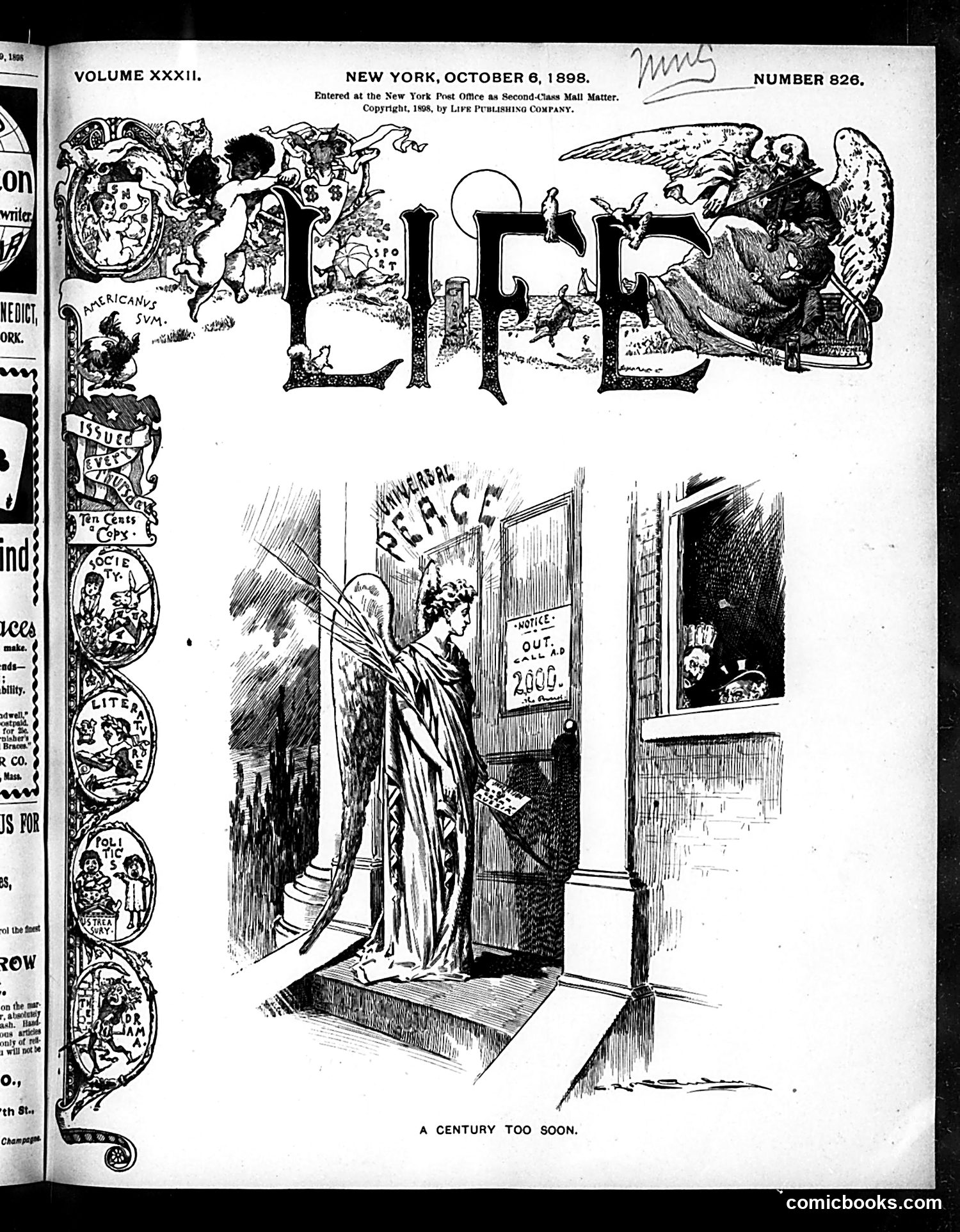
This Life magazine cover from October 6, 1898, depicts Lady Liberty (recognizable by her classical robes and pose) standing at a doorway marked "Universal Peace" with a notice reading "OUT OF ORDER 2000—" The cartoon satirizes optimistic predictions about world peace. The "2000" date suggests that peace advocates claimed peace would arrive by the year 2000, which the cartoonist considers absurdly distant—"a century too soon" to expect it actually to occur. This reflects 1898 pessimism about international conflicts, likely referencing ongoing imperial tensions and wars of that era. The satire mocks naive progressivism by suggesting that achieving universal peace requires far more than a century to accomplish.
This page is primarily **advertising and announcements** rather than political satire. The content includes: - A recommendation for *The Evening Post* as a source for international affairs - Advertisement for The Marvex Glove (kid leather gloves) by B. Allman & Co., New York - Announcement of Louise & Co. Milliners' relocation to 564 Fifth Avenue, opening Tuesday, October 11th - Advertisement for Arnold, Constable & Co.'s autumn novelties in fabrics - **Life Publishing Company announcement** offering proofs of original drawings on Japanese tissue paper, framed or unframed, with pricing details - A small **illustration of a fashionable woman** in early 20th-century dress with feathered hat, likely decorative rather than satirical The page reflects early 1900s consumer culture and *Life* magazine's business operations rather than containing political commentary.
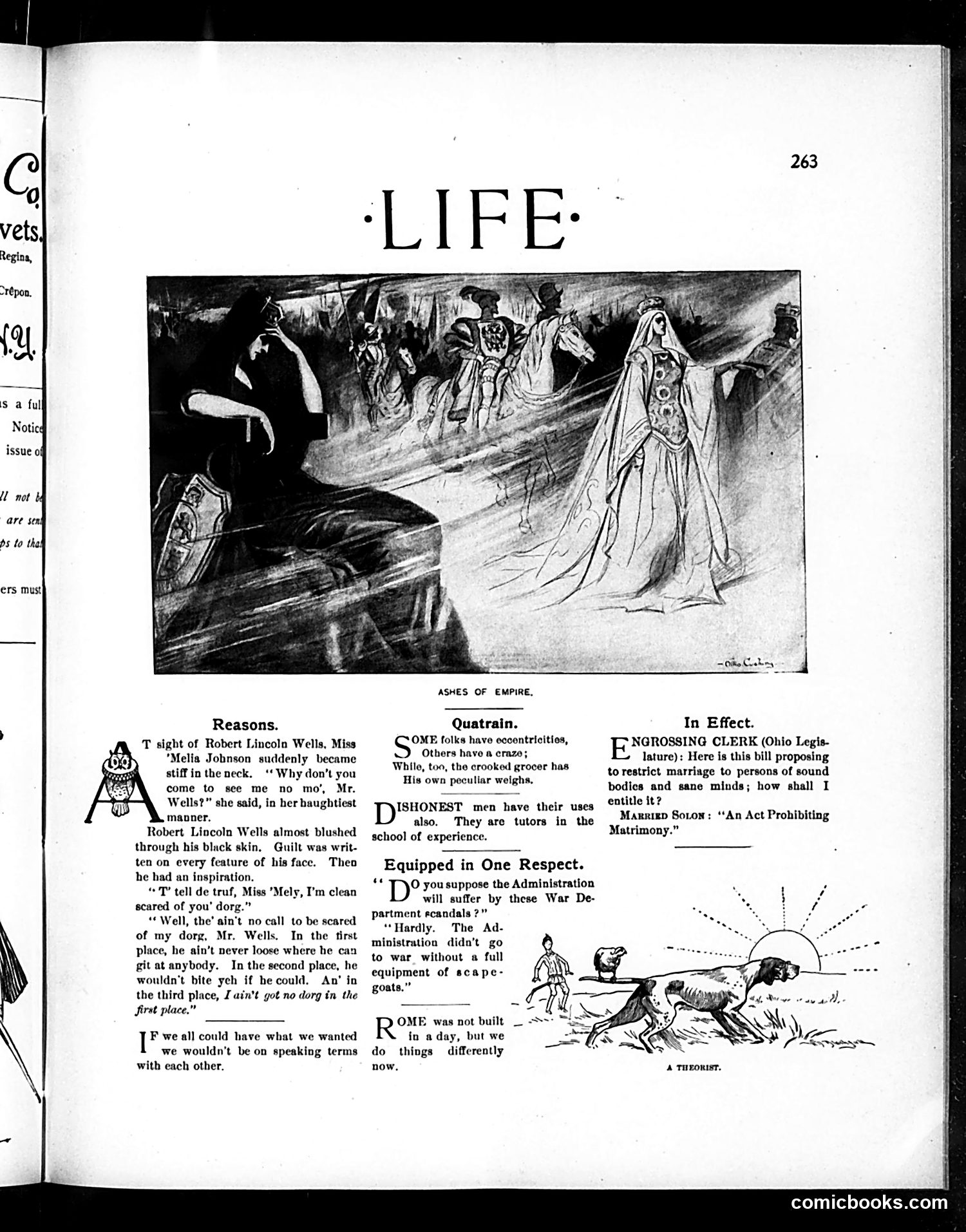
This page contains three separate satirical pieces: **"Ashes of Empire"** (top illustration): Depicts a woman in elaborate robes confronting a kneeling figure, likely referencing imperial decline or political upheaval, though the specific historical reference is unclear without additional context. **"Reasons"/"Quatrain"/"In Effect"** (left-center): A humorous anecdote about Robert Lincoln Wells and "Miss Melia Johnson" involving accusations of infidelity and household servants' loyalty—domestic satire rather than political commentary. **"A Theorist"** (bottom-right cartoon): Shows a figure theorizing while a goat pulls in opposite directions, satirizing impractical idealism divorced from reality—a common Life magazine theme criticizing politicians or reformers whose theories don't match practical outcomes. The page's satire targets personal morality, administrative incompetence, and theoretical naiveté rather than specific current events.
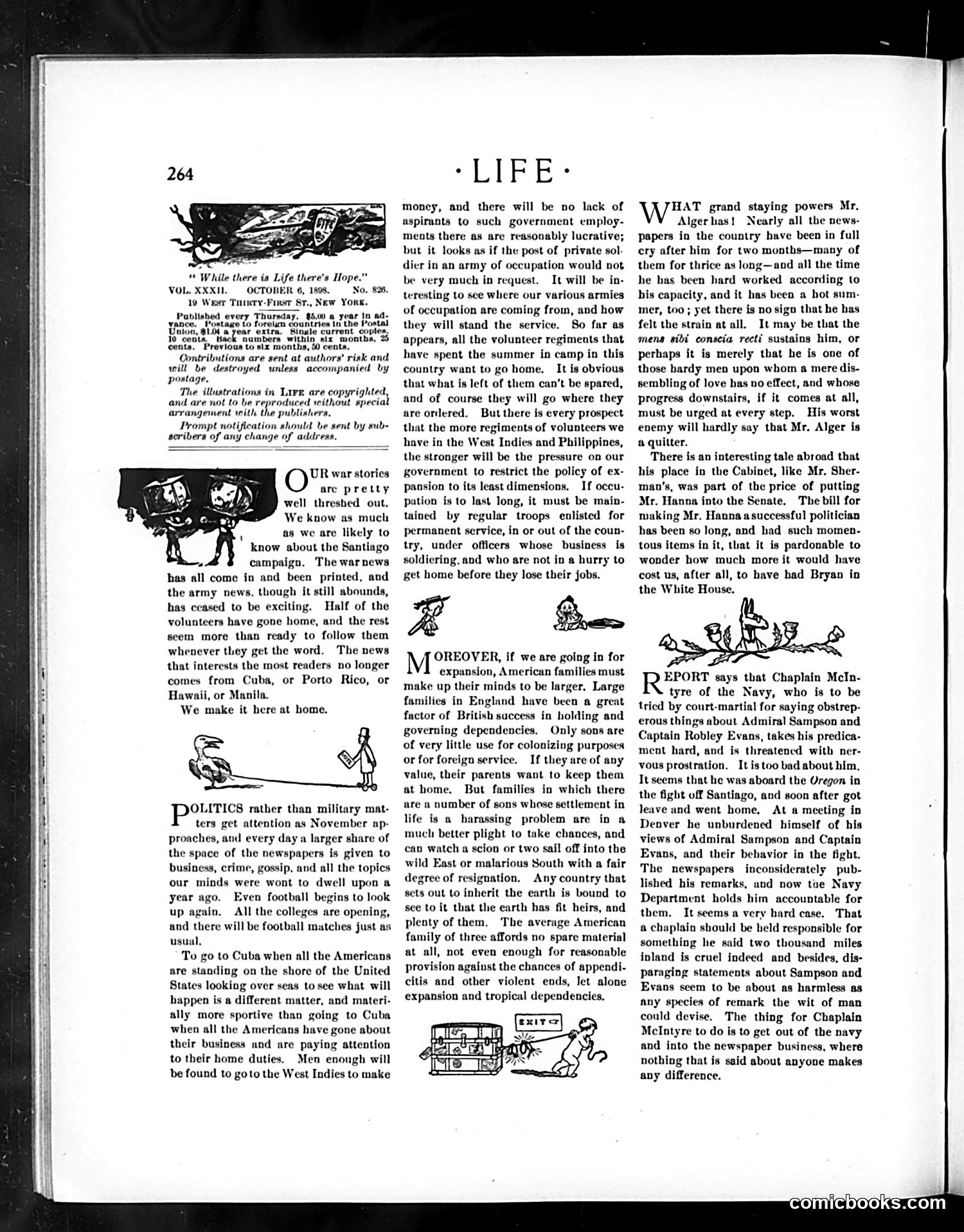
This page contains editorial discussion of American military expansion during the Spanish-American War era. The text addresses debates about U.S. occupation forces in Cuba, Puerto Rico, and the Philippines, discussing whether volunteer soldiers should return home and whether American expansion serves national interests. The cartoons (small illustrations scattered throughout) appear to be humorous visual commentary on these military and political topics, though specific figures are difficult to identify clearly in this reproduction. The central argument critiques concerns about military occupation policy and family separation, while defending American expansion as necessary. References to "Mr. Alger" likely concern Secretary of War Russell Alger, a prominent figure in Spanish-American War administration. The piece reflects 1898 debates over America's new imperial role.
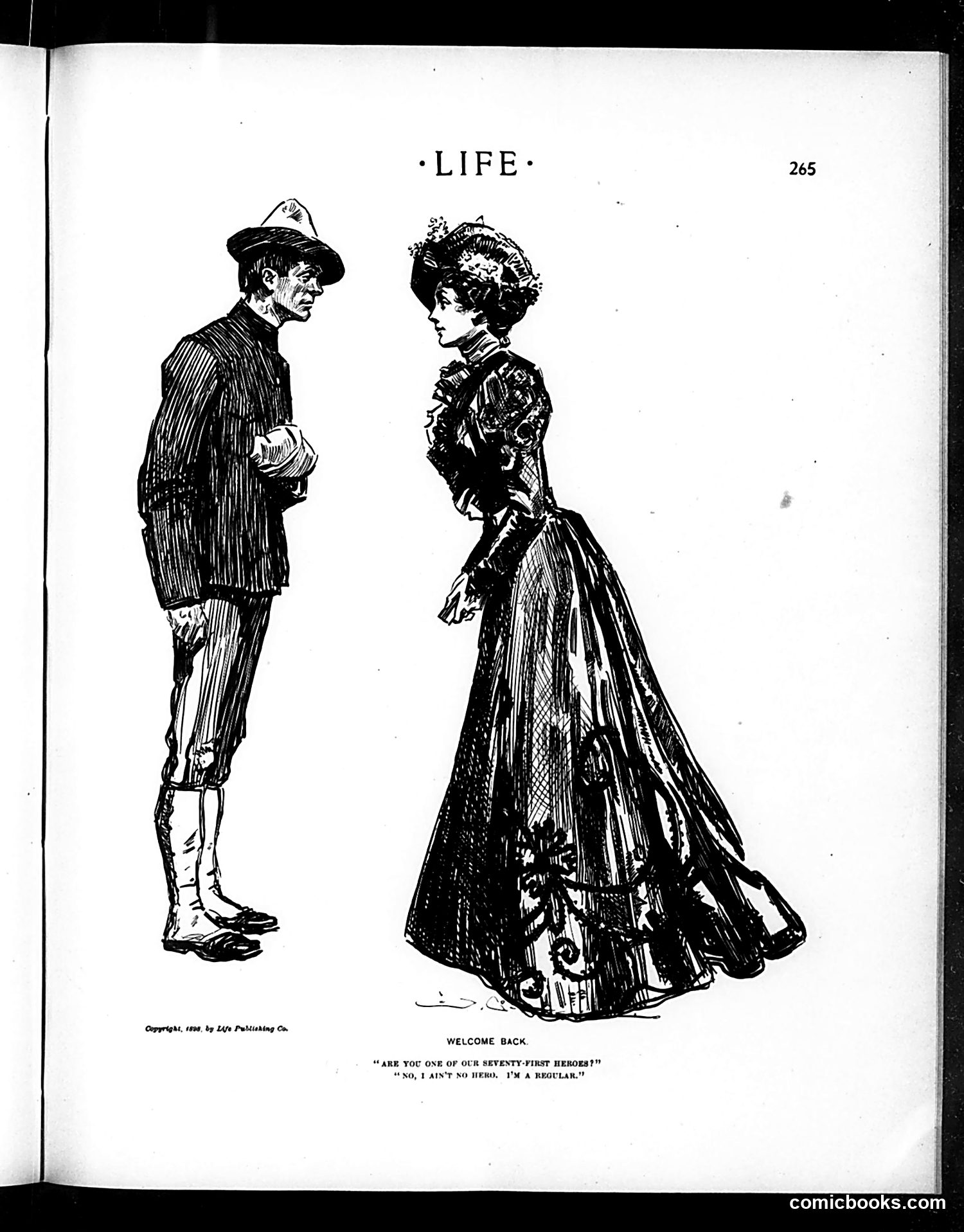
This satirical cartoon from Life magazine depicts a reunion between a returning soldier and a woman. The title "Welcome Back" and dialogue below—"Are you one of our seventy-first heroes?" / "No, I ain't no hero. I'm a regular."—suggest this addresses post-WWI homecoming attitudes. The cartoon likely satirizes the public's tendency to lionize returning soldiers as heroes, while the soldier himself modestly disclaims such status, identifying as merely "regular." The woman's fashionable dress and the soldier's worn uniform emphasize their different experiences during wartime. The satire appears to critique either excessive hero-worship of veterans or the disconnect between civilian expectations and soldiers' own self-perception regarding their service. The copyright date (1898, per OCR) seems inconsistent with WWI references, suggesting possible dating error.
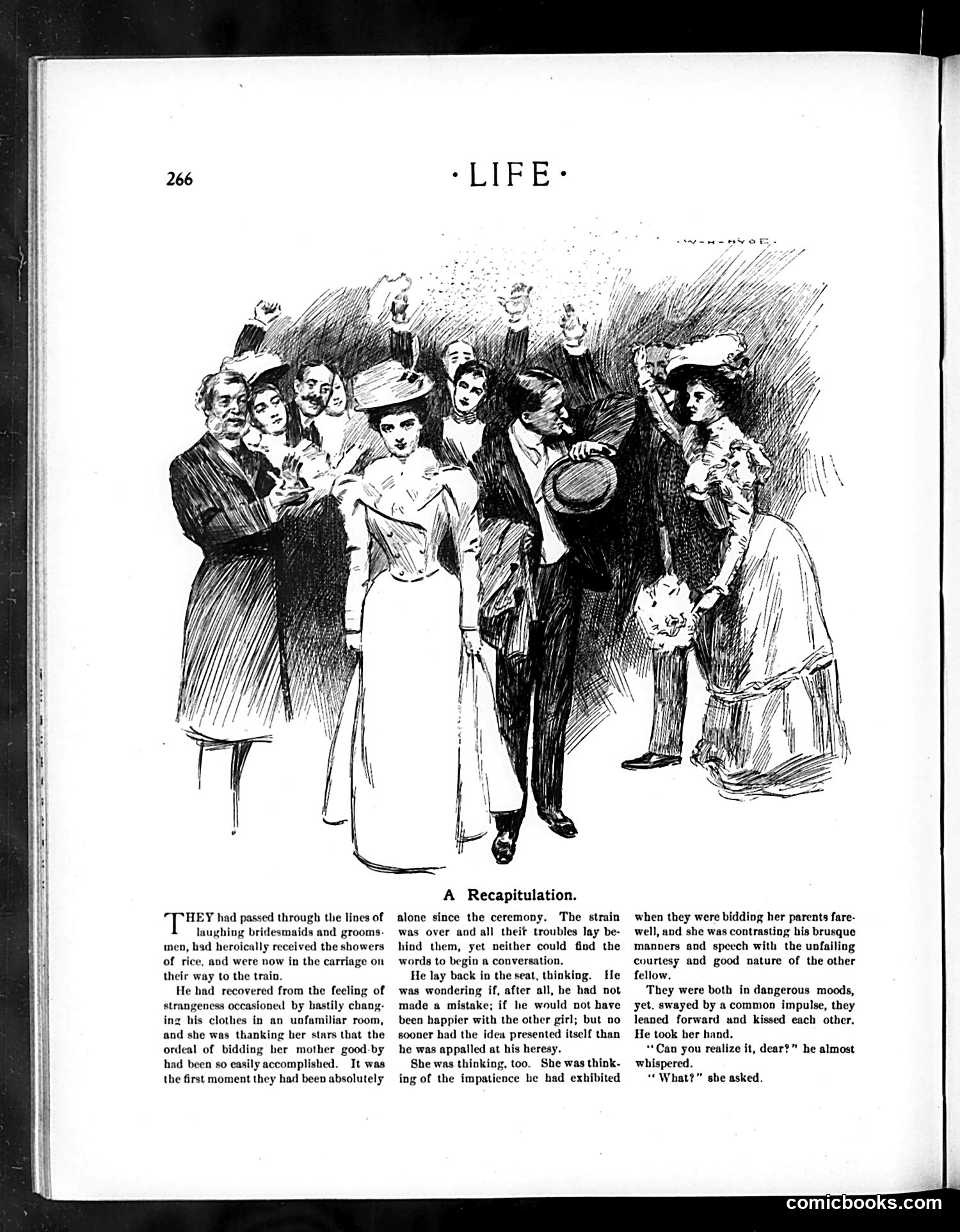
This illustration depicts a wedding scene with the newlyweds at center, surrounded by wedding guests including bridesmaids, groomsmen, and other attendees. The caption title "A Recapitulation" suggests this shows the couple after their ceremony. The accompanying text describes the couple's emotional state post-wedding: the bride feels relief that the challenging ordeal of the wedding itself has concluded, while the groom remains uncertain whether he made the right decision. Both are in "dangerous moods," yet a "common impulse" draws them together romantically. This appears to be satirical commentary on marriage anxieties—depicting the bride's focus on surviving the wedding event itself, contrasted with the groom's doubts about the commitment he's just made. The humor targets stereotypical newlywed emotions rather than specific political figures or events.
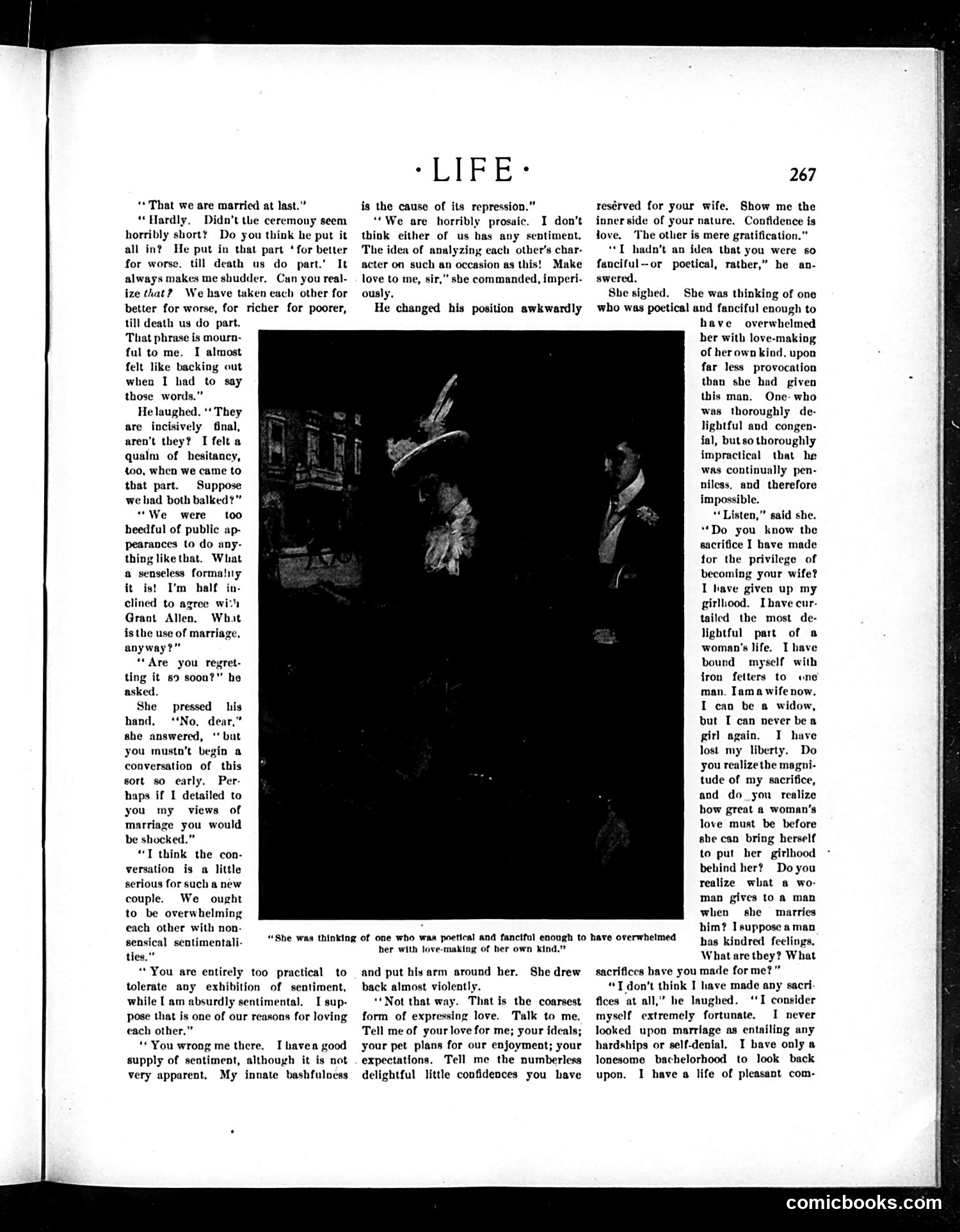
This page contains a **domestic drama scene** rather than political satire. The illustration shows a couple in what appears to be a heated marital dispute. The man stands confrontationally while the woman gestures emotionally. The accompanying text depicts a philosophical argument about marriage itself. The couple debates whether matrimony requires sentiment or practicality, with the woman arguing she's sacrificed her girlhood and freedom as a wife, while the man contends that excessive sentimentality is impractical. This appears to be **satirizing contemporary marriage debates** of the early 1900s—specifically tensions between romantic idealism and pragmatic views of marriage. The satire targets both partners' positions: her emotional appeals versus his dismissive rationalism, reflecting era-specific gender role conflicts and changing attitudes toward matrimony.
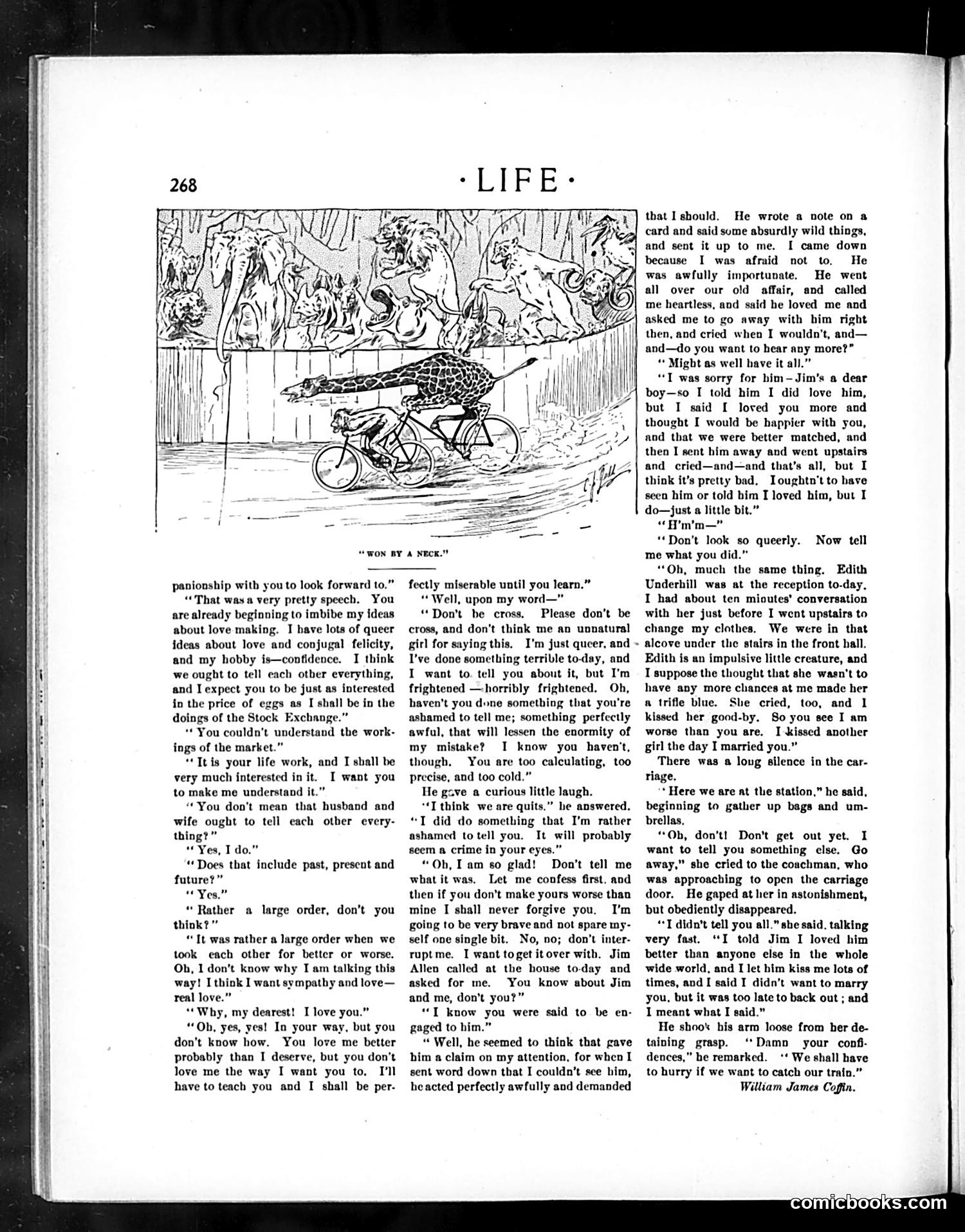
This cartoon depicts a woman riding a bicycle past an elaborate decorative relief or mural. The title "Won by a Neck" is a horse-racing idiom meaning a narrow victory. The accompanying story, credited to William James Colton, describes a romantic conflict between two men competing for a woman's affection. The narrative suggests the woman has chosen one suitor over another in what appears to be a close decision. The bicycle—a modern conveyance associated with women's independence and mobility in the late 19th/early 20th century—may symbolize the woman's agency and freedom in making her own choice. The racing metaphor combined with the bicycle imagery humorously frames romantic competition through the lens of contemporary sports and transportation.
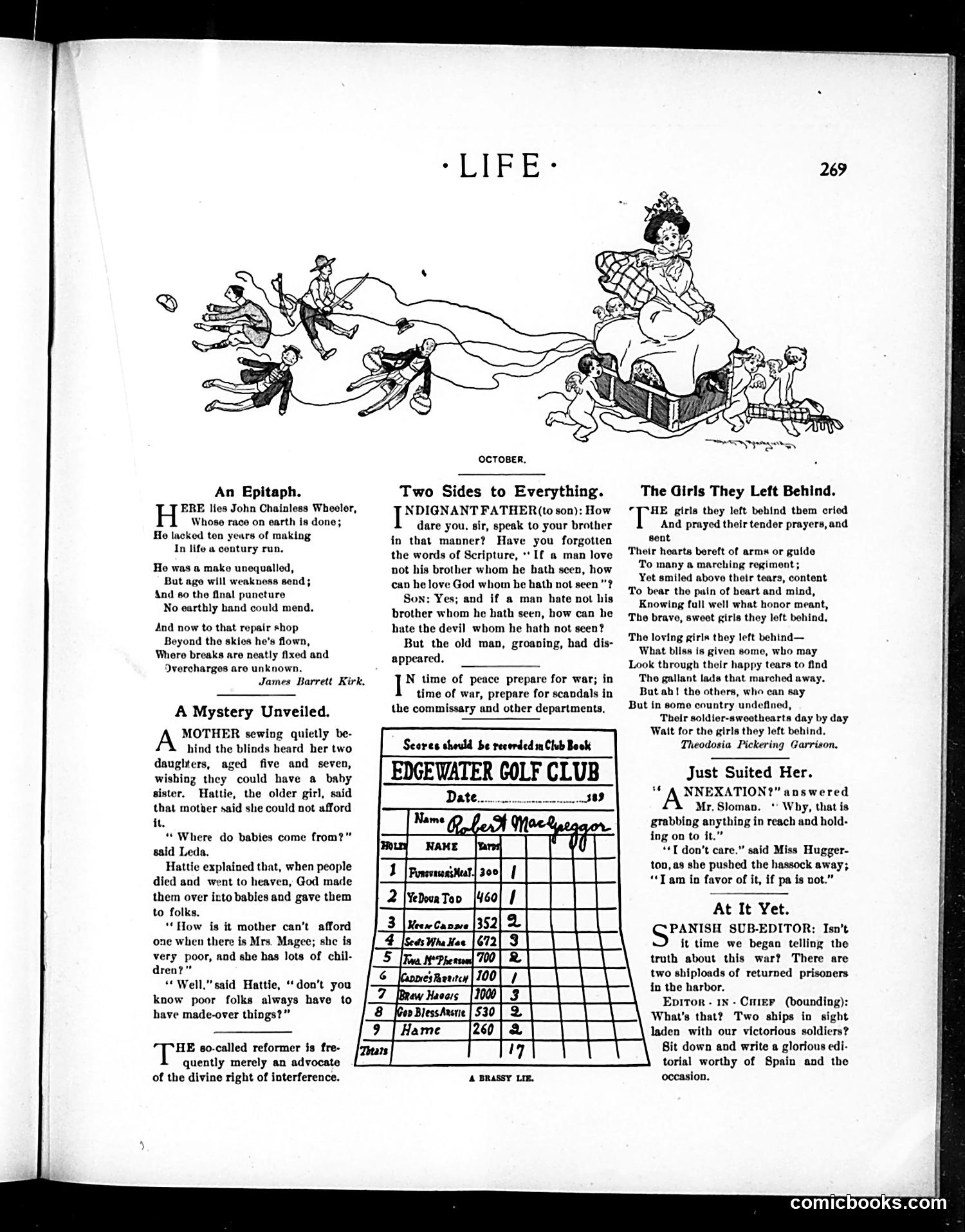
This page contains several humorous pieces typical of early-20th-century Life magazine, mixing social commentary with light satire. **"Two Sides to Everything"** depicts an "indignant father" confronting his son about proper behavior and brotherly love, using religious language. The satire mocks paternal lectures about morality. **"The Girls They Left Behind"** is a sentimental poem about women waiting for soldiers, referencing military service and wartime separation—likely from the WWI era based on the tone. **"Just Suited Her"** jokes about a woman named Miss Sloman rejecting an "annexation" proposal, using political language to describe marriage refusal—satire on both matrimony and possibly imperial expansion rhetoric. **"At It Yet"** ridicules a Spanish sub-editor spreading exaggerated war stories about captured ships, mocking propaganda and nationalist boasting. The **golf scorecard** is authentic advertising, not satire.
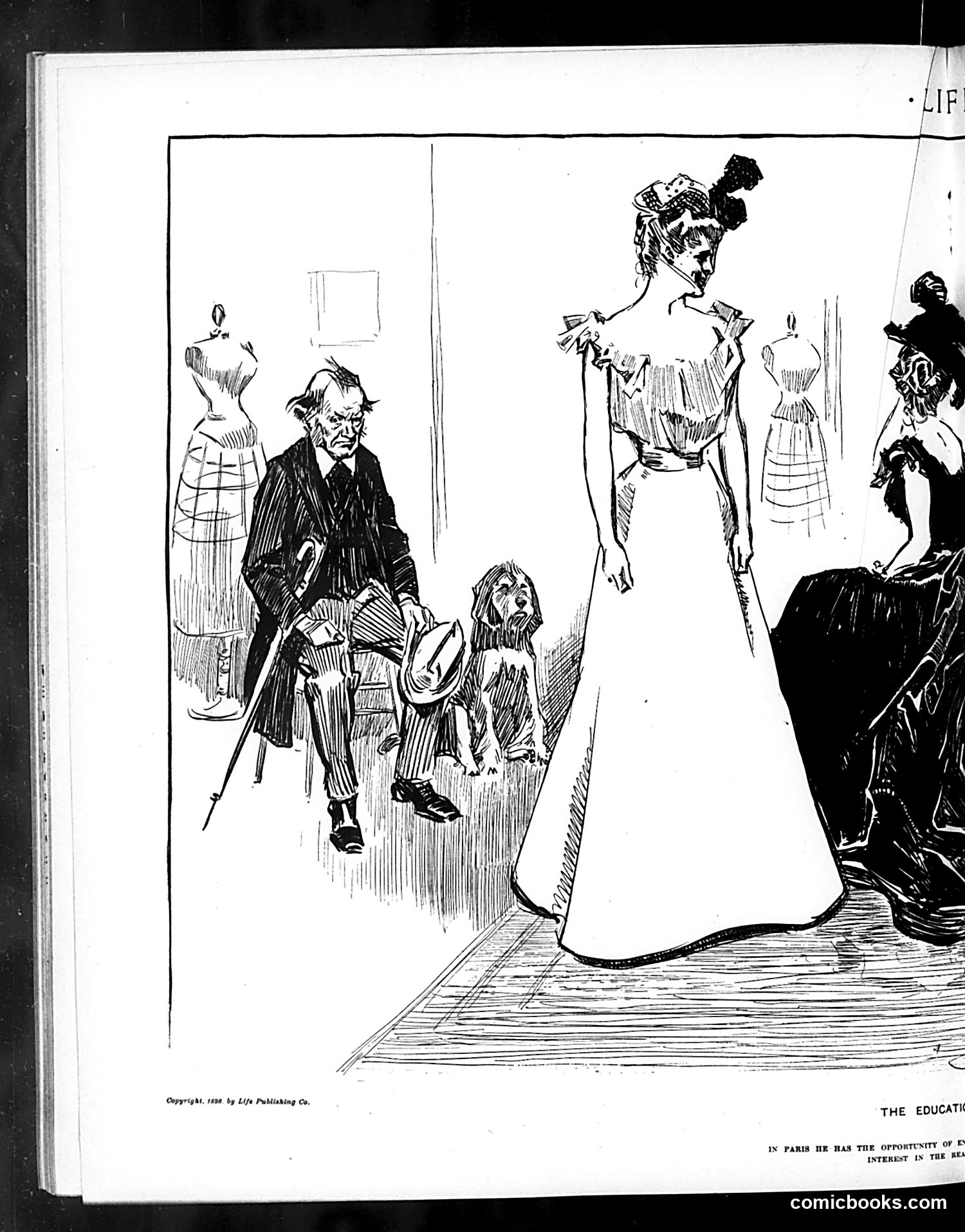
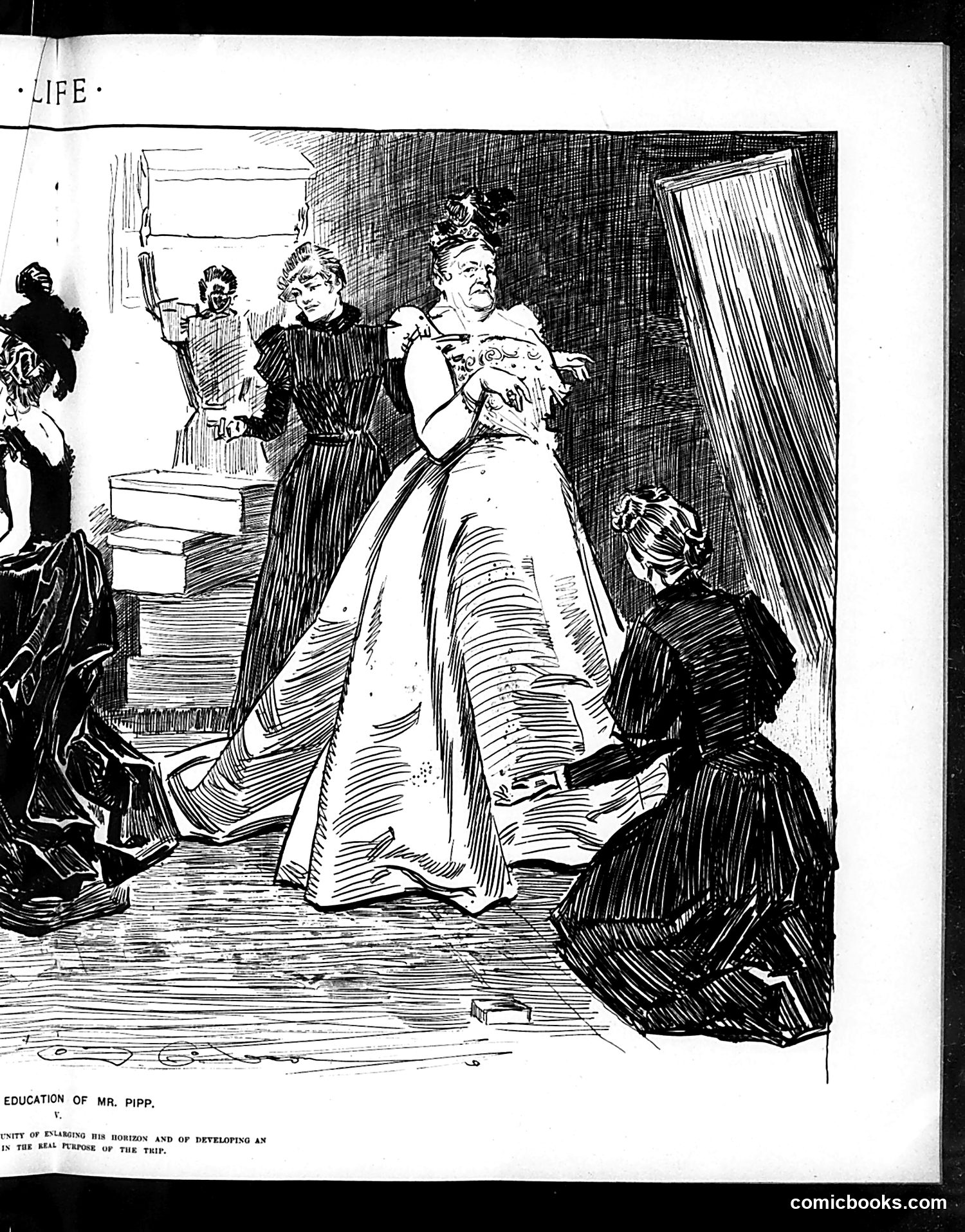
This Life magazine cartoon satirizes the social "education" of a wealthy or prominent man named Mr. Pipp through his interactions with fashionable society. The scene depicts what appears to be a formal social gathering where well-dressed women in elaborate gowns and hats attend to or instruct Pipp—suggesting he's being refined or indoctrinated into proper high-society behavior and etiquette. The caption mentions "expanding his horizon and of developing an in the real purpose of the trip," implying Pipp is undergoing some form of social cultivation or being taught society's expectations. The satire likely mocks how wealthy men are "educated" by society women and social conventions rather than through genuine intellectual or moral development.
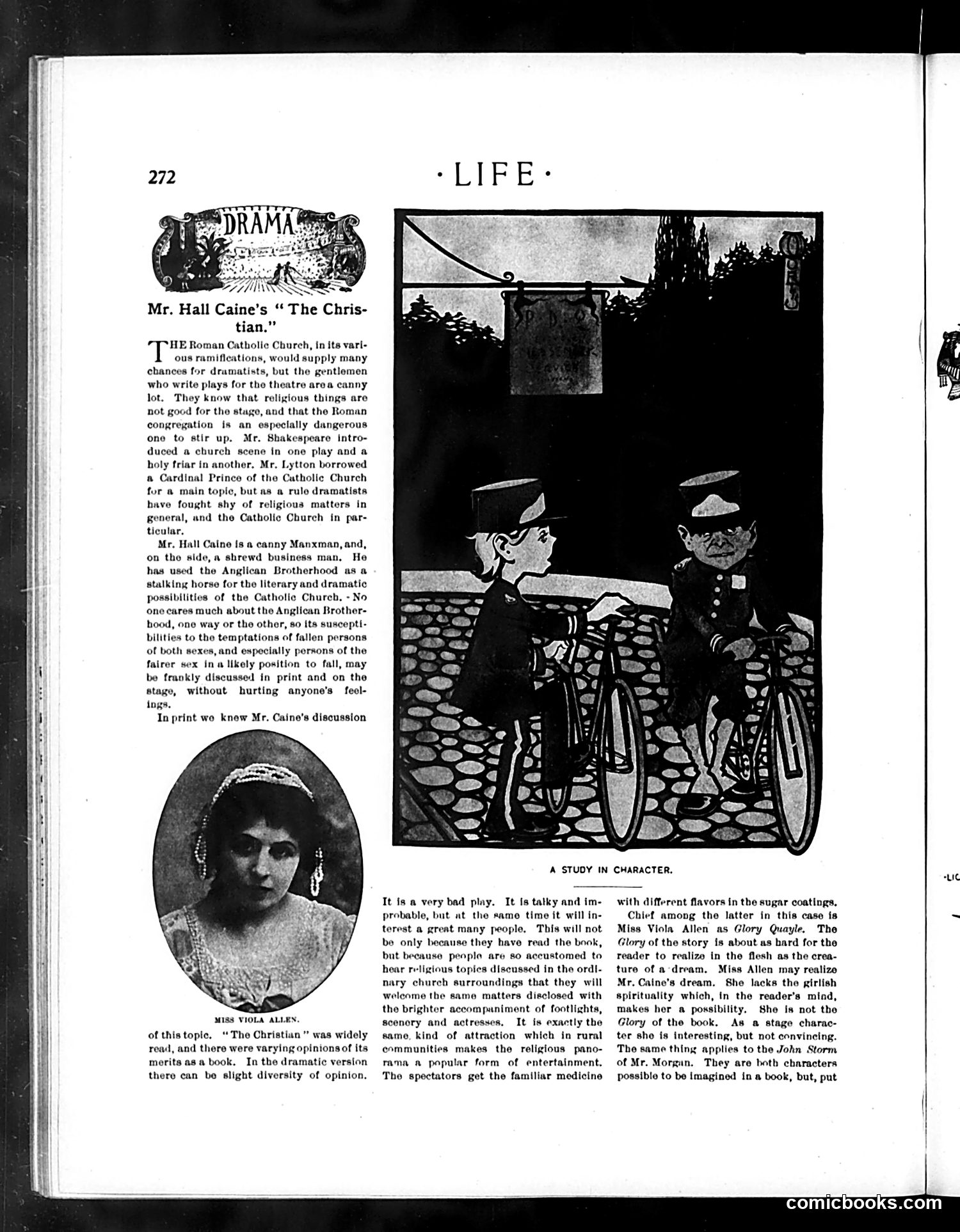
This page reviews Mr. Hall Caine's play "The Christian," which the text criticizes as "a very bad play" that is "talky and improbable." The central image shows two figures on bicycles—"A Study in Character"—appearing to illustrate contrasting moral types, likely referencing the play's themes. The accompanying text discusses Miss Viola Allen's performance as "Glory Quayle," noting she "lacks the girlish spirituality" needed for the role. The satire targets the play's heavy-handed religious moralizing about the Catholic Church and Anglican Brotherhood. The critic argues such "religious topics discussed in the ordinary church surroundings" are inappropriate for theater, and that audiences seeking this content would find it awkwardly presented compared to reading the book. The bicycle scene likely visualizes the play's melodramatic character contrasts.
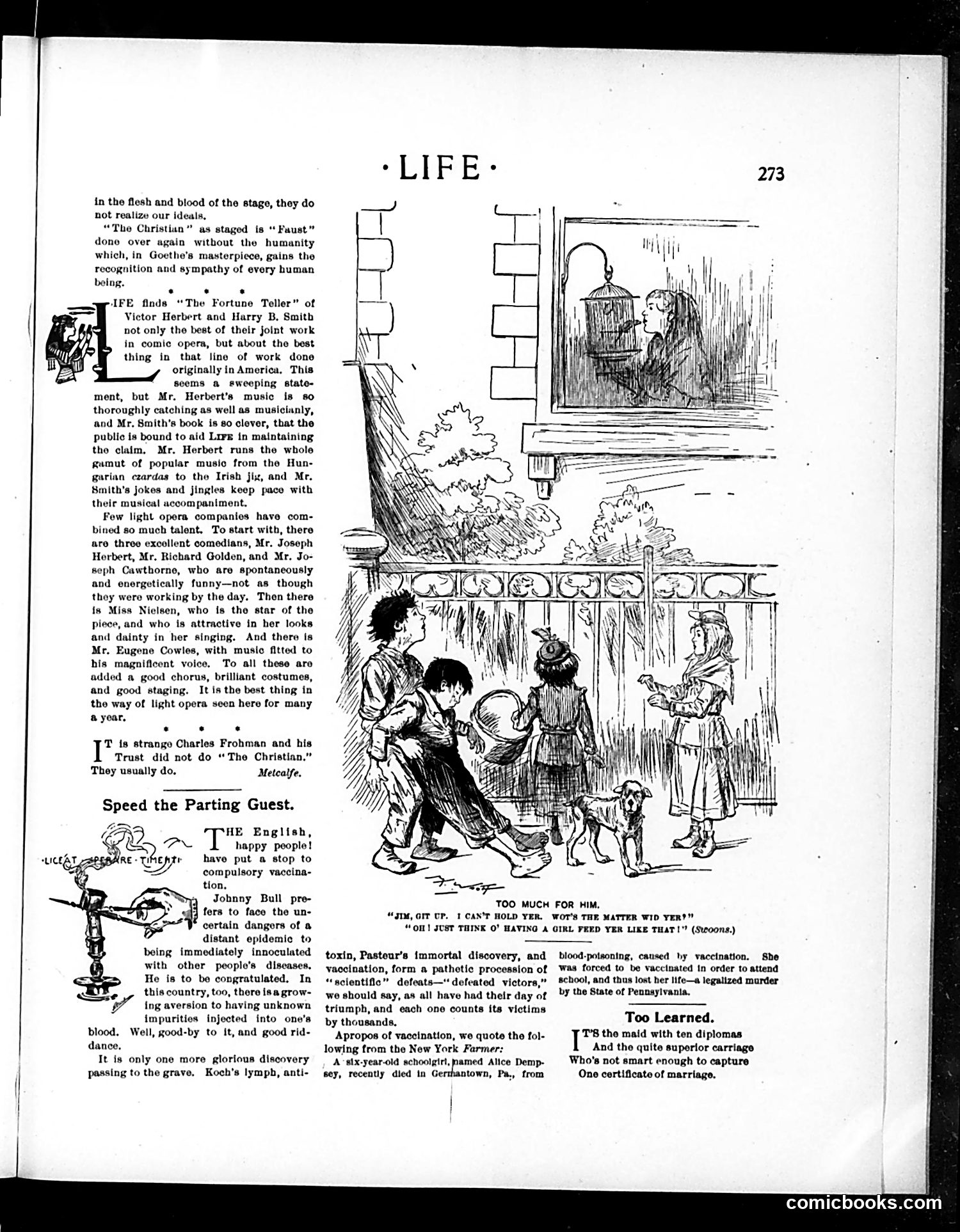
This page contains theater reviews and social commentary typical of early 1900s *Life* magazine satire. **Main cartoon** (center): Shows a young man overwhelmed by an overly affectionate woman at what appears to be a social gathering. The caption humorously depicts his distress—he "can't hold her" and she's swooning over him. The satire mocks excessive romantic displays or perhaps the woman's forward behavior, which would have been considered scandalous for the era. **"Speed the Parting Guest" section**: Satirizes England's recent decision to stop mandatory vaccination. *Life* criticizes this as foolish—the English prefer risking epidemic disease to vaccination. The piece mockingly calls this "another glorious discovery passing to the grave," sarcastically listing failed medical advances (Koch's lymph, Pasteur's work) while citing a Pennsylvania girl who died from vaccination complications. **"Too Learned" poem**: Brief social satire about educated women. The joke: a woman with ten diplomas is too intellectually pretentious ("superior carriage") to successfully secure marriage—suggesting overeducation made women unmarriageable, a common period prejudice. The reviews above discuss theater productions including "The Fortune Teller" comic opera.
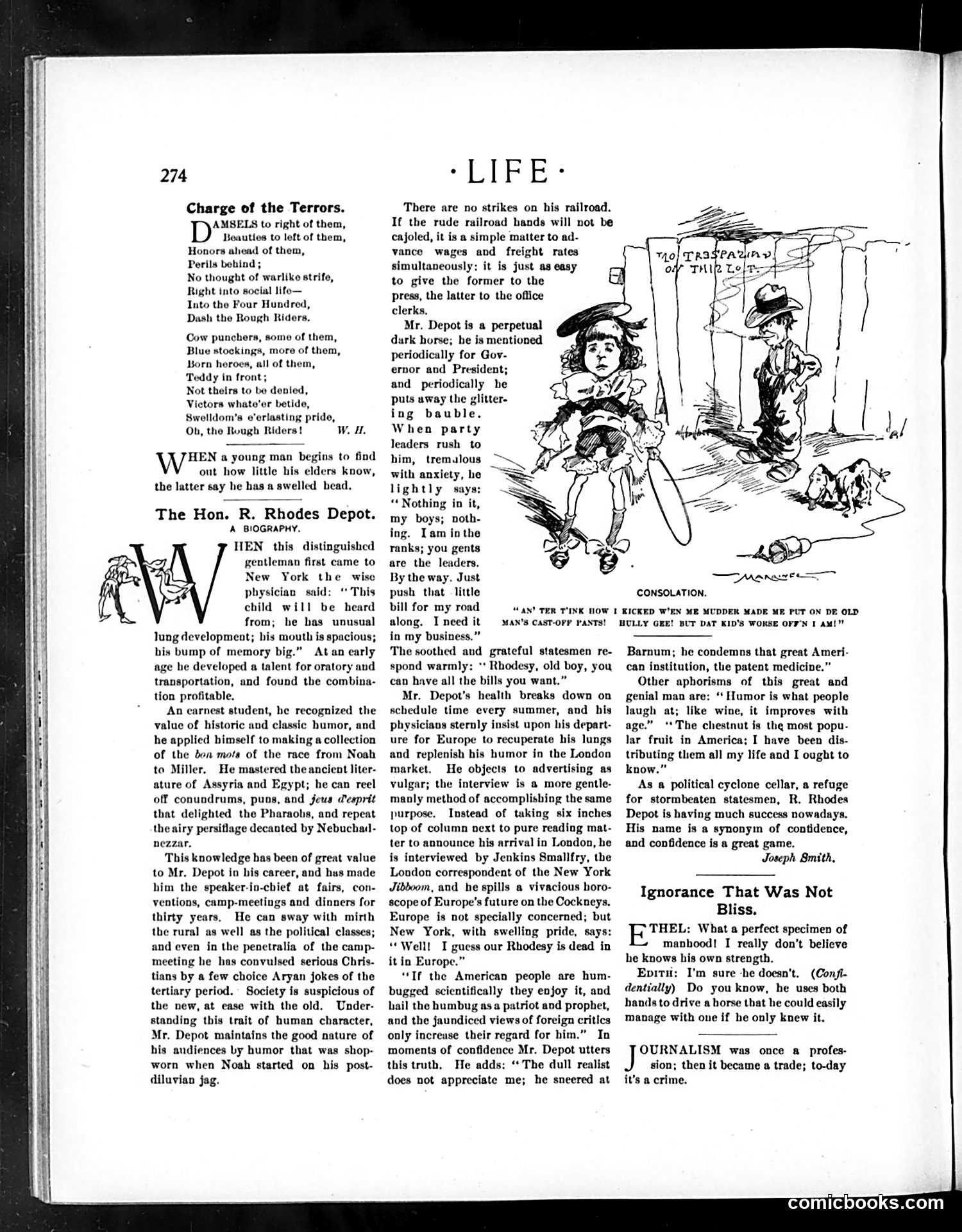
This page contains two satirical pieces about prominent figures in Gilded Age America. **"Charge of the Terrors"** mocks the "Rough Riders"—likely Theodore Roosevelt's famous cavalry unit—for invading New York high society. The poem parodies Tennyson's "Charge of the Light Brigade," suggesting these rough Western men (cowboys, ranch hands) are crashing into the social elite ("the Four Hundred"), with Teddy leading the charge. **"The Hon. R. Rhodes Depot"** is a biographical satire of a railroad magnate (the text references railroads, labor relations, and political influence). The piece ridicules his self-promotion: he pretends disinterest in political office while subtly pressuring politicians for favorable legislation; he avoids direct advertising but grants "interviews" to journalists; he manufactures trips to Europe for health reasons that generate flattering American newspaper coverage. The satire exposes how wealthy industrialists manipulated the press and politicians through calculated public relations.
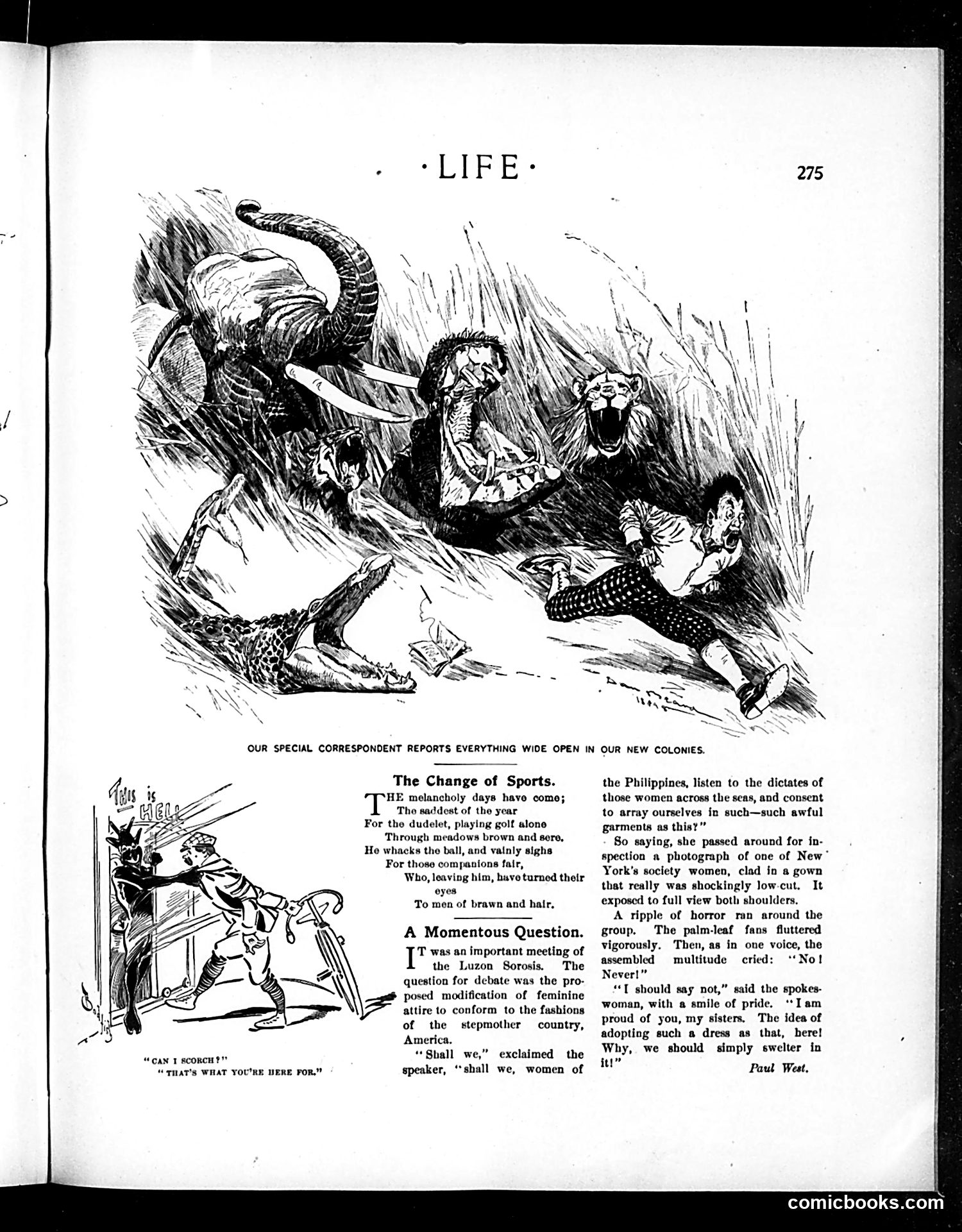
This page satirizes American imperialism and cultural attitudes toward the Philippines (a U.S. colony following the 1898 Spanish-American War). The top cartoon depicts wild animals in the colonies, representing chaos in newly conquered territories. The text references the "Luzon Sorosis"—a women's club in the Philippines—debating whether to adopt American women's fashions. The satire mocks two things simultaneously: American women's revealing modern clothing (shown in the shocking photograph of bare shoulders) and Filipino women's resistance to Western dress. The joke targets American moral hypocrisy—Americans impose "civilization" on colonies while their own fashion norms are scandalous by conservative standards. The Filipinas' horrified reaction underscores the cultural clash between American modernity and local values. The left cartoon shows a golfer alone ("Can I scorch?"), contrasting leisurely American sports with the implication that colonial life offers more "vigorous" male pursuits—suggesting imperial adventure replaces comfortable home life.
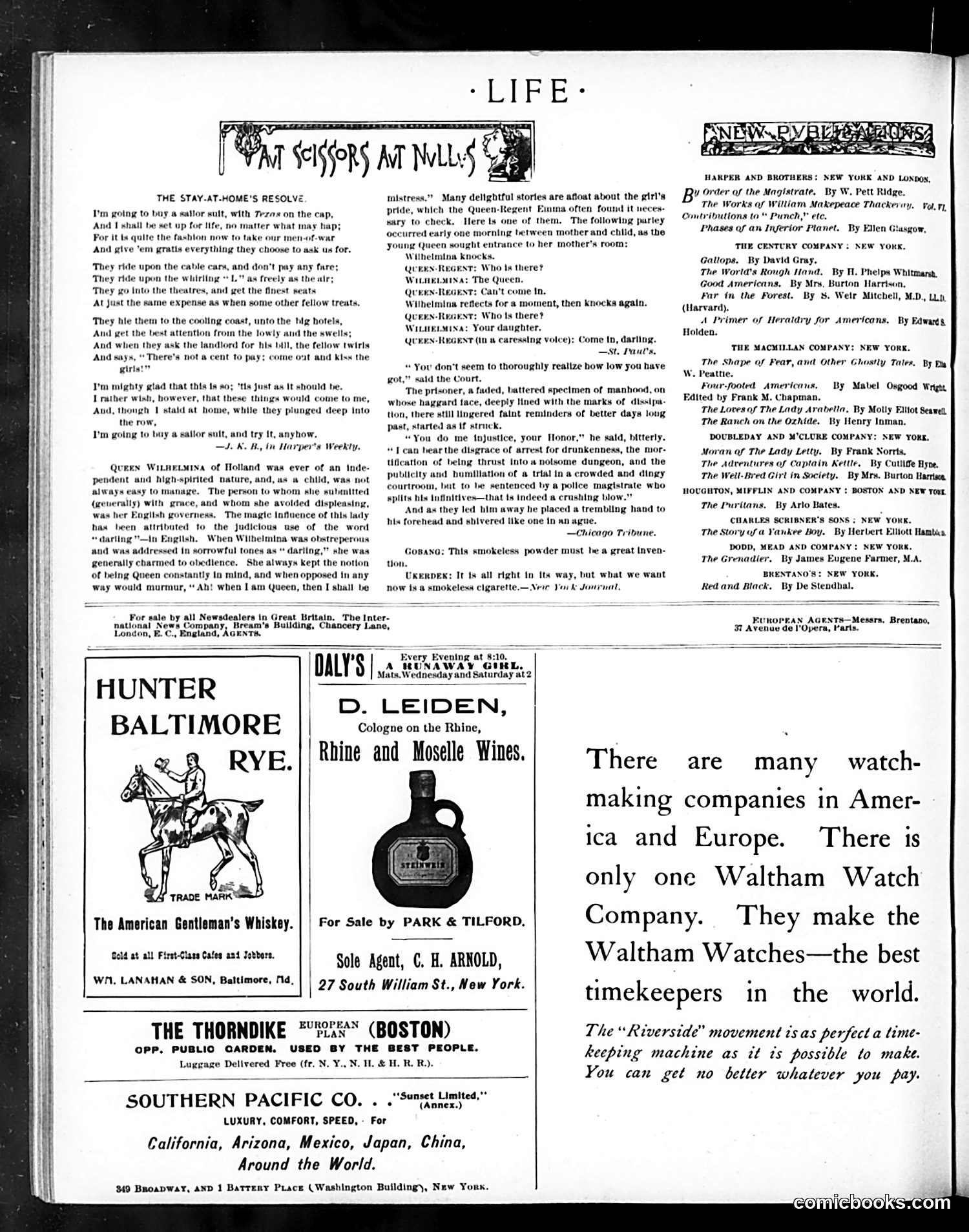
This page contains **three distinct satirical pieces**: 1. **"The Stay-at-Home's Resolve"**: A poem mocking American naval sailors receiving free public hospitality (streetcars, theaters, hotels). The narrator, staying home while sailors enjoy these perks, ironically resolves to wear a sailor suit anyway to claim the same benefits. The satire targets post-Spanish-American War patriotism and lavish public treatment of military personnel. 2. **Queen Wilhelmina anecdote**: A brief story about Dutch Queen Wilhelmina's childhood pride. Her English governess controlled her through affection ("darling"), but when resisting, Wilhelmina asserts her status. The satire gently mocks royal vanity and childhood obstinacy. 3. **Court scene fragments**: Two brief courtroom jokes—one about a defendant objecting to grammatical errors in sentencing; another about "smokeless" cigarettes. The page is primarily **textual satire with advertisements**, not visual political cartoons. The humor targets American military hero-worship, aristocratic pretension, and bureaucratic absurdity.
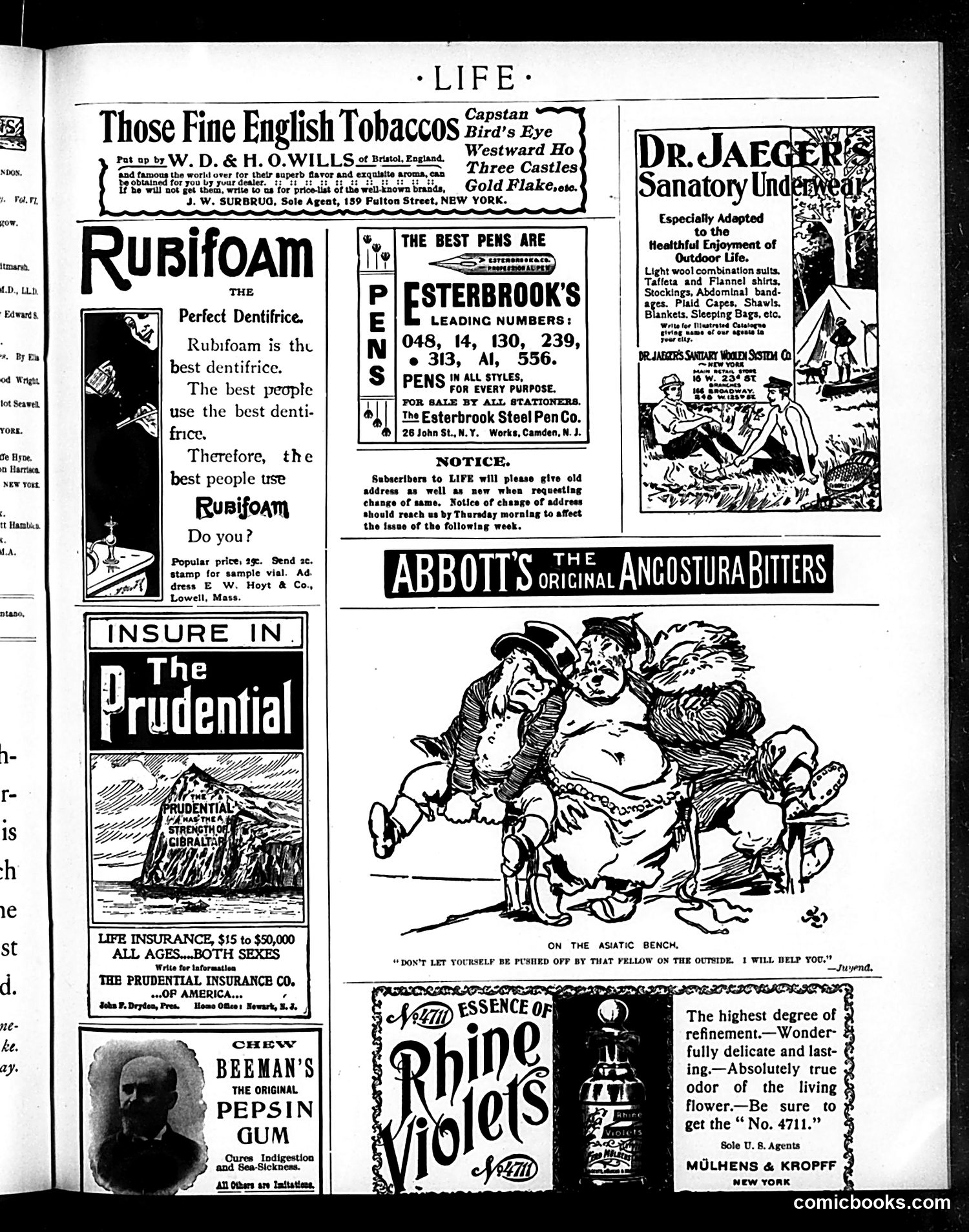
This page is primarily **advertisements** with one political cartoon. The main satirical image shows three rotund, caricatured figures labeled "On the Asiatic Bench." The caption reads: "Don't let yourself be pushed off by that fellow on the outside. I will help you." This appears to reference **colonial/imperial tensions in Asia**, likely depicting Western powers (the two larger figures) reassuring each other against an external threat or competitor (the smaller "fellow on the outside"). The "Asiatic Bench" suggests a literal or figurative seating arrangement where colonial powers divide influence. Without clearer identification of specific figures or a visible date, the exact geopolitical crisis referenced remains unclear—it could reference competing European/American interests in China, the Philippines, or elsewhere during the early 1900s imperial period. The remainder of the page consists of period advertisements for tobaccos, pens, insurance, dental products, and other goods typical of early-20th-century American magazines.
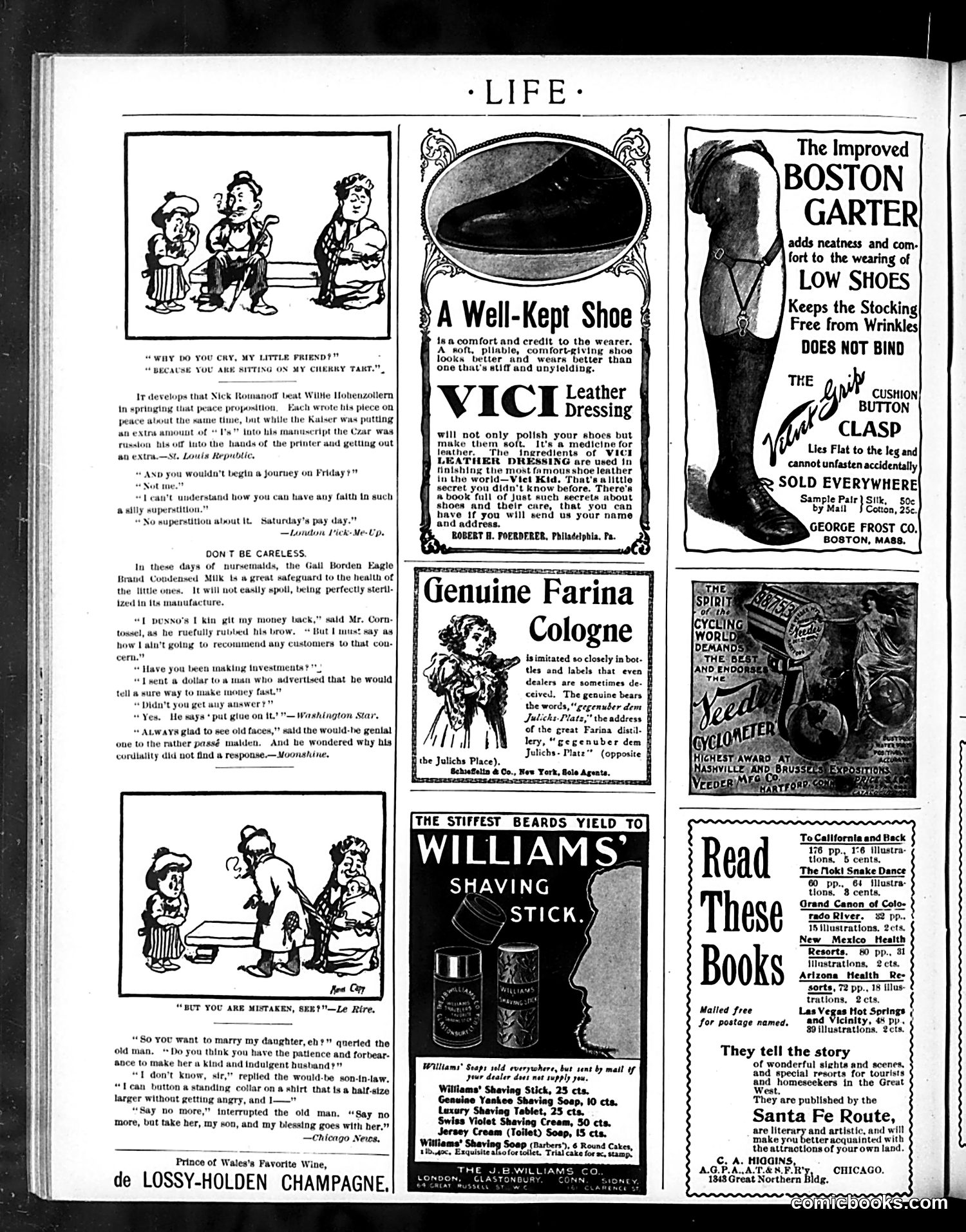
This is primarily an **advertising page** from Life magazine interspersed with brief humorous anecdotes. The cartoons are small comic strips illustrating joke scenarios. The two illustrated cartoons show domestic scenes with children and adults, accompanied by brief satirical exchanges. The first depicts someone sitting on a cherry tart (a literal visual gag). The second shows a child being scolded, with the punchline about marrying the daughter playing on the absurdity of testing a suitor's patience through mundane domestic tasks. The page is dominated by **product advertisements** typical of early 20th-century magazines: shoe care products (Vici Leather Dressing), garters, shaving supplies, champagne, and books offering travel information about American tourist destinations. The humor relies on wordplay and domestic situations rather than political commentary. The occasional anecdotes (about superstition, investment fraud) are lighthearted social observations rather than satirical critique. This represents Life's entertainment function before its later evolution into a serious photojournalism publication.
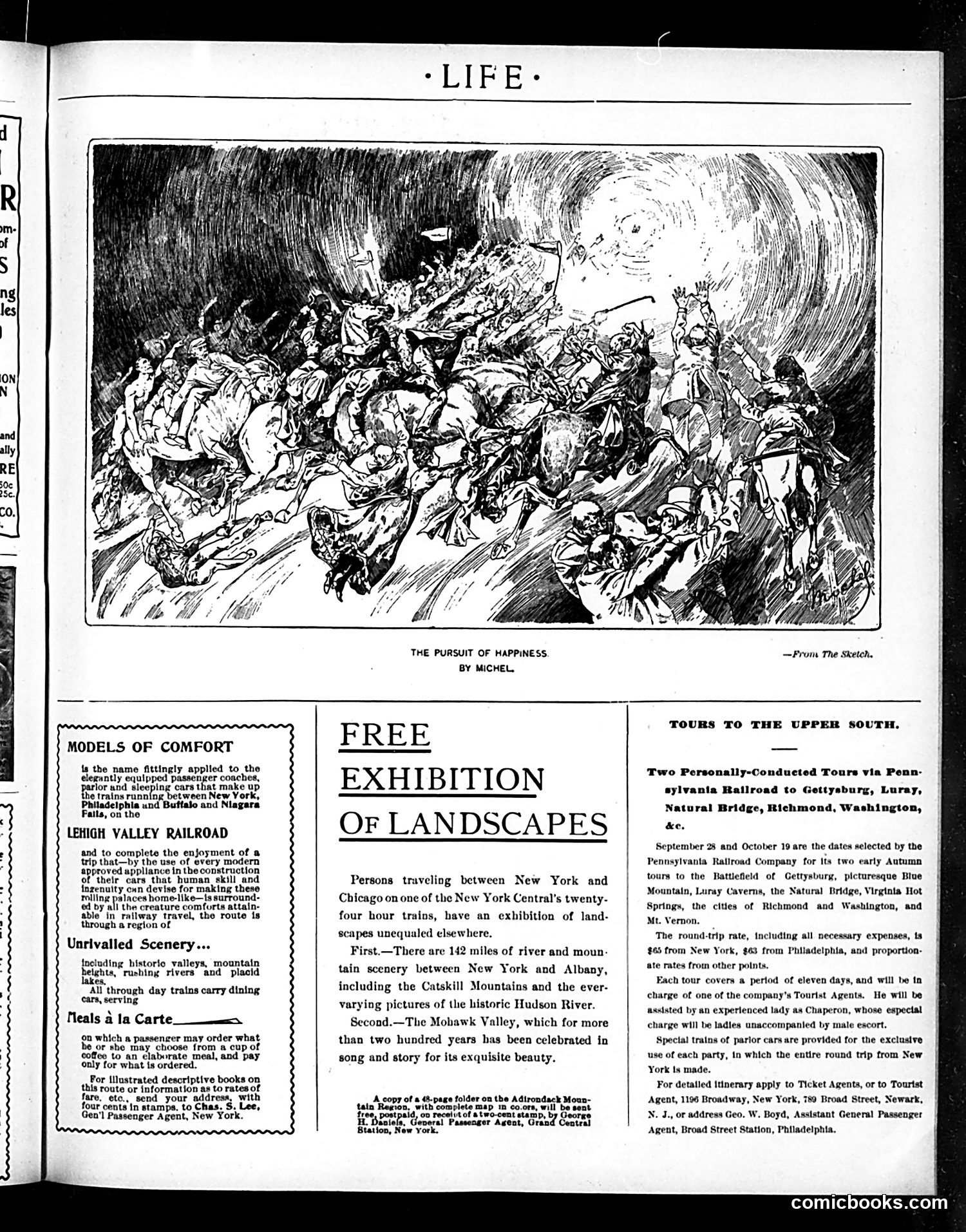
This page from *Life* magazine is primarily **advertising**, with a satirical cartoon at the top. The cartoon "The Pursuit of Happiness" (credited to Michel, from *The Sketch*) depicts a chaotic, swirling mass of figures—appearing to be people in frantic, disorganized motion. The style suggests social commentary on American life: the "pursuit of happiness" referenced in the Declaration of Independence becomes visual satire of ordinary citizens caught in a frenzy of activity, chaos, and materialism. Below the cartoon are railroad advertisements for the Lehigh Valley and New York Central railroads, promoting comfortable train travel and scenic routes (the Hudson River, Catskill Mountains, Mohawk Valley) as leisure destinations. The Pennsylvania Railroad also advertises guided tours to Civil War and historical sites (Gettysburg, Richmond, Washington). The juxtaposition is likely intentional: amid the satirical image of frenzied American life, the ads offer escape through rail travel and tourism.
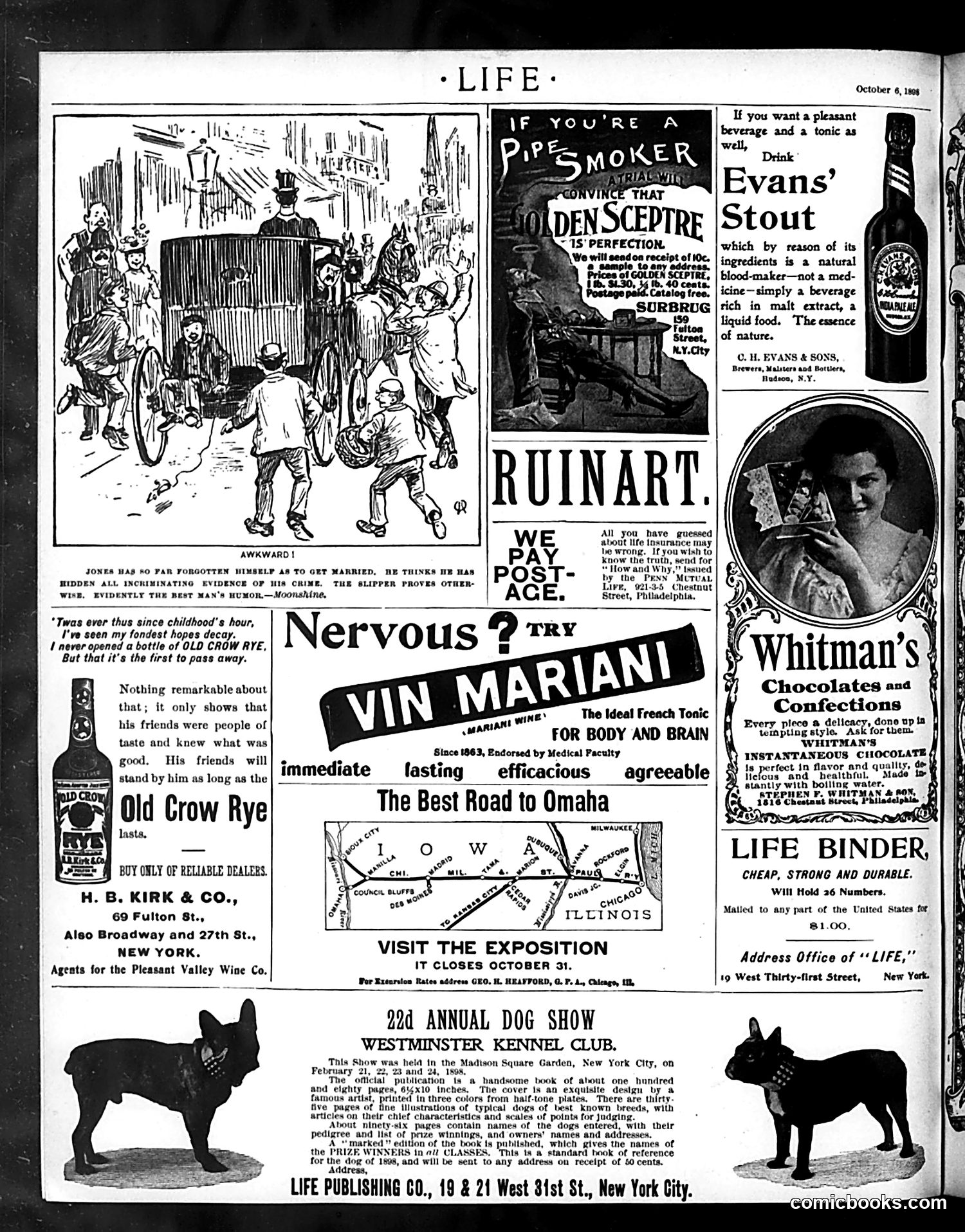
**Main Cartoon:** The top cartoon titled "Awkward!" depicts a newlywed man caught in an embarrassing situation. The caption explains he married to hide evidence of a crime, but a slipper (apparently incriminating) reveals the truth anyway. The joke relies on Victorian-era humor about marital awkwardness and a man's failed attempt at deception. The slipper as evidence is unclear in meaning but appears to be a comedic prop suggesting illicit activity. **Context:** This page is primarily advertisements (tobacco, wine, stout, chocolate, insurance, dog shows) with one satirical cartoon. The humor assumes readers understood contemporary social anxieties about marriage, masculinity, and respectability. The unnamed cartoonist "Moonshine" created domestic comedy typical of the era's satirical magazines.