
Life, 1898-10-06 · page 4 of 20
Life — October 6, 1898 — page 4: what you’re looking at
What you’re looking at
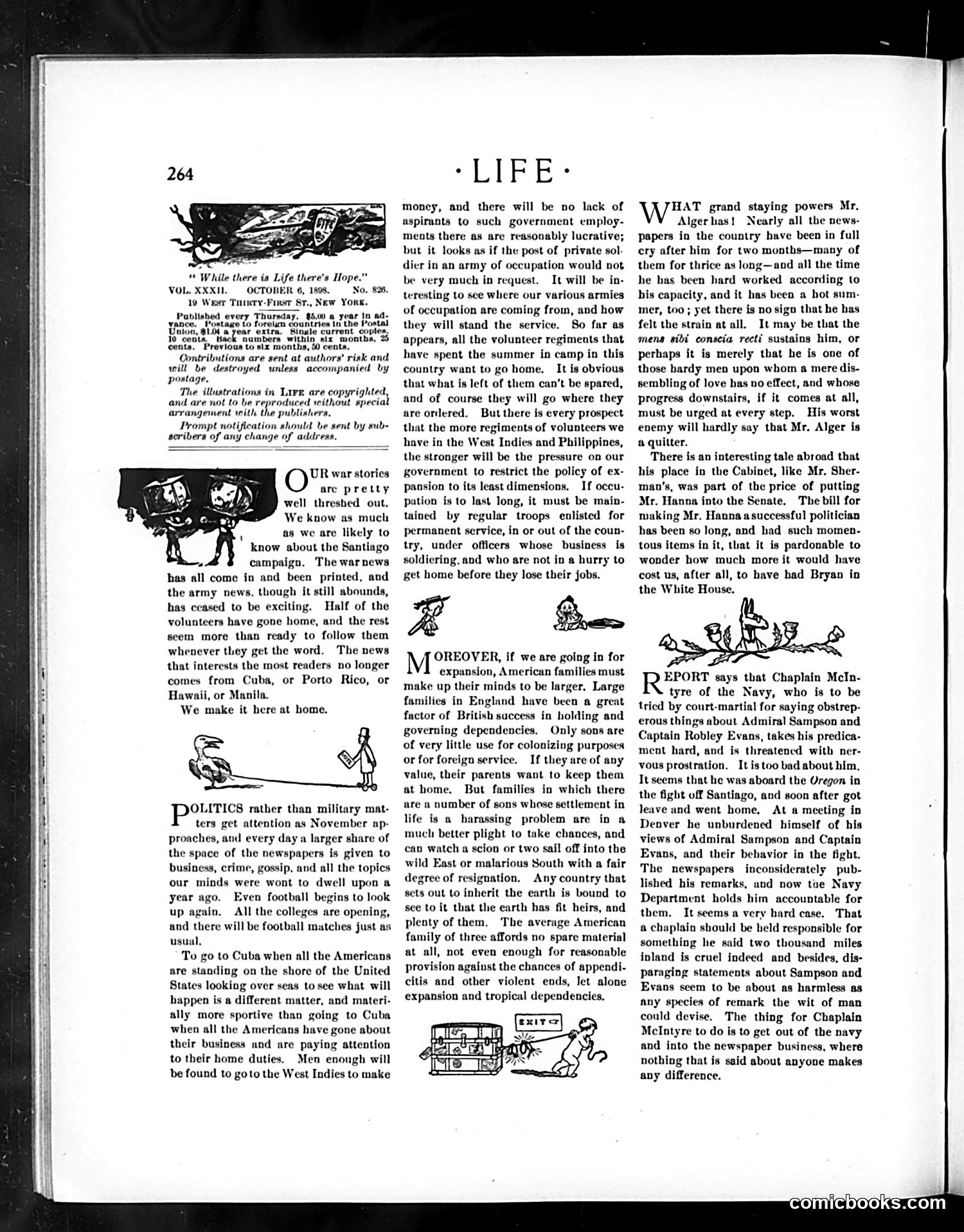
This page contains editorial discussion of American military expansion during the Spanish-American War era. The text addresses debates about U.S. occupation forces in Cuba, Puerto Rico, and the Philippines, discussing whether volunteer soldiers should return home and whether American expansion serves national interests. The cartoons (small illustrations scattered throughout) appear to be humorous visual commentary on these military and political topics, though specific figures are difficult to identify clearly in this reproduction. The central argument critiques concerns about military occupation policy and family separation, while defending American expansion as necessary. References to "Mr. Alger" likely concern Secretary of War Russell Alger, a prominent figure in Spanish-American War administration. The piece reflects 1898 debates over America's new imperial role.
📄 Transcribed text from this page (OCR, searchable)
Machine-transcribed from the original scan — historical spelling and the odd misread are preserved.
“* While there is Life there's Hope.” VOL. XXXII. OCTOBER 6, 1898, No, $28. 19 West Tuiety-Finst St., New Yorke. pabtlebed ev ‘Th $5.00 a year In ad- Baton, gt btw rear extra. Single current copies, 10 conta, ack numbers within six months, 25 Conts. Previous to six months, 60 cents. Contributions are sent at authors risk and will be destroyed unless accompanied by postage. The illustrations in Lave, are copyrighted, and are not to be reproduced without special arrangement with the publishers, Prompt notification shoul be sent by sub- soribers of any change of address, UR war stories arc pretty well threshed out. We know as much as we are likely to know about the Santiago campaign. The warnews has all come in and been printed, and the army news, though it still abounds, has ceased to be exciting. Half of the volunteers have gone home, and the rest seem more than ready to follow them whenever they get the word. The news that interests the most readers no longer comes from Cuba, or Porto Rico, or Hawaii, or Manila. We make it here at home. OLITICS rather than military mat- ters get attention as November ap- proaches, and every day a larger share of the space of the newspapers is given to business, crime, gossip, and all the topics our minds were wont to dwell upon a year ago. Even football begins to look up again. All the colleges are opening, and there will be football matches just as usual, To go to Cuba when all the Americans are standing on the shore of the United States looking over seas to see what will happen is a different matter, and materi- ally more sportive than going to Cuba when all the Americans have gone about their business and are paying attention to their home duties. Men enongh will be found to goto the West Indies to make LIFE moncy, and there will be no lack of aspirants to such government employ- ments there as are reasonably lucrative; but it looks as if the post of private sol- dier in an army of occupation would not be very much in request. It will be in- teresting to sce where our various armies of occupation are coming from, and how they will stand the servi So far as appears, all the volunteer regiments that have spent the summer in camp in this country want to go home. It is obvious that what is left of them can’t be spared, and of course they will go where they are ordered. But there is every prospect that the more regiments of volunteers we have in the West Indies and Philippines, the stronger will be the pressure on our government to restrict the policy of ex- pansion to its least dimensions, If occu- pation is to last long, it must be main- tained by regular troops enlisted for permanent service, in or out of the coun- try, under officers whose business is soldiering, and who are not in a hurry to get home before they lose their jobs. OREOVER, if we are going in for M expansion, American families must make up their minds to be larger. Large families in England have been a great factor of British success in holding and governing dependencies. Only sons are of very little use for colonizing purposes or for foreign service. If they are of any value, their parents want to keep them at home. But families in which there are a number of sons whose settlement in. life is a harassing problem are in a much better plight to take chances, and can watch a scion or two sail off into the wild East or malarious South with a fair degree of resignation. Any country that sets out to inherit the earth is bound to see to it that the earth has fit heirs, and plenty of them, The average American family of three affords no spare material at all, not even enough for reasonable provision against the chances of appendi- citis and other violent ends, let alone expansion and tropical dependencies, HAT grand staying powers Mr. Algerhas! Nearly all the news- papers in the country have been in full cry after him for two months—many of them for thrice as long—and all the time he has been hard worked according to his capacity, and it has been a hot sum- mer, too; yet there is no sign that he has felt the strain at all. It may be that the mens sibi conscia recti sustains him, or perhaps it is merely that he is one of those hardy men upon whom a mere dis- sembling of love has no effect, and whose progress downstairs, if it comes at all, must be urged at every step, His worst enemy will hardly say that Mr. Alger is a quitter. ‘There is an interesting tale abroad that his place in the Cabinet, like Mr. Sher- man’s, was part of the price of putting Mr. Hanna into the Senate, The bill for making Mr. Hanna a successful politician has been so long, and had such momen- tous items in it, that it is pardonable to wonder how much more it would have cost us, after all, to have had Bryan in the White House, RR erone says that Chaplain McIn- tyre of the Navy, who is to be tried by court-martial for saying obstrep- erous things about Admiral Sampson and Captain Robley Evans, takes his predica- ment hard, and is threatencd with ner- vous prostration, It is too bad about him, It seems that he was aboard the Oregon in the fight off Santiago, and soon after got leave and went home, At a meeting in Denver he unburdened himself of his views of Admiral Sampson and Captain Evans, and their bebavior in the fight. The newspapers inconsiderately pub- lished his remarks, und now tae Navy Department holds him accountable for them. It seems a very hard case. That a chaplain should be held responsible for something he said two thousand miles inland is cruel indeed and besides, dis- paraging statements about Sampson and. Evans seem to be about as harmless as any species of remark the wit of man could devise. The thing for Chaplain McIntyre to do is to get out of the navy and into the newspaper business, where nothing that is said about anyone makes any difference.