
Life, 1898-10-06 · page 12 of 20
Life — October 6, 1898 — page 12: what you’re looking at
What you’re looking at
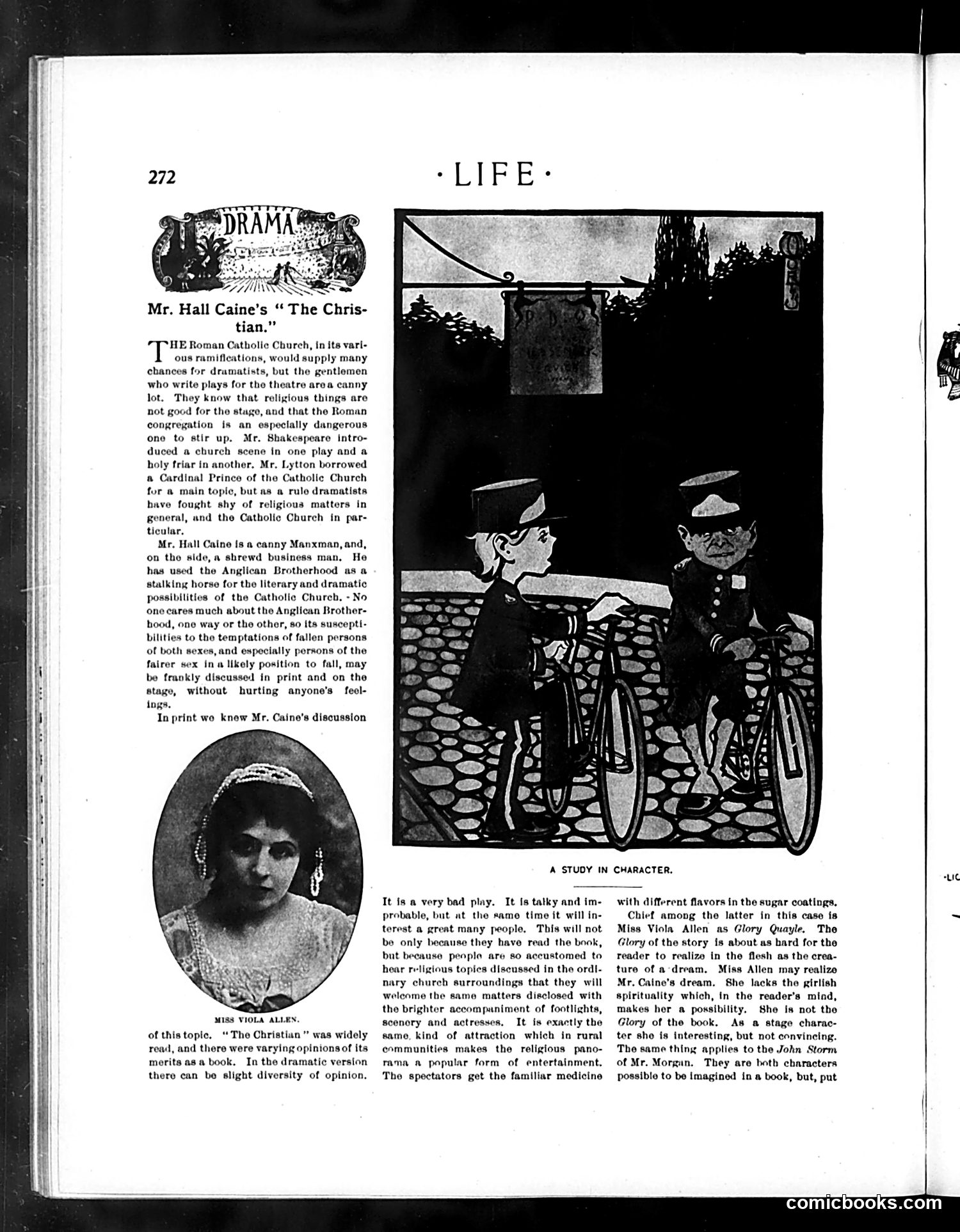
This page reviews Mr. Hall Caine's play "The Christian," which the text criticizes as "a very bad play" that is "talky and improbable." The central image shows two figures on bicycles—"A Study in Character"—appearing to illustrate contrasting moral types, likely referencing the play's themes. The accompanying text discusses Miss Viola Allen's performance as "Glory Quayle," noting she "lacks the girlish spirituality" needed for the role. The satire targets the play's heavy-handed religious moralizing about the Catholic Church and Anglican Brotherhood. The critic argues such "religious topics discussed in the ordinary church surroundings" are inappropriate for theater, and that audiences seeking this content would find it awkwardly presented compared to reading the book. The bicycle scene likely visualizes the play's melodramatic character contrasts.
📄 Transcribed text from this page (OCR, searchable)
Machine-transcribed from the original scan — historical spelling and the odd misread are preserved.
Mr. Hall Caine’s “ The Chris- tian.” HE Roman Catholic Church, in its varl- ous ramifications, would supply many ebances for dramatists, but the gentlemen who write plays for tho theatre aroa canny lot. They know that religious things are not good for the stago, and that the Roman congregation is an especially dangerous one to stir up. Mr. Shakespeare intro- duced a church scene in one play and a holy friar in another, Mr, Lytton borrowed & Cardinal Prince of the Catholic Church for a main topic, but as a rulo dramatists have fought shy of religious matters in general, and the Catholic Church in par- ticular. Mr. Hall Caine is a canny Manxman, and, on tho side, a shrewd business man, He has used the Anglican Brotherhood as a stalking horse for the literary and dramatic possibilities of the Catholic Church, -No one cares much about the Anglican Brother- hood, one way or the other, 80 its suscepti- bilities to the temptations of fallen persons of both sexes, and especially persons of the fairer sex ina likely position to fall, may be frankly discussed in print and on the stage, without hurting anyone's feol- ings. In print wo know Mr. Caino's discussion MISS VIOLA ALLEN. of this topic. “Tho Christian” was widely read, and there were varying opinionsof its merits asa book. In the dramatic version there can be slight diversity of opinion. A STUDY IN CHARACTER, It is a very bad play. It Is tatky and im- probable, but at the same time it will in- terest a great many people, This will not only because they have read the book, but because people are so accustomed to hear religious topics discussed in the ordl- nary church surroundings that they will welcome the same matters disclosed with tho brighter accompaniment of footlights, scenory and actresses, It is exactly the same, kind of attraction which in rural communities makes the religious pano- rama a popular form of entertainment. The spectators get the familiar medicine with different flavors in the sugar coatings. Chief among tho latter in this case is Miss Viola Allen as Glory Quayle. Tho Glory of the story {s about as bard for the reader to realizo in tho flesh as the crea- turo of a-dream, Miss Allen may realize Mr. Caino’s dream. Sho lacks tho girlish spirituality which, In the reader's mind, makes her a poxsibility, She is not tho Glory of the book, As a stage charac- ter sho is interesting, but not convincing. Tho same thing applies to the John Storm of Mr. Morgun. They are both characters possible to be Imagined in a book, but, put comicbooks.com “Lic