
Life, 1898-10-06 · page 7 of 20
Life — October 6, 1898 — page 7: what you’re looking at
What you’re looking at
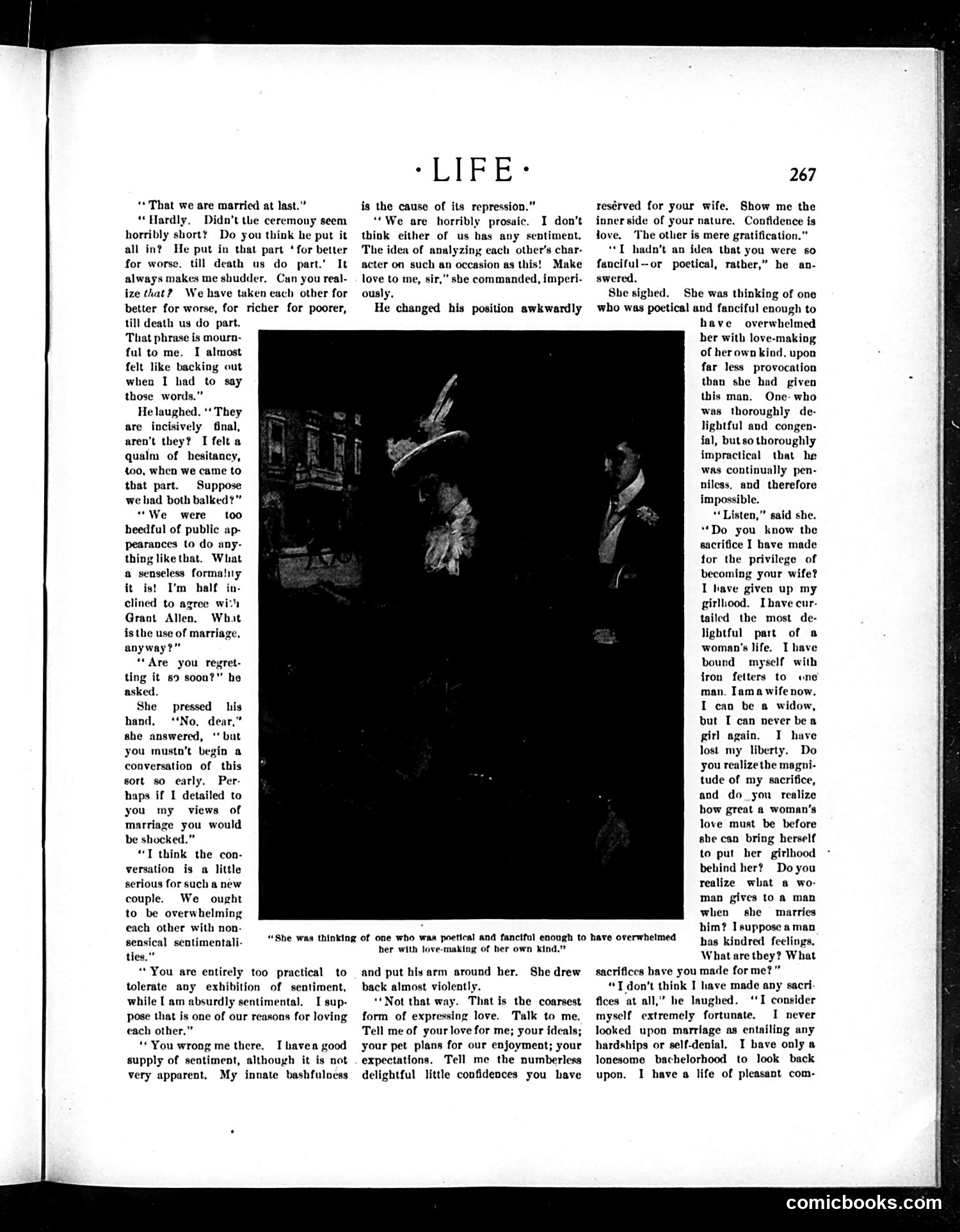
This page contains a **domestic drama scene** rather than political satire. The illustration shows a couple in what appears to be a heated marital dispute. The man stands confrontationally while the woman gestures emotionally. The accompanying text depicts a philosophical argument about marriage itself. The couple debates whether matrimony requires sentiment or practicality, with the woman arguing she's sacrificed her girlhood and freedom as a wife, while the man contends that excessive sentimentality is impractical. This appears to be **satirizing contemporary marriage debates** of the early 1900s—specifically tensions between romantic idealism and pragmatic views of marriage. The satire targets both partners' positions: her emotional appeals versus his dismissive rationalism, reflecting era-specific gender role conflicts and changing attitudes toward matrimony.
📄 Transcribed text from this page (OCR, searchable)
Machine-transcribed from the original scan — historical spelling and the odd misread are preserved.
‘* That we are married at last.” “Hardly. Didn't the ceremony seem horribly short? Do you think he put it all in? He put in that part ‘for better for worse. till death us do part.’ It always makes me shudder. Cun you real- ize that? We have taken each other for better for worse, for richer for poorer, till death us do part. ‘That phrase is mourn- ful to me. I almost felt like backing out when I had to say those words.” He laughed. ‘‘ They are incisively final, aren't they? I felt a qualm of hesitancy, too, when we came to that part. Suppose we had both balked?” “We were too heedful of public ap- pearances to do any- thing likethat. What a senseless formaliy it ist I'm half in- clined to agree with Grant Allen, What is the use of marriage, anyway?” “Are you regret- ting it 89 soon?” he asked. She pressed his hand, ‘‘No, dear,” she answered, ‘but you mustn’t begin a conversation of this sort so early. Per- haps if I detailed to you my views of marriage you would be shocked.” “TI think the con- versation is a little serious for such a new couple. We ought to be overwhelming each other with non- sensical sentimentali- ties.” “You are entirely too practical to tolerate any exhibition of sentiment, while I am absurdly sentimental. I sup- pose that is one of our reasons for loving each other,” ‘* You wrong me there. I havea good supply of sentiment, although it is not very apparent. My innate bashfuloess «LIFE * is the cause of its repression.” ‘*We are horribly prosaic. I don’t thiok either of us has any sentiment, ‘The idea of analyzing each other's char- acter on such an occasion as this! Make love to me, sir,” she commanded, imperi- ously. He changed his position awkwardly “She was thinking of one who waa poetical and fanciful enongh to have overwhelmed her with love-making of her own kind.” and put his arm around her. She drew back almost violently. “*Not that way. That is the coarsest form of expressing love. Talk to me. Tell me of your love for me; your idcals; your pet plans for our enjoyment; your expectations. Tell me the numberless delightful little confidences you have 267 resérved for your wife. Show me the inner side of your nature, Confidence is Jove. The other is mere gratification.” “TI hadn’t an idea that you were so fanciful—or poetical, rather,” he an- swered, She sighed. She was thinking of one who was poetical and fanciful enough to have overwhelmed ber with love-making of herown kind, upon far less provocation than she had given this man. One- who was thoroughly de- lightful and congen- ial, butso thoroughly impractical that he was continually pen- niless, and therefore impossible. “Listen,” said she. “Do you know the sacrifice 1 have made for the privilege of becoming your wife? I have given up my girlhood, Ihave cur- tailed the most de- lightful part of a woman's life. I have bound myself with iron fetters to one man. Iama wife now. I can be a widow, but T can never bea girl again. I have lost my liberty. Do you realizethe magni- tude of my sacrifice, and do you realize how great a woman's love must be before she can bring herself to put her girlhood behind her? Doyou tealize what a wo- man gives to a man when she marries him? I suppose aman has kindred feelings. What are they? What sacrifices have you made for me?” “T don't think I have made any sacri fices at all,” he laughed. ‘I consider myself extremely fortunate, I never looked upon marriage as entailing any hardships or self-denial. I bave only a lonesome bachelorhood to look back upon. I have a life of pleasant com- comicbooks.com