
Life, 1898-10-06 · page 8 of 20
Life — October 6, 1898 — page 8: what you’re looking at
What you’re looking at
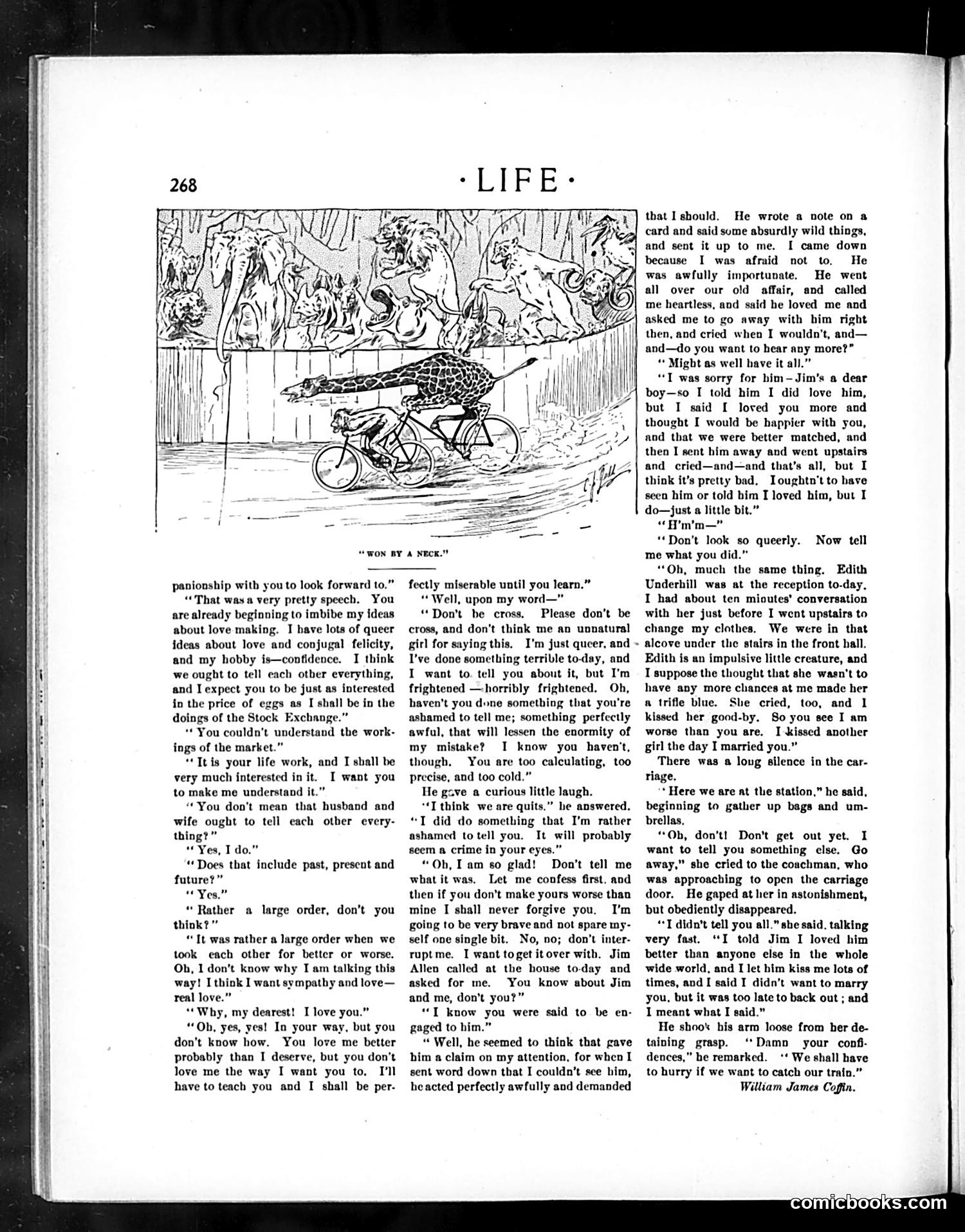
This cartoon depicts a woman riding a bicycle past an elaborate decorative relief or mural. The title "Won by a Neck" is a horse-racing idiom meaning a narrow victory. The accompanying story, credited to William James Colton, describes a romantic conflict between two men competing for a woman's affection. The narrative suggests the woman has chosen one suitor over another in what appears to be a close decision. The bicycle—a modern conveyance associated with women's independence and mobility in the late 19th/early 20th century—may symbolize the woman's agency and freedom in making her own choice. The racing metaphor combined with the bicycle imagery humorously frames romantic competition through the lens of contemporary sports and transportation.
📄 Transcribed text from this page (OCR, searchable)
Machine-transcribed from the original scan — historical spelling and the odd misread are preserved.
“WON BY A NECK.” panionship with you to look forward to.” “That was a very pretty speech, You are already beginning to imbibe my ideas about love making. I have lots of queer ideas about love and conjugal felicity, and my hobby is—contidence. I think we ought to tell each other everything, and I expect you to be just as interested in the price of eggs as I shall be in the doings of the Stock Exchange.” “You couldn't understand the work- ings of the market.” “*Ttis your life work, and I shall be very much interested in it. I want you to make me understand it.” ‘You don’t mean that husband and wife ought to tell each other every- thing?” “Yes, Ido.” “Does that include past, present and future?” “Yes,” “Rather a large order, don’t you think?” “Tt was rather a large order when we took each other for better or worse. Ob, 1 don’t know why Tam talking this way! I think I want sympathy and love— real love.” “Why, my dearest! I love you.” “Ob, yes, yes! In your way, but you don't know how. You love me better probably than I deserve, but you don’t love me the way I want you to. I'll have to teach you and I shall be per- fectly miserable until you learn.” “Well, upon my word—” “Don’t be cross. Please don’t be cross, and don’t think me an unnatural girl for saying this. I’ve done something terrible to-day, and I want to. tell you about it, but I'm frightened —horribly frightened. Oh, haven't you done something that you're ashamed to tell me; something perfectly awful, that will lessen the enormity of my mistake? I know you haven't, though. You are too calculating, too precise, and too cold.” He gave a curious little laugh. “I think we are quits.” he answered. “TI did do something that I’m rather ashamed to tell you. It will probably seem a crime in your eyes.” “Ob, Tam so glad! Don't tell me what it was. Let me confess first. and then if you don’t make yours worse than mine I shall never forgive you. I’m going to be very brave and not spare my- self one single bit. No, no; don’t inter- ruptme. I want toget itover with. Jim Allen called at the house to-day and asked for me. You know about Jim and me, don’t you?” “I know you were said to be en- gaged to him.” “ Well, he seemed to think that gave him a claim on my attention, for when I sent word down that I couldn’t see him, heacted perfectly awfully and demanded I'm just queer, and ~ that I should. He wrote a note on a card and said some absurdly wild things, and sent it up to me. I came down because I was afraid not to. He was awfully importunate. He went all over our old affair, and called me heartless, and said he loved me and asked me to go away with him right then, and cried when I wouldn't, and— and—do you want to hear any more?” “ Might as well have it all.” “TI was sorry for him-Jim’s a dear boy—so I told him I did love him, but I said [ loved you more and thought I would be happier with you, and that we were better matched, and then I sent him away and went upstairs and cried—and—and that’s all, but I think it’s pretty bad. Toughtn’t to have secn him or told bim I loved him, but I do—just a little bit.” “<'m'm—” ‘Don't look so queerly. Now tell me what you did.” “Oh, much the same thing. Edith Underhill was at the reception to-day, I had about ten mioutes’ conversation with her just before I went upstairs to change my clothes. We were in that alcove under the stairs in the front hall. Edith is an impulsive little creature, and I suppose the thought that she wasn't to have any more chances at me made her a trifle blue. She cried, too, and I kissed her good-by. So you see I am worse than you are. I kissed another girl the day I married you.” There was a loug silence in the car- riage, * Here we are at the station,” he said, beginning to gather up bags and um- brellas, “Ob, don’t! Don't get out yet. I want to tell you something clse. Go away,” she cried to the coachman, who was approaching to open the carriage door. He gaped at her in astonishment, but obediently disappeared. “T didn’t tell you all.” she said, talking very fast. “I told Jim I loved him better than anyone else in the whole wide world, and I let him kiss me lots of times, and [ said I didn’t want to marry you, but it was too late to back out ; and I meant what I said.” He shoot his arm loose from her de- taining grasp. ‘Damn your confi- dences,” he remarked. ‘‘ We shall have to hurry if we want to catch our train.” William James Coffin.