
A complete issue · 20 pages · 1898
Life — September 15, 1898
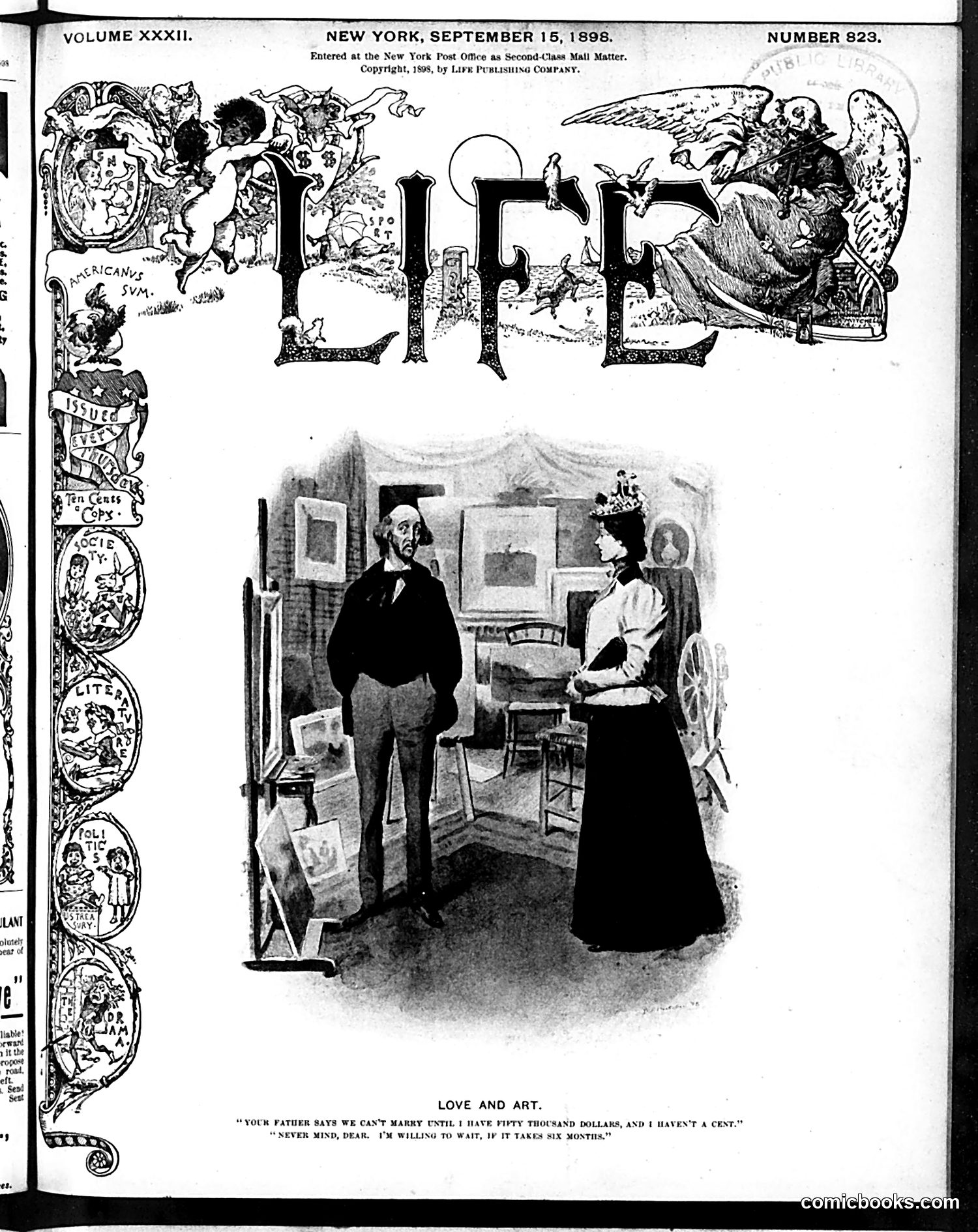
This cartoon satirizes romantic obstacles in artistic circles. The scene shows a poorly-dressed artist in his studio confronting a well-dressed woman (likely of higher social class, suggested by her crown-like hat). The caption reveals the central joke: her father forbids their marriage until the artist accumulates fifty thousand dollars and has "a cent" to his name—conditions requiring six months to meet. The satire mocks the class barriers preventing love matches between impoverished artists and wealthy women, while also gently ridiculing both the father's mercenary standards and the artist's presumption of romantic prospects despite his obvious poverty. The cartoon's title and scenario suggest broader themes about the incompatibility of Bohemian artistic life with respectable Victorian society expectations.
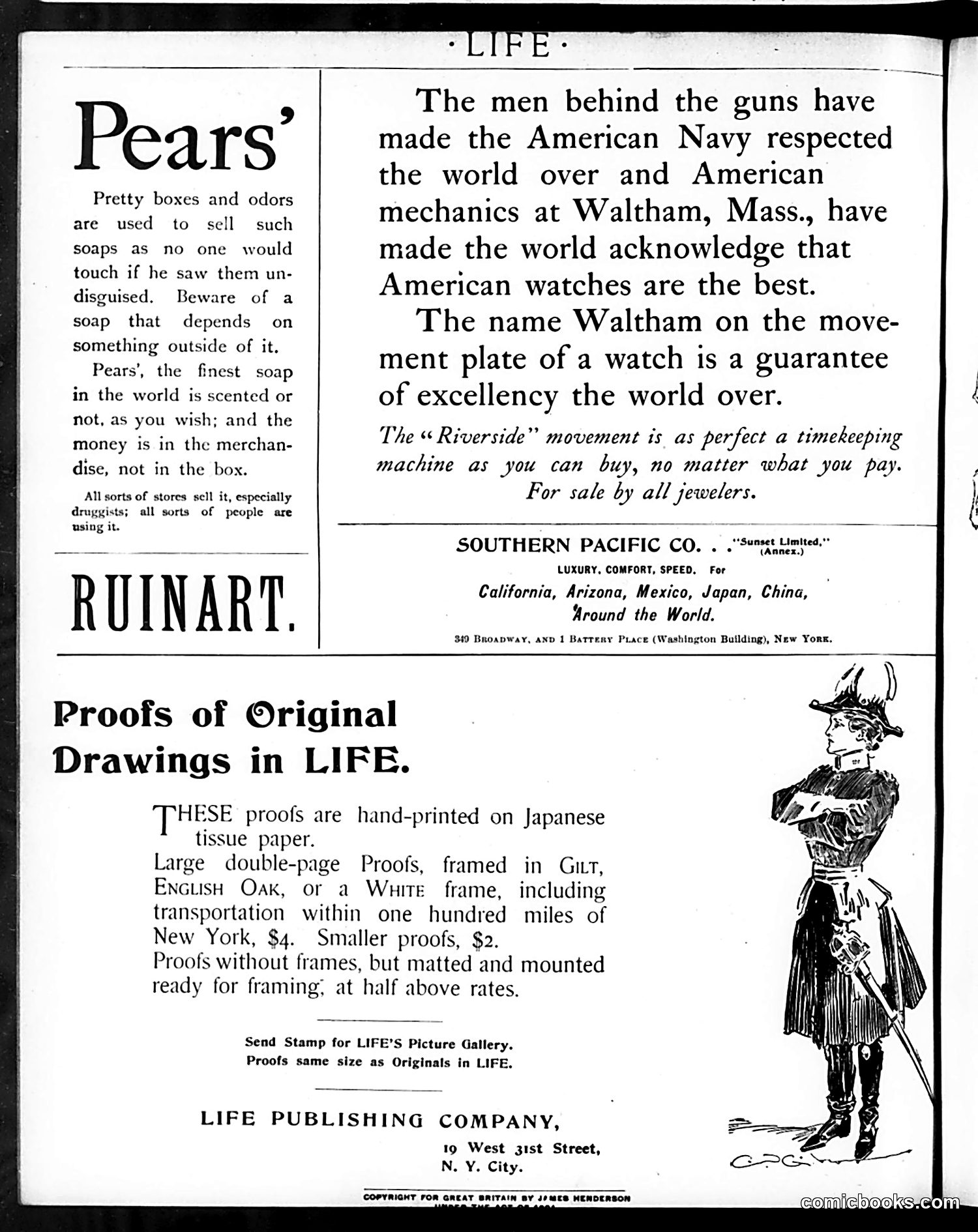
This page is primarily **advertising content** rather than political satire or comics. It contains four separate advertisements: 1. **Pears' Soap** — promotes the product's quality and scent options, emphasizing the value is in the merchandise itself 2. **Ruinart** (champagne) — a simple product notice 3. **Waltham Watches** — claims superiority of American-made watches, referencing the "Riverside" movement 4. **Proofs of Original Drawings in LIFE** — the magazine offers hand-printed proofs on Japanese tissue for framing The illustration on the right appears to be a **fashionable woman in Edwardian-era dress** (hat, corset, sword or parasol), likely decorative rather than satirical. The page reflects turn-of-the-century consumer culture targeting affluent readers rather than political commentary.
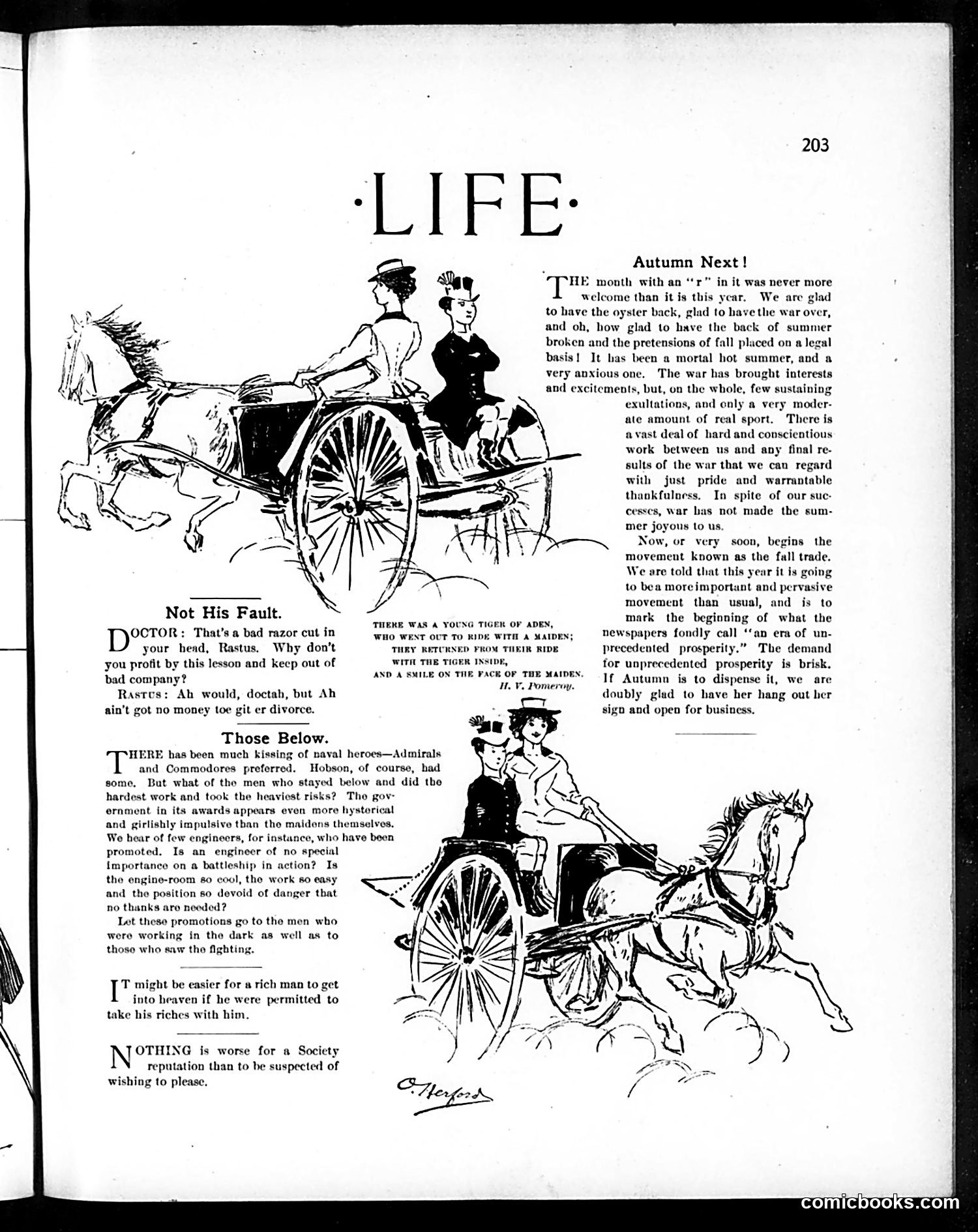
This page contains three separate pieces of social commentary from early 20th-century American life: 1. **"Not His Fault"** mocks a man named Rastus for his poor judgment in choosing bad company and marrying poorly—typical period humor about personal responsibility. 2. **"Those Below"** praises working-class naval engineers and mechanics who performed unglamorous but essential wartime labor, contrasting them with celebrated admirals. It advocates recognizing less visible contributors to society. 3. **"Autumn Next!"** celebrates autumn's arrival and the "fall trade," suggesting post-WWI economic optimism about upcoming business prosperity and recovery. The illustrations show fashionable women in carriages with horses, typical of the magazine's focus on upper-class leisure. The overall tone reflects post-war American society adjusting to peacetime.
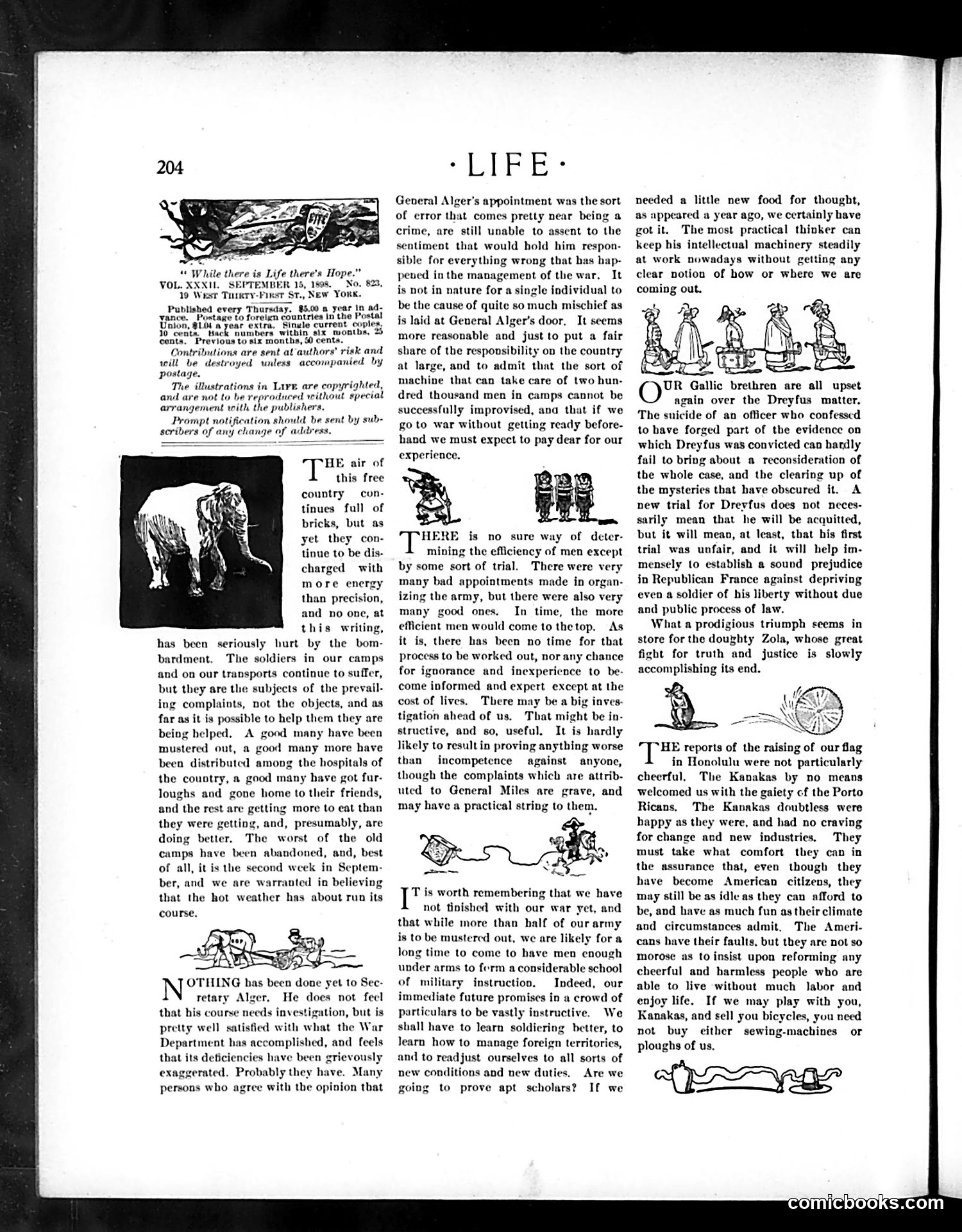
This page discusses General Alger's appointment and military management during what appears to be the Spanish-American War. The text criticizes how responsibility for wartime failures is attributed to Alger rather than systemic issues, arguing it's unfair to blame one individual for complex organizational problems. The small cartoon illustrations—showing soldiers, camp conditions, and military life—appear to satirize the army's unpreparedness and the gap between civilian expectations and battlefield reality. The text advocates for better military training and reorganization rather than scapegoating. The reference to Dreyfus and mentions of flags in Honolulu suggest contemporary international military and colonial concerns of 1898, though specific caricatured figures aren't clearly identifiable in these illustrations.
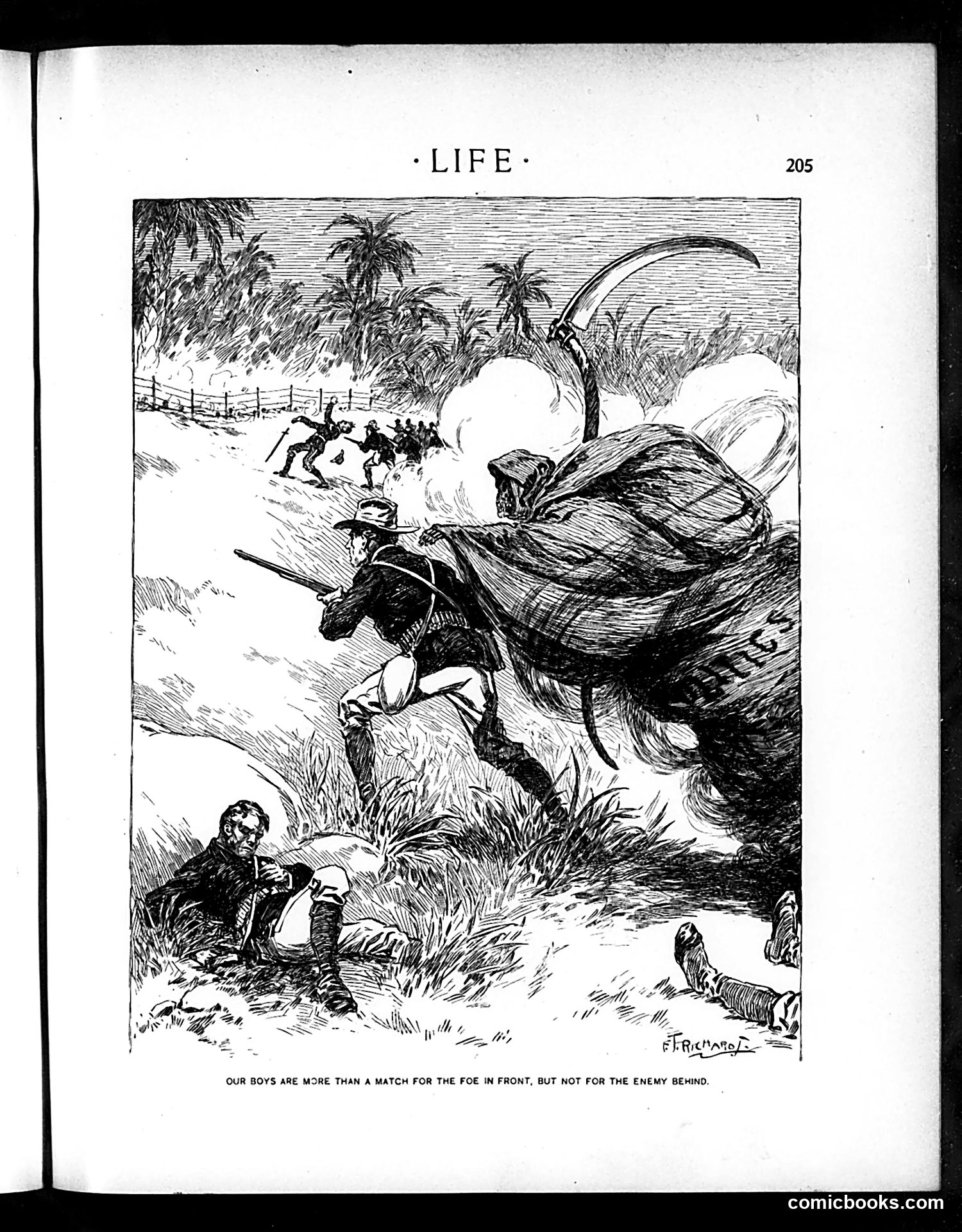
This is a satirical illustration from *Life* magazine (page 205) depicting a military scene. The caption reads: "OUR BOYS ARE MORE THAN A MATCH FOR THE FOE IN FRONT, BUT NOT FOR THE ENEMY BEHIND." The image shows a soldier in the foreground crouching in tall grass, apparently wounded or exhausted. Behind him, a mounted officer on horseback charges forward with drawn sword. In the background, more soldiers engage in combat near palm trees and fortifications. The satire critiques military leadership—suggesting that soldiers face greater danger from their own commanders' orders or incompetence ("the enemy behind") than from actual opposing forces. This reflects common WWI-era criticism of officers sending troops into suicidal attacks. The caption's bitter irony suggests soldiers are betrayed by their own side's command structure.
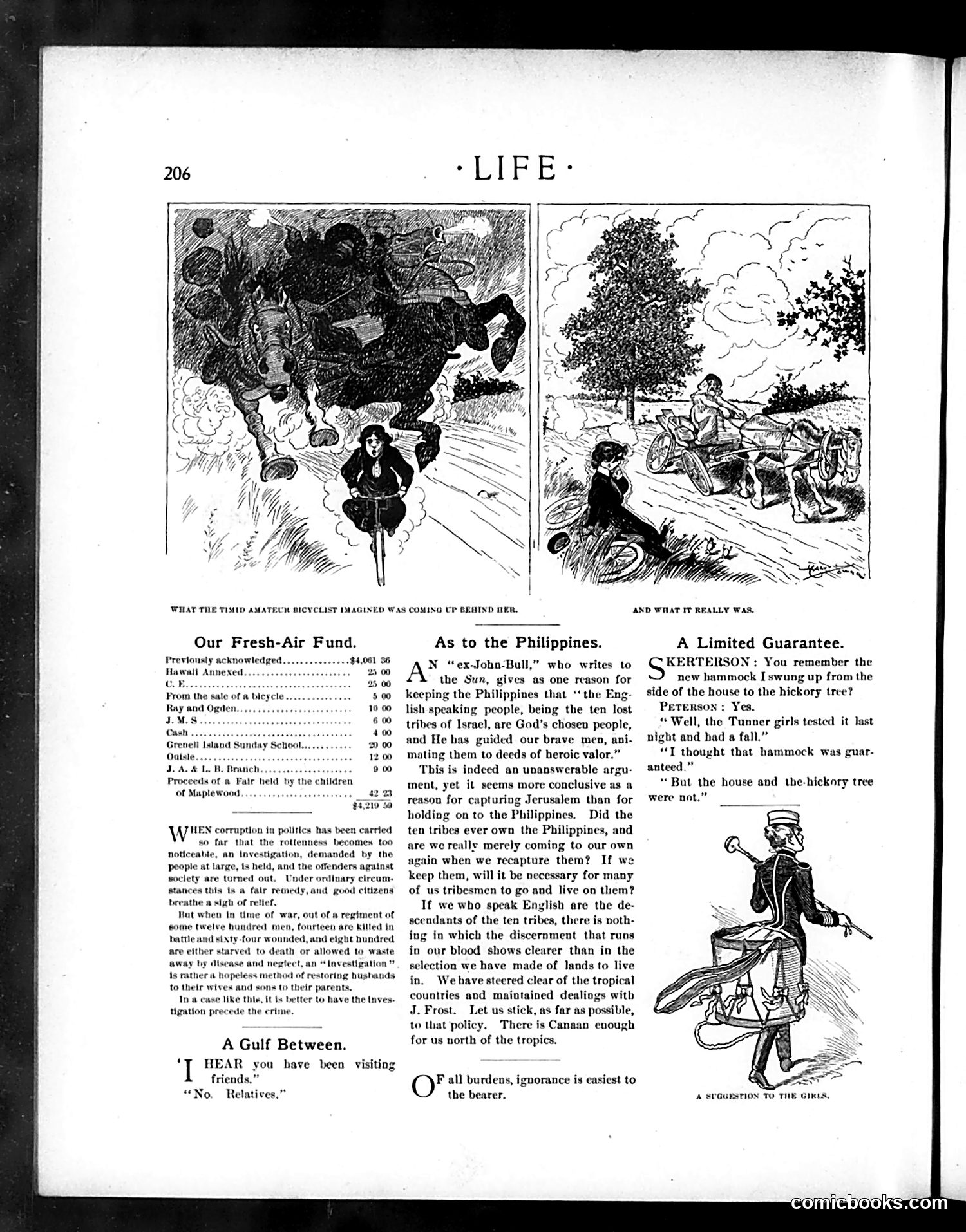
**The Two Bicycle Cartoons (top):** These contrasting panels mock timid amateur cyclists. The left shows an exaggerated imagining of what's coming: a monstrous horse-drawn vehicle bearing down menacingly. The right reveals reality: just ordinary cyclists on a peaceful road. The humor satirizes cyclists' anxiety and tendency to catastrophize minor road encounters. **"As to the Philippines" (center article):** This discusses the justification for maintaining American control of the Philippines, debating whether holding these territories represents colonial expansion or necessary strategic policy. The author questions whether keeping the islands requires ongoing military presence among indigenous populations. **"A Limited Guarantee" (right):** A brief humorous dialogue about a hammock's durability, playing on consumer skepticism of product guarantees.
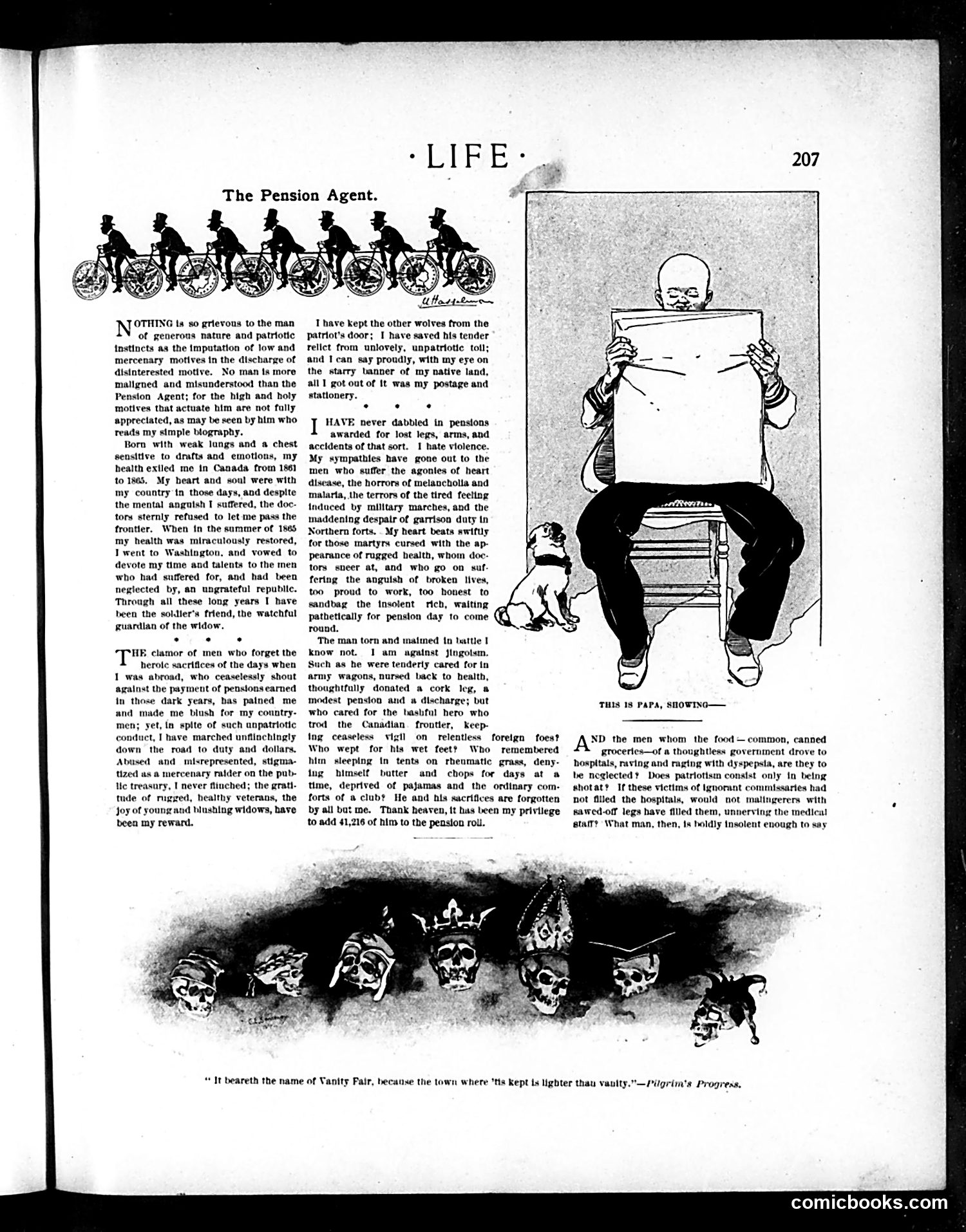
This satirical article attacks a Pension Agent—a government official responsible for distributing military pensions. The author, a Civil War veteran, argues that Pension Agents are corrupt bureaucrats who exploit wounded soldiers while enriching themselves through red tape and administrative fees. The accompanying cartoon shows a bald man presenting empty or minimal paperwork to a disabled veteran and child, suggesting the agent provides inadequate assistance. The article's tone is bitter, describing how soldiers suffered in battle while Pension Agents profit from those same veterans' misery. The bottom illustration of skulls appears to emphasize death and suffering. The satire targets government incompetence and institutional disregard for veterans' welfare—a recurring Progressive-era critique of Gilded Age bureaucracy.
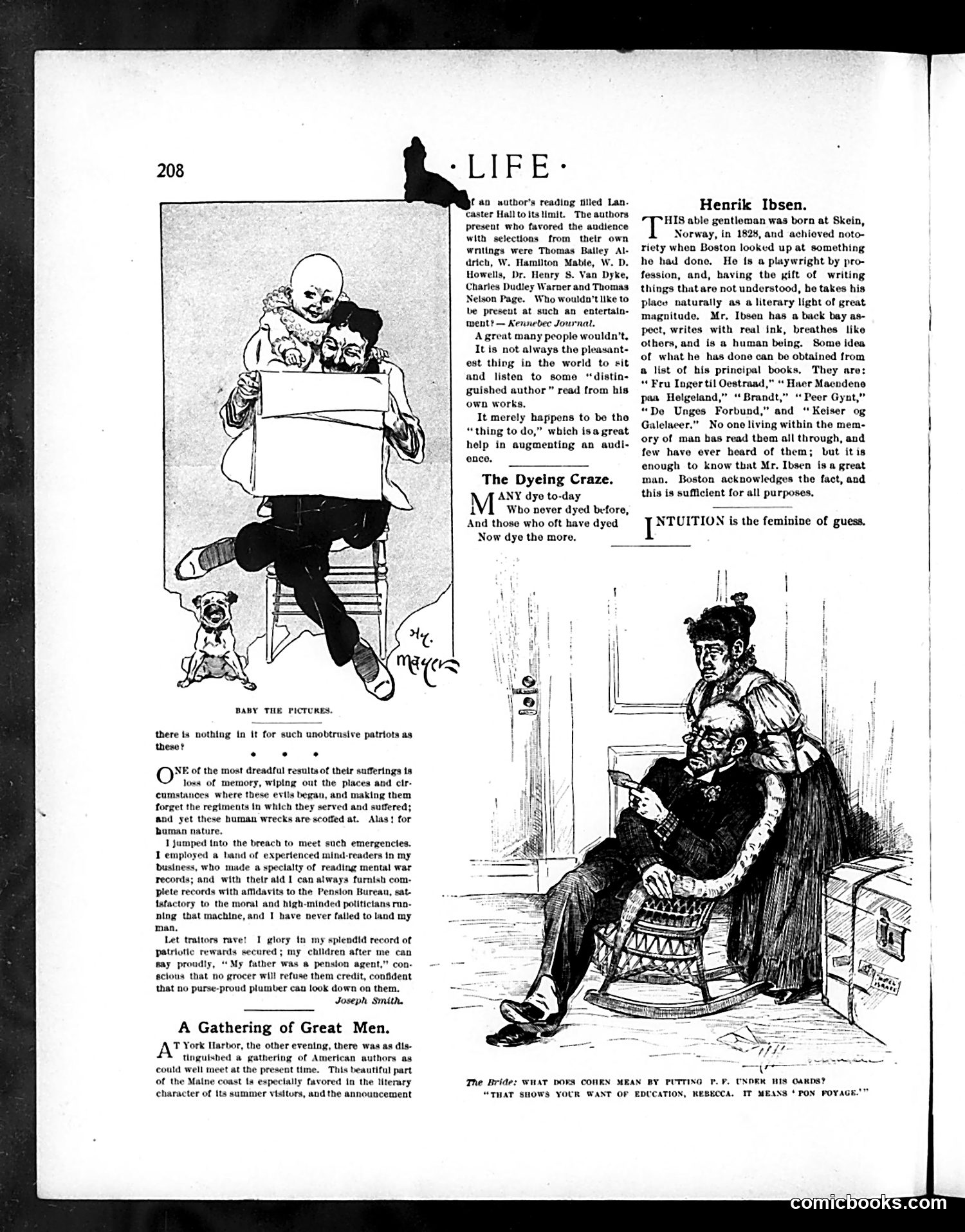
**Main Content:** This page features an article about Henrik Ibsen, the Norwegian playwright, born 1828. The text praises his literary significance and lists his major works. **Top Cartoon ("Baby the Pictures"):** A caricatured figure holds a box labeled with authors' names, surrounded by smaller figures and a dog. The caption critiques "unobtrusive patriots"—likely mocking people who boast about patriotic credentials while lacking substance. **Bottom Illustration:** Titled "The Bride," this appears to be a scene from an Ibsen play, showing a woman confronting a seated man about his putting "P.F." under his gardens, implying hidden shame or education deficiency. The satire targets class pretension and social hypocrisy—recurring Ibsen themes. **Overall:** The page celebrates Ibsen's work exposing social contradictions, ironically demonstrated through the patriotic satire above.
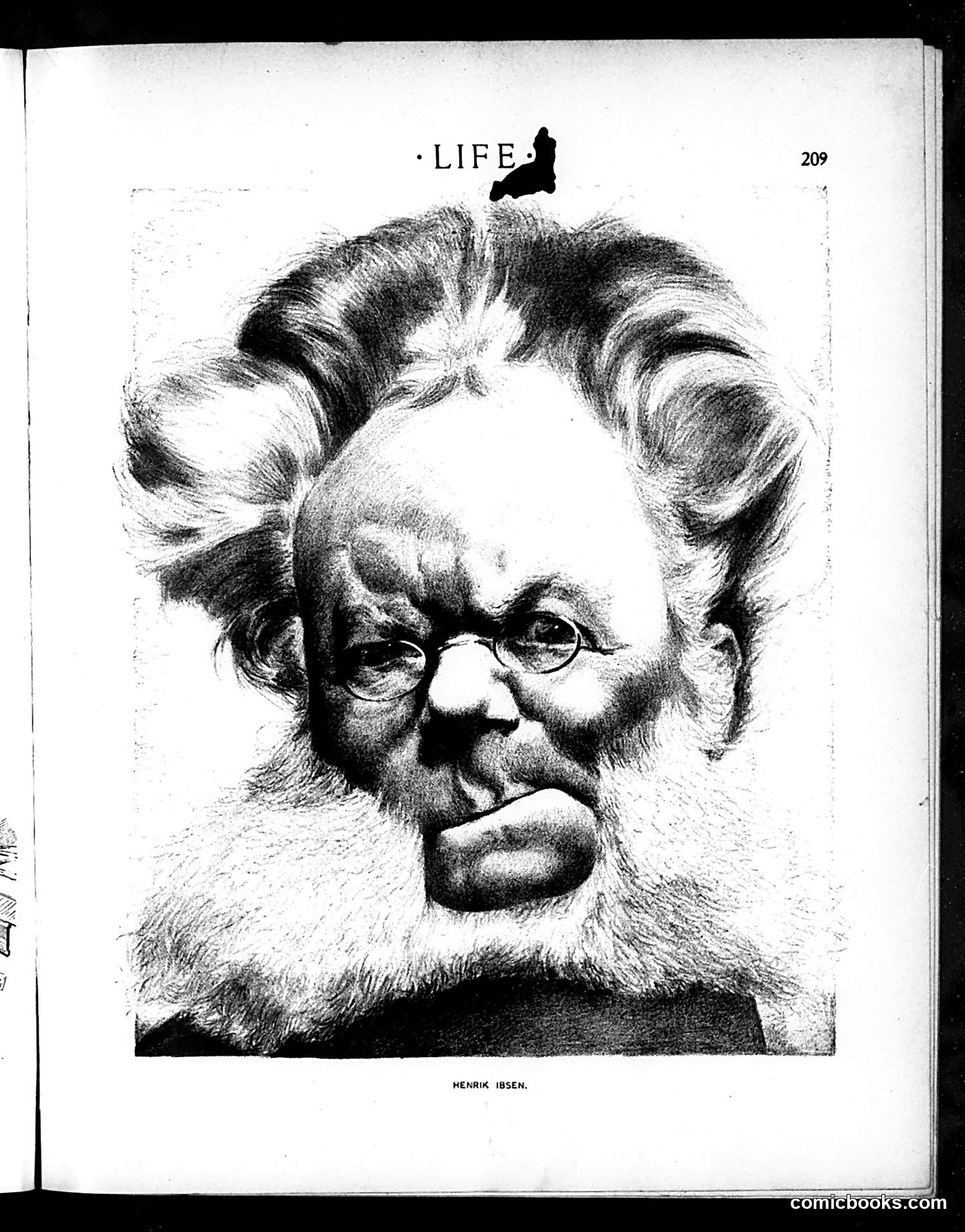
This page from *Life* magazine (page 209) features a portrait labeled "HENRIK IBSEN," the renowned Norwegian playwright. The image is a detailed sketch showing an elderly bearded man wearing glasses, with distinctive swept-back hair and a full beard. This appears to be a straightforward historical portrait rather than a political cartoon. Ibsen (1828-1906) was famous for realistic dramas addressing social issues, making him culturally significant in early 20th-century American intellectual circles. The *Life* masthead at top suggests this is part of the magazine's coverage of notable figures. Without additional context from surrounding pages, the specific satirical point—if any—remains unclear. This may simply be a respectful portrait of an influential literary figure.
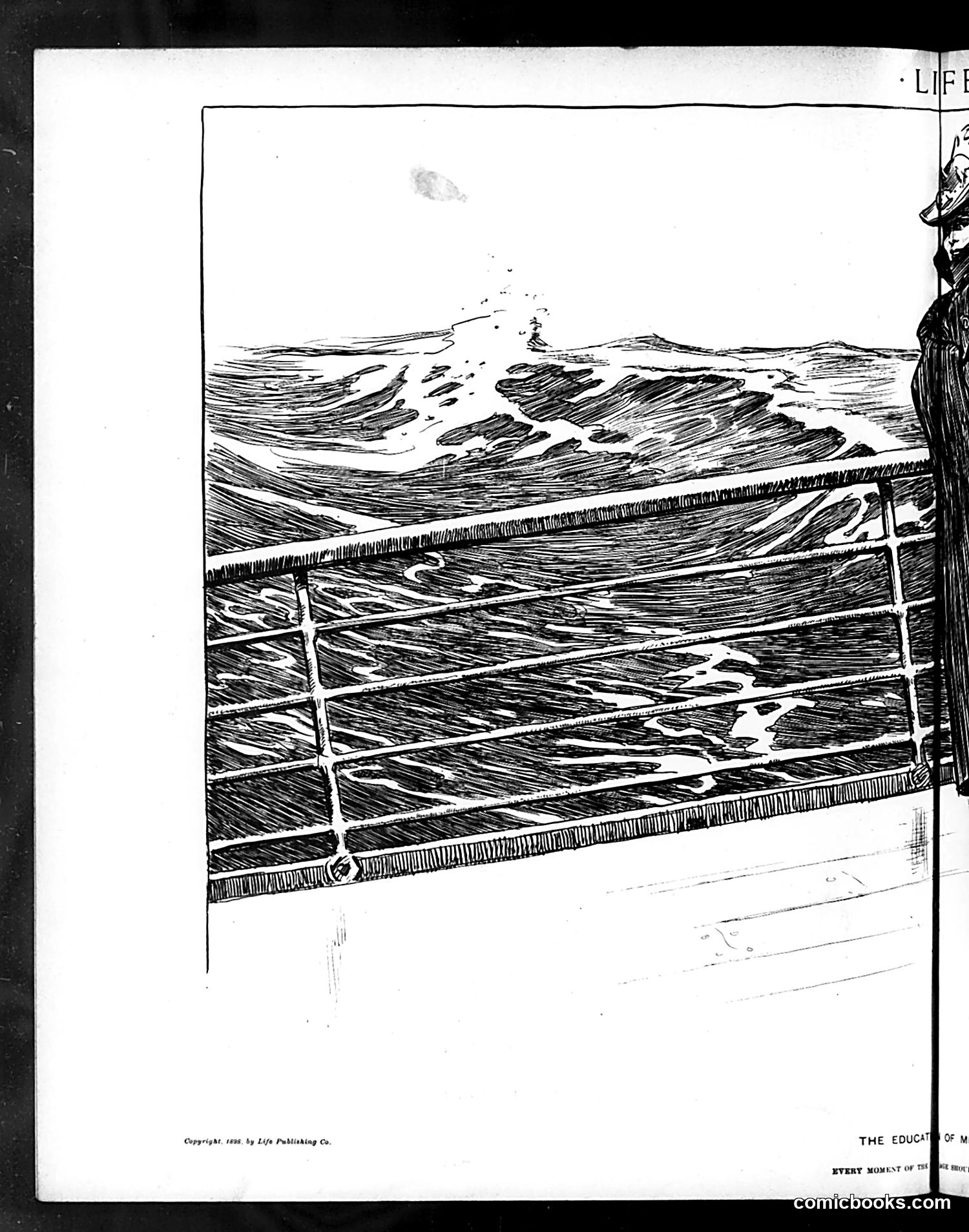
This is a black and white ink illustration showing a rural landscape viewed through a farm gate. The scene depicts rolling hills or fields stretching into the distance with what appears to be snow or light-colored terrain features. A wooden rail fence dominates the foreground, viewed from ground level as if the viewer is standing at the gate looking outward. The copyright indicates "1908 by Life Publishing Co." and partial text at bottom reads "THE EDUCATION OF M" and "EVERY MOMENT OF TH," suggesting this is part of a larger article or series. However, without seeing the complete caption, title, or accompanying article text, I cannot definitively identify what specific political or social commentary this illustration conveys. It may relate to agricultural policy, rural life, or expansion themes current in 1908, but asserting a particular meaning would require speculation unsupported by visible text.
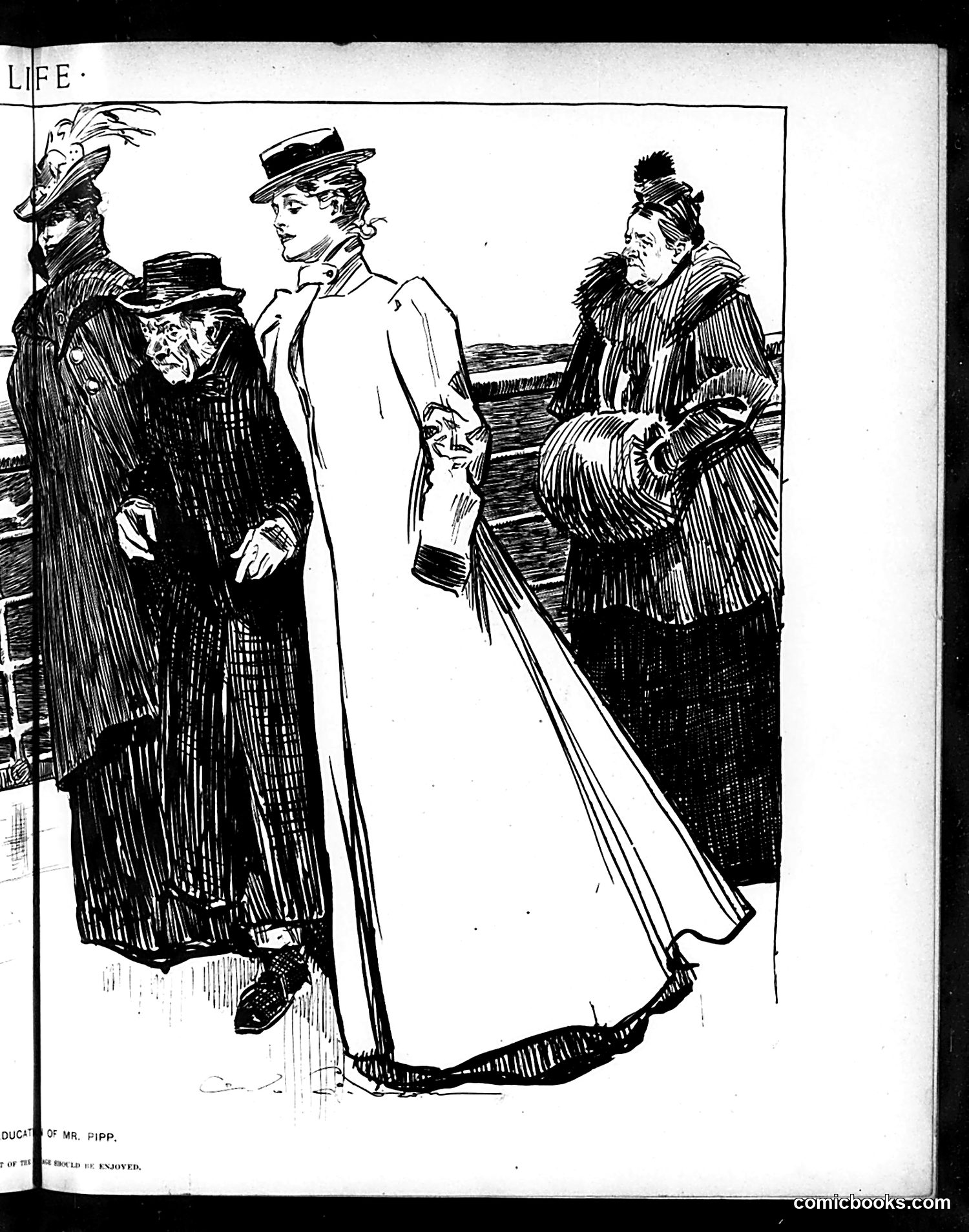
This page from *Life* magazine depicts a social encounter featuring elegantly dressed figures in what appears to be early 20th-century attire. The central figure is a woman in a striking white gown with an extremely long train, conversing with three other figures dressed in darker clothing. The caption references "Mr. Pipp," though the specific satirical point is unclear from the visible text. The cartoon likely satirizes social pretension or class dynamics—possibly mocking either the woman's ostentatious dress or the social awkwardness of the interaction. The exaggerated length of her train and the formal poses suggest satire about Victorian/Edwardian fashion excess or social posturing. Without additional context or clearer OCR text, the precise political or social critique remains uncertain.
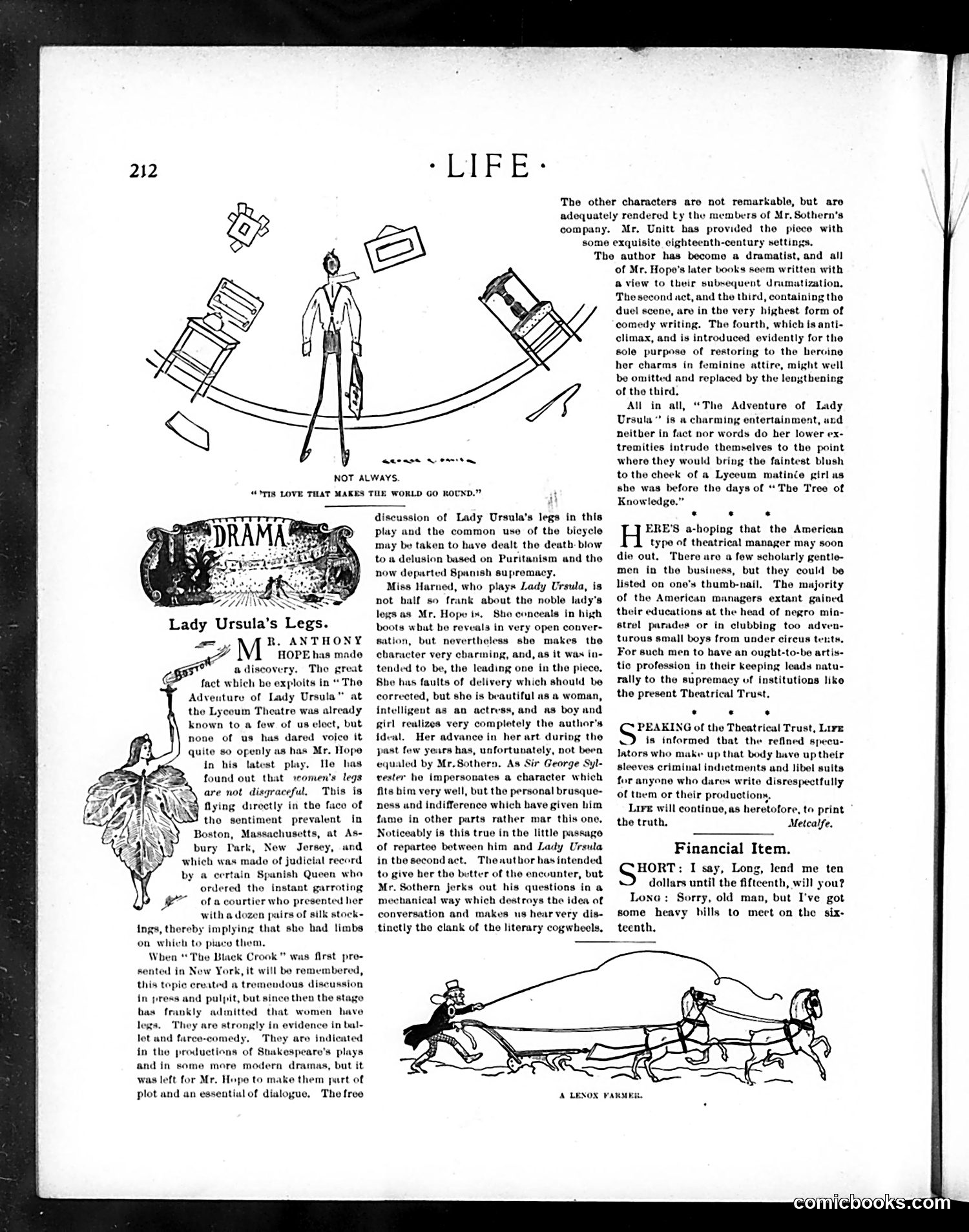
This page reviews "The Adventure of Lady Ursula," a theatrical production. The top cartoon depicts a man surrounded by tumbling furniture, captioned "TIS LOVE THAT MAKES THE WORLD GO ROUND" — likely satirizing the play's romantic chaos or physical comedy. The section "Lady Ursula's Legs" discusses how the play exploits the actress's legs as spectacle, referencing earlier theatrical controversy. The text notes this echoes "The Black Crook" production, which created public uproar by prominently displaying women's limbs on stage. The bottom cartoon shows "A LEXOS FARMER" — a visual gag unrelated to the main review. The "Financial Item" presents a brief comedic dialogue about lending money, typical of Life's humor filler content.
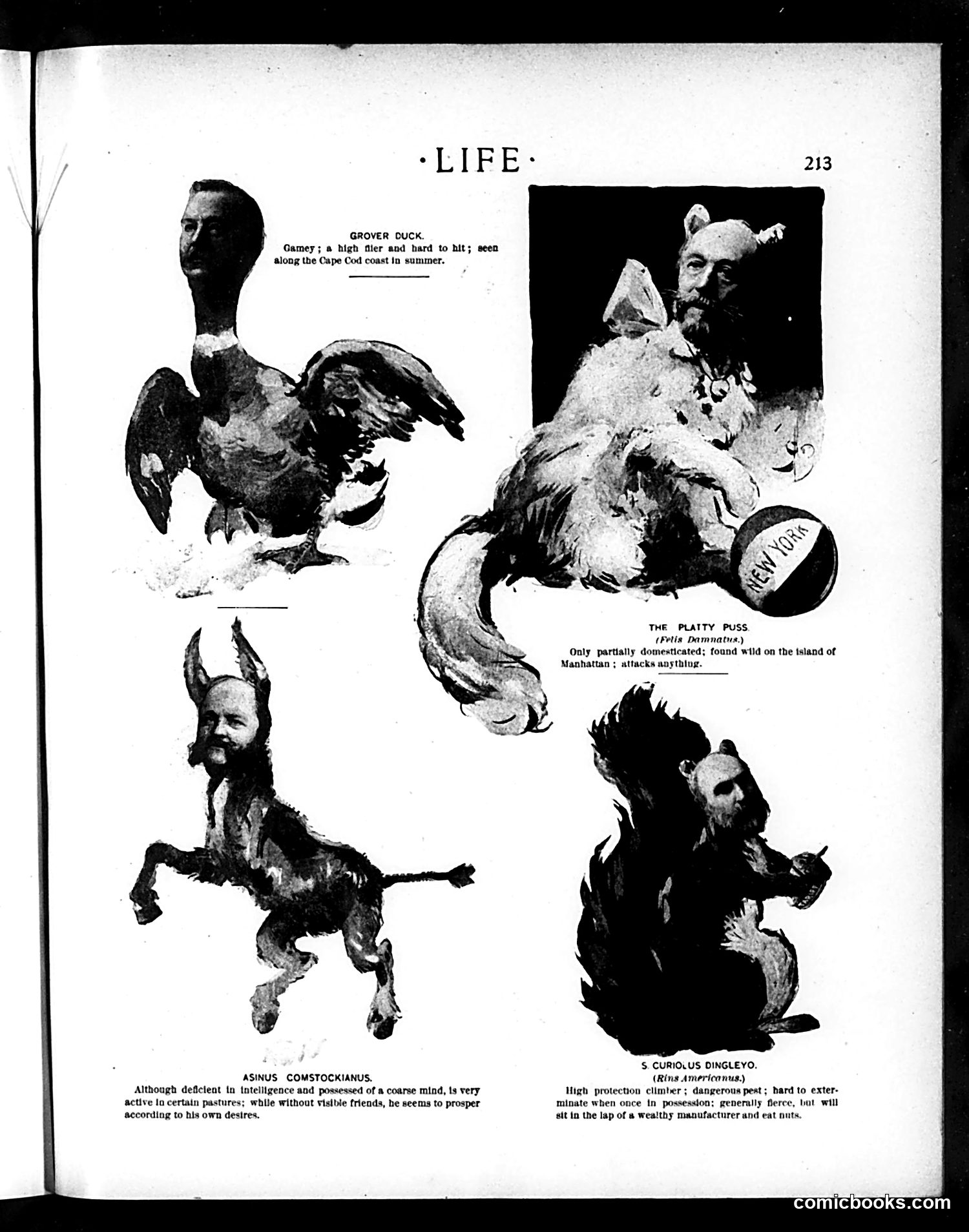
This page presents satirical "natural history" illustrations mocking contemporary political figures and New York society. Each creature receives a fake scientific name: - **"Grover Duck"** likely references President Grover Cleveland, depicted as game hunted along Cape Cod - **"Platty Puss"** (Manhattan) appears to satirize a fierce, undomesticated urban type—possibly a commentary on New York's rougher elements or political figures - **"Asinus Comstockianus"** references Anthony Comstock, the famous morality crusader, portrayed as a stubborn ass lacking intelligence but thriving in certain circles - **"Curiolus Dingleyo"** (unclear without fuller context) seems another society figure, described as a pest and climber who befriends wealthy manufacturers The humor relies on applying mock-Linnaean taxonomy to human types, a common Victorian satirical device. Modern readers would need to identify which specific politicians and public figures the cartoonist targeted to fully grasp each jab.
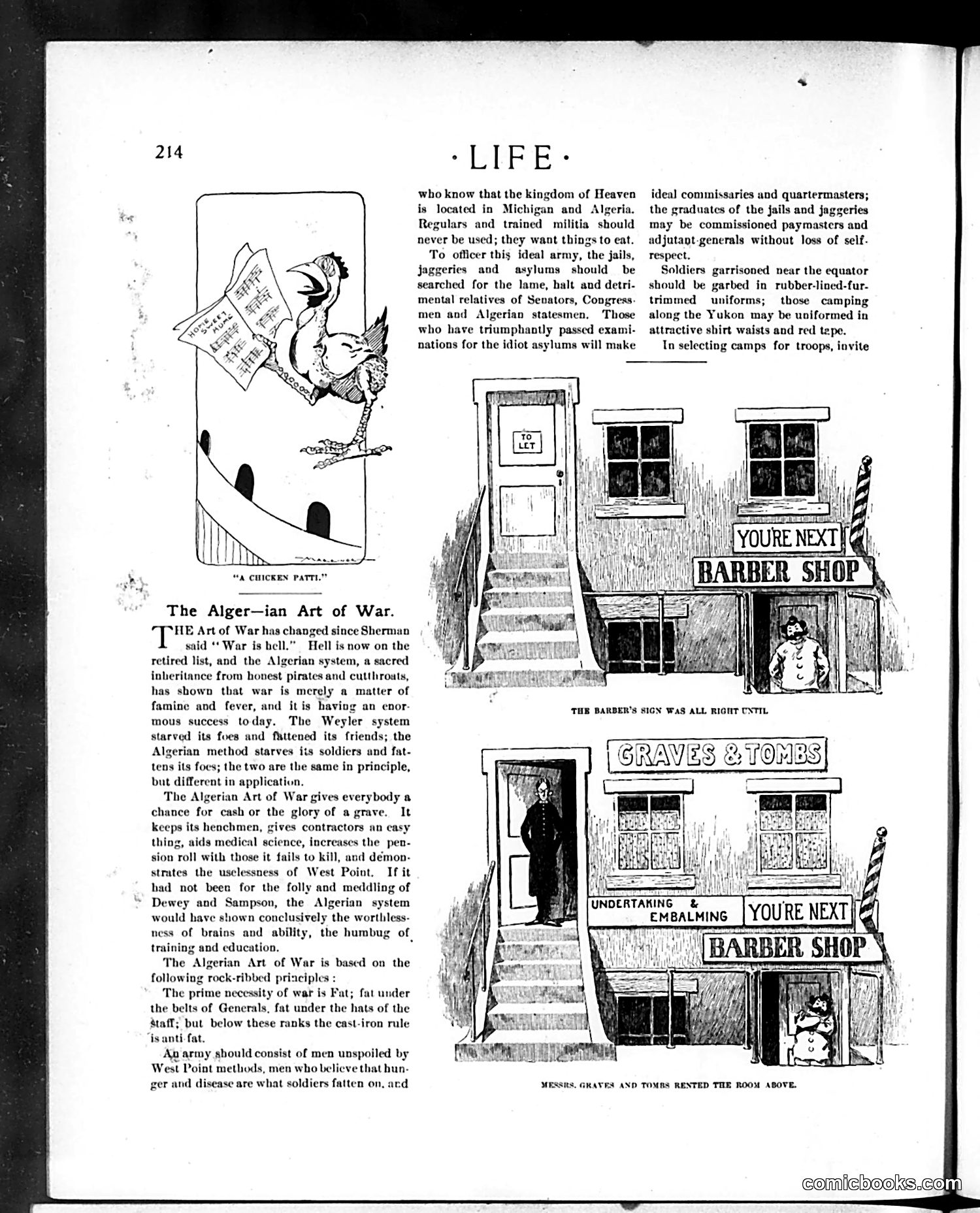
This satirical article mocks the U.S. military's conduct in the Philippine-American War (1899-1902), particularly under General Valeriano Weyler's strategy of starvation and disease. The piece sarcastically praises the "Algerian system"—deliberately starving soldiers while enriching military contractors and political appointees—as superior to traditional warfare. The satire targets: - **Military incompetence**: Officers chosen from asylums and jails rather than West Point graduates - **Political corruption**: Generals growing fat while soldiers starve - **Cronyism**: Contractors profiting from soldier deaths - **Absurd logistics**: tropical soldiers in fur uniforms, Arctic troops in "red tape" The cartoon shows a chicken (representing American strategy) reading a newspaper, suggesting the war effort is chaotic and ridiculous. The accompanying shop illustrations ("Barber Shop," "Graves & Tombs") darkly suggest the inevitable outcomes of such mismanagement: death and burial.
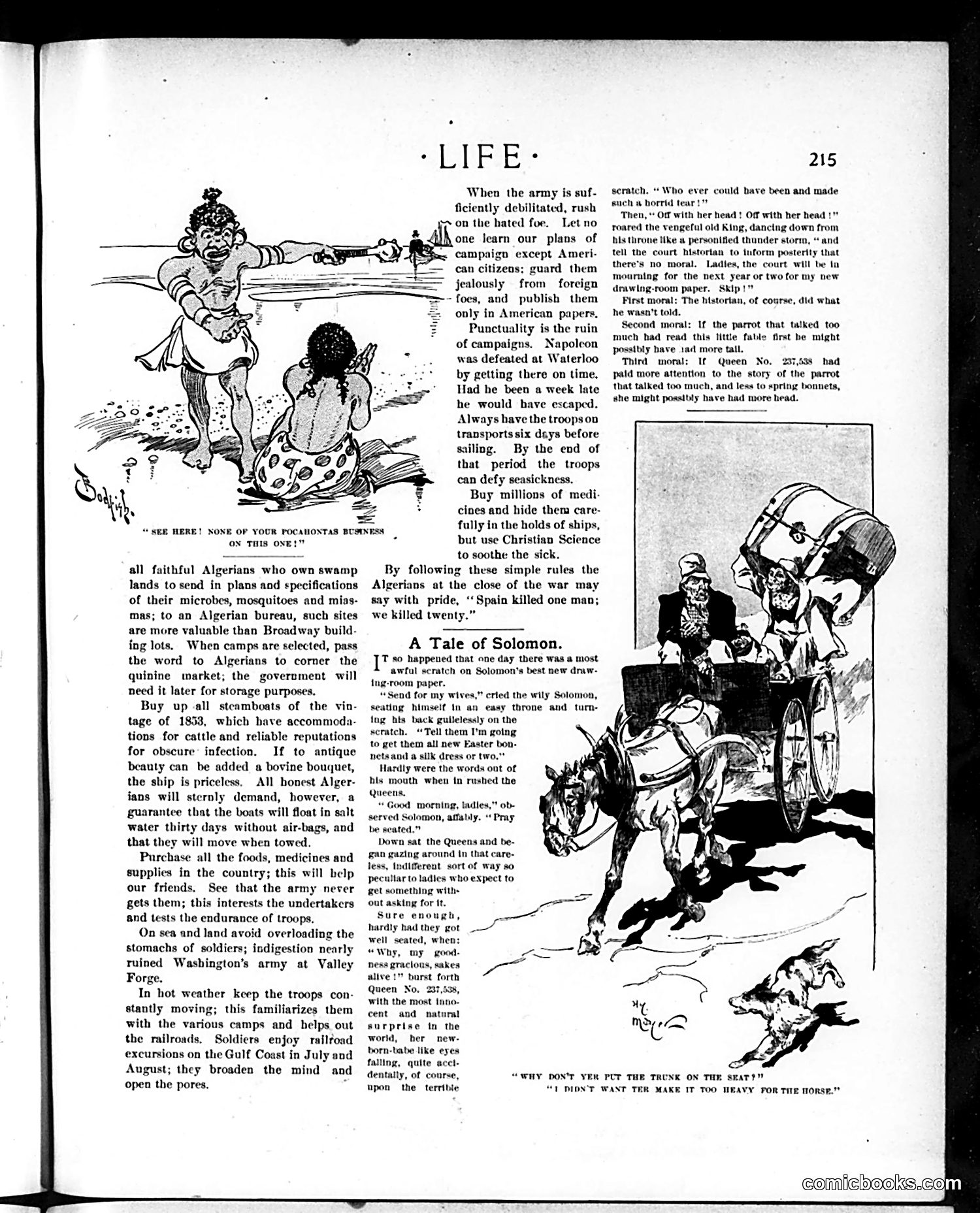
## Top Cartoon: "Pocahontas Business" This satirizes American military strategy during the Spanish-American War (likely concerning Cuba or Philippines). The cartoon mocks incompetent war planning by presenting absurdly destructive advice: deliberately debilitate troops through disease, starvation, and poor transport; keep battle plans secret from the army itself but publish them in newspapers; avoid punctuality (referencing Napoleon's defeat at Waterloo). The "Pocahontas" reference appears to critique underhanded dealing. The satire suggests American military leadership was so poorly managed that following these ridiculous rules would be no worse than actual practice. ## Bottom Story: "A Tale of Solomon" A brief humorous fable about King Solomon who deliberately allows his 237 wives to discover a scratch on his drawing-room paper, expecting them to blame each other rather than accept responsibility. The moral: people are unreliable narrators who avoid accountability. This appears to be light satirical commentary on human nature and blame-shifting. Both pieces employ exaggeration and absurdity to critique incompetence and self-serving behavior.
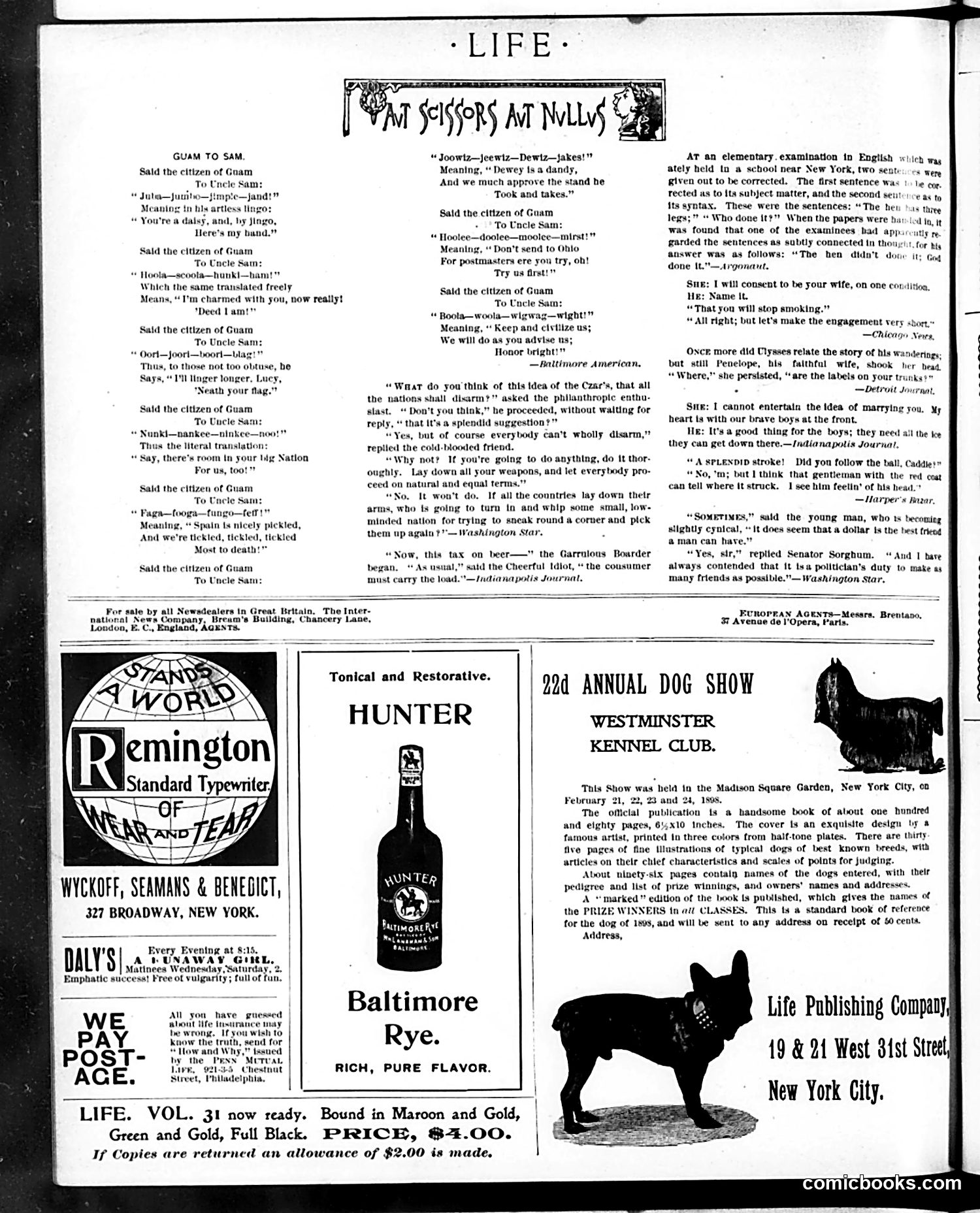
This satirical piece mocks American imperial expansion following the Spanish-American War (1898), when the U.S. acquired Guam from Spain. The cartoon depicts a Guam resident speaking to "Uncle Sam" (personification of America) in exaggerated, nonsensical "native" dialect—a common racist trope of the era. The humor relies on crude stereotyping: the Guamanian's gibberish supposedly translates into flattering endorsements of American rule, Admiral Dewey's naval victory, and acceptance of U.S. authority. References include approval of American "civilization," support for U.S. postmasters, and gratitude for remaining under American control rather than returning to Spanish rule. The satire critiques both American imperialism and the condescending attitudes toward newly acquired territories and their peoples—presenting colonial acquisition as benevolent while mocking the inhabitants' supposed eagerness to submit to American governance.
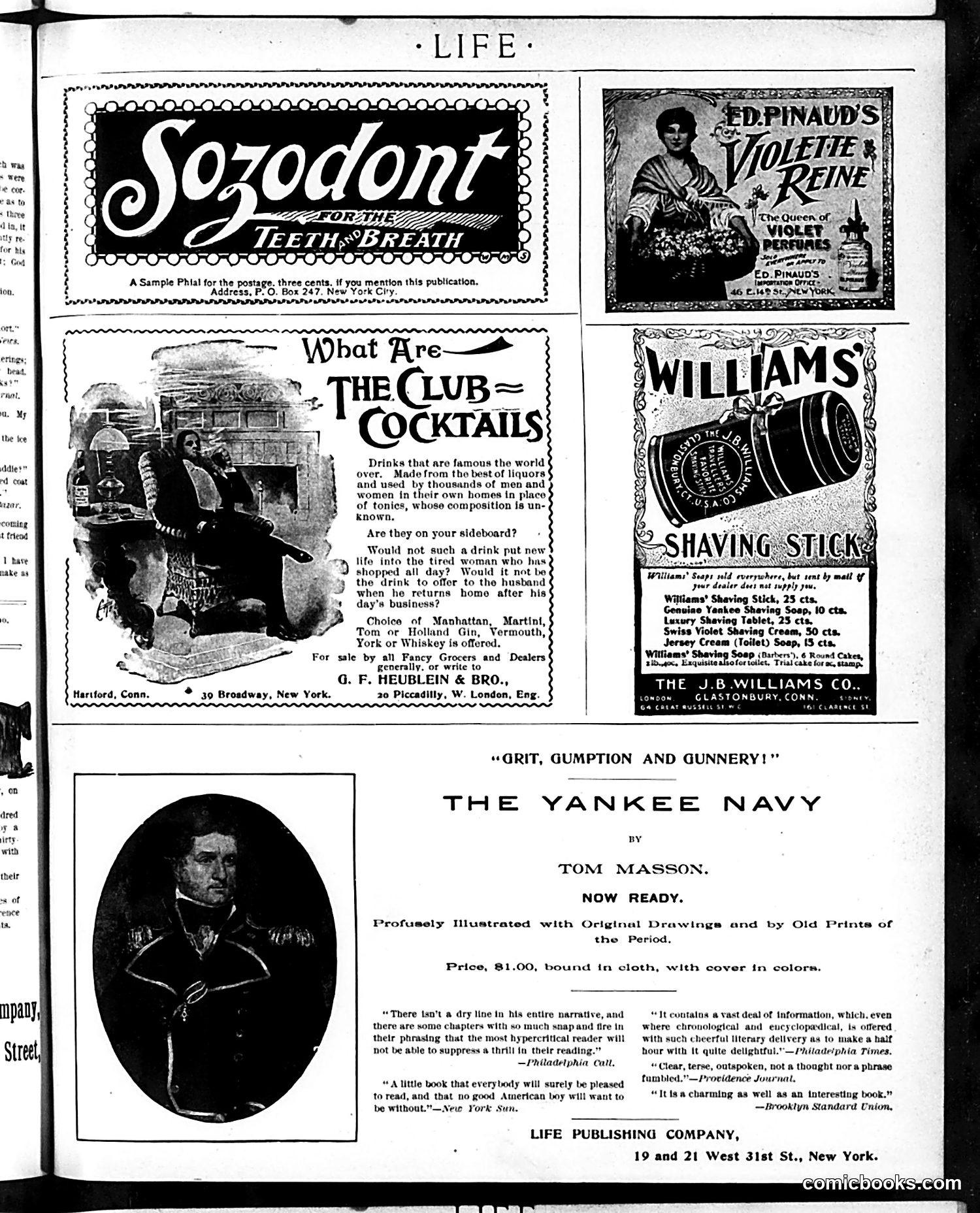
This is primarily a **commercial advertising page** from an early 20th-century Life magazine, not political satire. The content includes: **Product Advertisements:** - Sozodont toothpaste and mouthwash - Club Cocktails (spirits/mixers promoted for home use) - Williams Shaving products **Book Promotion:** The main feature promotes "The Yankee Navy" by Tom Masson—a humorous illustrated history of American naval history. The quoted reviews emphasize its patriotic appeal ("no good American boy will want to be without it") and its entertaining writing style. The single portrait illustration appears to be a historical naval figure, likely from the period covered by Masson's book, not a contemporary political figure. **Context for Modern Readers:** This represents turn-of-the-century American consumer culture and patriotic marketing—cocktails openly advertised for home consumption, grooming products, and historically-themed entertainment aimed at American nationalism and male readers.
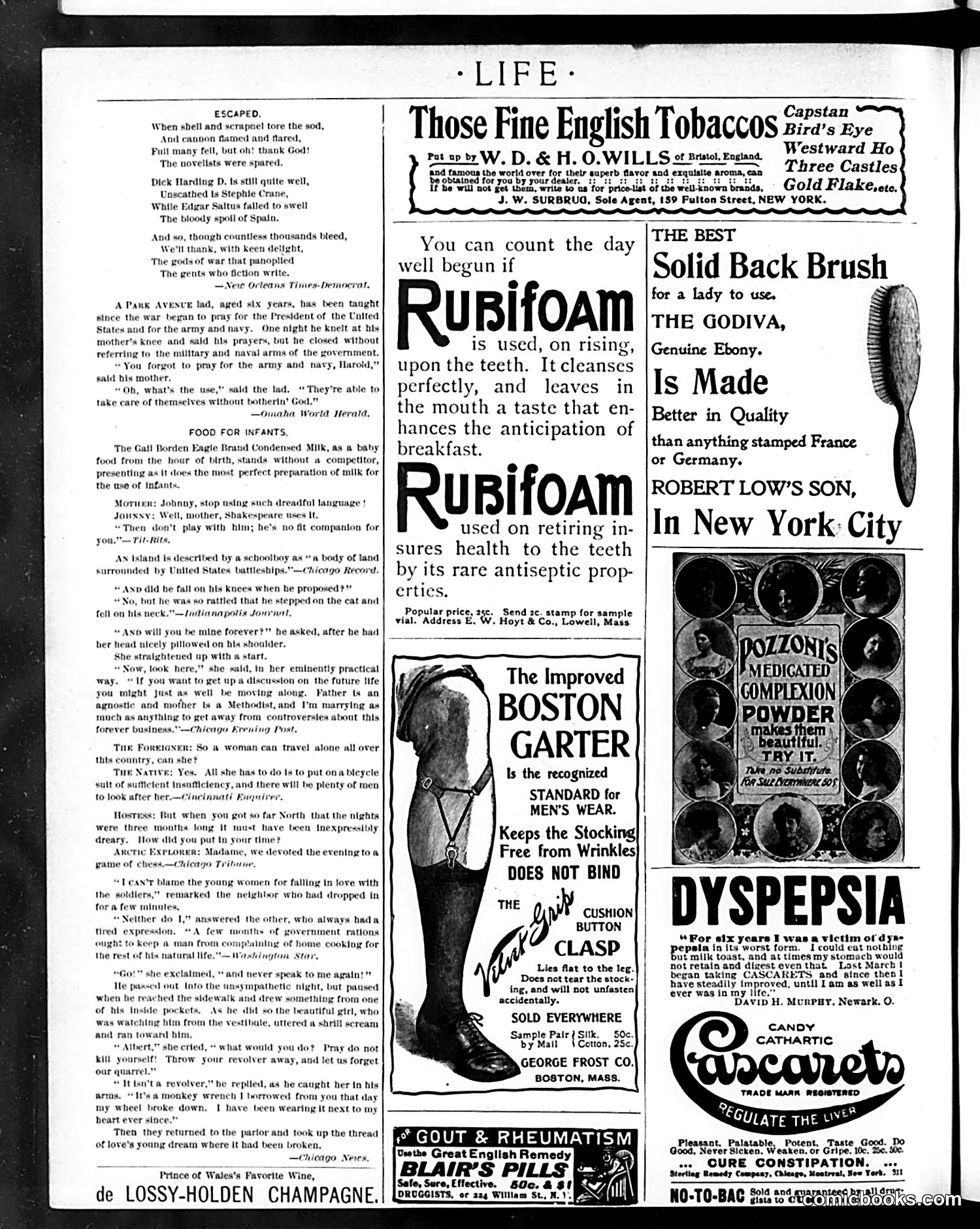
This page is primarily **advertising with satirical poetry and humor columns**, not political cartoons. The visible content includes: **Satirical Poetry ("Escaped"):** A joke about Spanish-American War casualties—while thousands died, American novelists (Dick Harding Davis, Stephen Crane, Edgar Saltus) survived unharmed. The satire mocks the irony that fiction writers escaped danger while soldiers didn't. **Humor Columns:** Brief anecdotes satirizing contemporary life—a child's naive theology about God not needing to protect the military; romantic mishaps; and women's independence (a woman traveling alone). **Advertisements:** The page is dominated by period product ads (Rubifoam toothpaste, Boston Garter, Cascarets laxative, etc.), typical of Life magazine's revenue model. The overall tone is light social satire aimed at middle-class readers, with the war reference being the only overtly serious element—presented humorously rather than critically.
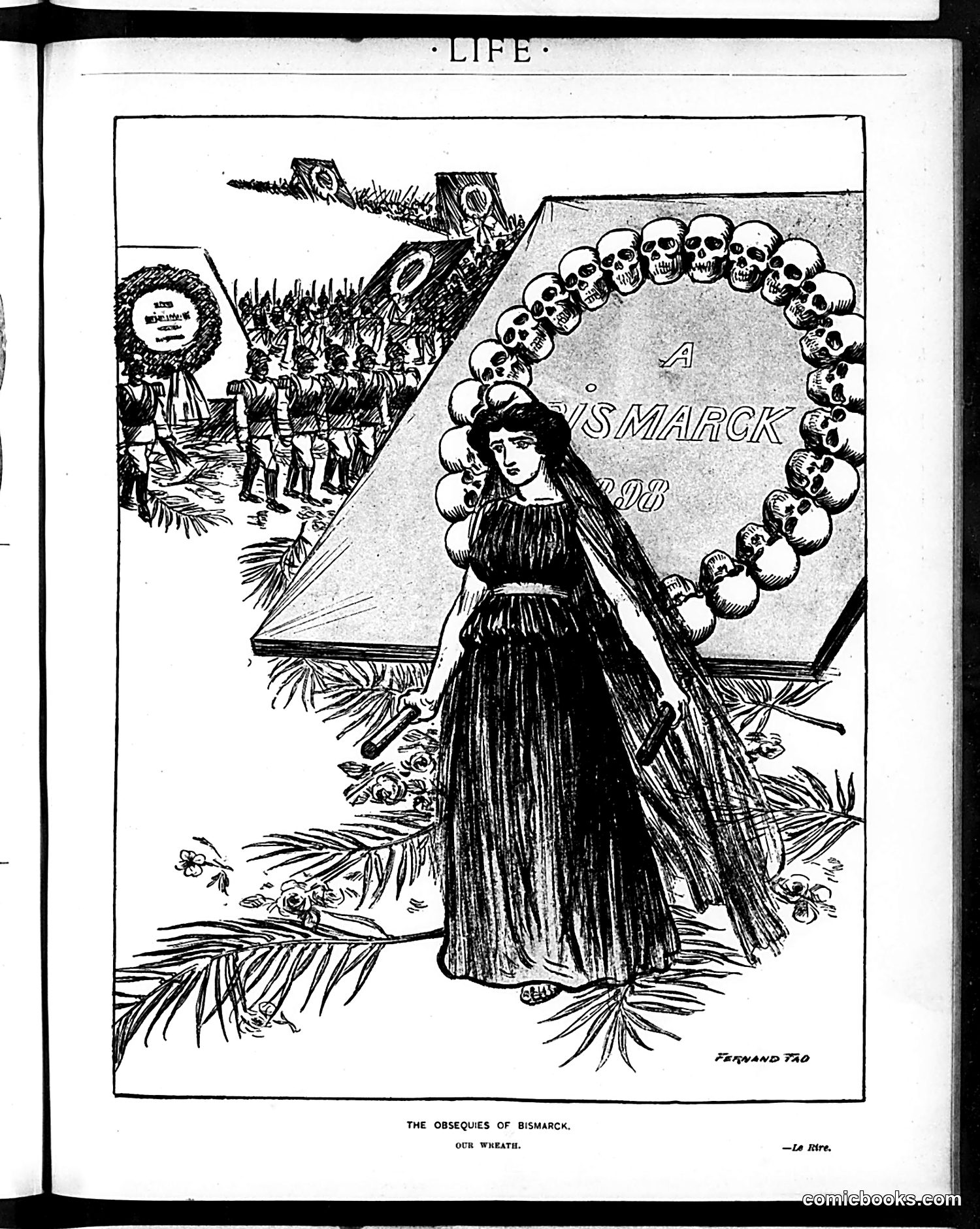
This satirical illustration mourns Otto von Bismarck's death, likely from 1898. The central female figure represents Germany or perhaps "Germania" (the German nation personified), dressed in mourning clothes and standing before a tomb decorated with skulls—symbolizing the death and destruction Bismarck caused. In the background, military forces and what appears to be warfare continue, suggesting that Bismarck's legacy of militarism and conflict persists beyond his death. The cartoonist presents an ironic "funeral"—the skulls frame the tomb as a monument to the human cost of Bismarck's aggressive policies and wars. The subtitle "Our Wreath" indicates this is *Life* magazine's commentary on his passing, treating his death as significant to American readers while criticizing his militaristic impact on European politics.
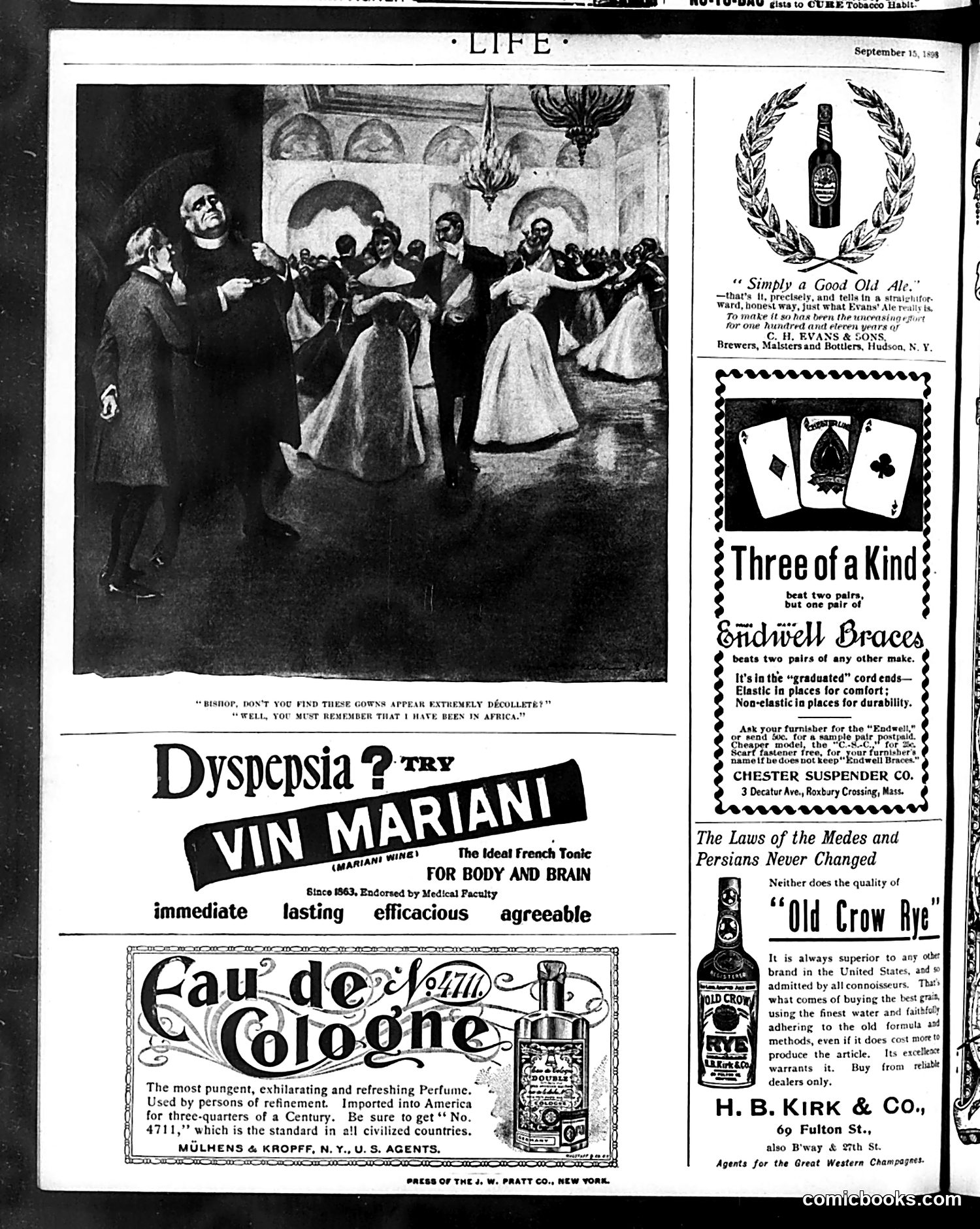
The main cartoon depicts a bishop conversing with a woman at what appears to be a formal social gathering. She's wearing a low-cut gown; he responds that he finds such exposed necklines acceptable because he's "been in Africa." **The satire:** This jokes about European colonial attitudes and the perceived "civilizing mission" in Africa. The bishop's logic suggests that exposure to African customs has made him tolerant of Western women's fashion—implying that African dress or culture is somehow less modest or refined. The humor relies on contemporary prejudices: the contrast between clerical propriety and worldly experience, combined with condescending assumptions about Africa as "uncivilized." The page is otherwise filled with period advertisements for tonics, perfume, suspenders, ale, and rye whiskey—typical Life magazine content from this era.