
Life, 1898-09-15 · page 4 of 20
Life — September 15, 1898 — page 4: what you’re looking at
What you’re looking at
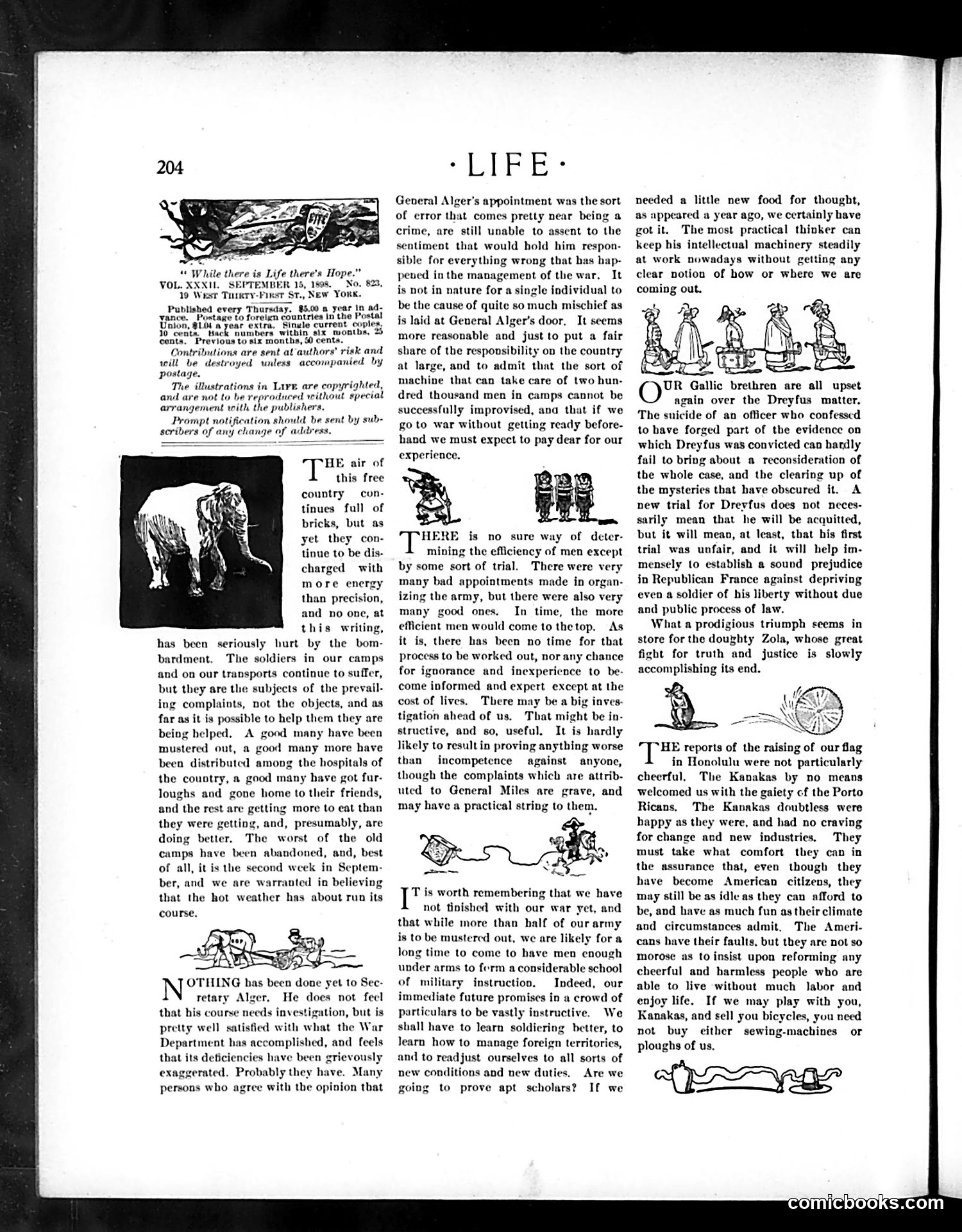
This page discusses General Alger's appointment and military management during what appears to be the Spanish-American War. The text criticizes how responsibility for wartime failures is attributed to Alger rather than systemic issues, arguing it's unfair to blame one individual for complex organizational problems. The small cartoon illustrations—showing soldiers, camp conditions, and military life—appear to satirize the army's unpreparedness and the gap between civilian expectations and battlefield reality. The text advocates for better military training and reorganization rather than scapegoating. The reference to Dreyfus and mentions of flags in Honolulu suggest contemporary international military and colonial concerns of 1898, though specific caricatured figures aren't clearly identifiable in these illustrations.
📄 Transcribed text from this page (OCR, searchable)
Machine-transcribed from the original scan — historical spelling and the odd misread are preserved.
“ While there is Life there's Hope. VOL. XXXIL._S BE . Published every Thursday. $5.00 a year I Yance. Postage to foreign countries In the Union, $104 a year extra. Sinsle current. coples; 10 centa. Hack numbers within six months, cents. Previous to six months, 40 cents. Contributions are sent at authors’ risk and will be destroyed unless accompanied by postage. The illustrations in Live. are copyrighted, and are not to be rer d without special arrangement with the publishers, Prompt no scriber ration should be sent by sub- of any change of address. HE air of this free country —con- tinues full of bricks, but as yet they con- tinue to be dis- charged with more energy than precision, and no one, at this writing, has been seriously hurt by the bom- bardment. The soldiers in our camps and on our transports continue to suffer, but they are the subjects of the prevail- ing complaints, not the objects, and as far as it is possible to help them they are being helped. A good many have been mustered out, a good many more have been distributed among the hospitals of the country, a good many have got fur- loughs and gone home to their friends, and the rest are getting more to eat than they were getting, and, presumably, are doing better. The worst of the old camps have been abandoned, and, best of all, it is the second week in Septem- ber, and we are warranted in believing that the hot weather has about run its course, OTHING has been done yet to Sec- retary Als He does not feel that his course necds investigation, but is pretty well satisfied with what the War Department has accomplished, and feels that its deticiencies have been grievously exaggerated. Probably they have. Many persons who agree with the opinion that ‘LIPE » General Alger’s appointment was the sort of error that comes pretty near being a crime, are still unable to assent to the sentiment that would hold him respon- sible for everything wrong that bas hap- pened inthe management of the war, It is not in nature fora single individual to be the cause of quite so much mischief as is laid at General Alger’s door, It seems more reasonable and just to put a fair share of the responsibility on the country at large, and to admit that the sort of machine that can take care of two hun- dred thousand men in camps cannot be successfully improvised, ana that if we goto war without getting ready before- hand we must expect to pay dear for our experience. HERE is no sure way of deter- mining the efficiency of men except by some sort of trial. There were very many bad appointments made in organ- izing the army, but there were also very many good ones. In time, the more efficient men would come to thetop. As it is, there has been no time for that process to be worked out, nor any chance for ignorance and inexperience to be- come informed and expert except at the cost of lives. There may be a big inves- tigation ahead of us. That might be in- structive, and so, useful, It is hardly likely to resultin proving anything worse than incompetence against anyone, though the complaints which are attrib- uted to General Miles are grave, and may have a practical string to them. = S T is worth remembering that we have not tinished with our war yet, and that while more than half of our army is to be mustered out, we are likely for a long time to come to have men enough under arms to form a considerable school of military instruction. Indeed, our immediate future promises in a crowd of particulars to be vastly instructive. We shall have to learn soldiering better, to learn how to manage foreign territories, and to readjust ourselves to all sorts of new conditions and new duties. Are we going to prove apt scholars? If we needed a little new food for thought, as appeared a year ago, we certainly have got it. The most practical thinker can keep his intellectual machinery steadily at work nowadays without getting any clear notion of how or where we are coming out, Weis on Gallic brethren are all upset again over the Dreyfus matter. The suicide of an officer who confessed to have forged part of the evidence on which Dreyfus was convicted can hardly fail to bring about a reconsideration of the whole case, and the clearing up of the mysteries that have obscured it. A new trial for Dreyfus does not neces- sarily mean that he will be acquitted, but it will mean, at least, that his first trial was unfair, and it will help im- mensely to establish a sound prejudice in Republican France against depriving even a soldier of his liberty without due and public process of law. What a prodigious triumph seems in store forthe doughty Zola, whose great fight for truth and justice is slowly accomplishing its end. HE reports of the raising of our flag in Honolulu were not particularly cheerful, The Kanakas by no means welcomed us with the gaiety cf the Porto Ricans. The Kanakas doubtless were happy as they were, and had no craving for change and new industries, They must take what comfort they can in the assurance that, even though they have become American citizens, they muy still be as idle as they can afford to be, and have as much fun as their climate and circumstances admit. The Ameri- cans have their faults, but they are not so morose as to insist upon reforming any cheerful and harmless people who are able to live without much labor and enjoy life. If we may play with you, Kanakas, and sell you bicycles, you need not buy either sewing-machines or ploughs of us.