
A complete issue · 20 pages · 1898
Life — June 9, 1898
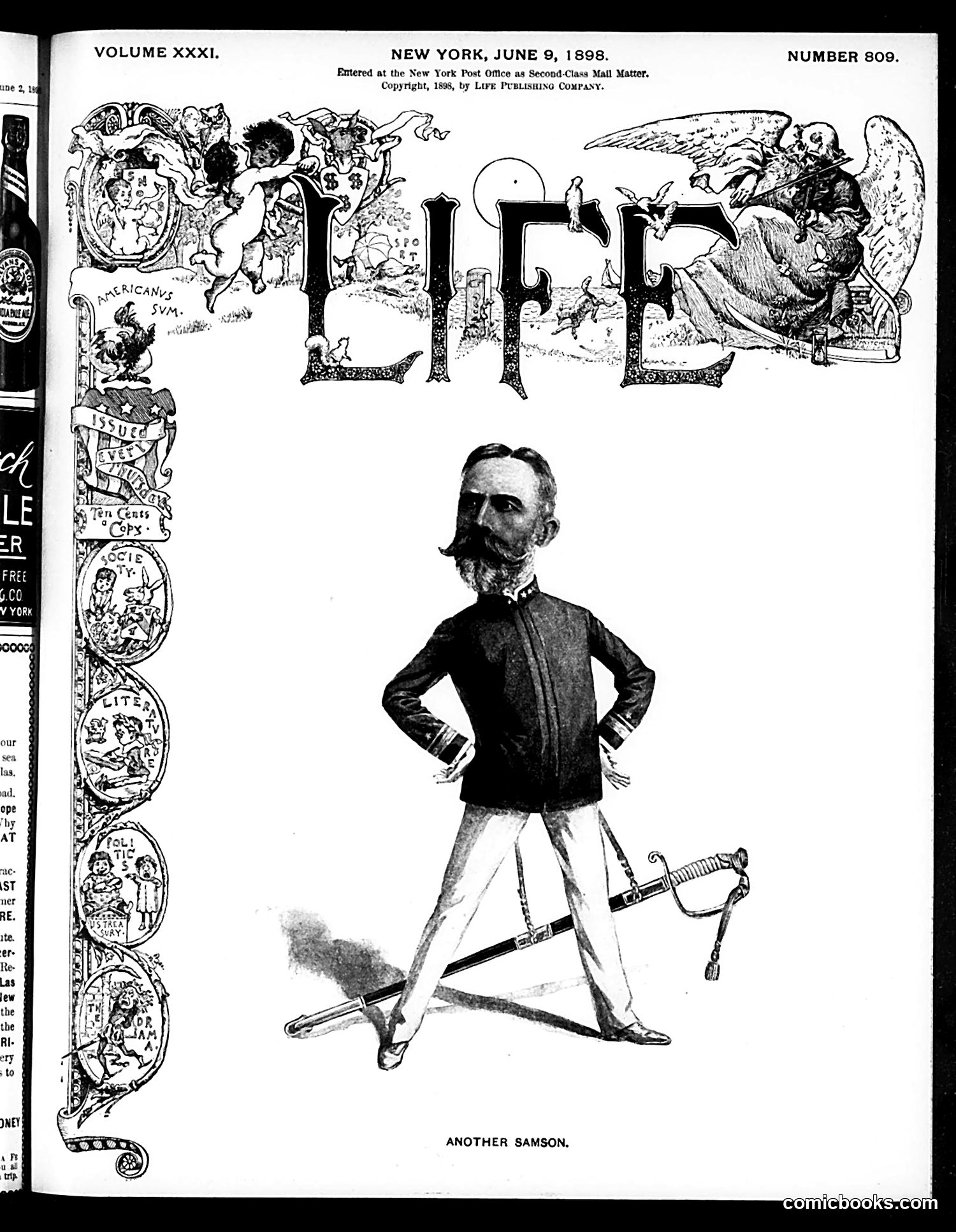
This political cartoon depicts a military figure in a dark jacket and white trousers, posed with legs spread wide, wielding a sword. The caption reads "Another Samson," invoking the biblical strongman who defeated enemies through physical prowess. The cartoon likely comments on American military leadership during the Spanish-American War (then underway in 1898). The figure's exaggerated, boastful stance—hands on hips, sword prominent—suggests satire of a contemporary military or political leader claiming superior strength or invincibility. The "Samson" reference implies the figure possesses great power, possibly mocking overconfidence in American military dominance. Without additional context, the specific person caricatured remains unclear, though the prominent facial hair and military bearing suggest a recognizable public figure of that era.
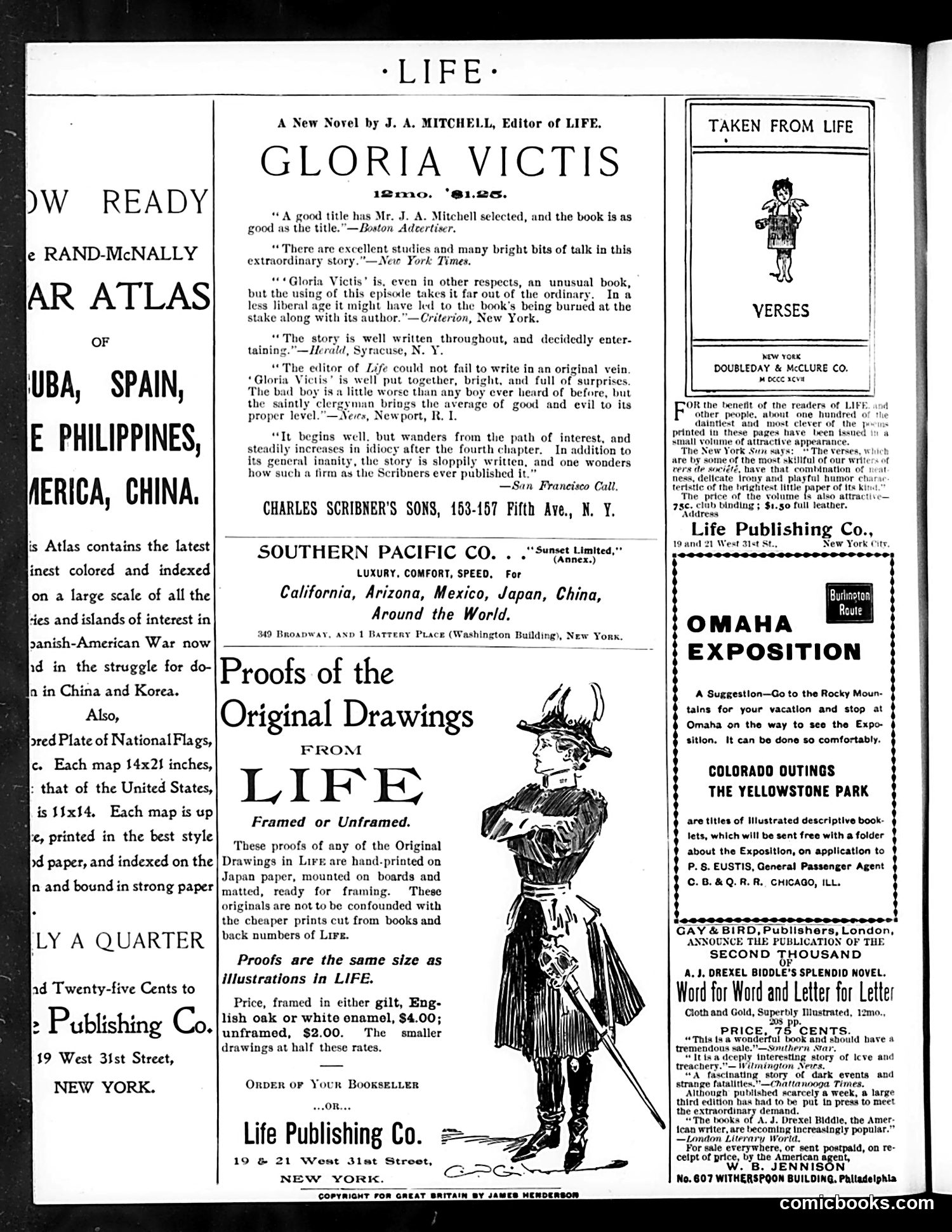
This page is primarily **advertising and book announcements** rather than satirical content. The main illustration depicts a **fashionably dressed woman in early 1900s attire** (elaborate hat, corseted dress, sword or walking stick), likely representing "Gloria Victis," the title of a new novel by J.A. Mitchell, the magazine's editor. The advertisements showcase publications and travel services typical of the era: atlases covering Spanish-American War territories, travel guides to the Southern Pacific routes, the Omaha Exposition, and Colorado outings. The woman's military-style accessory (sword) may subtly reference the book's title meaning "glory to the conquered," suggesting themes of triumph or victory, though the specific satirical intent isn't clearly evident from this excerpt alone.
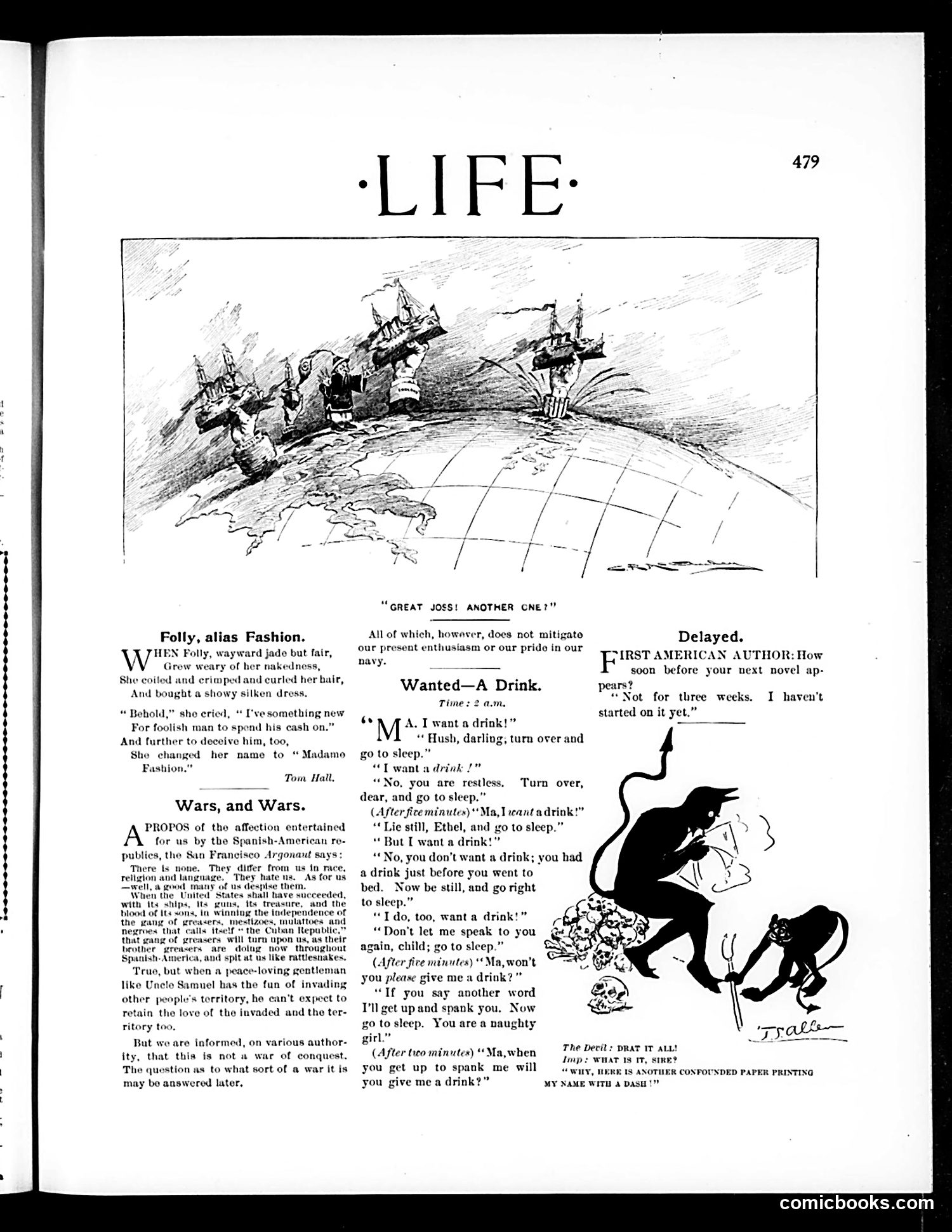
The main cartoon depicts several naval warships positioned around a globe, illustrating the article "Wars and Wars" above it. The piece discusses Spanish-American tensions and colonial rivalries, referencing Cuba and Spain's historical conflicts. The ships represent the imperial powers competing for territorial control and naval dominance during this era of expansionism. The separate cartoon shows a woman arguing with a man about getting a drink, captioned "The devil: 'DRAT IT ALL! How what is it, sir?'" with a note about "another confounded paper printing my name with a dash!!!" This appears to be satirizing careless newspaper printing practices or editorial censorship that obscures proper names using dashes—a common 19th-century convention when avoiding direct attribution or protecting identity.
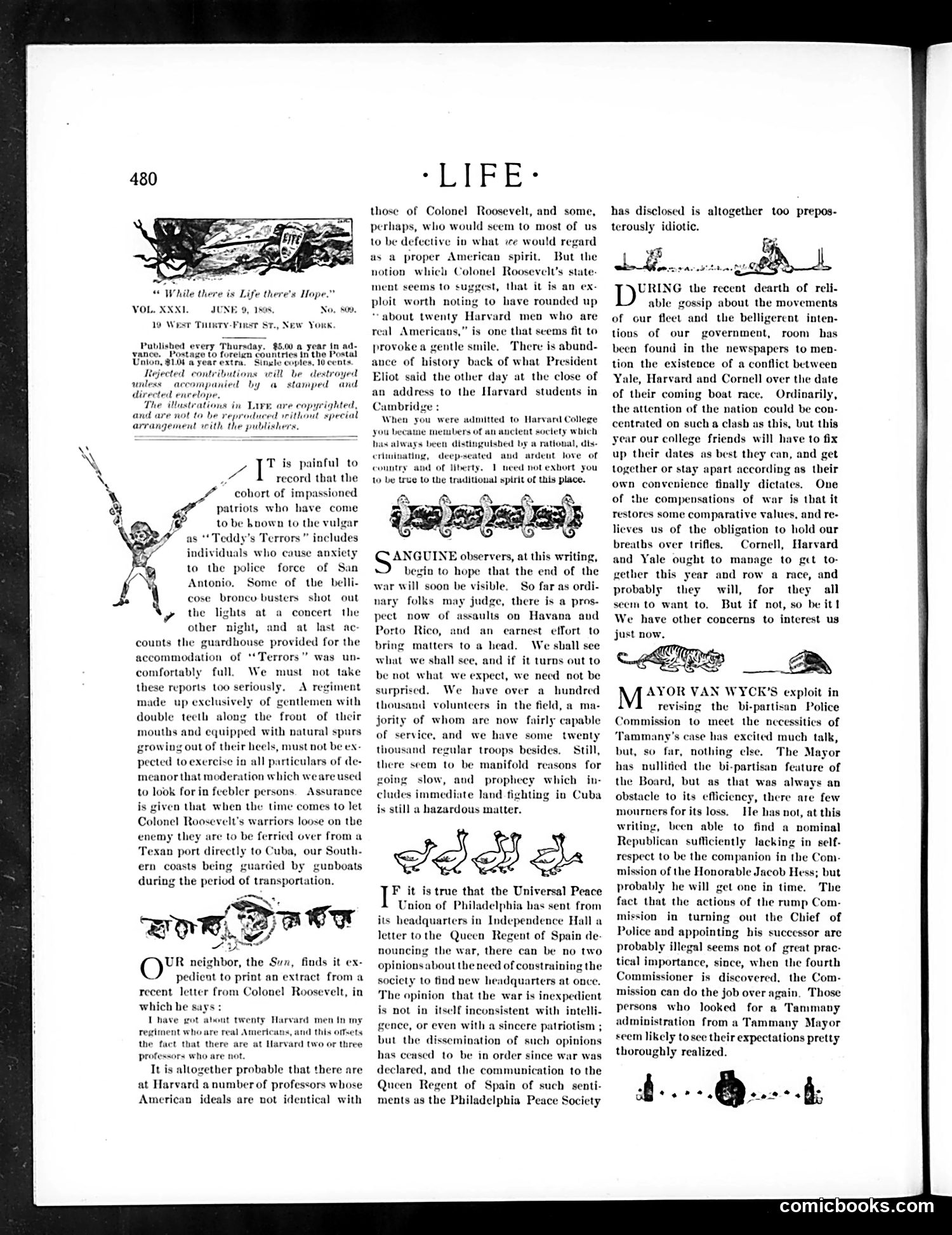
This page contains editorial commentary on Spanish-American War topics rather than traditional political cartoons. The small illustrations (a soldier, ducks in a line, and miscellaneous vignettes) are decorative rather than satirical. The text discusses several 1898 issues: Harvard students enlisting, American patriotism versus isolationism, military operations in Cuba and Puerto Rico, and Philadelphia's Universal Peace Union sending anti-war letters to Spain's Queen Regent. A key criticism targets Mayor Van Wyck's handling of New York's Police Commission—apparently he removed the bi-partisan feature to appoint his own successor. The author finds this politically motivated but notes it's "not of great practical importance." The overall tone is satirical commentary on wartime politics and institutional maneuvering.
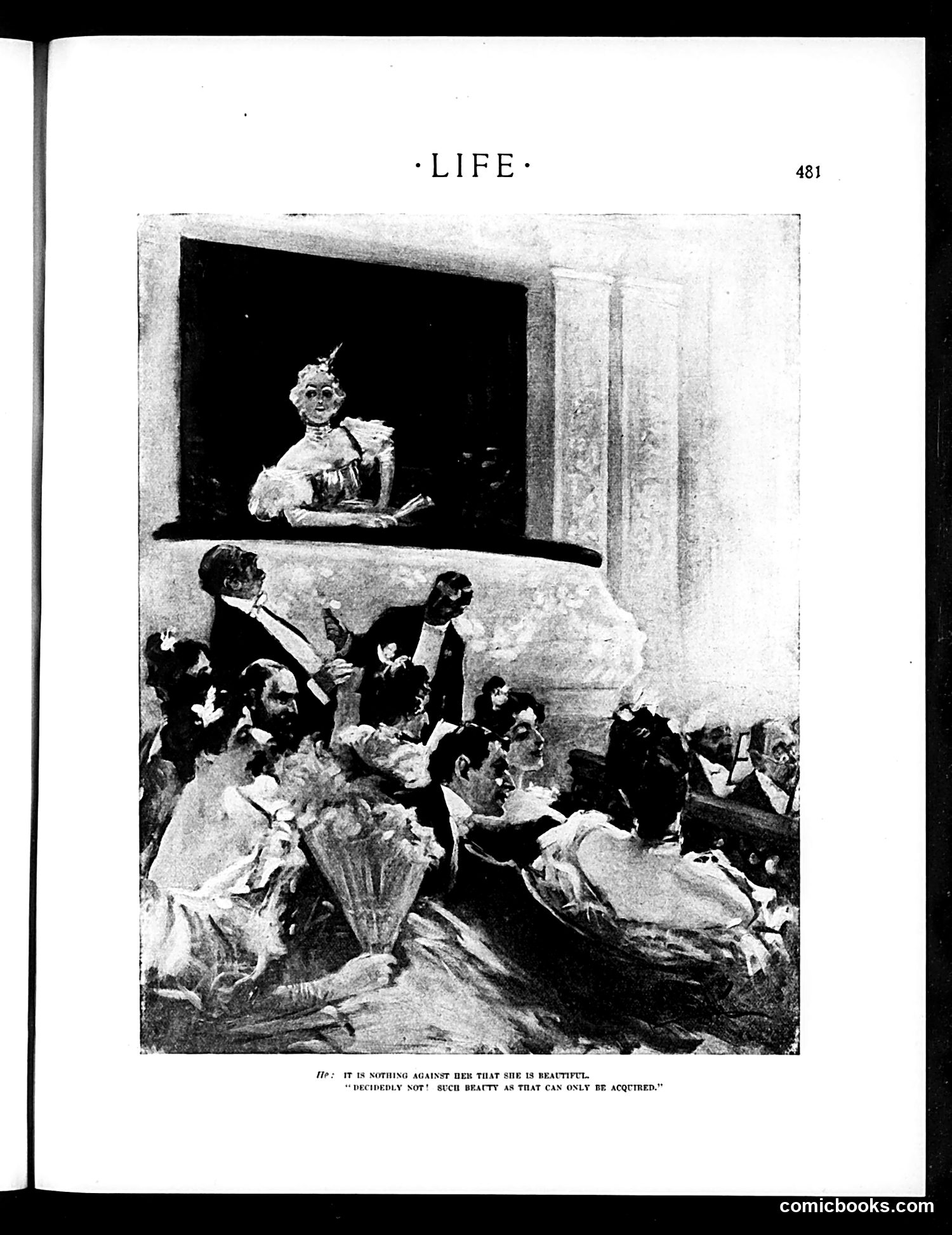
This satirical illustration depicts an elegant woman displayed in a theater box above an audience of well-dressed theatergoers. The caption reads: "It is nothing against her that she is beautiful. 'Decidedly not' such beauty as that can only be acquired." The satire appears to mock the artificiality of fashionable beauty standards among the wealthy elite. The woman in the box—positioned like a theatrical spectacle—represents beauty presented as an acquired commodity rather than a natural attribute. The audience gazing upward suggests society's obsession with viewing and evaluating women's appearance as entertainment or performance. The joke critiques how Gilded Age high society treated feminine beauty as something purchased, constructed, or performed rather than genuine—a commentary on materialism and the performative nature of social status among the wealthy.
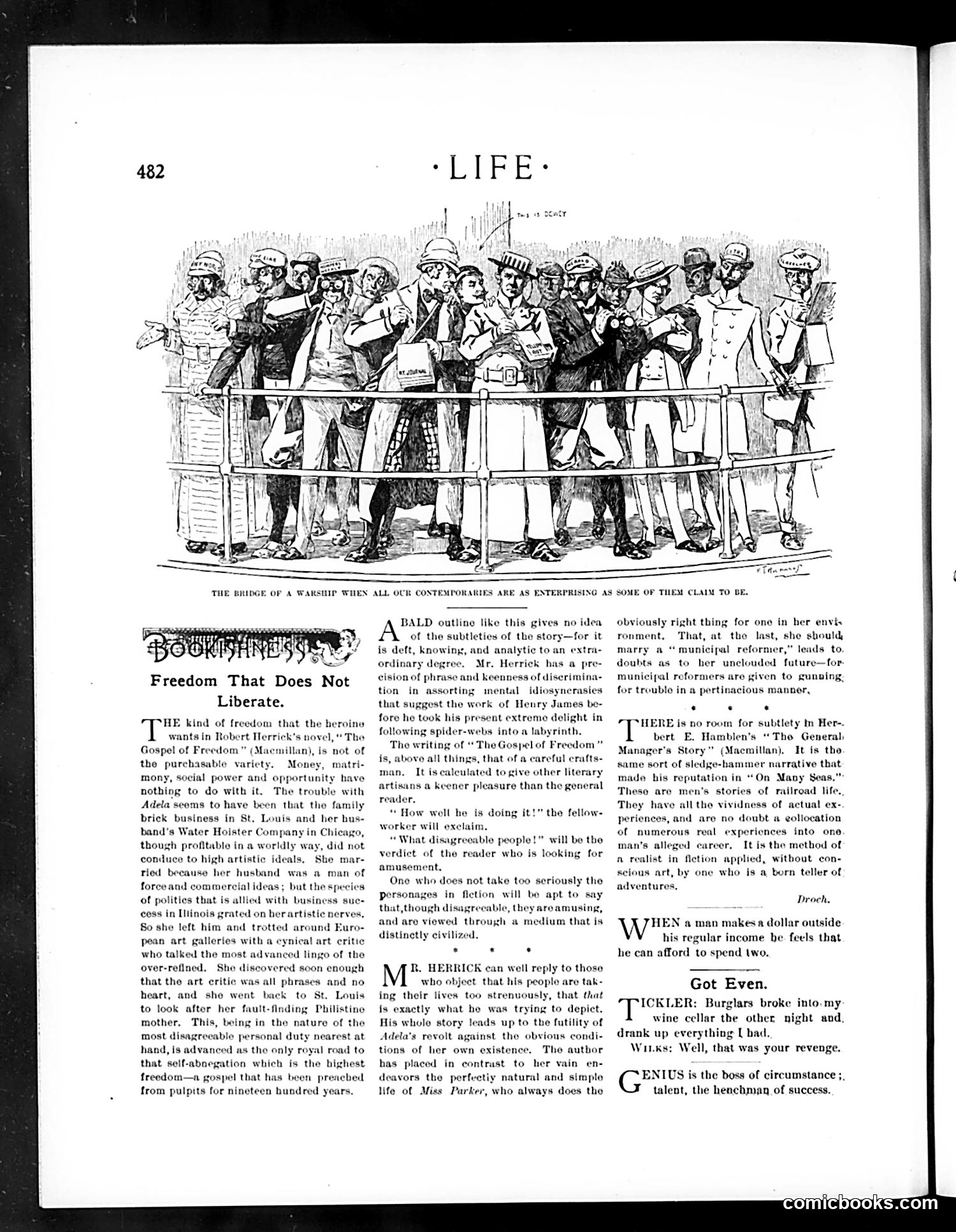
The main cartoon depicts numerous figures crowded on a warship's bridge, captioned: "The Bridge of a Warship When All Our Contemporaries Are as Enterprising as Some of Them Claim to Be." This satirizes overcrowding and competitive ambition among contemporary figures—likely journalists, businessmen, or politicians of the era. The joke suggests that if everyone claimed to be as enterprising as certain prominent individuals, a warship's command structure would become comically overstaffed and dysfunctional. The accompanying text discusses Robert Herrick's novel "The Gospel of Freedom," analyzing themes of freedom, ambition, and personal conduct. The article critiques characters who are "too strenuous" and uses the narrative to comment on contemporary American attitudes toward success and self-improvement. The page satirizes both literary characters and real-world figures through their excessive self-promotion and competitive posturing.
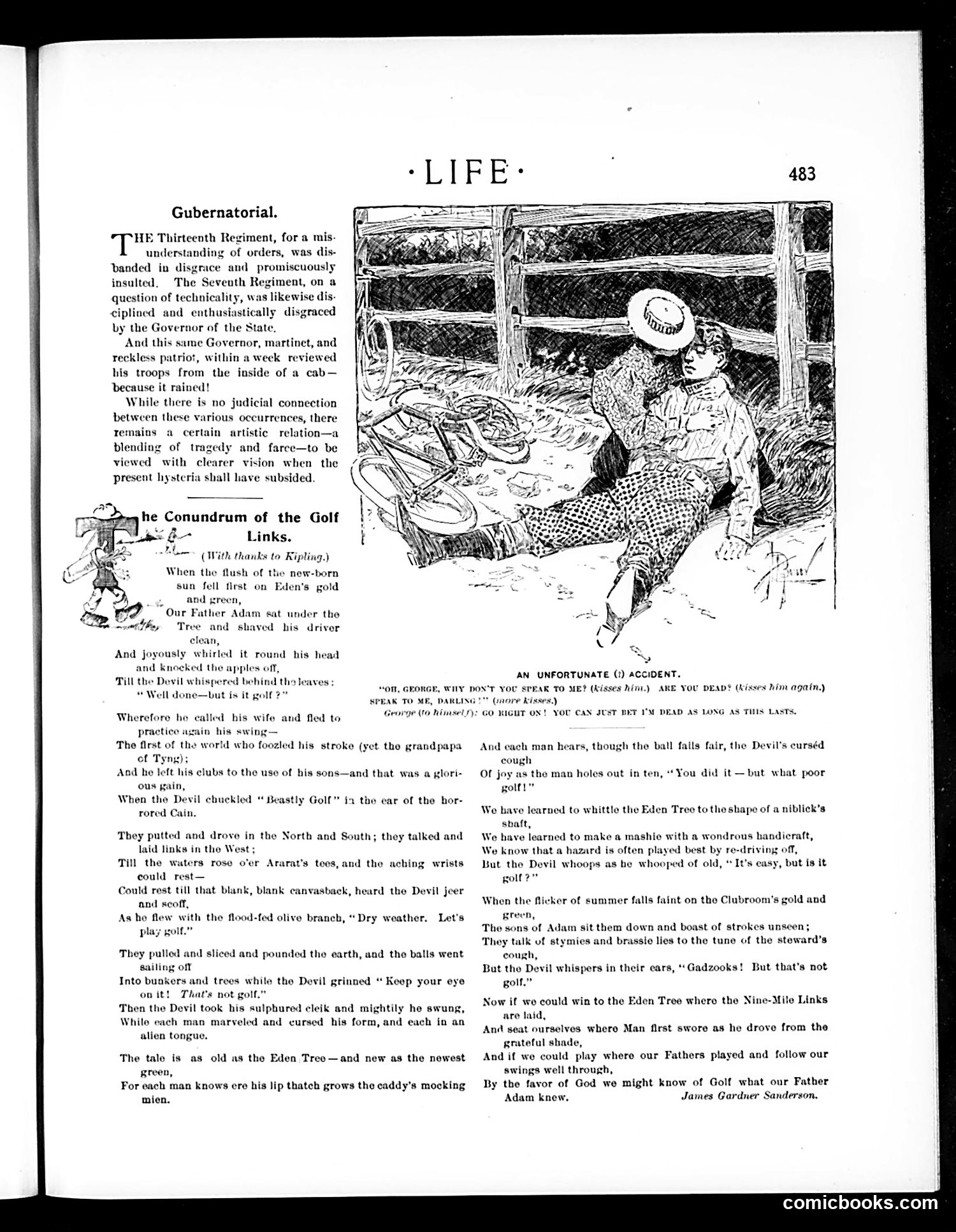
This page contains two distinct pieces: a "Gubernatorial" political commentary and "The Conundrum of the Golf Links," a humorous poem with an illustration. The **gubernatorial section** (upper left) criticizes a state Governor for disgracing two regiments through mismanagement and then insulting troops by reviewing them from inside a cab instead of properly. The text suggests this governor is reckless and unpatriotic, blending "tragedy and farce." The **main illustration** shows a man in a barn or stable setting surrounded by tools and farm equipment. Accompanying text titled "AN UNFORTUNATE (!) ACCIDENT" depicts a domestic dispute, with dialogue suggesting marital conflict and a threat about the man's death. The **golf poem** is satirical verse about golf's origins and early practitioners, treating the sport with mock-heroic language about Adam and Eden.
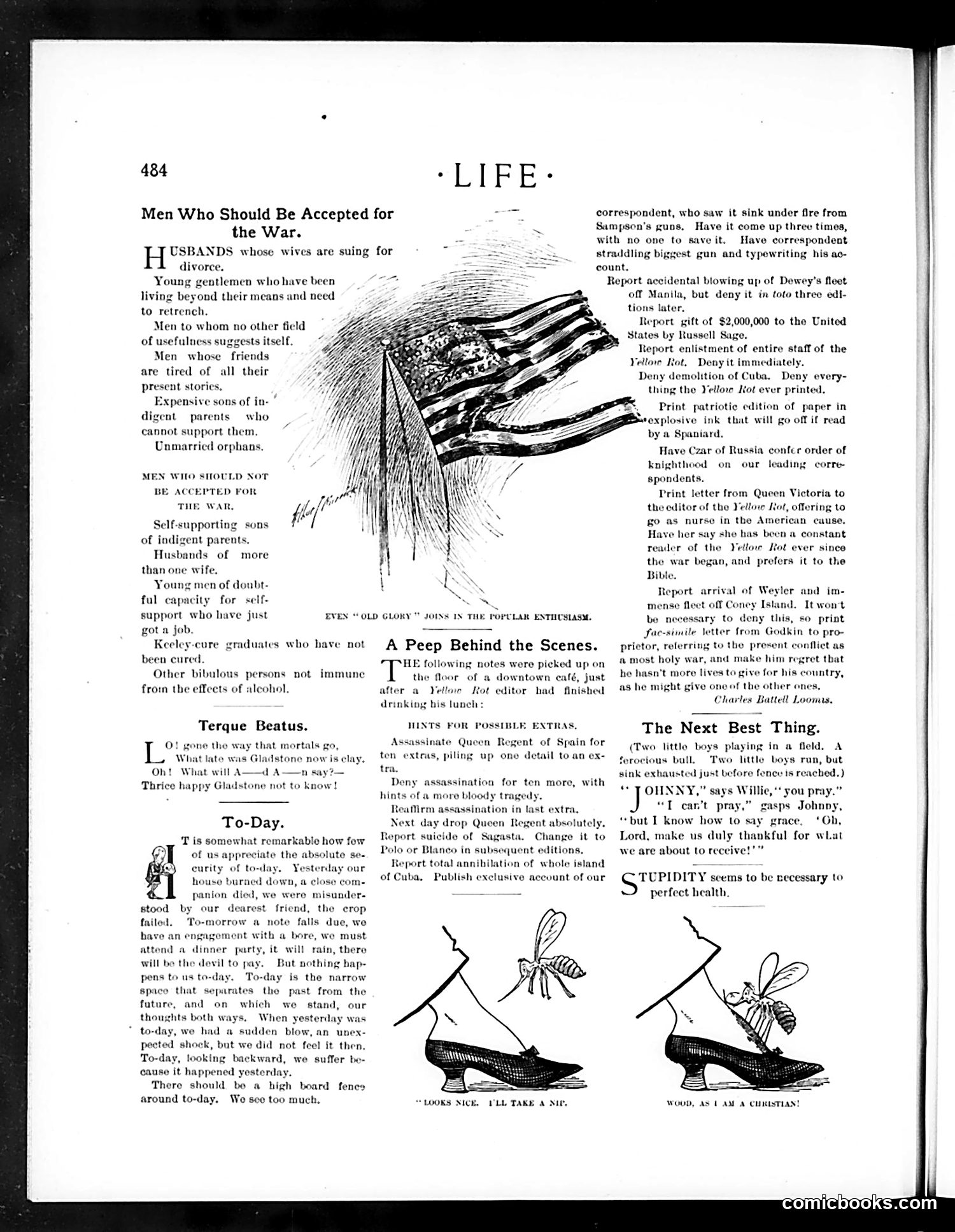
This page contains satirical commentary on World War I military recruitment and policy. The left column lists categories of men who "should" and "should not" be accepted for war service—a biting critique of recruitment standards that exempted the wealthy and connected while drafting the poor. The central illustration shows a hand holding the American flag, captioned "Eyes 'Old Glory' Joins in the Popular Enthusiasm"—likely mocking jingoistic patriotism. The bottom cartoons depict two flies, one saying "Looks nice, I'll take a nip" and the other "Wood, as I am a Christian!"—a crude joke about Christian morality and temptation, possibly critiquing selective ethics during wartime. The page reflects anti-war skepticism and class-based criticism of WWI mobilization policies prevalent in American satirical journalism of that era.
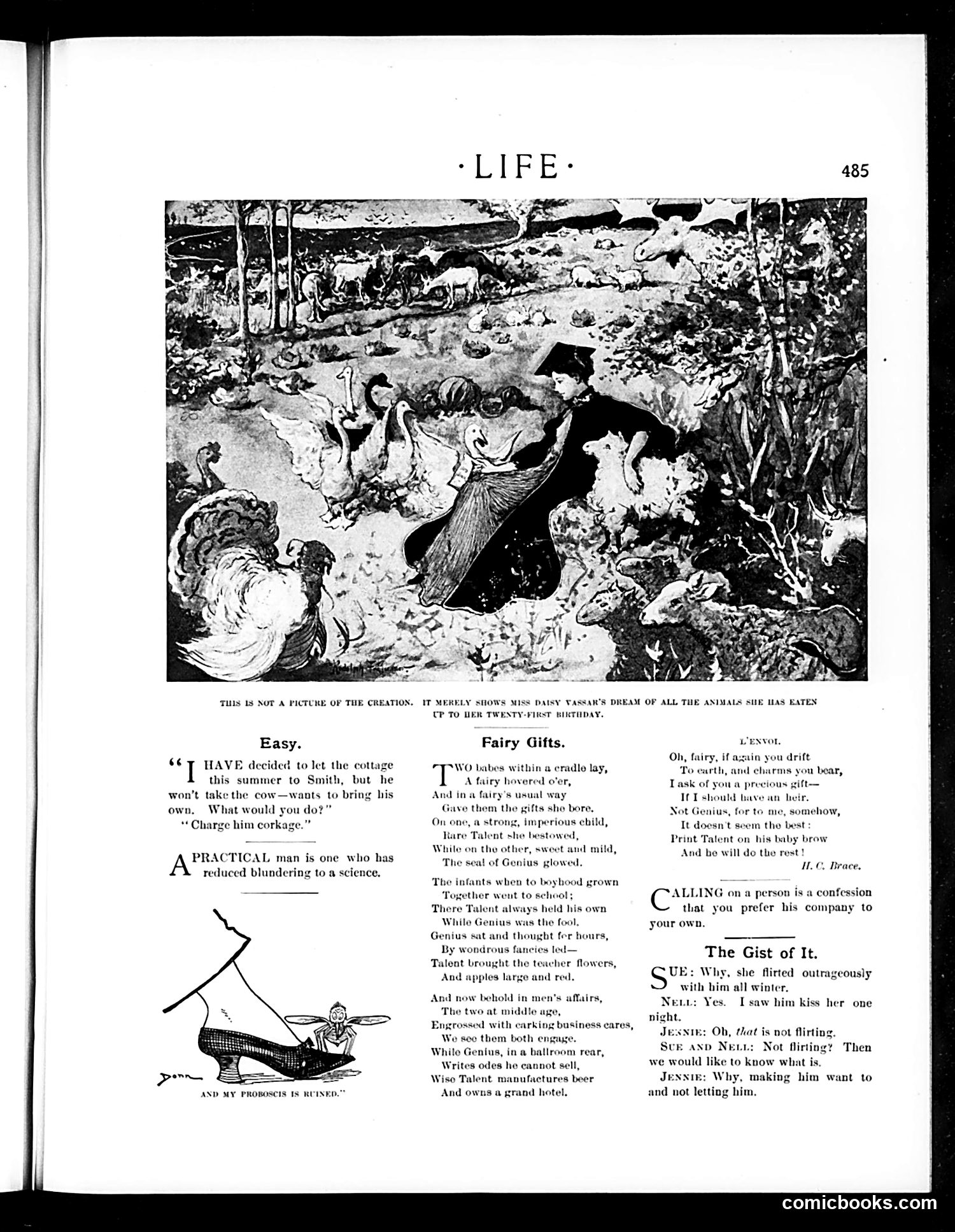
This page contains literary content rather than political cartoons. The main illustration depicts a fantastical scene with a woman in Victorian dress among various animals in a pastoral setting—likely illustrating the caption about "Miss Daisy Vassa's dream of all the animals she has eaten up to her twenty-first birthday," suggesting social satire about gluttony or excess consumption among the wealthy. The text includes three separate pieces: a humorous dialogue titled "Easy" about a practical man, a poem called "Fairy Gifts" contrasting two infants' destinies, and a brief comedic exchange titled "The Gist of It" about flirtation. These appear to be light satirical humor typical of early Life magazine's mix of jokes and verse rather than serious political commentary.
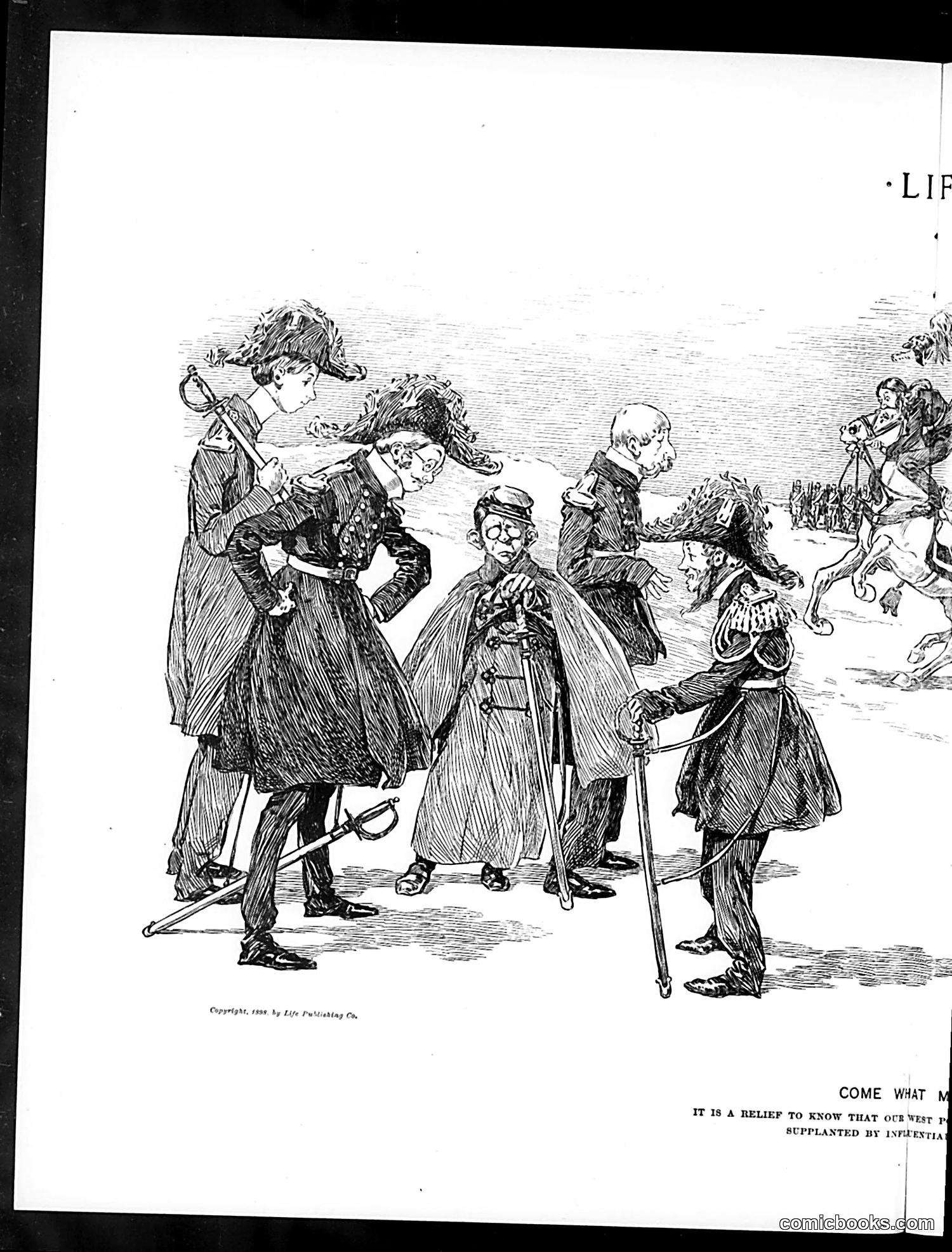
This appears to be an early 20th-century Life magazine satirical illustration depicting military or diplomatic figures in an outdoor setting. The central figure wears a military uniform with a cape, surrounded by other uniformed officials and what appear to be civilians observing from behind. The partially visible caption reads: "IT IS A RELIEF TO KNOW THAT OUR WEST [is] SUPPLANTED BY INDUSTRIA[L...]" The cartoon likely satirizes Western military or industrial interests abroad, suggesting relief that something (possibly American influence or military presence) has been replaced by industrial development. The specific context—which Western powers, which region, which historical moment—cannot be determined from the visible text alone.
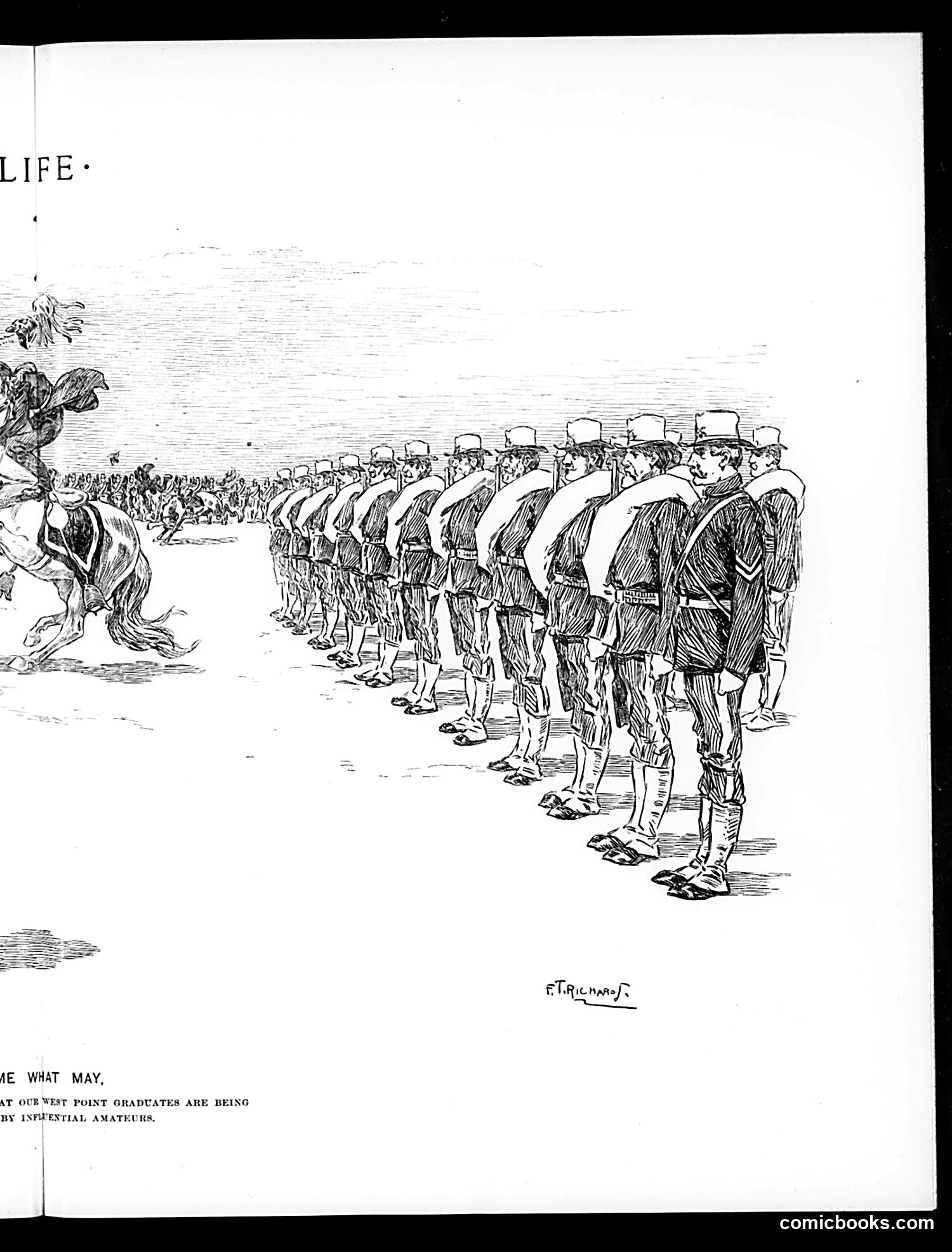
This appears to be a satirical cartoon from *Life* magazine mocking West Point military graduates. The image shows a long line of identical uniformed soldiers all bowing deeply in the same synchronized pose, creating a visual joke about conformity and obedience in military training. The caption references "WHAT MAY, / AT OUR WEST POINT GRADUATES ARE BEING / BY INFLUENTIAL AMATEURS" (OCR garbled, but clearly critical of West Point graduates). The cartoonist is satirizing how military academy training produces uniform, unthinking soldiers who follow orders without individuality—they've been "made" or shaped into identical copies by their training. The signature appears to be by F.T. Richmont (or similar). The satire critiques military education as producing conformity rather than independent thinking.
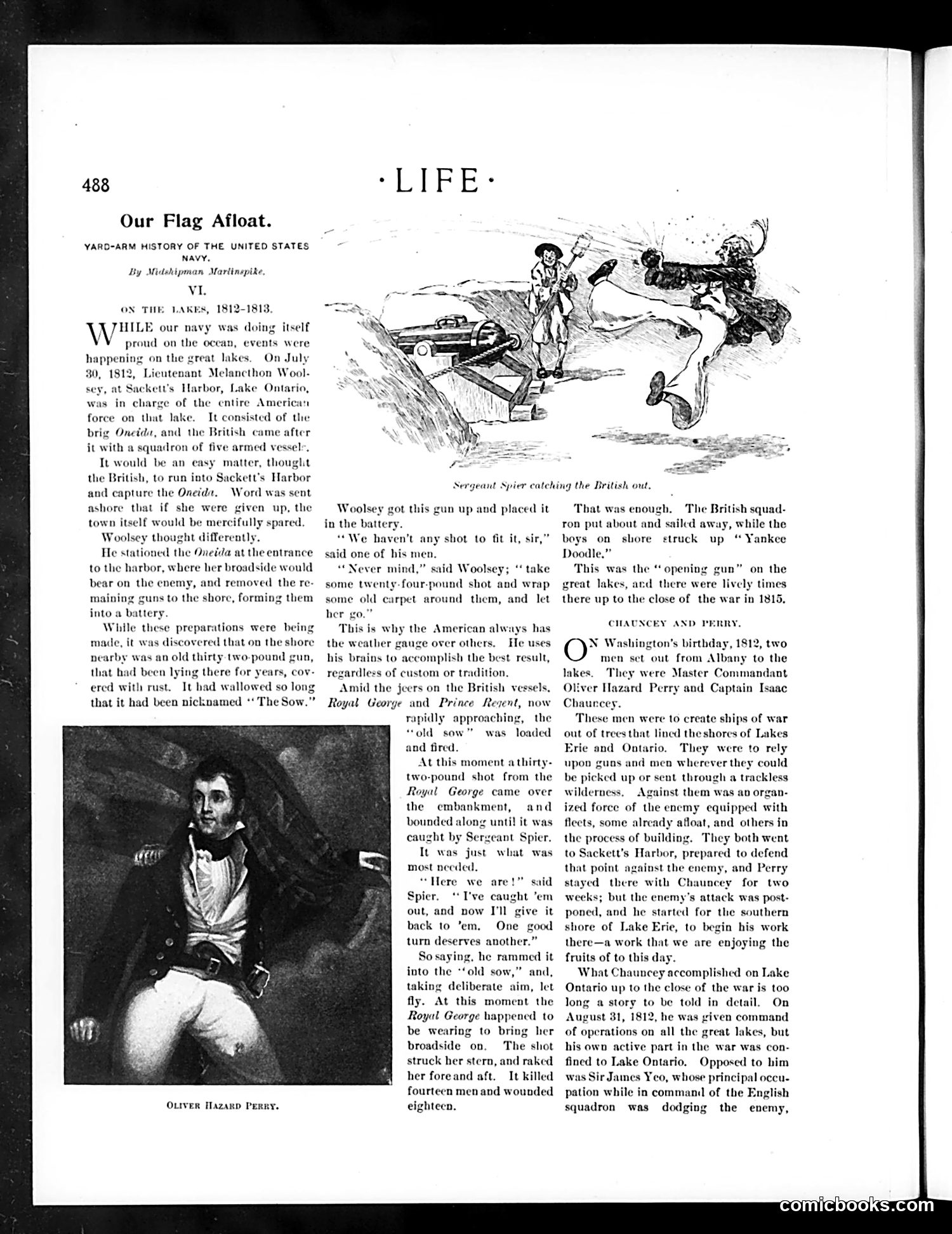
This page illustrates "Our Flag Afloat: Yard-History of the United States Navy," specifically Section VI covering Lakes operations during 1812-1813 (the War of 1812). The main cartoon shows "Sergeant Spier catching the British out"—depicting an American sergeant apprehending British forces, likely during the Great Lakes naval campaign. The illustration celebrates American naval success on inland waters. The accompanying text and portrait of Oliver Hazard Perry describe naval operations where American commanders like Perry built ships from lakeside trees to combat British forces. The narrative emphasizes American ingenuity and tactical advantage, particularly the famous "opening gun" moment that turned the tide on the Great Lakes through 1815. This is patriotic historical content celebrating early American naval victories, not satire.
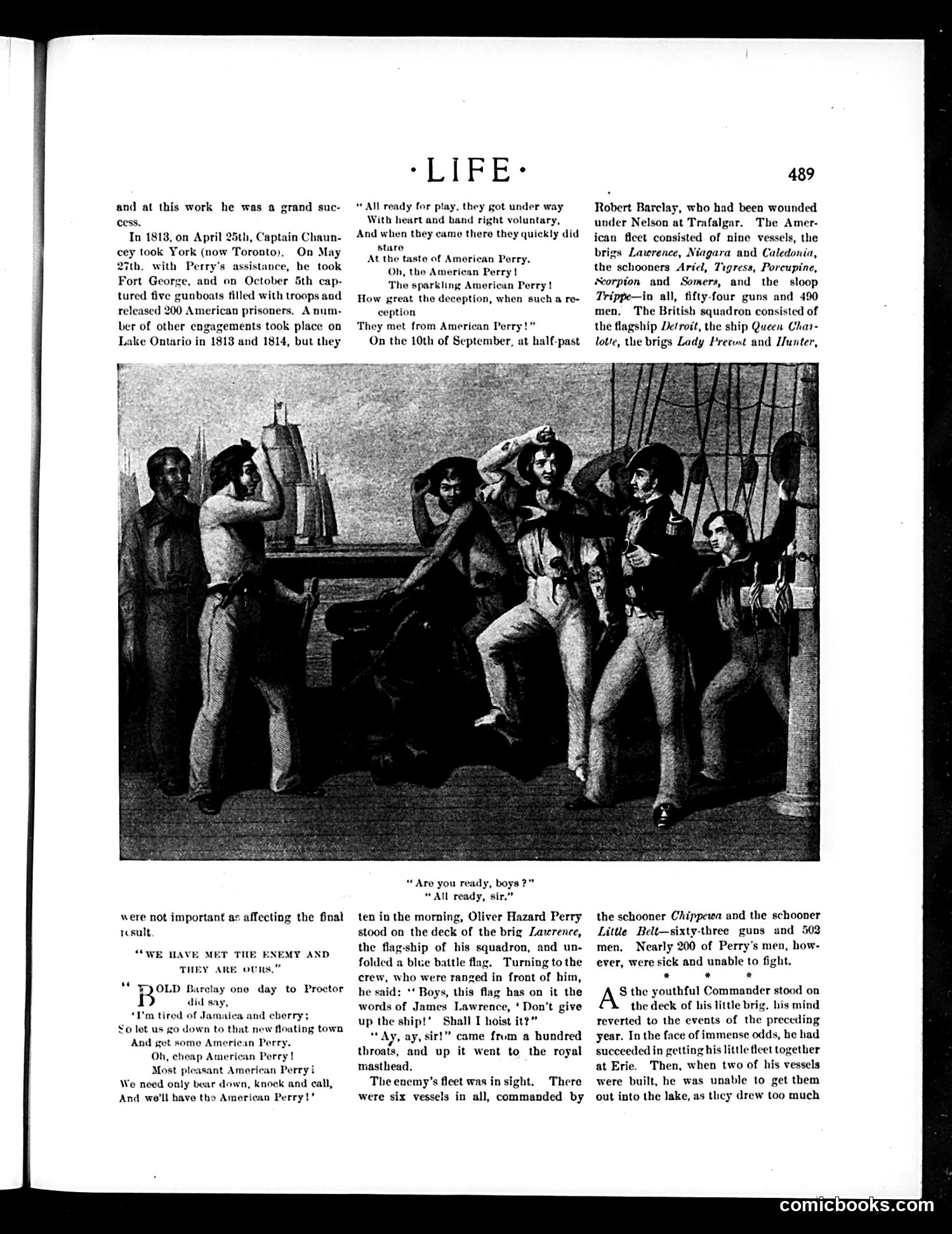
This page commemorates **Commodore Oliver Hazard Perry's naval victory during the War of 1812**, specifically the Battle of Lake Erie (September 10, 1813). **The central illustration** depicts Perry's crew preparing for battle aboard his flagship, the *Lawrence*. The famous dialogue shown ("Are you ready, boys?" / "All ready, sir") captures the moment before combat. **The satirical verse** mocks the British by personifying "American Perry" as an intoxicating drink—a pun on Commodore Perry's name. British Commander Robert Barclay supposedly desires this "American Perry," expecting an easy victory, only to be surprised by its potency (the American naval success). **Historical context**: Perry's outnumbered but better-coordinated fleet defeated the British squadron, giving Americans control of Lake Erie and cutting off British supply lines during the War of 1812. Perry became a national hero. The satire celebrates American naval prowess while ridiculing British underestimation of American military capability—a common theme in early 19th-century American patriotic literature.
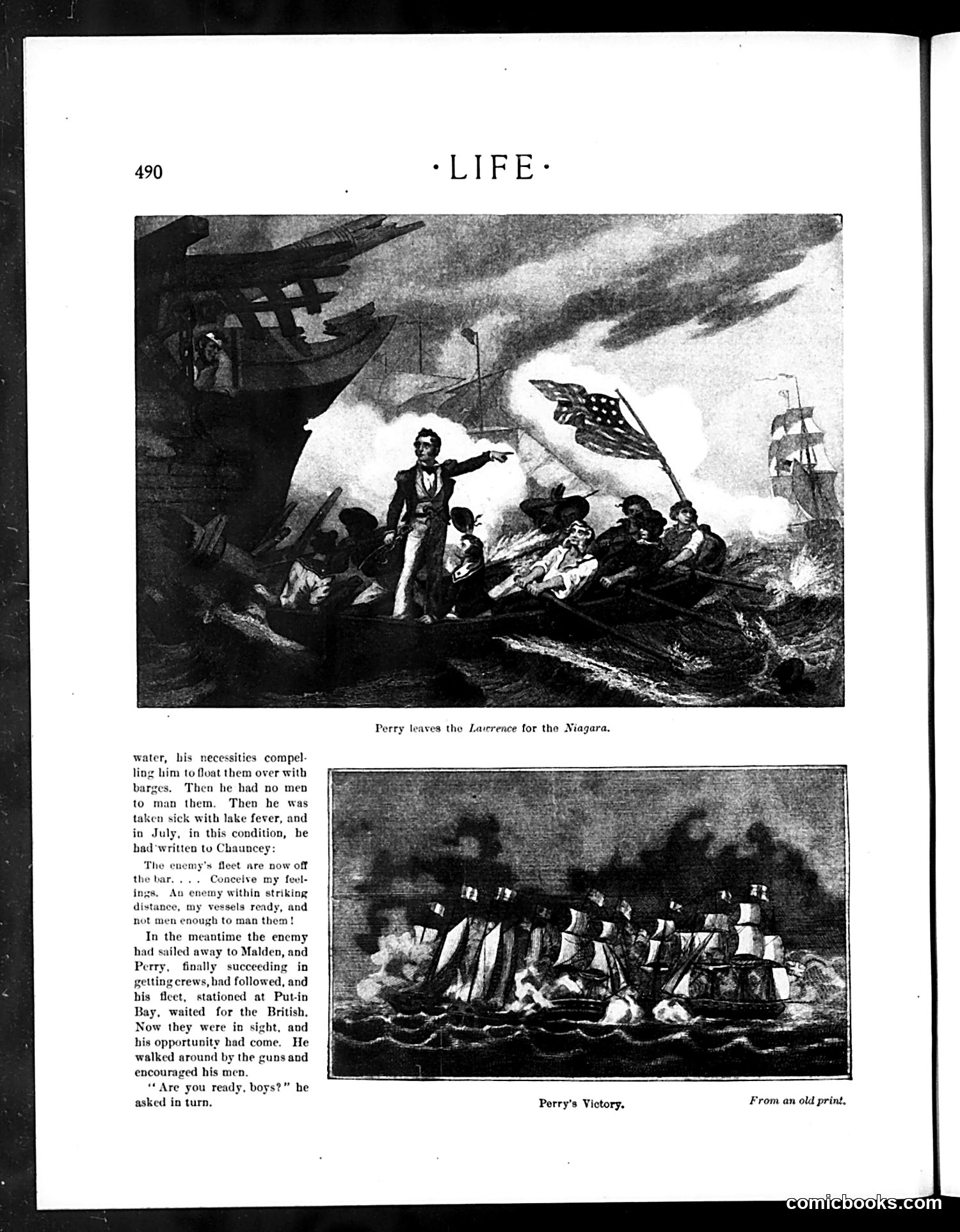
This page commemorates Commodore Oliver Hazard Perry's naval victory during the War of 1812. The top illustration shows Perry leaving the USS Lawrence during the Battle of Lake Erie (September 1813), when his flagship was damaged. The bottom image depicts his decisive victory over British forces. The text describes Perry's struggles: lack of crew despite enemy ships nearby, illness from lake fever, and supply problems. However, he persevered, gathered men, and confronted the British fleet at Put-in Bay. His famous rallying cry—"Are you ready, boys?"—exemplifies American determination. For modern readers: this celebrates American naval prowess and Perry's leadership during early American military history. The "old print" reference indicates Life magazine was reprinting historical material to commemorate past American achievement, likely during a period when such patriotic references were valued.
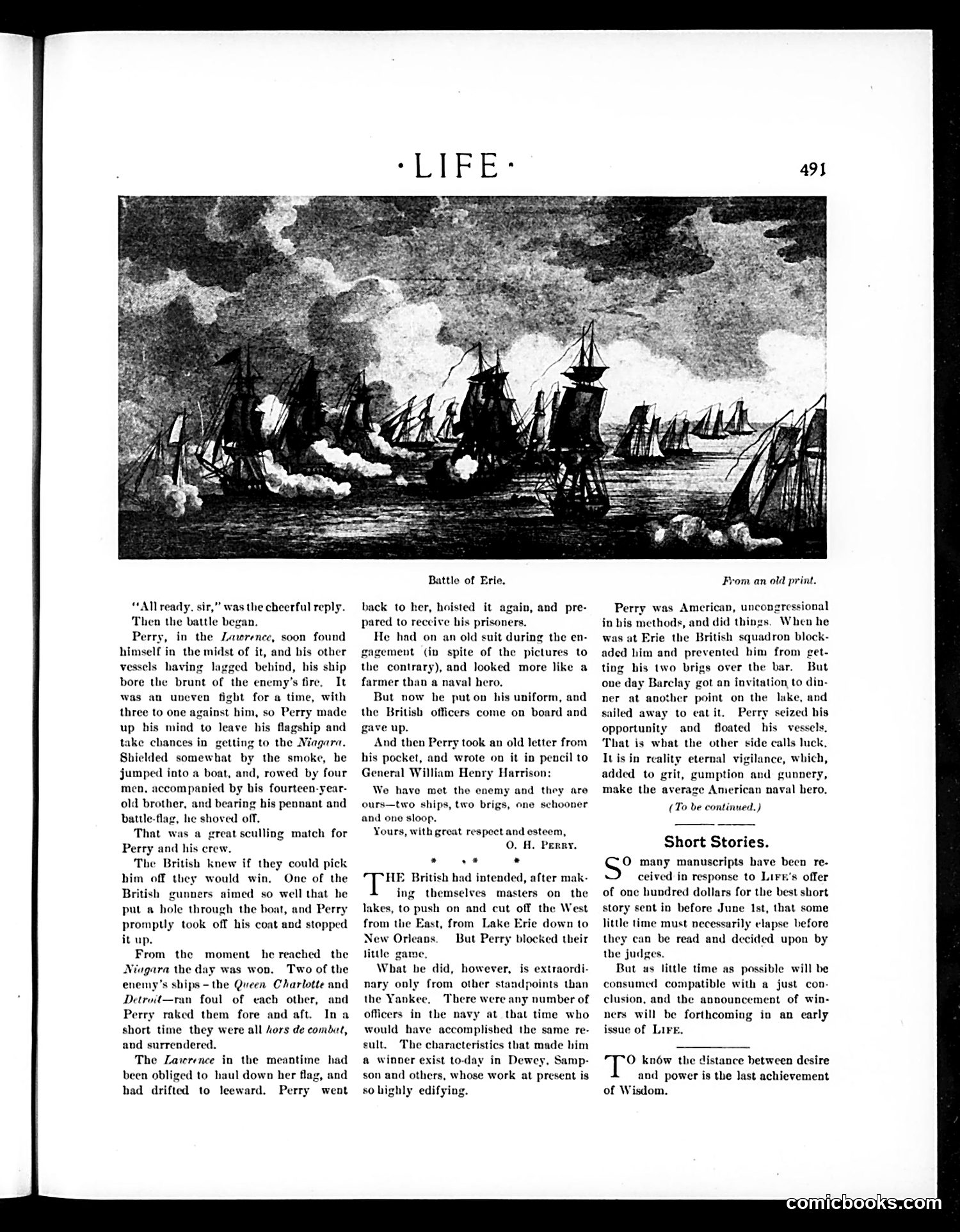
This page presents a historical account of Commodore Oliver Hazard Perry's 1813 naval victory during the War of 1812, illustrated by an engraving titled "Battle of Erie." The text celebrates Perry's decisive defeat of a British squadron on Lake Erie, which prevented British control of the Great Lakes and the separation of the American nation. The narrative emphasizes Perry's unconventional, action-oriented American character—he plugged a bullet hole in his boat with his coat during battle and seized an opportunity when the opposing British commander was away at dinner. The text compares Perry favorably to contemporary naval heroes like Dewey and Sampson, suggesting that American naval superiority stems from resourcefulness and determination rather than formal training. The passage concludes with Perry's famous message: "We have met the enemy and they are ours."
This satirical piece depicts a naval anecdote involving **Admiral Winfield Scott Schley**, a prominent Spanish-American War figure. The joke centers on a ship's enormous supply of beer stored in hogsheads (large barrels). **The Setup:** An emissary is sent to Schley to complain about the excessive alcohol aboard his vessel. Rather than lecture about intoxication, Schley—characterized as "quick-minded"—simply orders his crew to dump the offending hogshead overboard. **The Satire:** The humor lies in the contrast between expected naval discipline and Schley's pragmatic solution. Instead of moral reproach, he acts decisively, treating the problem as a practical matter rather than a character issue. The crew's enthusiastic response suggests this was the "right" answer all along. **Historical Context:** Schley was a celebrated naval officer, making this gentle mockery of military bureaucracy and officers' drinking culture appropriate for *Life's* satirical audience. The anecdote appears designed to portray Schley as competent and unafraid of unconventional solutions—likely flattering wartime sentiment.
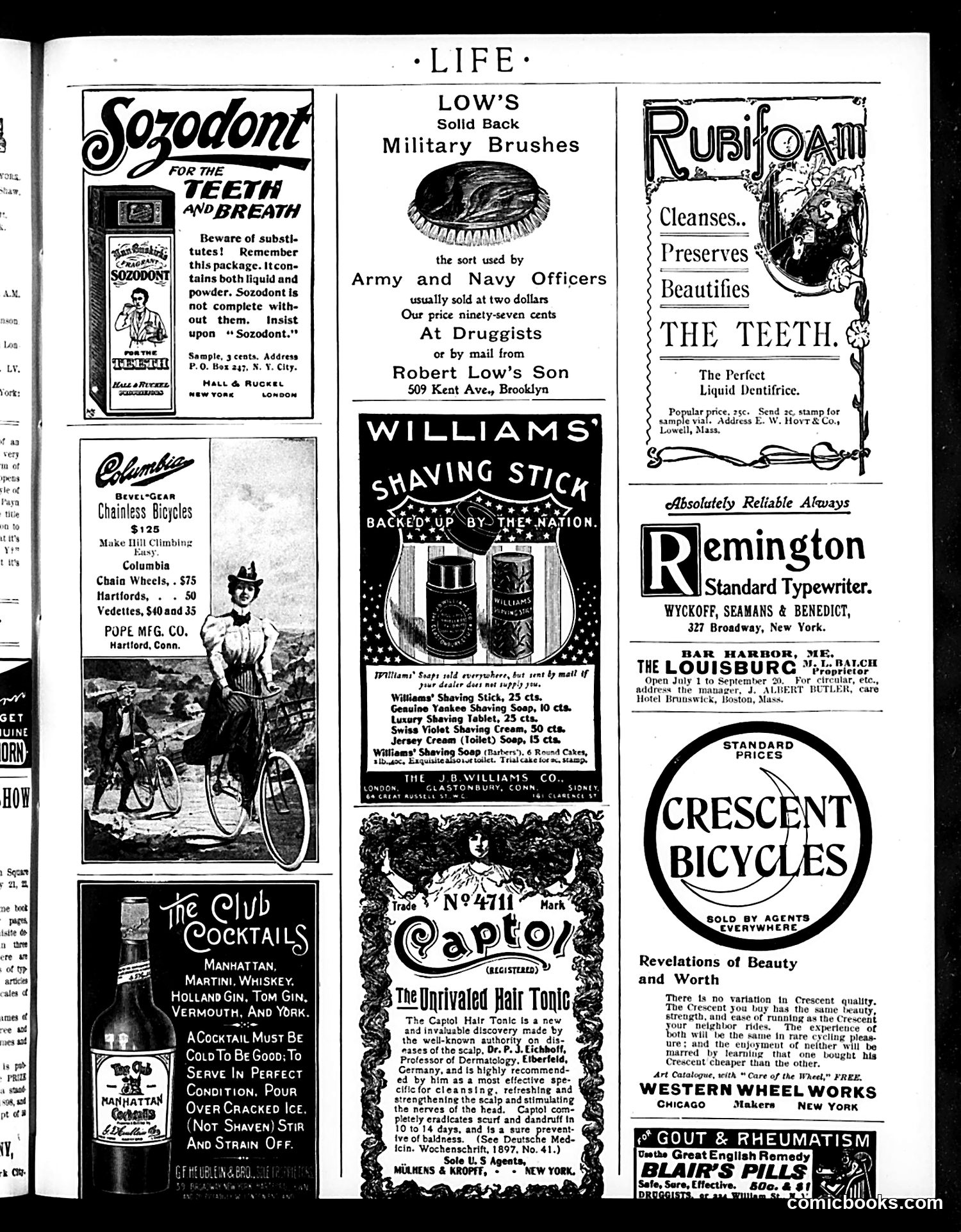
This page is primarily **advertisements**, not editorial content or satire. It showcases consumer products from the early 1900s aimed at middle-class readers. Notable ads include: - **Sozodont** toothpaste/powder, warning against counterfeits - **Columbia and Pope bicycles**, expensive at $125–$175 (chainless models marketed as easier for hill-climbing) - **Military brushes** by Low's Son—cheaper alternatives to officer-grade versions - **Williams' shaving products** and **Capitol Hair Tonic** (claiming to cure baldness in 10-14 days) - **Remington typewriters** and **Crescent bicycles** - **Club Cocktails** recipe guide The ads reflect Gilded Age consumer culture: bicycles as status symbols, dubious medical remedies, and emphasis on grooming products. The "Beware of substitutes!" language suggests widespread counterfeiting was a commercial concern. Most prices suggest these were marketed to relatively affluent readers.
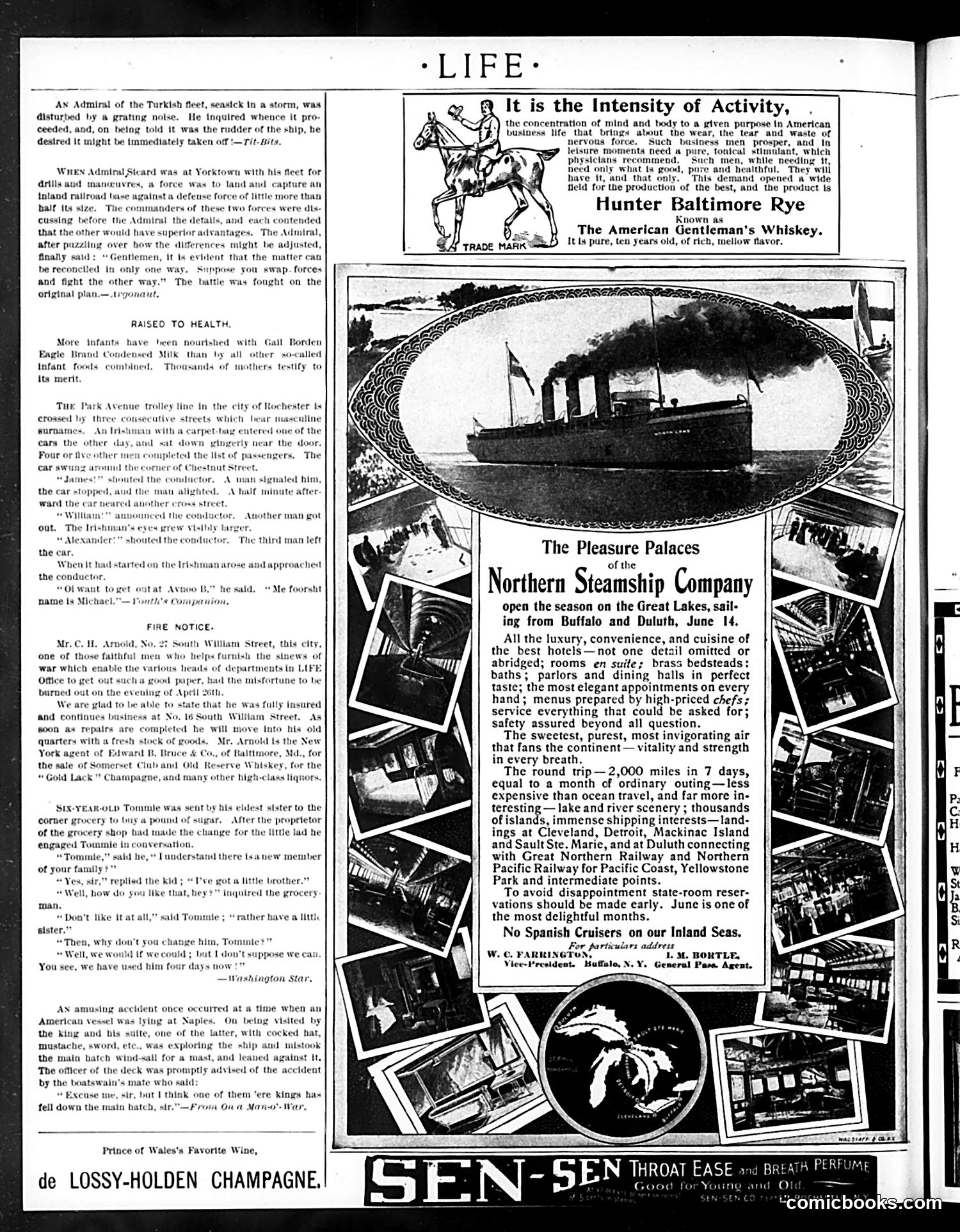
This page is primarily **advertising and light humor**, not political satire. It contains: **Main Content:** - Several humorous anecdotes (Turkish Admiral, Rochester trolley conductor mix-ups, child preferring a sibling change) - Product advertisements: Hunter Baltimore Rye whiskey, Gail Borden condensed milk, de Lossy-Holden Champagne, Sen-Sen throat lozenges - A fire notice about local businessman C.H. Arnold **The Central Advertisement:** A large promoted feature for Northern Steamship Company's "Pleasure Palaces"—Great Lakes cruise ships departing June 14 from Buffalo/Duluth, offering luxury travel experiences. **No Political Cartoon:** There is no political cartoon on this page. The humor is domestic/social comedy—typical Light Magazine fare from the early 1900s, mixing advertisements with amusing short stories about everyday mishaps. The page reflects period consumer culture and advertising practices rather than political commentary.
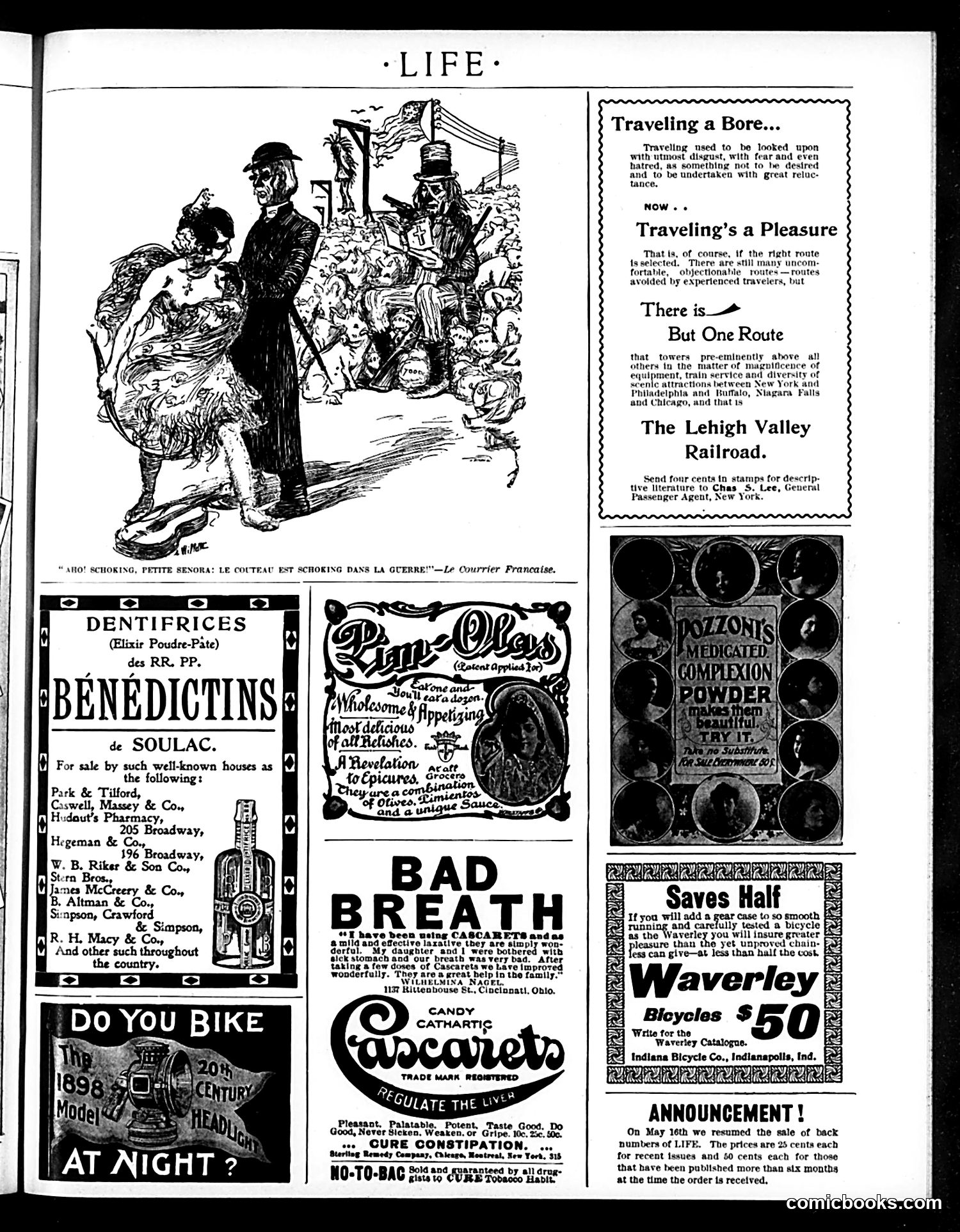
This page is primarily **advertising**, not satirical content. The main cartoon at top—showing well-dressed travelers with luggage—illustrates the Lehigh Valley Railroad advertisement's claim that travel has transformed from dreaded to pleasurable, provided one chooses the "right route." The advertisements showcase period consumer products: Benedictins toothpaste and digestive liqueur (French imports), Pim-Ola beverages, Cascarets laxatives, No-To-Bac (nicotine cessation), and Waverley bicycles. A small ad for bike headlights and one for Pozzoni's complexion powder (featuring what appears to be racist imagery typical of the era) round out the offerings. The French caption below the main illustration translates roughly to a comment about "screeching" and war—likely a humorous reference to traveling discomforts. The announcement notes Life resumed selling back issues as of May 16th at varying prices based on age.
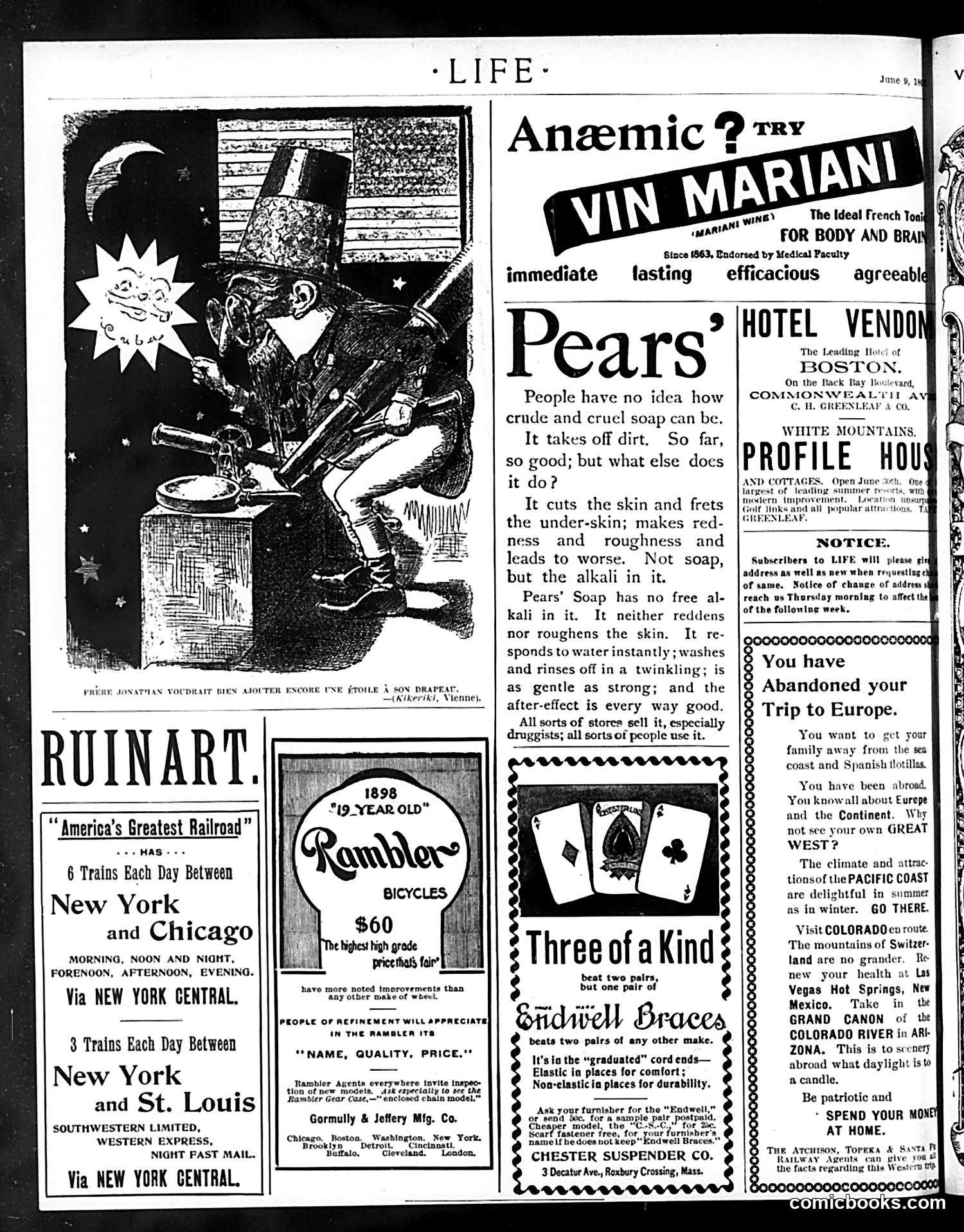
The main cartoon (top left) is a French political satire, captioned in French: "Pierre Jonathan would like to add another star to his flag." It depicts a caricatured figure (likely representing France or a French political figure) sitting atop a chamber pot, surrounded by military/imperial imagery. The "star" reference alludes to territorial expansion or colonial ambition—a satirical jab at French imperial aspirations, possibly during the period of European colonial competition in the 1890s. The rest of the page consists almost entirely of **period advertising** for railroads (New York Central), bicycles (Rambler), consumer goods (Pears' soap, suspenders), and travel—typical of Life magazine's revenue model. A notice encourages Americans to vacation domestically ("SPEND YOUR MONEY AT HOME") rather than traveling to Europe, reflecting post-Spanish-American War patriotic sentiment.