
Life, 1898-06-09 · page 4 of 20
Life — June 9, 1898 — page 4: what you’re looking at
What you’re looking at
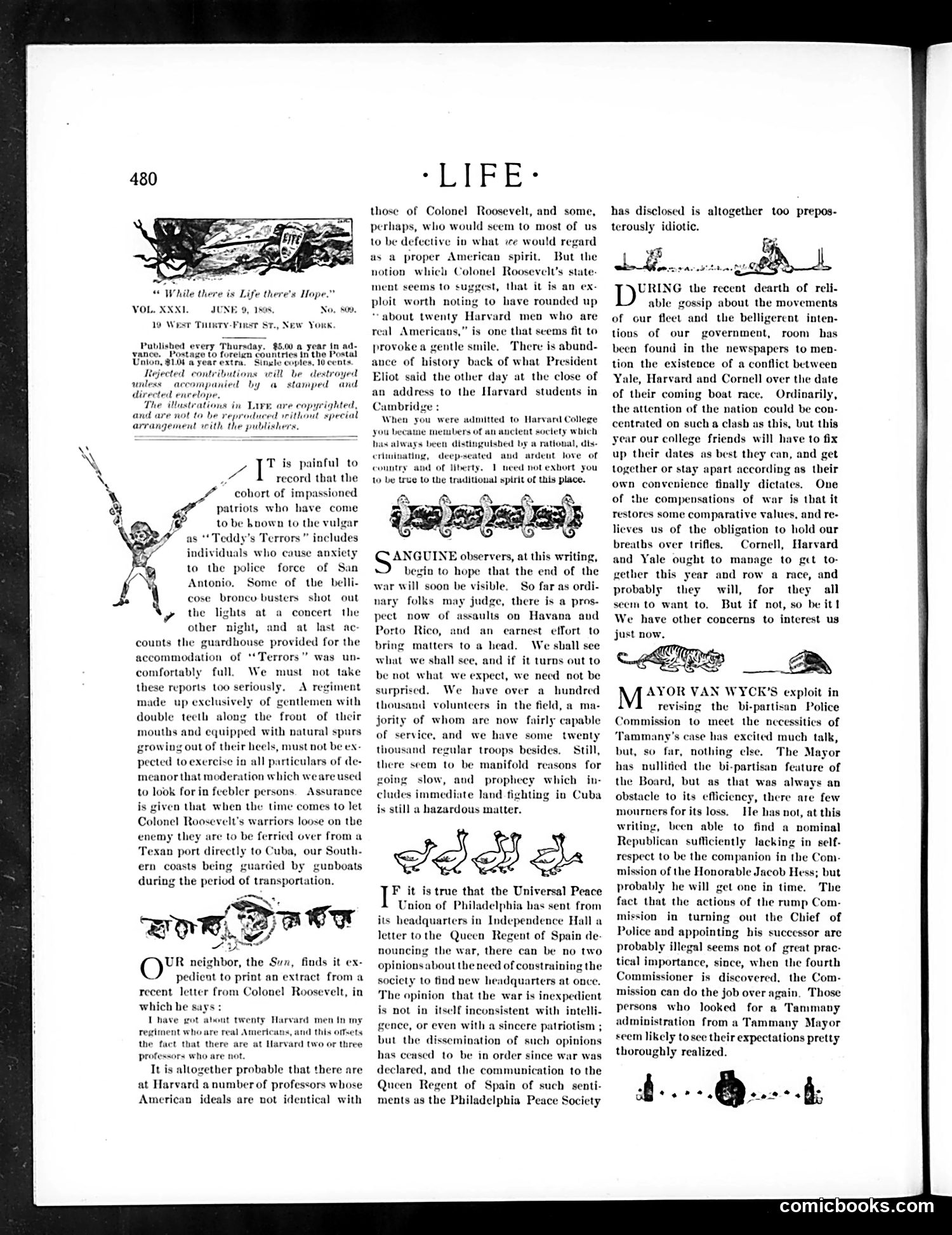
This page contains editorial commentary on Spanish-American War topics rather than traditional political cartoons. The small illustrations (a soldier, ducks in a line, and miscellaneous vignettes) are decorative rather than satirical. The text discusses several 1898 issues: Harvard students enlisting, American patriotism versus isolationism, military operations in Cuba and Puerto Rico, and Philadelphia's Universal Peace Union sending anti-war letters to Spain's Queen Regent. A key criticism targets Mayor Van Wyck's handling of New York's Police Commission—apparently he removed the bi-partisan feature to appoint his own successor. The author finds this politically motivated but notes it's "not of great practical importance." The overall tone is satirical commentary on wartime politics and institutional maneuvering.
📄 Transcribed text from this page (OCR, searchable)
Machine-transcribed from the original scan — historical spelling and the odd misread are preserved.
“* While th VOL. XXX1. u re is Life there's Ho, JUNE 9, Published every ‘Thursday, $5.00 a year in ad- Postage to forelan countries in the Postal Union, 81.01 a year extra. Single coples, 10 cents Rejected contributions will be destroyed accompanied by a stamped and directed enreloy The iltustrations in Lrvy, are copyrighted, and are not to be reproduced srithout special arrangement with the publishers. T is painful to yf record that the a cobort of impassioned « patriots who have come oy i to be huown to the vulgar as ** Teddy's Terrors” includes individuals who cause anxiety to the police force of San Antonio. Some of the belli- cose bronco busters shot out the lights at a concert the other night, and at last ac- counts the guardhouse provided for the accommodation of Terrors” was un- comfortably full) We must not take these reports too seriously, A regiment made up exclusively of gentlemen with double tecth the frovt of their mouths and equipped with natural spurs growing out of their heels, must not be ex- pected to exercise ia all particulars of de- meanor that moderation which weare used to look forin feebler persons. Assurance is given that when the time comes to let Colonel Roosevelt's warriors loose on the enemy they are to be ferricd over from a ‘Texan port directly to Cuba, our South- ern coasts being guarded by gunboats during the period of transportation. BOR eer UR neighbor, the Sun, finds it ex- pedient to print an extract from recent letter from Colonel Roosevelt, in which he says: LT have got about twenty Harvard men in my Tegiment who are real Americans, and this offsets the fact that Mere are at Harvard two or three Professors who are not. It is altogether probable that there are at Harvard a number of professors whose American ideals are not identi alon, LIFE those of Colonel Roosevelt, and some, perhaps, who would scem to most of us to be defective in what we would regard as a proper American spirit. But the notion which Colonel Roosevelt's state- ment seems to suggest, that it is an ex- ploit worth noting to have rounded up “about twenty Harvard men who are real Americans,” is one that seems fit to provoke a gentle smile. ‘There is abund- of history back of what President Eliot said the other day at the close of an address to the Harvard students Cambridge : When you were admitted to Harvard College became members of an anctent soctety which Iways been distinguished by a rational, dis- criminating, deep-seated and ardeut love of country and of liberty, 1 uced net extort you to be true to the truditioual spirit of this place. anc ANGUINE observers, at this writing, begin to hope that the end of the war will soon be visible. So far as ordi- nary folks may judge, there is a pros- pect now of assaults on Havana and Porto Rico, and an earnest effort to bring matters to a head. We shall see what we shall see, and if it turns out to be not what we expect, we need not be surprised. We have over a hundred thousand volunteers in the field, a ma- jority of whom are now fairly capable of service, and we have some twenty thousand regular troops besides. Still, there seem to be manifold reasons for going slow, and prophecy which in- cludes immediate land tighting in Cuba is still a hazardous matter. 3d d- F it is true that the Universal Peace Union of Philadelphia has sent from its headquarters in Independence Hall a letter tothe Queen Regent of Spain de- nouncing the war, there can be no two opinionsabout the need of constraining the society to tind new headquarters at once. The opinion that the war is inexpedient is not in itself inconsistent with intell gence, or even with a sincere patriotism ; but the dissemination of such opinions has ceased to be in order since war was declared, and the communication to the Queen Regent of Spain of such senti- ments as the Philadelphia Peace Society has disclosed is altogether too prepos- terously idiotic. watt Bonc: aes p° RING the recent dearth of reli- able gossip about the movements of our fleet and the belligerent inten- tious of our government, room hb: been found in the newspapers to men- tion the existence of a conflict between Yale, Harvard and Cornell over the date of their coming boat race. Ordinarily, the attention of the nation could be con- centrated on such a clasb as this, but this year our college friends will have to fix up their dates as best they can, and get together or stay apart according as their own convenience finally dictates. One of the compensations of war is that it Testores some comparative values, and re- lieves us of the obligation to hold our breaths over trifles, Cornell, Harvard and Yale ought to manage to gut to- gether this year and row a race, and probably they will, for they all seem to want to. But if not, so be it! We have other concerns to interest us just now. M AYOR VAN WYCR’S exploit in revising the bi-partisan Police Commission to meet the necessities of ‘Tammany’s case has excited much talk, but, so far, nothing else. The Mayor has nullified the bi-partisan feature of the Board, but as that was always an obstacle to its efficiency, there are few mourners for its loss, He has not, at this writing, been able to find a nominal Republican sufficiently lacking in self- respect to be the companion in the Com- mission of the Honorable Jacob Hess; but probably he will get one in time. The fact that the actions of the ramp Com- mission in turning out the Chief of Police and appointing his successor are probably illegal seems not of great prac- tical importance, since, when the fourth Commissioner is discovered, the Com- mission can do the job over again, Those persons who looked for a ‘Tammany administration from a Tammany Mayor seem likely tosce their expectations pretty thoroughly realized. comicbooks.com