
Life, 1898-06-09 · page 12 of 20
Life — June 9, 1898 — page 12: what you’re looking at
What you’re looking at
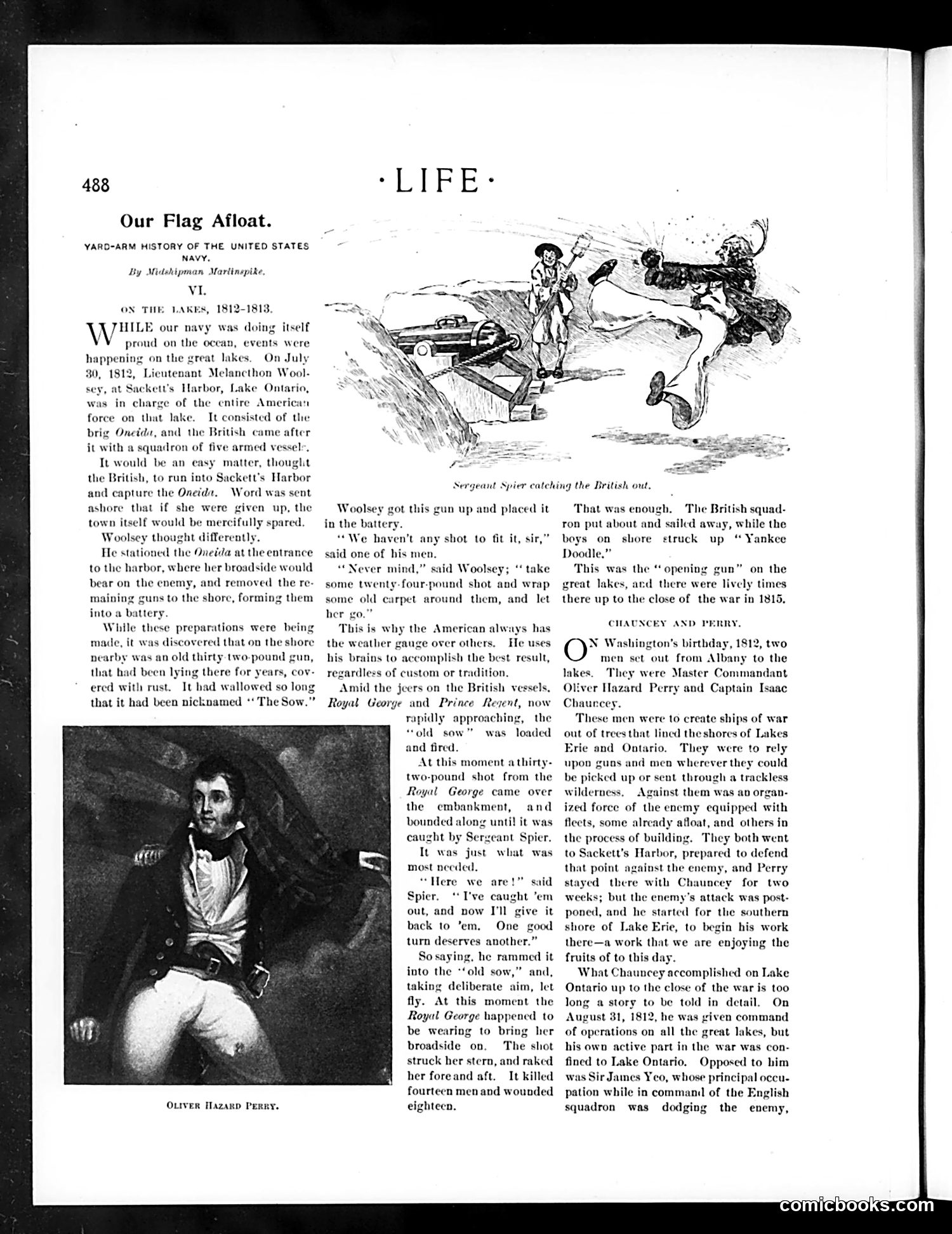
This page illustrates "Our Flag Afloat: Yard-History of the United States Navy," specifically Section VI covering Lakes operations during 1812-1813 (the War of 1812). The main cartoon shows "Sergeant Spier catching the British out"—depicting an American sergeant apprehending British forces, likely during the Great Lakes naval campaign. The illustration celebrates American naval success on inland waters. The accompanying text and portrait of Oliver Hazard Perry describe naval operations where American commanders like Perry built ships from lakeside trees to combat British forces. The narrative emphasizes American ingenuity and tactical advantage, particularly the famous "opening gun" moment that turned the tide on the Great Lakes through 1815. This is patriotic historical content celebrating early American naval victories, not satire.
📄 Transcribed text from this page (OCR, searchable)
Machine-transcribed from the original scan — historical spelling and the odd misread are preserved.
488 Our Flag Afloat. YARD-ARM HISTORY OF THE UNITED STATES NAVY. By Midshipman Martinspike, Vi. ON THE LAKES, 1812-1813. V JHILE our navy was doing itself y proud on the ocean, events were happening on the great lakes. On July 30, 1812, Lieutenant Melancthon Wool- at Sackett's Harbor, Lake Ontario, was in charge of the entire American force on that lake, It consisted of the brig Oneidi, and the British came after it with a squadron of five armed vessel. It would be an easy matter, thought the British, to run into Sackett's Harbor and capture the Oneidt. Word was sent ashore that if she were given up, the town itself would be mercifully spared. Woolsey thought differently, He stationed the Oneida at the entrance to the harbor, where her broadside would bear on the enemy, and removed the re- maining guns to the shore, forming them into a battery While these preparations were being made, it was discovered that on the shore nearby was an old thirty two-pound gun, that had been lying there for years, cov- ered with rust. It had wallowed so long that it had been nicknamed *‘ The Sow.” sey Ottver Mazanp Perry. ‘ant Spier catching the British out, Woolsey got this gun up and placed it in the battery. “We haven't any shot to fit it, si said one of his men, “Never mind,” said Wools some twenty -four-pound shot and wrap some old carpet around them, and let her This is why the American always has the weather gauge over others. He uses his brains to accomplish the best result, regardless of custom or tradition, Amid the jeers on the British vessels, Royat George and Prince Rezent, now rapidly approaching, the “old sow” loaded and fired. At this moment athirty- two-pound shot from the Royal George came over the embankment, and bounded along until it was caught by Sei nt Spier. It was just what was most needed. Here Spier. “I've caught ‘em out, and now I'll give it back to ’em. One good turn deserves another.” was we are!” said So saying, he rammed it into the ‘fold sow,” and, taking deliberate aim, let fly. At this moment the Royat George happened to be wearing to bring her broadside on. The shot struck her stern, and raked her foreand aft. It killed fourteen men and wounded eighteen. That was enough. ron put about and s boys on shore Doodle.” This was the “ opening The British squad- iled away, while the struck up “Yankee gun” on the great lakes, ard there were lively times there up to the close of the war in 1815, CHAUN AND PERRY, N Washington's birthday, 1812, two men set out from Albany to the They were Master Commandant ard Perry and Captain Isaac These men were to create ships of war out of trees that lined the shores of Lakes Erie and Ontario. They were to rely upon guns and men wherever they could be picked up or sent through a trackless wilderness, Against them was an organ- ized force of the enemy equipped with fleets, some already afloat, and others in They both went Harbor, prepared to defend point against the enemy, and Perry ed there with Chauoe for two weeks; but the enemy's attack was post- poned, and he started for the southern shore of Lake Erie, to begin his work there—a work that we are enjoying the fruits of to this day. What Chauncey accomplished on Lake Ontario up to the close of the war is too long a story to be told in detail, On August 31, 1812, he was given command of operations on all the great lakes, but his own active part in the war was con- fined to Lake Ontario. Opposed to him was Sir James Yeo, whose principal occu. pation while in command of the English squadron was dodging the enemy,