
Life, 1898-06-09 · page 15 of 20
Life — June 9, 1898 — page 15: what you’re looking at
What you’re looking at
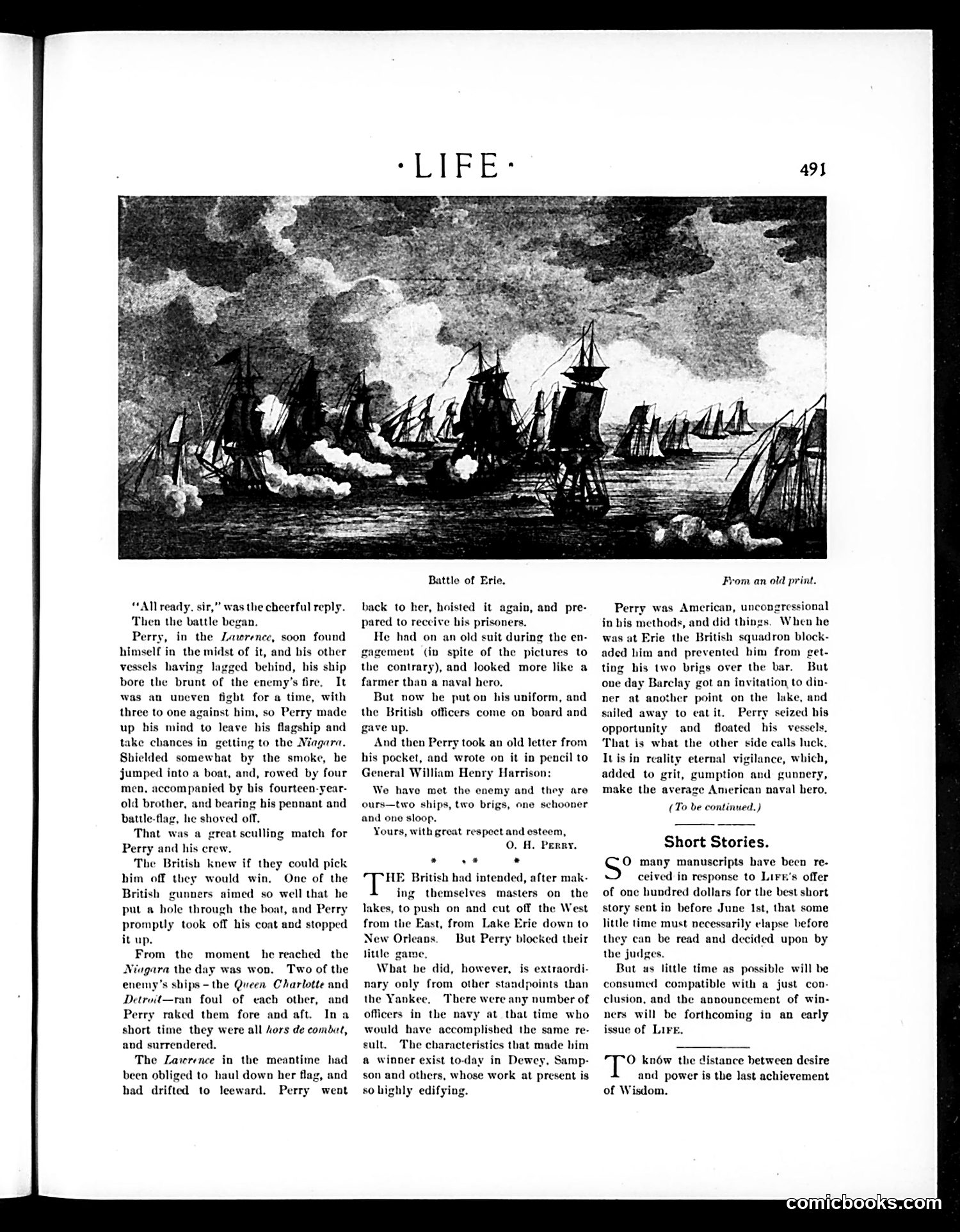
This page presents a historical account of Commodore Oliver Hazard Perry's 1813 naval victory during the War of 1812, illustrated by an engraving titled "Battle of Erie." The text celebrates Perry's decisive defeat of a British squadron on Lake Erie, which prevented British control of the Great Lakes and the separation of the American nation. The narrative emphasizes Perry's unconventional, action-oriented American character—he plugged a bullet hole in his boat with his coat during battle and seized an opportunity when the opposing British commander was away at dinner. The text compares Perry favorably to contemporary naval heroes like Dewey and Sampson, suggesting that American naval superiority stems from resourcefulness and determination rather than formal training. The passage concludes with Perry's famous message: "We have met the enemy and they are ours."
📄 Transcribed text from this page (OCR, searchable)
Machine-transcribed from the original scan — historical spelling and the odd misread are preserved.
“Allready, sir,” was the cheerful reply. Then the battle began. Perry, in the Lawrence, soon found himself in the midst of it, and his other vessels having lagged behind, his ship bore the brunt of the enemy’s fire, It was an uneven fight for a time, with three to one against him, so Perry made up his mind to leave his flagship and take chances in getting to the Niagara, Shielded somewhat by the smoke, be jumped into a boat, and, rowed by four men, accompanied by bis fourteen-year- old brother, and bearing his pennant and battle-flag, he shoved off, That was a great sculling match for Perry and his crew. The British knew if they could pick him off they would win, One of the British gunners aimed so well that he put a hole through the boat, and Perry promptly took off his coat and stopped it up. From the moment he reached the Niagara the day was won, Two of the enemy’s ships -the Queen Charlotte and Detroit—ran foul of each other, and Perry raked them fore and aft. Ina short time they were all hors de combat, and surrendered. The Lavrence in the meantime had been obliged to haul down her flag, and had drifted to leeward, Perry went Battle of Erie. back to her, hoisted it again, and pre- pared to receive bis prisoners. He had on an old suit during the en- gagement (in spite of the pictures to the contrary), and looked more like a farmer than a naval hero. But now he puton his uniform, and the British officers come on board and gave up. And then Perry took an old letter from his pocket, and wrote on it in pencil to General William Henry Harrison: We have mot the enemy and they are ours—two ships, two brigs, one schooner and one sloop. Yours, with great respect and esteem, O, H. Perry. > 48 . HE British had intended, after mak- ing themselves masters on the lakes, to push on and cut off the West from the East, from Lake Erie down to New Orleans. But Perry blocked their le game, What be did, however, is extraordi- nary only from other standpoints than the Yankee, There were any number of officers in the navy at that time who would have accomplished the same re- sult. The characteristics that made him a winner exist to-day in Dewey, Samp- son and others, whose work at present is so highly edifying. From an old print. Perry was American, uncongressional in his methods, and did things. When he was at Erie the British squadron block- aded him and prevented him from get- ting his two brigs over the bar. But one day Barclay got an invitation to din- ner at another point on the lake, and sailed away to eatit. Perry seized his opportunity and floated his vessels, That is what the other side calls luck. Itisin reality eternal vigilance, which, added to grit, gumption and gunnery, make the average American naval hero. (To be continued.) Short Stories. O many manuscripts have been re- ceived in response to Lirr’s offer of one hundred dollars for the best short story sent in before June Ist, that some little time must necessarily elapse before they can be read and decided upon by the judges. But as little time as possible will be consumed compatible with a just con- clusion, and the announcement of win- ners will be forthcoming in an early issue of Lire. O know the distance between desire and power is the last achievement of Wisdom.