
A complete issue · 20 pages · 1898
Life — April 7, 1898
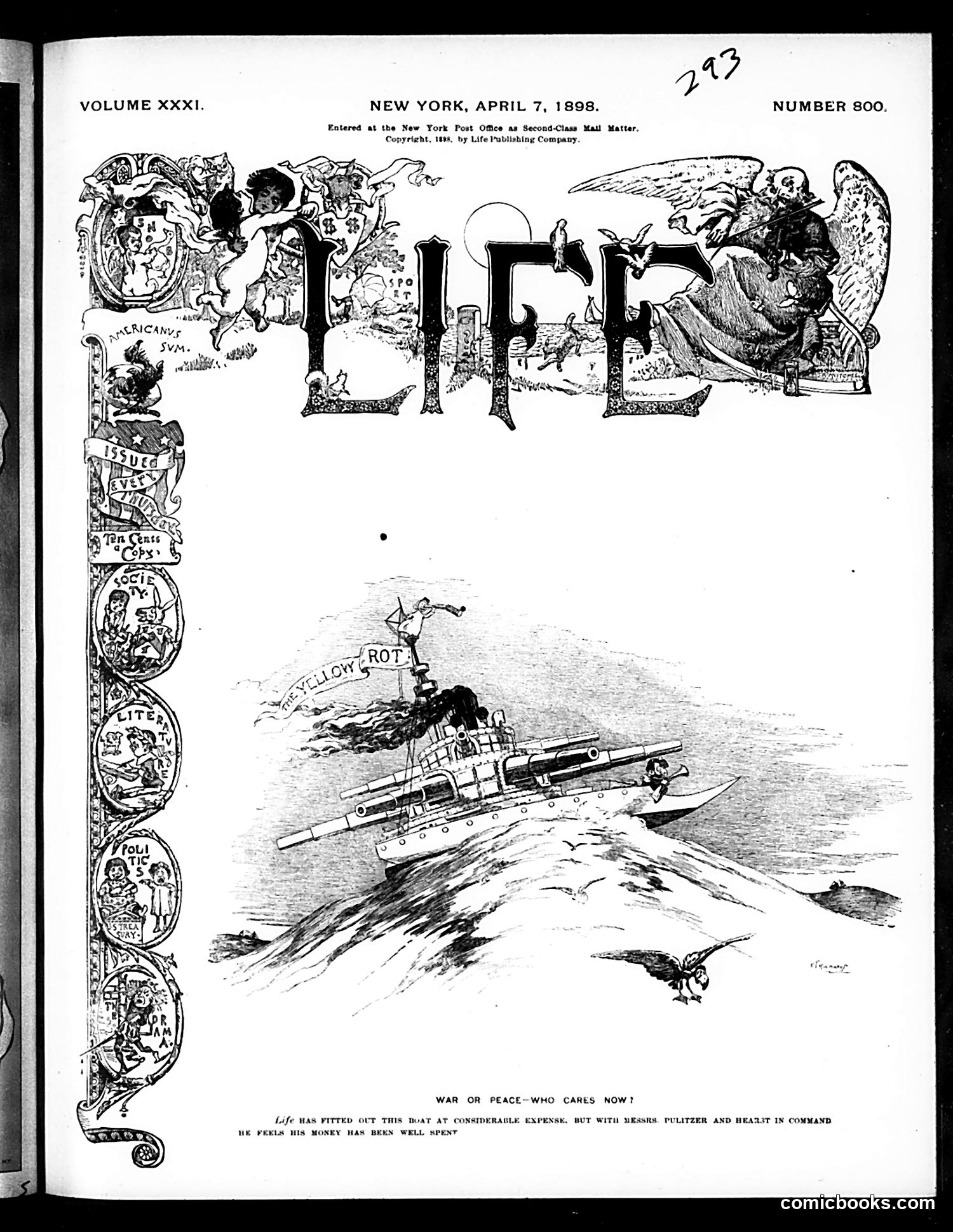
This satirical cover depicts a warship labeled "Yellow Rot" foundering on rocks, with an eagle flying nearby. The caption reads: "War or Peace—Who Cares Now? Life Has Fitted Out This Boat at Considerable Expense, But with Messrs. Pulitzer and Hearst in Command He Feels His Money Has Been Well Spent." The satire targets newspaper magnates **William Randolph Hearst and Joseph Pulitzer**, whose sensationalist "yellow journalism" was blamed for drumming up American support for the Spanish-American War (beginning April 1898). Life mocks their rivalry and inflammatory reporting as recklessly endangering national interests—the warship's destruction symbolizing the war they helped provoke through irresponsible journalism prioritizing profit over truth.
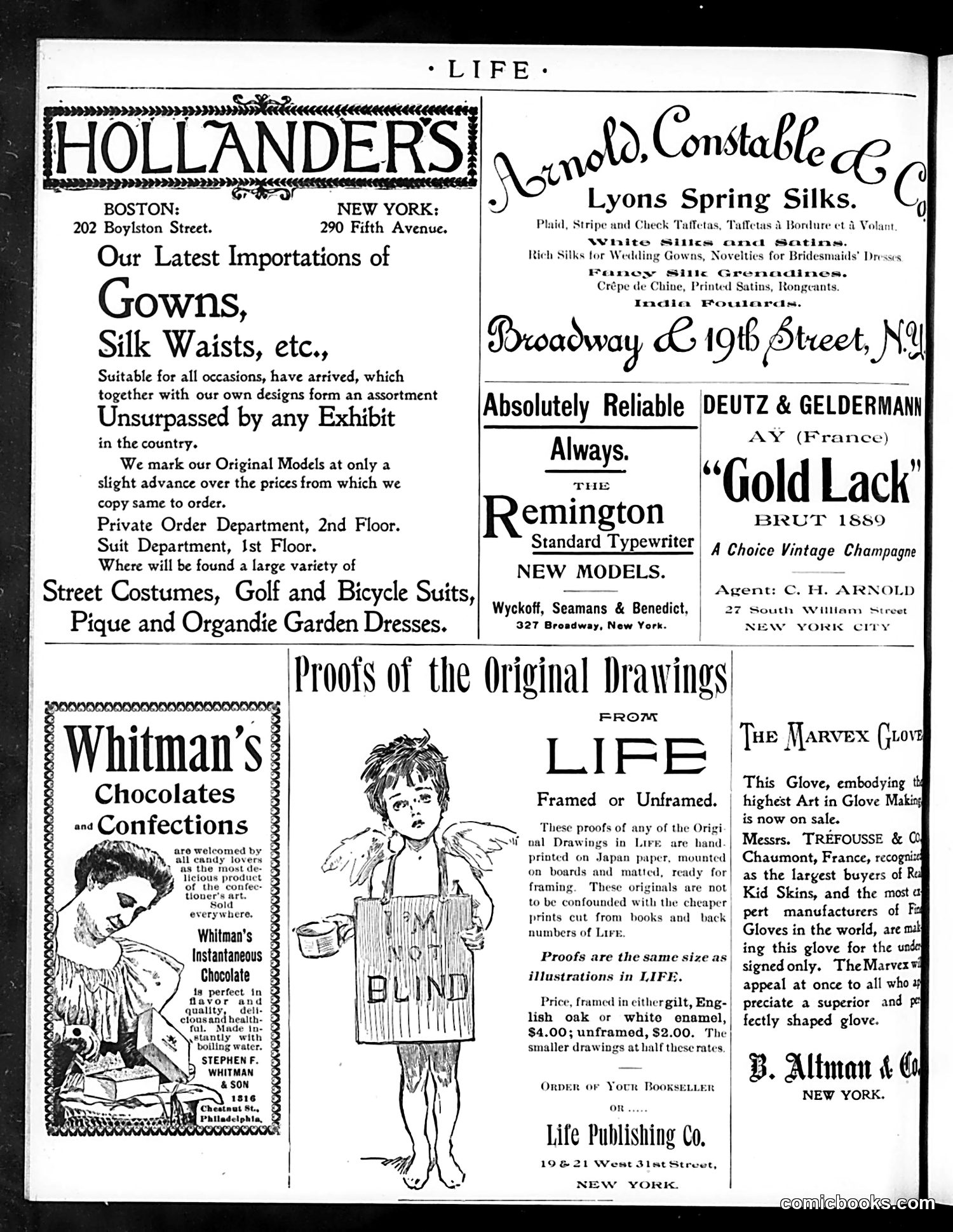
This page is primarily **advertisements** for luxury goods and services, with one small editorial cartoon. The central cartoon depicts a child holding a sign reading "BLIND," promoting Life magazine's offer to sell "Proofs of the Original Drawings" from the publication. The image is a straightforward commercial appeal rather than political satire—Life Publishing Co. is advertising that readers can purchase framed or unframed proofs of illustrations that appeared in the magazine, with prices ranging from $4.00 to $3.00 depending on size and framing. The surrounding ads feature high-end products: Hollanders gowns and silks, Lyons Spring Silks, Remington typewriters, Whitman's chocolates, and Marvex gloves. This reflects Life's audience of wealthy, fashionable urban readers in the early 20th century.
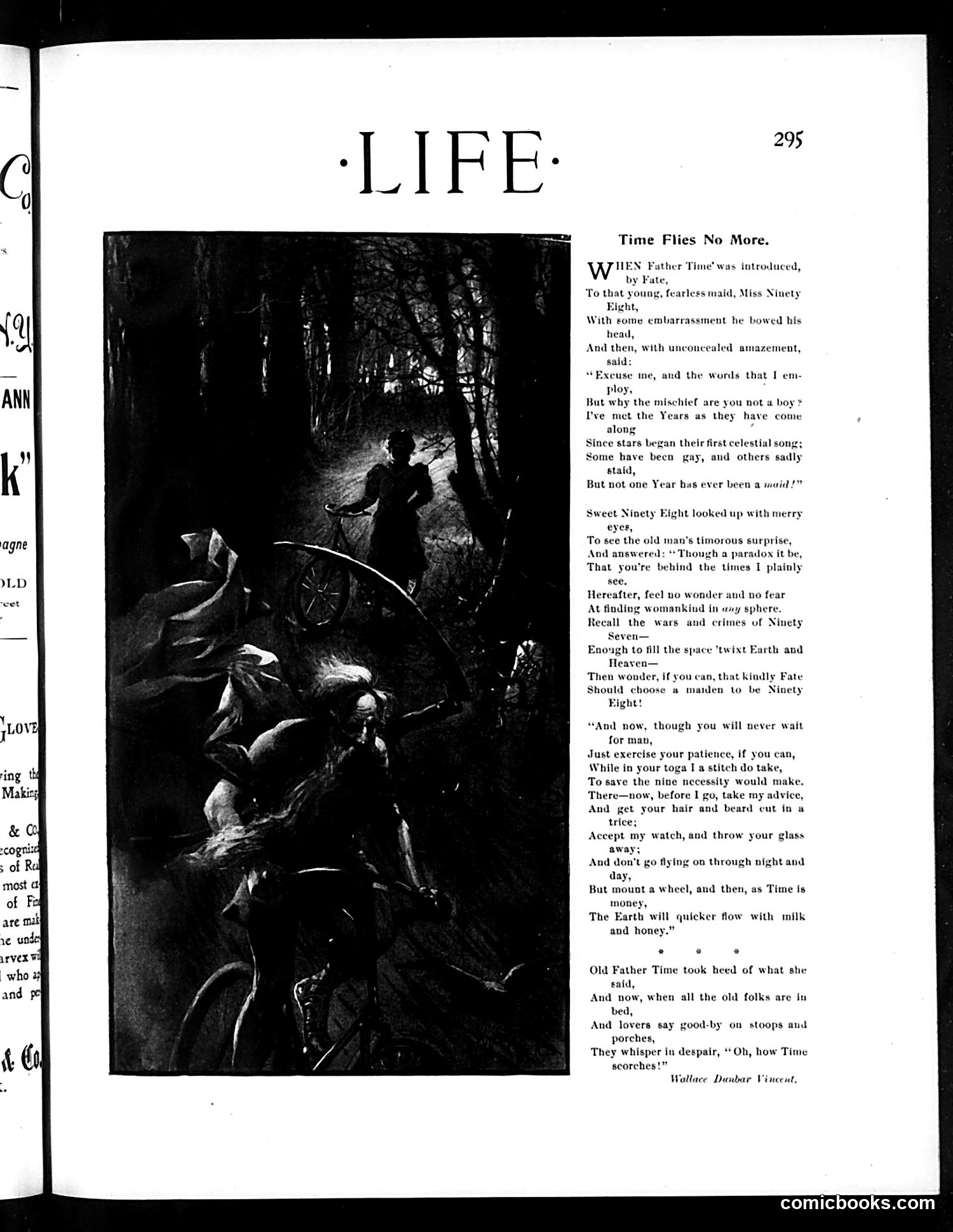
This page features a poem illustrated with an allegorical engraving showing Father Time (an elderly bearded figure with a scythe and hourglass) meeting Miss Ninety Eight (representing the year 1898). The humor derives from personifying years as characters and depicting Time as "tired" or reluctant to continue his duties. The poem's joke suggests that years have become increasingly "wayward"—some gay, others sad—but notably, no year has ever been "wout" (without fault). Time expresses exhaustion, advising Ninety Eight to exercise patience and "mount a wheel" since "Time is money." The satire gently mocks both the fatigue of aging and the era's obsession with time management and productivity.
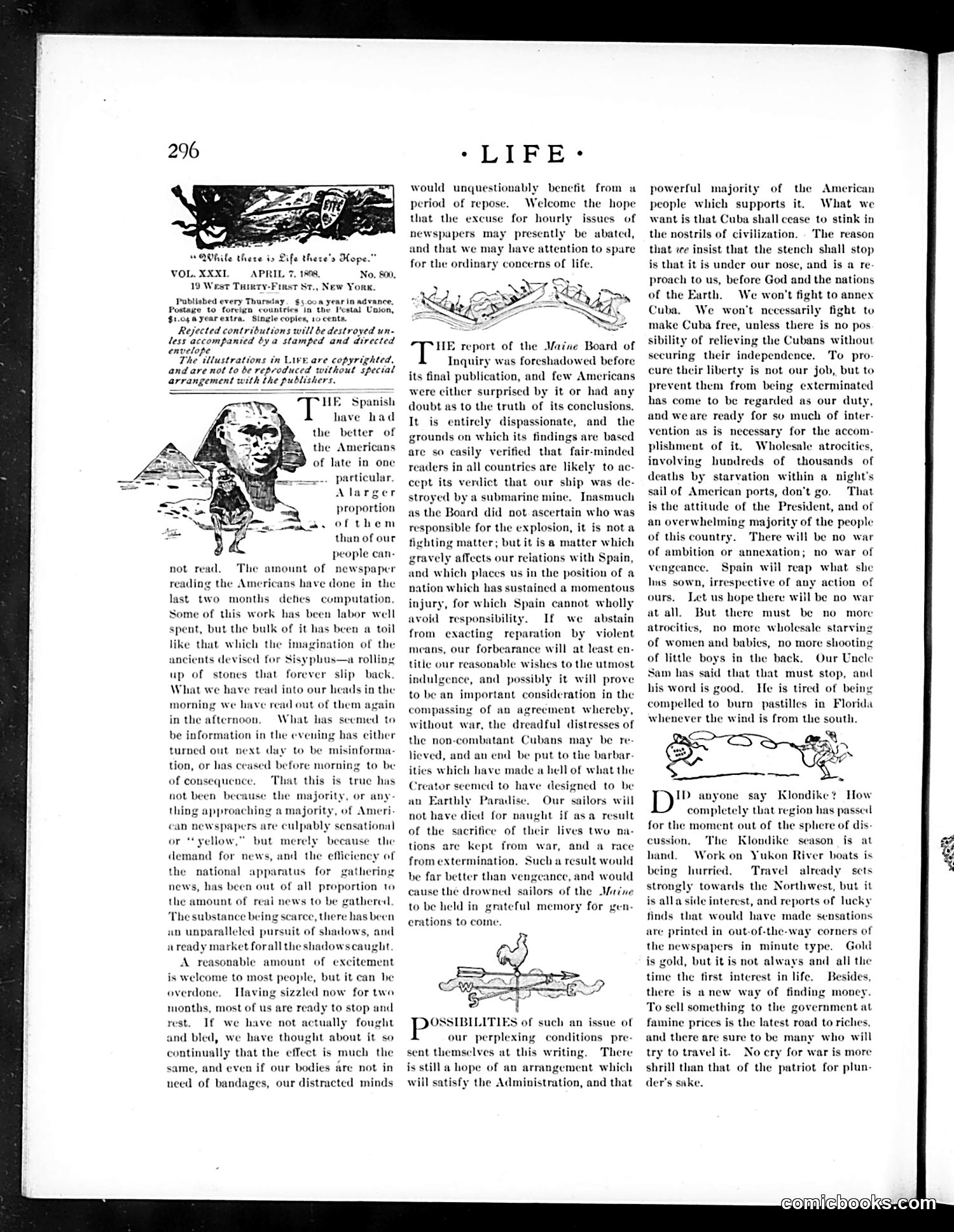
This page discusses the USS Maine explosion and American-Spanish relations, likely from 1898. The cartoon at top-left shows a caricatured figure labeled "While there is Life there's Hope," appearing to reference Spanish leadership facing American pressure over Cuba. The Egyptian sphinx illustration suggests Spain's ancient, declining power—a common metaphor for outdated empires. The text argues against war hysteria, urging measured diplomacy rather than military vengeance, while acknowledging Spain cannot avoid responsibility for the Maine incident. The final cartoon depicts what appears to be a figure finding wealth or opportunity—possibly satirizing Americans seeking profit from the Cuban crisis, a critique of opportunistic business interests using patriotism as cover for financial gain.
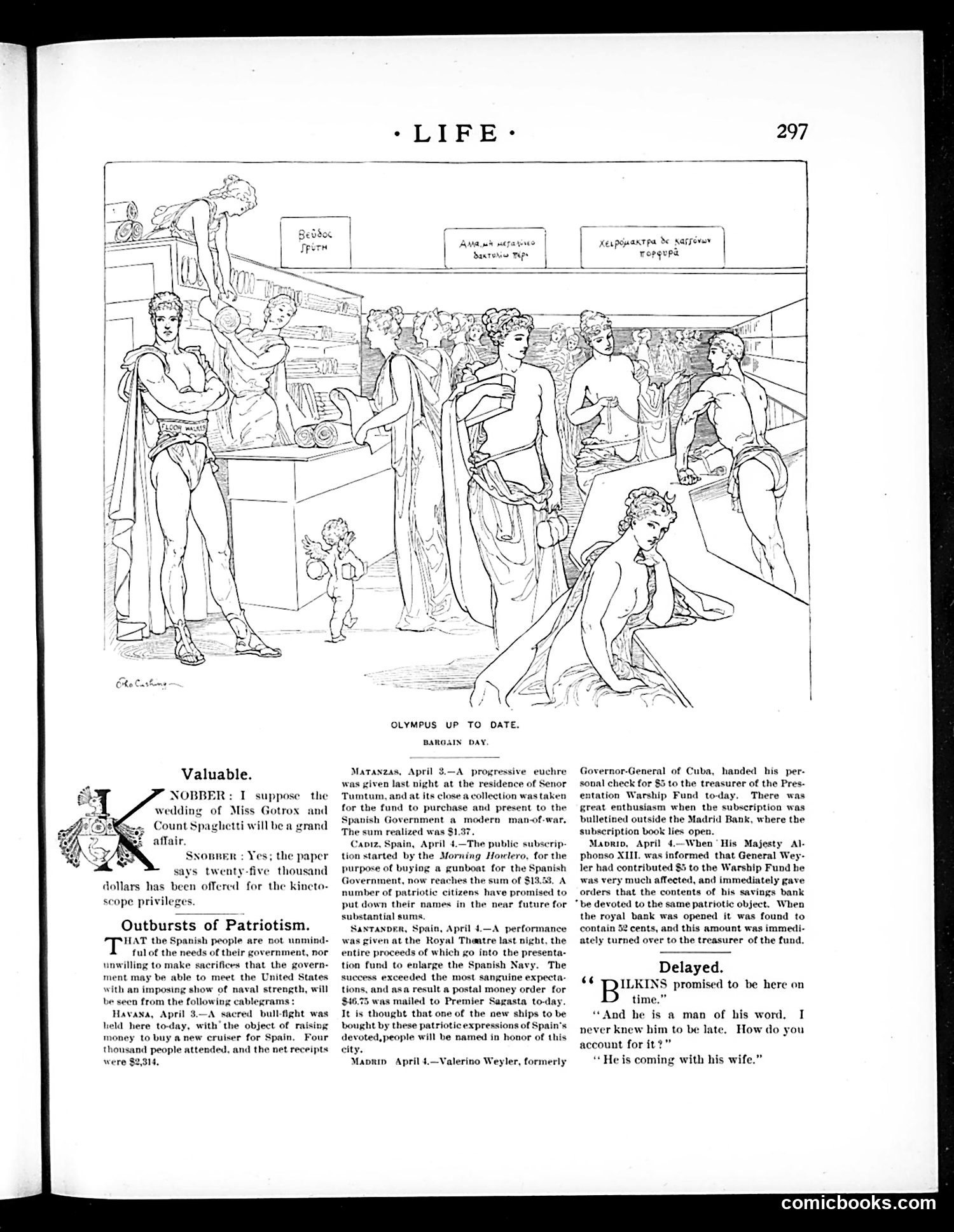
The main illustration depicts "Olympus Up to Date," a satirical scene showing classical Greek gods and goddesses in a modern marketplace or bazaar setting, complete with what appear to be price tags and commercial activity. The title suggests Life is mocking the commodification of classical ideals—reducing timeless mythology to commercial transactions. Below, three brief news items discuss Spanish patriotic fundraising efforts: a wedding with kinescope privileges, naval strength contributions, and a warship fundraising campaign in Havana and Madrid. The "Valuable" and "Outbursts of Patriotism" sections appear satirical commentary on nationalism and public fundraising schemes. The "Delayed" dialogue humorously portrays a domestic quarrel about punctuality, providing contrast to the weightier political content above.
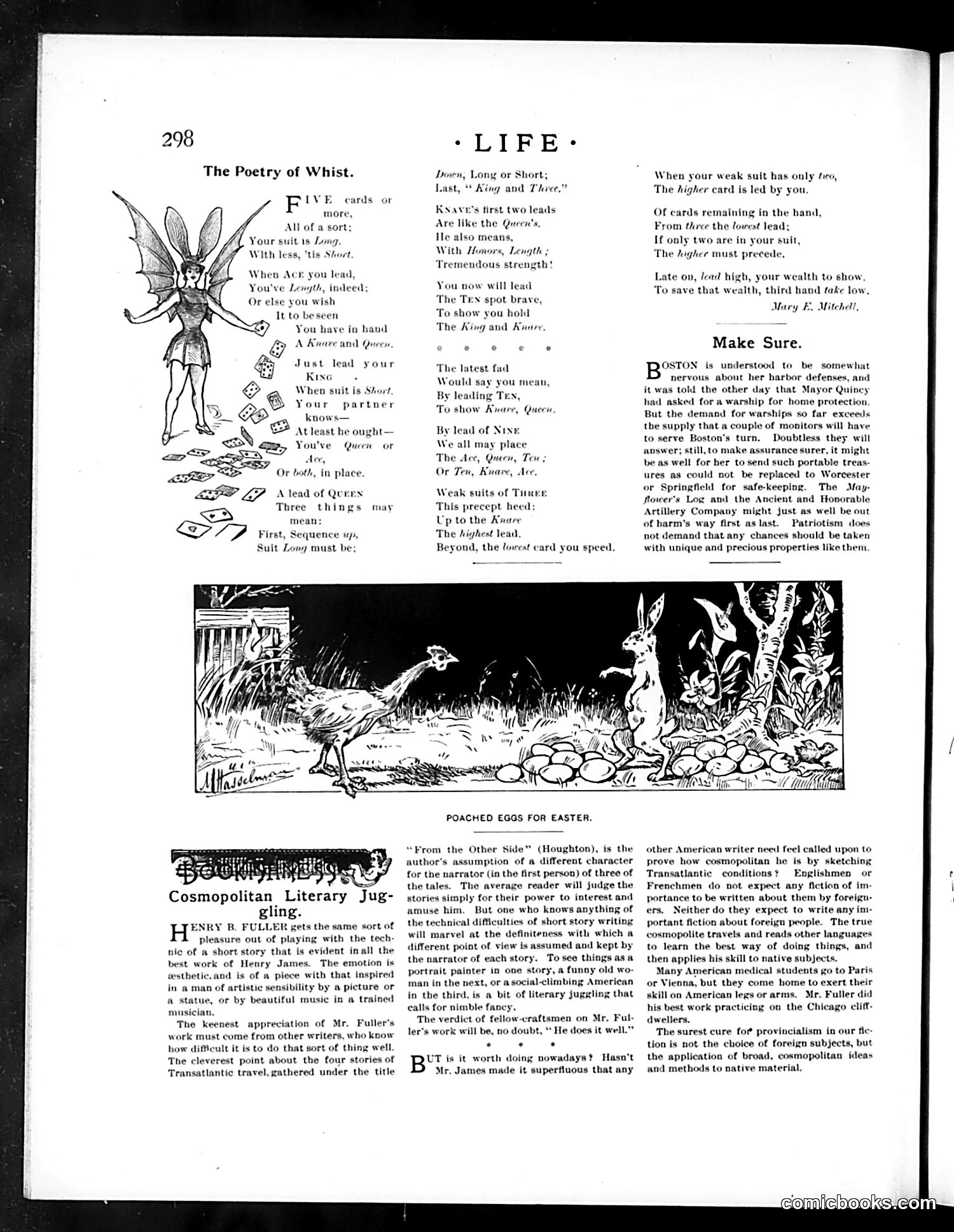
**"The Poetry of Whist"** (top left): A satirical poem mocking the card game Whist, personifying cards (King, Queen, Knave, etc.) as characters with exaggerated importance. The accompanying illustration shows a fairy-like figure surrounded by playing cards, ridiculing how seriously players took this Victorian parlor game. **"Make Sure"** (right column): A brief editorial piece expressing skepticism about Boston's request for warships for harbor defense, suggesting such preparations are unnecessary peacetime posturing. **"Poached Eggs for Easter"** (illustration): A whimsical woodland scene with anthropomorphized rabbits and eggs, likely a humorous Easter visual pun. **"Cosmopolitan Literary Juggling"** (bottom): Critiques Henry B. Fuller's literary work, praising his ability to blend different narrative perspectives and cultural viewpoints in fiction.
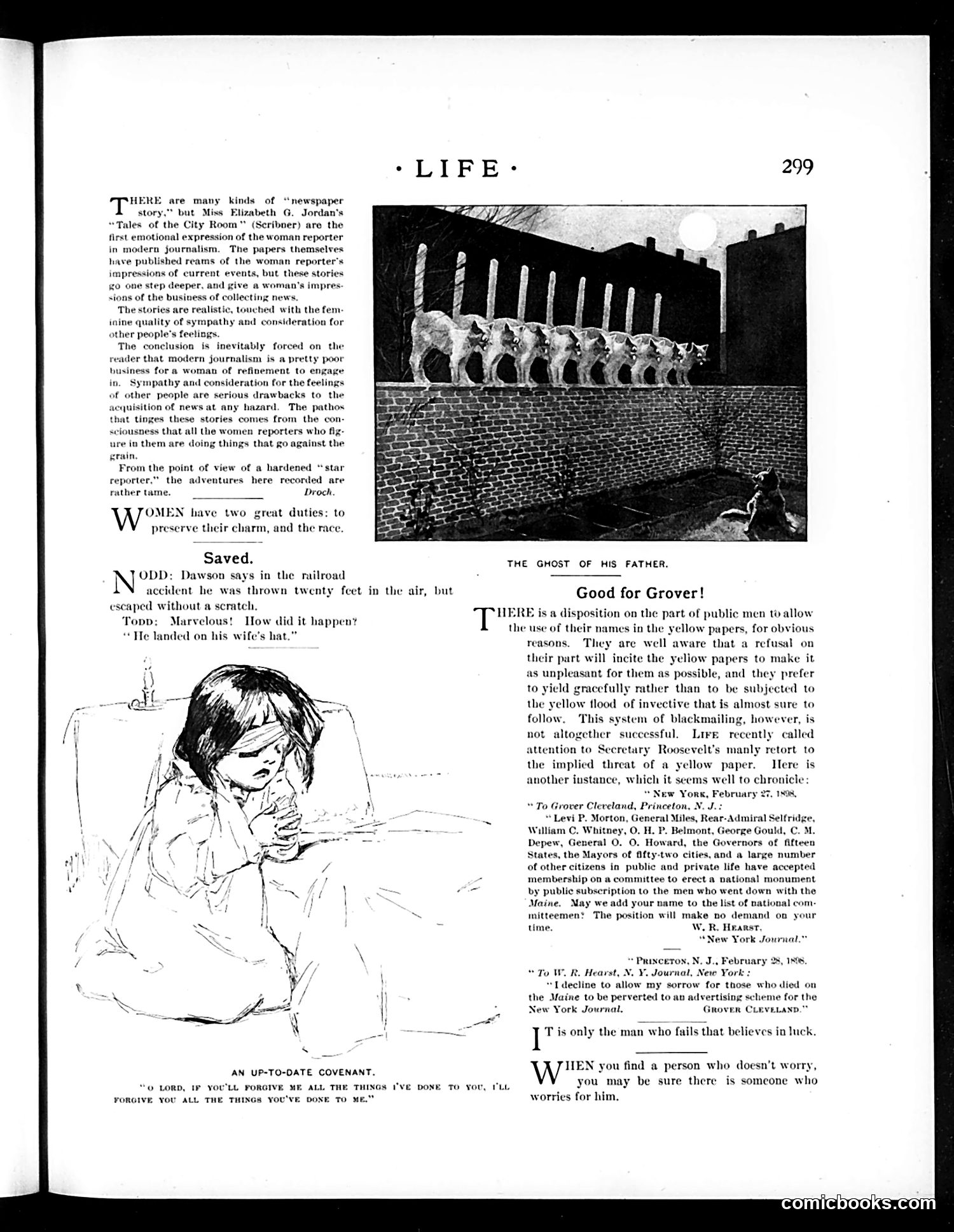
This page contains two sections: **Upper section:** A photograph titled "THE GHOST OF HIS FATHER" showing what appears to be classical statuary or architectural ruins, likely illustrating a story about inheritance or familial legacy. **Lower section:** A sketch titled "AN UP-TO-DATE COVENANT" depicts a woman in prayer, with a caption showing her offering God a modern bargain: forgiving divine transgressions in exchange for God forgiving her own wrongdoings. The cartoon satirizes modern, transactional attitudes toward religion—replacing traditional spiritual devotion with a business-like negotiation. It mocks how contemporary society, even in prayer, adopts mercenary language and conditional agreements rather than unconditional faith. The page also includes editorial commentary about journalism and yellow papers, reflecting early 1900s media debates.
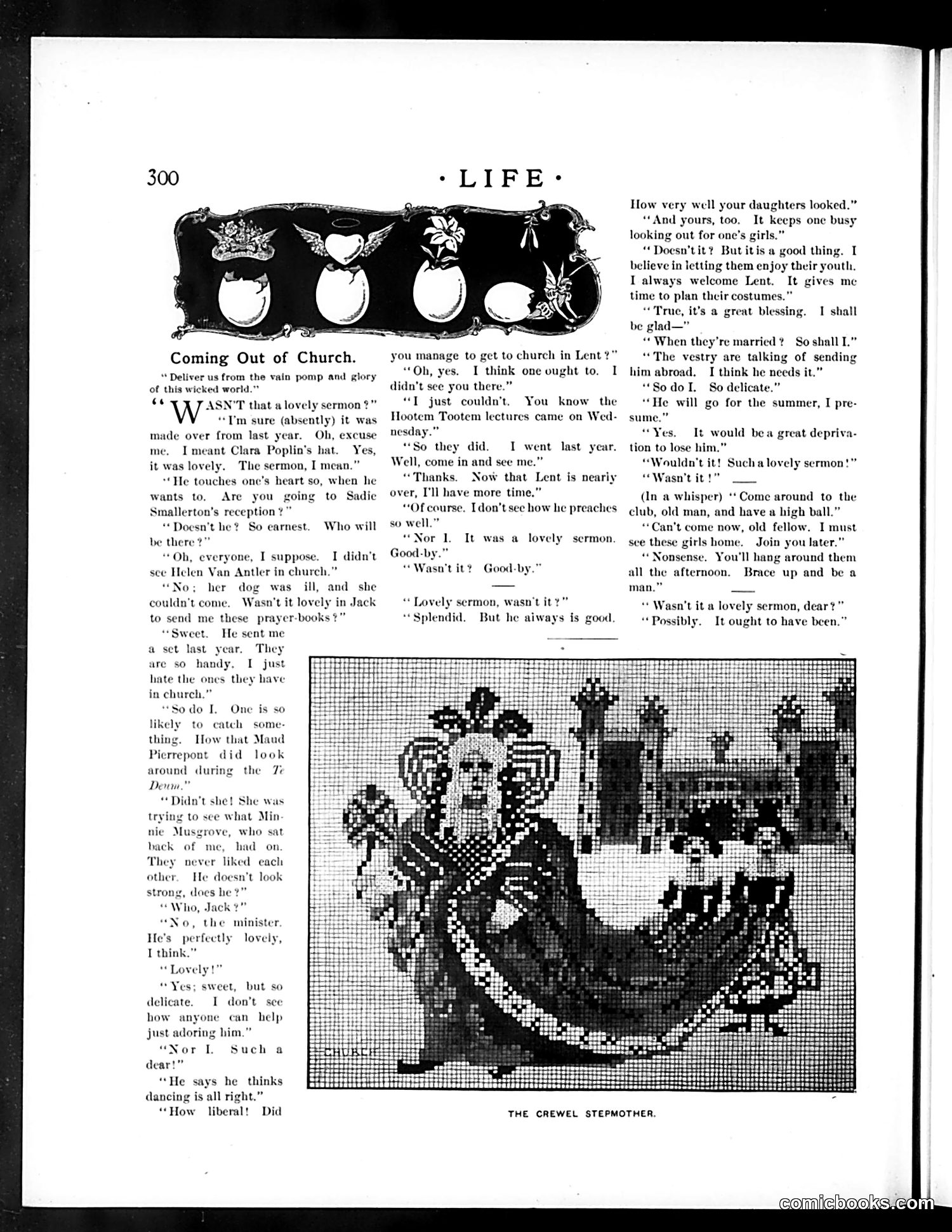
This appears to be a satirical dialogue about church attendance during Lent, illustrated by a pixelated/halftone image titled "THE CREWELL STEPMOTHER." The cartoon depicts a stern-faced woman in Victorian dress, seemingly representing a restrictive, disapproving figure—likely a stepmother character. The surrounding dialogue mocks upper-class social hypocrisy around religious observance: characters discuss attending church during Lent as social obligation rather than genuine piety, joke about "lovely sermons" without substance, and reveal that religious practices are performed primarily for appearance and social standing. The "stepmother" image likely represents the judgmental, rigid enforcement of these superficial religious conventions—the uncomfortable social authority that demands proper behavior regardless of authentic belief.
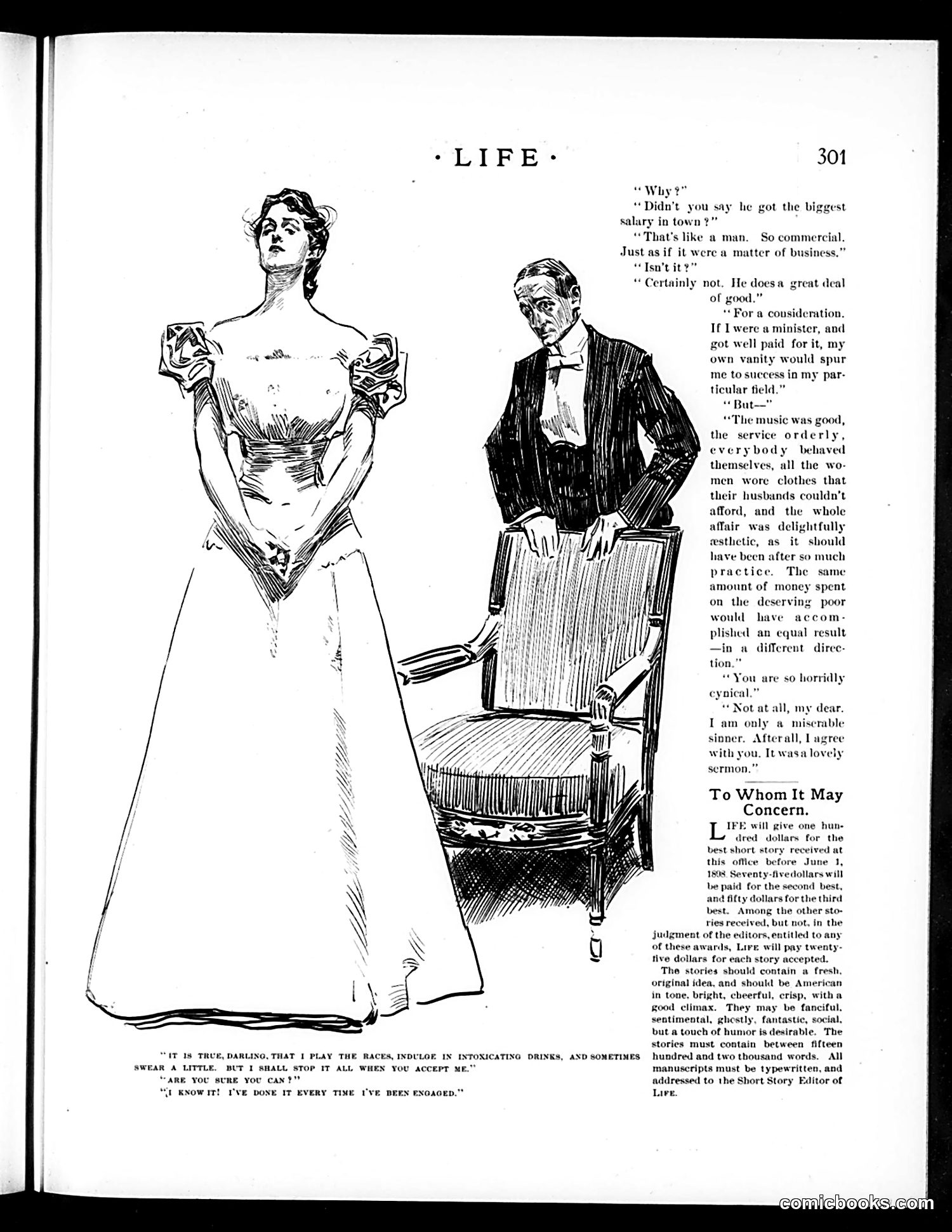
This page from *Life* magazine contains a satirical cartoon and dialogue mocking marital discord and wealth disparities. The illustration shows a well-dressed man seated while a woman in an evening gown stands before him, apparently confronting him about his behavior. The dialogue satirizes a husband's justifications for his vices—gambling, drinking, and infidelity—which he promises to reform once his wife accepts him. The woman's responses express cynicism about his excuses and his materialism (boasting about his large salary). The satire targets upper-class hypocrisy: a wealthy man using financial success to excuse moral failings, while his wife criticizes his shallow values. The cartoon critiques both marital inequality and the equation of wealth with respectability in Gilded Age society.
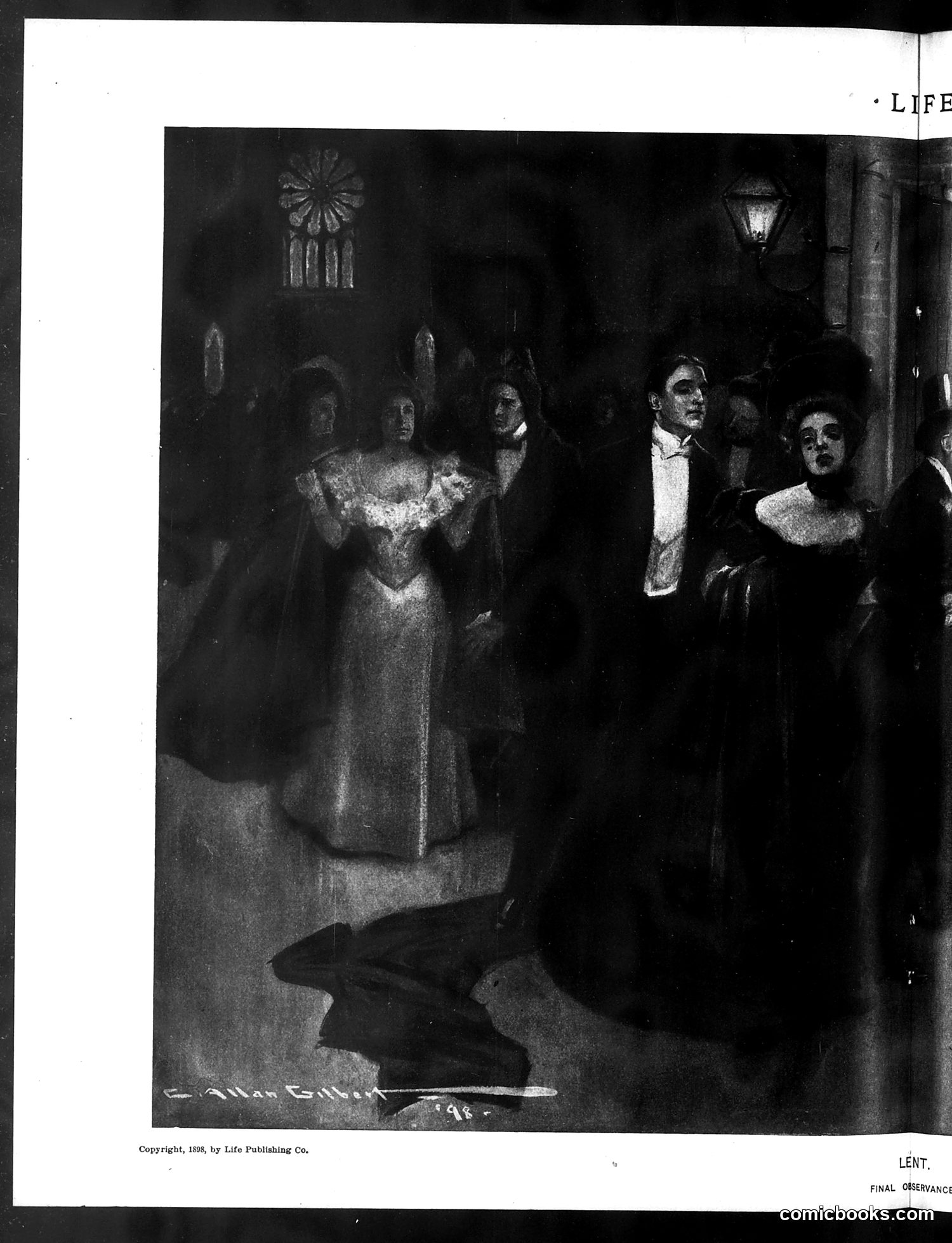
This appears to be an illustration titled "LENT: FINAL OBSERVANCE" (based on visible text at bottom), dated 1898 by Life Publishing Co. The dark, atmospheric scene depicts what appears to be a formal religious or social gathering in an interior setting—possibly a church or formal venue given the architectural details visible. The image shows formally dressed figures in evening wear, with a woman in a light-colored dress prominent on the left. The "Final Observance" title suggests this is satirizing the conclusion or end of Lenten observances—the Christian fasting period preceding Easter. Without clearer identification of specific individuals or additional context text, the exact satirical target remains unclear, though it likely comments on how wealthy or fashionable society members observed (or failed to observe) religious practices.
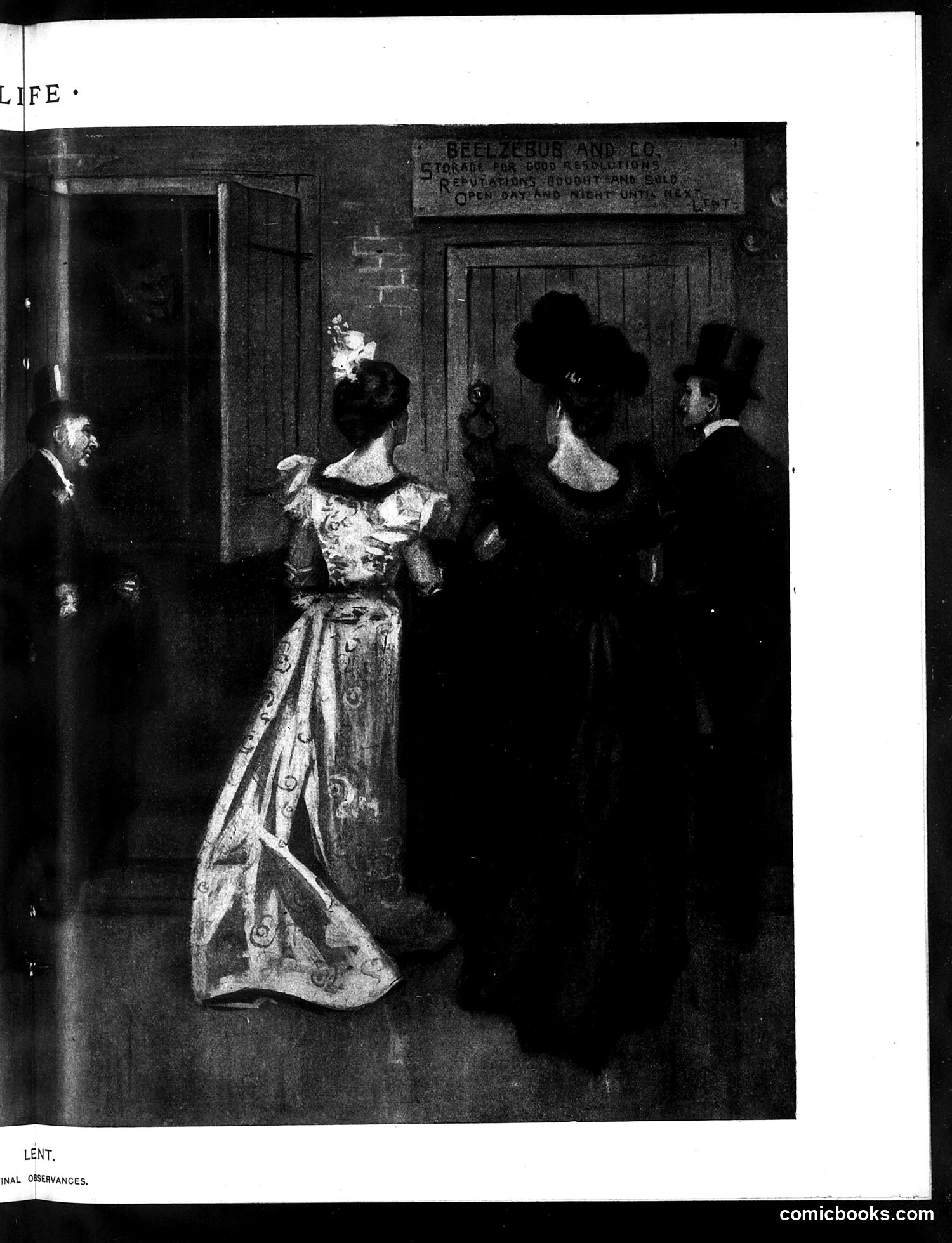
This appears to be a scene from a satirical illustration showing several people gathered outside what looks like a storage facility or business (signage reading "BEETZEBOR AND CO." is visible at top). The image depicts what appears to be a social or commercial transaction or interaction. A woman in an ornate, patterned dress stands prominently among several other figures in darker clothing, suggesting a contrast in status or circumstance. Without clearer text or additional context identifying the specific figures or the satirical point being made, I cannot definitively explain the cartoon's political or social commentary. The scene suggests commentary on class differences, commerce, or social conventions of the era, but the precise target of the satire remains unclear from this image alone.
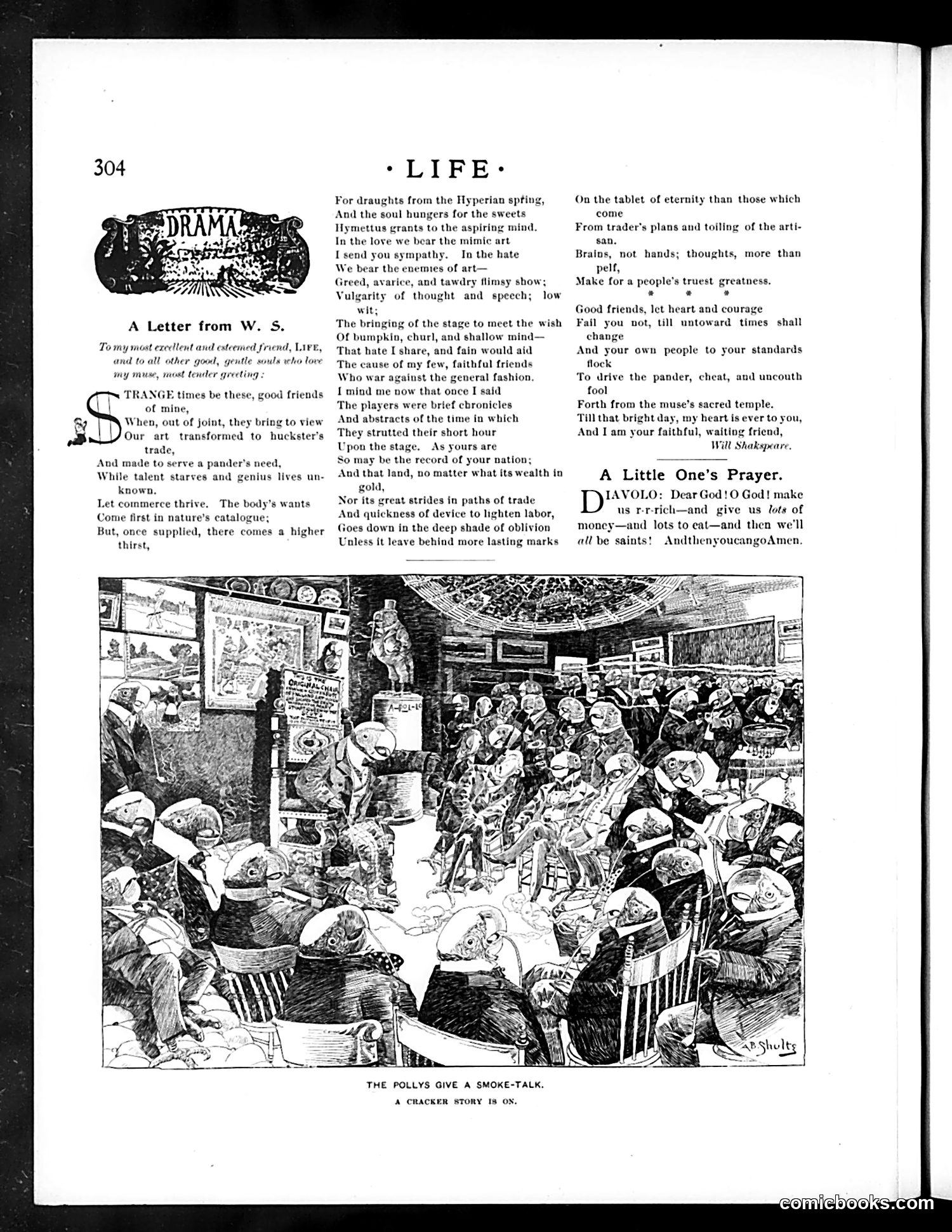
This is a satirical illustration depicting what appears to be a crowded theatrical or entertainment venue filled with rotund figures wearing hats, smoking cigars. The caption reads "The Follys Give a Smoke-Talk. A Cracker Story is On." The satire likely mocks a specific theatrical production or entertainment event—possibly the Ziegfeld Follies or similar vaudeville show. The exaggerated rotund physiques and the emphasis on smoking suggests commentary on either audience behavior, the theatrical establishment, or public leisure culture of the early 20th century. The phrase "cracker story" is unclear in meaning without additional context. The overall tone appears to be gentle social satire rather than sharp political commentary, poking fun at theatrical entertainment and its attendees.
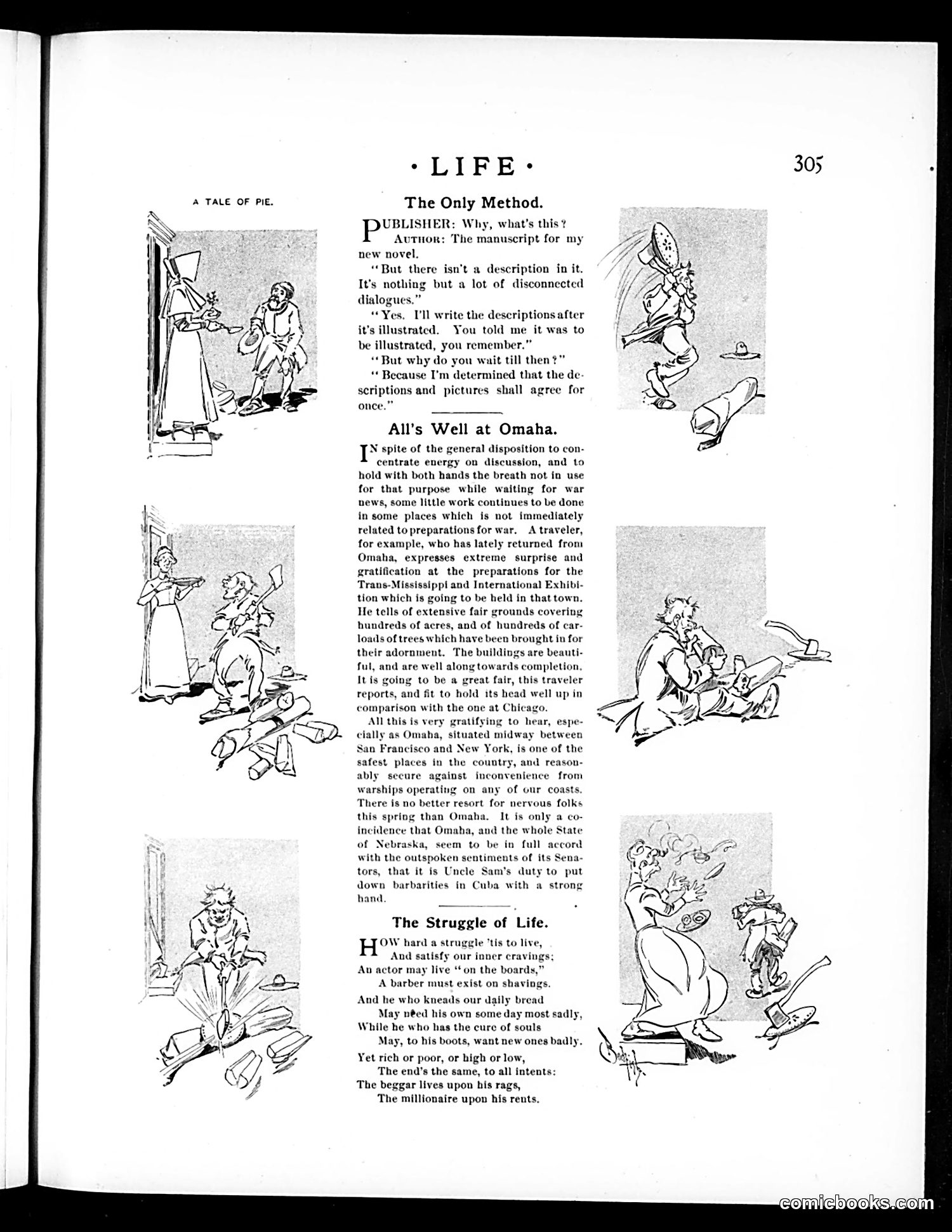
**"The Only Method"** mocks contemporary literary practice: a publisher confronts an author whose novel contains only dialogue with no descriptions. The author's solution—waiting to write descriptions *after* illustrations are completed so they'll "agree for once"—satirizes the absurdity of working backwards, suggesting writers compromise their craft for illustrated editions. **"All's Well at Omaha"** celebrates the Trans-Mississippi Exposition while indirectly commenting on the Spanish-American War (referenced as ongoing). The piece praises Omaha's safety and progress despite national war preoccupation, with a closing jab at American interventionism in Cuba—likely critiquing the Senate's pro-war stance. **"The Struggle of Life"** is a verse musing on economic irony: all social classes struggle regardless of wealth. Whether an actor lives "on the boards," a baker needs bread, or a millionaire depends on rents, everyone faces existential precarity. The poem uses occupational wordplay (barber/shavings, baker/bread) to argue that survival's burden is universal.
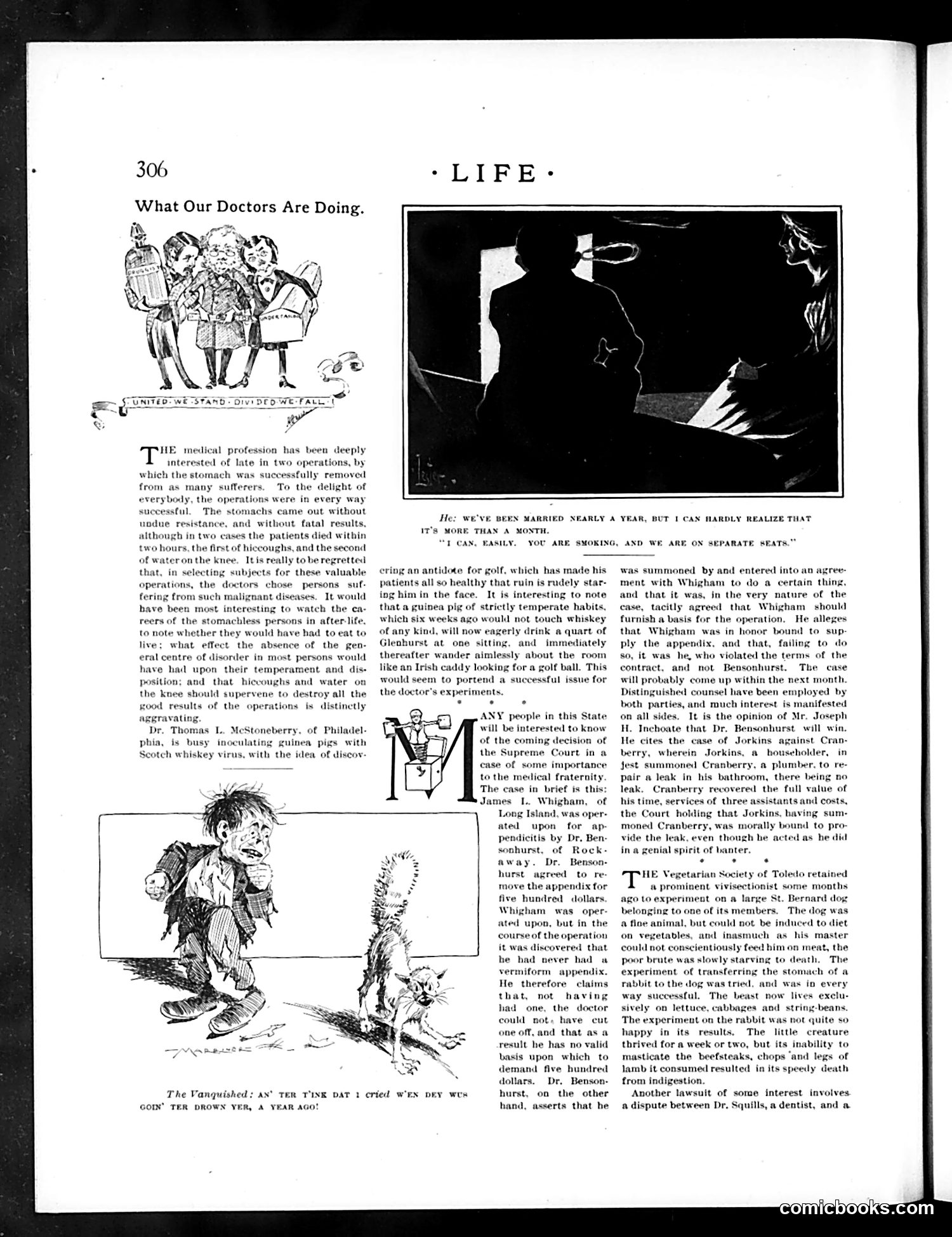
This satirical piece mocks medical malpractice and questionable medical practices of the era. The main cartoon depicts **Dr. McStoneberry inoculating guinea pigs with Scotch whiskey** to develop an antidote—absurd pseudoscience. The joke's punchline shows a guinea pig now happily drinking whiskey (a "strictly temperate" animal now behaving like an Irish laborer), suggesting the "cure" has backfired comically. The lengthy text satirizes **a lawsuit between patient James Whigham and Dr. Bensonhurst**. After removing Whigham's appendix for five hundred dollars, the doctor discovers Whigham never *had* an appendix. The satire lies in the absurd legal arguments: Whigham claims he shouldn't pay because there was nothing to remove; Bensonhurst counters that Whigham was "morally bound" to provide an appendix for the operation. The side caption mocks marital discord ("we've been married nearly a year... we are on separate seats"). The overall message critiques medical incompetence, frivolous litigation, and dubious professional practices in turn-of-the-century America.
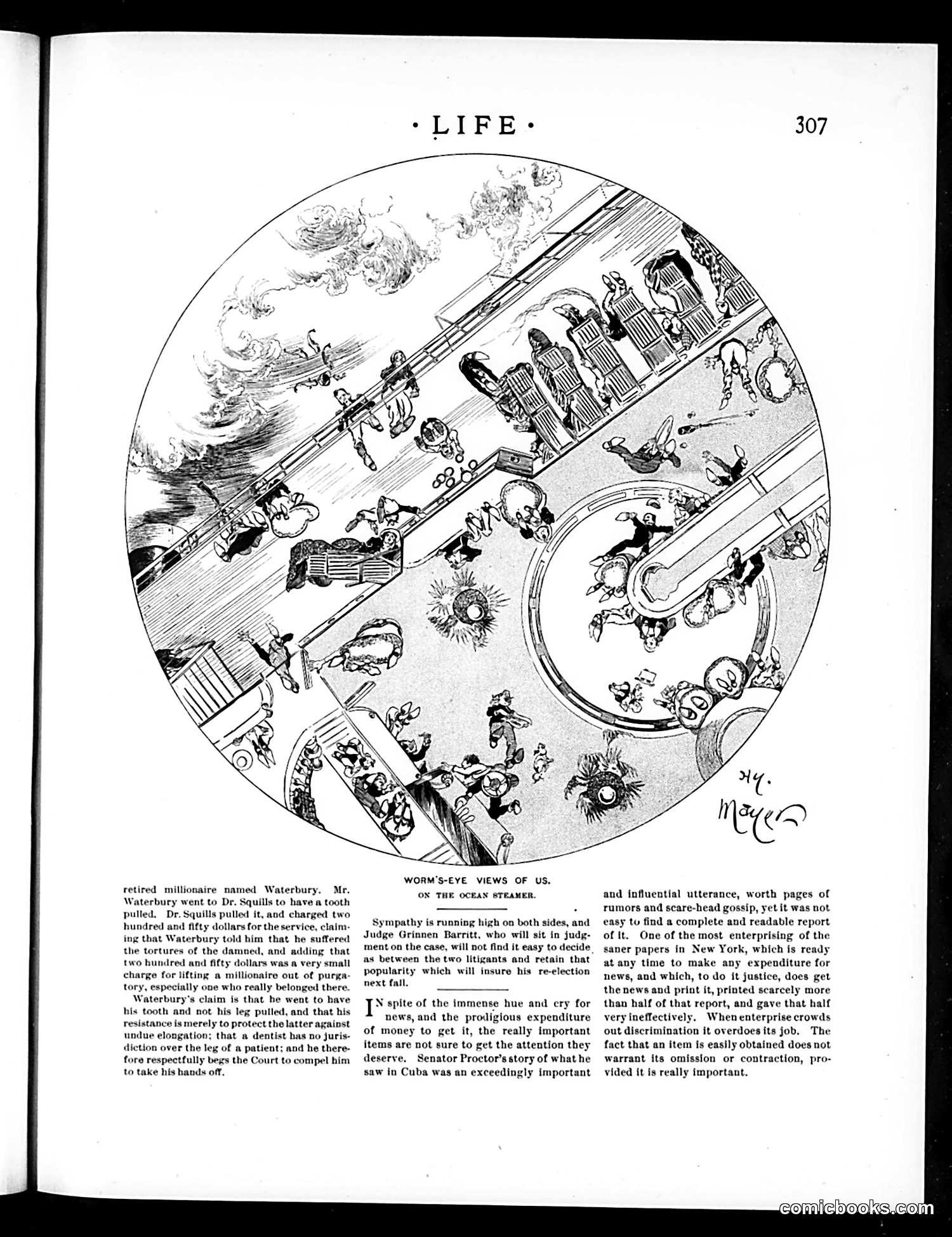
This page contains two distinct pieces: **The Main Cartoon** ("Worm's-Eye Views of Us"): A humorous legal dispute depicts a dentist, Dr. Squills, who charged a wealthy patient, Mr. Waterbury, $250 for a tooth extraction. Waterbury claims the dentist also pulled his leg (literally—a visual pun showing elongation) and seeks court intervention. Judge Grinnen Barritt must rule fairly while protecting his re-election chances—satirizing judges' political calculations. **The Editorial Column** criticizes news media priorities. Though expensive efforts go toward sensational stories, Senator Proctor's important firsthand account from Cuba received inadequate coverage. The complaint: news outlets pursue easily-obtained stories over genuinely significant ones, confusing "enterprise" (aggressive newsgathering) with actual editorial judgment. This likely references the Spanish-American War era's yellow journalism.
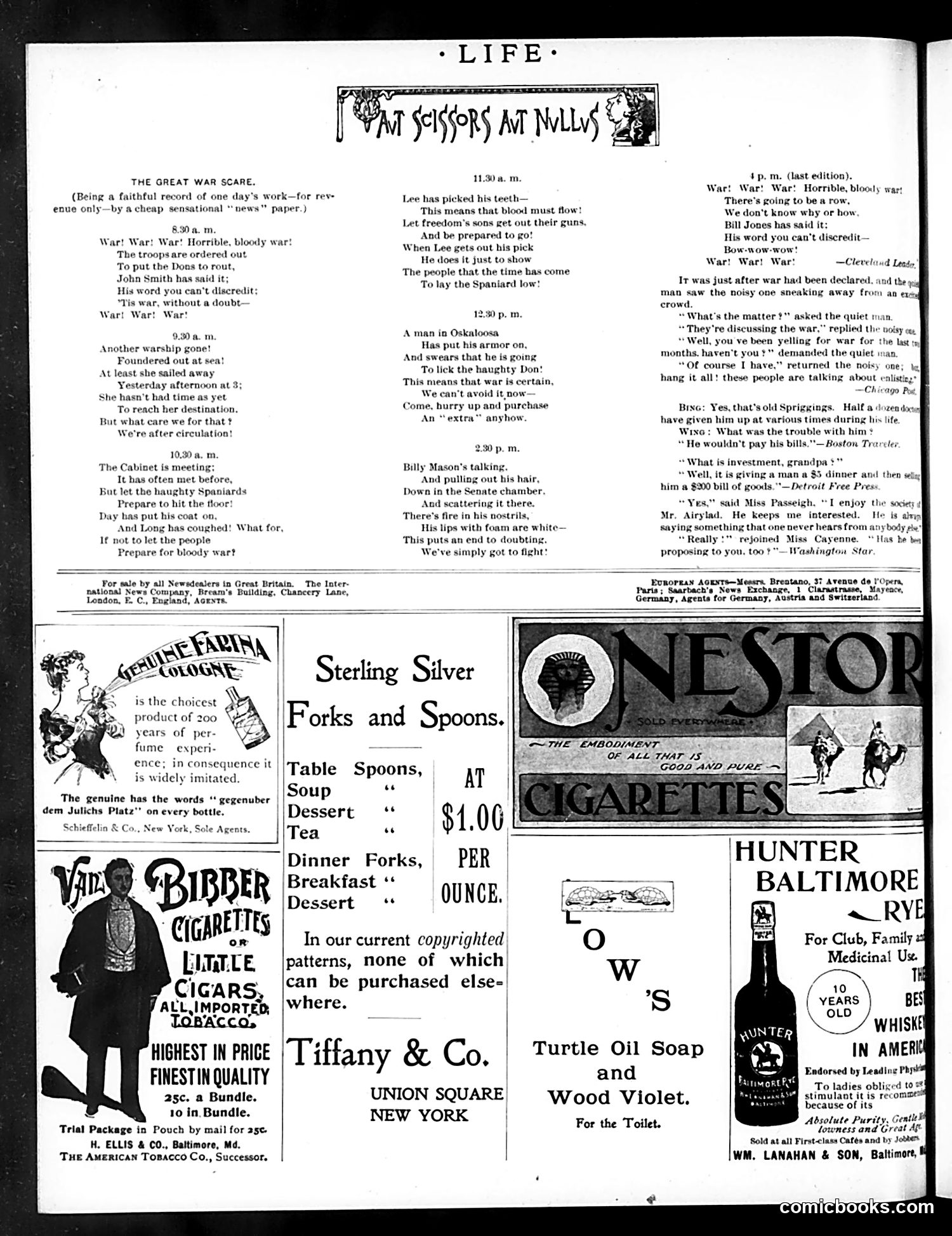
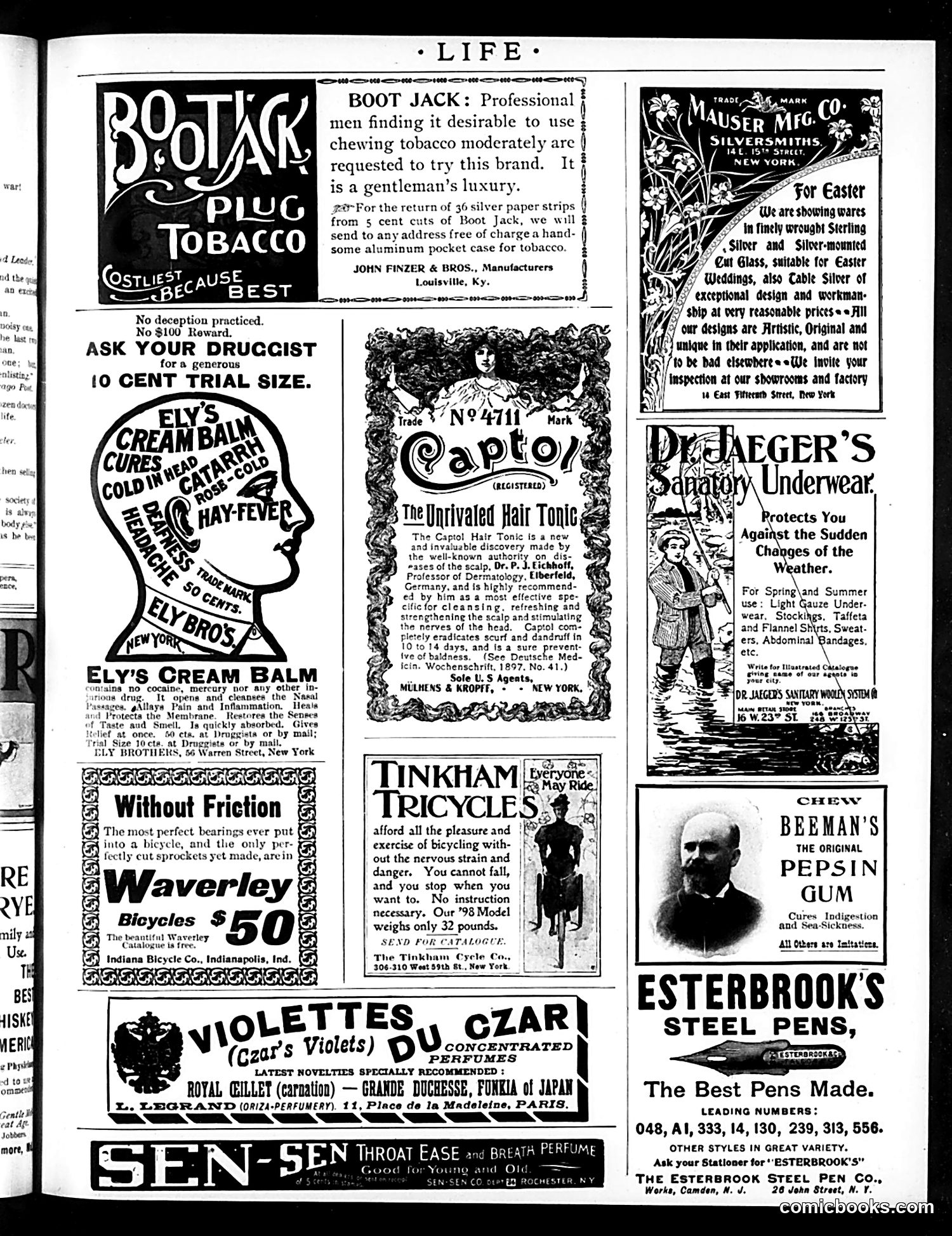
This is primarily an **advertising page** from Life magazine, not a satirical cartoon page. It contains commercial advertisements typical of late 19th/early 20th-century publications. The ads reflect period products and concerns: - **Boot Jack Plug Tobacco**: Markets chewing tobacco to "gentlemen," offering a promotional aluminum case - **Ely's Cream Balm & Capitol Hair Tonic**: Address common health anxieties—baldness and dandruff—with dubious remedies - **Beeman's Pepsin Gum**: Claims to cure indigestion and seasickness - **Bicycles/Tricycles**: New transportation technology promoted as safe exercise - **Mauser Manufacturing**: Advertises luxury sterling silver goods for weddings and Easter The page demonstrates how early Life capitalized on consumer anxieties about appearance, health, and modernity. The repeated claims of medical efficacy (often unsubstantiated) reflect an era before strict FDA regulations on advertising. No political satire or notable caricatures appear here—it's a commercial venture reflecting Gilded Age consumer culture.
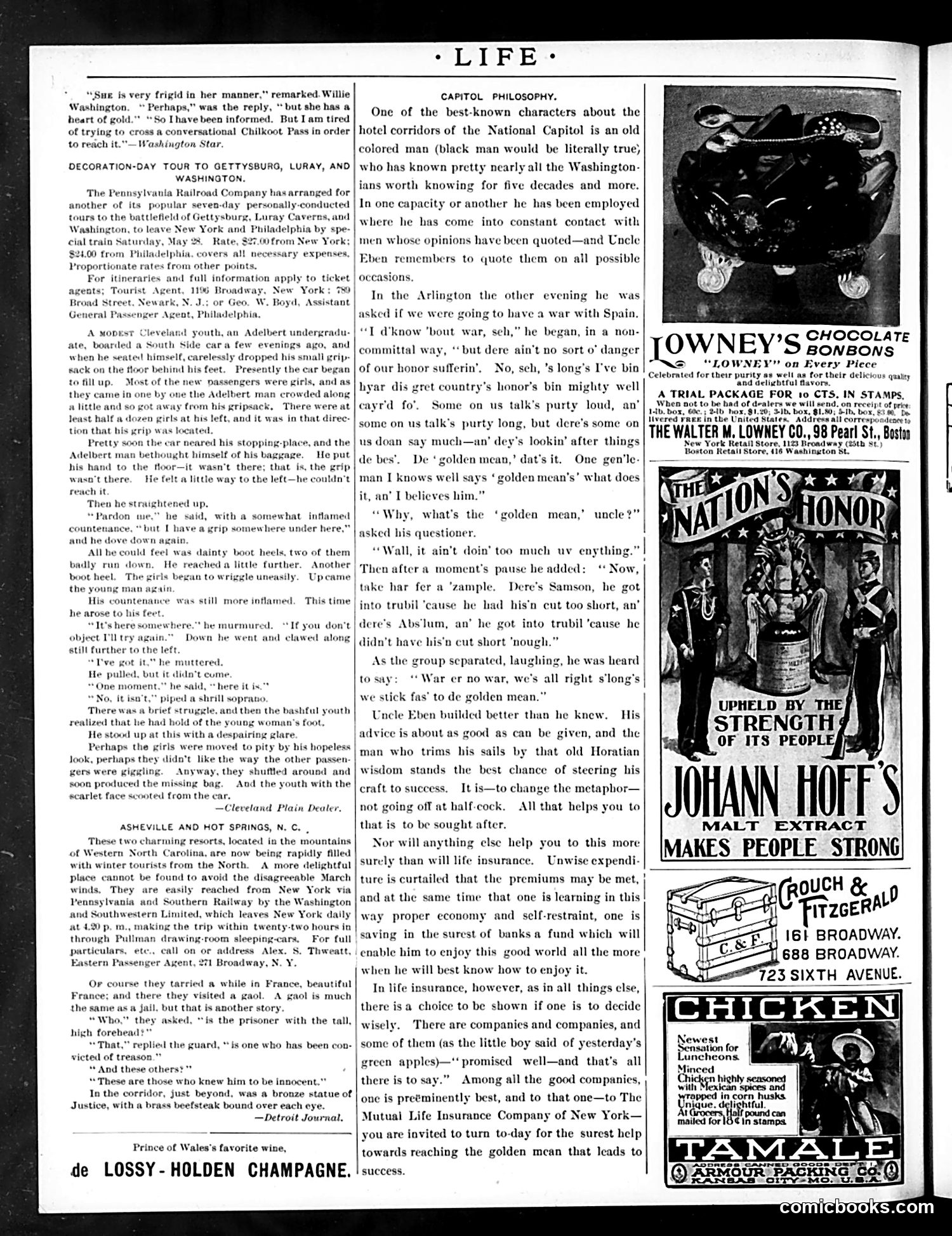
This page contains primarily **advertisements and humorous anecdotes** rather than political cartoons. The main content includes: 1. **"Capitol Philosophy"** - A sketch of an elderly Black man who works at the National Capitol and has observed Washington politicians for decades. He offers folk wisdom about life insurance and the "golden man" (success), using colloquial dialect. This appears to be gentle social commentary on how long-serving staff possess unique perspective on power. 2. **The Adelbert anecdote** - A comedic story about a young man accidentally grabbing female passengers' feet while retrieving his luggage on a train, causing embarrassment. 3. **Travel advertisements** for Pennsylvania Railroad tours and resorts. The page's humor is mild and domestic rather than sharply satirical. The "Capitol Philosophy" section uses the figure of an unnamed elderly Black man as a repository of practical wisdom—a common literary device of the era, though one that reflects period attitudes about race.
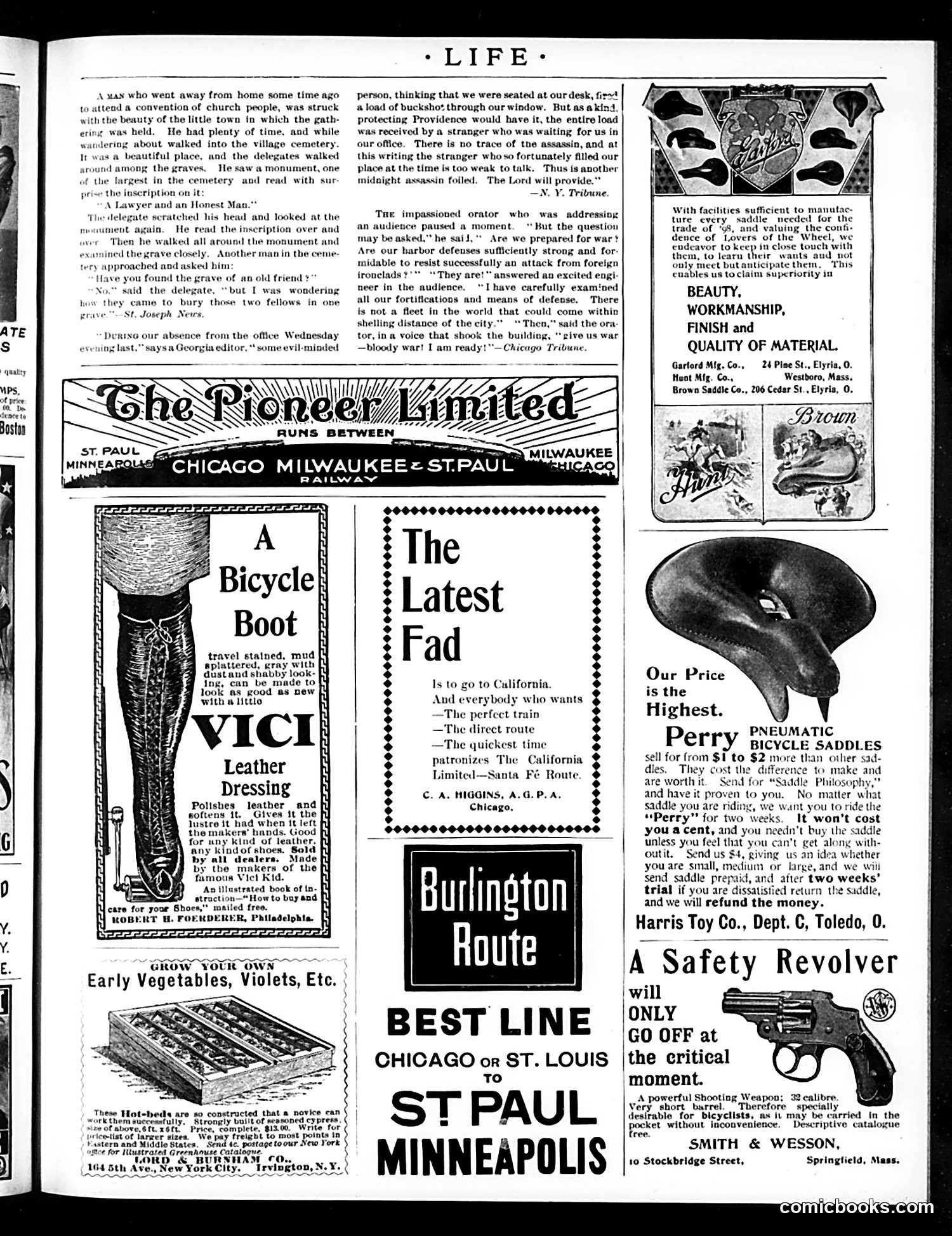
This page consists primarily of **advertisements and brief humorous anecdotes** rather than political cartoons. The main satirical pieces are short jokes: 1. **"A Lawyer and an Honest Man"**: A delegate at a church convention reads a cemetery monument praising someone as both a lawyer AND honest man, then jokes about wondering how two such rare people could be buried in one grave—satirizing lawyers' reputation for dishonesty. 2. **Georgia Editor anecdote**: An editor claims someone fired buckshot through his office window, but a convenient stranger was there to absorb the bullets instead. The editor attributes his survival to divine Providence. This appears to mock either the editor's implausible storytelling or Southern violence/feuding culture. 3. **Orator and Engineer exchange**: An orator asks if America is prepared for war; an engineer confidently claims all fortifications are impregnable; the orator then demands war anyway. This likely satirizes reckless warmongering among confident military figures. The page is otherwise filled with period product advertisements (bicycle boots, saddles, revolvers, railroad routes).
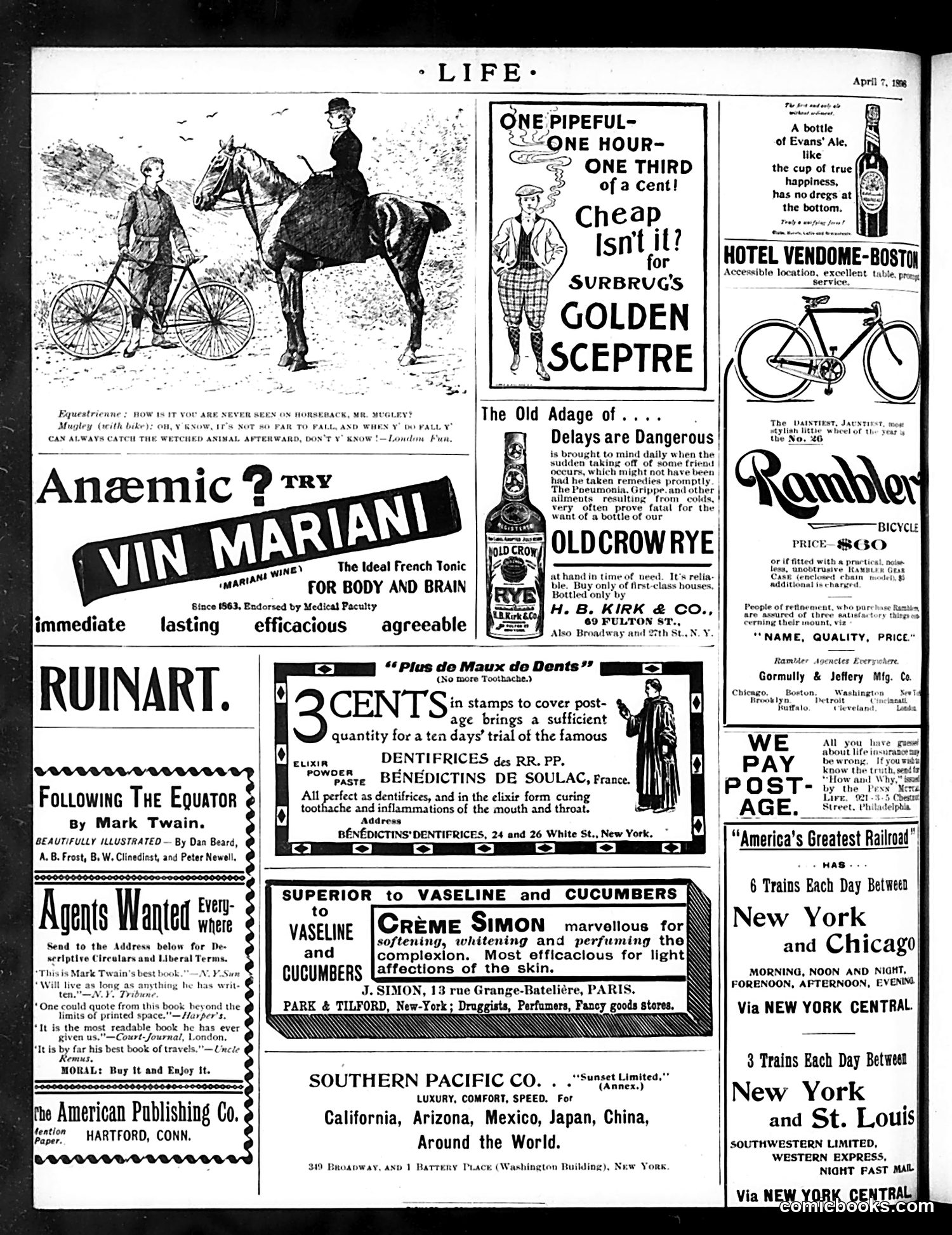
The top cartoon depicts a woman on a bicycle confronting a man on horseback. The woman (identified as "Equestrienne") asks Mr. Mugley why he's never seen riding horses, despite his pretensions. Mugley replies that he knows it's "not so far to fall" from a bike—implying he fears falling from a horse. The satire targets the social pretension around horsemanship as a mark of class status. The joke plays on the bicycle's recent popularity (this is 1898) as a democratic alternative to horses: even someone cautious like Mugley can appear fashionable on a bike without the literal risks of horsemanship. The cartoon gently mocks both Mugley's cowardice and the arbitrary class distinctions of the era—suggesting that modern bicycles made aristocratic pursuits accessible to ordinary people, regardless of skill or bravery.