
Life, 1898-04-07 · page 6 of 20
Life — April 7, 1898 — page 6: what you’re looking at
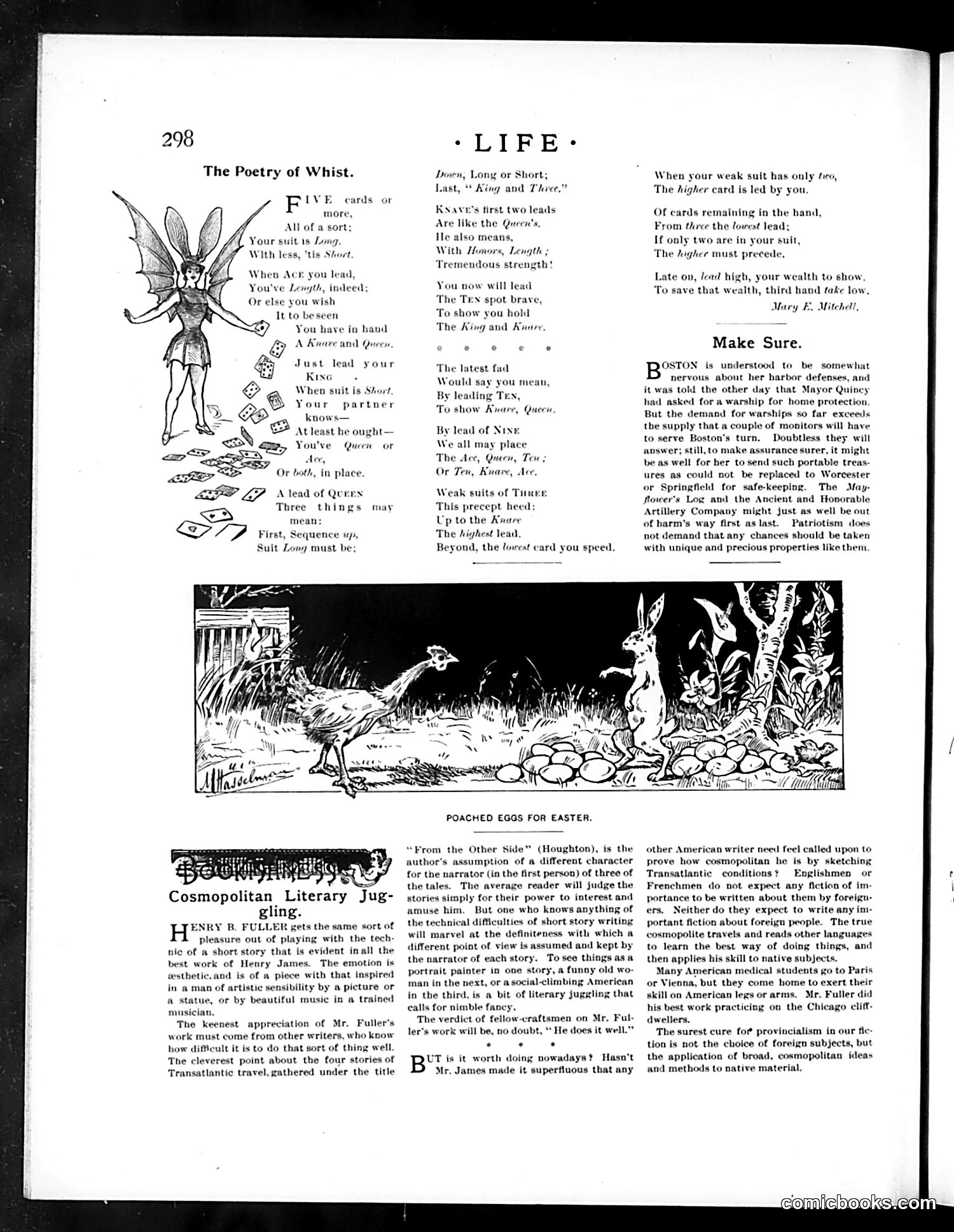
What you’re looking at
**"The Poetry of Whist"** (top left): A satirical poem mocking the card game Whist, personifying cards (King, Queen, Knave, etc.) as characters with exaggerated importance. The accompanying illustration shows a fairy-like figure surrounded by playing cards, ridiculing how seriously players took this Victorian parlor game. **"Make Sure"** (right column): A brief editorial piece expressing skepticism about Boston's request for warships for harbor defense, suggesting such preparations are unnecessary peacetime posturing. **"Poached Eggs for Easter"** (illustration): A whimsical woodland scene with anthropomorphized rabbits and eggs, likely a humorous Easter visual pun. **"Cosmopolitan Literary Juggling"** (bottom): Critiques Henry B. Fuller's literary work, praising his ability to blend different narrative perspectives and cultural viewpoints in fiction.
📄 Transcribed text from this page (OCR, searchable)
Machine-transcribed from the original scan — historical spelling and the odd misread are preserved.
The Poetry of Whist. F IVE cards or more All of a sort: Your suit is Lang. With less, ‘tis Short, When Ace You've Le Or else you wish It to beseen You have io hand A Krave and Queen Just Kixe When su Your partner knows— ast he ought— Queen or lead your 8 Short, Or both, in place. LLP GP read of Queers aos Three things Suit Long must be; may quen * LIFE: Dien, Long or Short; Last, ** Aing and Thiee.” Kave’s first two leads Are like the Queen's, He also means, With Honors, Length ; Tremendous strength! You now will lead The TEN spot brave, To show you hold The King and Knure. The latest fad Would say 3 By leading Tes, To show Kuan, Queen ‘ou mean, ad of Nive H may place Queen, Or Ten, Knave Weak suits of Tuner This precept heec Up to the Anare The highest lead. Beyond, the lowest card you speed. When your weak suit has only feo, The higher card is led by you. Of cards remaining in the hand, From three the lowest lead: If only two are in your suit, The Jagher must prec Late on, lead high, your wealth to show, To save that wealth, third hand fake low, Mary E. Mitchell, Make Sure. OSTON is understood to be somewhat nervous about her harbor defenses, and it was told the other day that Mayor Quincy had asked for a warship for home protectior But the demand for warships so far exceeds the supply that a couple of monitors will have to serve Boston's turn, Doubtless they will answer; still, to make assurance surer, it might be as well for her to send such portable treas- ures as could not be replaced to Worcester or Springfleld for safe-keeping. The May- flower's Log aud the Ancient and Honorable Artillery Company might just as well be out of harm's way first as last. Patriotism does not demand that any chances should be taken with unique and precious properties like them. i Mkitien::| Cosmopolitan Literary Jug- gling. RY B. FULLER gets the same sort of pleasure out of playing with the tech- nic of a short story that is evident inall the best work of Henry James. The emotion ix sthetic.and is of a piece with that inspired in a man of artistic sensibility by a picture or @ statue, or by beautiful music in a trained musician, The keenest appreciation of Mr. Fuller's work must come from other writers, w how difficult it is to do that sort of thing well. ‘The cleverest point about the four stories of Transatlantic travel, gathered under the title POACHED EGGS FOR EASTER. “From the Other Side“ (Houghton), is the author's assumption of a different character for the narrator (in the first person) of three of the tales. The average reader will judge the stories simply for their power to interest and amuse him, But one who knows anything of the technical difficulties of short story writing will marvel at the definiteness with which a different point of view is assumed and kept by the narrator of each story. To see things asa portrait painter in one story, a funny old wo- man in the next, or asocial-climbing American in the third, is a bit of literary juggling that calls for nimble fancy, The verdict of fellow-craftsmen on Mr. Ful- ler's work will be, no doubt, * He does it well UT is it worth doing nowadays? Hasn't Mr, James made it superfluous that any other American writer need feel catled upon to prove how cosmopolitan he is by sketching Transatlantic conditions? Englishmen or Frenchmen do not expect any fiction of im- portance to be written about them by foreign: ers. Neither do they expect to write any im- portant fiction about foreign people. The true cosmopolite travels and reads other languages to learn the best way of doing things, and then applies his skill to native subjects. Many American medical students go to Paris or Vienna, but they come home to exert their skill on American legs or arms. Mr. Fuller did his best work practicing on the Chicago cliff- dwellers, The surest cure fot provincialism in our fic- tion is not the choice of foreign subjects, but the application of broad, cosmopolitan ideas and methods to native material,