
Life, 1898-04-07 · page 13 of 20
Life — April 7, 1898 — page 13: what you’re looking at
What you’re looking at
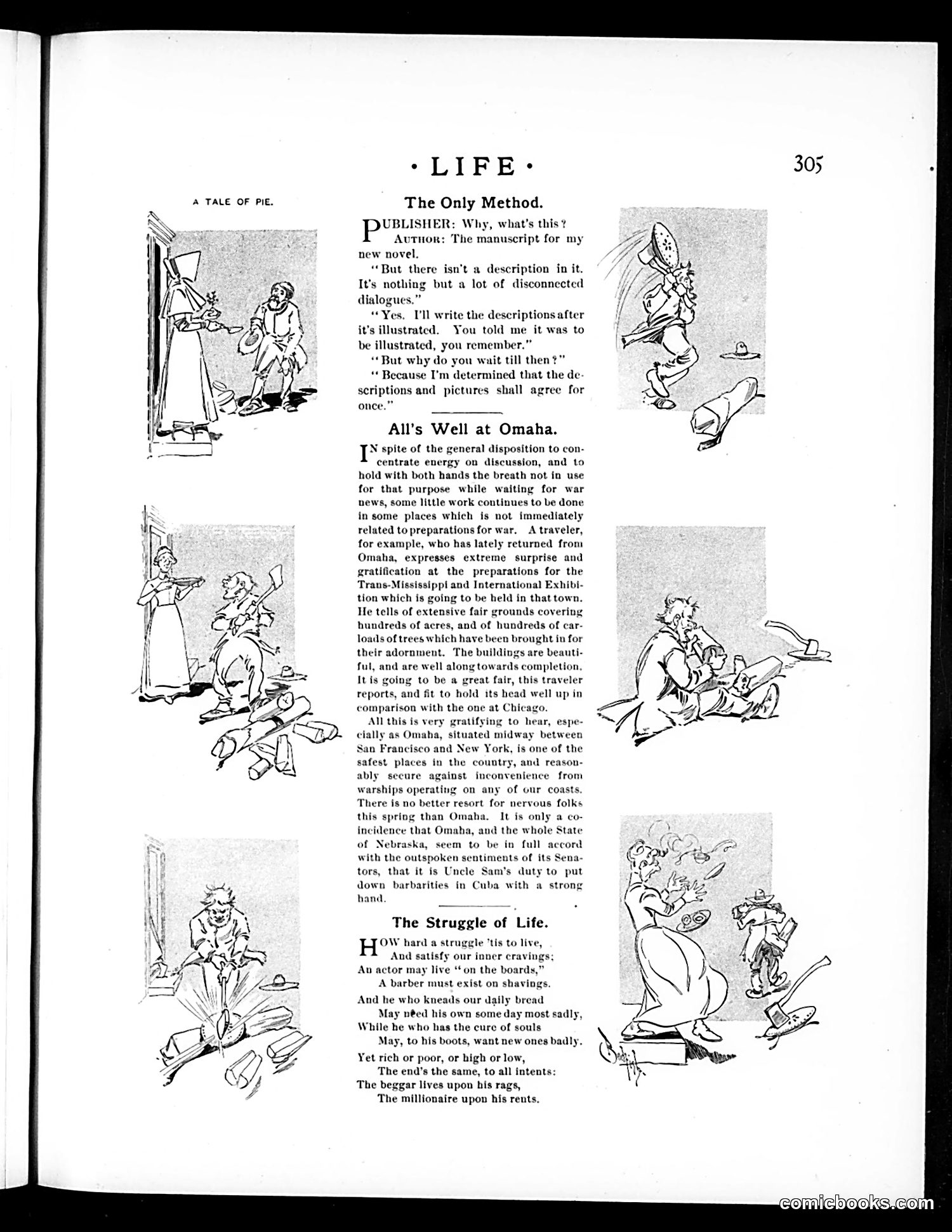
**"The Only Method"** mocks contemporary literary practice: a publisher confronts an author whose novel contains only dialogue with no descriptions. The author's solution—waiting to write descriptions *after* illustrations are completed so they'll "agree for once"—satirizes the absurdity of working backwards, suggesting writers compromise their craft for illustrated editions. **"All's Well at Omaha"** celebrates the Trans-Mississippi Exposition while indirectly commenting on the Spanish-American War (referenced as ongoing). The piece praises Omaha's safety and progress despite national war preoccupation, with a closing jab at American interventionism in Cuba—likely critiquing the Senate's pro-war stance. **"The Struggle of Life"** is a verse musing on economic irony: all social classes struggle regardless of wealth. Whether an actor lives "on the boards," a baker needs bread, or a millionaire depends on rents, everyone faces existential precarity. The poem uses occupational wordplay (barber/shavings, baker/bread) to argue that survival's burden is universal.
📄 Transcribed text from this page (OCR, searchable)
Machine-transcribed from the original scan — historical spelling and the odd misread are preserved.
A TALE OF PIE. * LIFE: The Only Method. UBLISHER: Why, what's this? Autnor: The manuscript for my new novel. “But there isn’t a description in it. It's nothing but a lot of disconnected dialogues. “Yes, I'll write the descriptions after it’s illustrated. You told me it was to be illustrated, you remember.” “But why do you wait till then?” ‘* Because I'm determined that the de- scriptions and pictures shall agree for once.” All’s Well at Omaha. N spite of the general disposition to con- centrate energy on discussion, and to hold with both hands the breath not in use for that purpose while waiting for war news, some little work continues to be done in some places which is not immediately related to preparations for war. A traveler, for example, who has lately returned from Omaha, expresses extreme surprise and gratification at the preparations for the Trans-Mississippi and International Exhibi- tion which is going to be held in that town. He tells of extensive fair grounds covering hundreds of acres, and of hundreds of car- loads of trees which have been brought in for their adornment. The buildings are beauti- ful, and are well along towards completion, It is going to be a great fair, this traveler reports, and fit to hold its head well up in comparison with the one at Chicago. All this is very gratifying to hear, espe- cially as Omaba, situated midway between San Francisco and New York, is one of the safest places in the country, and reasou- ably secure against inconvenience from warships operating on any of our coasts. There is no better resort for nervous folks this spring than Omaha. It is only a co- incidence that Omaha, and the whole State of Nebraska, seem to be in full accord with the outspoken sentiments of its Sena- tors, that it is Uncle Sam's duty to put down barbarities in Cuba with a strong hand The Struggle of Life. OW hard a struggle ‘tis to live, And satisfy our inner cravings; An actor may live “on the boards,” A barber must exist on shavings. And he who kneads our daily bread May néed his own some day most sadly, While he who has the cure of souls May, to his boots, want new ones badly. Yet rich or poor, or high or low, ‘The end’s the same, to alll intents: The beggar lives upon his rags, The millionaire upon his rents.