
Life, 1898-04-07 · page 7 of 20
Life — April 7, 1898 — page 7: what you’re looking at
What you’re looking at
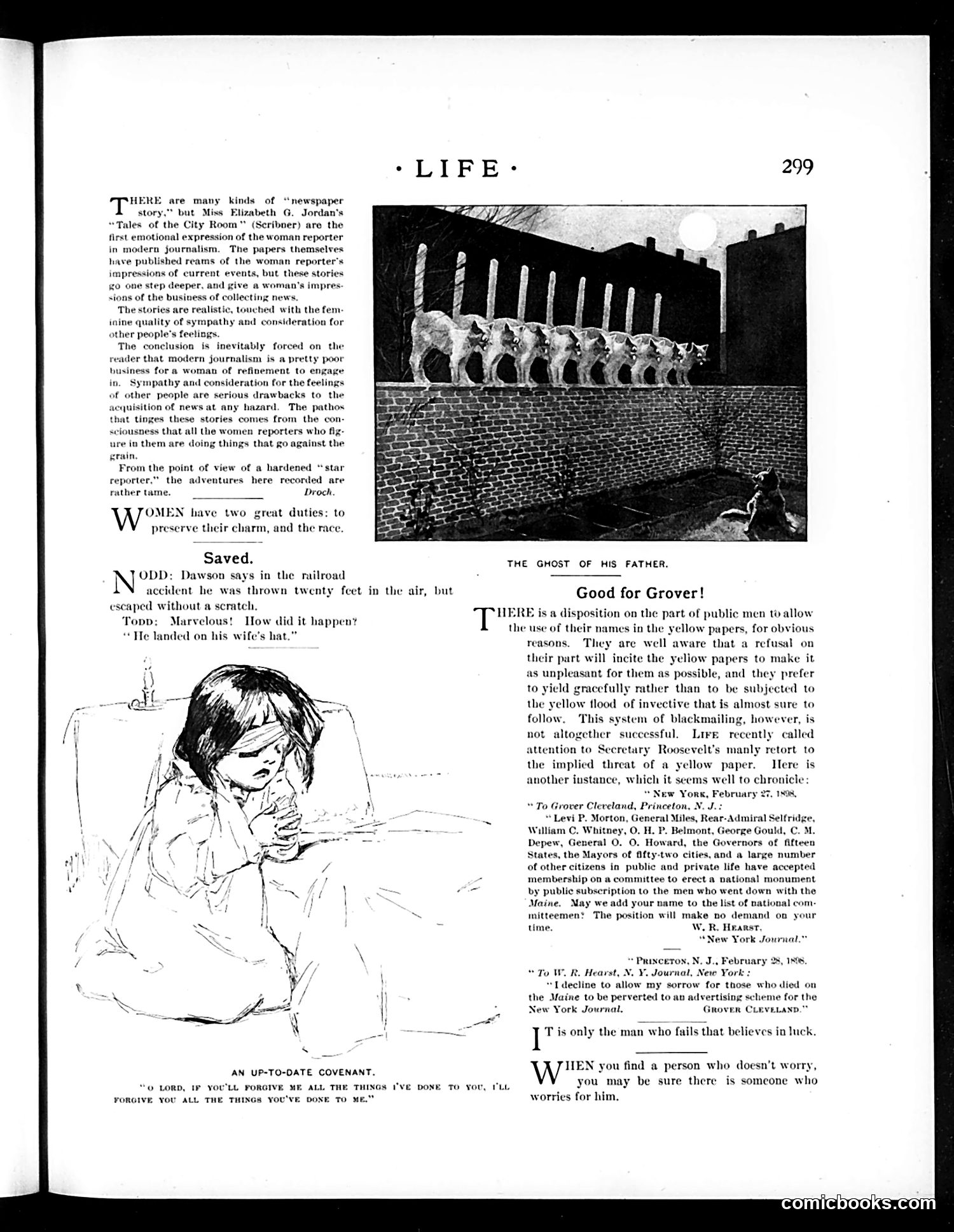
This page contains two sections: **Upper section:** A photograph titled "THE GHOST OF HIS FATHER" showing what appears to be classical statuary or architectural ruins, likely illustrating a story about inheritance or familial legacy. **Lower section:** A sketch titled "AN UP-TO-DATE COVENANT" depicts a woman in prayer, with a caption showing her offering God a modern bargain: forgiving divine transgressions in exchange for God forgiving her own wrongdoings. The cartoon satirizes modern, transactional attitudes toward religion—replacing traditional spiritual devotion with a business-like negotiation. It mocks how contemporary society, even in prayer, adopts mercenary language and conditional agreements rather than unconditional faith. The page also includes editorial commentary about journalism and yellow papers, reflecting early 1900s media debates.
📄 Transcribed text from this page (OCR, searchable)
Machine-transcribed from the original scan — historical spelling and the odd misread are preserved.
HERE are many kinds of “newspaper story,” but Miss Elizabeth G. Jordan's “Tales of the City Room” (Scribner) are the first emotional expression of the woman reporter in modern journalism. The papers themselves have published reams of the woman reporter's impressions of current events, but these stories go one step deeper, and give a woman's impres sions of the business of collecting news, The stories are realistic, touched with the fem- inine quality of sympathy and consideration for other people's feelings. The conclusion is inevitably forced on the reader that modern journalism is a pretty poor business for a woman of refinement to engage in. Sympathy and consideration for the feelings of other people are serious drawbacks to the acquisition of news at any hazard. The pathos that tinges these stories comes from the con- sciousness that all the women reporters who fig- ure in them are doing things that go against the grain, From the point of view of a hardened “star reporter,” the adventures here recorded are rather tame. Droch. Woes have two great duties: to preserve their charm, and the race. Saved. ODD: Dawson says in the railroad it accident he was thrown twenty feet in the air, but Good for Grover! escaped without a scratch, Topp; Marvelous! How did it happen? “He landed on his wife's hat.” THE GHOST OF HIS FATHER. HERE is a disposition on the part of public men to allow the use of their names in the yellow papers, for obvious reasons. They are well aware that a refusal on their part will incite the yeliow papers to make it as unpleasant for them as possible, and they prefer to yield gracefully rather than to be subjected to the yellow flood of invective that is almost sure to follow. This system of blackmailing, however, is not altogether successful. Lire recently called attention to Secretary Roosevelt's manly retort to the implied threat of a yellow paper. Mere is another instance, which it seems well to chronicle: “New York, February 27, 1808, o Grover Cleveland, Princeton, N. J.: Levi P. Morton, General Miles, Rear-Admiral Selfridge, William C, Whitney, 0. H. P. Belmont, George Gould, C. M. Depew, General O. 0. Howard, the Governors of fifteen States, the Mayors of fifty-two cities, and a large number of other citizens in public and private life have accepted membership on a committee to erect a national monument by public subscription to the men who went down with the Maine. May we add your name to the list of national com: mitteemen The position will make no demand on your time. W. R. Hearst, “New York Journal.” “ Princeton, N. J., February 2, 180, “To W. R. Hearst, N.Y. Journal, New York : “Ldecline to allow my sorrow for those who died on the Maine to be perverted to an advertising scheme for the New York Journal. Gnoven CLrnveLann.” ] T is only the man who fails that believes in luck. AN UP-TO-DATE: COVENANT. IIEN you find a person who doesn’t worry, FORGIVE YOU ALL THE THINGS YOU'VE DONE TO ME.” worries for him,