
A complete issue · 32 pages · 1898
Life — April 2, 1898
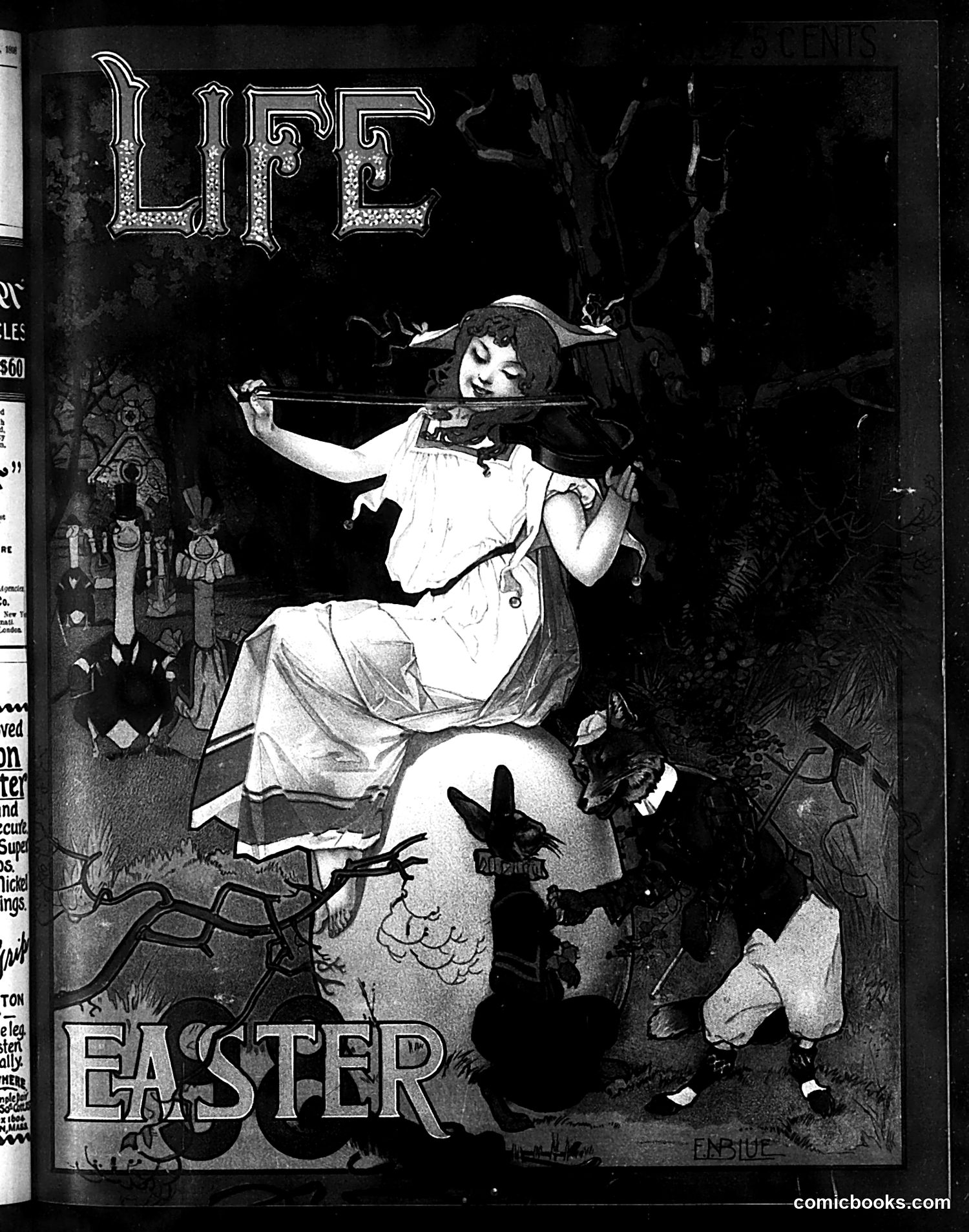
This is a **Life magazine Easter cover** featuring a whimsical, decorative illustration rather than political satire. The image depicts a young woman in classical dress sitting playfully among Easter symbols—eggs, chicks, rabbits, and branches—holding a flute or pipe. The design is **art nouveau in style**, typical of early 20th-century American magazine aesthetics. The ornate lettering spelling "LIFE" and "EASTER" frames an idealized, allegorical scene celebrating the spring holiday. Rather than satirizing specific political figures or events, this cover uses **personification and pastoral imagery** common to seasonal holiday issues. The woman represents springtime fertility and renewal—traditional Easter themes—rendered through decorative illustration rather than pointed commentary.
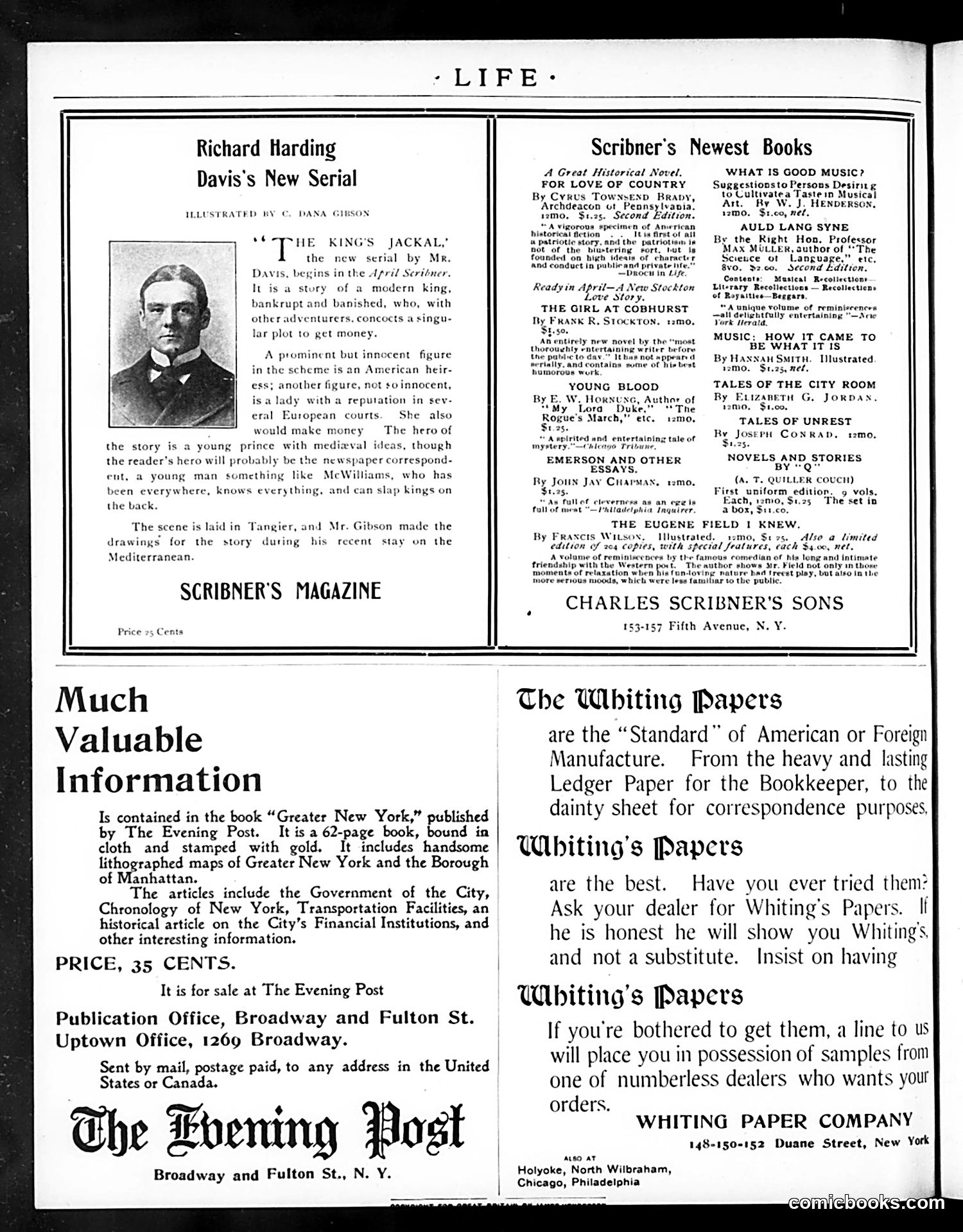
This page is primarily **advertising and literary content**, not political satire. The top section features an advertisement for Scribner's Magazine, highlighting Richard Harding Davis's new serial "The King's Jackal," illustrated by C. Dana Gibson. The text describes it as a story about a modern king involved in banking and adventure, featuring an American heir and a protagonist resembling McWilliams. The right column advertises Scribner's newest books, while the lower sections promote "Greater New York" (a factual book about city government) and Whiting's Papers (writing materials). **No political cartoons or satirical commentary appear on this page.** It represents typical early 20th-century magazine advertising mixed with literary promotion.
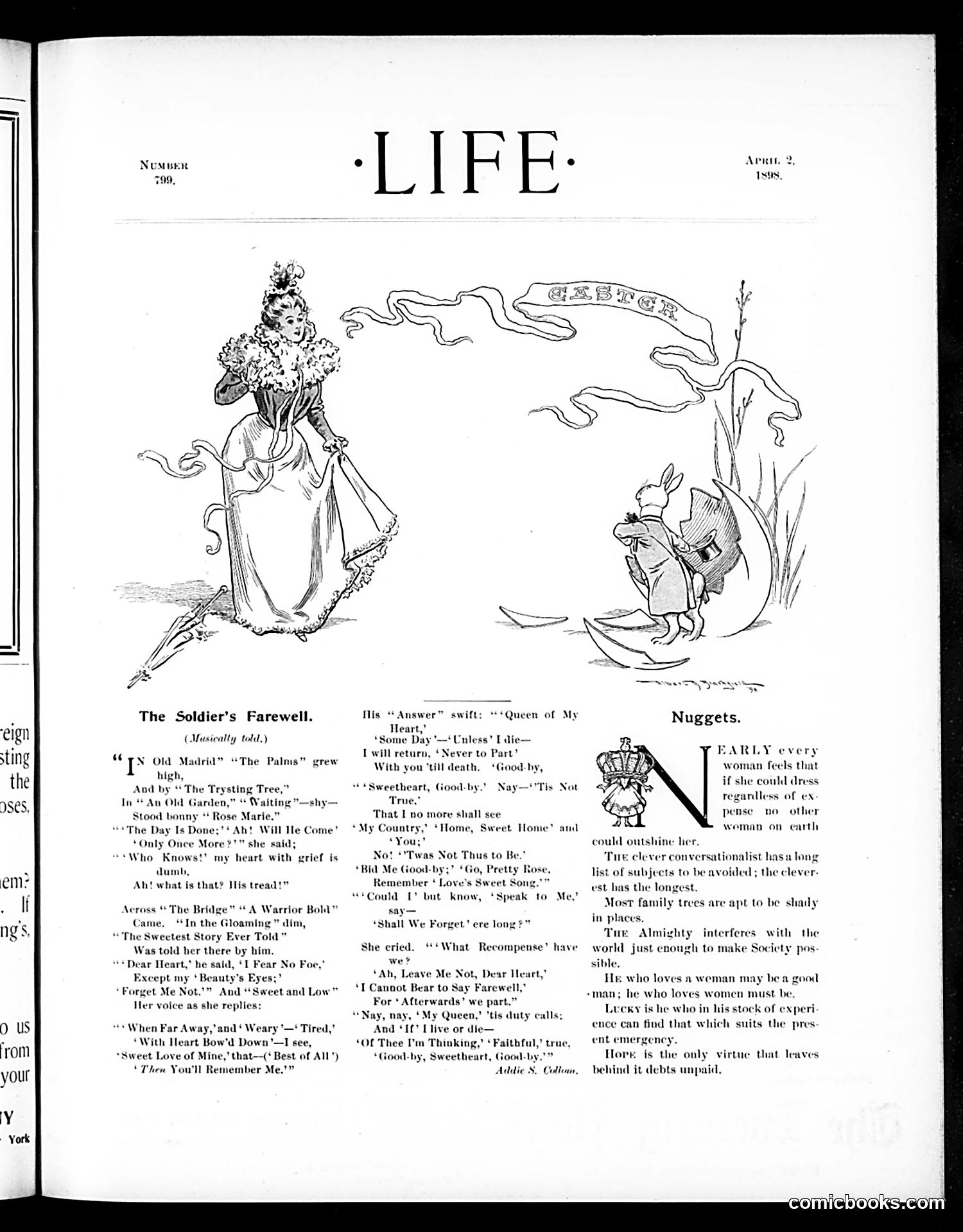
This page contains two distinct pieces: **"The Soldier's Farewell"** depicts a woman in elaborate dress (likely representing Spain or a Spanish noblewoman) bidding goodbye to a small soldier figure. The accompanying verse references Spanish locations ("Old Madrid," "The Palms") and romantic farewells, suggesting this satirizes Spain's position during the Spanish-American War (which began in April 1898). The woman's grand appearance contrasts with the tiny soldier, possibly mocking Spain's military weakness. **"Nuggets"** is an advice column by Addie S. Odson offering social commentary. The featured nugget warns that clever conversationalists should avoid discussing certain topics, and advises that hope and virtue in women matter more than luck in managing emergencies. Both pieces reflect late-1890s concerns about war, gender, and social propriety.
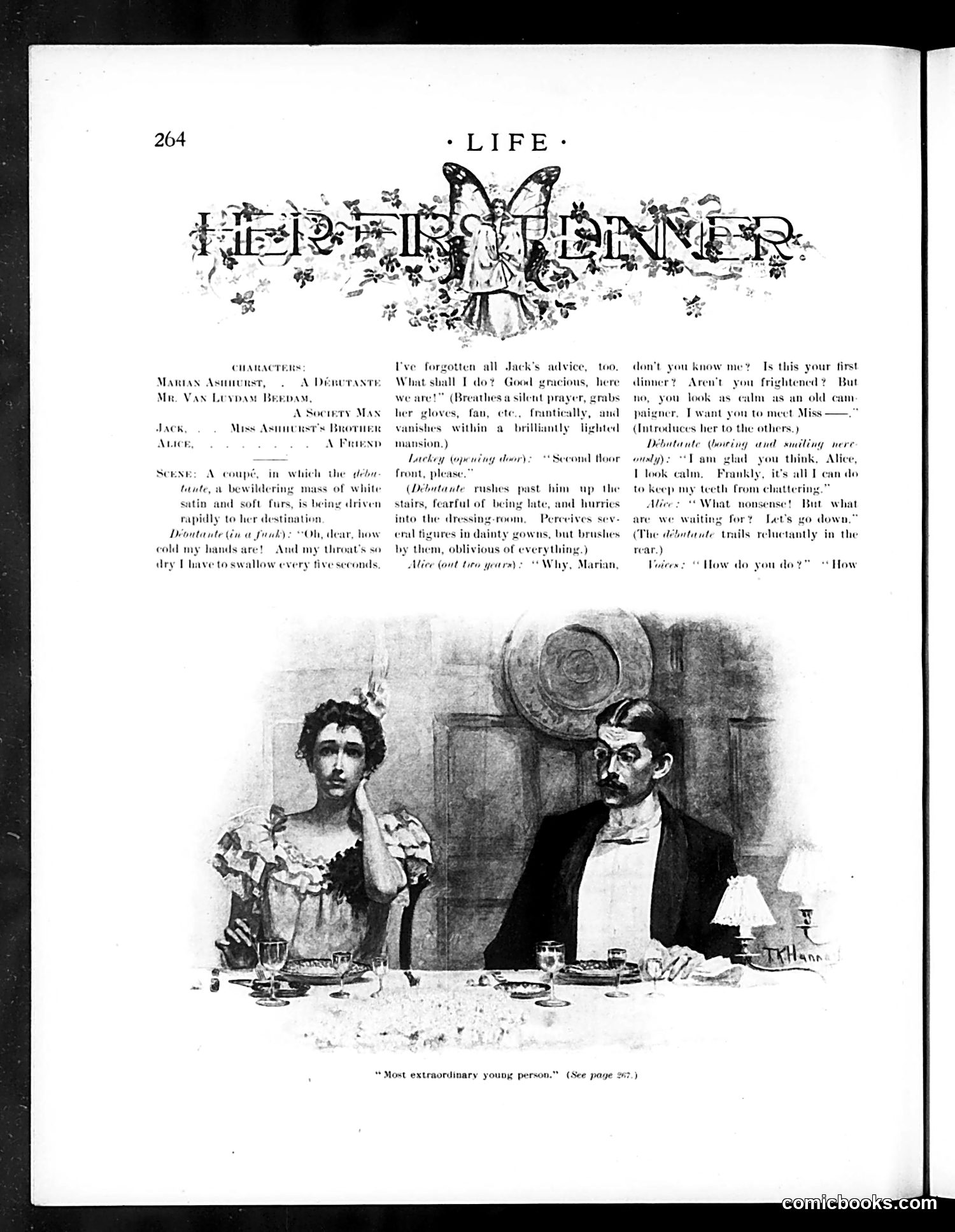
This page presents a theatrical sketch titled "The Debutante" featuring characters including Marian Ashurst, Jack, Alice, and Mr. Van Leydam Beedam. The illustration shows a formal dinner scene with a woman and man at a table, depicting what appears to be social comedy around a young woman's debut into society. The dialogue suggests satire of debutante culture—the elaborate coming-of-age ritual for upper-class young women. References to "Second floor" and "dressing room" indicate backstage theatrical action, while Alice's comment about "nonsense" and wanting to "go down" suggests the sketch mocks the pretension and artificiality of these social conventions. The humor appears to target the formality and expectations surrounding a woman's introduction to high society.
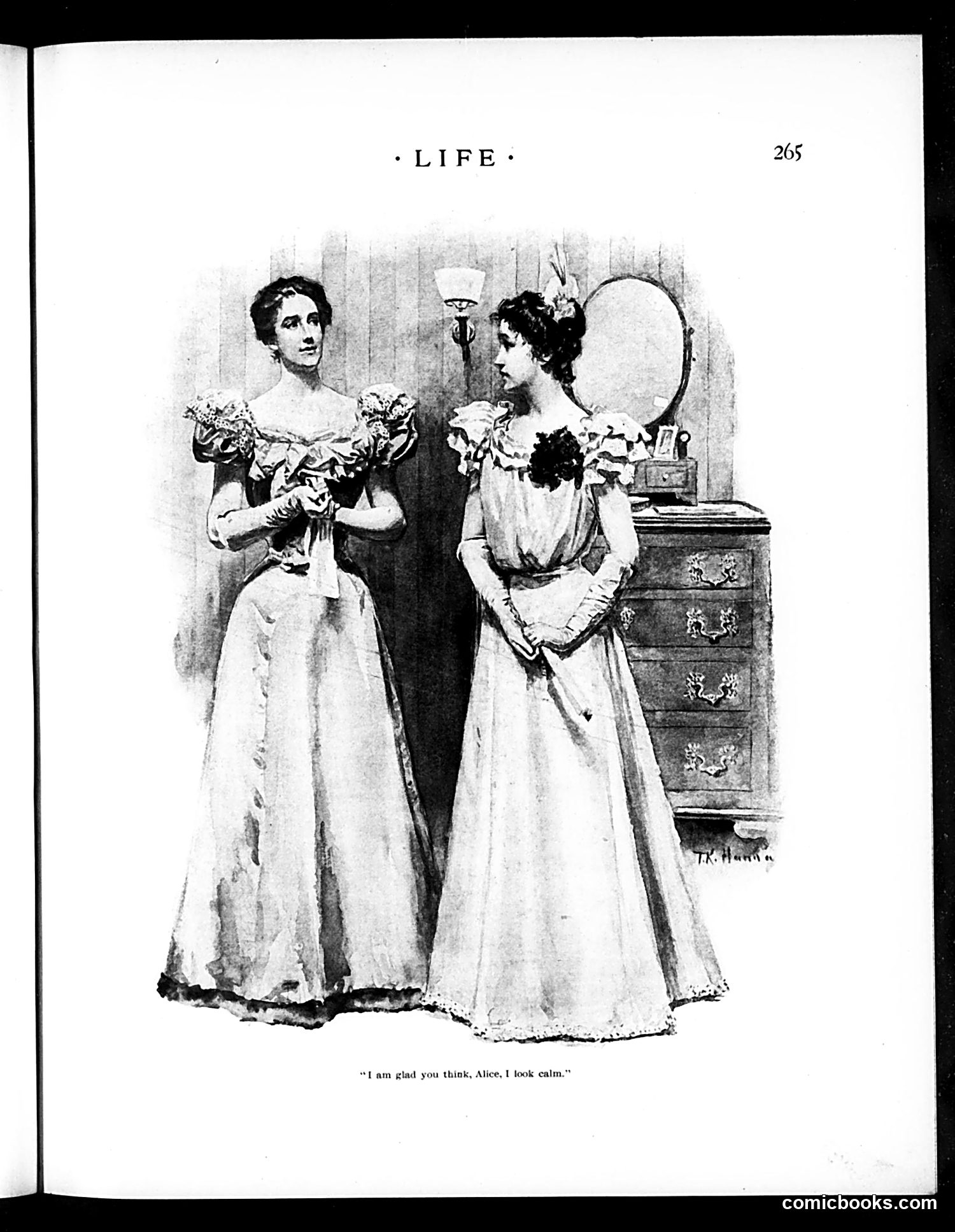
This illustration depicts two women in elegant Edwardian-era evening gowns in what appears to be a bedroom or dressing room. The figure on the left holds flowers and looks upward, while the woman on the right, seated near a mirror and dresser, speaks the caption: "I am glad you think, Alice, I look calm." The humor appears to center on **contrasting appearances versus inner emotional states**—a common satirical theme in Life magazine's social commentary. The woman claims to "look calm" despite presumably experiencing anxiety or distress (suggested by her posture and expression). The other woman's flowers and admiring gaze imply she's complimenting Alice's composed appearance, unaware of her actual emotional turmoil. This reflects early 20th-century social satire about feminine performance and the pressure on women to maintain composure in public situations.
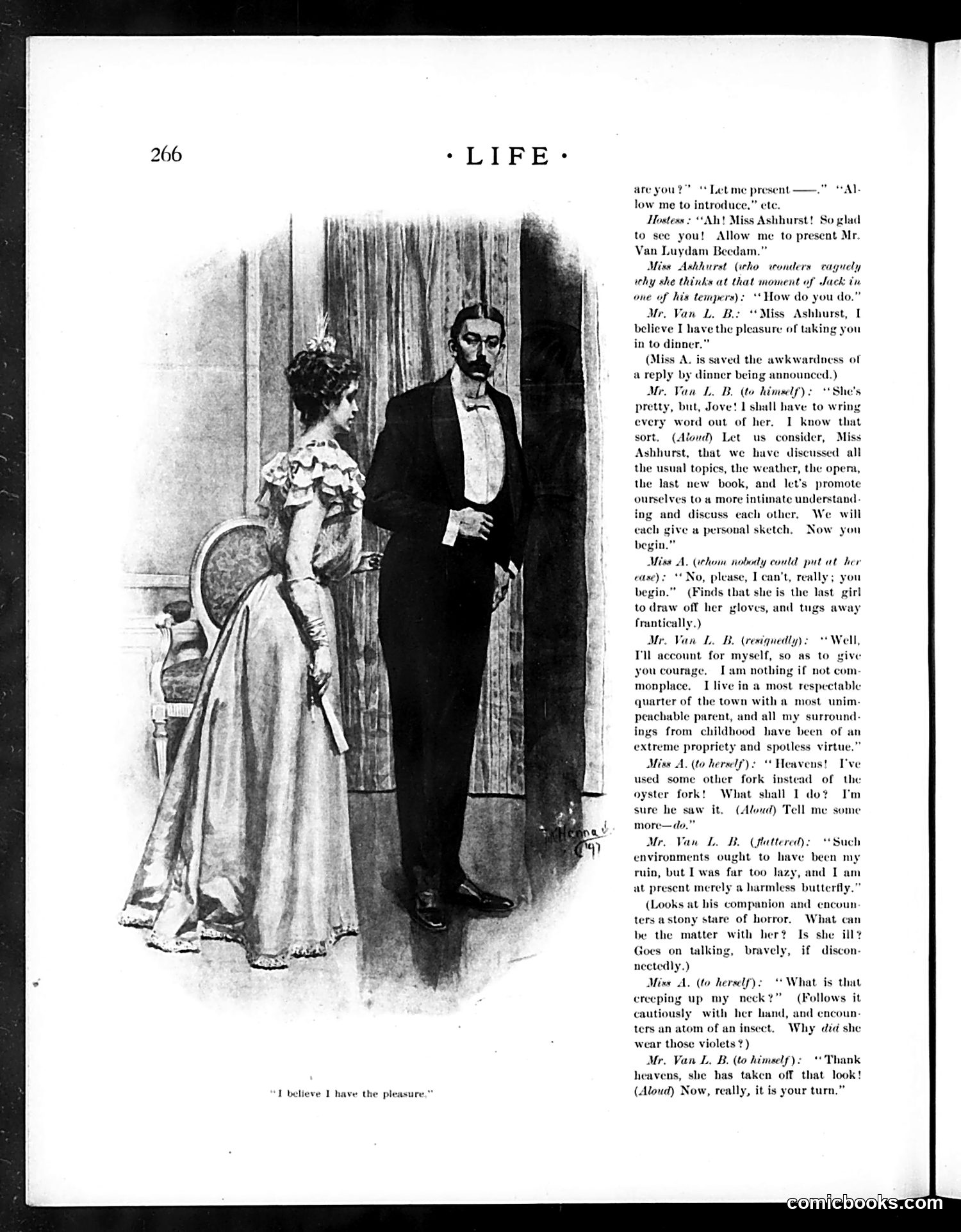
This page from *Life* magazine (page 266) depicts a social comedy scene rather than political satire. The illustration shows a formal introduction between a woman (Miss Ashurst) and a man (Mr. Van Luydam Beedlam) at what appears to be a dinner party. The humor derives from social awkwardness: Mr. Van Luydam attempts flattery while being patronizing, Miss Ashurst responds with mock politeness while committing embarrassing social gaffes (using an oyster fork incorrectly, wearing violets). The dialogue satirizes upper-class pretension and the performative nature of formal social interactions—how people present artificial versions of themselves in polite society. This is genteel domestic satire targeting Victorian-era social conventions rather than political commentary.
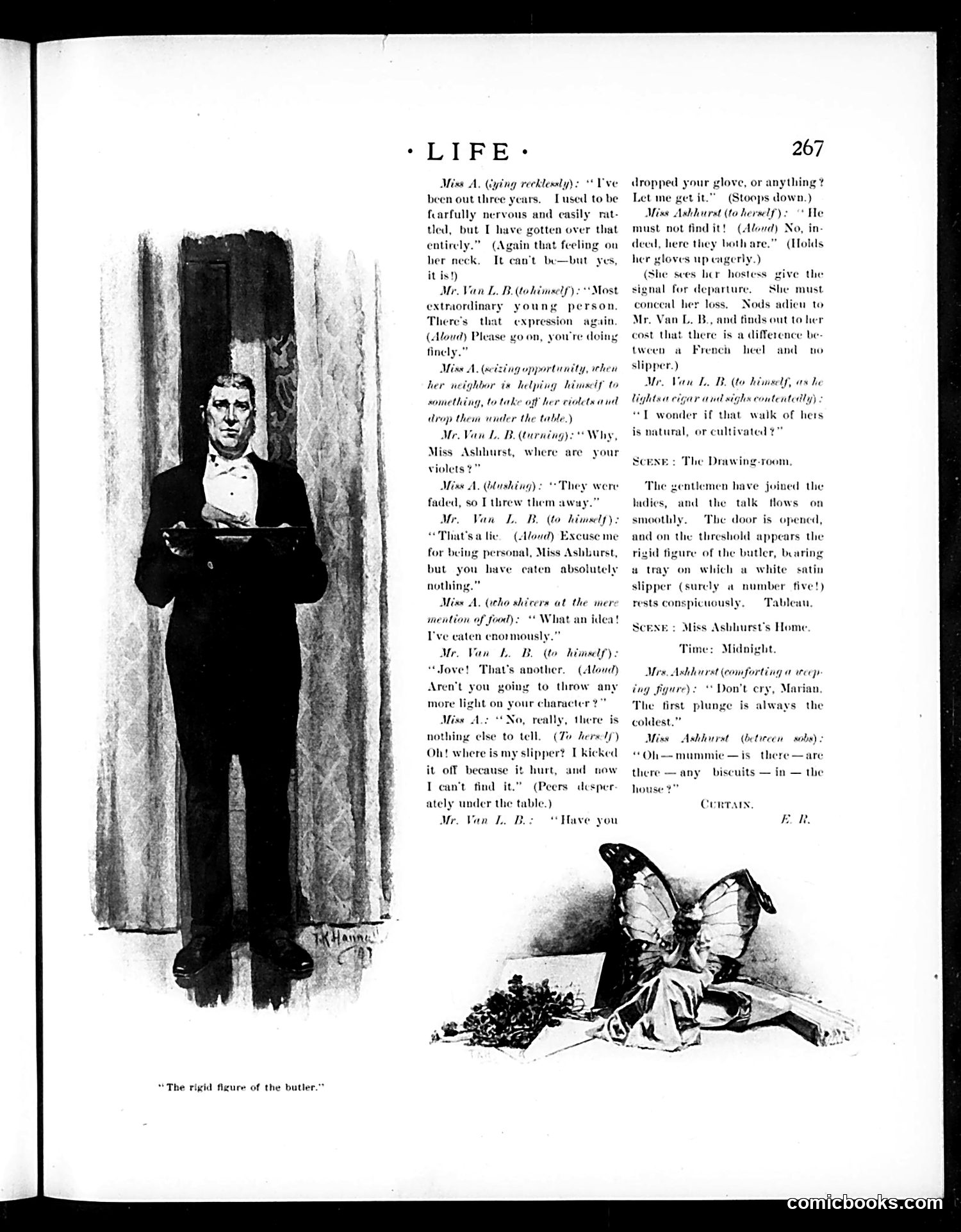
This page contains a satirical theatrical piece featuring two scenes. The main illustration shows a formally dressed butler—"the rigid figure of the butler," as captioned—standing stiffly in a doorway, representing the stereotype of rigid, proper household service. The dialogue satirizes social pretension and domestic absurdity. Characters discuss missing slippers, eaten food, and dropped gloves with exaggerated formality. Mr. Van L.B. and Miss Ashurst embody upper-class affectation, while the butler's unwavering propriety becomes the target of humor—poking fun at both servant rigidity and aristocratic manners. The decorative illustration below (featuring a butterfly) appears purely ornamental. Overall, this mocks Edwardian-era class consciousness and household hierarchies through comedic domestic situations.
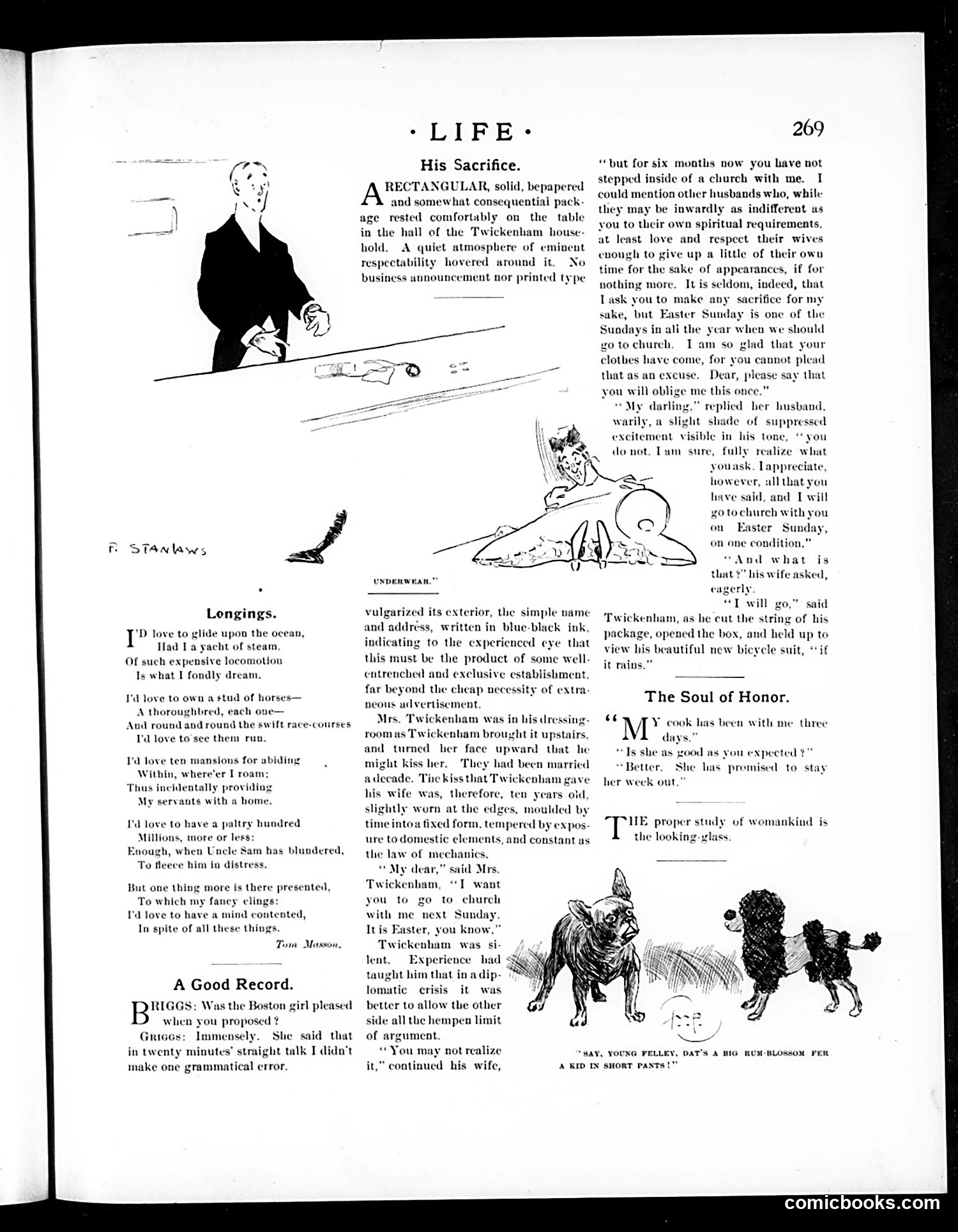
This page contains three distinct satirical pieces: 1. **"His Sacrifice"** (top): Shows a man at a table; the text describes Mr. Twickenham reluctantly agreeing to attend church on Easter Sunday with his wife—presented as a major marital compromise. The satire mocks how men viewed obligatory religious attendance as an onerous burden requiring their wives' persuasion. 2. **"Lengings"** (left): A poem by Tom Masson expressing romantic fantasies about leisure (yachts, mansions, servants)—satirizing escapist daydreams while acknowledging real-world limitations. 3. **"The Soul of Honor"** and **"A Good Record"** (bottom): Brief humorous anecdotes about social expectations and grammatical pedantry, typical of the magazine's short-form comedy. The illustrations feature F. Stanlaws's characteristic line drawings. The overall tone reflects early 20th-century American middle-class anxieties and gender dynamics.
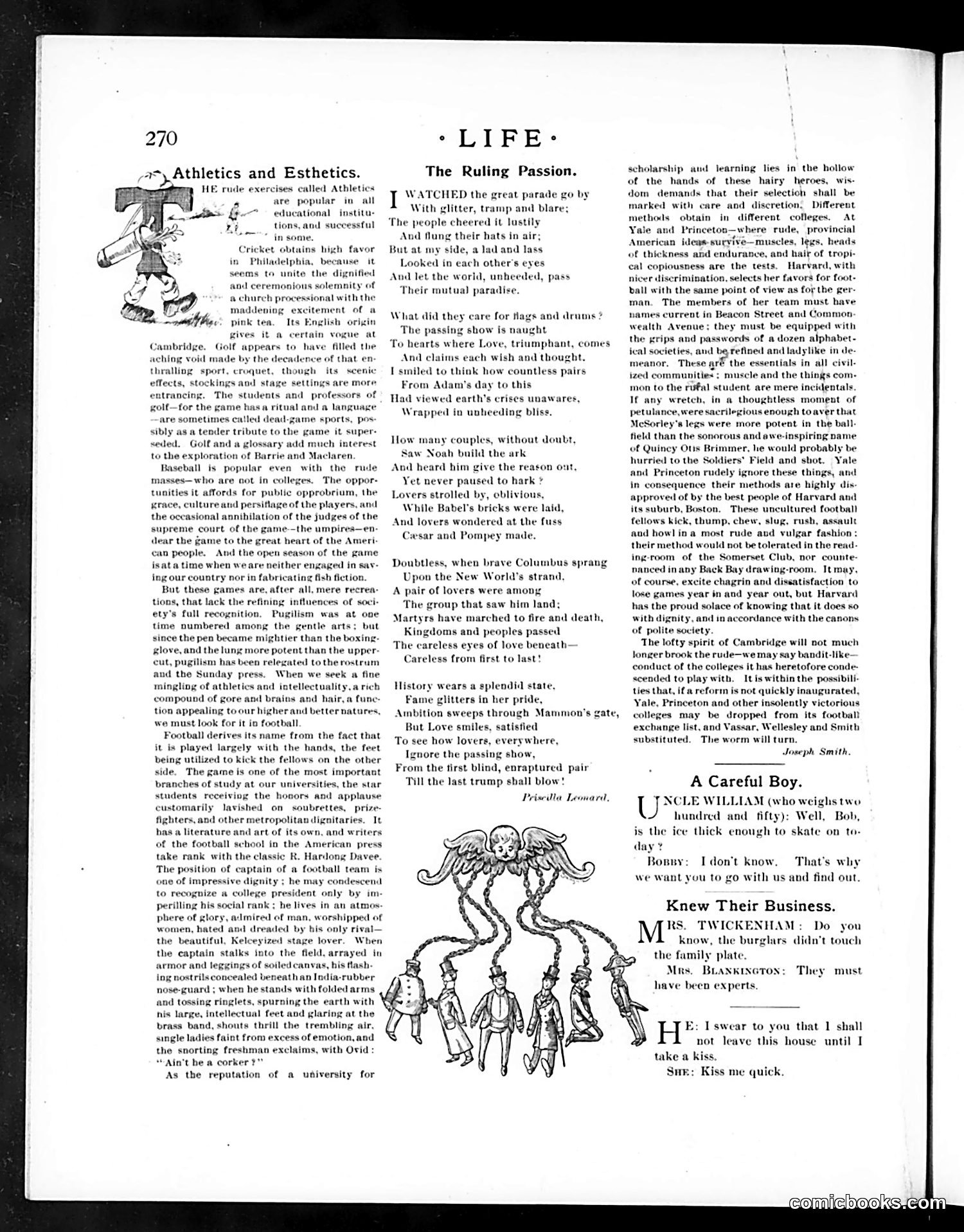
This page contains three distinct pieces: an essay on "Athletics and Esthetics" discussing football's cultural status; a poem titled "The Ruling Passion" about historical figures (Columbus, Noah, Caesar, Pompey, lovers); and two brief humorous dialogues. The central cartoon depicts a demonic or mischievous winged figure suspended above several hanging human figures—likely representing souls or people under the figure's control. This appears to be an allegorical illustration accompanying "The Ruling Passion," visualizing the poem's theme about how desires and passions control human behavior across history. The page's satire critiques both academic pretensions about football's value and the universal human susceptibility to ruling passions—suggesting that regardless of status or era, people remain enslaved to their desires.
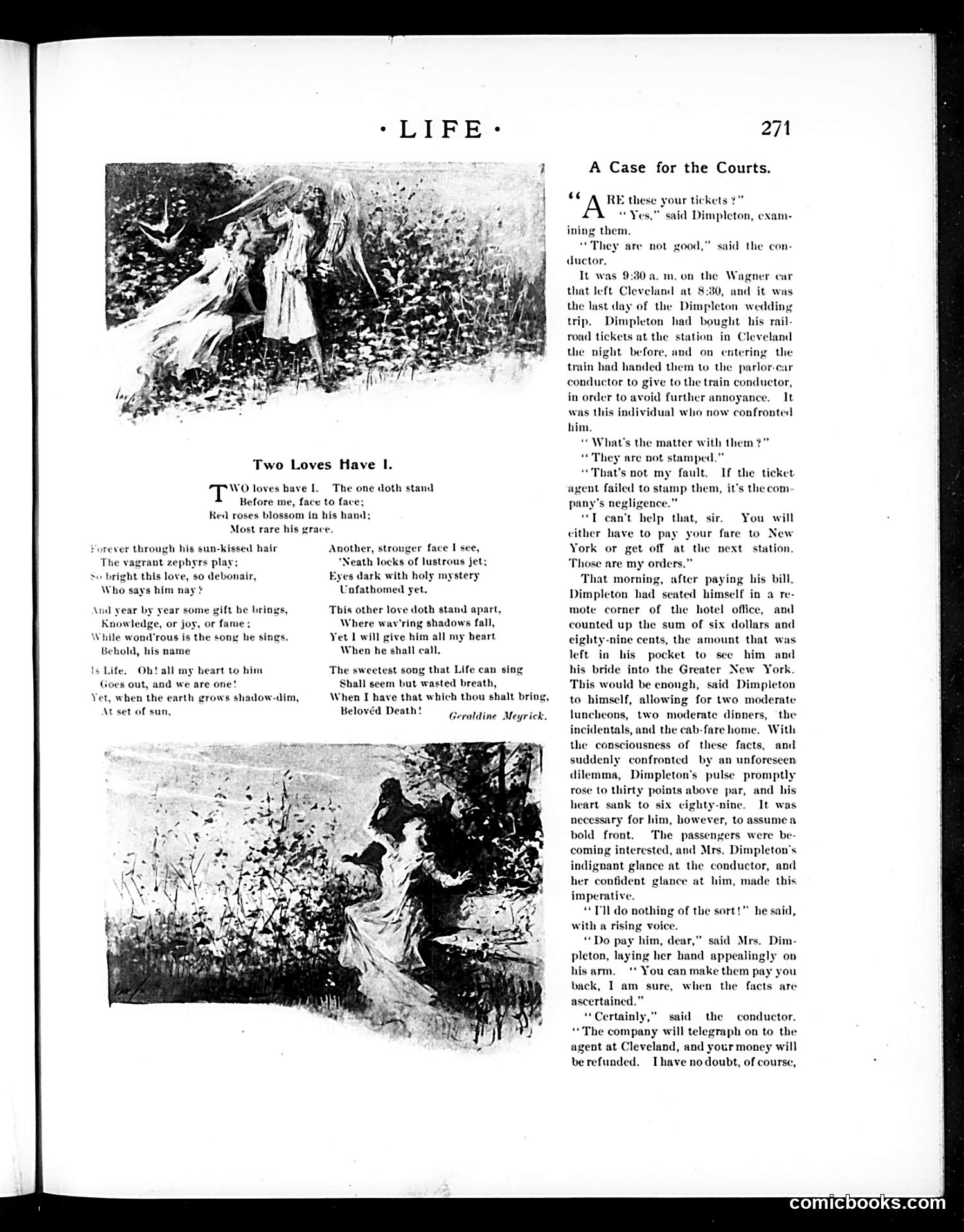
This page contains a short story about a railroad dispute. Mr. and Mrs. Dimpleton purchased tickets for a train departing Cleveland, but the tickets weren't stamped by the agent. When a conductor boards to collect fares, he refuses to accept the unstamped tickets and demands payment or demands they exit at the next station. The satire targets railroad company practices and consumer vulnerability. The conductor invokes "company orders" as justification, placing blame on corporate bureaucracy rather than individual negligence. Mrs. Dimpleton's confident assertion that "You can make them pay you back" when facts are ascertained suggests satirizing both corporate inflexibility and ordinary travelers' naive faith in eventual justice through formal complaint procedures. The accompanying poem "Two Loves Have I" appears unrelated to the main narrative.
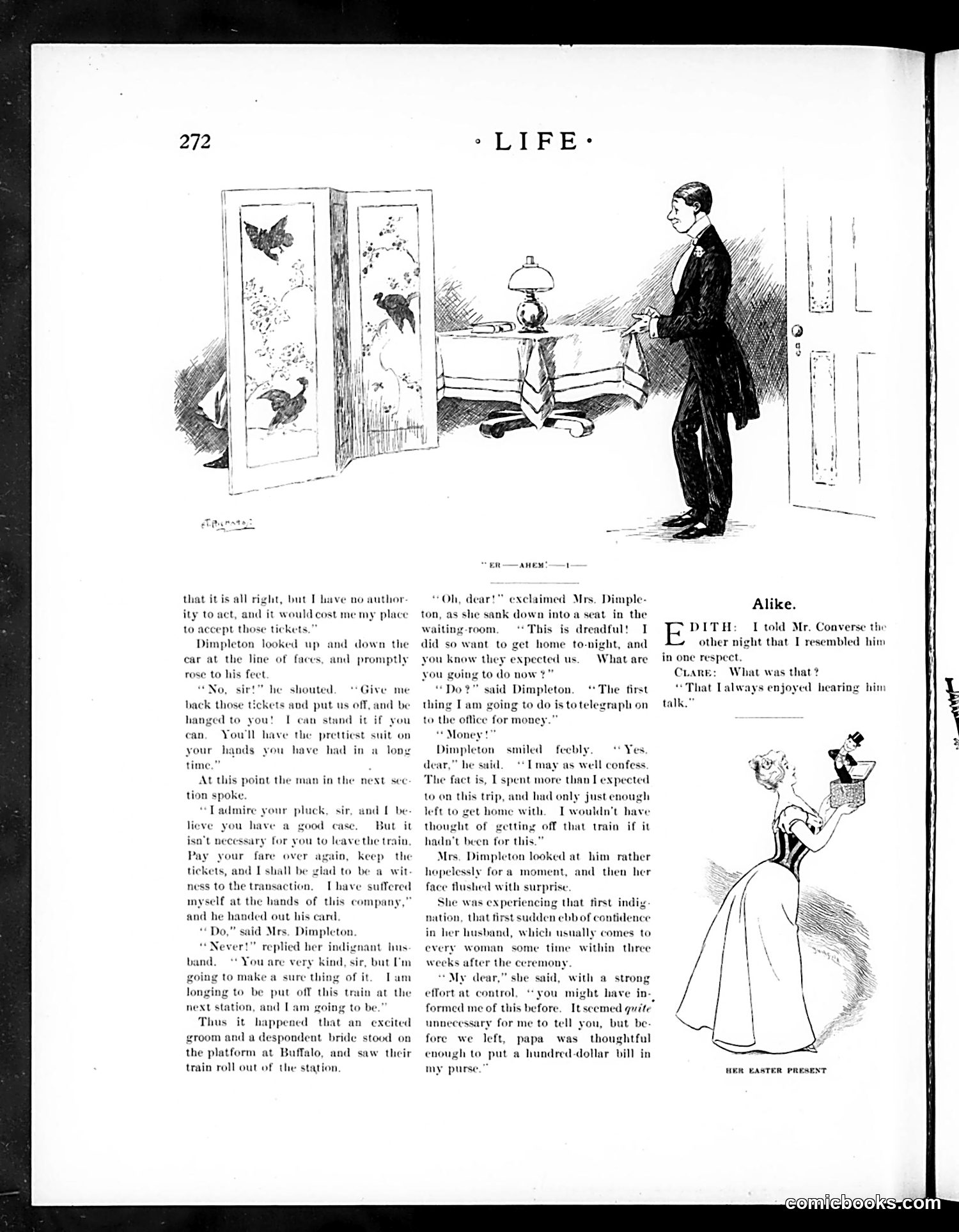
This page from *Life* magazine contains a story titled "Alike" featuring dialogue between characters named Edith, Clare, and others discussing a marital incident. The main illustration shows a man in formal attire standing in a room with decorative panels and a lamp, apparently confronting someone off-panel. The narrative centers on Mrs. Dimpleton's confession that she spent more money than expected on a trip and must ask her husband for additional funds. The humor derives from marital financial discord—a common satirical theme in early 20th-century magazines. A smaller illustration labeled "HER EASTER PRESENT" depicts a woman in a large Easter hat, likely mocking the expense of women's fashions. The satire targets domestic power dynamics and women's spending habits as perceived social issues of the era.
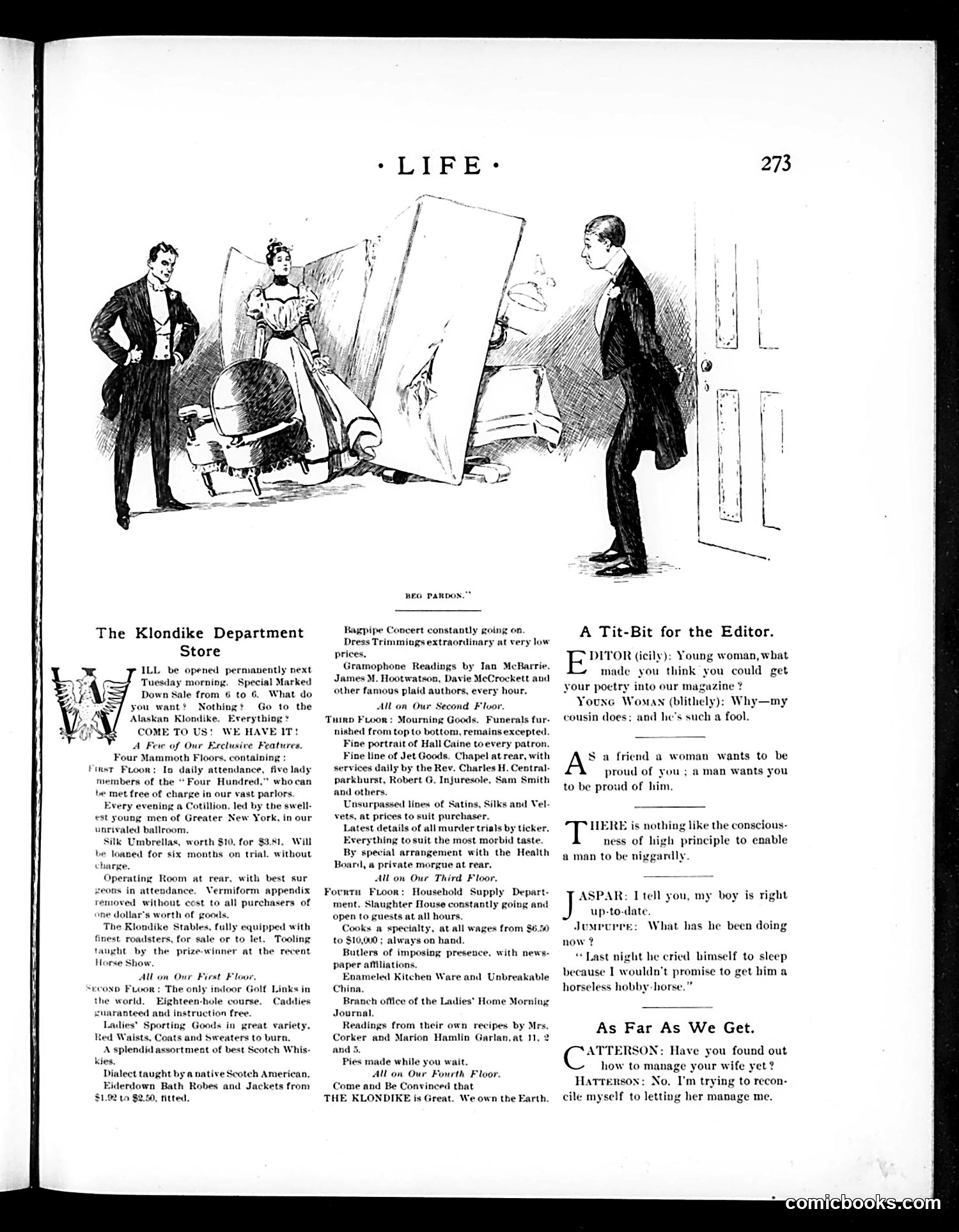
This page satirizes the Klondike Gold Rush craze (1890s Alaska gold discovery) by imagining an absurd luxury department store exploiting that fever. The elaborate advertisement mocks wealthy New York society's obsession with the Klondike by offering ridiculous "services": the Four Hundred (elite social class) as floor attendants, free appendix removal with purchases, indoor golf, and a working slaughterhouse. The cartoon at top ("Beg Pardon") shows bewildered gentlemen observing movers struggling with enormous mirrors or furniture, illustrating the chaotic materialism the ad lampoons. The smaller comic snippets below mock contemporary social pretensions: editors rejecting poetry, relationships, and a man surrendering control to his wife. Together, the page satirizes Gilded Age excess, conspicuous consumption, and absurd social hierarchies while the Klondike Rush gripped American imagination.
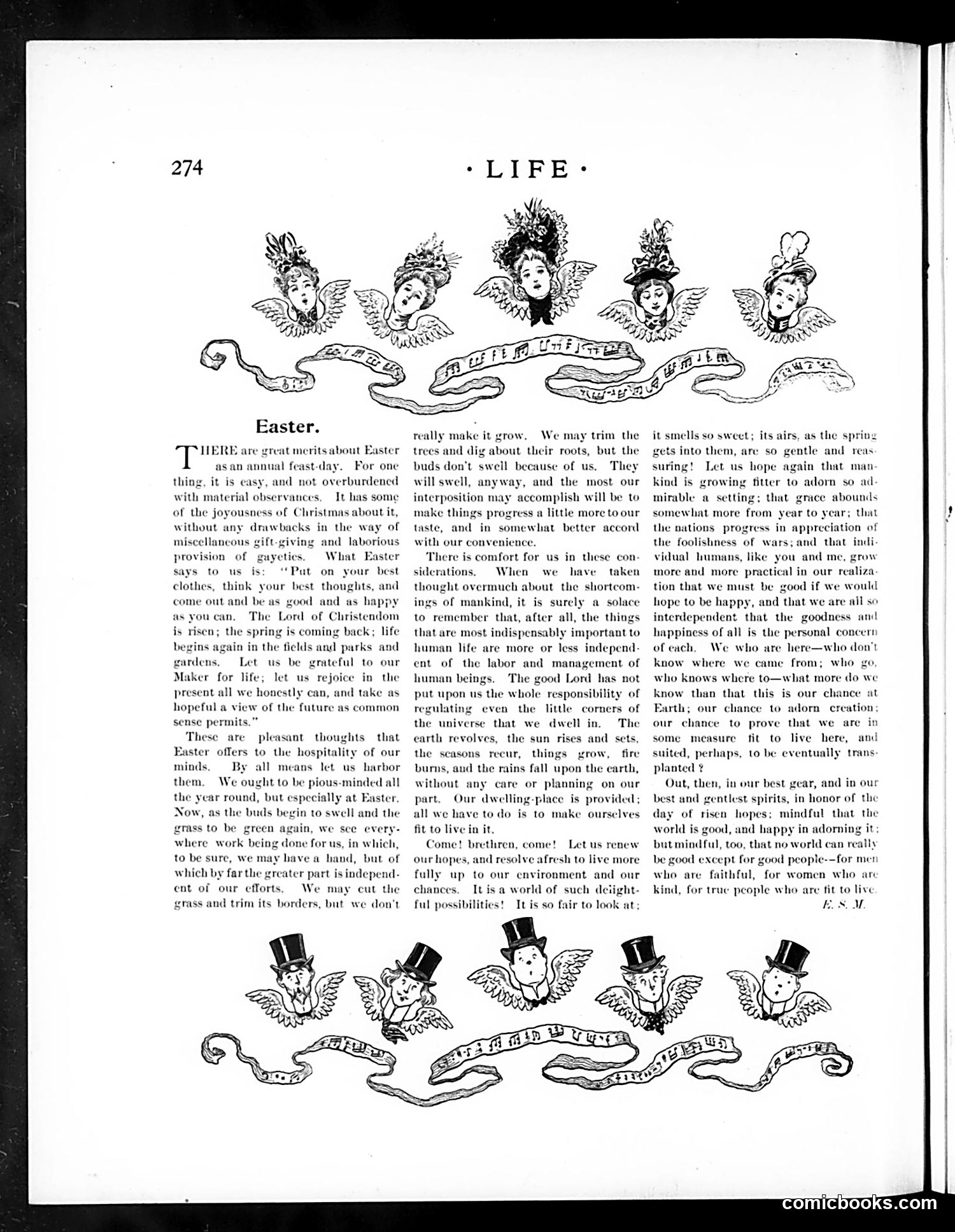
This is an Easter editorial essay with decorative angelic illustrations, not a political cartoon. The piece celebrates Easter as a holiday offering spiritual renewal without the commercial excess of Christmas. The essay's central message counsels readers to appreciate spring's natural growth while recognizing human limitations—we can tend gardens and trim trees, but cannot make grass grow or buds swell. This serves as metaphor for accepting what lies beyond our control while doing our modest part. The author (signed E.S.M.) advocates for optimism about human progress, particularly regarding reduced warfare and increased practical morality. The piece emphasizes interdependence: that personal goodness matters because all humans are connected, and that "no world can really be good except for good people." The tone is inspirational rather than satirical—encouraging readers to embody virtue, gratitude, and hope during the Easter season.
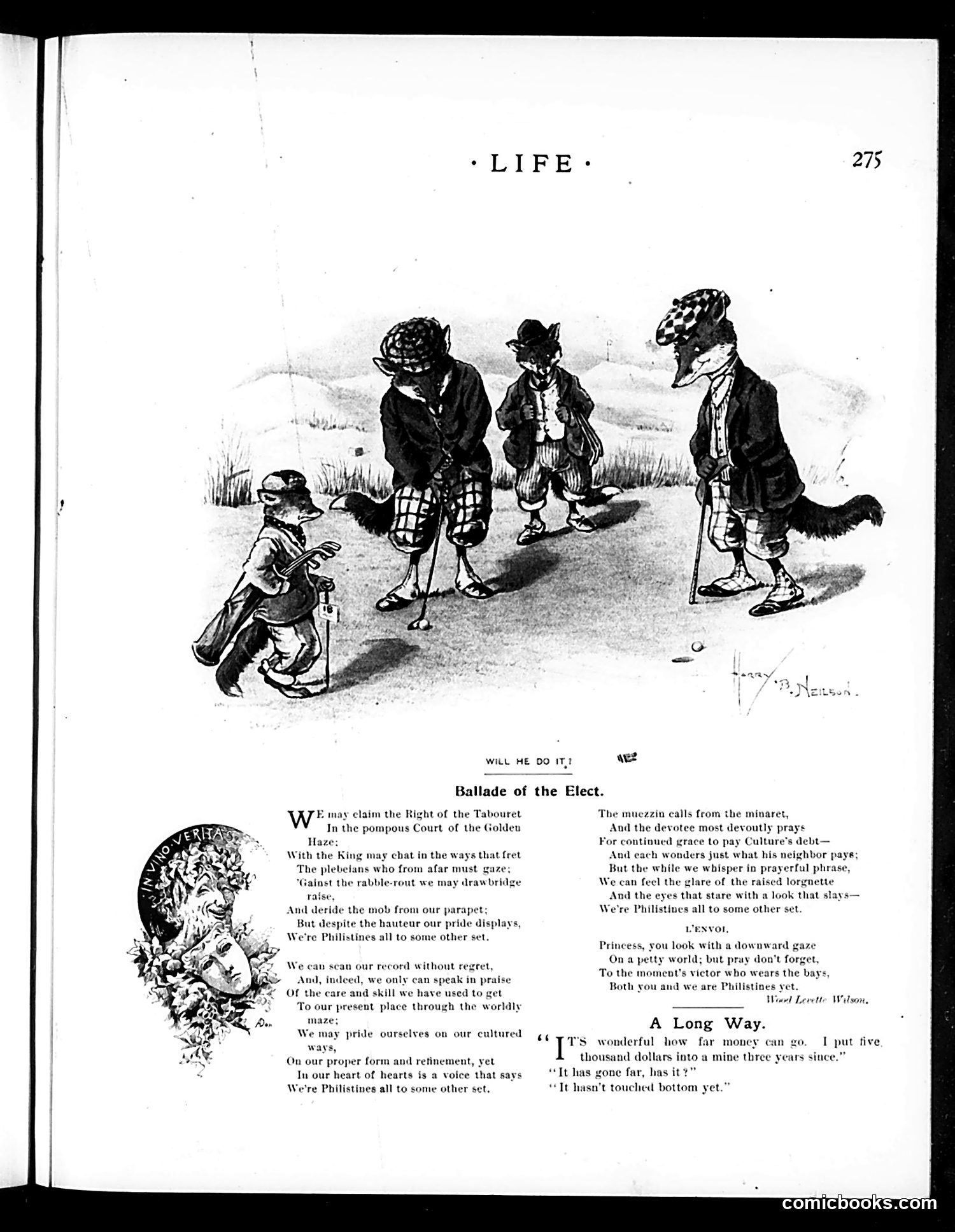
The cartoon depicts what appears to be a child or small figure approaching four well-dressed adults in a golf setting, titled "Will He Do It?" The humor suggests uncertainty about whether the youngster will succeed at some task—likely golfing. The accompanying poem, "Ballad of the Elect," is satirical social commentary on class pretension. It mocks the wealthy and privileged ("We're Philistines all to some other set")—arguing that despite their cultured refinements, education, and superiority complex over the common mob, they themselves are cultural philistines to an even higher social tier. The poem uses the medieval court imagery and religious references to emphasize the arbitrary, cyclical nature of social hierarchy. Everyone looks down on someone while being looked down upon by others. The "A Long Way" caption about money disappearing into mines appears unrelated, likely advertising or filler content typical of Life magazine's format.
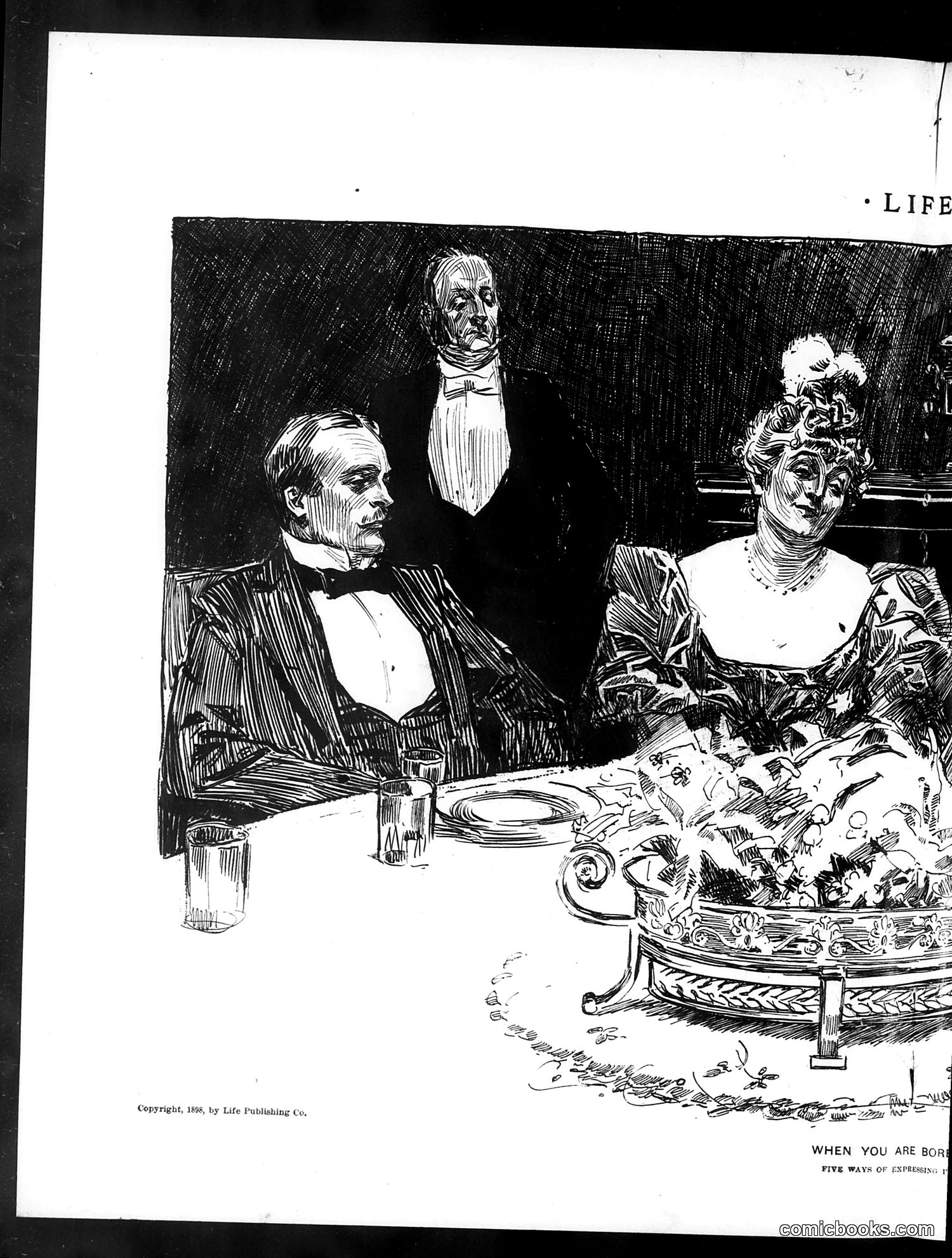
This 1898 *Life* magazine page depicts a formal dinner scene with three figures in evening dress. The visible caption suggests the piece satirizes different expressions or behaviors "when you are bor[n]" — likely "bored" — showing "five ways of expressing" this emotion. The illustration shows what appears to be upper-class diners at an elegant table with fine dishware and glassware. The figures' postures and facial expressions seem intended to convey different levels of social ennui or disinterest during formal dining. Without seeing the complete caption and remaining illustrated figures, I cannot definitively identify the specific individuals caricatured or pinpoint the exact social commentary. The piece appears to satirize Victorian-era aristocratic dining conventions and affected social behaviors among the wealthy.
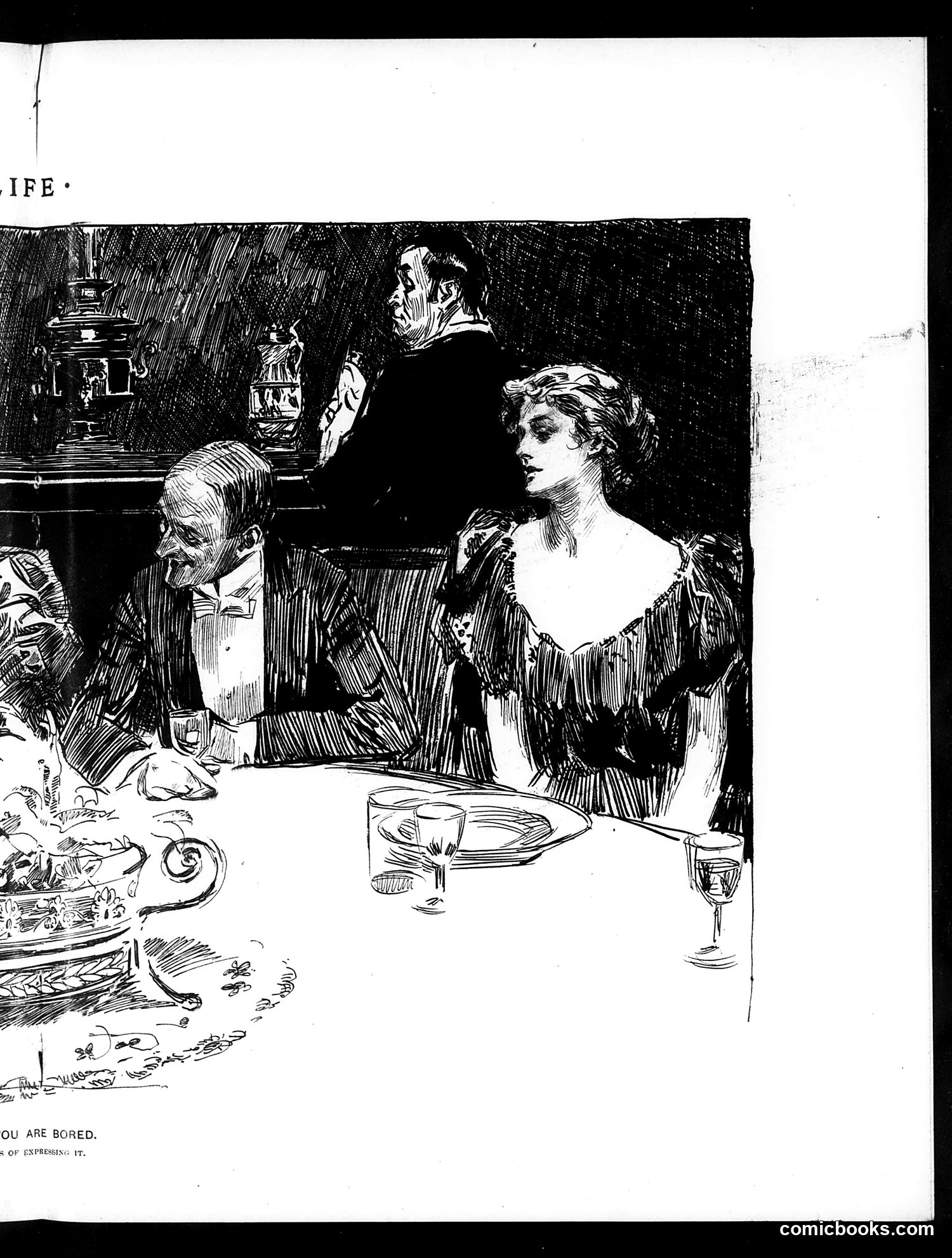
This is a sketch from *Life* magazine depicting a dinner scene with three figures at a formal table. The visible OCR text fragments suggest the caption reads something like "You are bored" and references "a way of expressing it." The illustration appears to be satirizing social conduct at high-society dinner parties—likely mocking either the pretentiousness of formal dining etiquette or the boredom that accompanies such events. The woman on the right displays a notably bored or dismissive expression, while the seated gentleman appears absorbed in his meal. The standing figure in back gestures expressively. Without the complete caption and context, the specific satirical target remains unclear, but the sketch likely comments on the artificiality or tedium of upper-class social gatherings typical of *Life* magazine's satirical focus.
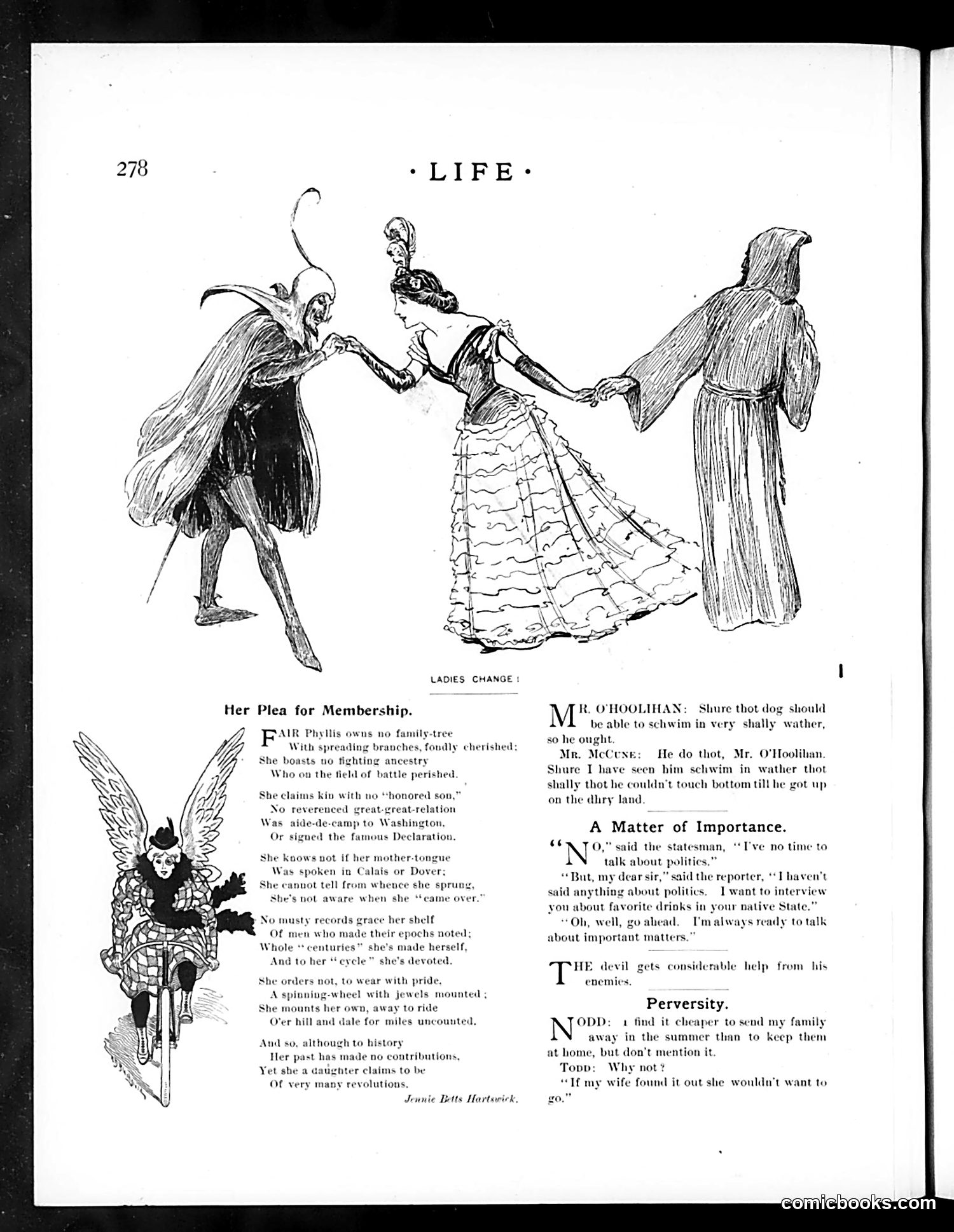
This page contains **satirical commentary on women's suffrage and social status** circa early 1900s. The top cartoon "Ladies Change!" mocks women seeking club membership by depicting a woman (Phyllis) who lacks aristocratic pedigree—no family tree, no Revolutionary War ancestors, no documented history. Yet she paradoxically claims descent from "many revolutions," likely referencing the women's rights movement. The irony: she's independent (rides her own bicycle), yet claims kinship through social causes rather than lineage. This satirizes both snobbish membership requirements and the "new woman" challenging traditional society. Below are brief humor pieces: an Irish dialect joke about a swimming dog, and two short anecdotes mocking politicians (who only discuss "important matters" like drinks) and marital deception (a husband hiding vacation costs from his wife). The satire targets both rigid class systems and emerging feminist independence, presenting women's activism as simultaneously ridiculous and threatening to traditional hierarchies.
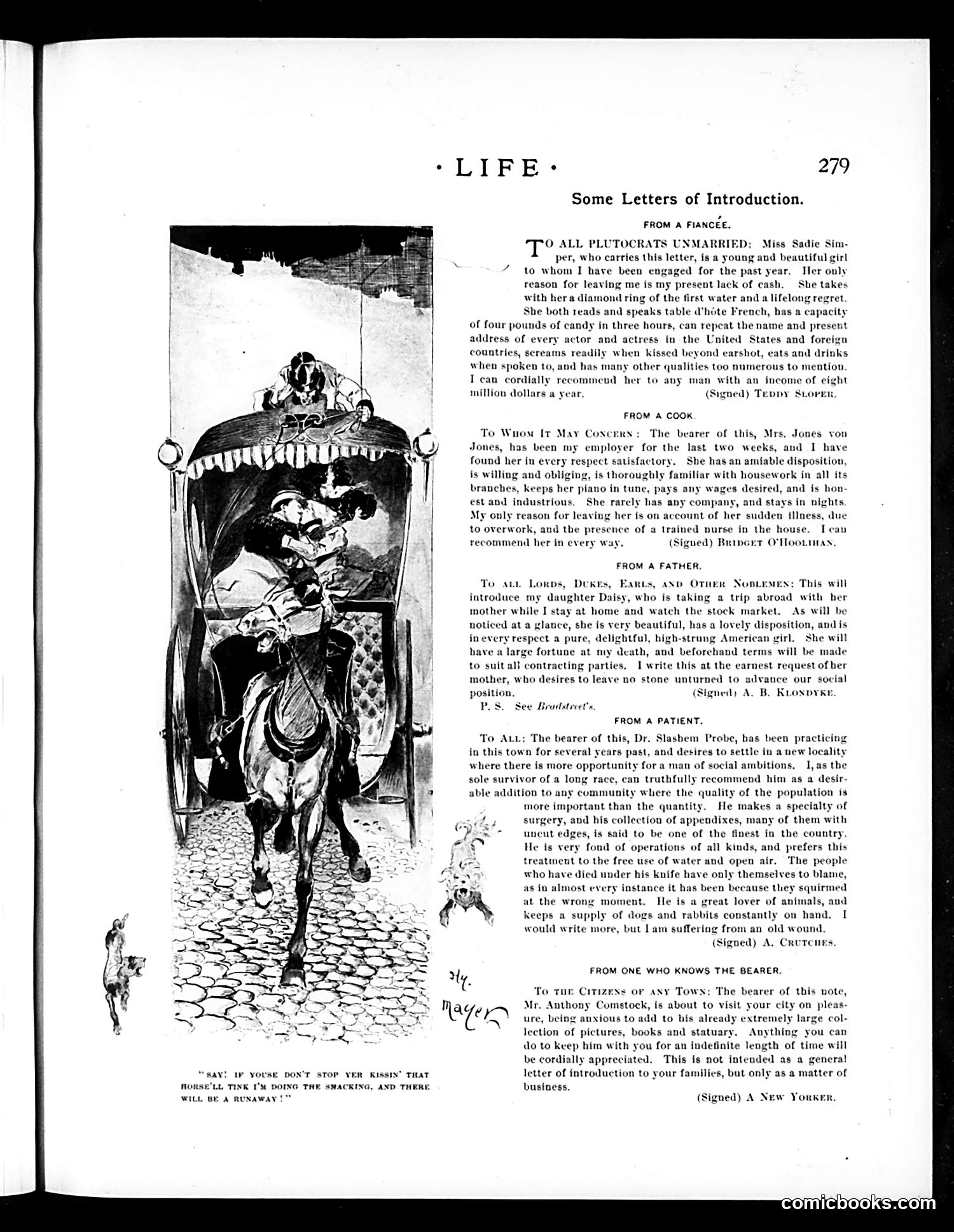
This page contains mock letters of introduction—a Victorian social convention—that brutally satirize American society's obsession with wealth and status. The central cartoon depicts a grotesquely caricatured woman on a donkey, illustrating the fiancée letter: a young woman engaged only for her suitor's money, equipped with superficial accomplishments (French, candy-eating, celebrity gossip) but utterly mercenary. The letters mock: - **Gold-digging fiancées** (requiring $8 million annually) - **Employers** (the cook's letter notes the woman paid wages "desired") - **Social-climbing fathers** (Klondyke explicitly mentions advancing "social position" through his daughter's marriage to nobility) - **Unethical doctors** (Probe performs unnecessary surgeries; his patients' deaths are their own fault for "squirming") - **Censors** (Comstock, likely referencing the real Anthony Comstock, famous for moral crusades) The satire exposes hypocrisy: people writing glowing recommendations while revealing damning truths. It's a withering critique of Gilded Age materialism, medical malpractice, and social pretension.
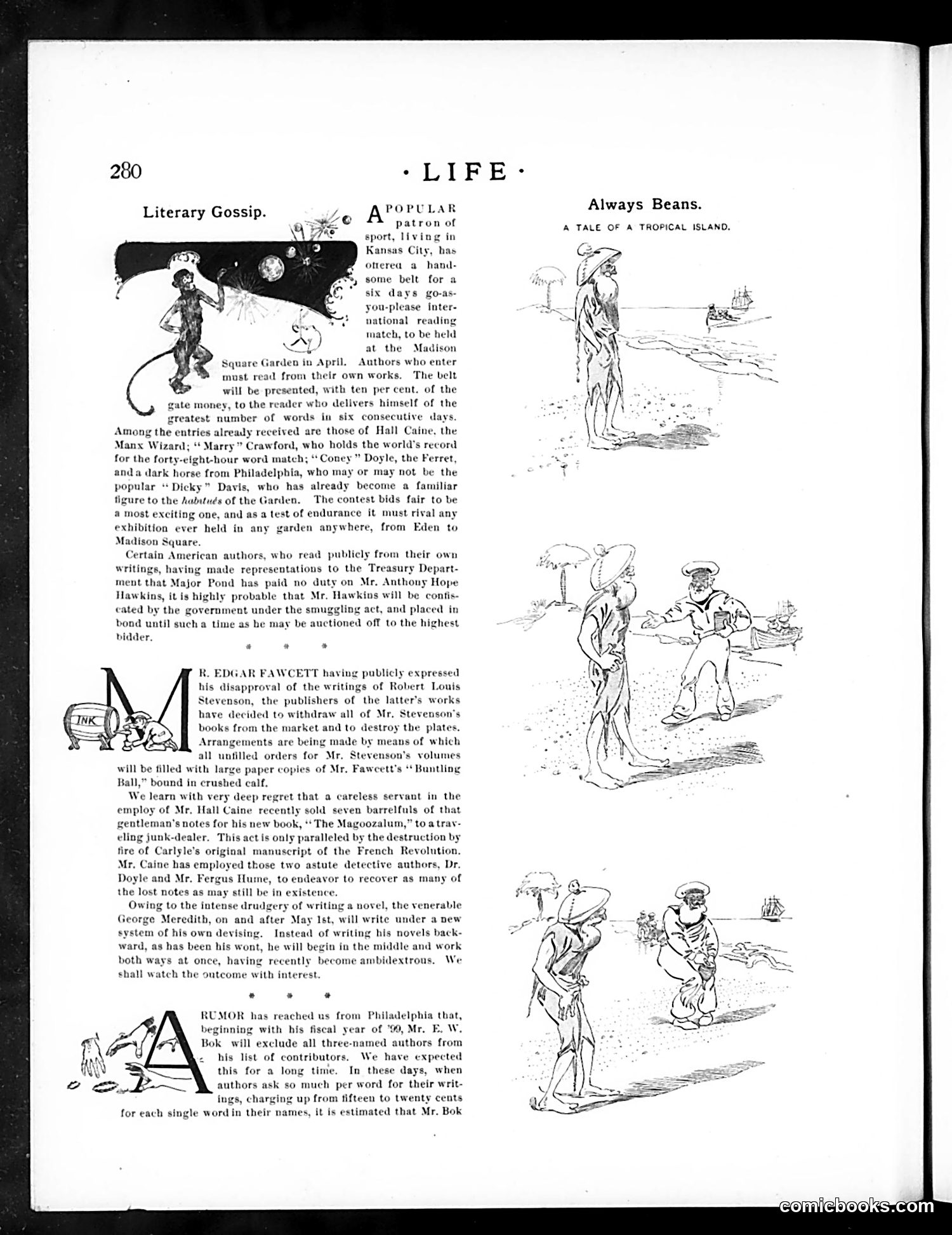
This page contains literary gossip satirizing the publishing world of the 1890s. The humor relies on absurdist exaggeration: **Key Satirical Points:** 1. **The "Reading Match"**: Mocks endurance competitions and celebrity authors by proposing a six-day marathon where writers read their own works—treating literature like a sporting event. 2. **Anthony Hope "Smuggling"**: Jokes that British author Anthony Hope Hawkins should be seized as contraband by the U.S. government for entering without paying duty—absurdly treating an author as taxable goods. 3. **Literary Feuds**: Claims publisher Edward Fawcett's disapproval of Robert Louis Stevenson caused his works to be destroyed and replaced with Fawcett's inferior writing—satirizing petty author rivalries. 4. **Hall Caine's Lost Manuscript**: Parallels losing notes to a junk-dealer with Carlyle's French Revolution fire—mocking overly dramatic publishing crises. 5. **George Meredith's Innovation**: Suggests the aging author will now write novels "in the middle" working "both ways"—gentle mockery of eccentric artistic methods. The illustrations on the right depict a tropical island tale (likely satirizing adventure fiction popularity).
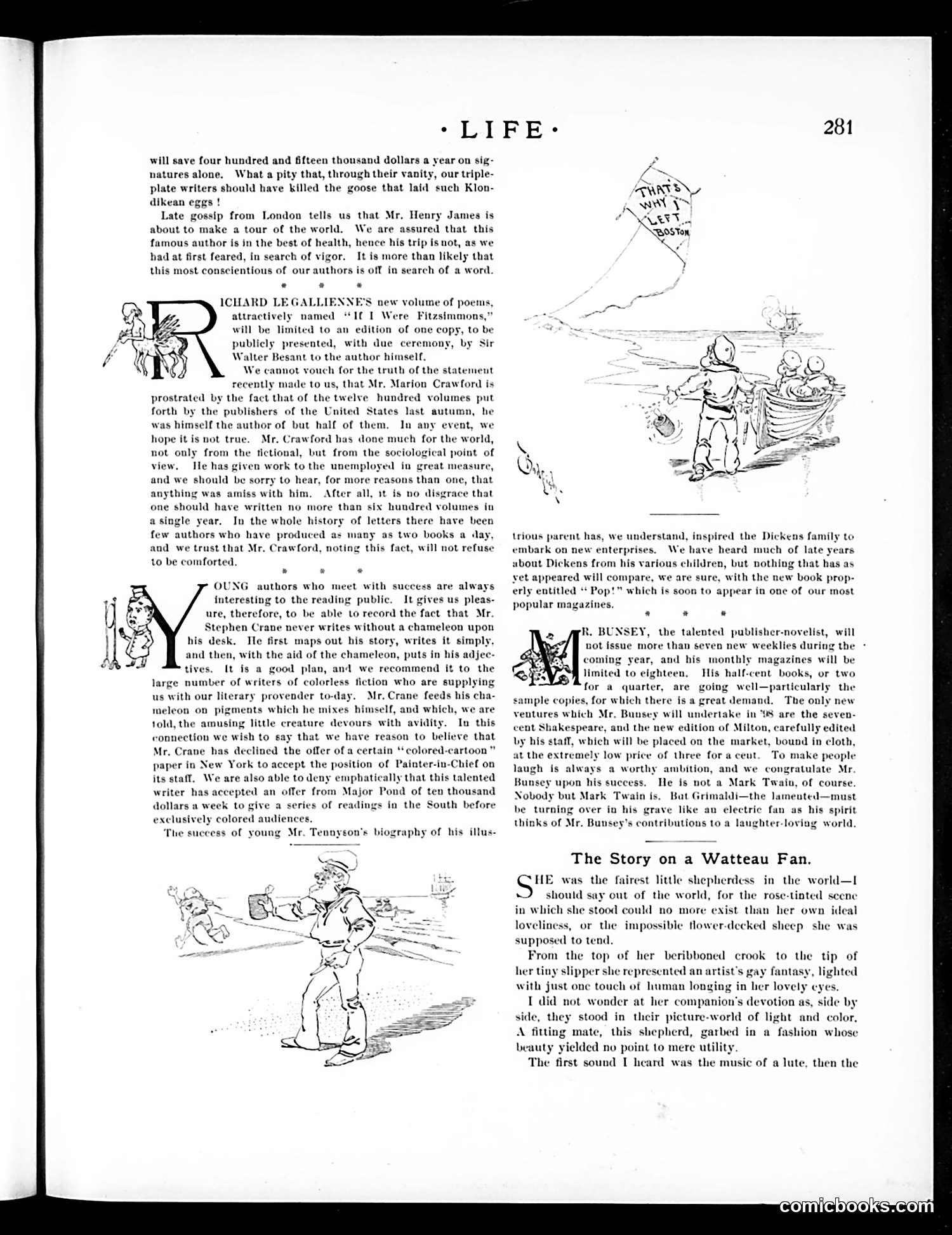
This page contains literary gossip and satirical commentary typical of Life magazine's "Vida" section. The cartoons and text mock prolific authors of the era: **Main targets:** - **Marion Crawford**: Satirized for allegedly authoring 600 of 1,200 American books published in one season—the joke being his absurd productivity is simultaneously praised and mocked as actual "work" for society. - **Richard Le Gallienne**: His poetry collection limited to one copy is absurd satire on vanity publishing. - **Stephen Crane**: The chameleon anecdote mocks his use of descriptive adjectives—suggesting he artificially "feeds" color into colorless writing. - **Henry James**: Joked that his world tour seeks not health but "a word" (implying his verbose style exhausts language). The cartoons (depicting shepherdesses and rural figures) illustrate "The Story on a Watteau Fan," a separate literary piece below. The overall tone mixes affectionate mockery of contemporary literary celebrities with insider publishing gossip targeting writers readers would have recognized.
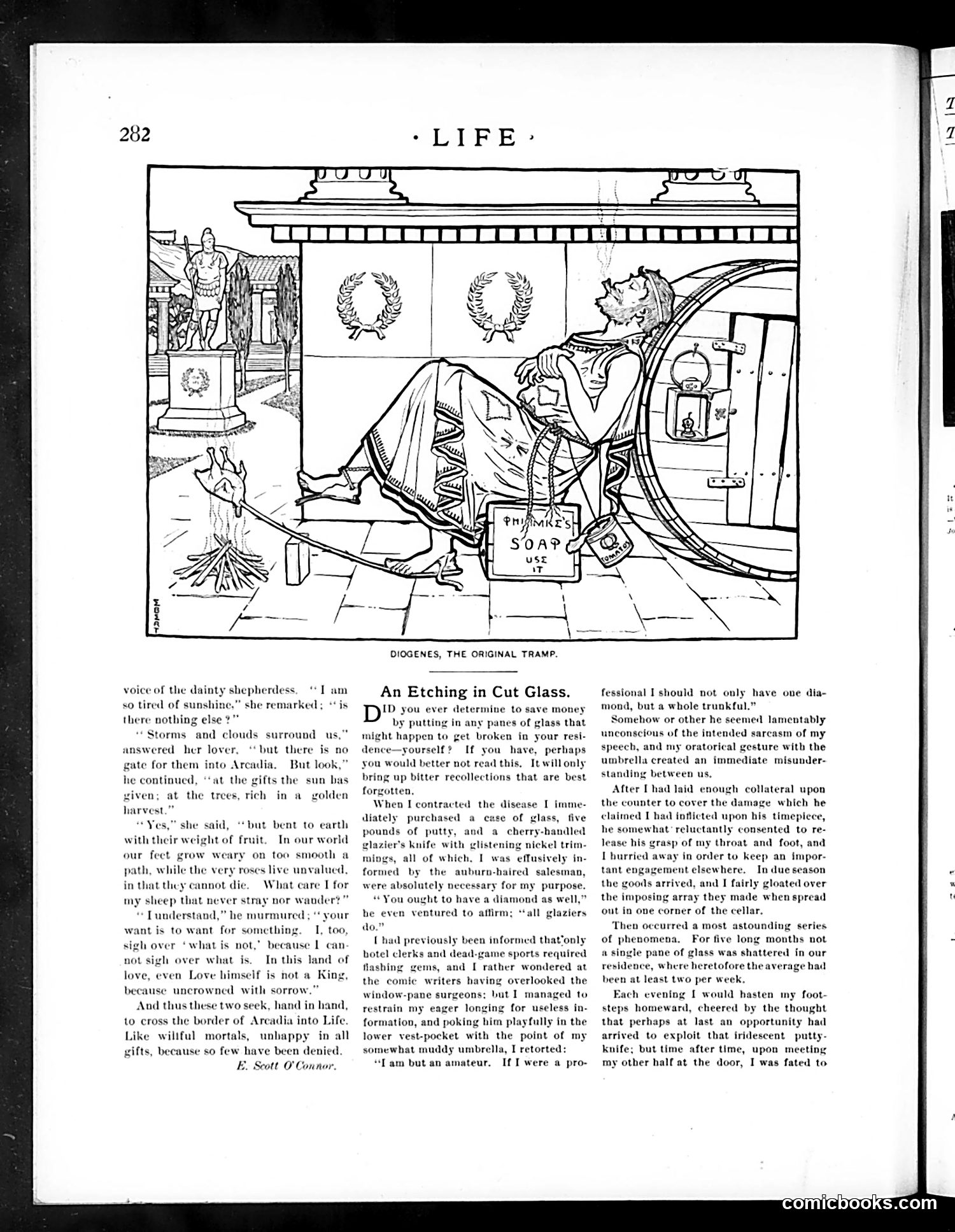
This page contains two distinct pieces: **"Diogenes, the Original Tramp"** (top illustration): A satirical cartoon showing a vagabond or hobo lounging luxuriously indoors with soap and comfort—ironically titled after Diogenes, the ancient Greek philosopher famous for rejecting material possessions and living ascetically. The joke appears to mock either the contradiction between the vagrant's supposed philosophy and actual comfort-seeking, or satirizes modern "tramps" as pretentious. **"An Etching in Cut Glass"** (main text, humorous essay): A comedic first-person narrative about a man who purchases supplies to repair broken window panes himself, expecting constant breakage. The joke is the ironic twist: once he owns the equipment and materials, no windows break for five months. He repeatedly hurries home expecting to finally use his new glazier's tools, only to be disappointed. It's a commentary on Murphy's Law—how possessing a solution prevents the problem from occurring. Both pieces are lighthearted humor typical of Life's satirical approach to American life and human nature.
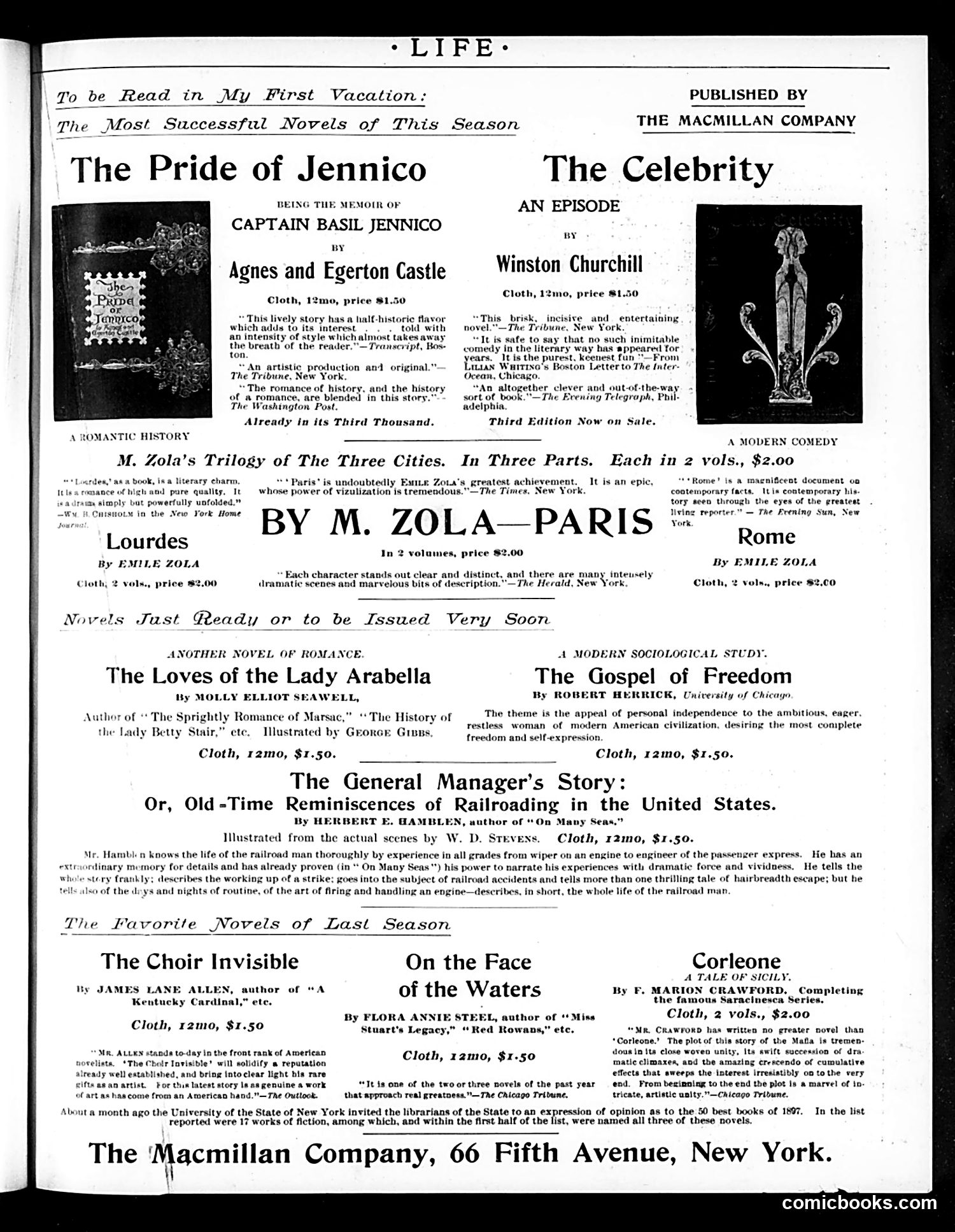
This is entirely a **book advertisement page**, not a political cartoon or satirical content. Published by Macmillan Company, it showcases the "most successful novels of this season" available for vacation reading. The page advertises roughly a dozen contemporary novels from the 1890s-early 1900s, including works by Émile Zola (*Paris*, *Lourdes*, *Rome*), Winston Churchill (*The Celebrity*), and others. Each book entry includes the title, author, cloth binding price (typically $1.50), and brief favorable press quotes. Notable titles include *The Pride of Jennico* (described as romantic history), *The Gospel of Freedom* (sociological study of modern American women), and *The General Manager's Story* (railroad memoir). There is **no satire, political commentary, or caricature** on this page—it is straightforward commercial publishing promotion aimed at readers seeking quality fiction for leisure time.
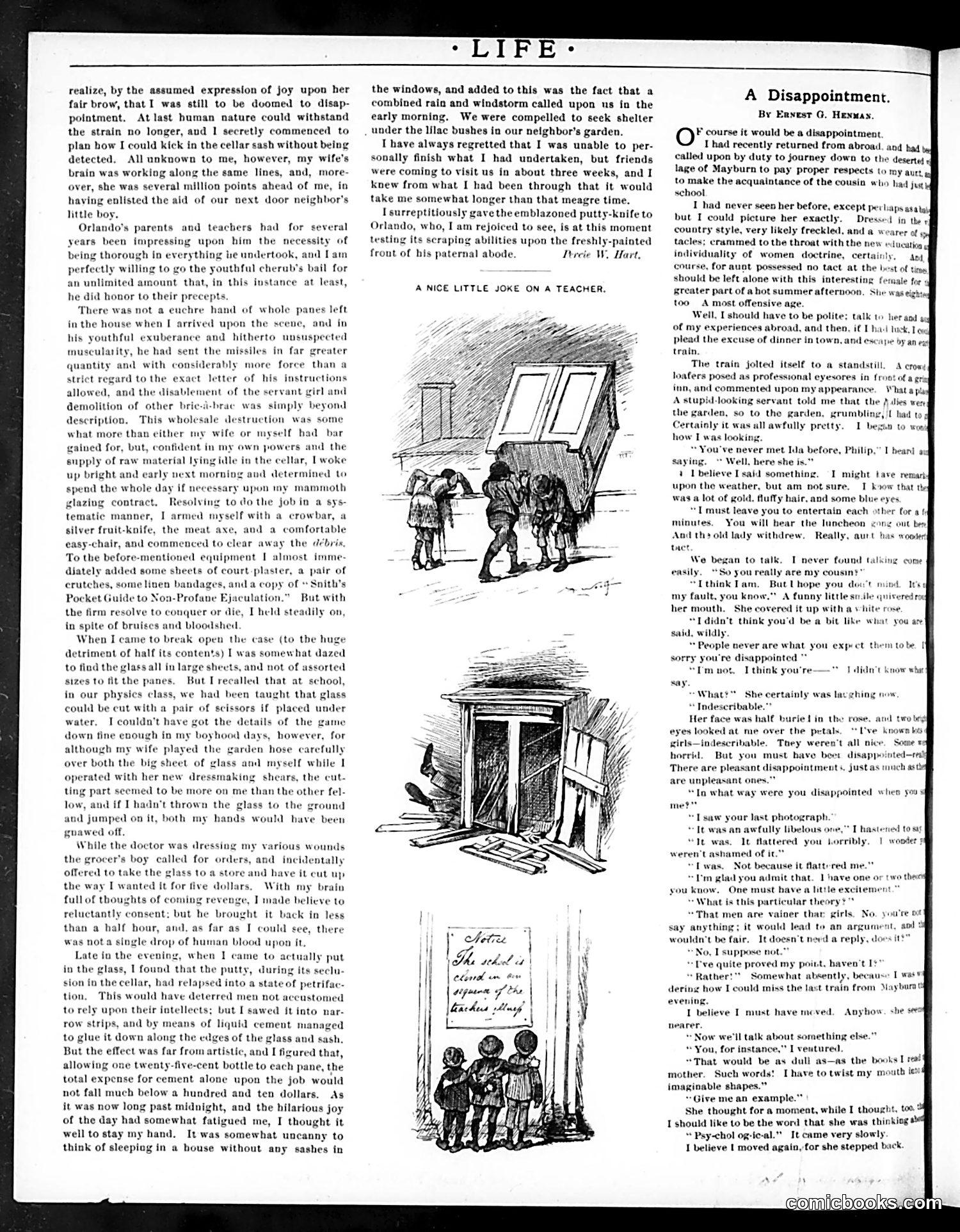
This page contains two illustrated anecdotes satirizing domestic life and foolish persistence. **The main cartoon** (top) shows a teacher being struck by a snowball—a visual punchline to the accompanying story about a man attempting home window repair after a neighborhood boy has broken them all with a baseball. The joke mocks the narrator's incompetence: he injures himself repeatedly (cutting glass under water, damaging property), pays a grocer's boy to finish the job properly, then discovers the putty has hardened, forcing him to start over with expensive supplies. The satire ridicules masculine pride and amateur DIY efforts that cost more in medical bills and materials than hiring professionals. **The lower illustration** depicts children reading, likely relating to the "A Disappointment" article on the right side, which discusses women's education and societal expectations. The overall theme: middle-class American frustration with domestic responsibilities and the consequences of stubborn self-reliance over practical solutions.
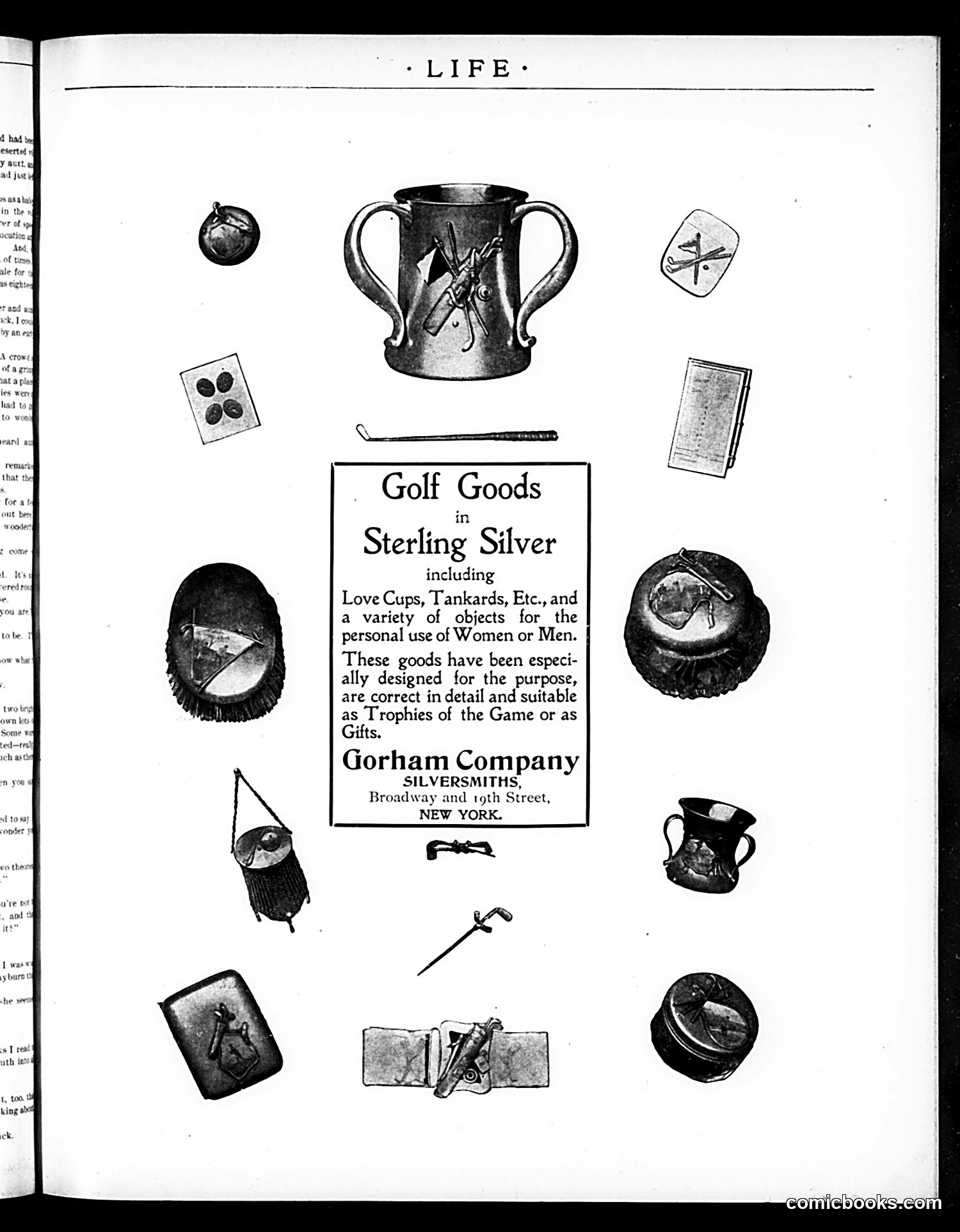
This is a **Gorham Company advertisement**, not a political cartoon. The page promotes sterling silver golf trophies and gifts from the prestigious New York silversmith. The ad displays various silver items arranged decoratively: love cups, tankards, belt buckles, hat pins, match safes, and other luxury goods suitable as golf prizes or gifts for both women and men. The central dual-handled cup is likely a "love cup" (a ceremonial drinking vessel). The satire, if any exists, is implicit rather than explicit: the ad reflects early 20th-century upper-class culture where expensive silver golf accessories signified wealth and social status. Golf itself was an elite pursuit at this time. The emphasis on items "for the personal use of Women or Men" suggests golf's growing accessibility to women, which was still relatively novel. This is primarily **commercial content** rather than satirical commentary.
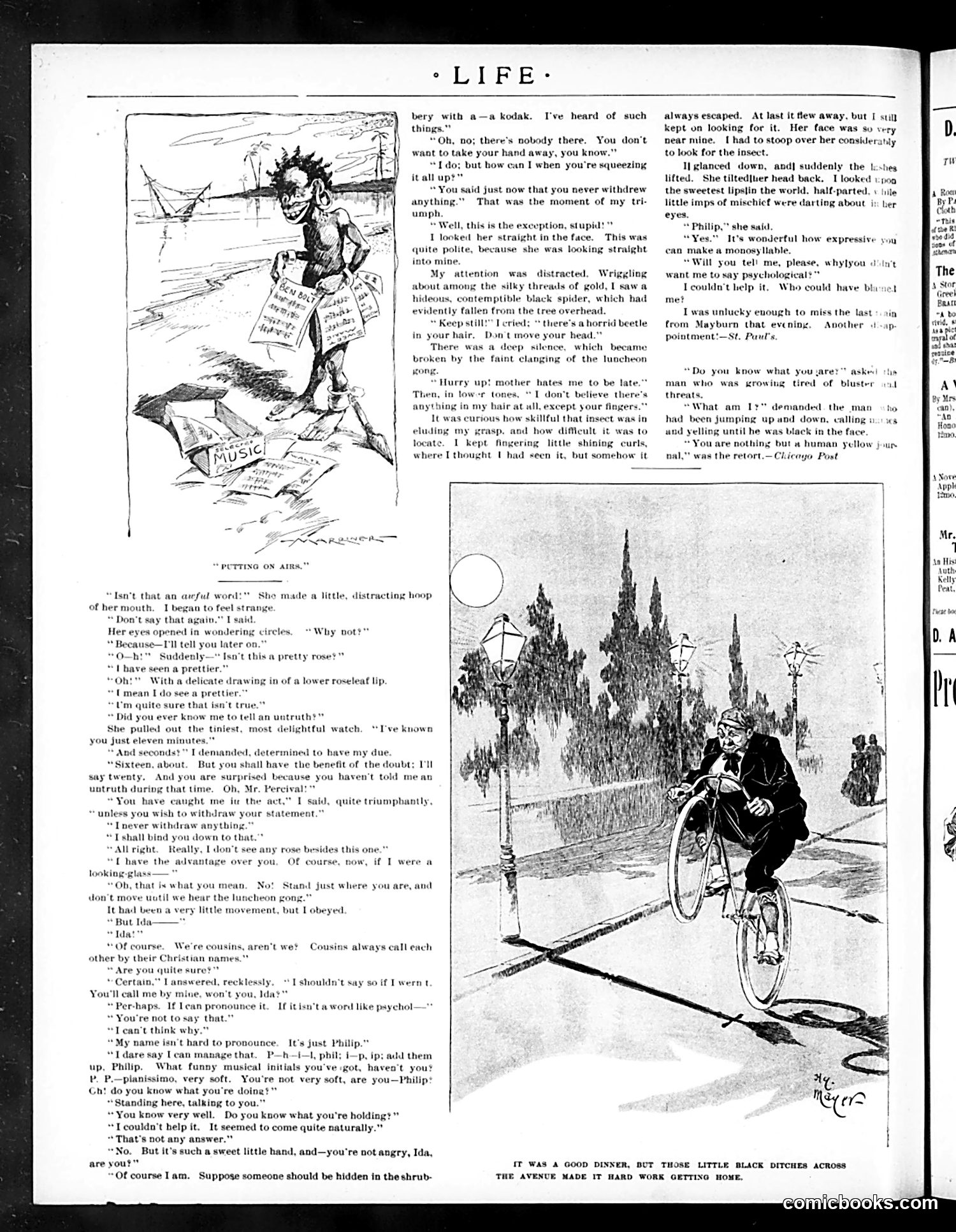
This page contains two distinct elements: a serialized romantic story and accompanying illustrations. **The Left Illustration** ("Putting on Airs"): A caricatured woman in an exaggerated pose, laden with sheet music and papers, represents someone pretending to sophistication or artistic pretense—likely satirizing women who affect cultured airs. **The Main Content**: A flirtatious dialogue between two young people (Philip and Ida, who are cousins). The text is a romantic/comedic narrative typical of early 20th-century serialized fiction, focusing on witty banter, romantic tension, and mild scandal (holding hands, almost kissing). **The Right Illustration**: A cyclist approaching a Gothic castle, illustrating the narrative's romantic setting. **The Satire**: Life magazine lampooned affected sophistication and romantic melodrama popular in contemporary literature. The exaggerated illustrations mock both pretentious artistic posturing and the overwrought emotional conventions of period romance fiction. The humor relies on readers recognizing these familiar literary tropes.
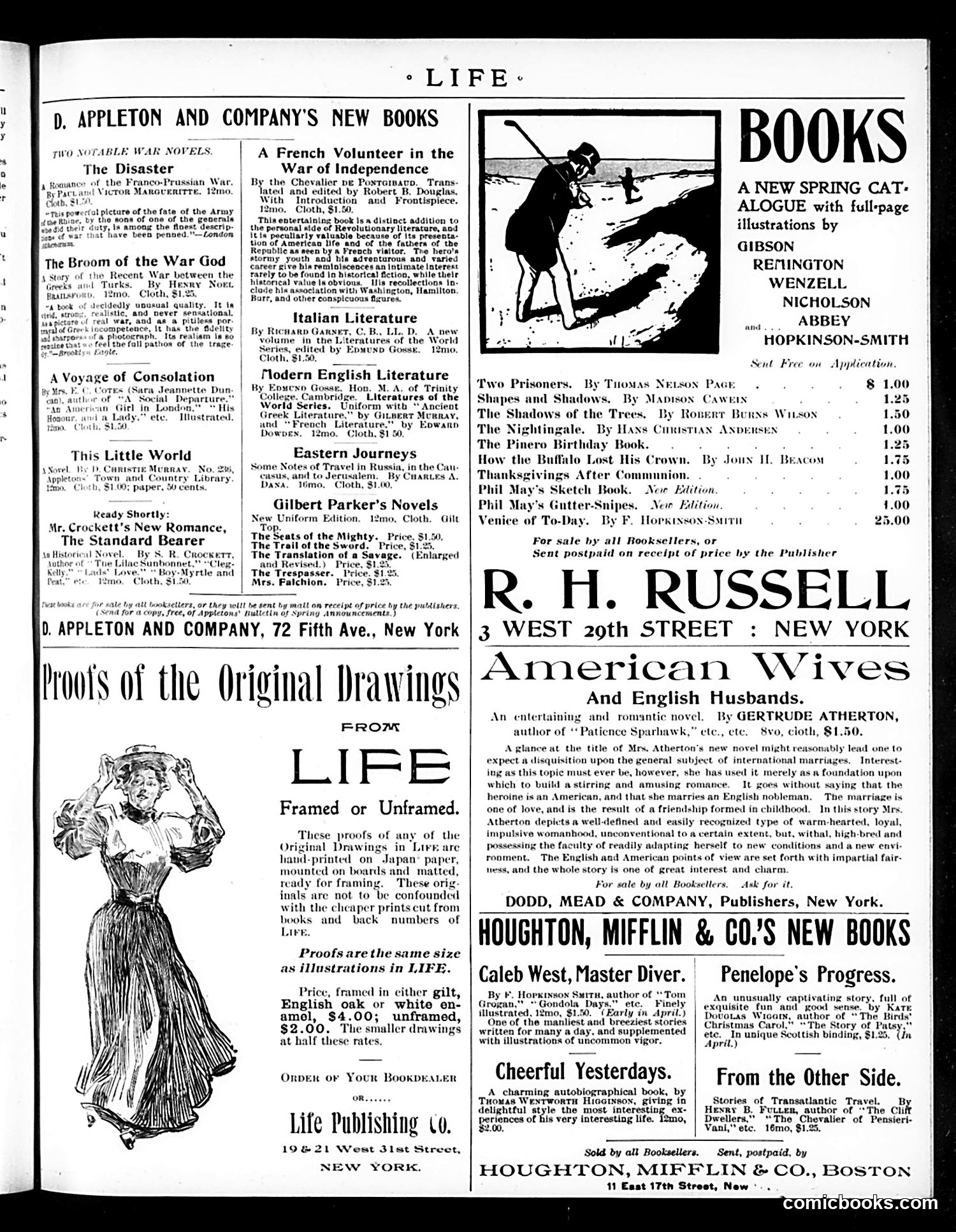
This page is primarily **book advertisements** from major American publishers (D. Appleton & Company, R. H. Russell, Houghton Mifflin & Co.), typical of early 20th-century literary magazines. The only substantive illustration is a **pen-and-ink drawing of a woman in Victorian/Edwardian dress** (lower left), advertising "Proofs of the Original Drawings from LIFE" — framed reproductions of artwork that appeared in the magazine itself, available for home decoration. The cartoonists named (Gibson, Remington, Wenzell, Nicholson, Abbey, Hopkinson-Smith) were Life's regular illustrators, and the advertisement promotes their work as collectible art. The text emphasizes that these prints were "hand-printed on Japan paper" and "ready for framing" — marketing aesthetic sophistication to middle-class readers. There is no political satire visible on this page; it represents the magazine's revenue model: selling books and reproductions of its own editorial content.
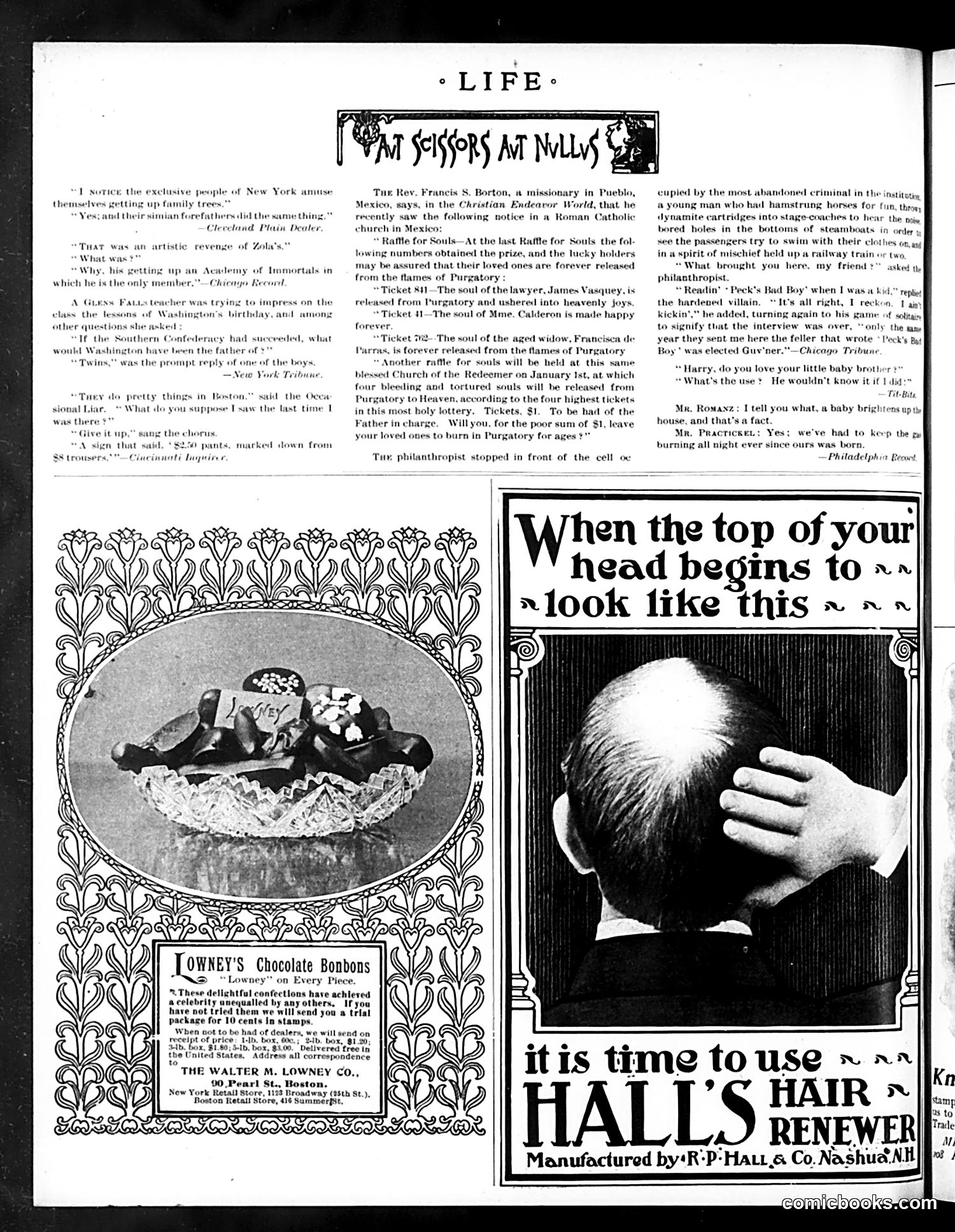
This page combines satirical commentary with period advertising. The main content mocks the Catholic Church's practice of selling indulgences—specifically, raffles for releasing souls from Purgatory. A missionary in Mexico reported seeing church notices advertising ticket sales ($1 each) where winners were assured their deceased loved ones would be freed from eternal punishment. Life's editors presented this as absurd corruption, implying the Church cynically exploited believers' grief and superstition for profit. The page also includes humorous anecdotes about human nature and social commentary—including one about a criminal who blamed his crimes on reading "Peck's Bad Boy" (a mischievous character in popular literature). The advertisements (Lowney's Chocolate and Hall's Hair Renewer) are typical period marketing using crude visual comparisons and pseudo-scientific claims common to early 1900s advertising. The satire targets ecclesiastical hypocrisy and commercial exploitation of faith.
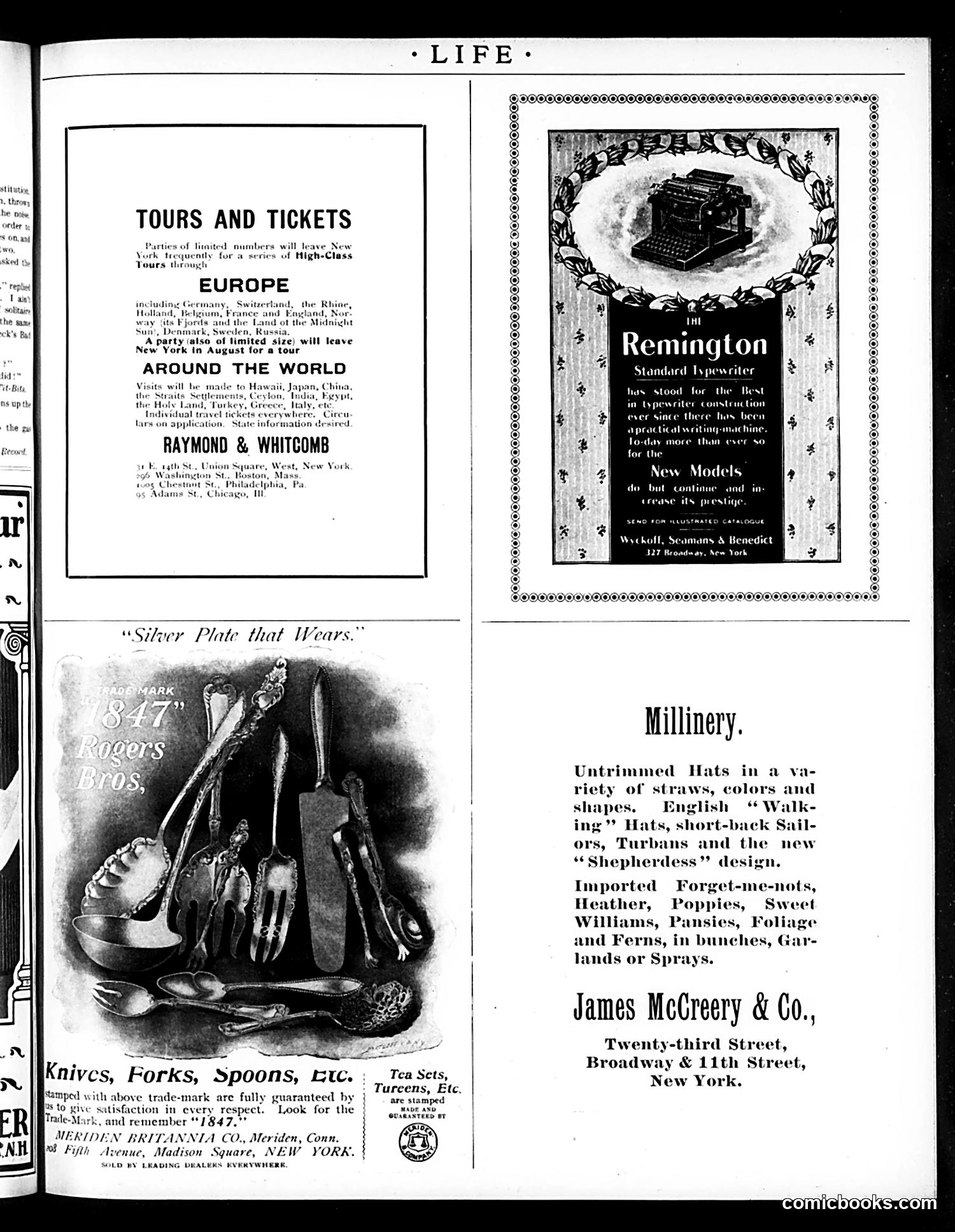
This page is primarily **advertising content**, not satire or political commentary. It contains four distinct advertisements: 1. **Tours and Tickets** (Raymond & Whitcomb): Promotes luxury European tours and around-the-world travel packages for wealthy clients. 2. **Remington Standard Typewriter**: Advertises the machine as a practical business tool that outperforms competitors. 3. **Rogers Bros. Silverware**: Features an illustration of ornate cutlery and serving pieces, emphasizing the 1847 trademark guarantee of quality. 4. **James McCreery & Co. Millinery**: Advertises fashionable women's hats and imported flower decorations. The page reflects early 20th-century consumer culture targeting affluent readers—international tourism, modern office equipment, fine tableware, and high-end fashion accessories. There is no visible cartoon or political satire; this is a straightforward commercial advertisement section from Life magazine.
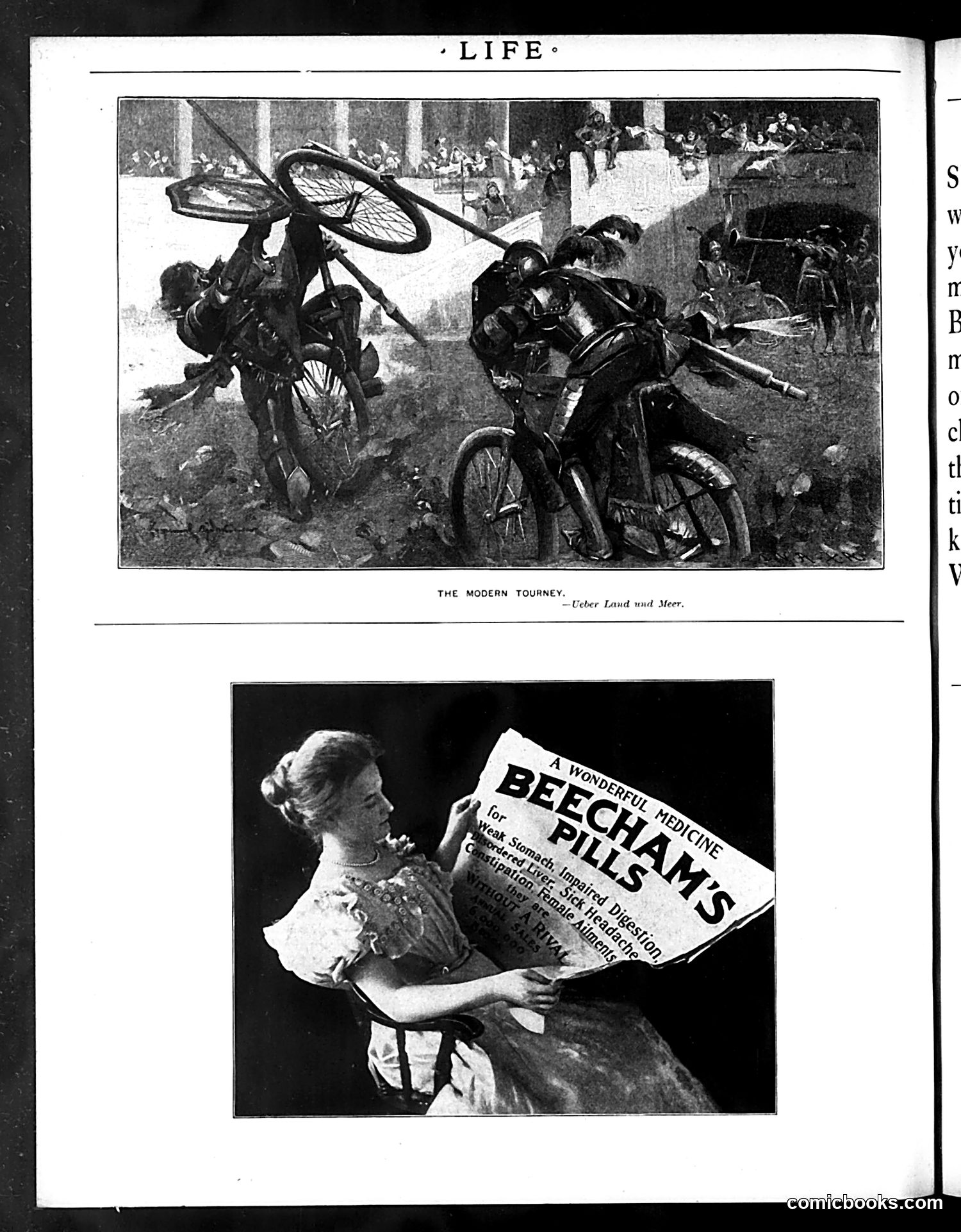
**Top Image: "The Modern Tourney"** This satirical cartoon depicts two cyclists engaged in a competitive "tourney" (tournament), referencing medieval jousting but with bicycles instead of horses. The riders lean dramatically, one holding a bicycle wheel aloft like a lance. Spectators watch from bleachers in the background, treating this bicycle competition as serious sport. The humor lies in the contrast between traditional knightly tournaments and modern athletic competition—bicycling was a relatively new, popular sport at this time (late 1800s/early 1900s), and the cartoon gently mocks how seriously contemporary society treated these novel sporting events. The German credit line suggests this was reprinted from a European source. **Bottom Image:** This appears to be a period advertisement for "Beecham's Pills," a medicinal product, showing a woman reading promotional material.
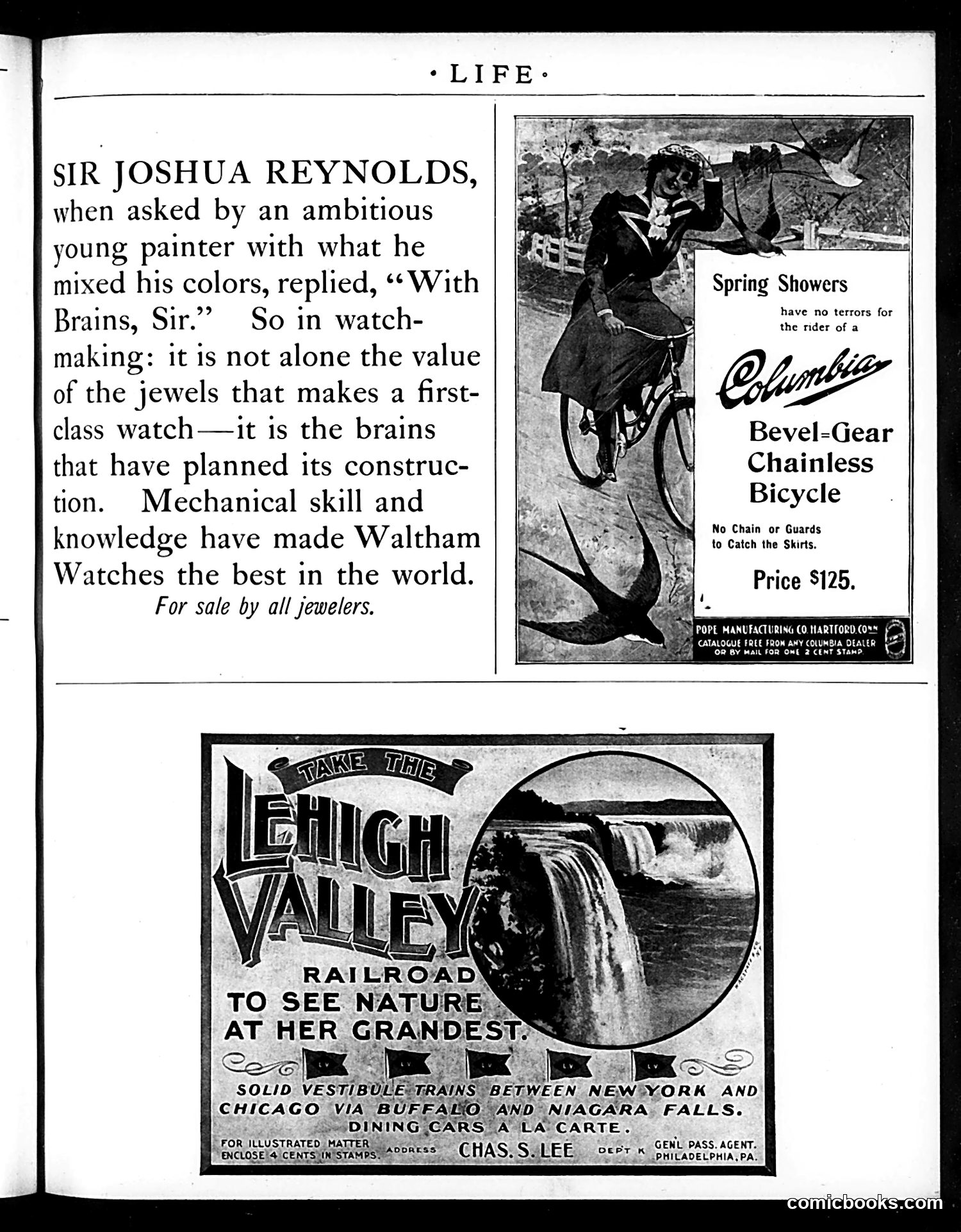
This page contains three separate advertisements rather than political cartoons: 1. **Waltham Watches**: Uses a quote attributed to Sir Joshua Reynolds (18th-century painter) about mixing colors "with brains" as a metaphor for watchmaking quality. The ad argues that superior design and engineering—not just expensive materials—make fine watches. 2. **Columbia Bicycles**: Markets a chainless bicycle model as practical for women, specifically highlighting that spring showers pose "no terrors" because there's no chain or guards to catch skirts. This addresses a real concern for women cyclists of the era, whose long skirts could snag on bicycle chains. 3. **Lehigh Valley Railroad**: Advertises scenic train travel to Niagara Falls, promoting luxury "solid vestibule trains" with dining cars between New York and Chicago. All three ads reflect early 1900s consumer culture and gender-specific marketing—particularly the bicycle ad's acknowledgment of women as customers with distinctive practical needs.
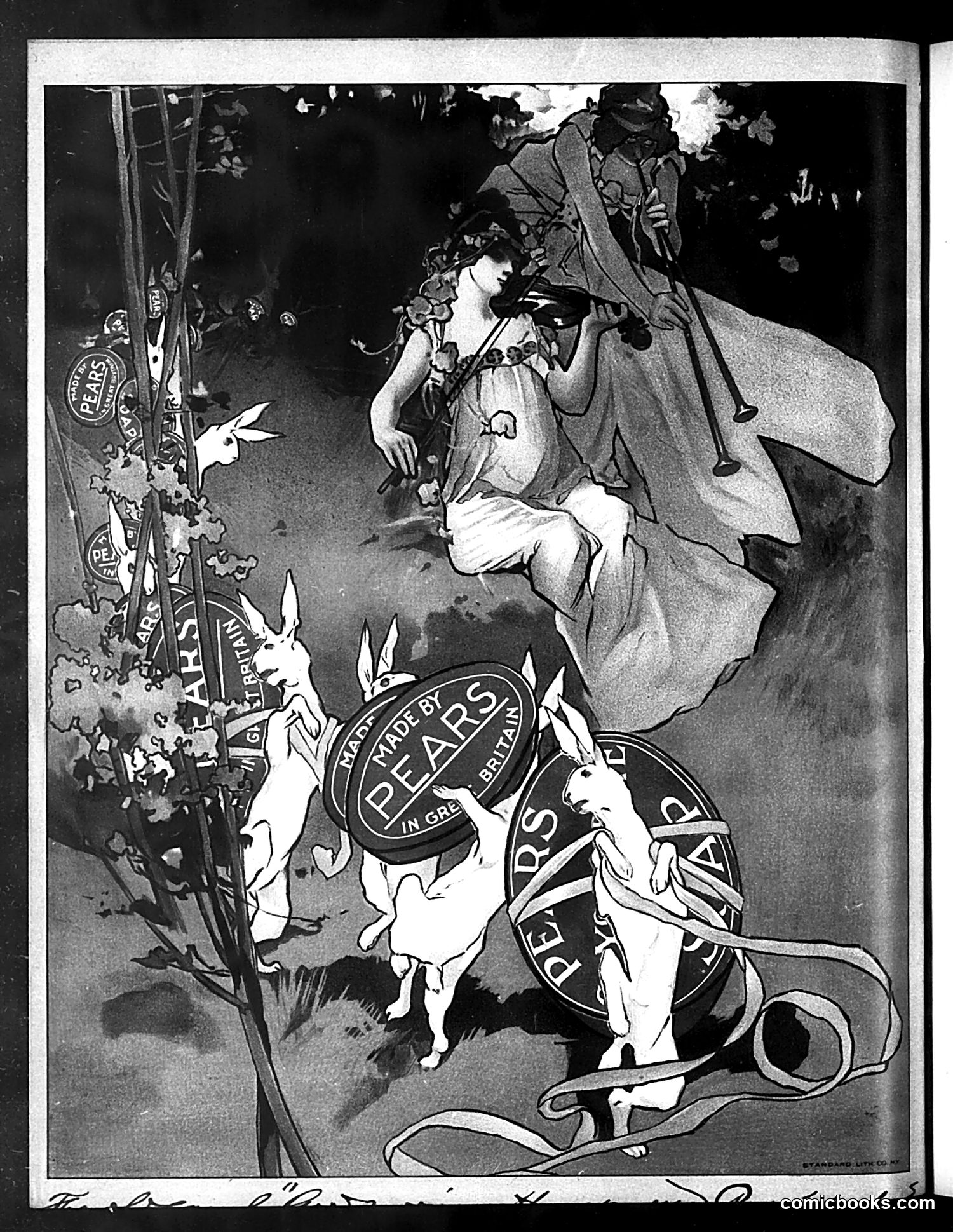
This appears to be a vintage Life magazine advertisement or illustration featuring a whimsical scene with a woman and a figure in a cape alongside goats carrying circular medallions or seals. The seals appear to reference "Pears" products and mention "Made by Pears in Great Britain." The imagery suggests a satirical advertisement promoting Pears soap or related products, likely from the late 19th or early 20th century. The goats serving as delivery animals and the theatrical staging (cape-wearing figure) create humorous contrast—playing on the idea of exotic or foreign products being brought to consumers. The woman's interested pose suggests consumer appeal. Without clearer OCR text, I cannot definitively identify which specific product or campaign this promotes or what particular social commentary, if any, is intended beyond standard period advertising satire.