
Life, 1898-04-02 · page 11 of 32
Life — April 2, 1898 — page 11: what you’re looking at
What you’re looking at
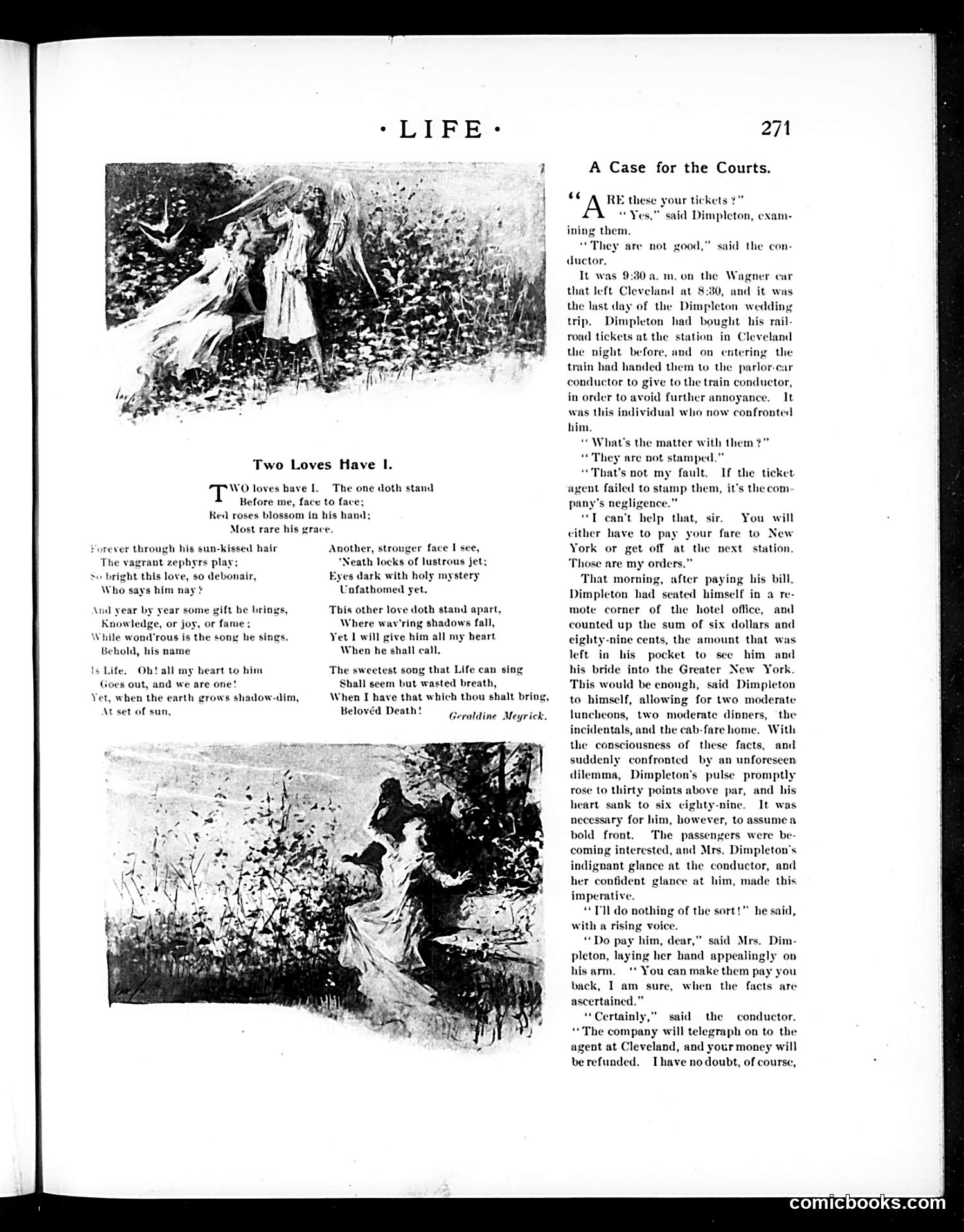
This page contains a short story about a railroad dispute. Mr. and Mrs. Dimpleton purchased tickets for a train departing Cleveland, but the tickets weren't stamped by the agent. When a conductor boards to collect fares, he refuses to accept the unstamped tickets and demands payment or demands they exit at the next station. The satire targets railroad company practices and consumer vulnerability. The conductor invokes "company orders" as justification, placing blame on corporate bureaucracy rather than individual negligence. Mrs. Dimpleton's confident assertion that "You can make them pay you back" when facts are ascertained suggests satirizing both corporate inflexibility and ordinary travelers' naive faith in eventual justice through formal complaint procedures. The accompanying poem "Two Loves Have I" appears unrelated to the main narrative.
📄 Transcribed text from this page (OCR, searchable)
Machine-transcribed from the original scan — historical spelling and the odd misread are preserved.
Two Loves Have I. WO loves bave I. The one doth stand Before me, face to face; Red roses blossom in his hand; Most rare his grace. Forever through his sun-kissed hair The vagrant zephyrs play: su bright this love, so debonair, Who says him n: \nd year by year some gift he brings, Knowledge, or joy, or fame ; While wond’rous is the song he sings. Behold, his name Ob! all my heart to him out, and we are one! Yet, when the earth grows shadow-dim, At set of sun, Another, stro "Neath locks of lustrous jet; Eyes dark with holy mystery Unfathomed yet. This other love doth stand apart, Where way'ring shadows fall, Yet I will give him all my heart When he shall call. The sweetest song that Life can sing Shall seem but wasted breath, When I have that which thou shalt bring, Belovéd Death! Gyratdine Meyrick. 271 A Case for the Courts. RE these your tickets ?” “Yes,” said Dimpleton, exam- them, ey are not good,” said the con- ductor, It wa :30.a.m.on the Wagner car that left Cleveland at 8:30, and it was the last day of the Dimpleton wedding trip. Dimpleton had bought his rail- road tickets at the station in Cleveland the night before, and on entering the train had handed them to the parlor-car conductor to give to the train conductor, in order to avoid further annoyance. It was this individual who now confronted him. “What's the matter with th “They are not stamped.” That's not my fault. If the ticket agent failed to stamp them, it’s thecom “T can't help that, sir. You will cither have to pay your fare to New York or get off at the next. station. ‘Those are my orde That morning, after paying his bill, Dimpleton had seated himself in a re- mote corner of the hotel office, and counted up the sum of six dollars and eighty-nine cents, the amount that was left in his pocket to see him and his bride into the Greater New York. This would be enough, said Dimpleton to himself, allowing for two moderate luncheons, two moderate dinners, the incidentals, and the cab-fare home. With the consciousness of these facts, and suddenly confronted by an unforeseen dilemma, Dimpleton’s pulse promptly rose to thirty points above par, and his heart sank to six cighty-nine. It was necessary for him, however, to assume a bold front. The passengers were be- coming interested, and Mrs, Dimpleton’s indignant glance at the conductor, and her confident glance at him, made this imperative. “Tl do nothing of the sort!” he said, with a rising voice. “Do pay him, dear,” said Mrs. Dim- pleton, laying her hand appealingly on his arm. ‘* You can make them pay you back, I am sure, when the facts are ascertained.” “Certainly,” said the conductor. “The company will telegraph on to the agent at Cleveland, and your money will be refunded. Thave no doubt, of course, comicbooks.com