
A complete issue · 20 pages · 1898
Life — March 31, 1898
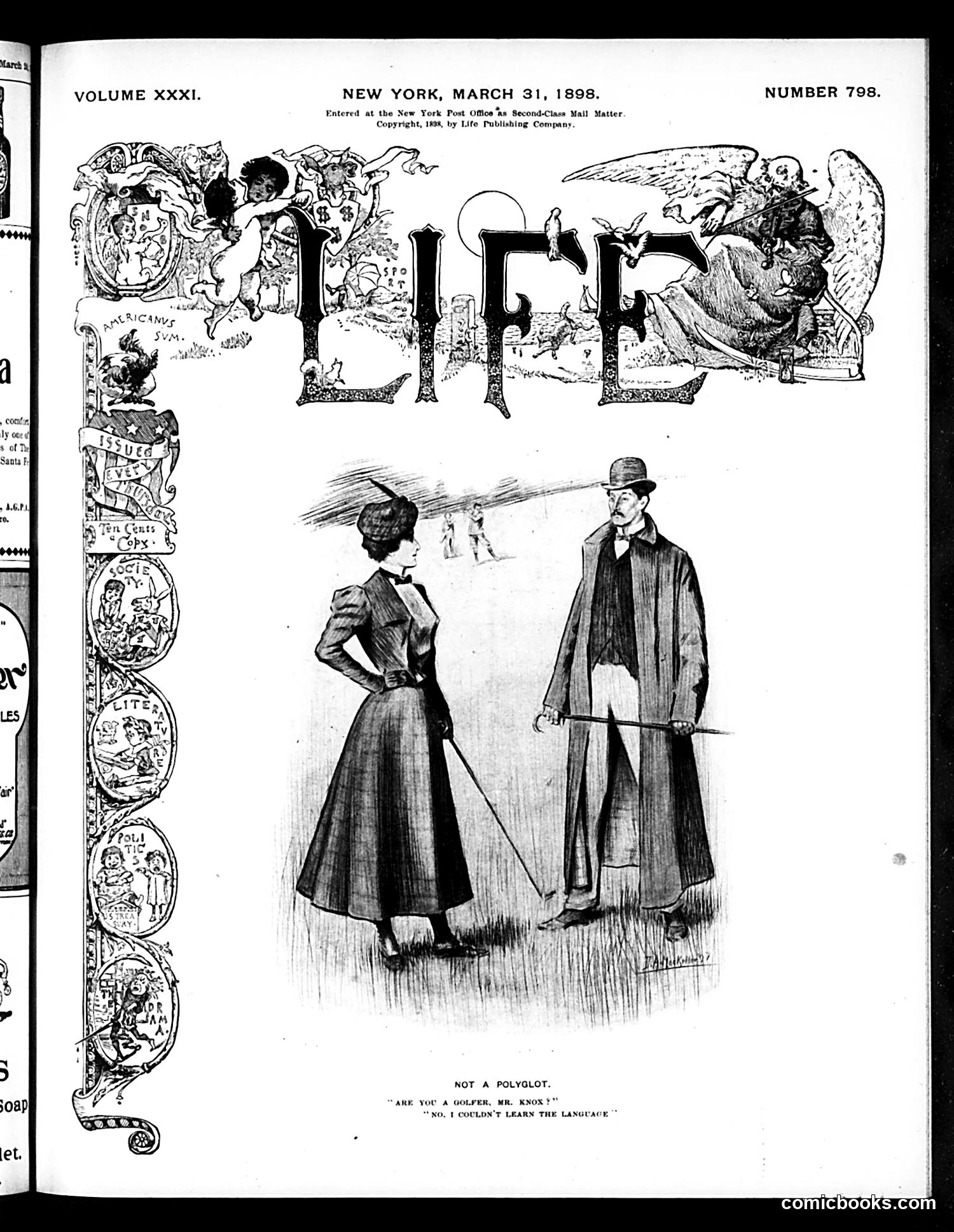
This cartoon satirizes a man's inability to communicate across language barriers. The caption reads: "Are you a golfer, Mr. Knox?" / "No, I couldn't learn the language." The joke plays on the term "polyglot" (someone fluent in multiple languages). The man, presumably Mr. Knox, claims he cannot learn golf because he doesn't understand "the language"—presumably golf's specialized terminology and jargon. This is gentle satire mocking either Knox's intellectual limitations or the overly complex, almost foreign-sounding technical language that golfers use. The cartoon reflects late-19th-century attitudes about golf as an elite, somewhat exclusive sport with its own peculiar vocabulary that could be bewildering to outsiders.
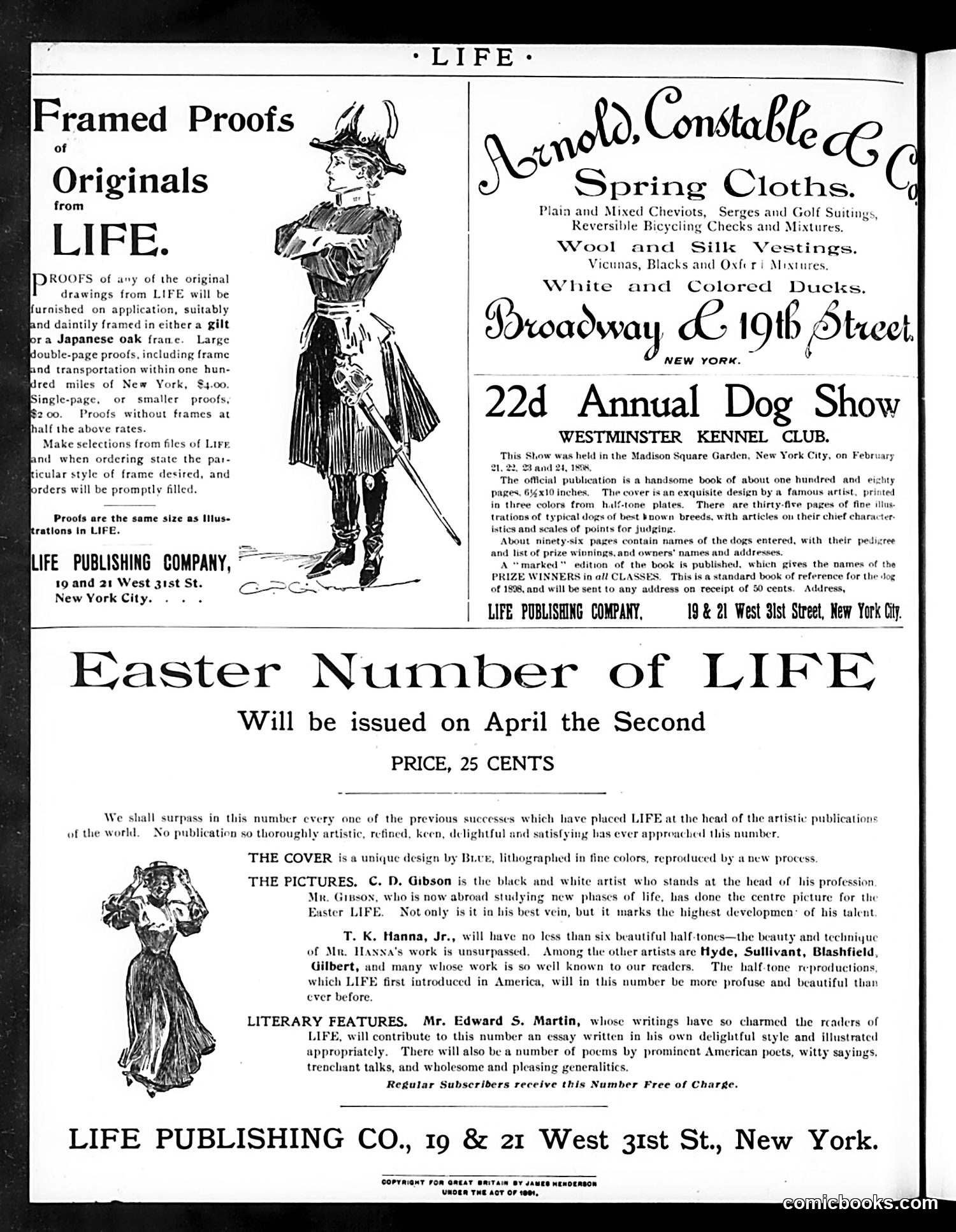
This page is primarily **advertising**, not political satire. The left side advertises **framed proofs of original LIFE drawings** available for purchase, showing a stylized illustration of a woman in Edwardian dress. The right side features two ads: one for **Arnold, Constable & Co.** (a department store advertising spring clothing), and another for the **22nd Annual Dog Show** of the Westminster Kennel Club, held at Madison Square Garden in New York City. The bottom section announces the **Easter Number of LIFE** (to be issued April 2nd, priced 25 cents), highlighting contributions from notable artists like C.D. Gibson and T.K. Hanna Jr., plus writer Edward S. Martin. A small decorative illustration of a woman in period dress appears at left. No political satire or commentary is evident on this page.
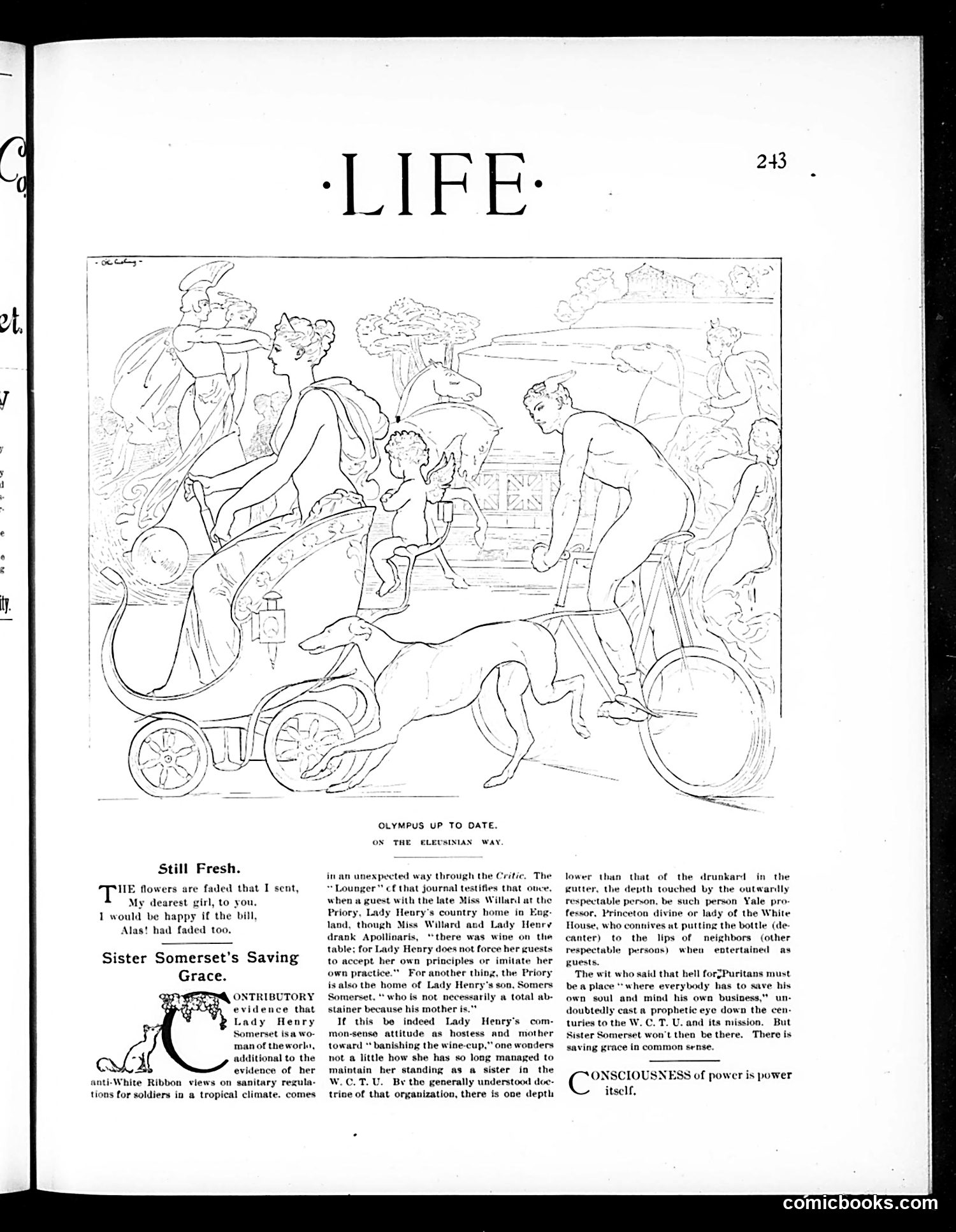
This page from *Life* magazine features "Olympus Up to Date. On the Eleusinian Way"—a classical mythological scene rendered in modern early-20th-century style. The illustration depicts Greek gods and goddesses alongside contemporary figures engaged in modern activities like cycling and automobiles, creating satirical contrast between ancient mythology and modern life. The accompanying articles—"Still Fresh," "Sister Somerset's Saving Grace," and "Consciousness of Power"—appear to address social commentary, likely including references to feminism (Sister Somerset suggests suffragette activism) and power dynamics of the era. The overall effect satirizes how classical ideals clash with contemporary society, typical of *Life* magazine's sophisticated social satire during this period.
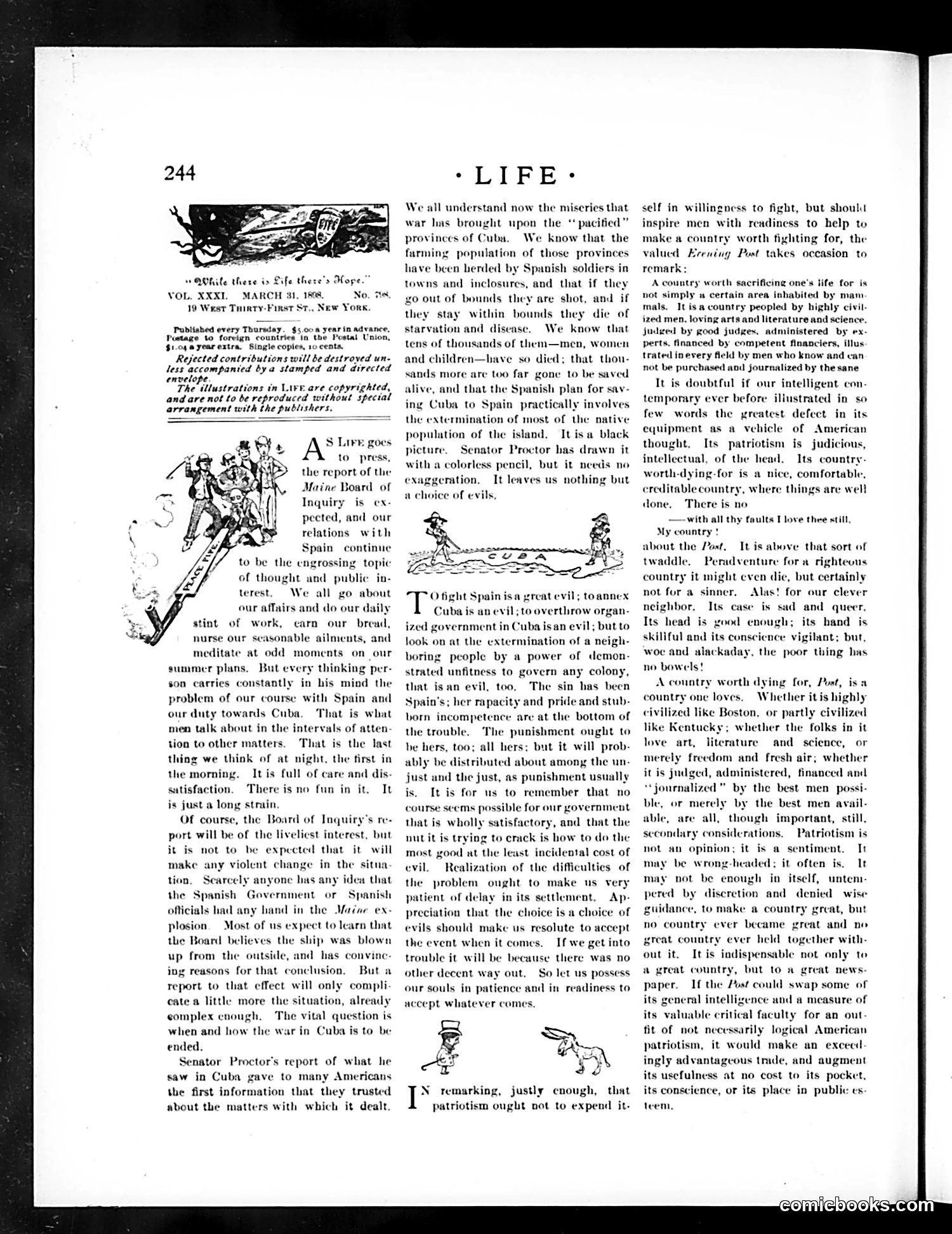
This page discusses America's moral position regarding Spain's conduct in Cuba. The editorial argues that while Spain's government and Cuba policy are evils, America shouldn't pretend righteousness—the real issue is ending the war, not moral grandstanding. The left margin contains two cartoon illustrations: one showing a figure climbing a tall ladder or mast (likely depicting American intervention/ambition), and another showing two figures in apparent conflict or struggle. The text advocates for **pragmatic patriotism** over empty moralizing—suggesting that a great nation's duty is concrete action for peace, not self-righteous posturing. The piece reflects the pre-Spanish-American War debate (1898) about America's proper role regarding Cuban independence and Spanish colonial rule.
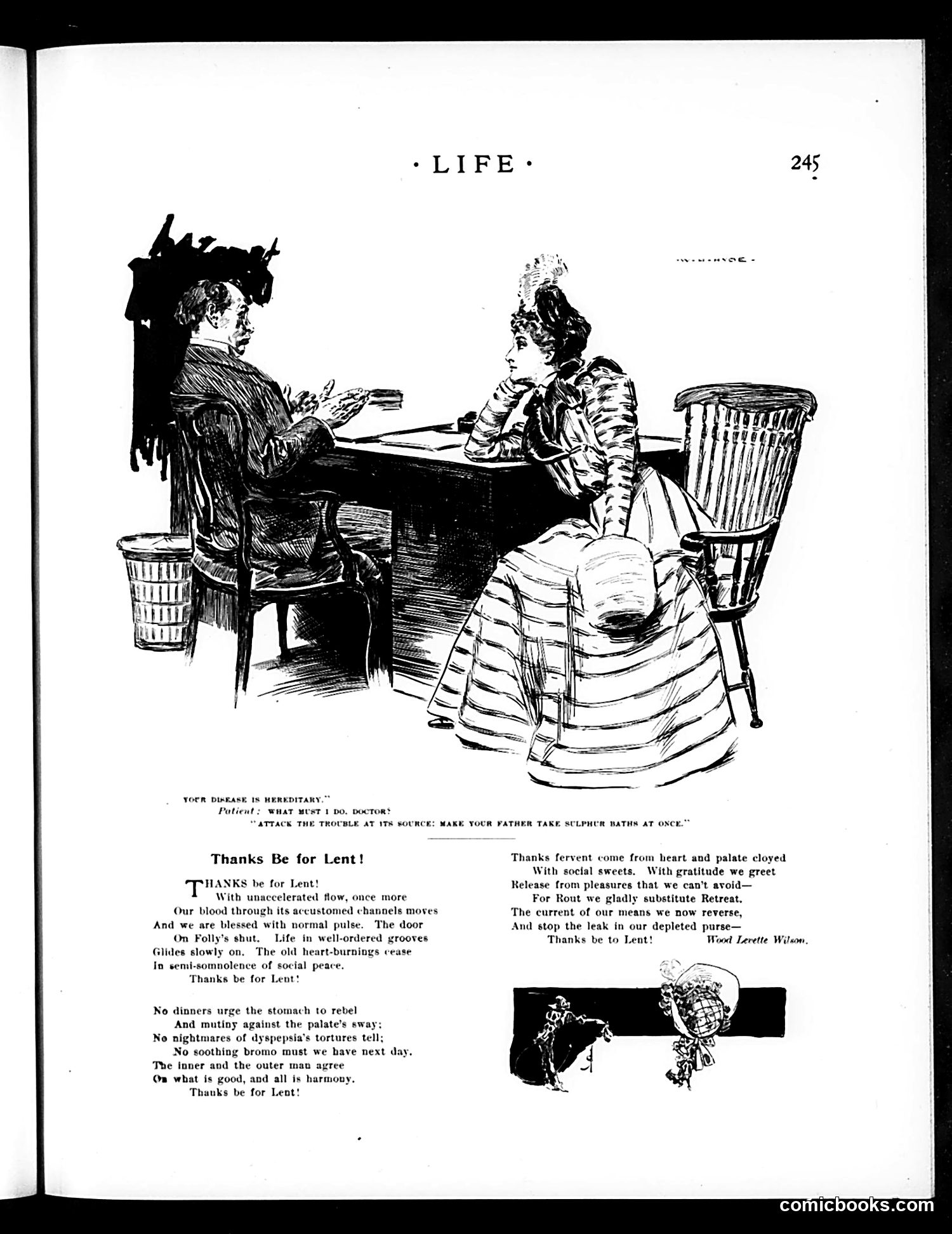
**Main Image:** A sketch shows two figures at a desk in what appears to be a medical consultation. The caption indicates a discussion about hereditary disease, with the patient requesting the doctor make "your father take sulphur baths at once" — suggesting the patient is deflecting blame for illness onto the doctor's family rather than accepting responsibility. **Poems:** Two verses titled "Thanks Be for Lent!" celebrate the religious observance of Lent, emphasizing abstinence from food and pleasures as beneficial for health and bodily discipline. References to digestive relief ("no dinners urge the stomach to rebel") suggest satirical commentary on Victorian overconsumption. **Context:** This appears to mock both hypochondria and the era's pseudo-scientific medical advice while celebrating Lenten self-restraint as genuinely healthful.
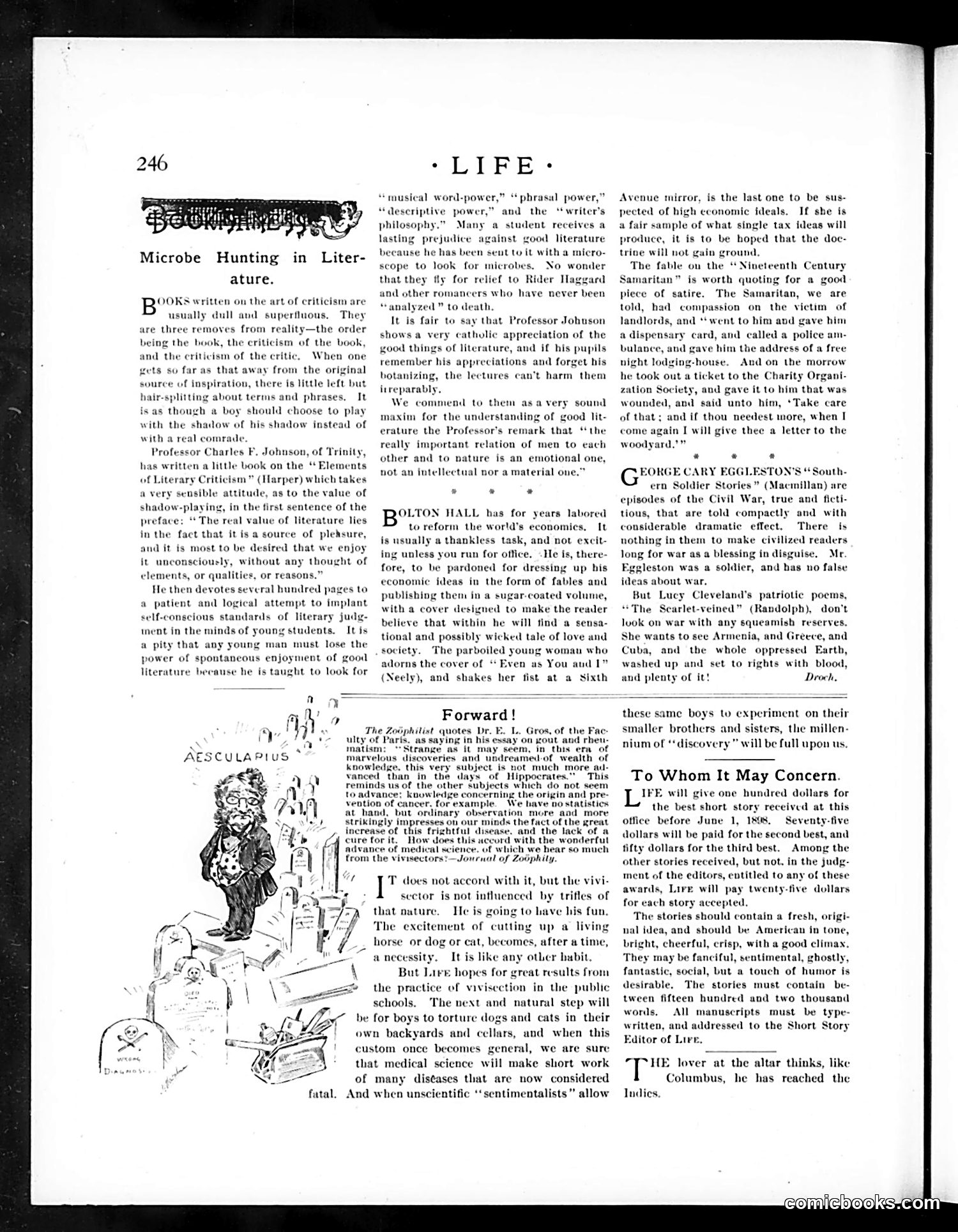
This page contains three distinct articles with one illustration. The cartoon shows a figure labeled "AESCULAPIUS" (Greek god of medicine) standing atop a pile of bones and skulls, appearing to satirize medical practice or vivisection. The articles criticize: 1. **Literary criticism** — mocking pretentious academic analysis of literature 2. **Vivisection in medicine** — condemning animal experimentation, arguing it's become a casual habit rather than necessary science 3. **War literature** — praising Civil War poetry while criticizing sanitized accounts The Aesculapius cartoon appears to attack medical science's reliance on animal testing, depicting it as building knowledge literally upon death. The overall tone is satirical critique of institutional practices (academia, medicine, publishing) the magazine viewed as corrupt or excessive.
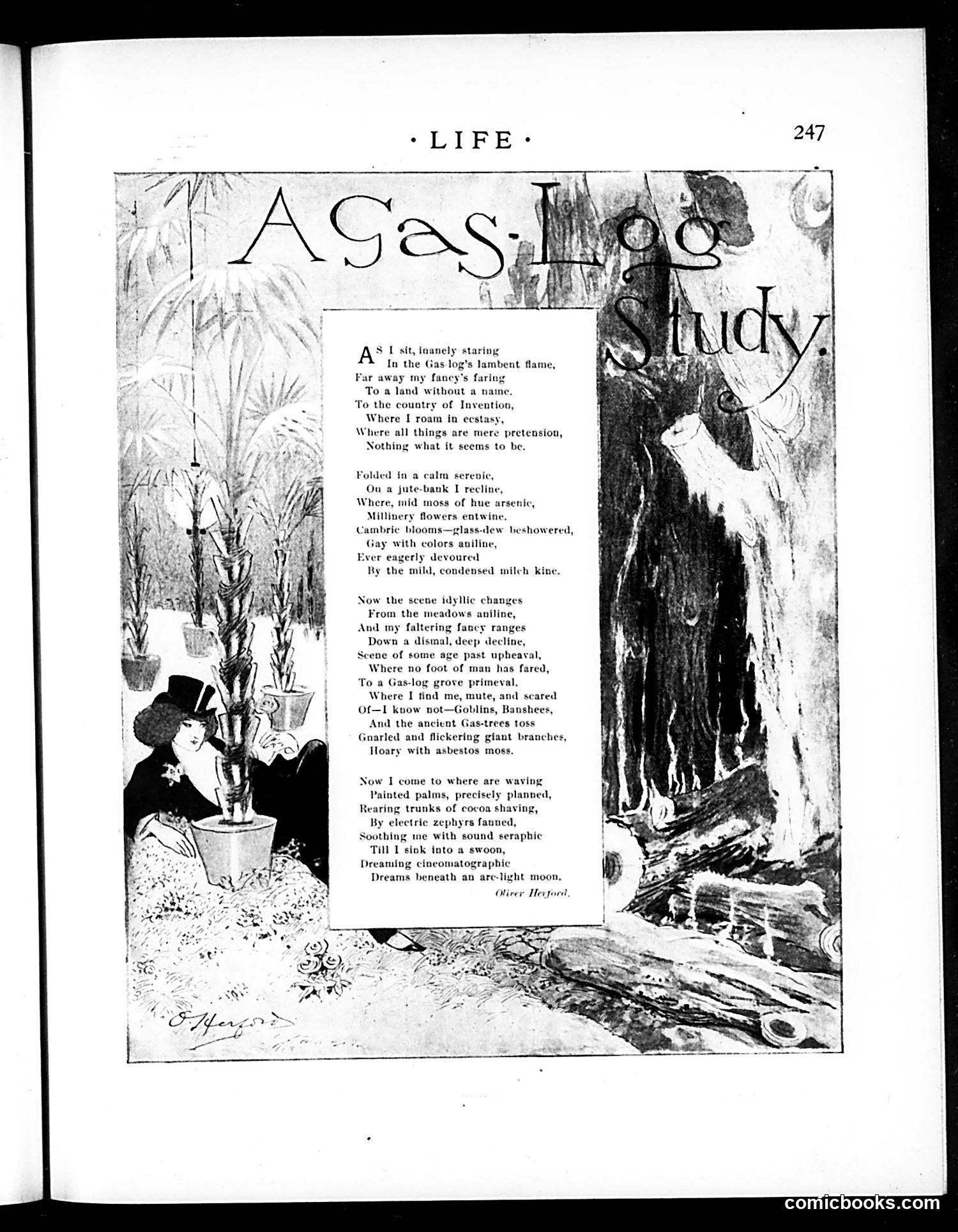
This page presents a poem titled "A Gas-Lad Study" by Oliver Herford, accompanied by two illustrations. The text is a fantastical, stream-of-consciousness narrative about daydreaming while staring at a gas lamp flame. The speaker imagines traveling to surreal landscapes—a "country of Invention" with artificial flowers and exotic plants. The left illustration shows a fashionable woman in a top hat admiring potted plants (likely palms), suggesting she's the "gas-lad" in a contemplative state. The right illustration depicts a dramatic forest scene with a ghost-like figure. The satire appears to mock aesthetic pretension and the fashionable preoccupation with exotic décor and artificial beauty among the upper classes, using the gas lamp's hypnotic effect as a metaphor for escapist fantasy.
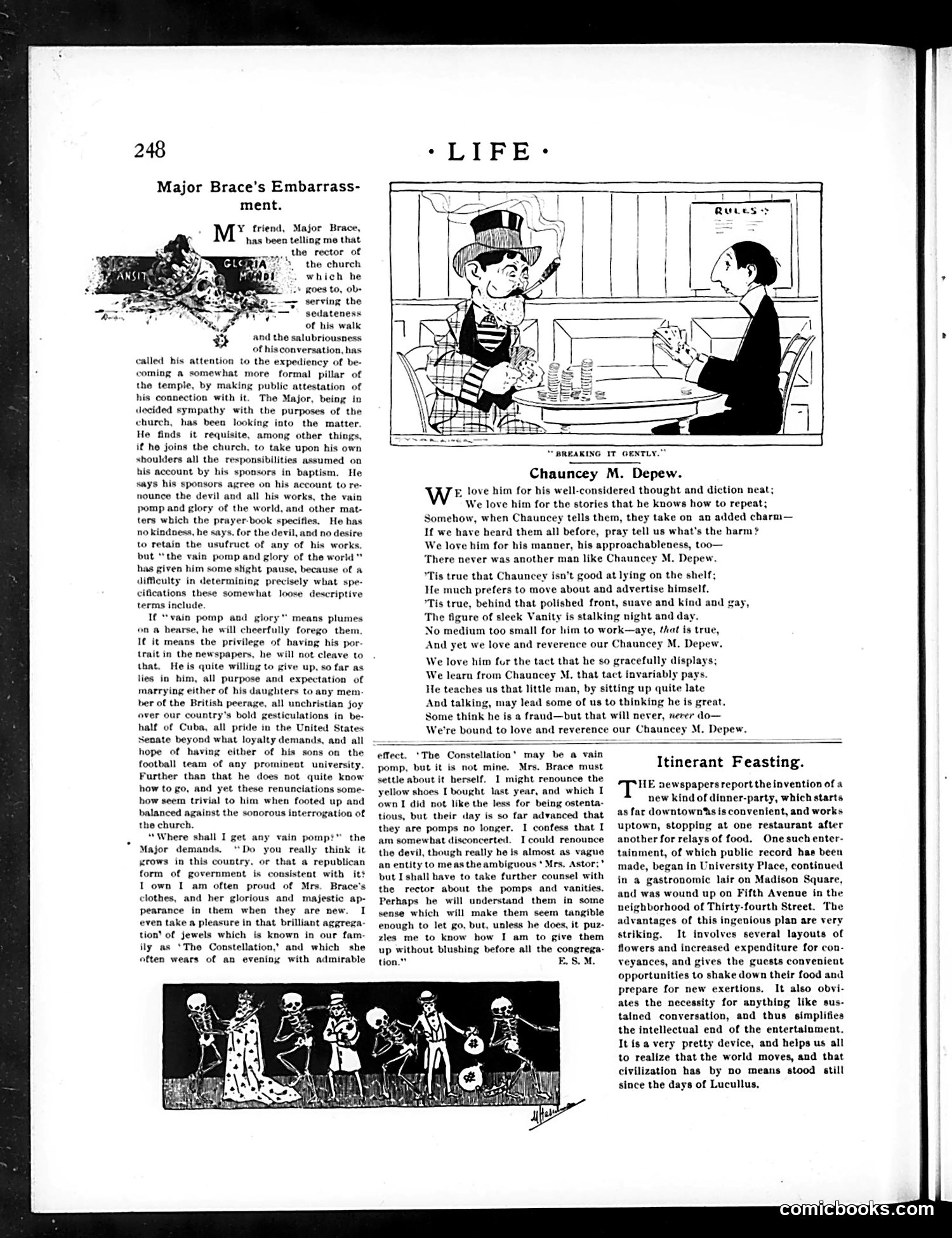
**"Major Brace's Embarrassment"** (top cartoon): The sketch depicts a church official confronting a man about his wife's excessive spending on jewelry and fancy dress. The satire targets wealthy, pompous church leaders who publicly champion moral virtue while privately displaying and justifying lavish consumption. The humor lies in the hypocrisy of religious authority figures lecturing parishioners about spiritual values while indulging in material excess. **"Chauncey M. Depew"** (poem below): A celebratory verse praising this public figure for his wit, storytelling ability, and refined manner. Depew appears to have been a prominent, admired personality of the era known for his polished deportment and entertaining conversation. **"Itinerant Feasting"** (right column): Describes a new social entertainment involving moveable restaurant parties across neighborhoods, allowing guests convenient dining experiences without traditional restaurant visits.
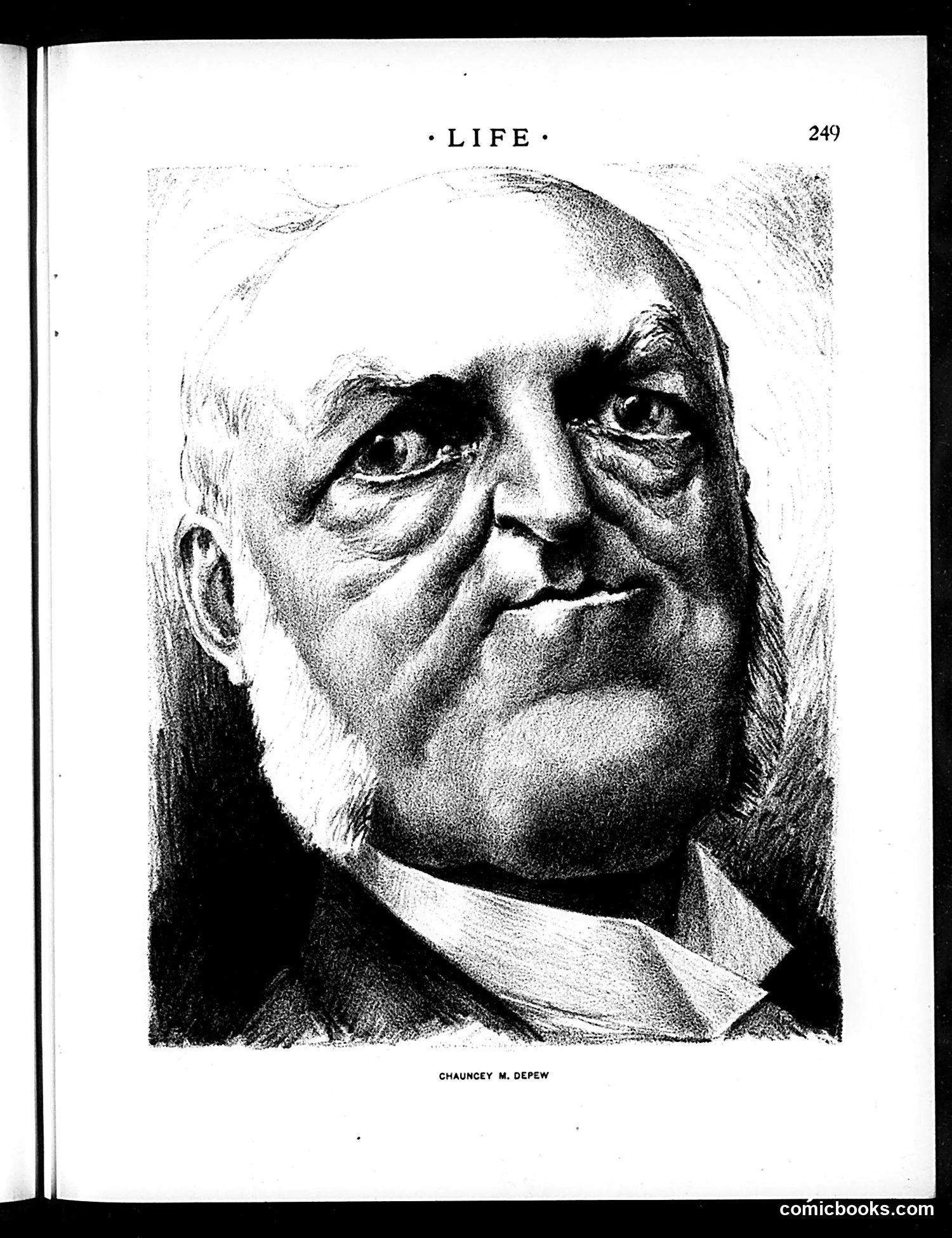
This page from *Life* magazine (page 249) features a portrait sketch labeled "CHAUNCEY M. DEPEW." The image is a detailed charcoal or pencil portrait of an older gentleman with distinctive features: receding hair, heavy-lidded eyes, and a slight smile. He's wearing what appears to be formal attire with a white shirt or collar visible. Chauncey M. Depew was a prominent American businessman, lawyer, and politician of the Gilded Age and early 20th century—a railroad executive and U.S. Senator. *Life* magazine frequently published portraits of notable public figures. Without accompanying text visible on this page, the specific satirical point or context remains unclear, though *Life's* portraiture often carried implicit commentary on the subject's prominence or character.
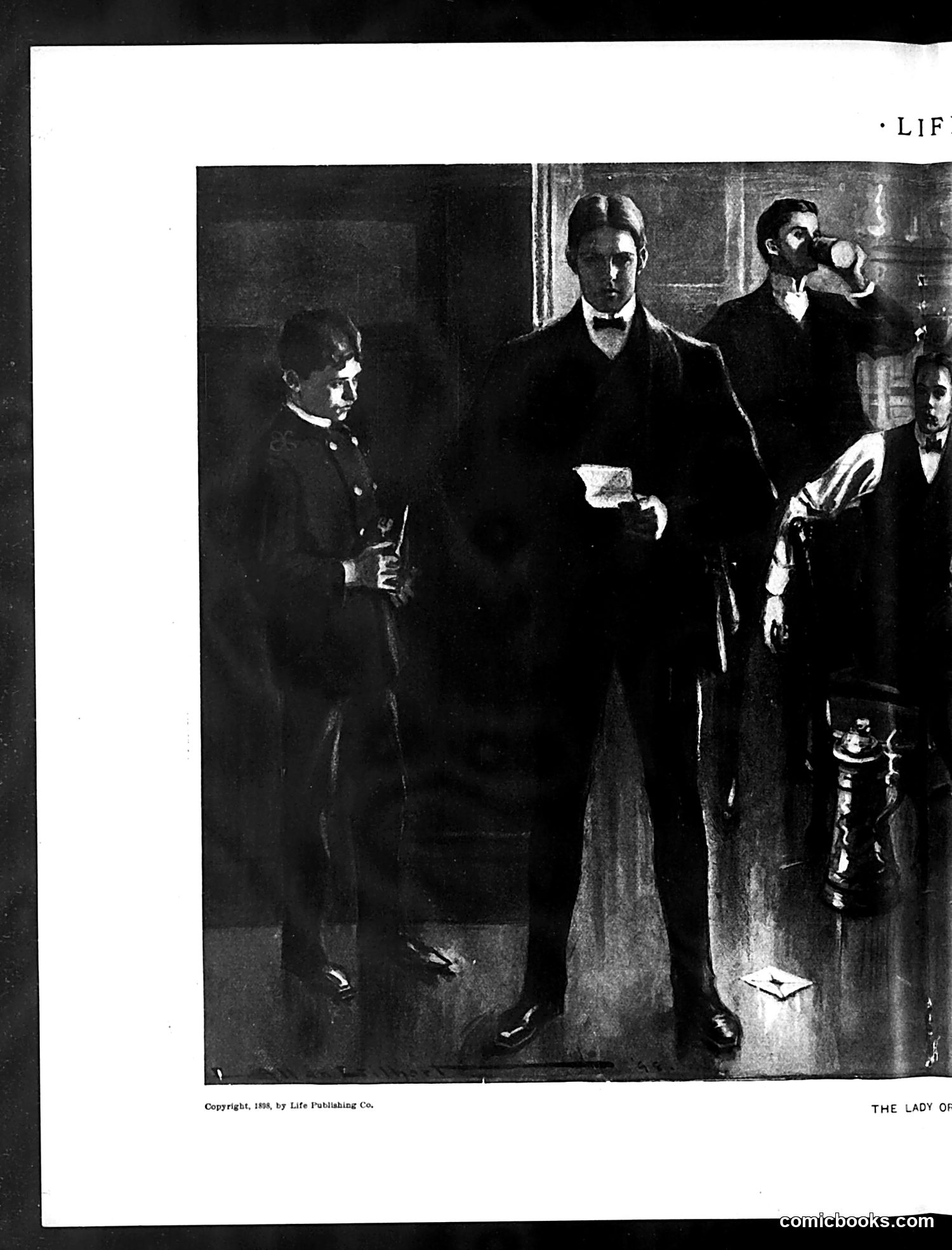
This appears to be a scene from a theatrical production or dramatic illustration titled "The Lady of..." (text cut off). The image shows five men in formal late 19th or early 20th-century attire in what appears to be an interior setting. Without the complete title or caption visible, I cannot definitively identify which specific play or satirical subject this depicts. The formal dress and indoor setting suggest either a society drama or political satire common to *Life* magazine's content. The copyright date (1898) and "Life Publishing Co." attribution confirm this is from the magazine's early period. However, without seeing the complete caption or title, I cannot accurately explain what political or social commentary this scene represents or identify the specific figures depicted.
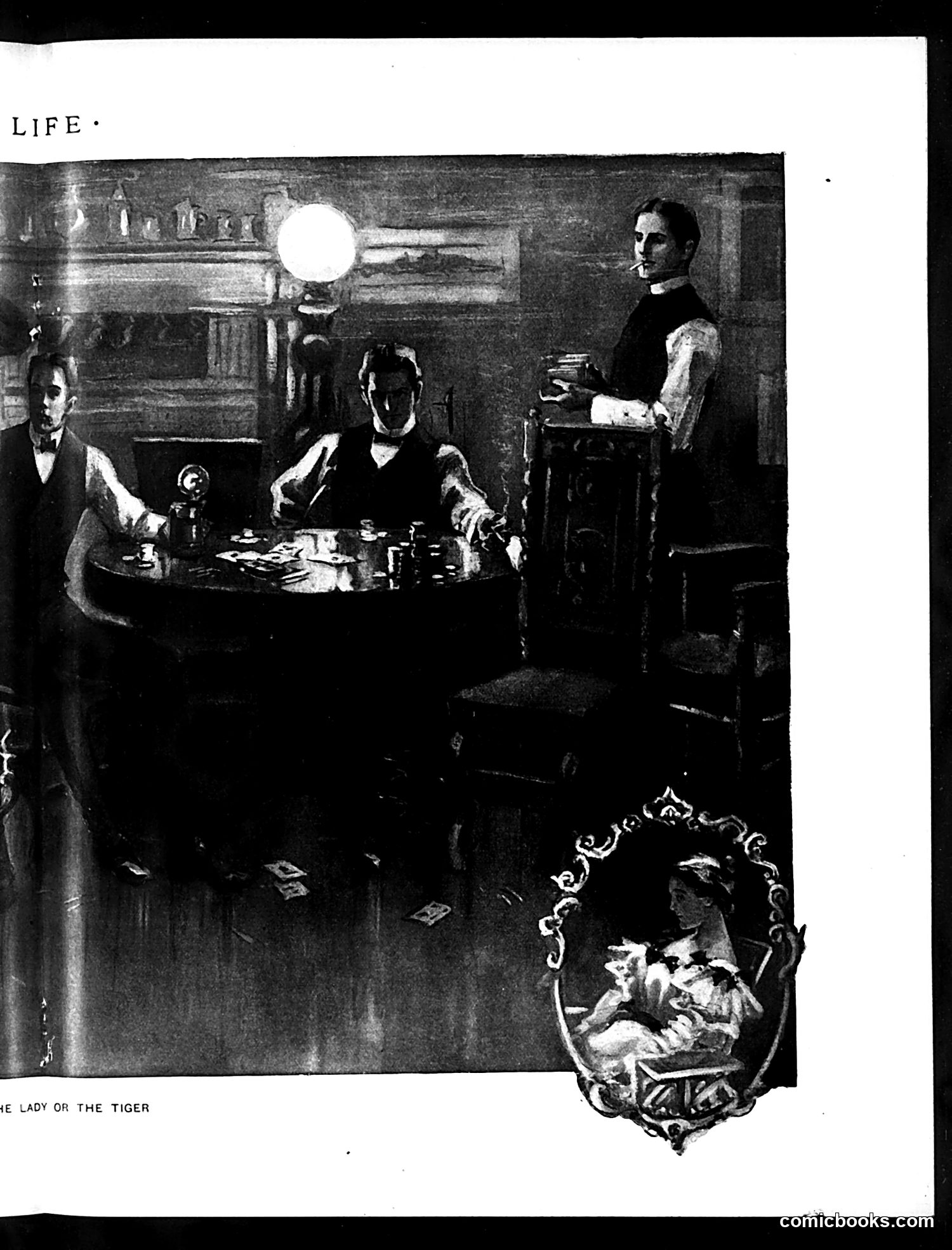
This page from *Life* magazine presents an illustration titled "The Lady or the Tiger"—a reference to Frank Stockton's famous 1882 short story about a person forced to choose between two doors, one hiding a lady and one a tiger. The scene depicts four men in formal dress gathered around a table with money and cards, suggesting a gambling game. The standing figure on the right appears to be presenting or explaining something to the seated players. The decorative frame at bottom contains a figure, likely representing the "choice" element central to Stockton's tale. The satire likely comments on gamblers' dilemma: choosing between love/reward or ruin/danger. This reflects period concerns about gambling's moral hazards and the illusory nature of chance-based fortune.
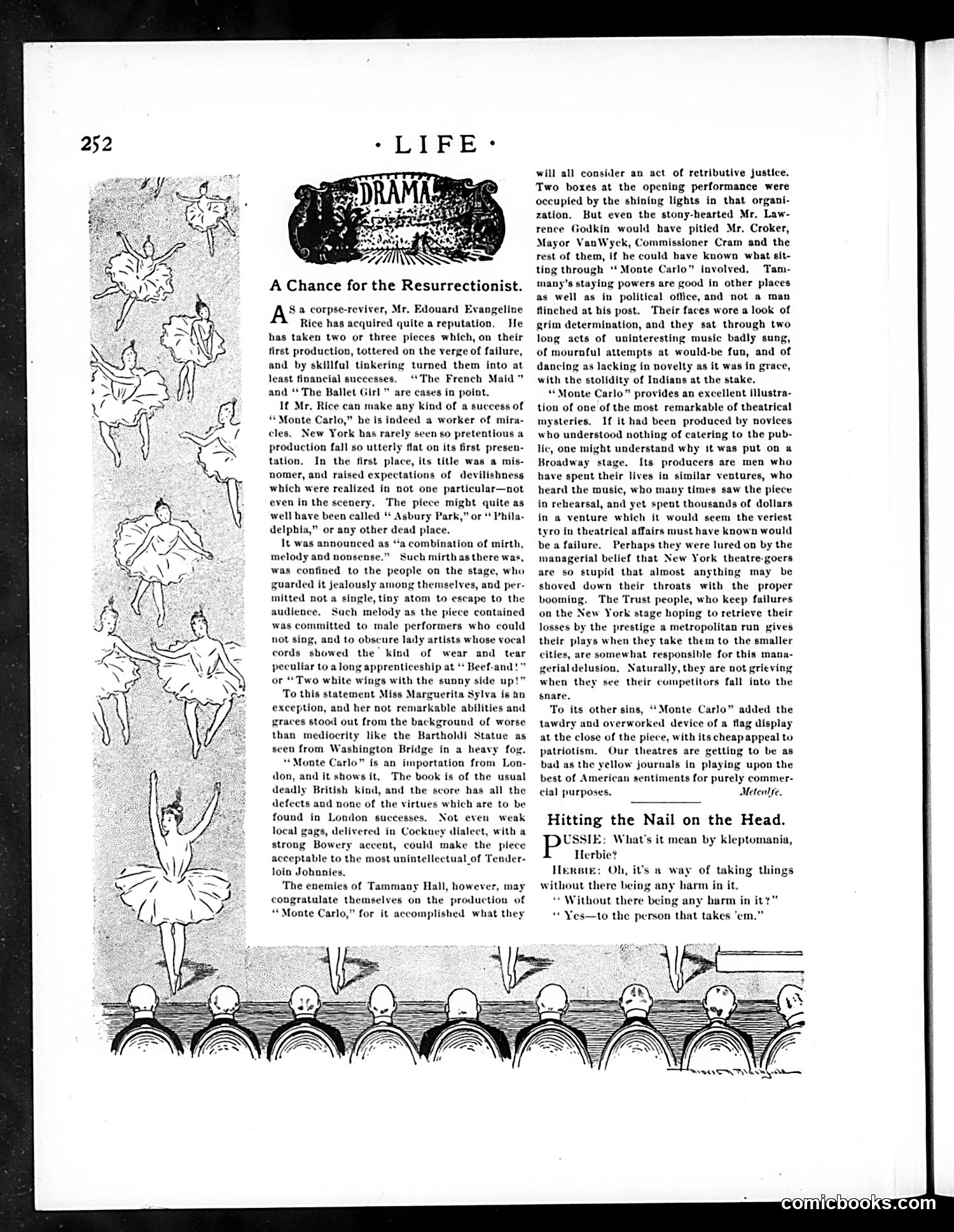
This page contains theater criticism. The main article "A Chance for the Resurrectionist" reviews the London import "Monte Carlo," a musical piece that had previously failed. The critic argues the show is mediocre—poorly constructed, featuring weak performances and unimpressive music—yet somehow succeeded in London. The piece mocks both the production's shortcomings and the theater industry's willingness to import failed shows, suggesting New York audiences and critics are easily duped. The smaller item "Hitting the Nail on the Head" is a brief comedic dialogue about "kleptomania"—a euphemistic way of describing theft without acknowledging harm. The left illustration shows theatrical dancers in an ornate decorative style typical of Life's visual humor from this era.
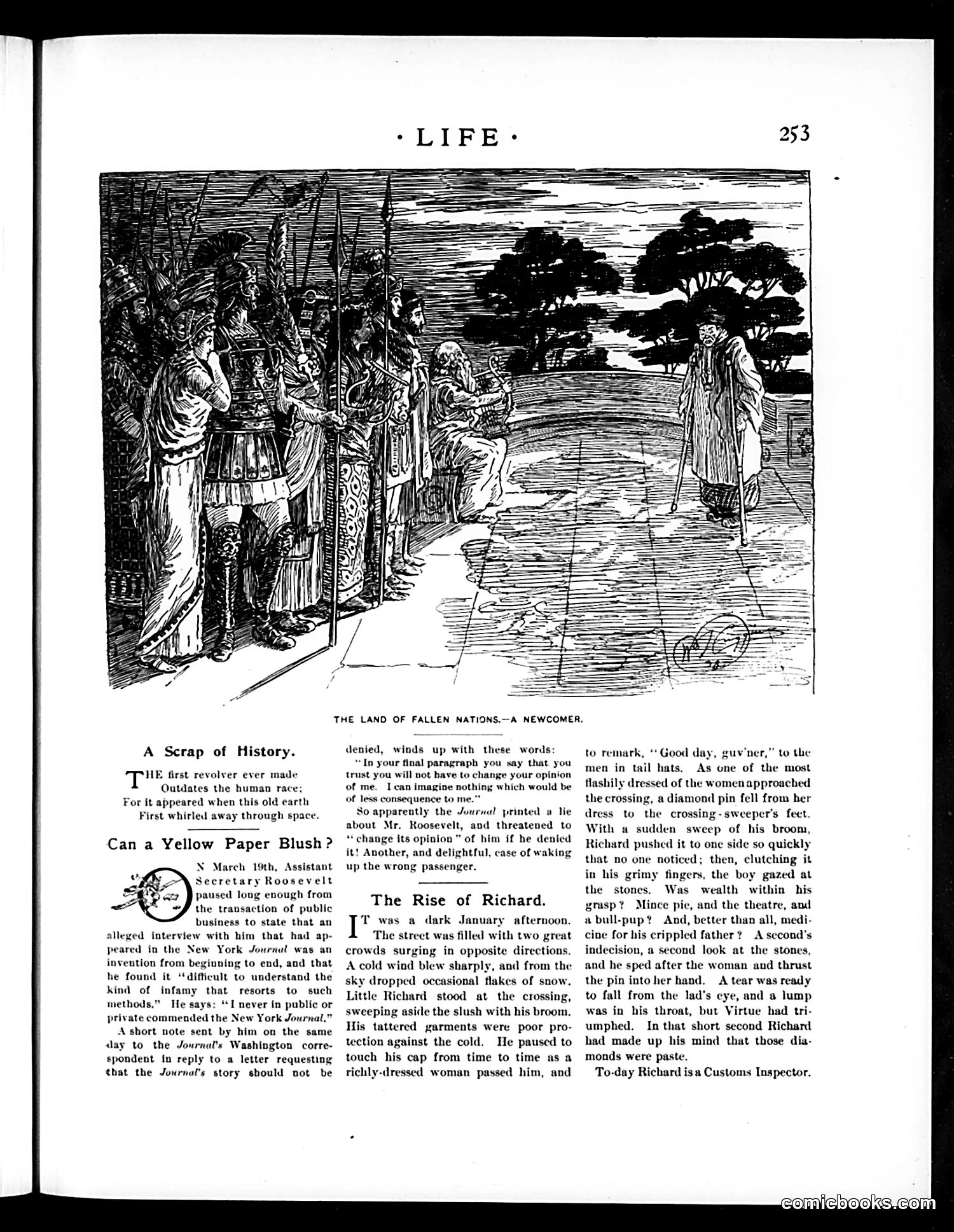
This page contains two satirical pieces from *Life* magazine: **"Can a Yellow Paper Blush?"** mocks the *New York Journal* (a sensationalist newspaper) for fabricating an interview with Assistant Secretary Roosevelt, then threatening to change its opinion of him if he denied it. The satire ridicules the Journal's audacity and logical absurdity—essentially blackmailing through bad press. **"The Rise of Richard"** is a cynical fairy tale mocking Victorian morality tales. A poor street sweeper finds and returns a woman's diamond pin, expecting virtue will be rewarded. The punchline: he becomes a Customs Inspector—a modest, bureaucratic position. The joke suggests that honesty doesn't lead to real wealth or advancement, only to mundane government work. The bitter ending ("those diamonds were paste") adds insult: his sacrifice was pointless anyway. Both pieces satirize American institutions—corrupt yellow journalism and the false promise of social mobility through virtue.
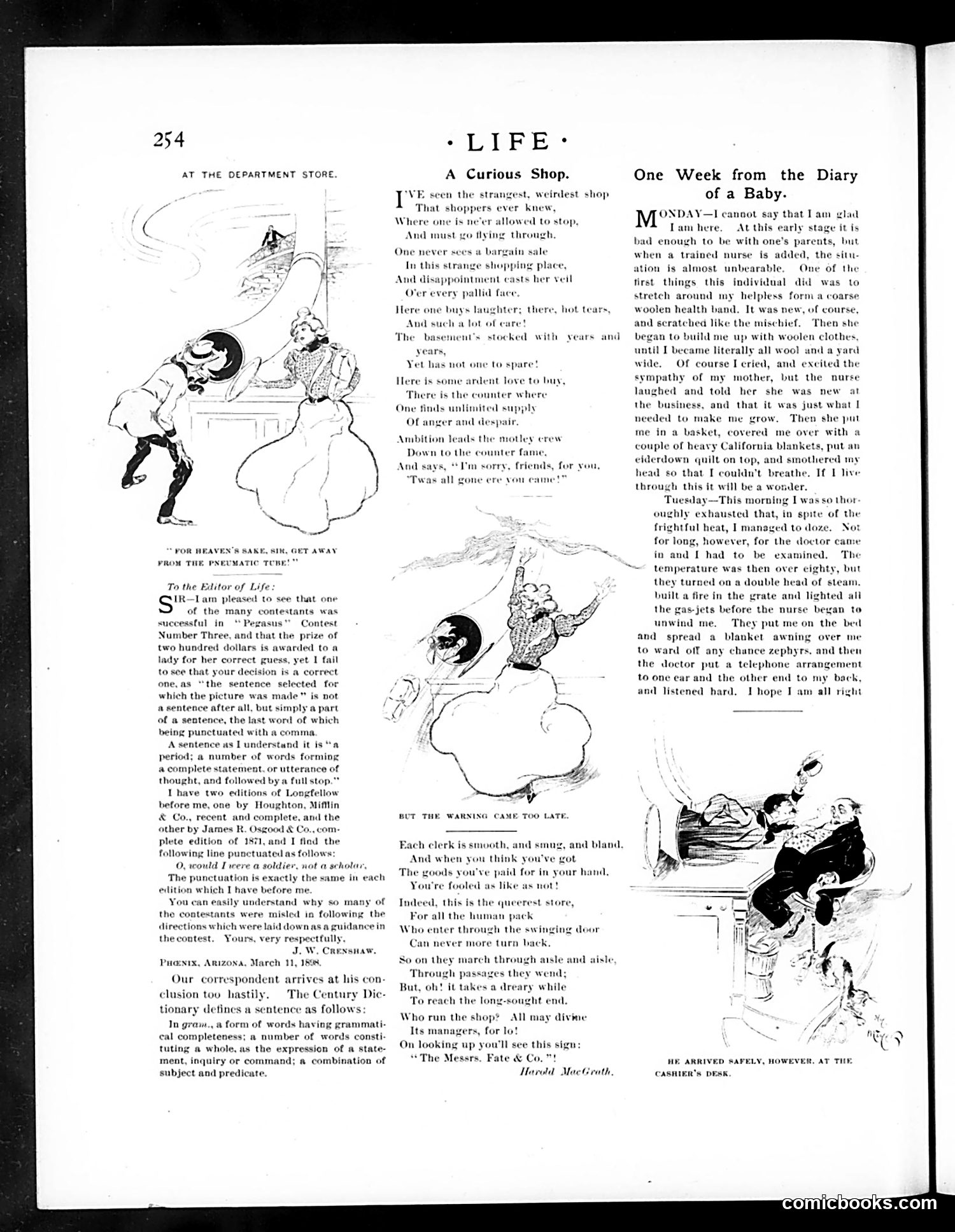
This *Life* magazine page contains three distinct pieces of satirical humor: 1. **"At the Department Store"**: A visual gag about pneumatic tube systems used in department stores to transport cash and goods. The cartoon depicts the chaotic results of these mechanical systems malfunctioning or misbehaving, poking fun at the "modern" technology of automated retail. 2. **"A Curious Shop"**: A poem with accompanying illustrations describing an allegorical store where impossible things are bought and sold—laughter, despair, love, ambition. The joke culminates in revealing the proprietors are "Fate & Co.," making life itself the "queerest store" where people never get what they expect. 3. **"One Week from the Diary of a Baby"**: A humorous first-person account where a newborn complains about being swaddled in restrictive woolen clothes and health bands by an overbearing nurse, despite his mother's sympathy. The satire mocks contemporary pediatric practices and the clash between parental instinct and professional "expert" advice. All three pieces use visual and textual humor to critique modern conveniences, life's unpredictability, and changing childcare fashions.
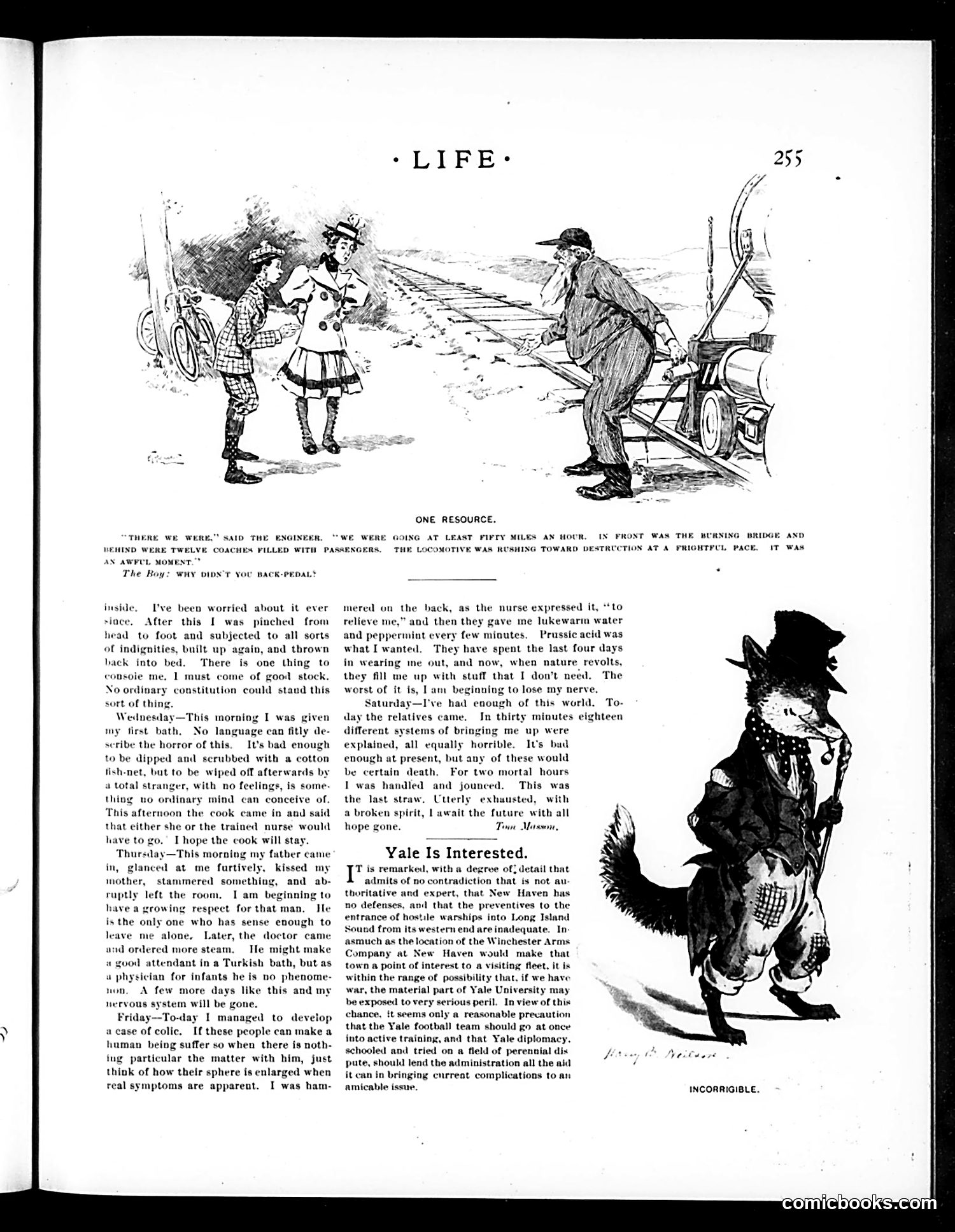
**Top Cartoon ("One Resource"):** The sketch depicts an engineer and boy on a stalled bicycle confronting a man on a motorcycle. The engineer recounts a harrowing train incident—traveling 50+ mph with a burning bridge ahead and twelve coaches of passengers. When asked why he didn't "back-pedal," the joke's absurdity lies in applying bicycle terminology to a locomotive crisis. This satirizes people offering simplistic solutions to complex problems, or perhaps mocks those who second-guess others' emergency decisions with hindsight. **Main Text:** A humorous diary of a newborn's first week, narrated from the infant's perspective. The satirical complaint catalogs medical and parental interventions—cold baths, peppermint water, handling by relatives—as torturous ordeals. It ridicules both medical fussiness and well-meaning but exhausting family attention to infants. **"Yale Is Interested" Section:** Satirizes Yale University's vulnerability to naval attack given New Haven's weak coastal defenses and the nearby Winchester Arms Company. The piece sarcastically proposes the Yale football team undergo "active training" as defense strategy—absurdist humor suggesting academic institutions cannot protect themselves against military threats.
This page from *Life* magazine contains several brief satirical items targeting American politics and social pretensions: **"Senator Scutoway"** mocks civil service reform debates. A senator becomes heated arguing about hiring qualifications, yet the anecdote shows absurdity: examiners ask a Black applicant an impossible astronomy question ("distance to the moon") for a mail-carrier position, causing him to refuse the job. The satire criticizes both the examination's irrelevance and racial discrimination in hiring. **"Whiskey Anecdote"** jokes about a Southern gentleman so wealthy he owns frozen whiskey he can break apart like ice—mocking antebellum Southern aristocratic pretense. **"Mother's Condition"** satirizes social climbing: a man avoids discussing someone's mother with an "elegant" acquaintance, fearing it's unseemly to discuss practical matters with the socially superior. The page is primarily **advertising** (Tiffany & Co., Yale tobacco, Walden Cognac, Low's soap), with these satirical snippets interspersed—typical *Life* magazine format mixing humor with commerce.
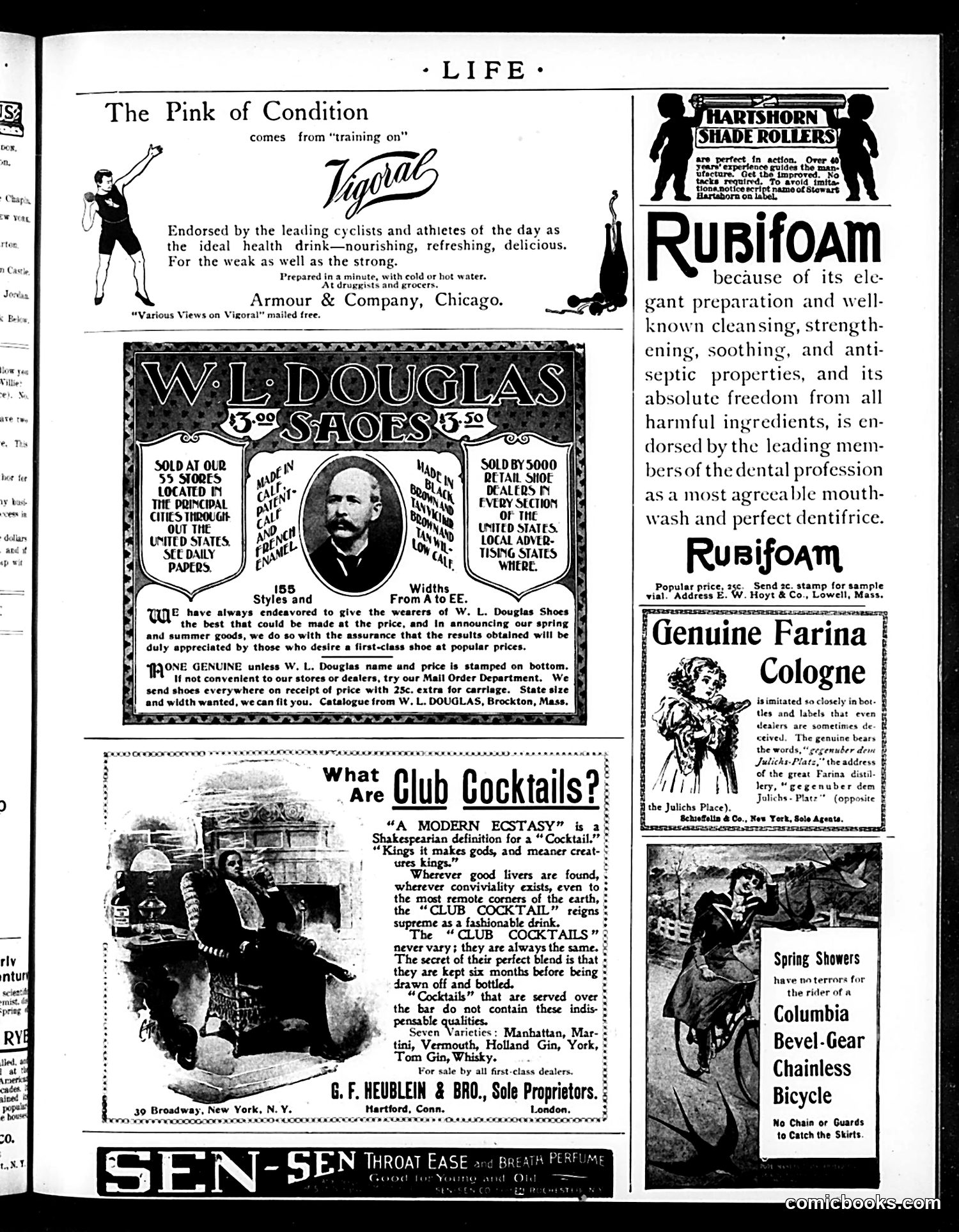
This is primarily an **advertising page** with no political cartoons or satire. The content consists of product advertisements typical of early 20th-century American magazines. Key ads include: - **Vigoral** (health drink) endorsed by athletes - **W.L. Douglas Shoes** (prominent brand emphasizing affordability and variety) - **Club Cocktails** (pre-mixed spirits marketed as reliably consistent) - **Rubifoam** (mouthwash endorsed by dentists) - **Farina Cologne** (imitating a genuine German product) - **Columbia Bevel-Gear Chainless Bicycle** (marketed to women, emphasizing safety—"no guards to catch the skirts") The advertisements reflect **turn-of-the-century consumer culture**: mass production, mail-order retail, endorsements by professionals, and products marketed as modern conveniences. The bicycle ad notably addresses women's practical concerns about clothing, indicating evolving social attitudes. There is **no satire or political content** on this page—it represents straightforward commercial messaging of the era.
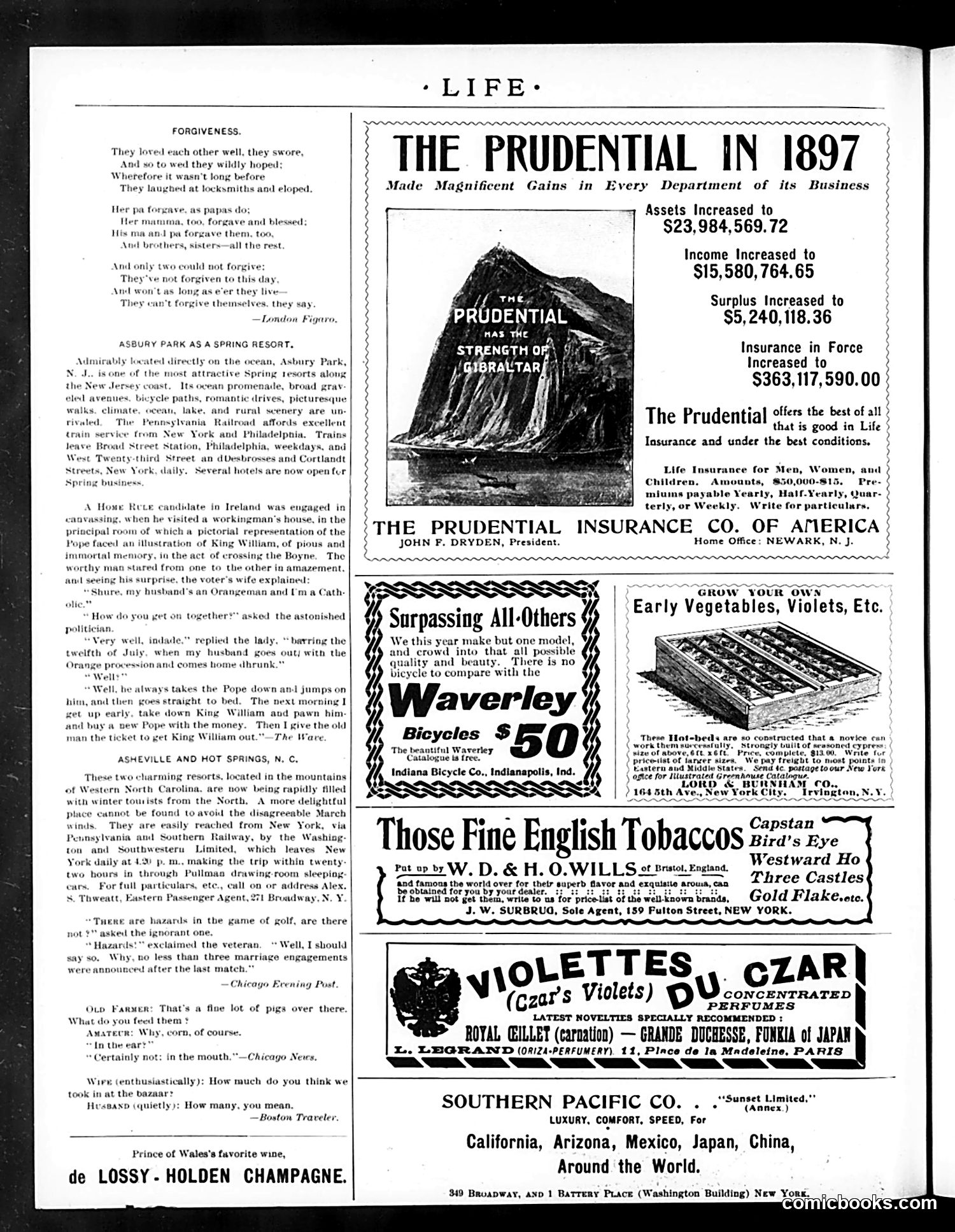
This page is primarily **advertising and light humor** rather than political satire. The content includes: **Text Content:** Humorous anecdotes about forgiveness, Irish-Catholic/Protestant tensions (a husband takes down the Pope's picture to jump on it, then pawns King William's picture for church money), and golf hazards leading to broken engagements. **Advertisements:** The page features major ads for The Prudential Insurance Company (showcasing 1897 financial gains), Waverley Bicycles ($50), Violettes du Czar perfume, English tobaccos, and travel services. **Historical Context:** This reflects the magazine's dual purpose as both satirical publication and advertising vehicle. The Irish humor reflects contemporary American attitudes toward Irish immigrant communities. The insurance and consumer goods ads indicate a growing middle-class market in the 1890s. **No significant political cartoon or satire** is present on this particular page—it's largely a period advertising layout with filler humor.
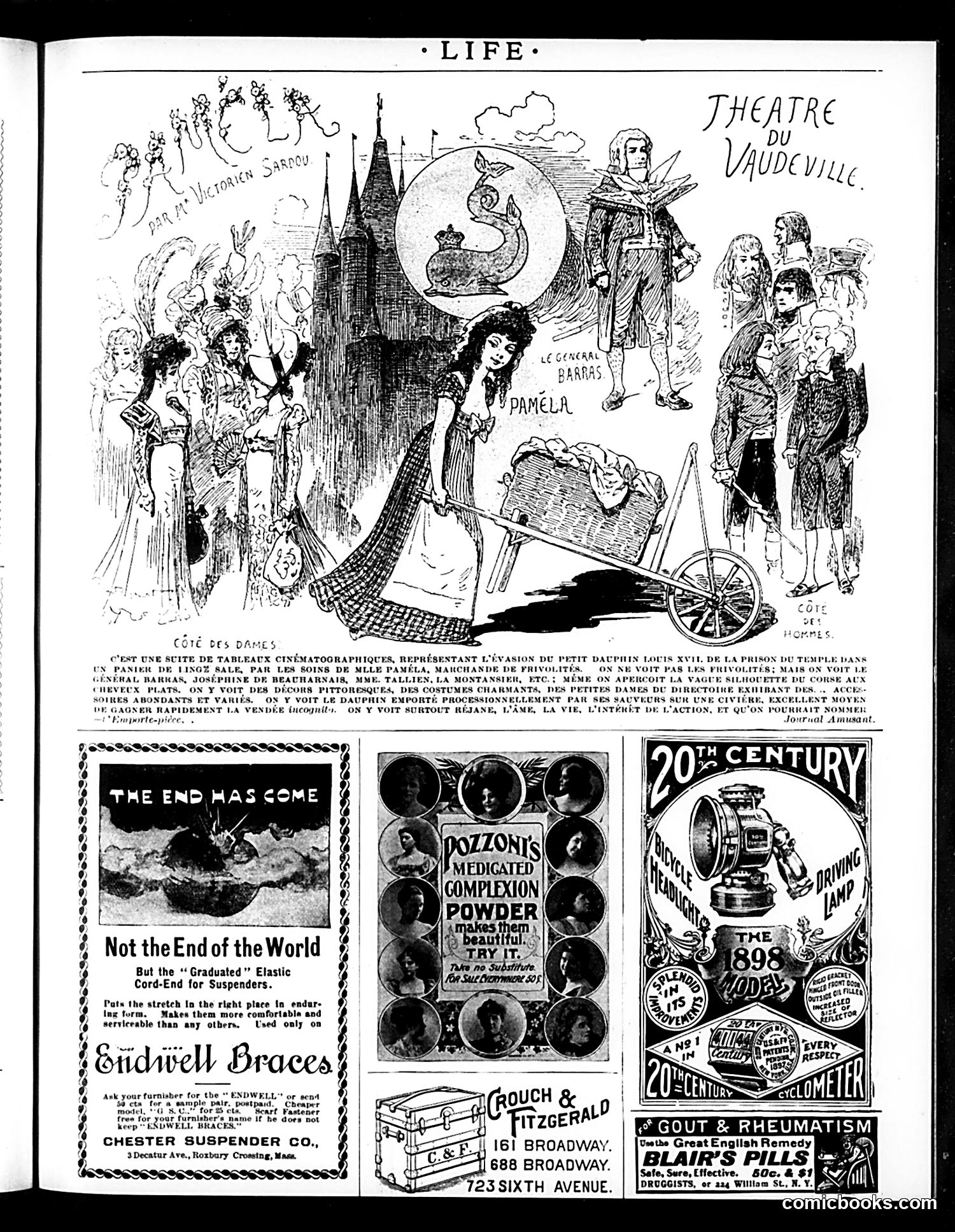
This page combines a French theatrical illustration at top with period advertisements below—typical early 20th-century Life magazine layout. **The Theatrical Illustration:** depicts "Theatre du Vaudeville," showing characters labeled "Le Général Barras," "Pamela," and "Côté des Dames" (Ladies' Side). The ornate style and French references suggest satire of dramatic Continental theater, likely mocking its elaborate conventions and romantic plots. The central swan emblem and period costumes indicate parody of aristocratic or historical drama. **The Advertisements** are standard commercial notices: Endwell Braces (elastic suspenders with graduated cord-end technology), Pozzoni's Medicated Complexion Powder, a 20th Century driving lamp, Rouch & Fitzgerald luggage, and Blair's Pills for gout and rheumatism. These reflect common consumer products and health remedies of the era, with no particular satirical intent—they're simply period advertisements typical of Life's revenue model. The page represents Life's mixed editorial/advertising approach rather than unified satirical commentary.
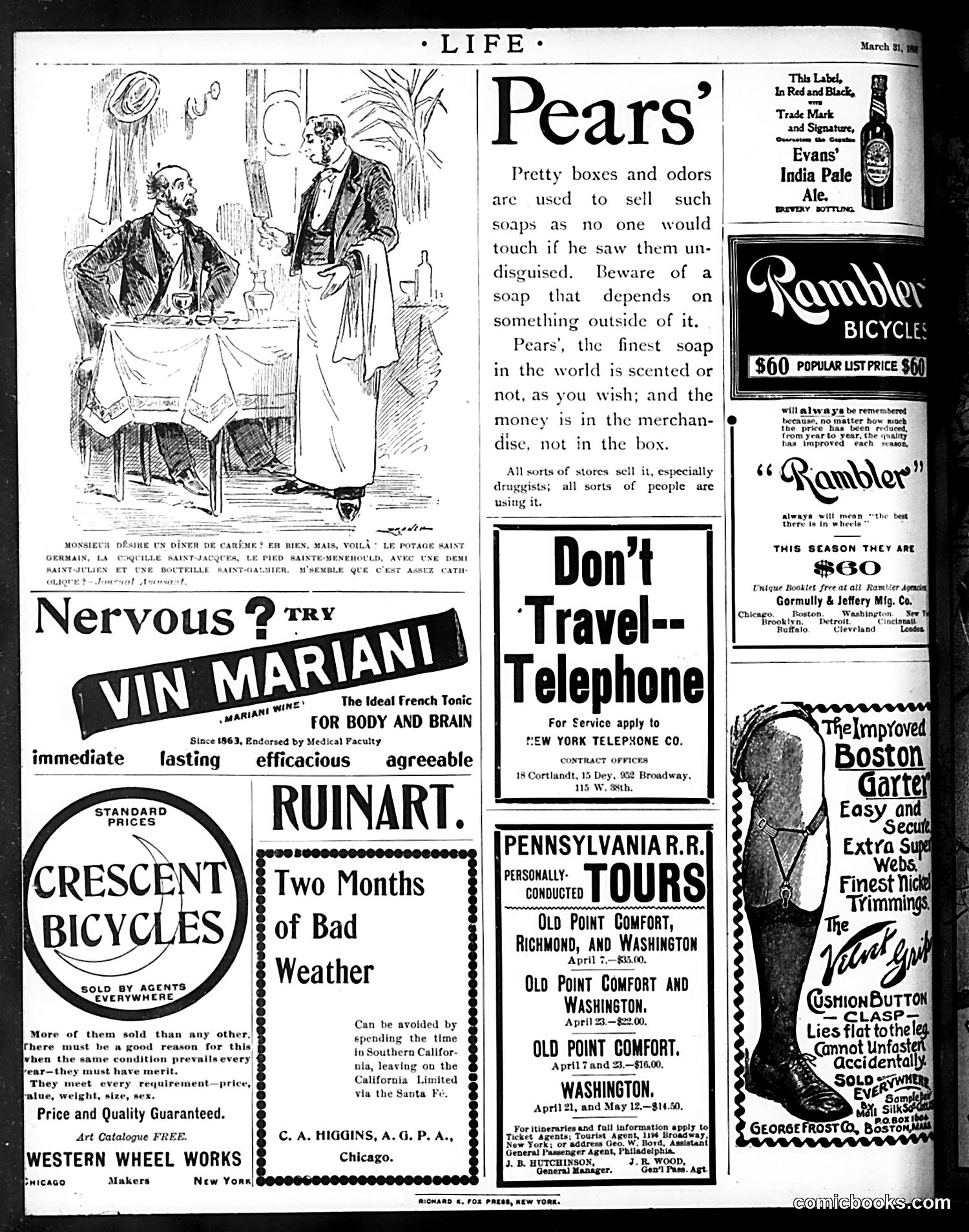
The main cartoon (top left, in French) depicts a pretentious French waiter presenting an absurdly elaborate meal, with a caption joking about the ornate names of dishes making them sound grand—a critique of how fancy language obscures mundane content. This visual pun connects to the adjacent **Pears' Soap advertisement**, which explicitly states the satirical point: "Pretty boxes and odors are used to sell such soaps as no one would touch if he saw them undisguised." The ad argues that Pears' soap is honest—the value is in the merchandise itself, not decorative packaging or perfume masking inferior quality. The satire targets late-19th-century commercial deception: manufacturers using presentation, branding, and sensory manipulation to sell ordinary or poor-quality goods. The French dinner joke and soap ad together mock consumer culture's reliance on superficial appeal over substance—a recurring theme in *Life* magazine's social criticism of the Gilded Age.