
Life, 1898-03-31 · page 4 of 20
Life — March 31, 1898 — page 4: what you’re looking at
What you’re looking at
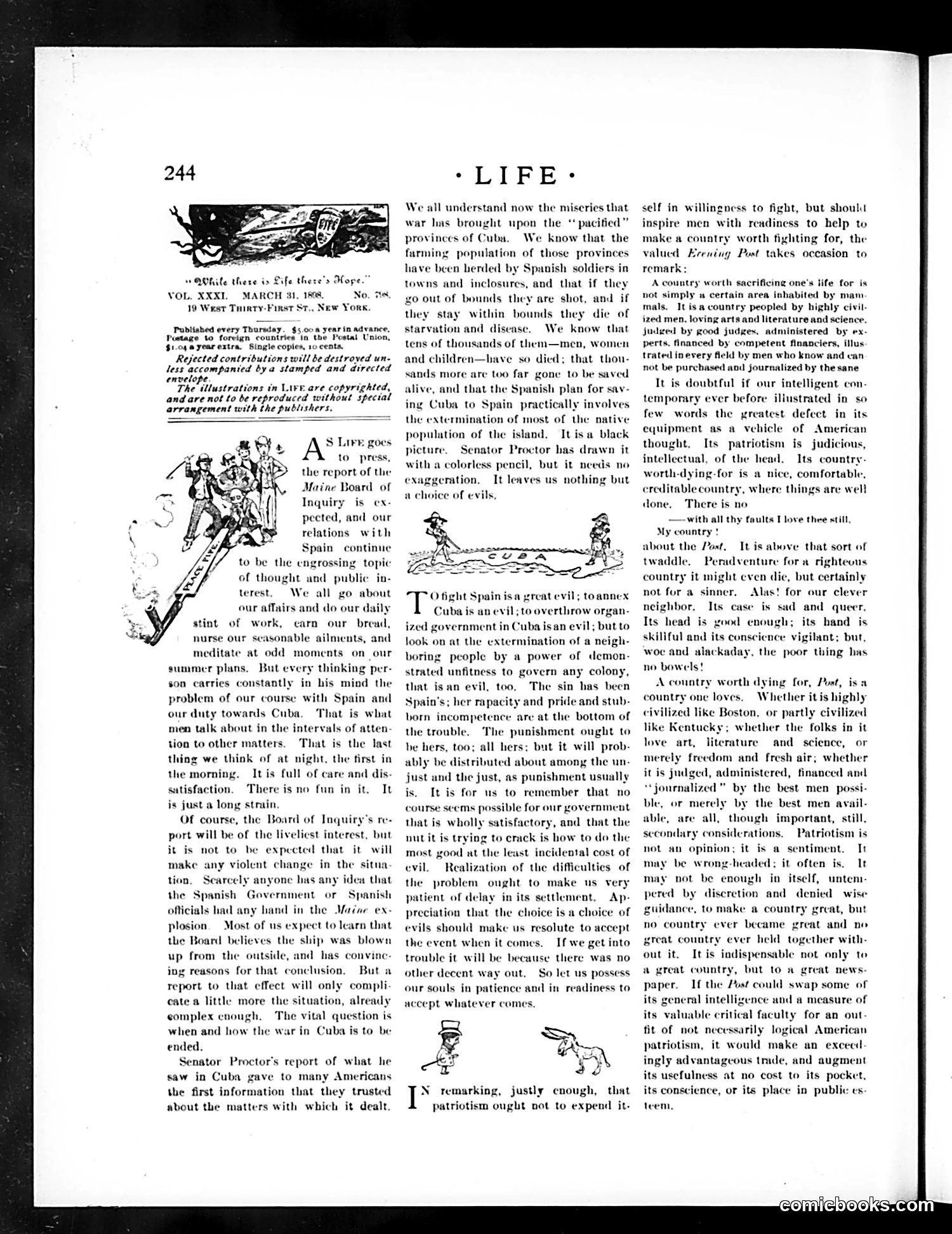
This page discusses America's moral position regarding Spain's conduct in Cuba. The editorial argues that while Spain's government and Cuba policy are evils, America shouldn't pretend righteousness—the real issue is ending the war, not moral grandstanding. The left margin contains two cartoon illustrations: one showing a figure climbing a tall ladder or mast (likely depicting American intervention/ambition), and another showing two figures in apparent conflict or struggle. The text advocates for **pragmatic patriotism** over empty moralizing—suggesting that a great nation's duty is concrete action for peace, not self-righteous posturing. The piece reflects the pre-Spanish-American War debate (1898) about America's proper role regarding Cuban independence and Spanish colonial rule.
📄 Transcribed text from this page (OCR, searchable)
Machine-transcribed from the original scan — historical spelling and the odd misread are preserved.
“OWhile there is Life there's Hope.” VOL. XXXI, MARCH 31, 18, No. 19 West Trirty-Finst St., New York, Ne Publisbed every Thursday. $5008 yearin advance, Postage to foreign countries in the Postal Union, $1.04 8 Year extra. Single copies, 10 cents, Rejected contributions will be destroyed un- less accompanted bya stamped and directed envelope The illustrations in Live are copyrighted, and are not to be reproduced without special arrangement with the publishers. AS Lire: goes to press, the report of the Maine Board of Inquiry is ex- pected, and our with relations Spain to be the engrossing topic of thought and public in- terest. We all go about our affairs and do our daily stint of work, carn our bread, nurse our seasonable ailments, and meditate at odd moments summer plans. But every thinking per- son carries constantly in his mind the problem of our course with Spain and our duty towards Cuba. That is what men talk about in the intervals of atten- tion to other matters. That is the last thing we think of at night. the first in the morning. It is full of care and di satisfaction. There is no fun in it, It is just a long strain. Of course, the Board of Inquiry’s rn port will be of the liveliest interest, it is not to make continue on our be expected that it olent change in the sitna tion, y anyone has any idea that the Spanish Government or Spanish officials had any hand in the Maéae ex- plosion Most of us expect to learn that the Board believes the ship was blown up from the outside, and has convine- ing reasons for that conclusion. But a report to that effect will only compli cate a little more the situation, already The vital question is rin Cuba is to be complex enough. when and how the w. ended, Senator Proctor’s report of what he saw in Cuba gave to many Americans the first information that they trusted about the matters with which it dealt. *LIFE: We all understand now the miseries that war has brought upon the ‘ pacified” provinces of Cuba. We know that the farming population of those provinces have been herded by Spanish soldiers in towns and inclosures, and that if they go out of bounds they are shot, and if they stay within bounds they die of We know that tens of thousands of them—men, women and children—have so died; that thou- sands more are too far gone 10 be saved alive, and that the Spanish plan for sav- ing Cuba to Spain practically involves the extermination of most of the native population of the island. It isa black picture. Senator Proctor has drawn it ith a colorless pencil, but it needs no ggcration, It leaves us nothing but starvation and disease. Ofight Spain isa great evil; toann Cuba is an evil; to overthrow organ- ized government in Cuba isan evil; but to look on at the extermination of a neigh- boring people by a power of demon- strated unfitness to govern any colony, that i The sin has been Spain's; her rapacity and pride and stub- born incompetence are at the bottom of the trouble. The punishment ought to be hers, too; all hers: but it will prob- ably be distributed about among the un- just and the just, as punishment usually is. It is for us to remember that no course seems possible for our government that is wholly satisfactory, and that the nucit is trying to crack is how to do the most good xt the least incidental cost of evil. Realization of the difficulties of the problem ought to make us very patient of delay in its settlement, Ap- preciation that the choice is a choice of evils should make us resolute to accept the event when it come If we get into trouble it will be because there was no other decent way out. So let us possess our souls in patience and in readiness to rpt whatever comes too, remarking, justly cnough, that patriotism ought not to expend it- self in willingness to fight, but should inspire men with readiness to help to make a country worth fighting for, the valued Erening Post takes occasion to remark: A country worth sacrificing one’s life for is not simply u certain area inhabited by mam mals. It isa country peopled by highly civil- ized men, loving arts and literature and science, Judged by good judges. administered by ex: perts. financed by competent financiers, illus trated inevery fled by men who know and can not be purebased and journalized by the sane It is doubtful if our intelligent con- temporary ever before illustrated in so few words the greatest defect in its equipment as a vehicle of American thought, Its patriotism is judicious, intellectual, of the head. Its country- worth-dying-for is a nice, comfortable. creditable country, where things are well done. There is no —with all thy faults T love thee still, My country ! about the Post, It is above that sort of twaddle. Peradventure for a righteous country it might even dic, but certainly not for a sinner, Alas! for our clever neighbor. Its case is sad and queer. Its head is xl cnough; its hand is skiliful and its conscience vigilant; but, woe and alackaday, the poor thing has no bowels! A country worth dying for, Post, isa country one loves. Whether itis highly civilized like Boston, or partly civilized like Kentucky; whether the folks in it art, literature and _ science, or merely freedom and fresh air; whether it is judged, administered, financed and “<jonrnalized” by the best men_possi- ble, or merely by the best men avail- able, are all, though important, still, secondary considerations. Patriotism is not an opinion; it is a sentiment. It may be wrong-headed; it often is. It may not be enough in itself, untem- pered by discretion and denied wise guidance, to make a country great, but no country ever became great and ne great country ever held together with- out it. Itis indispensable not only te a great country, but to a great news- paper. If the Post could swap some of its general intelligence and a measure of its valuable critical faculty for an out fit of not necessarily logical American patrio' it would make an exceed ingly advantageous trade, and augment its usefulness at no cost to its pocket, its conscience, of its place in public es teem, love