
Life, 1898-03-31 · page 6 of 20
Life — March 31, 1898 — page 6: what you’re looking at
What you’re looking at
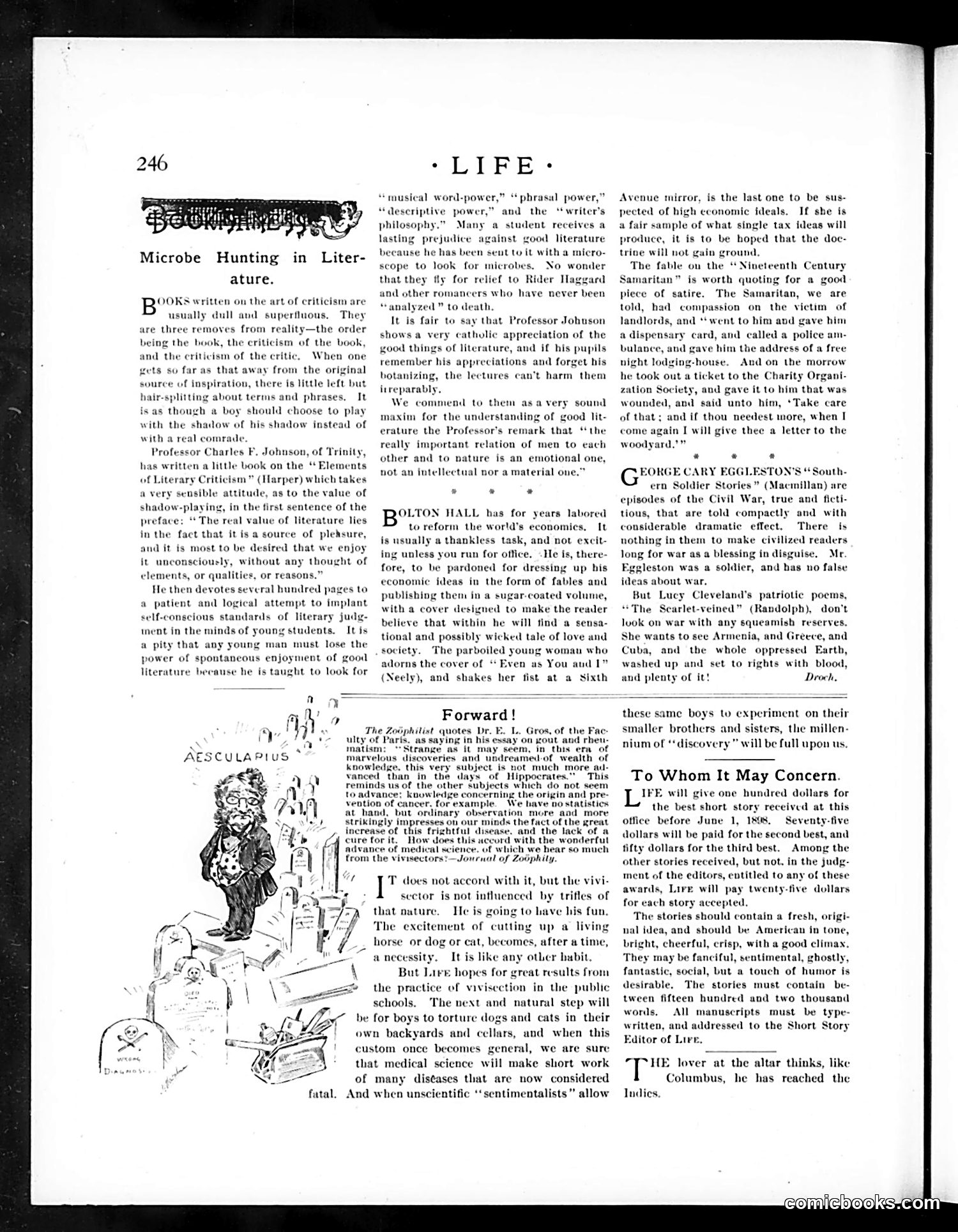
This page contains three distinct articles with one illustration. The cartoon shows a figure labeled "AESCULAPIUS" (Greek god of medicine) standing atop a pile of bones and skulls, appearing to satirize medical practice or vivisection. The articles criticize: 1. **Literary criticism** — mocking pretentious academic analysis of literature 2. **Vivisection in medicine** — condemning animal experimentation, arguing it's become a casual habit rather than necessary science 3. **War literature** — praising Civil War poetry while criticizing sanitized accounts The Aesculapius cartoon appears to attack medical science's reliance on animal testing, depicting it as building knowledge literally upon death. The overall tone is satirical critique of institutional practices (academia, medicine, publishing) the magazine viewed as corrupt or excessive.
📄 Transcribed text from this page (OCR, searchable)
Machine-transcribed from the original scan — historical spelling and the odd misread are preserved.
Microbe Hunting in Liter- ature. B' JOKS written on the art of eriticism are usually dull and superfluous. They are three removes from reality—the order ok, the criticism of the book, and the criticism of the critic, When one ts so faras that away from the origin: of inspiration, there is little left but bair-splitt out terms and phrases. It isas though a boy should choose to play with the shadow of his shadow instead of with a real comra Professor Charles F. Johnson, of Trinity, has written a little book on the “ Elements of Literary Criticism” (Harper) which takes a very sensible attitude, as to the value of shadow-playing, in the first sentence of the preface; “ The real value of literature lies in the fact that it isa source of pledsure, and it is most to be desired that we enjoy it unconsciously, without any thought of nts, or qualities, or reasons. He then devotes several hundred pages to a patient and logical attempt to implant self-conscious standards of literary judg- inent in the minds of young students. It is a pity that any young man must lose the power of spontaneous enjoyment of good literature because he is taught to look for being the I sourc *LIFE: “musical word-power,” “descriptive power,” and the “writer's philosophy.” Many a student receives a lasting prejudice against good literature because he has been sent to it with a micro- scope to look for microbes. No wonder that they fly for relief to Rider 1 and other romancers who have never been “analyzed” to death, It is fair to say th “ phrasal power,” t Professor Johuson shows a very catholic appreciation of the good things of literature, and if his pupils remember his appreciations and forget his hotanizing, the lectures can't harm them inreparably. We commend to them asa very soun! maxim for the understanding of good lit- erature the Professor's remark that “the really important relation of men to each other and to nature is an emotional one, not an intellectual nor a material one.” * * * OLTON HALL has for years labored to reform the world’s economics, [t is usually a thankless task, and not excit- ing unless you run for office. «He fs, there- fore, to be pardoned for dressing up his economic ideas in the form of fables and publishing them in a sugar-coated volume, with a cover designed to make the reader believe that within he will tind a sensa- tional and possibly wicked tale of love and society. The parboiled young woman who adorns the cover of * Even as You aud 1” (Neely), and shakes her fist at a Sixth Forward! The Zobphitist quotes Dr. EL. Gros, of the Fac: ulty of Paris. as saying in hi matism: marvelc AESCULA essay on xout and rheu- ay seem, in this era of indreamedof wealth of “Strange as itt s discoveries and knowledge. this very subject is not much more ad- vanced than in the days of Hippocrates." This reminds us of the other subjects which do not seem to advance; knowledge concerning the origin and pre- vention of cancer. for example. We have no statistics at hand, but ordinary observation more and more strikingly impresses on our minds the fact of the great increase of this frightful disease cure for it, and the lack of a How does this accord with the wonderful advance of medical science. of which we hear so much from x be La the vivisectors:—Jonrnal of Zodphily. does not accord with it, but the vivi- sector is not influenced by trifles of that nature. Ie is going to have his fun, The excitement of cutting up a livin horse or dog or cat, becomes, after a time, anecessity. It is like any other habit, But Lire hopes for great results from the practice of vivisection in the public schools. The next and natural step will for boys to torture dogs and cats in their own backyards and cellars, und when this custom once becomes general, we are sure that medical science will make short work of fatal, And many distases that are now considered when unscientific “sentimentalists” allow Avenue mirror, is the last one to be sus- pected of high cconomic ideals, If she is a fair sample of what single tax ideas will produce, it is to be hoped that the doc- trine will not gain ground, The fable ou the “ Nineteenth Century Samaritan” is worth quoting for a good piece of satire. The Samaritan, we are told, had compassion the victim of landlords, and ‘‘ went to him and gave him adispensary card, and called a police am- bulance, and gave him the address of a free night lodging-house. And on the morrow he took out a ticket to the Charity Organi- zation Society, and gave it to him that was wounded, and said unto him, ‘Take care of that; and if thou needest more, when I come again I will give thee a letter to the an on wood * * * ORGE CARY EGGLESTON’S “ South- ern Soldier Stories ” (Macmillan) are episodes of the Civil War, true and ficti- tious, that are told compactly and with considerable dramatic effect. There is nothing in them to make civilized readers long for war as a blessing in disguise. Mr Eggleston was a soldier, and bas no false id about war, But Lucy Cleveland's patriotic poems, “The Scarlet-veined” (Randolph), don't luok on war with any squeamish reserves, She wants to see Armenia, and Greece, and Cuba, and the whole oppressed Earth, washed up and set to rights with blood, and plenty of it! Droch. these same boys to experiment on their smaller brothers and sisters, the millen- nium of “discovery” will be full upon us. To Whom It May Concern. IFE will give one hundred dollars for the best short story received at this office before June 1, 1808, Seventy-five dollars will be paid for the second best, and fifty dollars for the third best. Among the other stories received, but not, in the judg- ment of the editors, entitled to any of these awards, Lire will pay twenty-five dollars for each story accepted. The stories should contain a fresh, origi- nal idea, and should be American in tone, bright, cheerful, crisp, with a good climax, They may be fanciful, sentimental, ghostly, fantastic, social, but a touch of humor is desirable, The stories must contain be- tween fifteen hundred and two thousand words, All manuscripts must be type- written, and addressed to the Short Story Editor of Lire. “TC HE lover at the altar thinks, like Columbus, he has reached the Indies.