
Life, 1898-03-31 · page 12 of 20
Life — March 31, 1898 — page 12: what you’re looking at
What you’re looking at
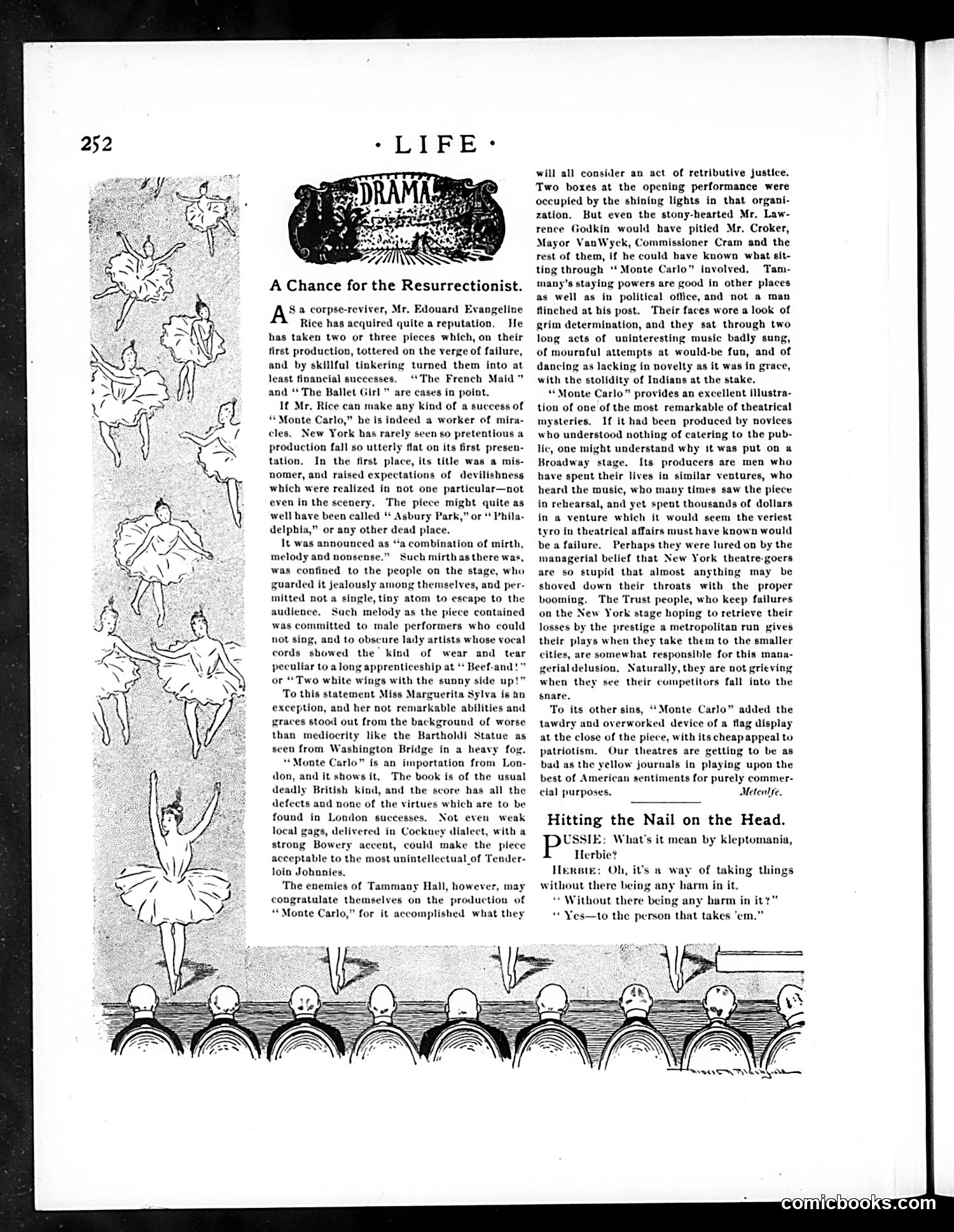
This page contains theater criticism. The main article "A Chance for the Resurrectionist" reviews the London import "Monte Carlo," a musical piece that had previously failed. The critic argues the show is mediocre—poorly constructed, featuring weak performances and unimpressive music—yet somehow succeeded in London. The piece mocks both the production's shortcomings and the theater industry's willingness to import failed shows, suggesting New York audiences and critics are easily duped. The smaller item "Hitting the Nail on the Head" is a brief comedic dialogue about "kleptomania"—a euphemistic way of describing theft without acknowledging harm. The left illustration shows theatrical dancers in an ornate decorative style typical of Life's visual humor from this era.
📄 Transcribed text from this page (OCR, searchable)
Machine-transcribed from the original scan — historical spelling and the odd misread are preserved.
A Chance for the Resurrectionist. $a corpse-reviver, Mr. Edouard Evangeline Rice has acquired quite a reputation. He has taken two or three pieces which, on their first production, tottered on the verge of failure, and by skillful tinkering turned them into at least financial successes. ‘‘The French Maid ” and ‘ The Ballet Girl” are cases in point. If Mr. Rice can make any kind of a success of “Monte Carlo,” he is indeed a worker of mira- cles. New York has rarely seen so pretentious a production fall so utterly flat on its first presen- tation, In the first place, its title was a mis- nomer, and raised expectations of devilishness which were realized in not one particular—not even in the scenery. The piece might quite as well have been called ** Asbury Park,” or‘ Phila- delpbia,” or any other dead place. Tt was announced as “‘a combination of mirth, melody and nonsense.” Such mirth as there was, was confined to the people on the stage, who guarded it jealously among themselves, and per- mitted not a single, tiny atom to escape to the audience. Such melody as the piece contained was committed to male performers who could not sing, and to obscure lady artists whose vocal cords showed the kind of wear and tear peculiar to along apprenticeship at “ Beef-and or “Two white wings with the sunny side up! To this statement Miss Marguerita Sylva is an exception, and her not remarkable abilities and graces stood out from the background of worse than mediocrity like the Bartholdi Statue as scen from Washington Bridge in a heavy fog. “Monte Carlo” fs an importation from Lon- don, and it shows it, The book is of the usual deadly British kind, and the score has all the defects and none of the virtues which are to be found in London successe: Not even weak local gags, delivered in Cockney dialect, with a strong Bowery accent, could make the piece acceptable to the most unintellectual_of Tender- loin Johnnies, ‘The enemies of Tammany Hall, however, may congratulate themselves on the production of “Monte Carlo,” for it accomplished what they will all consider an act of retributive justice. Two boxes at the opening performance were occupied by the shining lights in that organi- zation. But even the stony-hearted Mr. Law- rence Godkin would have pitied Mr. Croker, Mayor VanWyck, Commissioner Cram and the rest of them, if he could have known what sit- ting through “Monte Carlo” involved. Tam- many’s staying powers are good in other places as well as in political office, and not a man flinched at his post. Their faces wore a look of grim determination, and they sat through two long acts of uninteresting music badly sung, of mournful attempts at would-be fun, and of dancing as lacking in novelty as it was in grace, with the stolidity of Indians at the stake. “Monte Carlo” provides an excellent illustra- tion of one of the most remarkable of theatrical mysteries, If it had been produced by novices who understood nothing of catering to the pub- lic, one might understand why it was put on a Broadway stage. Its producers are men who have spent their lives in similar ventures, who heard the music, who many times saw the piece in rehearsal, and yet spent thousands of dollars in a venture which it would seem the veriest tyro in theatrical affairs must have known would be a failure. Perhaps they were lured on by the managerial belief that New York theatre-goers are so stupid that almost anything may be shoved down their throats with the proper booming. The Trust people, who keep failures on the New York stage hoping to retrieve their losses by the prestige a metropolitan run gives their plays when they take them to the smaller cities, are somewhat responsible for this mana- etialdelusion, Naturally, they are not grieving when they see their competitors fall into the snare. To its other sins, ‘Monte Carlo” added the tawdry and overworked device of a flag display at the close of the piece, with its cheap appeal to patriotism, Our theatres are getting to be as bad as the yellow journals in playing upon the best of American sentiments for purely commer- cial purposes. “Metcalfe. Hitting the Nail on the Head. USSIE: What's it mean by kleptomania, Herbie? Ilennte: Oh, it's a way of taking things without there being any harm in it. “ Without there being any harm in itt” “ Yes—to the person that takes ‘em.”