
A complete issue · 20 pages · 1898
Life — March 10, 1898
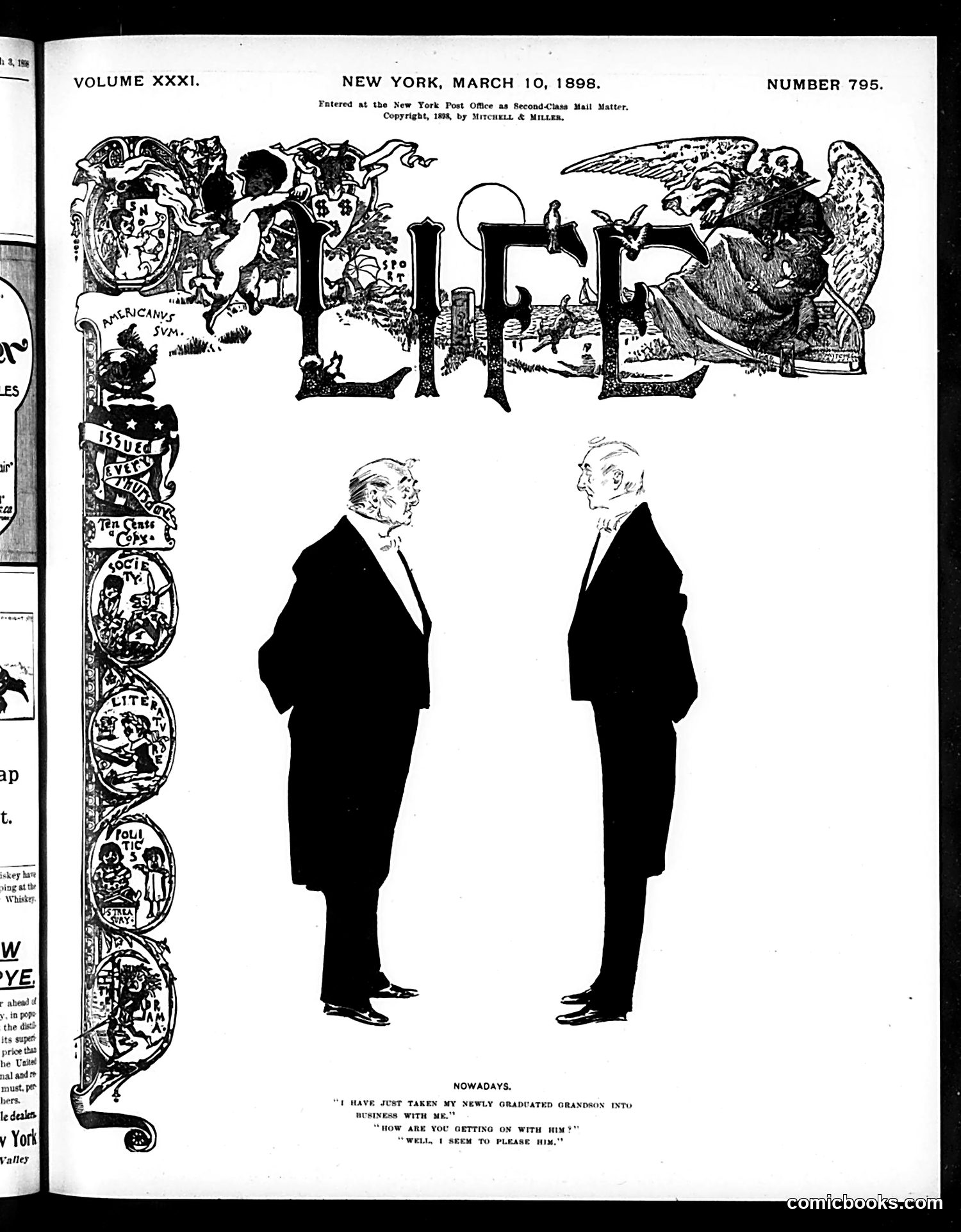
This page features a cartoon titled "Nowadays" showing two silhouetted businessmen in conversation. The dialogue reads: - "I have just taken my newly graduated grandson into business with me." - "How are you getting on with him?" - "Well, I see to please him." The satire mocks the generational shift in business dynamics of the 1890s. Rather than the traditional hierarchy where experienced businessmen trained younger generations with strict discipline, the cartoon suggests grandfathers now defer to their educated grandsons' preferences. This reflects anxieties about changing workplace authority and the perceived softening of business mentorship during America's transition to modern corporate culture. The joke implies the elder's loss of control over his own enterprise.
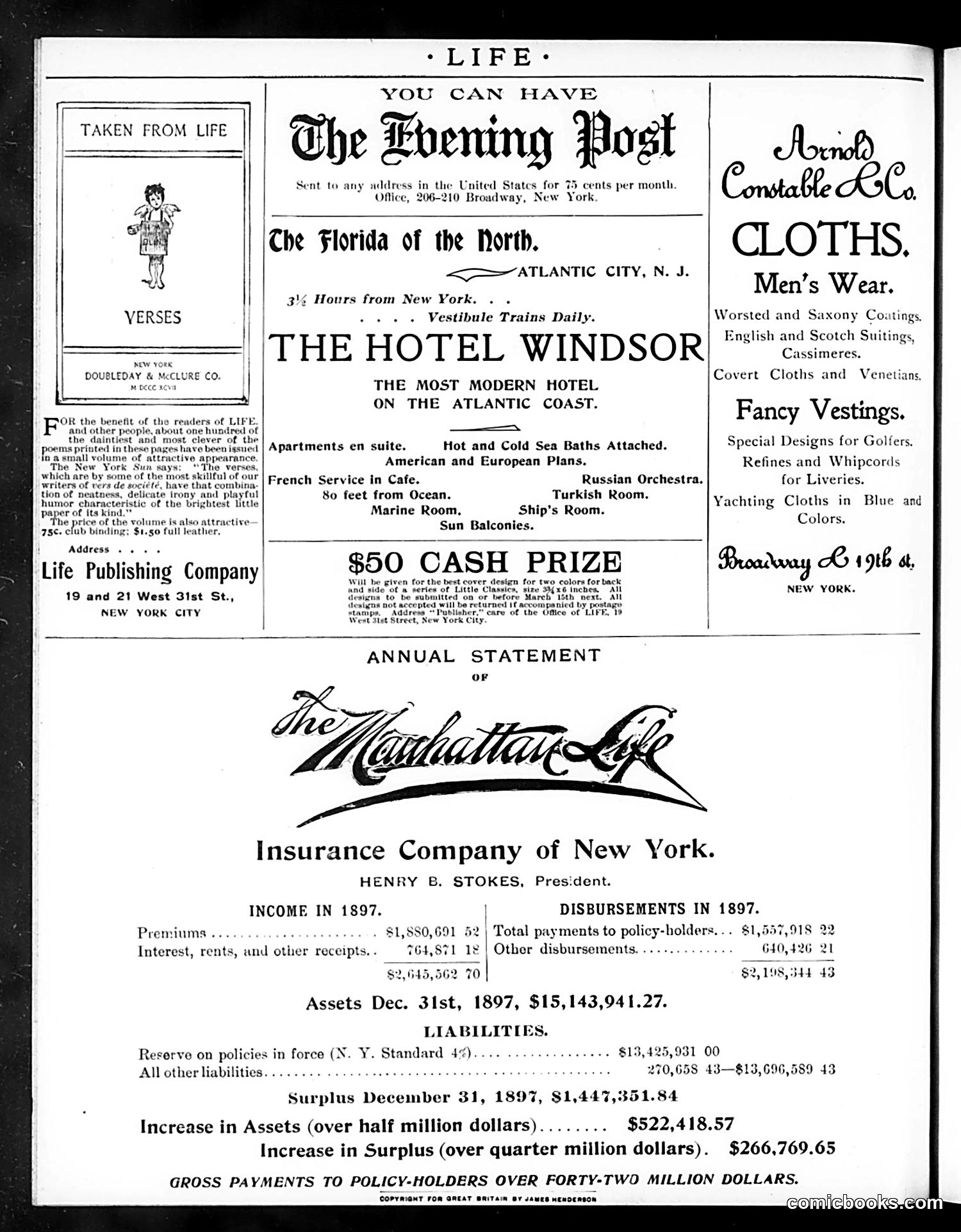
This page is primarily **advertising and business content** rather than political satire. The left column features "Verses" from Life Publishing Company—likely humorous poetry typical of Life magazine's satirical style, though the specific cartoon/verse content isn't clearly visible in this image. The bulk of the page contains ads for The Evening Post newspaper, Hotel Windsor in Atlantic City, and Arnold Constable & Co. clothing store. The lower half displays a financial statement for The Manhattan Life Insurance Company of New York, reporting 1897 income and assets—standard corporate disclosure advertising. **No clear political satire or recognizable caricatures are evident** on this page. It represents Life magazine functioning as both satirical publication and advertising vehicle, common for period magazines.
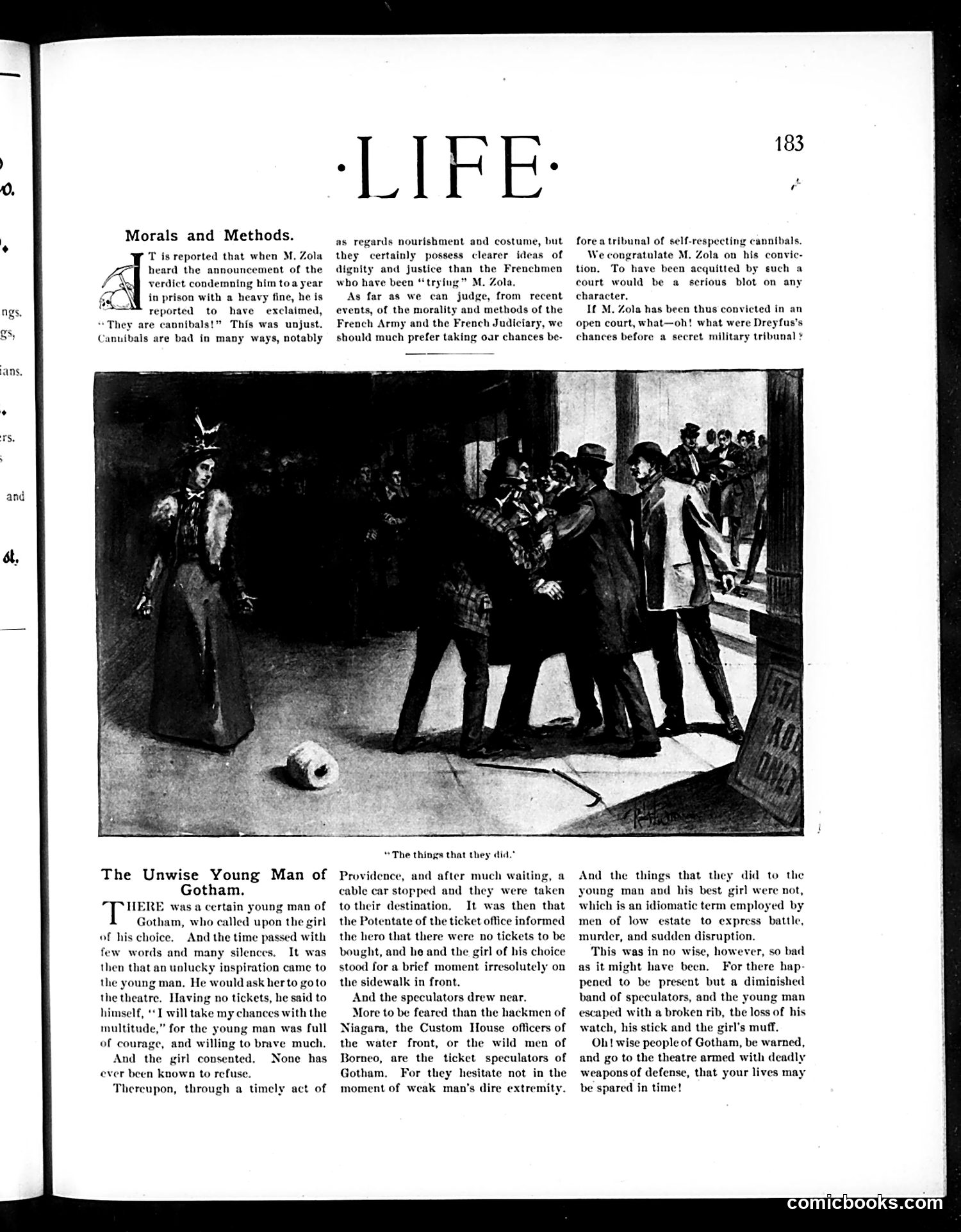
The top section discusses M. Zola's verdict condemning French military conduct, sarcastically suggesting France's army resembles "cannibals" — likely referencing the Dreyfus Affair controversies over military injustice. The main illustration and story, "The Unwise Young Man of Gotham," depicts a satirical narrative about a naive young man attempting to take a cable car without a ticket. When caught by authorities, he resists—leading to injury (broken rib, lost watch). The satire targets foolish attempts at defiance against institutional power. The phrase "The things that they did" suggests the authorities' violent response to minor transgression. This appears to be humorous social commentary on the futility of challenging established systems, presented as cautionary tale about naïve youthful rebellion.
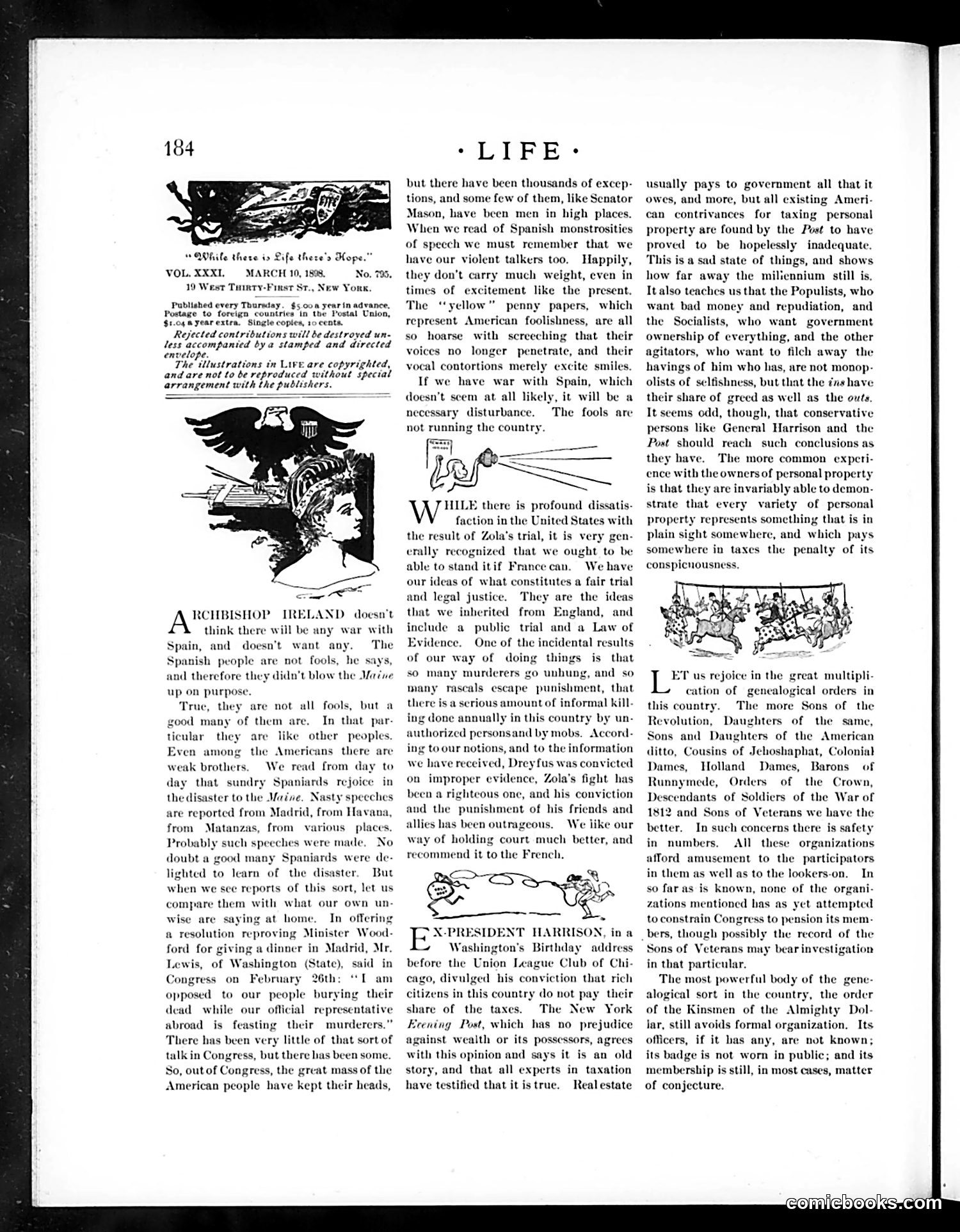
**Top Cartoon:** "While there is Life there's Hope" depicts Archbishop Ireland expressing opposition to war with Spain. The text indicates he opposes conflict, though Spain "didn't blow the *Maine* up on purpose." **Bottom Cartoon:** Shows an eagle (U.S. symbol) with a female head, likely representing Lady Liberty or America. She appears distressed or agitated, suggesting anxiety about the Spanish situation. **Context:** This page discusses the USS *Maine* explosion (February 1898), which triggered the Spanish-American War. The cartoons reflect divided American opinion: Archbishop Ireland opposed war, while the eagle imagery suggests national concern over potential conflict with Spain. The satire critiques both pacifist and war-hawk positions amid escalating tensions.
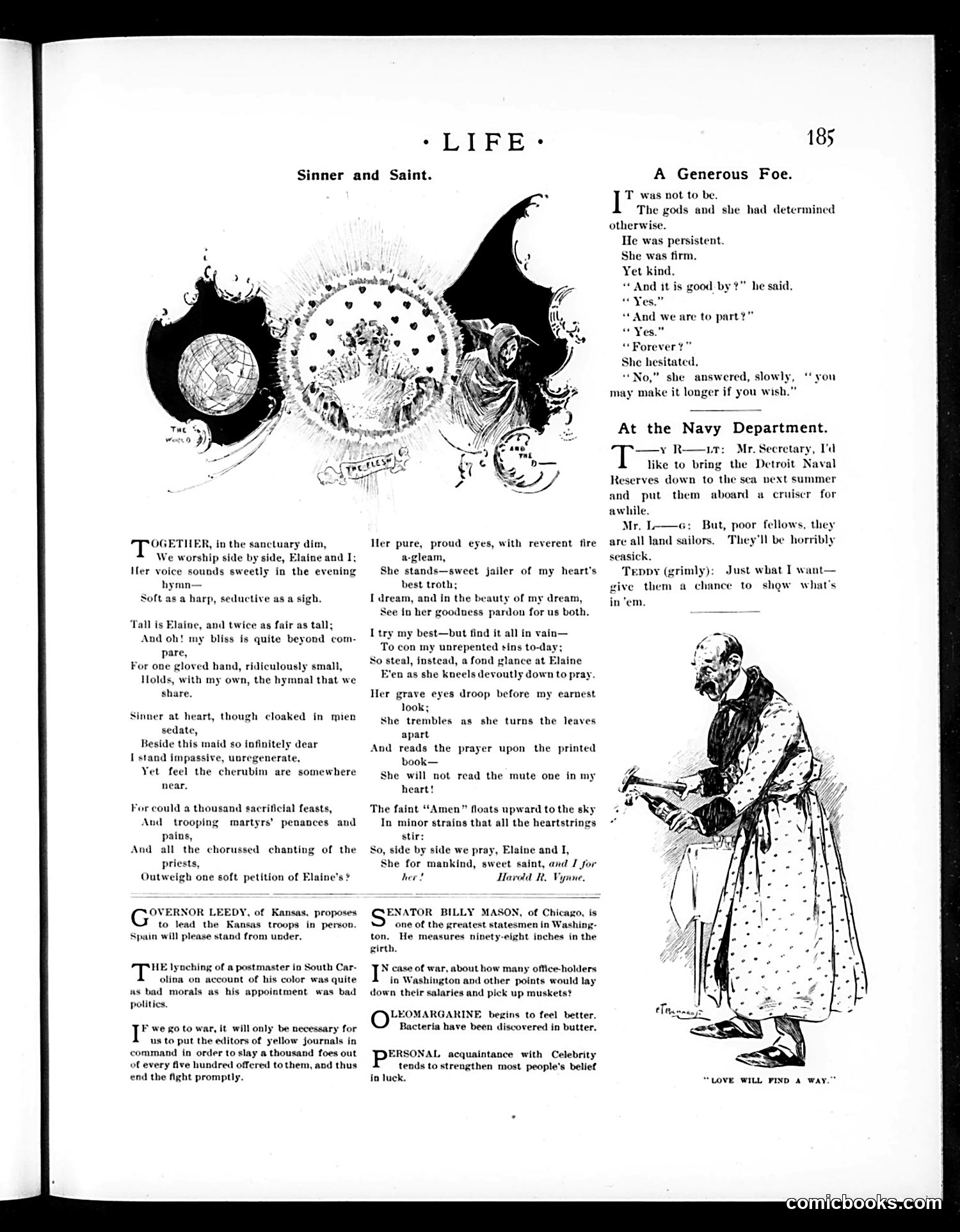
The page contains several distinct items: **"Sinner and Saint"** (left): A poem about Elaine, contrasting a man's idealized view of her with his actual sins. The accompanying illustration shows celestial/religious imagery with figures and a globe—likely satirizing romantic hypocrisy or the gap between how men view women versus their own moral failings. **"A Generous Foe"** (right): A brief dialogue where a couple discusses making their relationship permanent, with the woman offering flexibility on duration. **"At the Navy Department"** (center-right): A satirical exchange about bringing Detroit Naval Reserves to sea, with sailors objecting they're "land sailors" and will be "horribly seasick." **"Love Will Find a Way"** (bottom right): An illustration of an older man with a cane. The page primarily contains social commentary through poetry and humor about relationships, military matters, and human nature typical of early-20th-century satirical magazines.
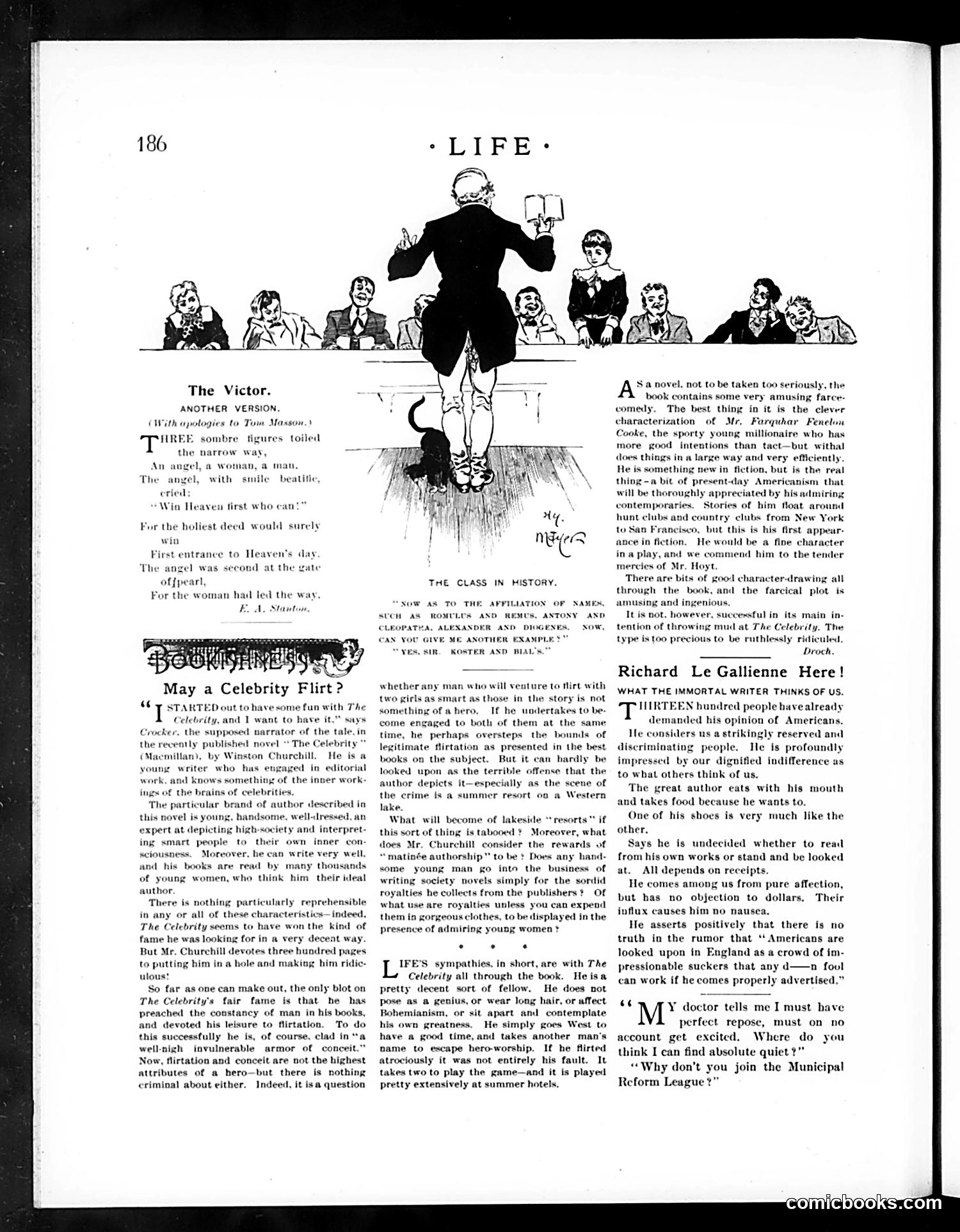
The central cartoon, "The Class in History," depicts a courtroom or judicial setting where a bald man in black clothing stands before a judge and jury, holding a book aloft. The caption references "affiliation of names" and historical figures like Cleopatra and Alexander, suggesting a trial or debate about literary authorship or plagiarism. Below, "May a Celebrity Flirt?" discusses whether public figures should engage in flirtation, referencing *The Celebrity* as a narrative work. The text satirizes concerns about famous people's romantic behavior and their public image. "Richard Le Gallienne Here!" appears to be a critical profile of writer Richard Le Gallienne, mocking his affected mannerisms and pretensions—his eating habits, shoe preferences, and claims about "American" attitudes toward England. The overall tone is characteristic of Life's satirical commentary on literary and celebrity culture.
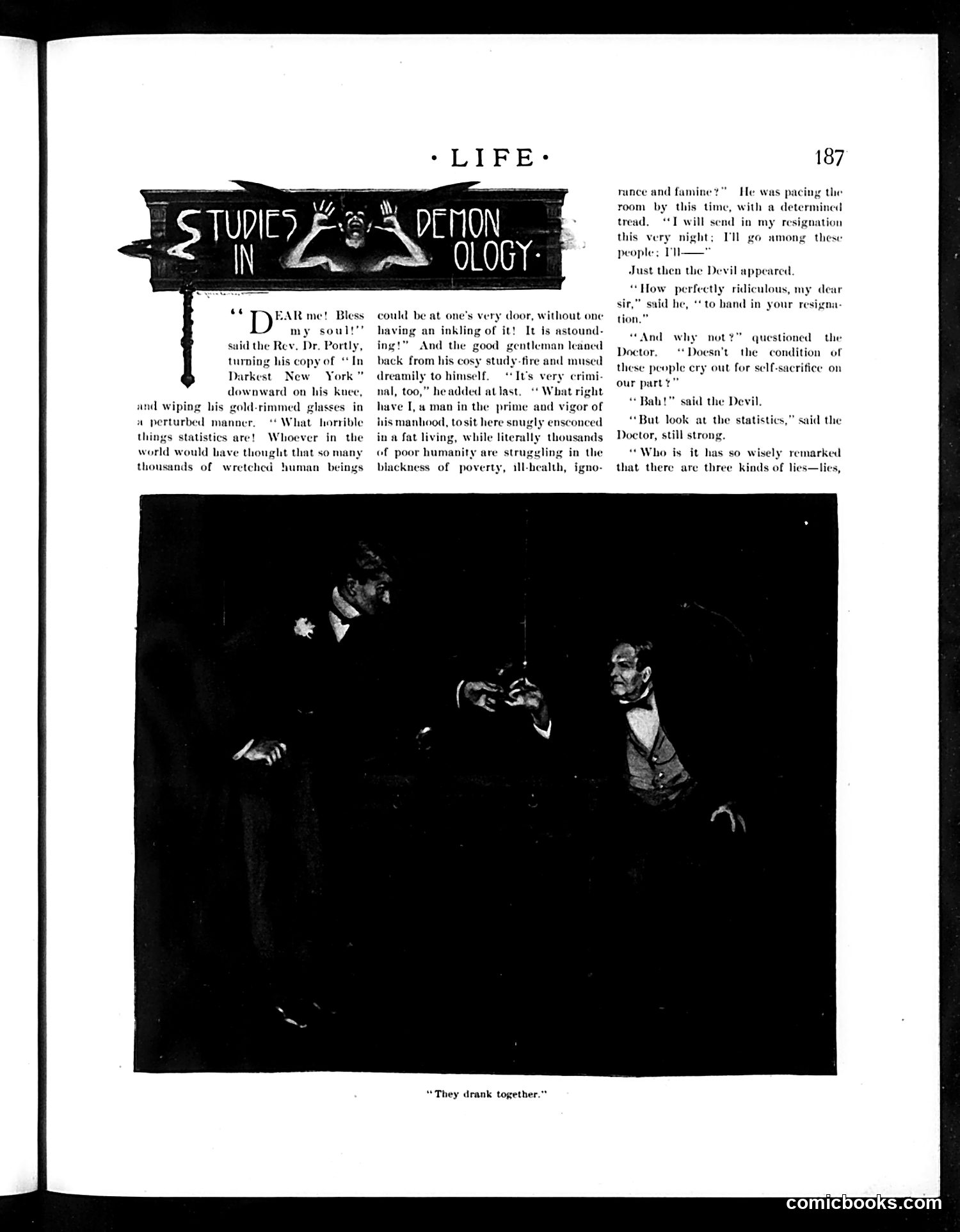
This satirical piece uses religious imagery to mock poverty and suffering. A clergyman (Rev. Dr. Portly) dismisses social statistics about human misery—poverty, illness, ignorance—as "dreadful" but fundamentally acceptable. The Devil appears to challenge this complacency, sarcastically praising the Doctor's rationalization that such suffering exists naturally. The satire targets clergy who cite statistics to justify inaction on social problems rather than advocate for reform. The "three kinds of lies" reference (likely alluding to Mark Twain's famous quote) suggests that statistics are being manipulated to legitimize indifference. The cartoon critiques religious hypocrisy—using faith and data selectively to avoid uncomfortable moral obligations to help the poor and suffering.
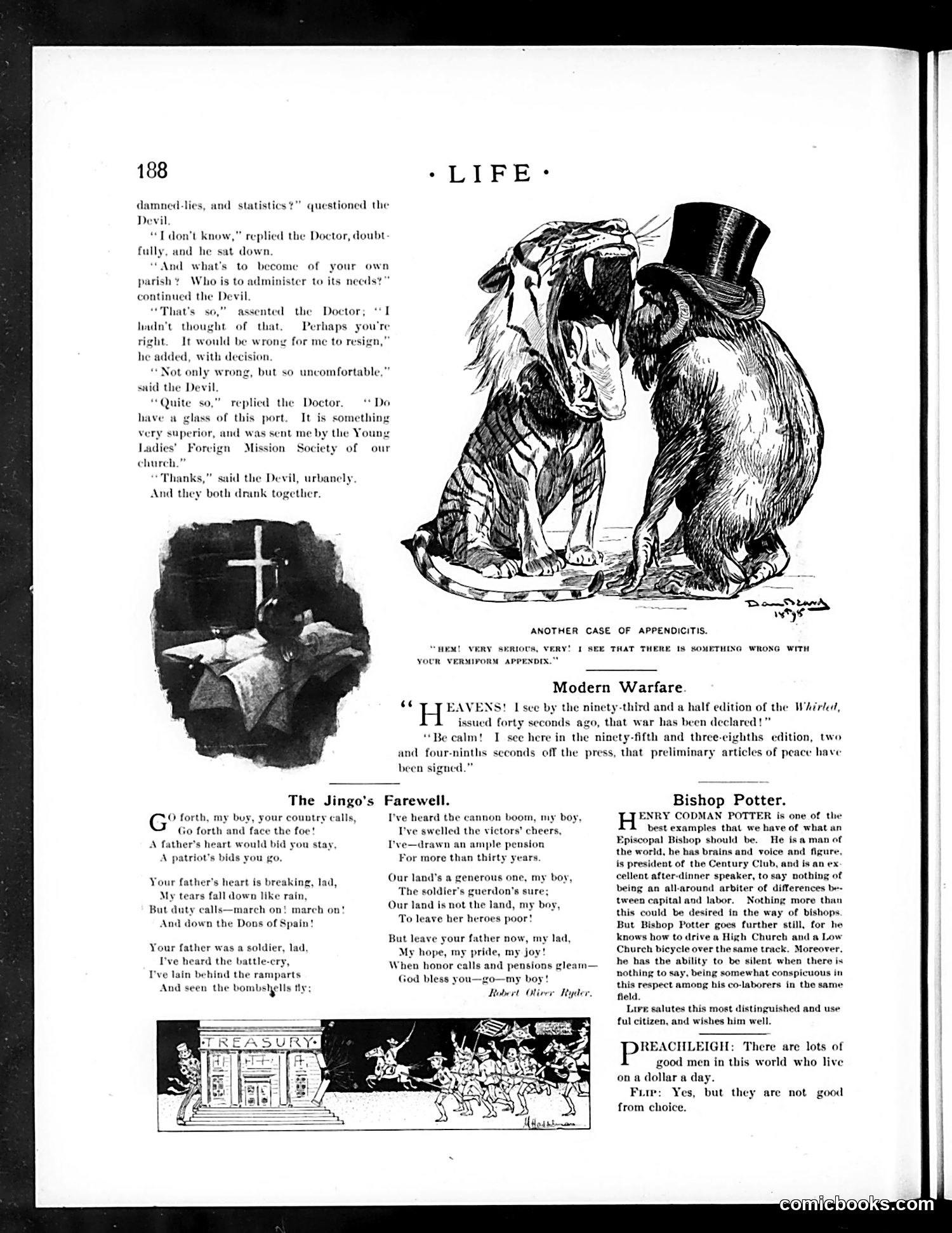
The main cartoon depicts two dogs in top hats labeled "Another Case of Appendicitis," with one examining the other's abdomen. This is a visual pun satirizing medical overdiagnosis—the joke being that dogs wearing formal dress are being treated as human patients, mocking doctors who may have unnecessarily recommended appendectomies (a then-common procedure). The page includes poetry titled "The Jingo's Farewell" (a patriotic send-off to soldiers) and a biographical entry on "Bishop Potter," praising his integrity and influence. The "Modern Warfare" section discusses peace treaty preliminaries during what appears to be WWI-era conflict. Overall, the page blends political commentary on war with social satire about medical practice and clerical authority—typical of Life's turn-of-the-century content mixing humor with substantive social criticism.
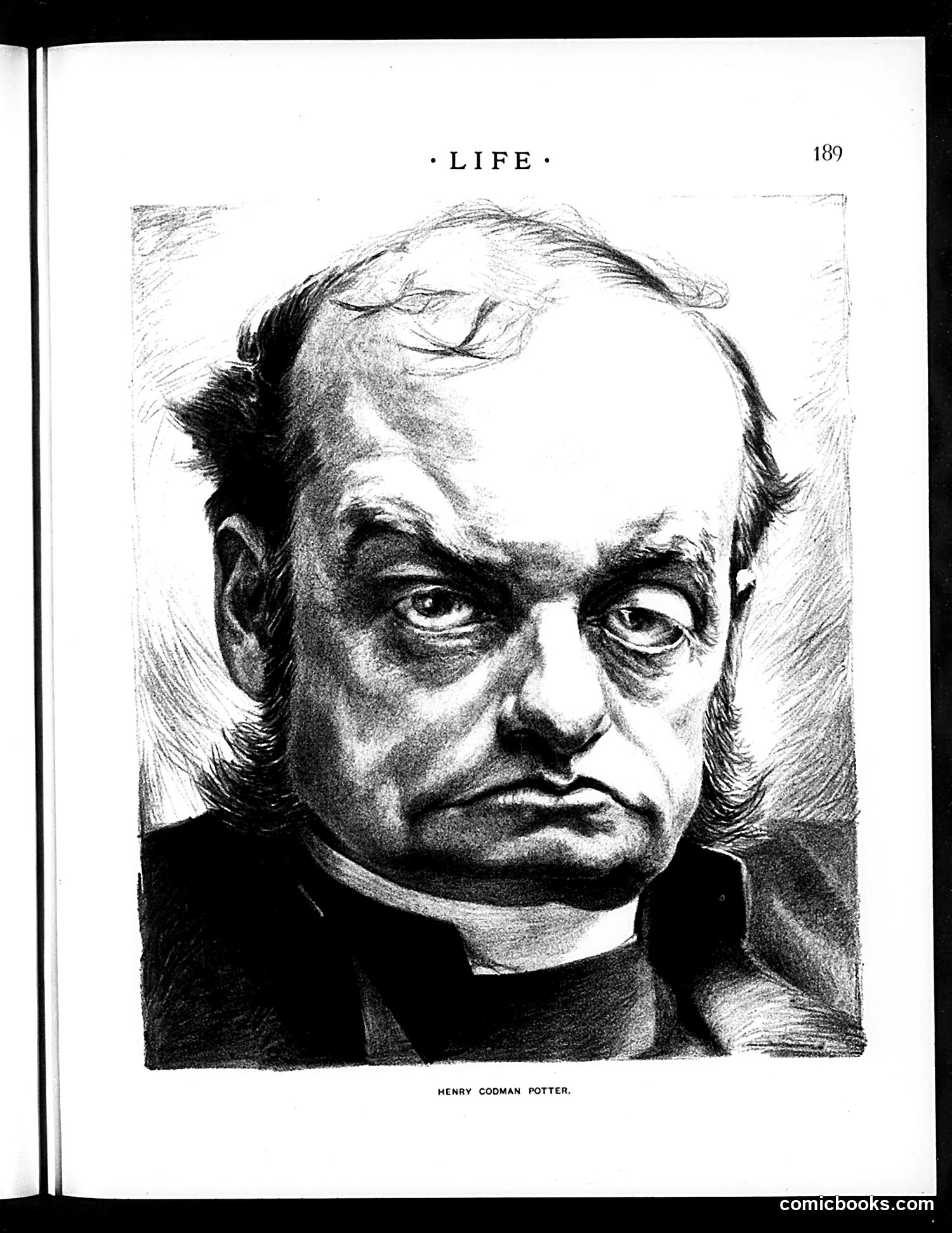
This page features a portrait labeled "HENRY CODMAN POTTER" — a detailed engraving-style headshot of a distinguished bald man with a mustache wearing formal attire. Without additional context from surrounding pages, I cannot definitively explain the satirical intent. However, Henry Codman Potter was a prominent American Episcopal bishop in the late 19th/early 20th century, known for progressive social views. *Life* magazine frequently published portraits of notable public figures, sometimes to lampoon them. The serious, dignified rendering suggests this may be either a straightforward biographical feature or subtle satire of his public persona. The page number (189) indicates this is part of a larger issue; additional content would clarify whether this is political commentary or biographical documentation.
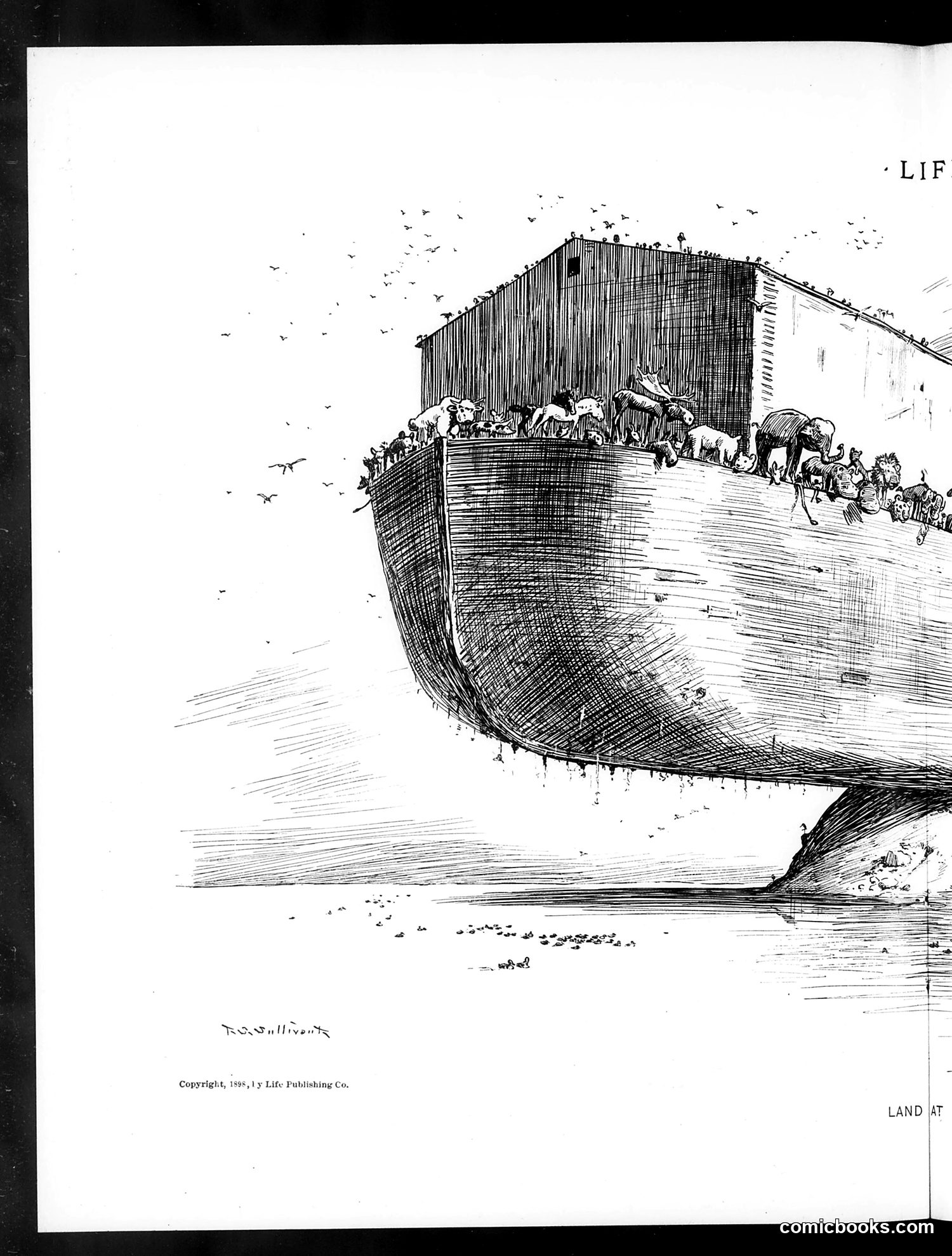
This is a satirical illustration depicting Noah's Ark, crowded with animals and people preparing to land. The ark appears overloaded and precarious, listing toward the shore where figures await. Birds fly overhead, and the composition emphasizes the chaotic, cramped conditions aboard. The cartoon likely satirizes **immigration and overpopulation** concerns—a recurring theme in early 20th-century American political humor. The "ark" metaphor suggests humanity's salvation or escape, while the overcrowding and awkward landing satirize anxieties about too many arrivals to America. The copyright date of 1908 places this during peak immigration periods when such themes dominated public debate. The artist's signature appears to read "B. Goddillivans" (though unclear). The satire works by contrasting the biblical salvation narrative with contemporary social anxieties about national capacity and resources.
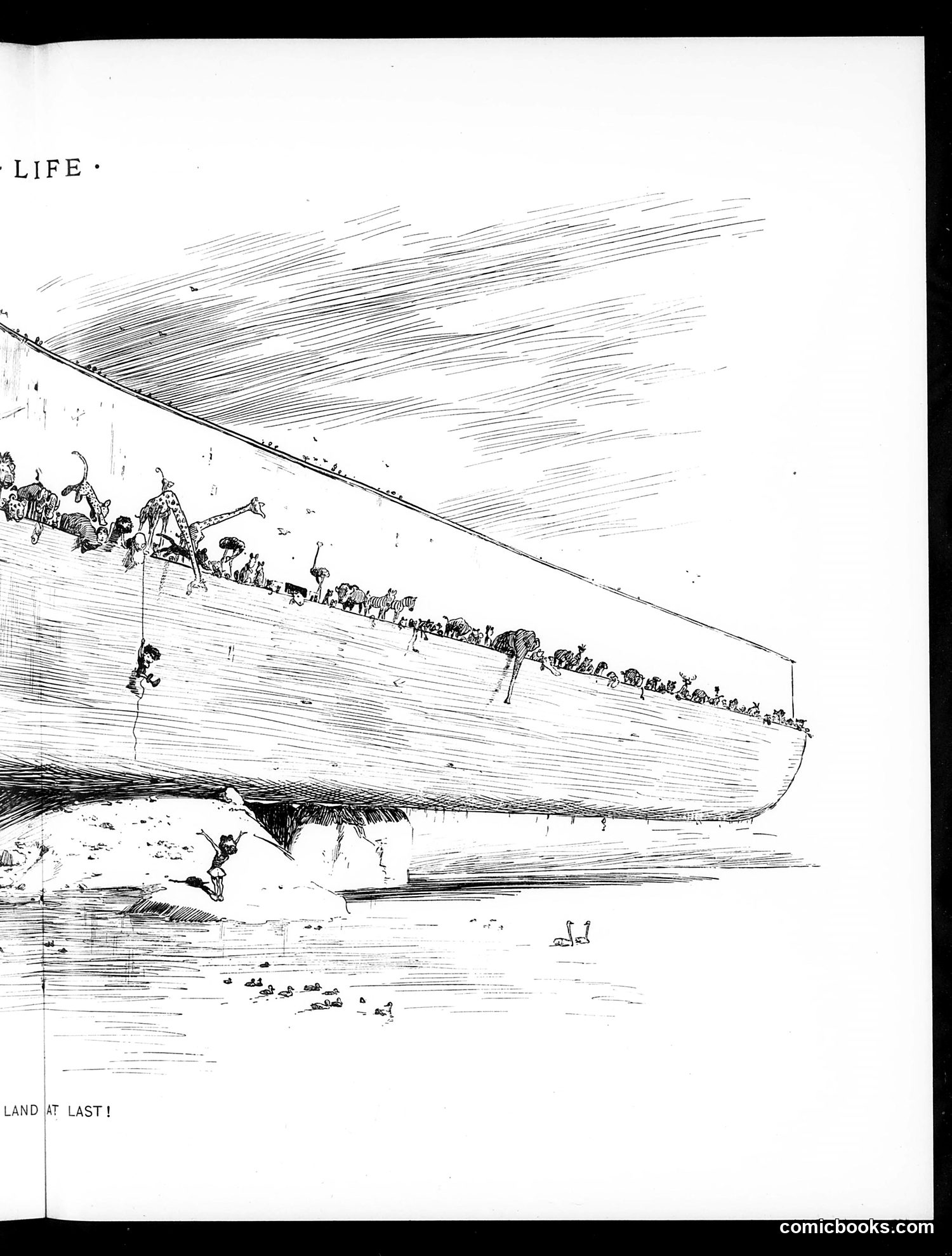
This satirical cartoon depicts a massive ship tilted at a steep angle, crowded with passengers clinging to its side. The caption "LAND AT LAST!" appears at bottom left, while "LIFE" marks the masthead. The image likely satirizes immigration and arrival at America, showing the chaotic, precarious conditions of immigrant ship travel. The overcrowded vessel at a dangerous angle suggests both the physical dangers of transatlantic passage and—satirically—the tumultuous, unstable nature of the immigration experience itself. The cartoon appears to comment on the immigrant experience of early 20th-century America, when massive numbers arrived by ship. The apparent relief of "land at last" is undercut by the depicted chaos, suggesting irony about the difficult realities awaiting arrivals.
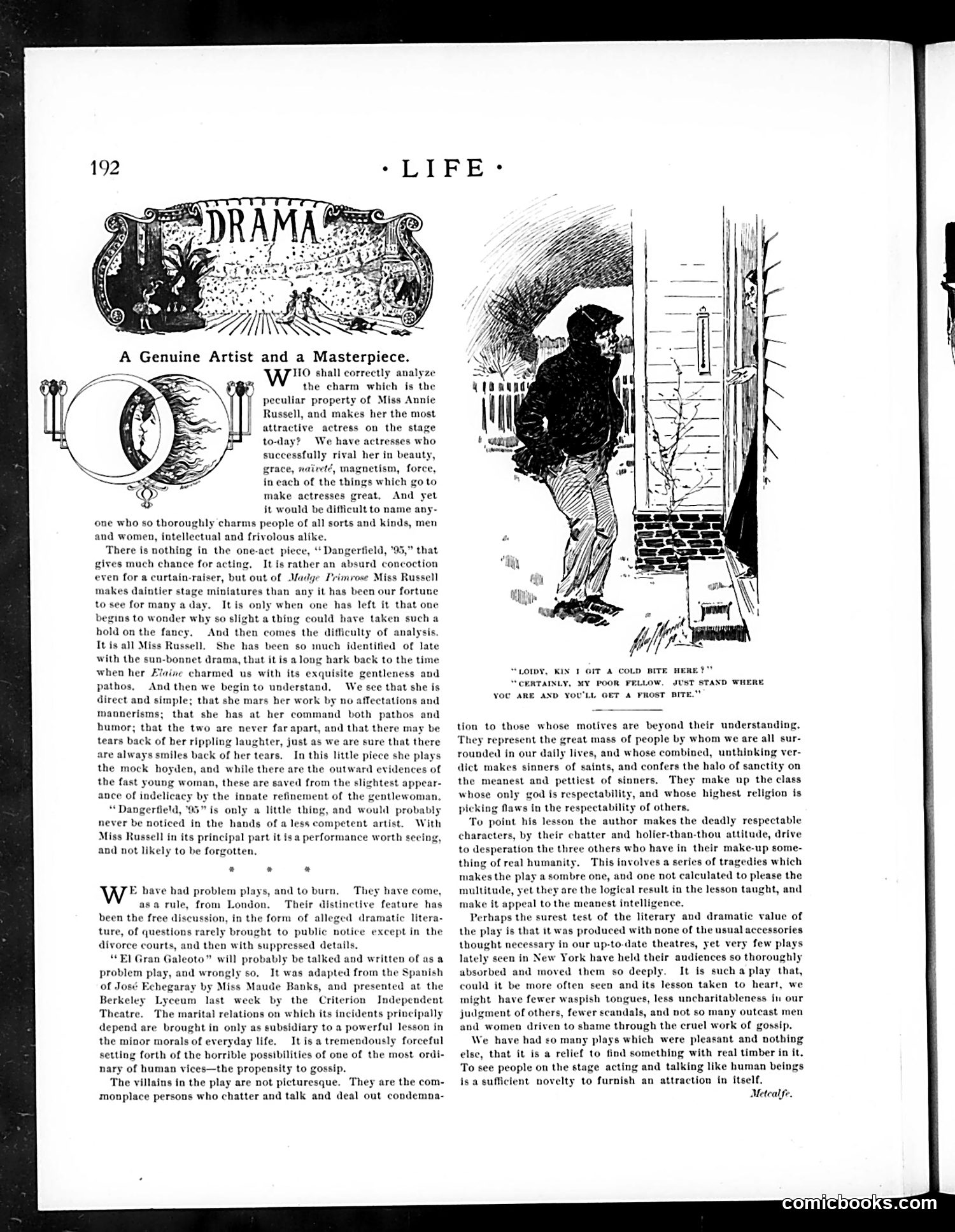
This page from *Life* magazine (page 192) contains a drama criticism article titled "A Genuine Artist and a Masterpiece." The text praises actress Miss Annie Russell and analyzes her performance, likely in a theatrical production. The illustration shows a silhouetted figure in period dress standing at a doorway in winter conditions, apparently depicting a dramatic scene from the play being reviewed. The article discusses Russell's talent for portraying complex human characters with authenticity rather than theatrical affectation. It criticizes plays that rely on melodrama and gossip, praising instead works that explore genuine moral questions and human nature. The piece appears to be standard drama criticism rather than political satire—it's evaluating an actress's performance and the theatrical work itself as legitimate art.
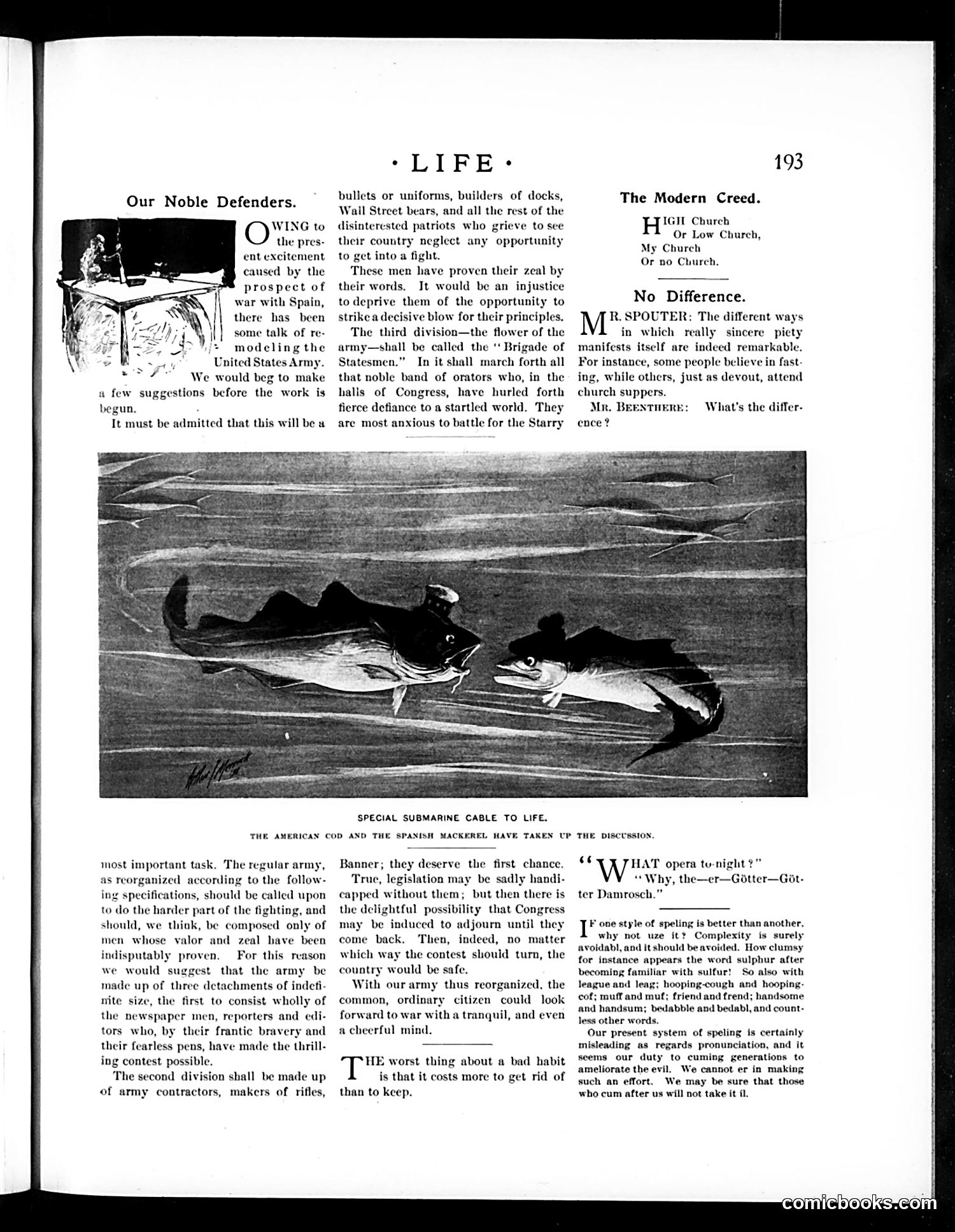
This page satirizes American enthusiasm for war with Spain (likely the Spanish-American War, 1898) by proposing a cynical reorganization of the Army into three divisions: 1. **Newspaper men and editors** - mocked for their "frantic bravery" in promoting war through their pens rather than actual combat 2. **Army contractors and weapons manufacturers** - criticized as profiteers using war for financial gain 3. **Congressional orators** - labeled the "Brigade of Statesmen," ridiculed for making fierce speeches while the "common, ordinary citizen" would actually fight The cartoon's joke: assign all the war-promoting loudmouths to the frontlines, leaving civilians safe. The accompanying submarine cable cartoon (American Cod vs. Spanish Mackerel) appears to be a nationalistic pun on the conflict. The piece attacks warmongering elites who profit from or agitate for war without personal sacrifice—a classic Progressive-era critique of special interests and political hypocrisy.
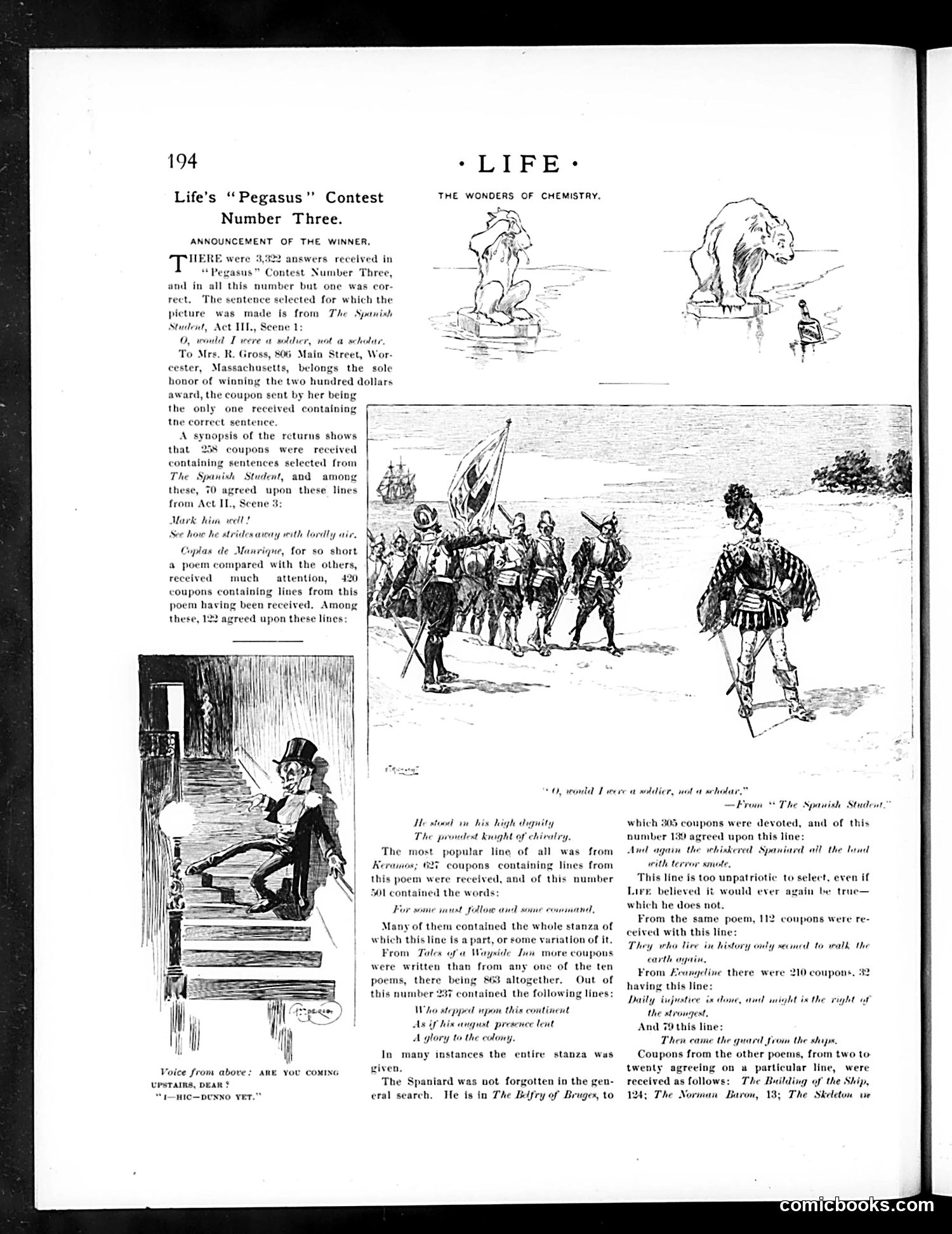
This page announces the winner of Life magazine's third literary contest, called the "Pegasus" Contest. Readers submitted coupons with sentences or lines from Henry Wadsworth Longfellow's poems, attempting to correctly complete a sentence from *The Spanish Student*. **The Winner:** Mrs. R. Gross of Worcester, Massachusetts won $200 for submitting the only coupon with the correct sentence. **The Content:** The page analyzes 258 submitted coupons, breaking down which Longfellow works readers quoted most frequently. *Tales of a Wayside Inn* generated 863 coupons total—far exceeding other poems. **The Cartoons/Illustrations:** Show two small scenes: one depicting "The Wonders of Chemistry" (bears), another showing a domestic scene with the caption "Are you coming upstairs, dear? 'I-hic—denno yet'" (a drunk husband avoiding his wife). **The Satire:** The contest itself demonstrates Longfellow's cultural dominance among educated Americans of this era, while the domestic cartoon humorously contrasts refined literary pursuits with working-class drunkenness.
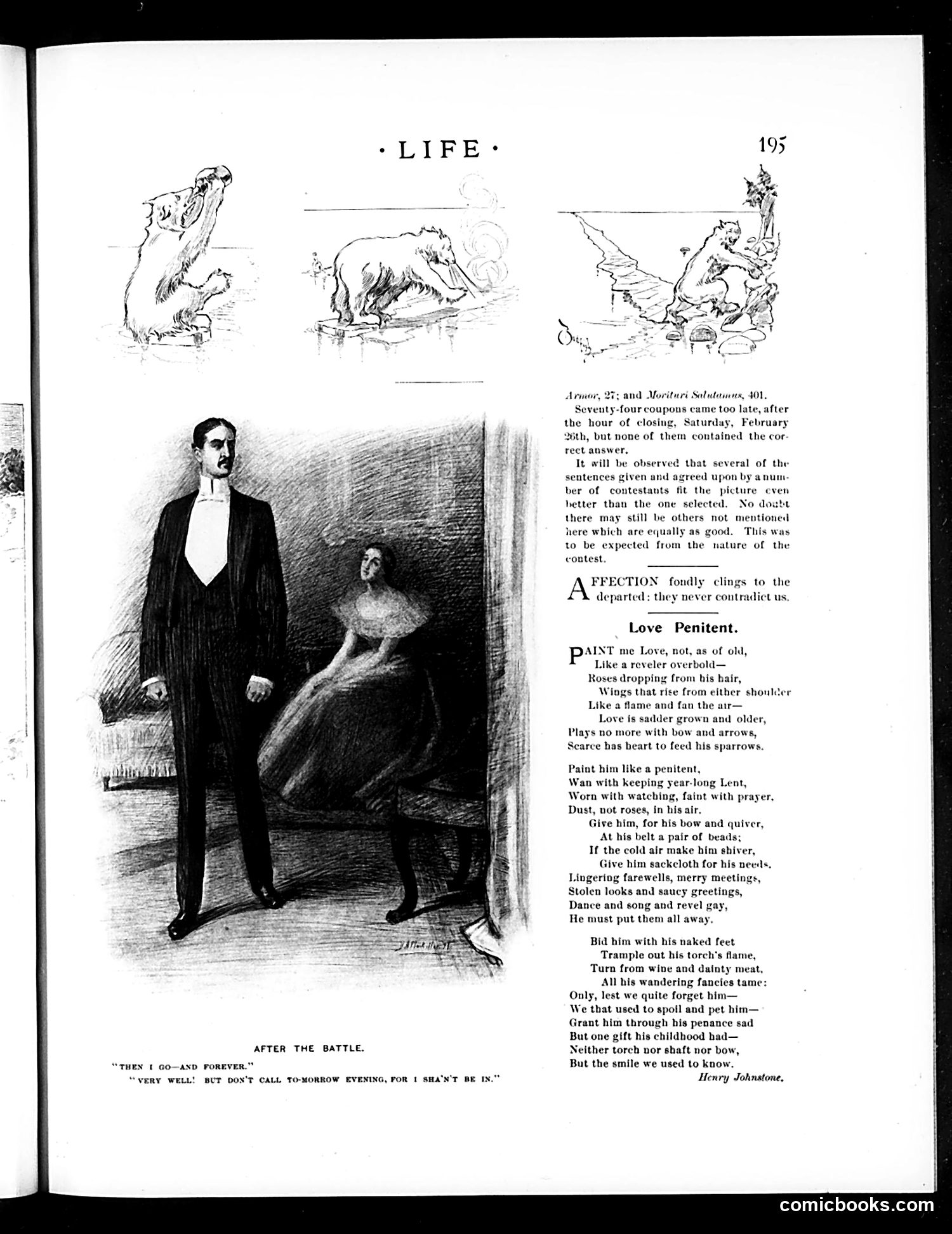
**The Main Cartoon ("After the Battle"):** Shows a well-dressed man telling a woman he's leaving her forever—but adds the cruel stipulation "don't call tomorrow evening, for I shan't be in." The satire mocks the absurdity of dramatic romantic breakups where the departing party adds petty conditions, undermining the supposed finality of their gesture. It's commentary on insincere or self-serving romantic gestures. **"Love Penitent" Poem:** This lengthy poem reimagines Cupid (classical Love) as a sorrowful, penitent figure rather than the traditional joyful, arrow-shooting cherub. Instead of roses and revelry, the poem depicts Love as worn, fasting, praying—stripped of worldly pleasures. The final stanza suggests even reformed Love deserves one comfort: the innocent smile from childhood. **Context:** The page appears to be from an early 20th-century Life issue mixing humor with sentimental poetry—typical of the magazine's blend of satire and romantic/moralistic content. The tone reflects contemporary attitudes about love's declining vigor in modern times.
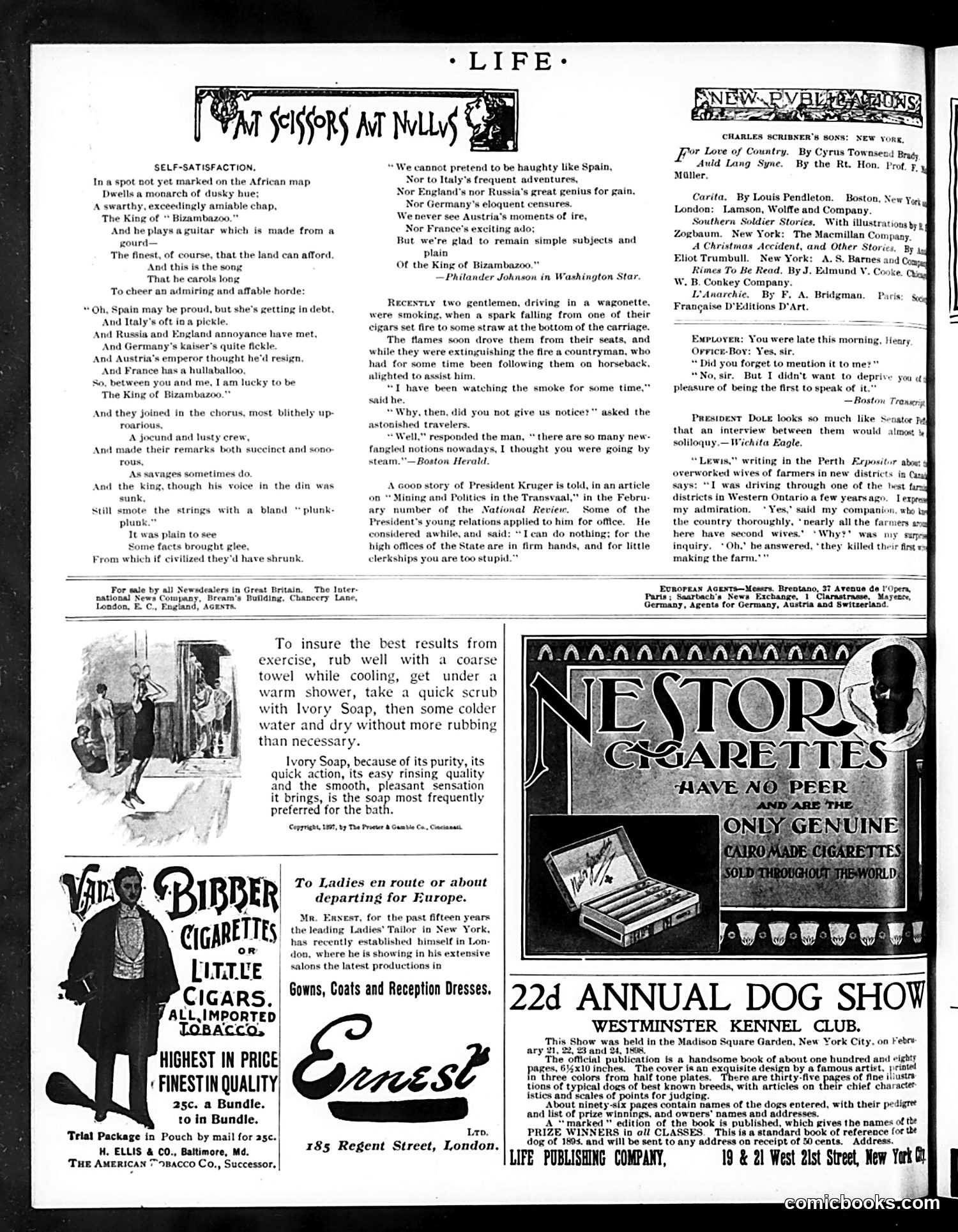
This satirical poem mocks European self-satisfaction during a period of international tension. The fictional "King of Bizambazoo"—a deliberately absurd African ruler—boasts that his obscure kingdom avoids the troubles afflicting major European powers: Spain's debt, Italy's instability, Russia-England conflicts, Germany's unreliable leadership, Austria's upheaval, and France's turmoil. The satire targets European arrogance by suggesting that even an invented, primitive African monarch can feel superior by simply avoiding involvement in "civilized" affairs. The joke inverts the racial hierarchy typical of the era—the "savage" king is wiser than Europe's squabbling powers. The poem appeared in *Life* magazine, which regularly published political commentary on international affairs. The context suggests this reflects genuine European instability, likely from the 1890s-1900s period when the Boer War, colonial tensions, and rising militarism threatened continental peace.
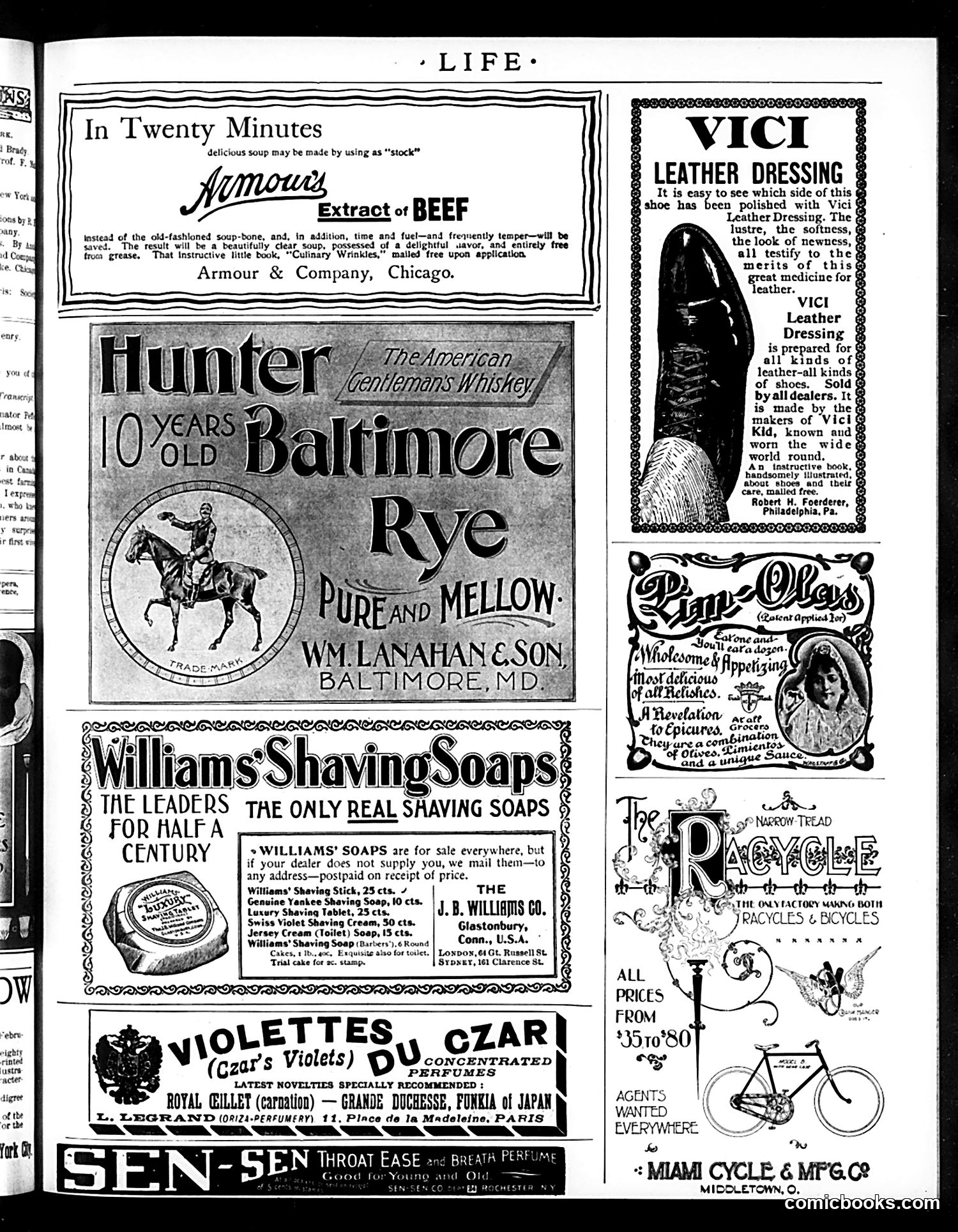
This is primarily an **advertising page** from Life magazine, not a political cartoon. It contains six unrelated product advertisements typical of early 20th-century print media: 1. **Armour's Extract of Beef** - a soup stock product 2. **Hunter Baltimore Rye Whiskey** - spirits advertisement 3. **Williams' Shaving Soaps** - claiming century-long market leadership 4. **Vici Leather Dressing** - shoe polish 5. **Pian-Oles** - food product ("most delicious of all relishes") 6. **Violettes du Czar perfume** - French fragrance with royal branding 7. **Sen-Sen throat lozenges** and **Racycle bicycles** (right margin) **No satire or political content is present.** The page demonstrates how Life balanced editorial content with revenue through full-page advertising. The products reflect consumer goods and luxuries of the era; the "Czar" branding in perfume was simply marketing that invoked Russian imperial prestige, with no political commentary intended.
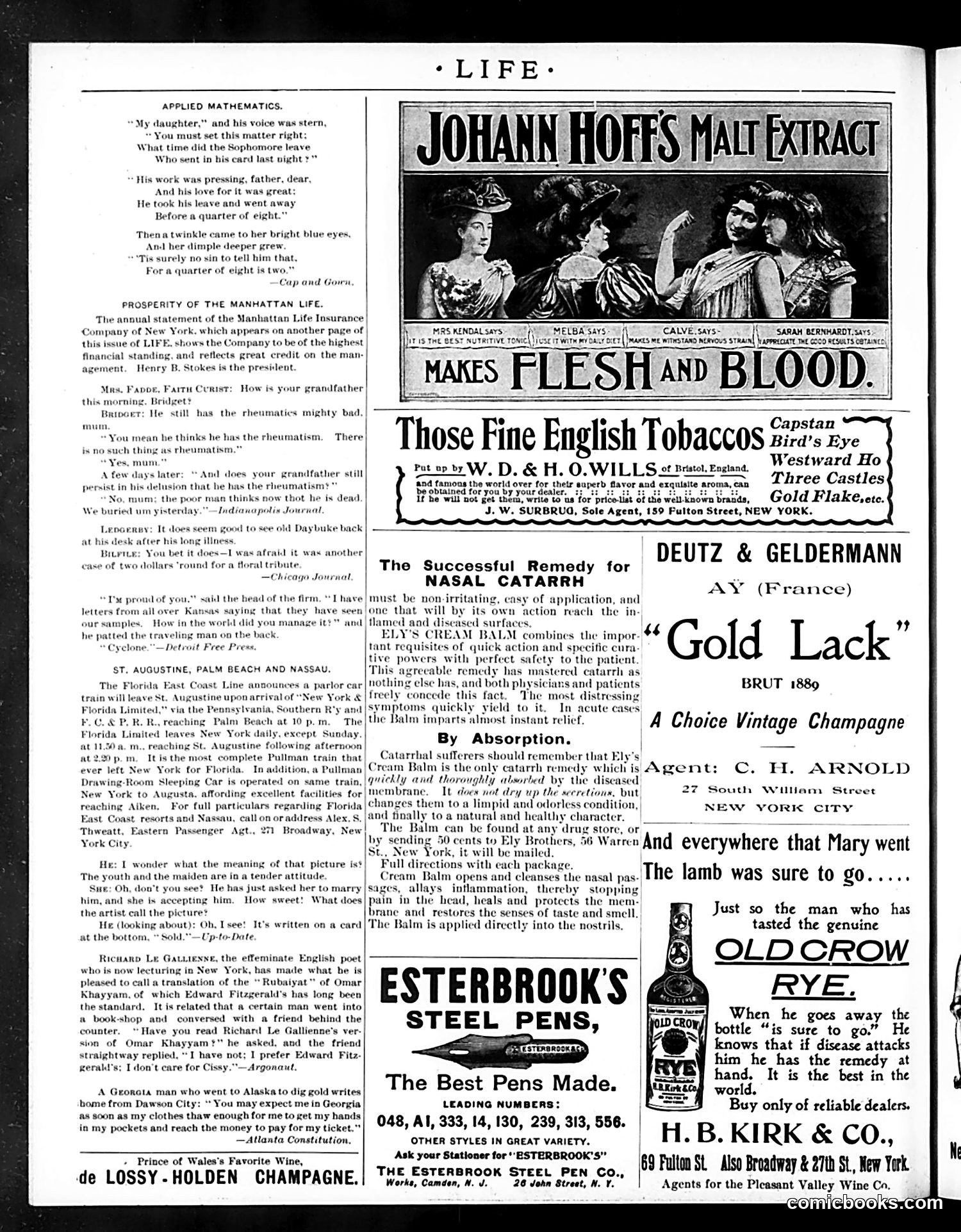
This page contains **primarily advertisements and humorous anecdotes** rather than political cartoons. The main content includes: **"Applied Mathematics"** — A joke about a father interrogating his daughter about a young man's departure time. She claims he left "before a quarter of eight," but then reveals "a quarter of eight is two"—a play on how she's mathematically reframed the time to deceive her father about the visitor staying late. **Other brief comedic pieces** mock various social situations: a man's confusion about his grandfather's rheumatism, workplace pride, and romantic misunderstandings. **The large illustrated advertisement** for Johann Hoffs Malt Extract features actresses (Kendal, Melba, Calve, Bernhardt) endorsing the product's ability to build "flesh and blood"—a common health tonic pitch of the era. The page is dominated by **period advertisements** for tobaccos, champagne, steel pens, and medical remedies—typical for Life magazine's revenue model. There is **no significant political satire** on this particular page.
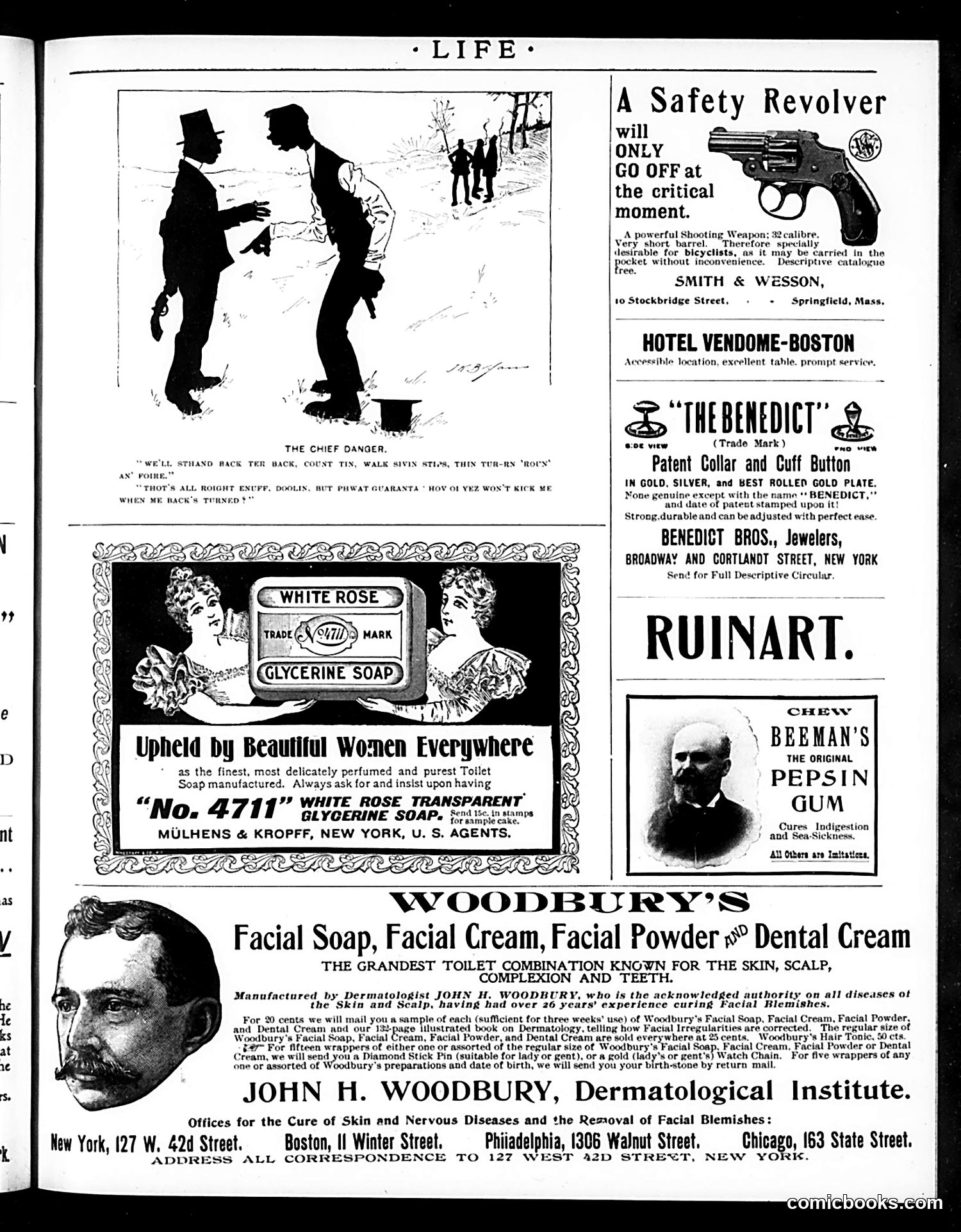
This single political cartoon depicts two men in working-class Irish dialect (indicated by phonetic spelling: "THOT'S," "PHWAT," "YEZ") discussing a street confrontation. One warns they'll "stand back ter back" and "walk sivin stios, thin tur-rn 'round" — describing a classic street-fighting stance. The other expresses concern: "but phwat guaranty how ol yez won't kick me when me back's turned?" **The satire**: This appears to mock Irish immigrant street culture and honor-code violence of early 1900s urban America. The joke plays on the contradiction between ritualized fighting protocols and the practical unreliability of trusting an opponent to follow them — a dig at both the combatants' naiveté and broader stereotypes about Irish working-class violence. The remainder of the page comprises period advertisements (soap, revolvers, dental cream, chewing gum) unrelated to the cartoon's message.
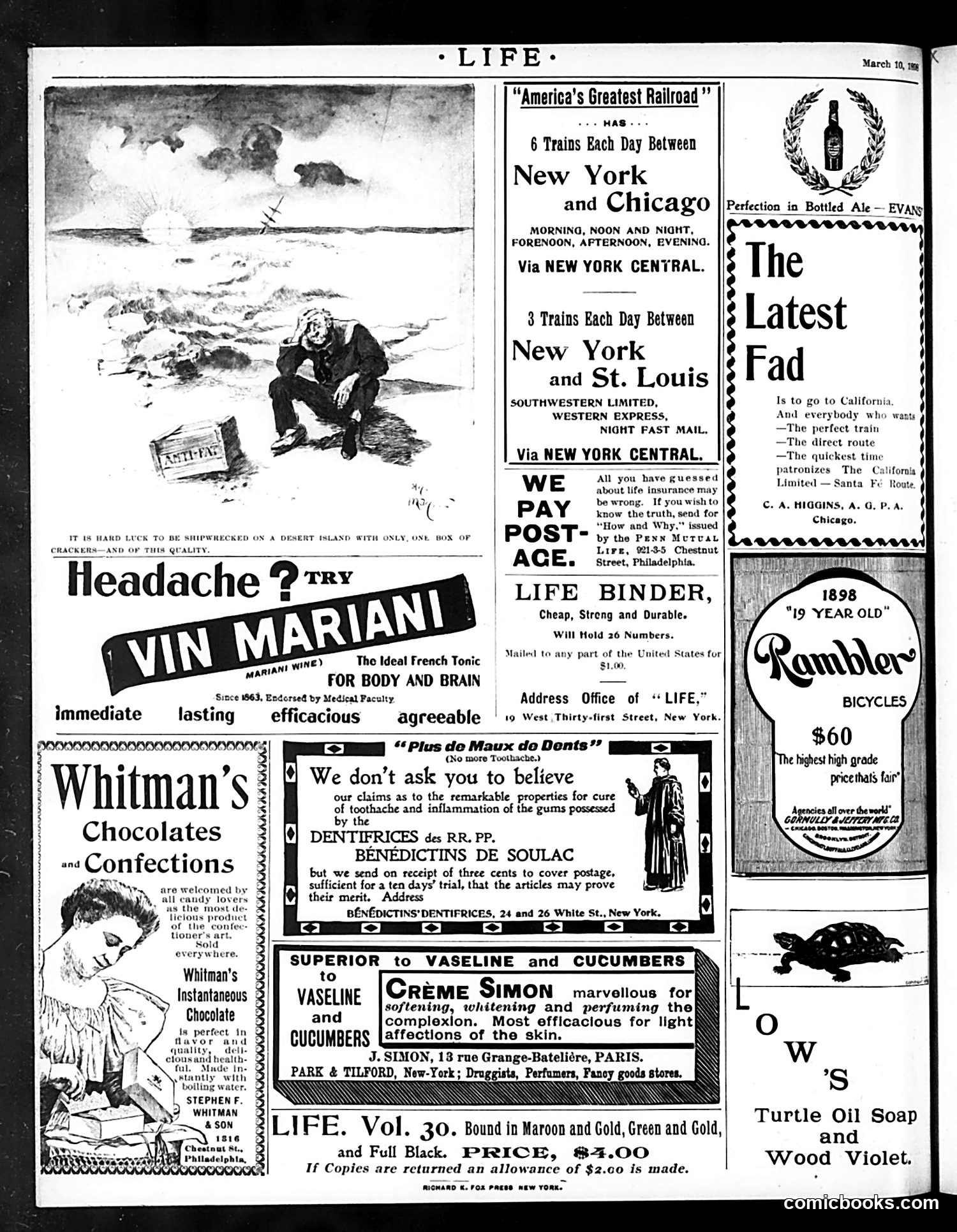
This page is primarily **advertisements and railroad promotions**, not political satire. The only cartoon appears at top left: a shipwrecked man on a desert island holding a box labeled "CRACKERS" with the caption "IT IS HARD LUCK TO BE SHIPWRECKED ON A DESERT ISLAND WITH ONLY, ONE BOX OF CRACKERS—AND OF THIS QUALITY." **The joke:** The satire targets poor-quality crackers—the humor lies in the grim irony that even with food available, these particular crackers are so bad they barely constitute survival provisions. This reflects contemporary concerns about food quality and shelf-stable products. The remainder of the page features typical period advertisements: Vin Mariani (a tonic drink), Whitman's Chocolates, railroad schedules, dental products, skin creams, and bicycles. These ads reflect late-1890s consumer goods and technologies of the era.