
Life, 1898-03-10 · page 6 of 20
Life — March 10, 1898 — page 6: what you’re looking at
What you’re looking at
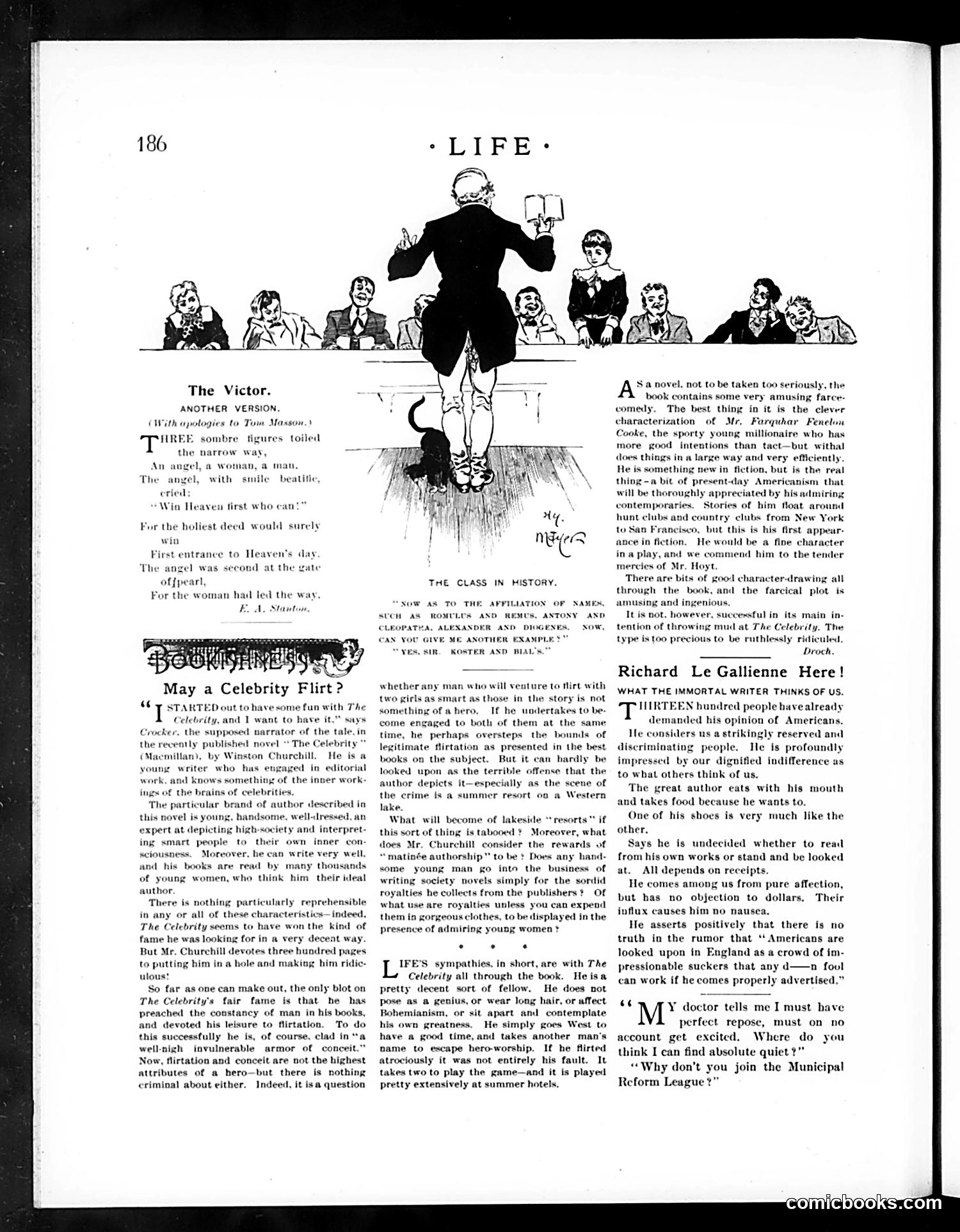
The central cartoon, "The Class in History," depicts a courtroom or judicial setting where a bald man in black clothing stands before a judge and jury, holding a book aloft. The caption references "affiliation of names" and historical figures like Cleopatra and Alexander, suggesting a trial or debate about literary authorship or plagiarism. Below, "May a Celebrity Flirt?" discusses whether public figures should engage in flirtation, referencing *The Celebrity* as a narrative work. The text satirizes concerns about famous people's romantic behavior and their public image. "Richard Le Gallienne Here!" appears to be a critical profile of writer Richard Le Gallienne, mocking his affected mannerisms and pretensions—his eating habits, shoe preferences, and claims about "American" attitudes toward England. The overall tone is characteristic of Life's satirical commentary on literary and celebrity culture.
📄 Transcribed text from this page (OCR, searchable)
Machine-transcribed from the original scan — historical spelling and the odd misread are preserved.
The Victor. ANOTHER VERSION, With « HREE the narrow logies to Tom Masson.) sombre figures toiled way, An The ugel, a Woman, a man. nyel, with cried: Win Heaven first who can!” sinile be: For the holiest deed would surely win First entrar The angel was se of{pearl, For the woman had led the way. EA © to Heaven's day Stanton, May a Celebrity Flirt ? STARTED out to have some fun with 7 Celebrity, and 1 want to have it the supposed narrator of th nily published novel “ The C “ I Crocker. the re (Macmillan), by Winston Churchill. says tale, in ‘ority He is a who ha din editorial ows something of the inner work ings of the beains of ce ities. The particular brand of author described ia this novel is young, handsome. welll expert at depicting high-soc! ing smart people to their own Moreover, he can write very well young write work, and sciousness, and his books are read by many thousands of young women, who think him their ideal author. There is nothing particularly reprehensible any or all of these characteristics— indeed, ‘he Celebrity seems to have won the kind of fame he was looking for in a very deceat way. But Mr. Churchill devotes three hundred pages to putting bim ina hole and making him ridi ulous! So far as one can make out, the only blot on The Celebrity's fair fame is that he has preached the constancy of man in his books, and devoted his leisure to flirtation. To do this successfully he is, of course, clad ina well-nigh invulnerable armor of conceit.” Now, flirtation and conceit are not the highest attributes of a hero—but there is nothing criminal about either. Indeed, it isa question THE CLASS IN HISTORY. “NOW AS TO THE AFFILIATION OF NAMEN, ROMULUS AND REMUS. ANTONY AND. ALEXANDER AND DIOGEN vow, VE ME ANOTHER EXAMPLE?" KOSTER AND BIALS.” sven as CLROPATE. CAN ¥C VES, SIR sture to Mirt with two girls as smart as those the story is not something of ahero, If he undertakes to be- come engaged to both of them at the same time, he perhaps oversteps the bounds of legitimate flirtation as presented in the best books on the subject. But it can hardly be looked upon as the terrible offense that the author depicts it—especially as the scene of the crime fs a summer resort oo a Western lake. What will become of lakes! this sort of thing is tabooed # Moreover, what does Mr, Churchill consider the rewards of “matinée authorship” to be t Does any hand- some young man go into the business of writing society novels simply for the sordid royalties he collects from the publishers? Of what use are royalties unless you can expend them in gorg hes, to be displayed in the presence of admiring young women + whether any man who will v “resorts” if pus, IFE’S sympathies, in short, are with The Celebrity all through the book. He is a pretty decent sort of fellow. He does not pose as a genius, or wear long hair, or affect Bohemianism, or sit apart and contemplate his own greatness, He simply goes West to have a good time, and takes another man’s name to escape hero-worship. If he flirted atrociously it was not entirely his fault. It takes two to play the game—and it is played pretty extensively at summer hotels. A Sitorel. not to be taken too seriously. the book contains some very amusing far comedy. The best thing in it is the clever characterization of Mr. Farquhar Fenelon Cooke, the sporty young millionaire who has more good intentions than tact—but withal dloes things ina large way and very efficiently. He is something new in fiction, but is the real thing-a bit of present-day Americanism that will be thoroughly appreciated by his admiring Stories of him float around hunt clubs and country clubs from New York to San Francisco, but this is his first appear- ance in fiction, He would be a fine character ina play, and we commend him to the tender mercies of Mr. H. There are bits of good character-drawing all through the book, and the farcical plot is amusing and ingenious, It is not. however, successful in its main in- tention of throwing mud at The Celebrity. The type is too precious to be ruthlessly ridiculed, Droch. Richard Le Gallienne Here! WHAT THE IMMORTAL WRITER THINKS OF US. HIRTEEN hundred people havealready demanded his opinion of Americans. Ile considers us a strikingly reserved and discriminating people. Ie is profoundly impressed by our dignified indifference as to what others think of us. The great author eats with his mouth and takes food because he wants to, One of his shoes is very much like the other, Says he is undecided whether to read from his own works or stand and be looked at. All depends on receipts. He comes among us from pure affection, but has no objection to dollars, Their influx causes him no nausea, He asserts positively that there is no truth in the rumor that “Americans are looked upon in England as a crowd of im- pressionable suckers that any d—n foul can work if he comes properly advertised.” contemporaries. &¢ M* doctor tells me I must have perfect repose, must on no account get excited. Whcre do think I can find absolute quiet 1” “Why don't you join the Municipal Reform League?” you