
Life, 1898-03-10 · page 12 of 20
Life — March 10, 1898 — page 12: what you’re looking at
What you’re looking at
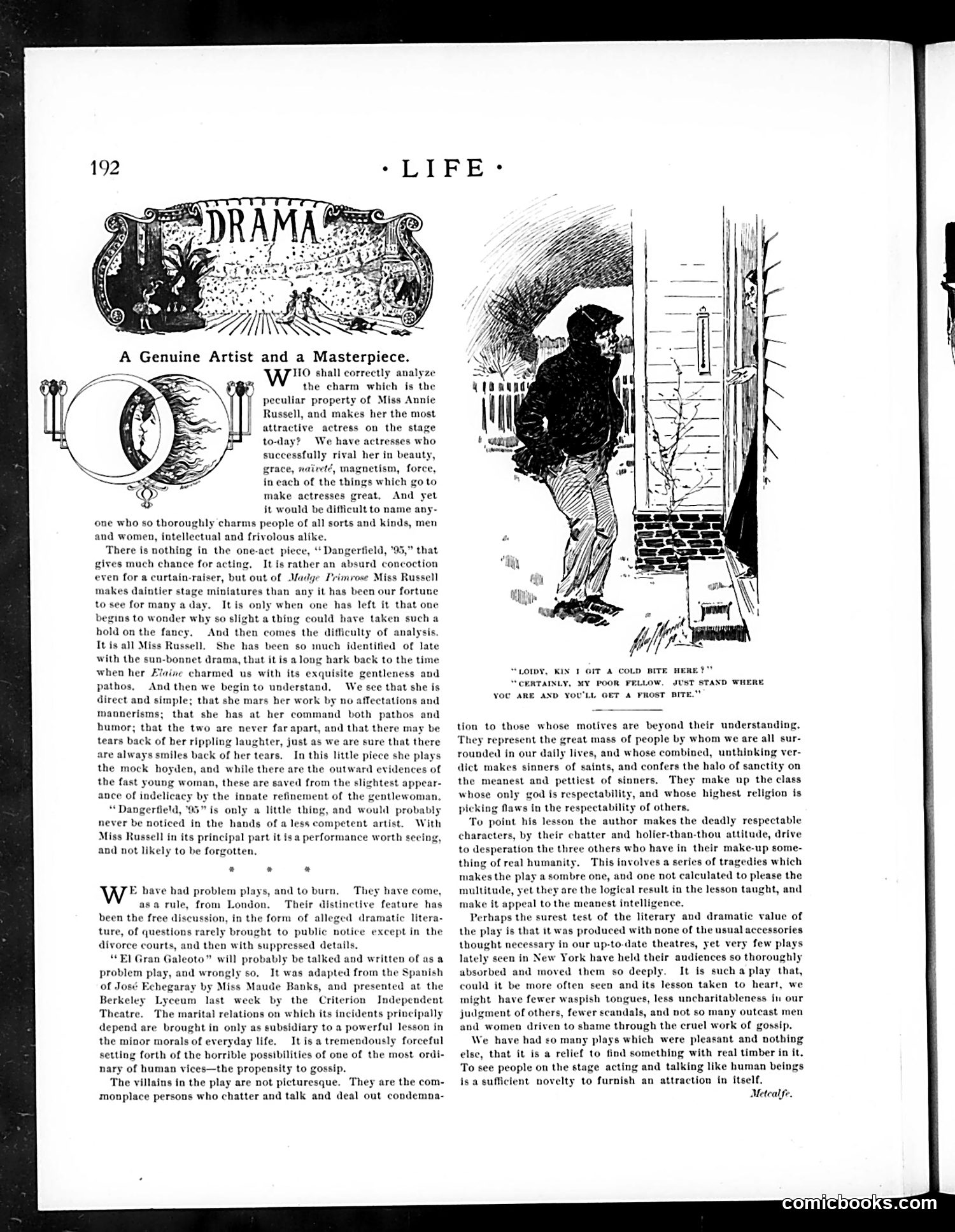
This page from *Life* magazine (page 192) contains a drama criticism article titled "A Genuine Artist and a Masterpiece." The text praises actress Miss Annie Russell and analyzes her performance, likely in a theatrical production. The illustration shows a silhouetted figure in period dress standing at a doorway in winter conditions, apparently depicting a dramatic scene from the play being reviewed. The article discusses Russell's talent for portraying complex human characters with authenticity rather than theatrical affectation. It criticizes plays that rely on melodrama and gossip, praising instead works that explore genuine moral questions and human nature. The piece appears to be standard drama criticism rather than political satire—it's evaluating an actress's performance and the theatrical work itself as legitimate art.
📄 Transcribed text from this page (OCR, searchable)
Machine-transcribed from the original scan — historical spelling and the odd misread are preserved.
A Genuine Artist and a Masterpiece. HO shall correctly analyze the charm which fs the peculiar property of Miss Annie | Russell, and makes her the most attractive actress on the stage y? We have actresses who successfully rival her in beauty, grace, nairvté, magnetism, force, in each of the things which go to make actresses great, And yet it would be difficult to name any- one who so thoroughly charms people of all sorts and kinds, men and women, intellectual and frivolous alike. ‘There is nothing in the one-act piece, “Dangerfield, ‘5, that gives much chance for acting. It is rather an absurd concoction even for a curtain-raiser, but out of Madye Primrose Miss Russell es daintier stage miniatures than ar to see for many a day begins to wonder wh it has been our fortune Itis only when one has left it that one so slight a thing could have taken such a hold on the fancy. And then comes the difficulty of analysis. It is all Miss Russell. She has been so much identified of late with the sun-bonnet drama, that it is along hark back to the time when her Evainc charmed us with its exquisite gentleness and pathos, And then we begin to understand, We see that she is direct and simple; that she mars her work by no affectations and mannerisms; that she has at her command both pathos and humor; that the two are never far apart, and that there may be tears back of her rippling laughter, just as we are sure that there are always smiles back of her tears. In this little piece she plays the mock hoyden, and while there are the outward evidences of the fast young woman, these are saved from the slightest appear- ance of indelicacy by the innate refinement of the gentlewoman, “Dangerfield, 85” is only a little thing, and would probably never be noticed in the hands of a less competent artist. With Miss Russell in its principal part it is a performance worth secing, and not likely to be forgotten. * * * WE Dave had problem plays, and to burn. asa rule, from London. been the free discussion, in the form of alleged dramatic litera- ture, of questions rarely brought to public notice except in the They have come, Their distinctive feature has divorce courts, and then with suppressed details, ‘El Gran Galeoto” will probably be talked and written of as a problem play, and wrongly so, It was adapted from the Spanish of José Echegaray by Miss Maude Banks, and presented at the Berkeley Lyceum last week by the Criterion Independent Theatre. The marital relations on which its incidents prineipally depend are brought in only as subsidiary to a powerful lesson in the minor morals of everyday life. It is a tremendously forceful setting forth of the horrible possibilities of one of the most ordi- nary of human vices—the propensity to gossip. The villains in the play are not picturesque. They are the com- monplace persons who chatter and talk and deal out condemna- “Lowy, “CERTAIN YoU ARE AND You KIN 1 GIT A COLD BITE HERE LOW, JUST STAND WHERE yROST BITE."* tion to those whose motives are beyond their understanding. They represent the great mass of people by whom we are all sur- rounded in our daily lives, and whose combined, unthinking ver- dict makes sinners of saints, and confers the halo of sanctity on the meanest and pettiest of sinners, They up the class whose only god is respectability, and whose highest religion is picking flaws in the respectability of others, To point his lesson the author makes the deadly respectable characters, by their chatter and holier-than-thou attitude, drive to desperation the three others who have in their make-up some- thing of real humanity. This involves a series of tragedies which makes the play a sombre one, and one not calculated to please the multitude, yet they are the logical result in the lesson taught, and make it appeal to the meanest intelligence. Perhaps the surest test of the literary and dramatic value of the play is that it was produced with none of the usual accessories thought necessary in our up-to-date theatres, yet very few play lately seen in New York have held their audiences so thorough! absorbed and moved them so deeply. It is sucha play that, could it be more often seen and its lesson taken to heart, we might have fewer waspish tongues, less uncharitableness in our judgment of others, fewer scandals, and not so many outcast men and women driven to shame through the cruel work of gossip. We have had so many plays which were pleasant and nothing else, that it is a relief to find something with real timber in it. To see people on the stage acting and talking like human beings isa sufficient novelty to furnish an attraction in itself. Metealfe.