
Life, 1898-03-10 · page 3 of 20
Life — March 10, 1898 — page 3: what you’re looking at
What you’re looking at
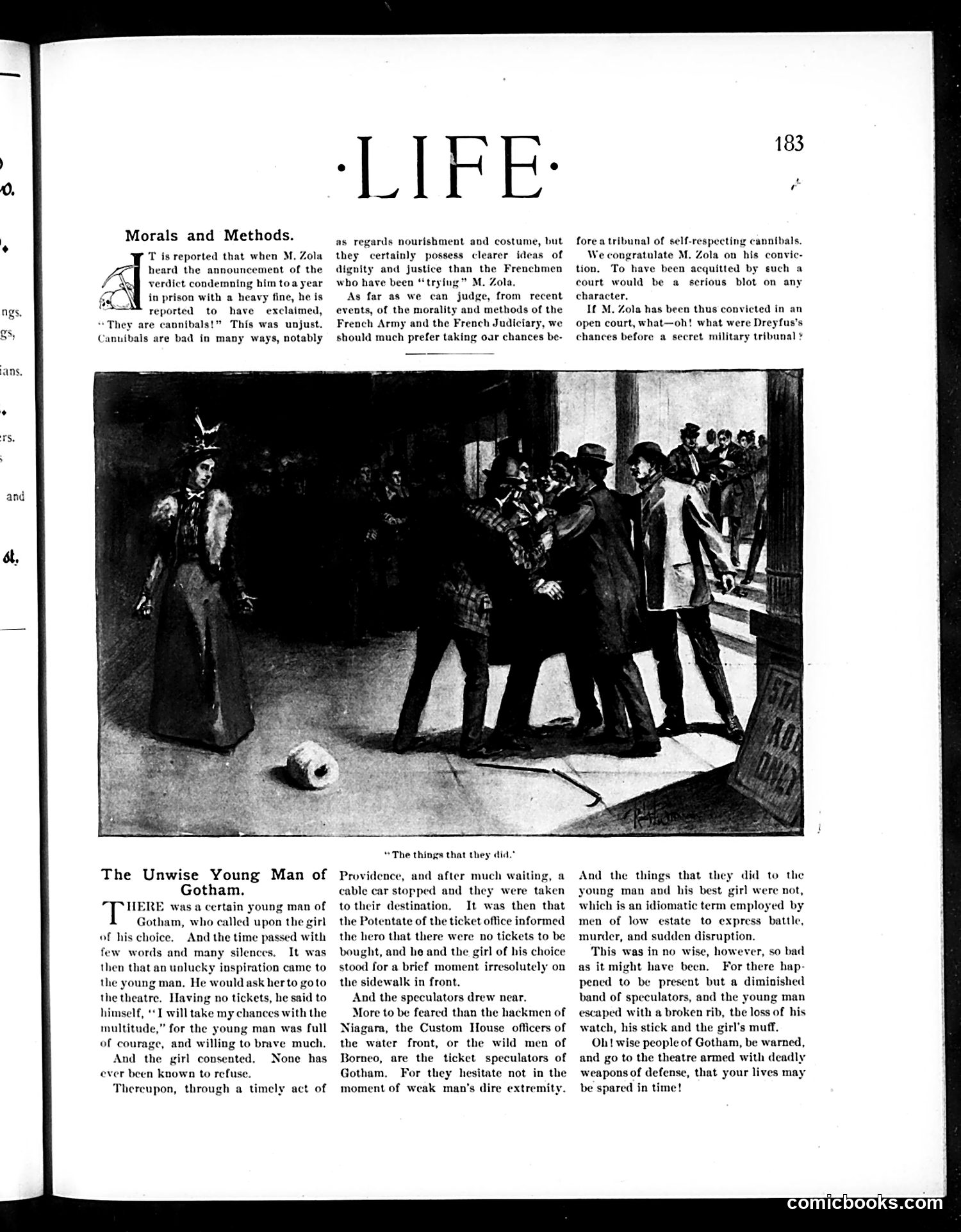
The top section discusses M. Zola's verdict condemning French military conduct, sarcastically suggesting France's army resembles "cannibals" — likely referencing the Dreyfus Affair controversies over military injustice. The main illustration and story, "The Unwise Young Man of Gotham," depicts a satirical narrative about a naive young man attempting to take a cable car without a ticket. When caught by authorities, he resists—leading to injury (broken rib, lost watch). The satire targets foolish attempts at defiance against institutional power. The phrase "The things that they did" suggests the authorities' violent response to minor transgression. This appears to be humorous social commentary on the futility of challenging established systems, presented as cautionary tale about naïve youthful rebellion.
📄 Transcribed text from this page (OCR, searchable)
Machine-transcribed from the original scan — historical spelling and the odd misread are preserved.
Morals and Methods. T is reported that when M. Zola heard the announcement of the verdict condemning him toa year in prison with a heavy fine, he is reported to have exclaimed, “They are cannibals!” This was unjust. Canuibals are bad in many ways, notably The Unwise Young Man of Gotham. “THERE was a certain young man of Gotham, who called upon the girl of his choice. And the time passed with few words and many silences, It was then that an unlucky inspiration came to the young man. He would ask her to goto the theatre, Having no tickets, he said to himself, ‘1 will take my chances with the multitude,” for the young man was full of courage, and willing to brave much. And the girl consented. None has ever been known to refuse. Thereupon, through a timely act of as regards nourishment and costume, but they certainly possess clearer ideas of dignity and justice than the Frenchmen who have been “trying” M. Zola, As far as we can judge, from recent events, of the morality and methods of the French Army and the French Judiciary, we should much prefer taking oar chances be- “The things that they di Providence, and after much waiting, a cable car stopped and they were taken to their destination, It was then that the Potentate of the ticket office informed the hero that there were no tickets to be bought, and he and the girl of his choice stood for a brief moment irresolutely on the sidewalk in front. And the speculators drew near. More to be feared than the hackmen of Niagara, the Custom House officers of the water front, or the wild men of Borneo, are the ticket speculators of Gotham. For they hesitate not in the moment of weak man’s dire extremity. fore a tribunal of self-respecting cannibals. We congratulate M. Zola on his conv tion. To have been acquitted by such court would be a serious blot on any character, If M. Zola has been thus convicted in an open court, what—oh! what were Dreyfus’s chances before a secret military tribunal ¥ And the things that they did to the young man and his best girl were not, which is an idiomatic term employed by men of low estate to express battle, murder, and sudden disruption. This was in no wise, however, so bad as it might have been. For there hap- pened to be present but a diminished band of speculators, and the young man escaped with a broken rib, the loss of his watch, his stick and the girl's muff. Oh! wise people of Gotham, be warned, and go to the theatre armed with deadly weapons of defense, that your lives may be spared in time!