
A complete issue · 20 pages · 1898
Life — February 3, 1898
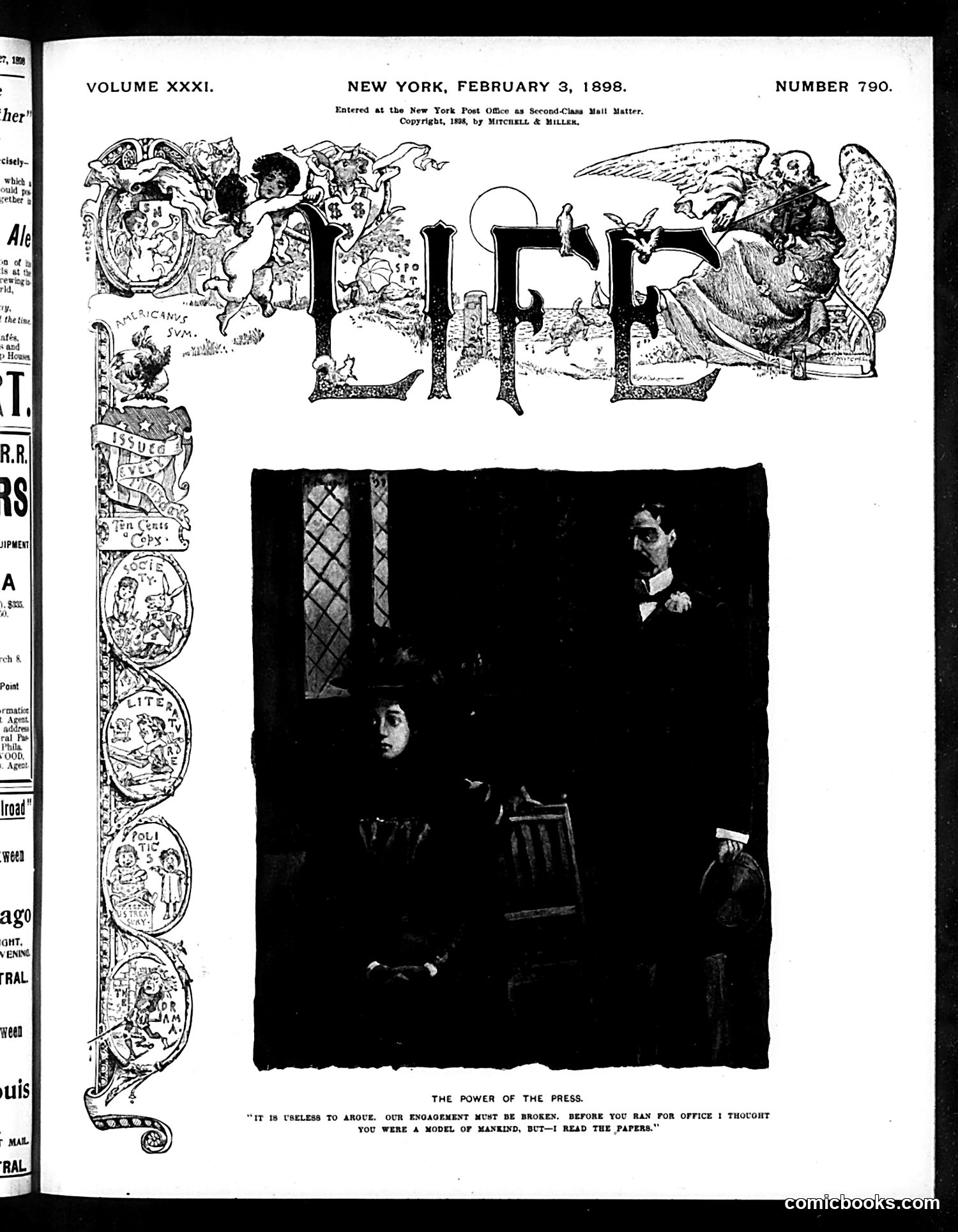
The main illustration titled "The Power of the Press" depicts a dramatic scene where a man reads a newspaper to another figure, with the caption: "It is useless to argue. Our engagement must be broken. Before you ran for office I thought you were a model of manhood, but—I read the papers." This cartoon satirizes the influence of newspaper coverage on public perception and personal reputation during the 1898 election period. The joke targets how press reporting—particularly negative coverage—can destroy a political candidate's public image and credibility, even among those who know him personally. It suggests newspapers wielded significant power in shaping opinion about political figures, sometimes regardless of actual character or merit.
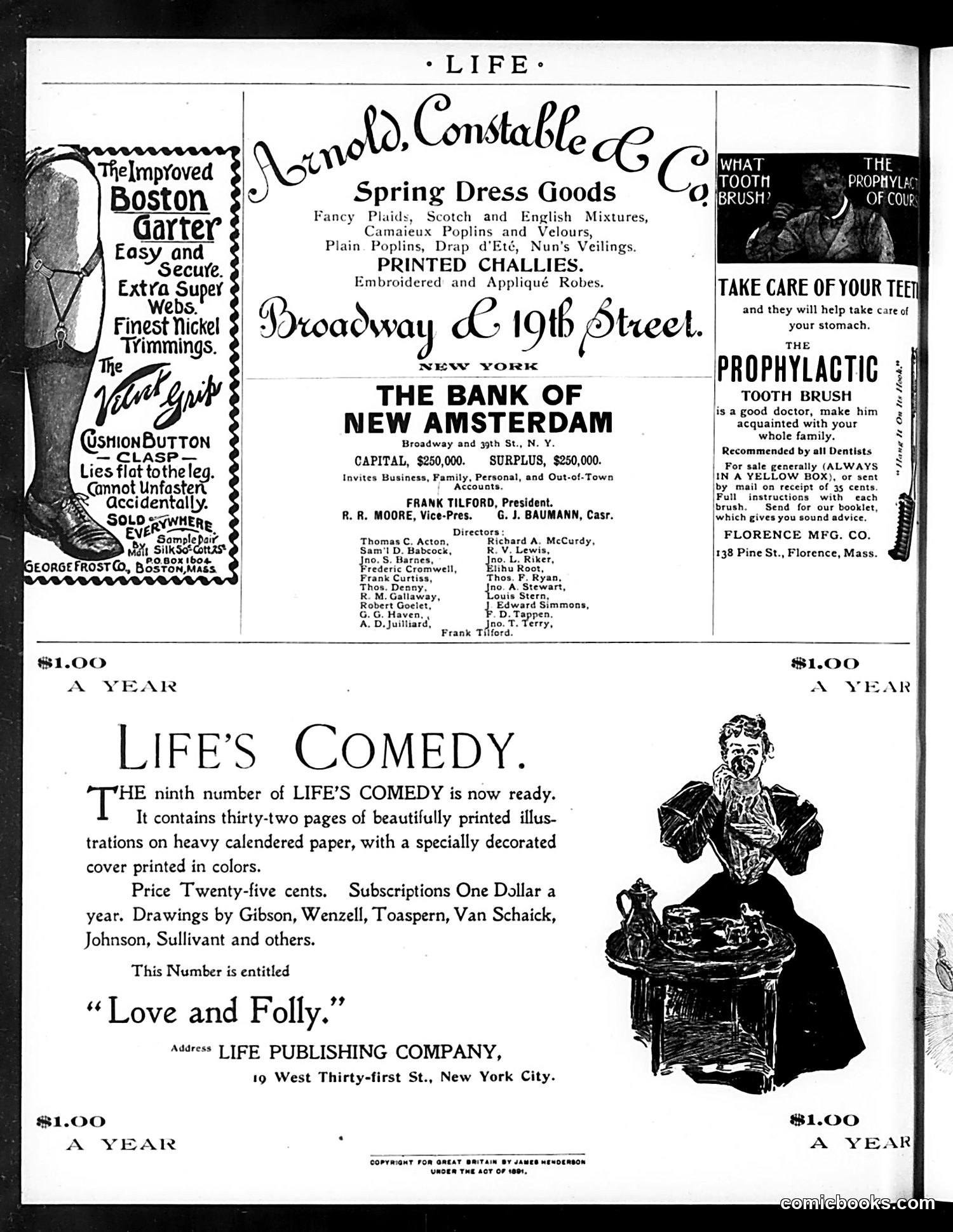
This page is **primarily advertising**, not political cartoons. The content includes: 1. **Arnold, Constable & Co.** advertisement for spring dress goods (top center) 2. **The Improved Boston Garter** ad (left side) - a fashion product claiming superior design 3. **Bank of New Amsterdam** advertisement (center) listing officers and capital 4. **The Prophylactic Tooth Brush** ad (right) - a dental hygiene product 5. **Life's Comedy** promotion (bottom) - announcing the ninth issue of Life magazine's comedy collection, priced at 25 cents, featuring artwork by Gibson, Wenzell, and others The only illustration with potential satirical content is the small figure at bottom right promoting "Love and Folly" — appearing to be a dandy or foppish character, likely mocking vanity or romantic foolishness, though context is limited. **This is fundamentally an advertising page from early 1900s Life magazine.**
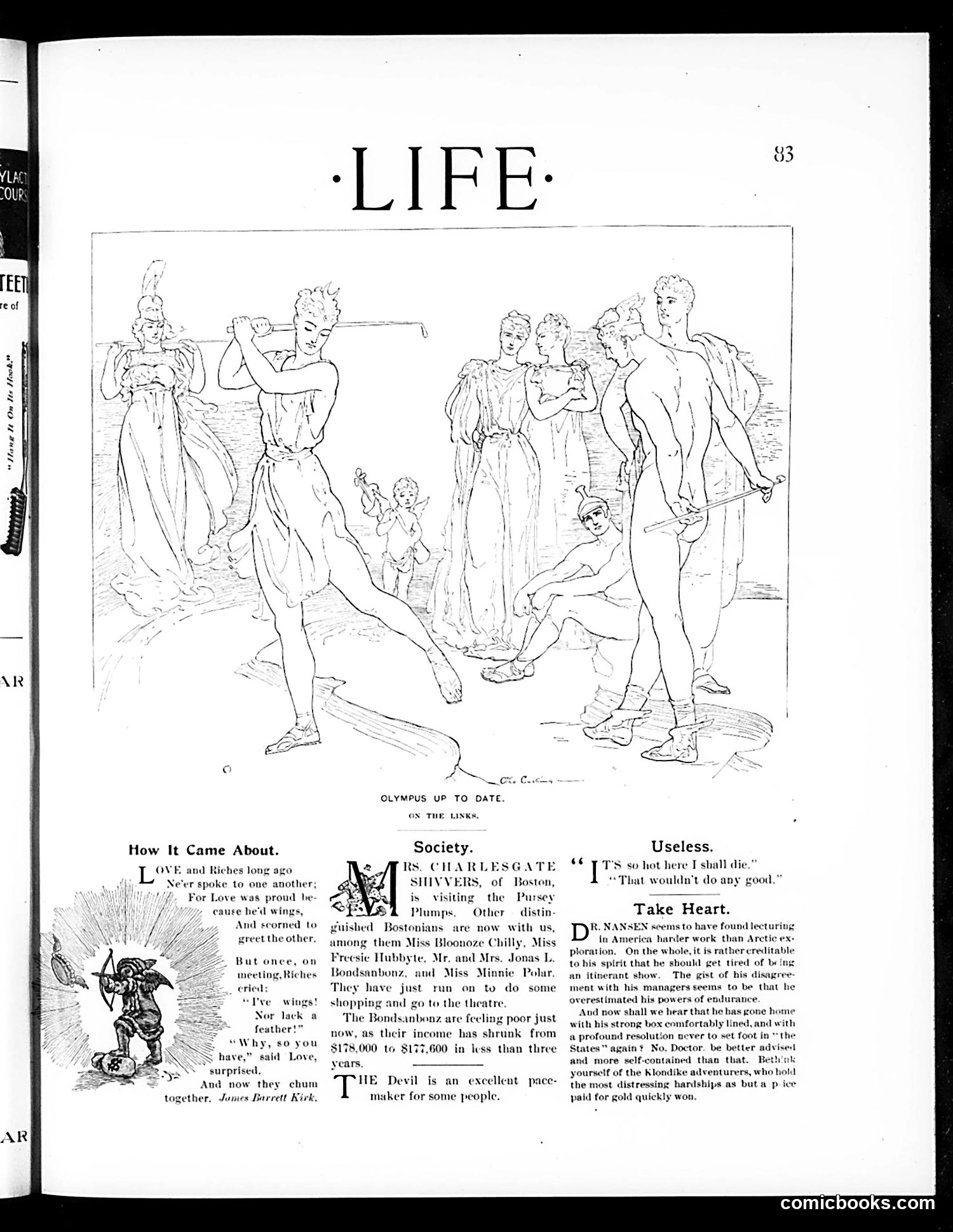
The main illustration depicts classical Greek/Roman gods and figures in modern dress, titled "Olympus Up to Date: On the Links." This satirizes wealthy Bostonians—specifically mentioned are the Shivvers and Poles families, along with visitors like "Miss Hoosooze Chilly"—engaging in golf, a fashionable sport among the elite. The accompanying text sections mock various social pretensions: wealthy families experiencing income decline ("$178,000 to $177,000"), romantic entanglements among the upper class, and a lecturer (Dr. Ranses) exhausting himself performing tedious intellectual work. The satire targets Gilded Age excess, social climbing, financial anxiety despite wealth, and the performative intellectualism of Boston society. The "gods on the links" metaphor suggests these wealthy individuals see themselves as superior beings.
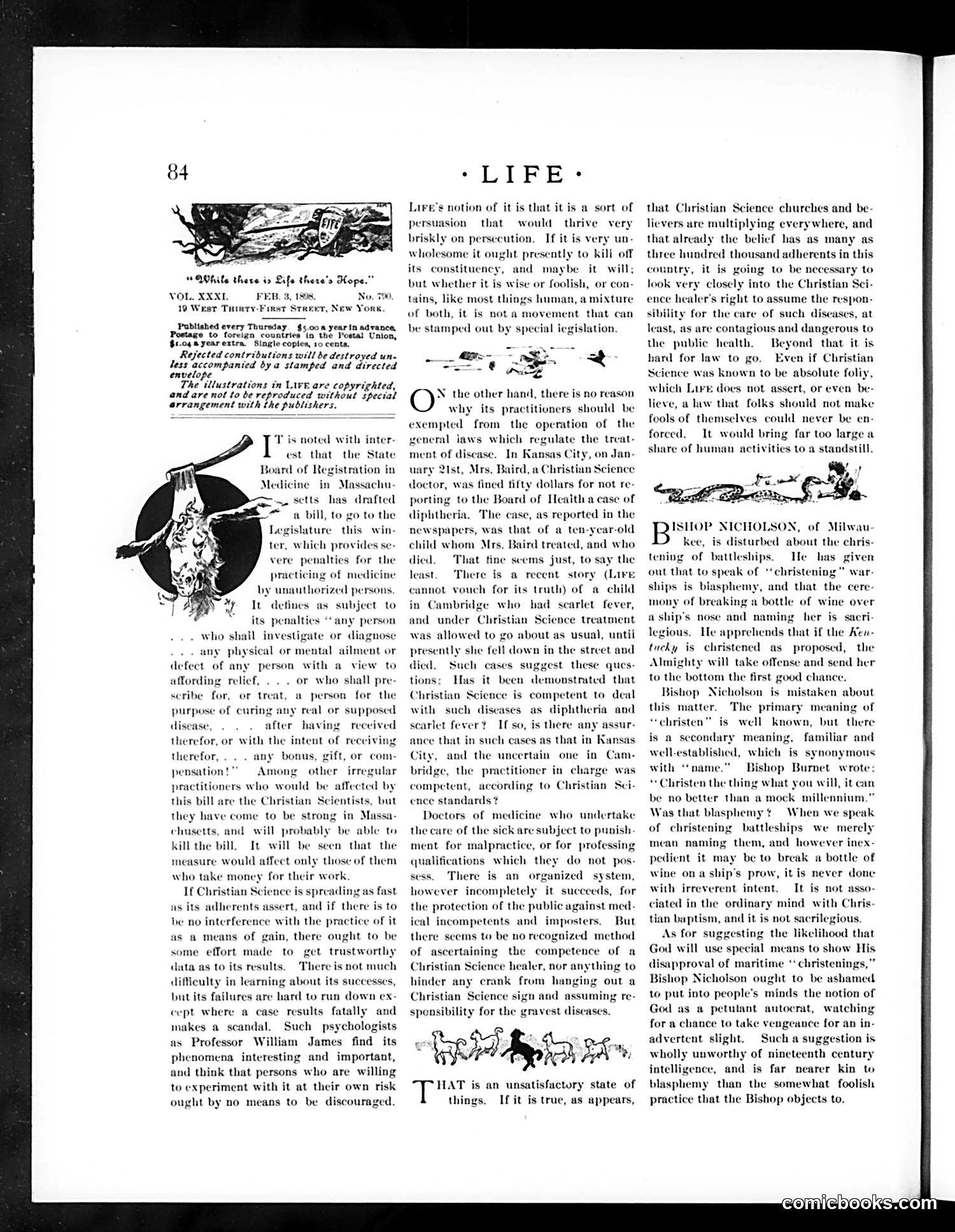
This page critiques **Christian Science** practitioners and their legal exemptions from medical regulations. The text discusses a specific case: a Christian Science doctor in Kansas City was fined for not reporting a child's diphtheria case to health authorities. The **anatomical illustration** (left side) appears to depict disease or medical conditions, likely emphasizing why medical oversight matters. The satire argues that Christian Science should not be legally exempt from standard medical practices, particularly regarding contagious diseases. The piece questions whether allowing untrained practitioners to treat serious illnesses serves public health, even if adherents believe in their faith's efficacy. Bishop Nicholson's objection to "Christening" ships (naming ceremonies) is presented as petty compared to the serious health dangers posed by unregulated Christian Science medicine.
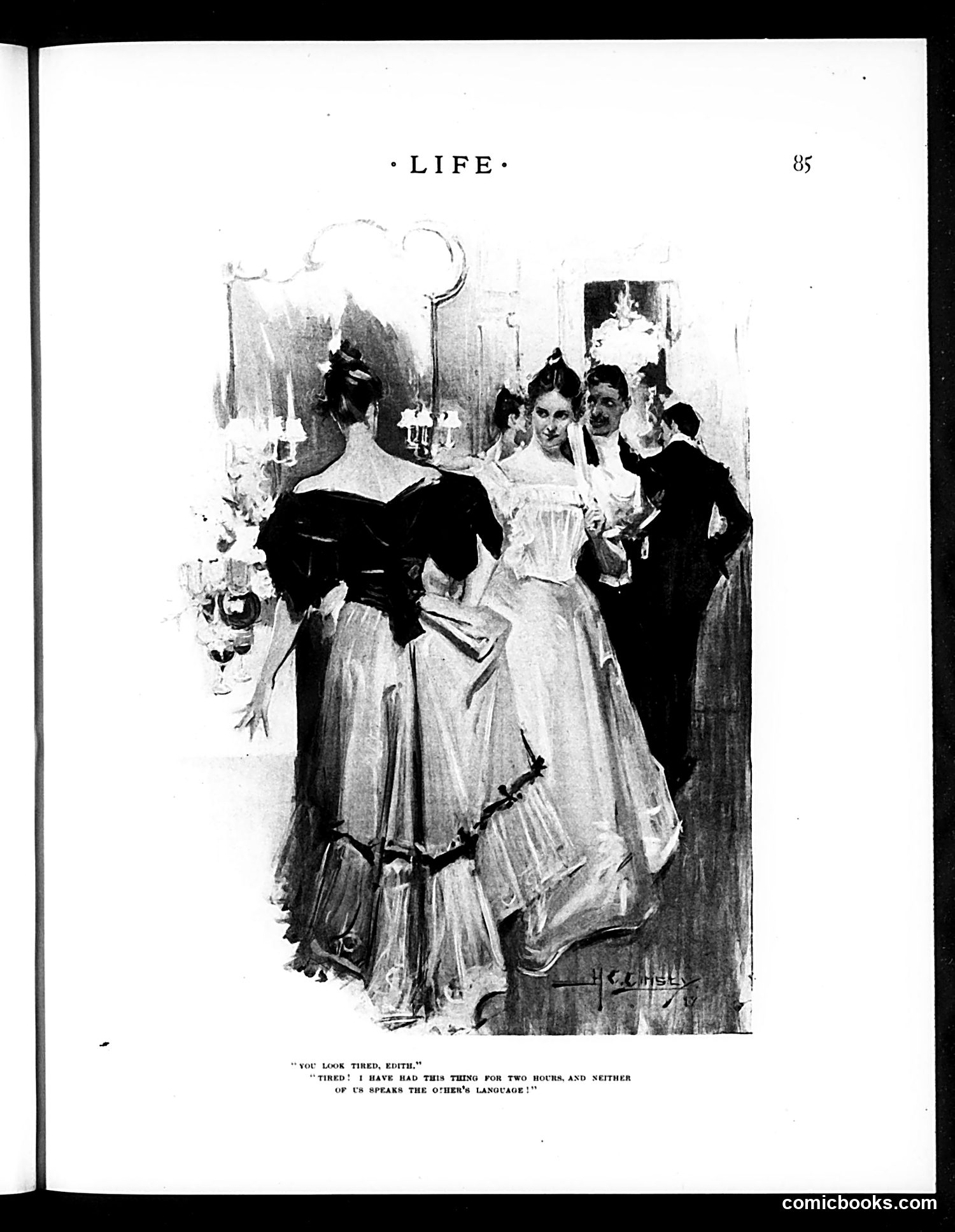
This illustration depicts an elegant social gathering—likely a formal dinner or reception from the early 20th century. The central figure is a woman in an elaborate white gown, surrounded by men in black evening wear and other formally dressed attendees. The caption reads: "You look tired, Edith." / "Tired? I have had this thing for two hours, and neither of us speaks the other's language!" The satire appears to target the social awkwardness of formal gatherings where guests struggle with communication barriers—possibly alluding to language differences or simply the difficulty of maintaining conversation at high-society events. The joke emphasizes the tedium and forced nature of upper-class social obligation, where physical appearance of engagement matters more than genuine connection or meaningful dialogue.
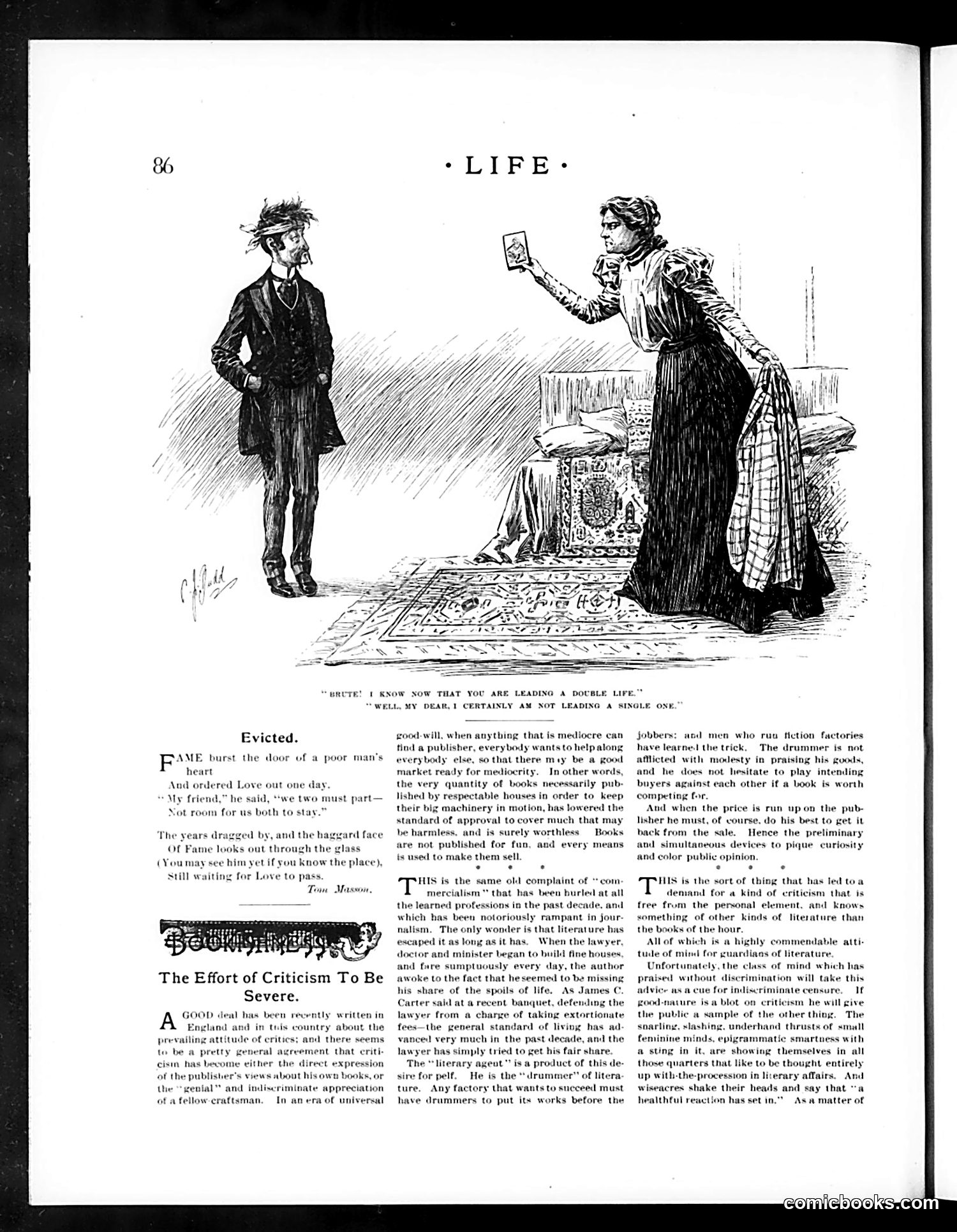
The main illustration depicts a domestic scene where a woman holds up a playing card to a man, accusing him of "leading a double life." He protests he's "not leading a single one." The satire targets marital infidelity and deception—a husband caught with evidence of duplicitous behavior. The woman's gesture with the card suggests she's discovered proof, possibly gambling debts or other secretive activity. His defensive response claiming he leads no honest life at all is the joke's dark humor. The accompanying articles discuss literary criticism and book publishing standards. The page reflects late 19th/early 20th-century concerns about morality, marriage, and social respectability—common Life magazine satirical themes attacking hypocrisy and moral failings among the middle and upper classes.
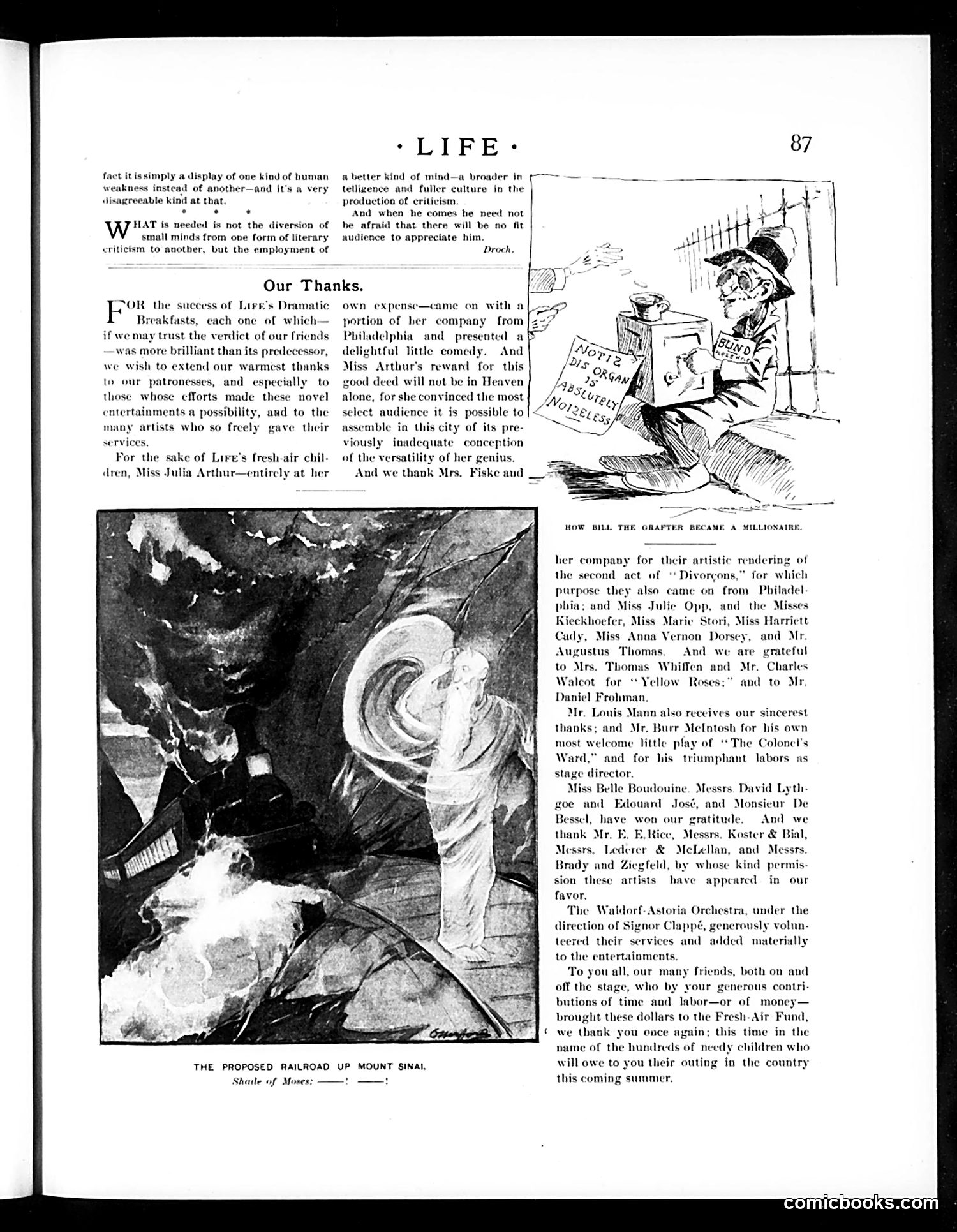
The top cartoon, titled "How Bill the Grafter Became a Millionaire," depicts a dishonest character labeled with signs reading "GRAFT," "BOODLE," and "HONEST" (the last ironic). The figure appears to be a political corruption caricature—likely a local politician or businessman enriching himself through illegal schemes. The artist ridicules how grafters accumulate wealth through bribery and embezzlement while maintaining a facade of respectability. The lower image, "The Proposed Railroad Up Mount Sinai," shows a mountainous landscape with religious connotations—presumably satirizing a commercial scheme to desecrate a sacred biblical site with modern infrastructure. The page also contains a lengthy acknowledgment thanking contributors to Life's "Dramatic Breakfasts" fundraiser for the Fresh Air Fund, a charitable organization providing country outings for poor urban children.
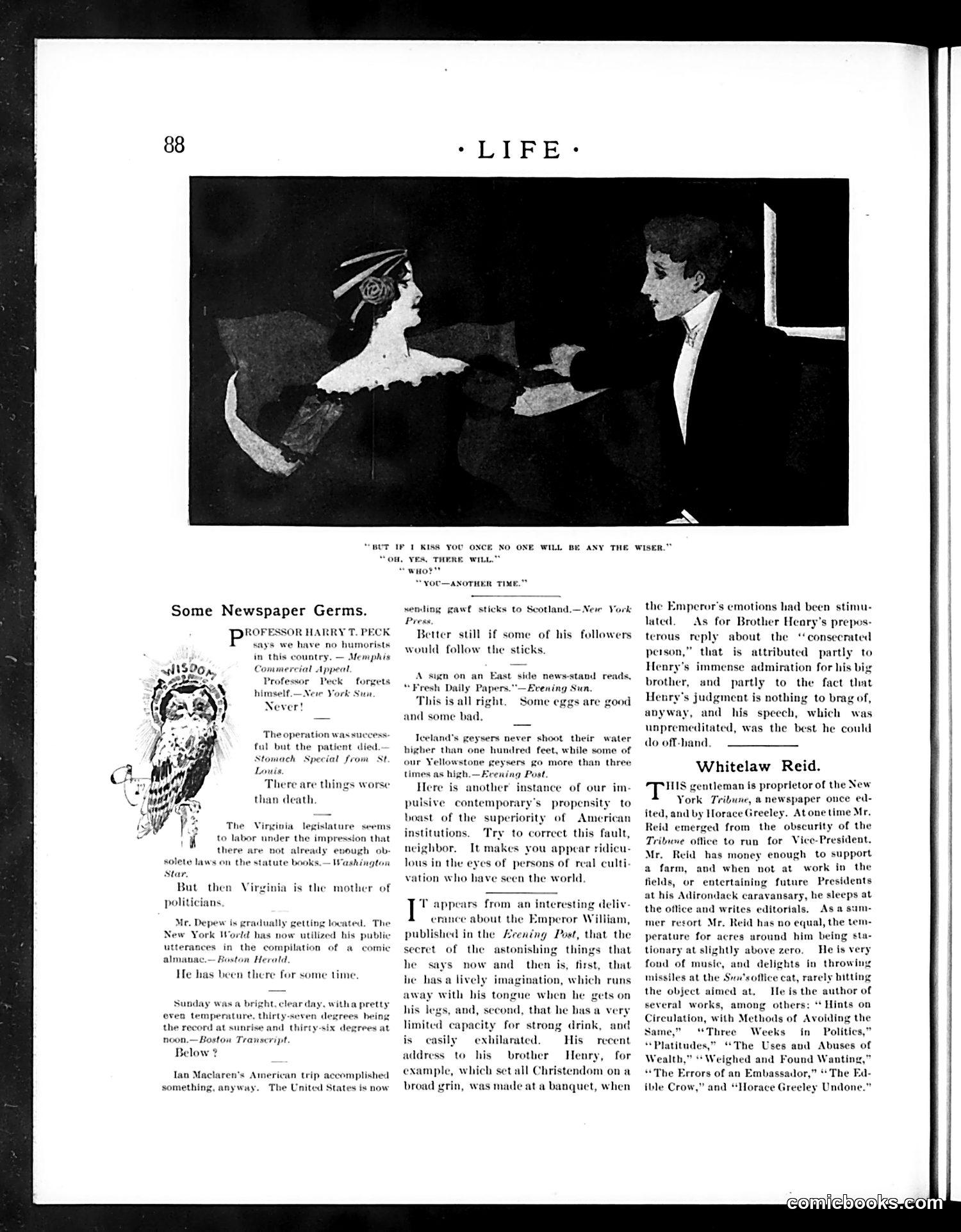
This page contains a dialogue cartoon at top (showing a woman and man in evening dress) with the caption addressing kissing and discretion—typical satirical commentary on romantic/social behavior. Below are three separate gossip/news items: 1. **"Some Newspaper Germs"** — A Professor Harry T. Peck item satirizing newspapers' unreliability, using a owl illustration. References Scottish and New York press reports about geysers. 2. **"Whitelaw Reid"** — A biographical profile of this newspaper editor and politician (described as proprietor of the *New York Tribune*), mentioning his work supporting Vice-President candidates and his literary publications. The page appears to be a satirical news/gossip column format typical of *Life* magazine, mixing humor about press credibility with biographical sketches of public figures. The overall tone mocks journalism's accuracy and discusses contemporary political figures.
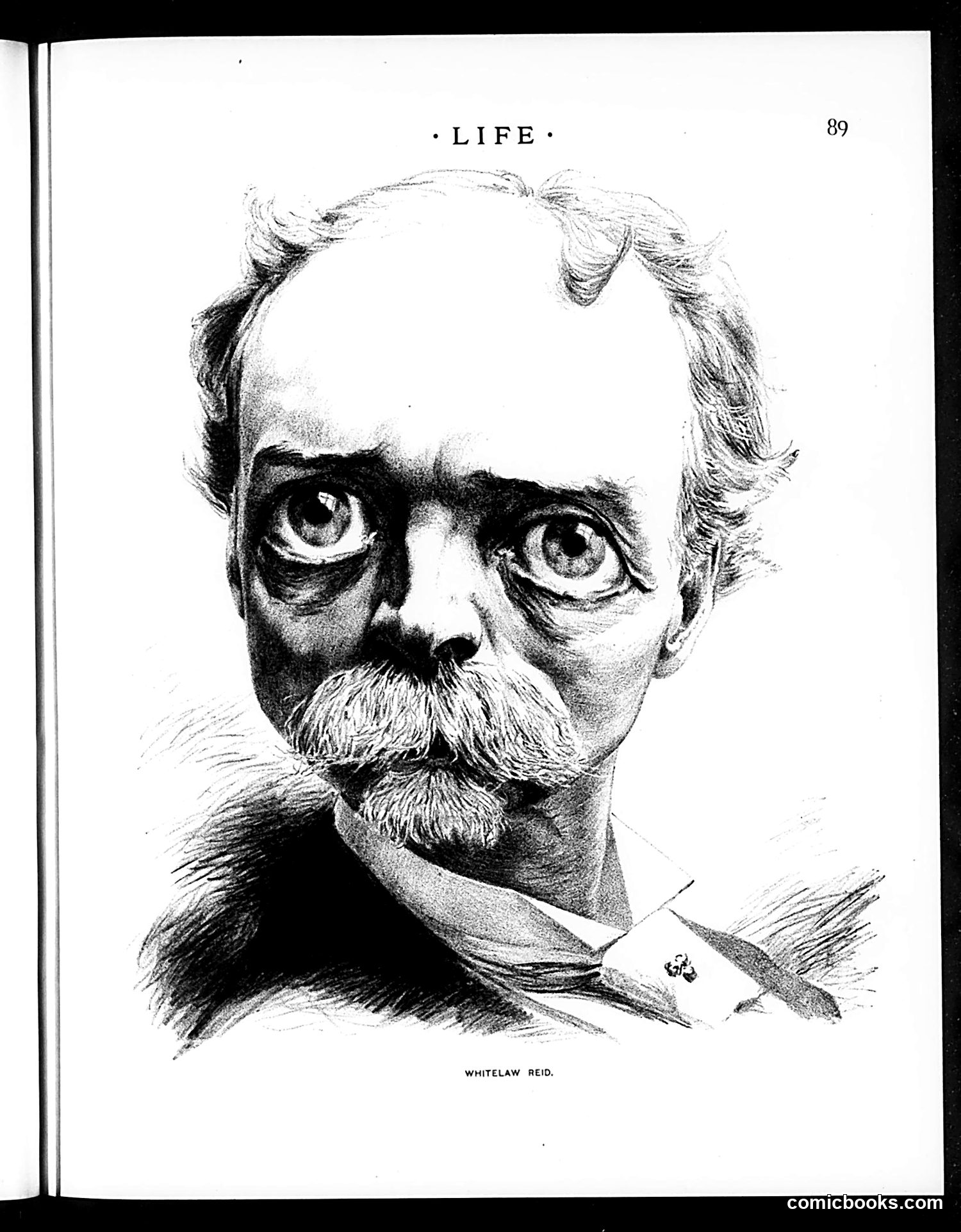
This page features a portrait labeled "WHITELAW REID," a prominent American political and newspaper figure. The sketch is a detailed pen-and-ink drawing showing a distinguished gentleman with a receding hairline, prominent eyes, full mustache and beard, wearing formal attire with what appears to be a decorative pin or medal. The page itself is primarily a portrait rather than a satirical cartoon. Without additional context from surrounding pages, the satirical intent—if any—is unclear. The portrait's inclusion in *Life* magazine (known for political satire) suggests Reid was a newsworthy figure, likely commenting on his prominence in journalism or politics during this era. More context would be needed to determine the specific satirical angle or point being made about him.
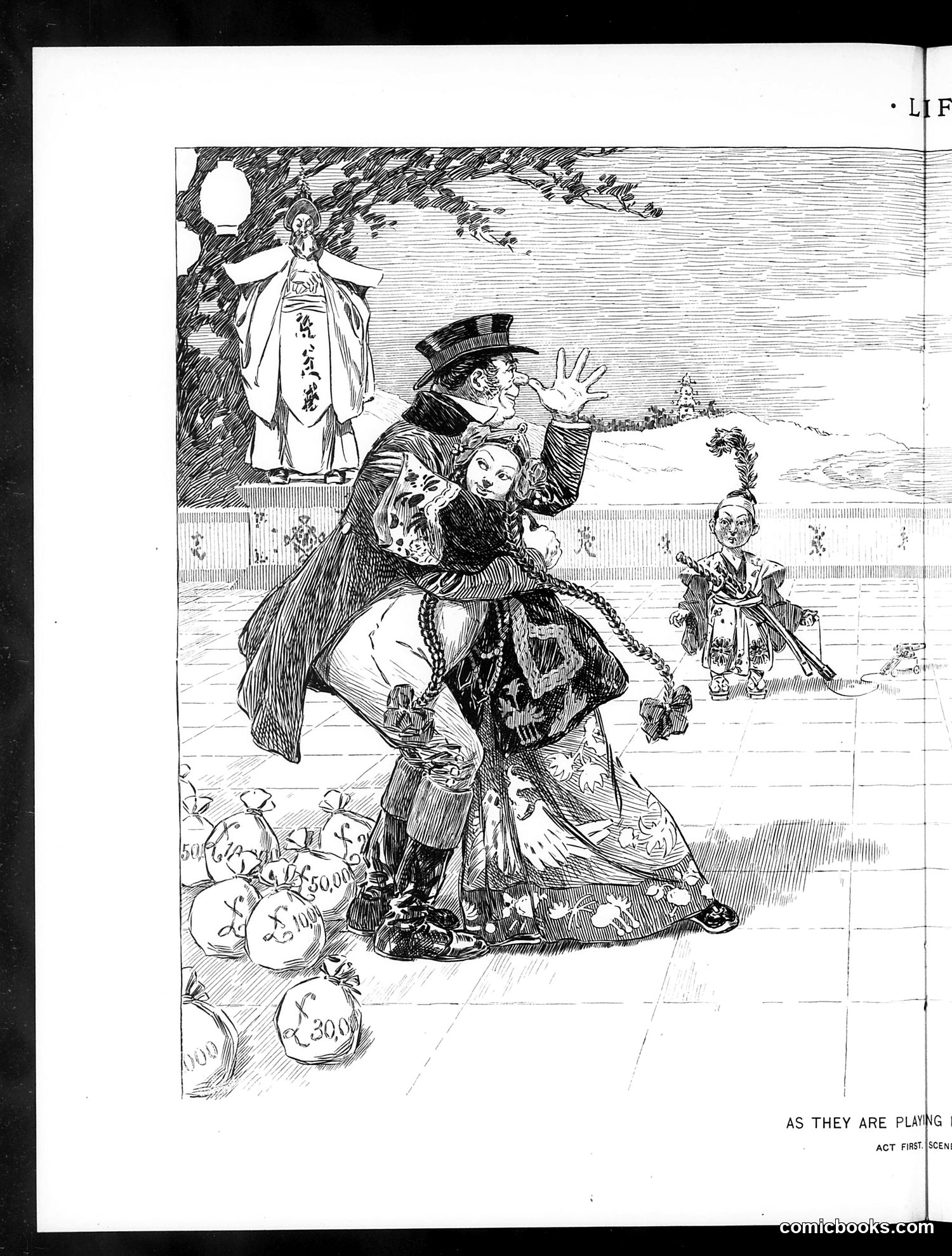
This is a satirical illustration titled "As They Are Playing" (Act First Scene). The cartoon depicts what appears to be a theatrical or political performance involving figures in Asian dress (suggested by the characters and architectural elements in the background). The central figure—a Western man in a top hat—is shown in an exaggerated, undignified pose, seemingly manipulated or controlled by a woman in elaborate dress. Money bags marked with pound symbols (£) litter the ground, suggesting financial exploitation or corruption. The figure in the background wearing Asian robes appears god-like or commanding, implying foreign influence or control. This likely satirizes Western involvement in Asian affairs, colonial exploitation, and financial corruption during the imperialist era, with the Western figure depicted as buffoonish and controlled by hidden powers.
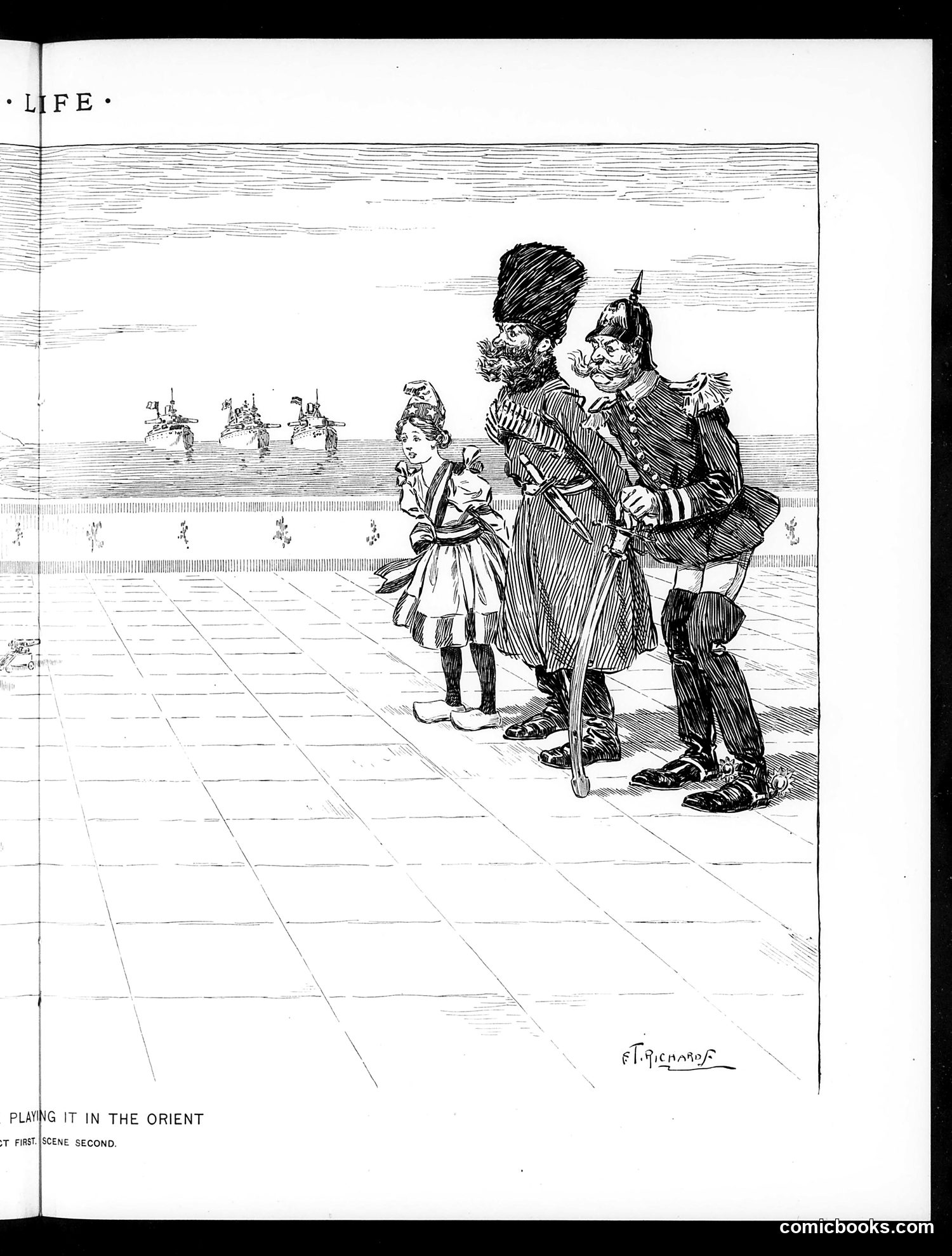
This political cartoon depicts three exaggerated caricatured figures on what appears to be a formal plaza or parade ground, with military vessels visible in the background. The caption "PLAYING IT IN THE ORIENT" (subtitled "First Scene, Second") suggests this is part of a multi-scene satirical narrative about diplomatic or military activity in Asia. The figures appear to represent Western powers engaged in colonial or imperialist activities in Eastern territories. The exaggerated facial features and military dress indicate satire directed at international power-playing, likely commenting on late 19th or early 20th-century imperial competition in Asia. Without additional context, the specific nations and events referenced remain unclear, though the naval presence suggests military or naval diplomatic tensions.
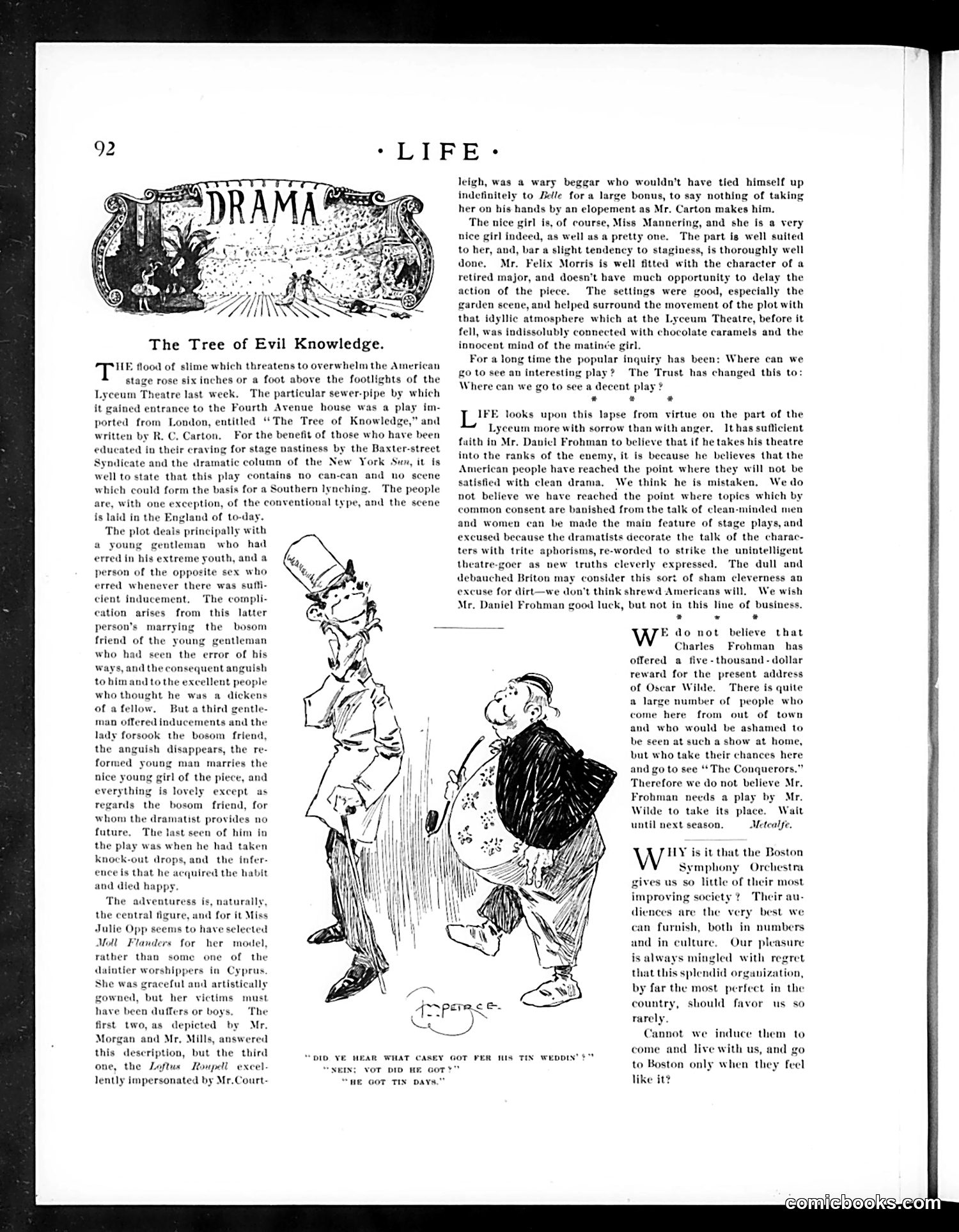
This page reviews a theatrical production at the Lyceum Theatre, criticizing a play imported from London about a young gentleman's moral corruption. The accompanying illustration depicts a caricatured figure in exaggerated dress—likely representing either the protagonist or a type of foolish gentleman—stumbling or falling, embodying the play's theme of moral degradation. The drama section's commentary suggests Life magazine dismisses the production as overly moralistic and containing "trite aphorisms" delivered by underdeveloped characters. The magazine advocates for cleaner American drama rather than relying on European imports with hackneyed cautionary tales. The cartoon visually reinforces this critique through physical comedy, suggesting the play's pretentiousness deserves ridicule.
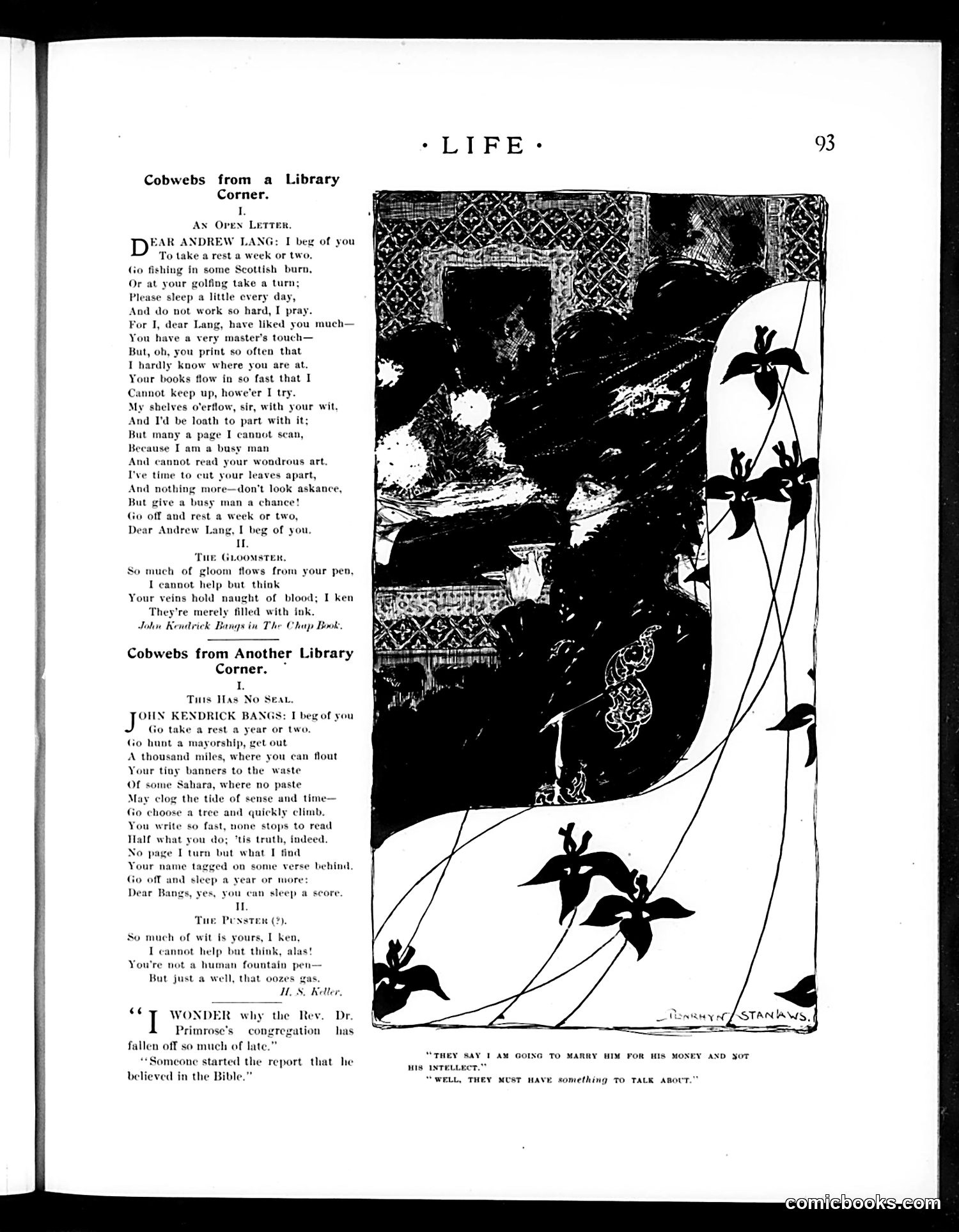
This page from *Life* magazine contains literary criticism disguised as humorous letters. Two prolific writers—Andrew Lang and John Kendrick Bangs—are gently mocked for publishing too frequently. The first section complains that Lang produces books so rapidly that readers cannot keep up; a busy man cannot read everything published. The second criticizes Bangs for writing with such gloom and speed that his output exceeds anyone's ability to read it. The illustration shows a woman in an interior, with the caption about marriage prospects. A gossipy observer suggests the woman will marry for money rather than intellect, prompting the reply that people "must have *something* to talk about"—implying shallow gossip fills social conversation. The overall satirical point: contemporary readers were overwhelmed by the sheer volume of literary production from popular authors, while society distracted itself with trivial scandal.
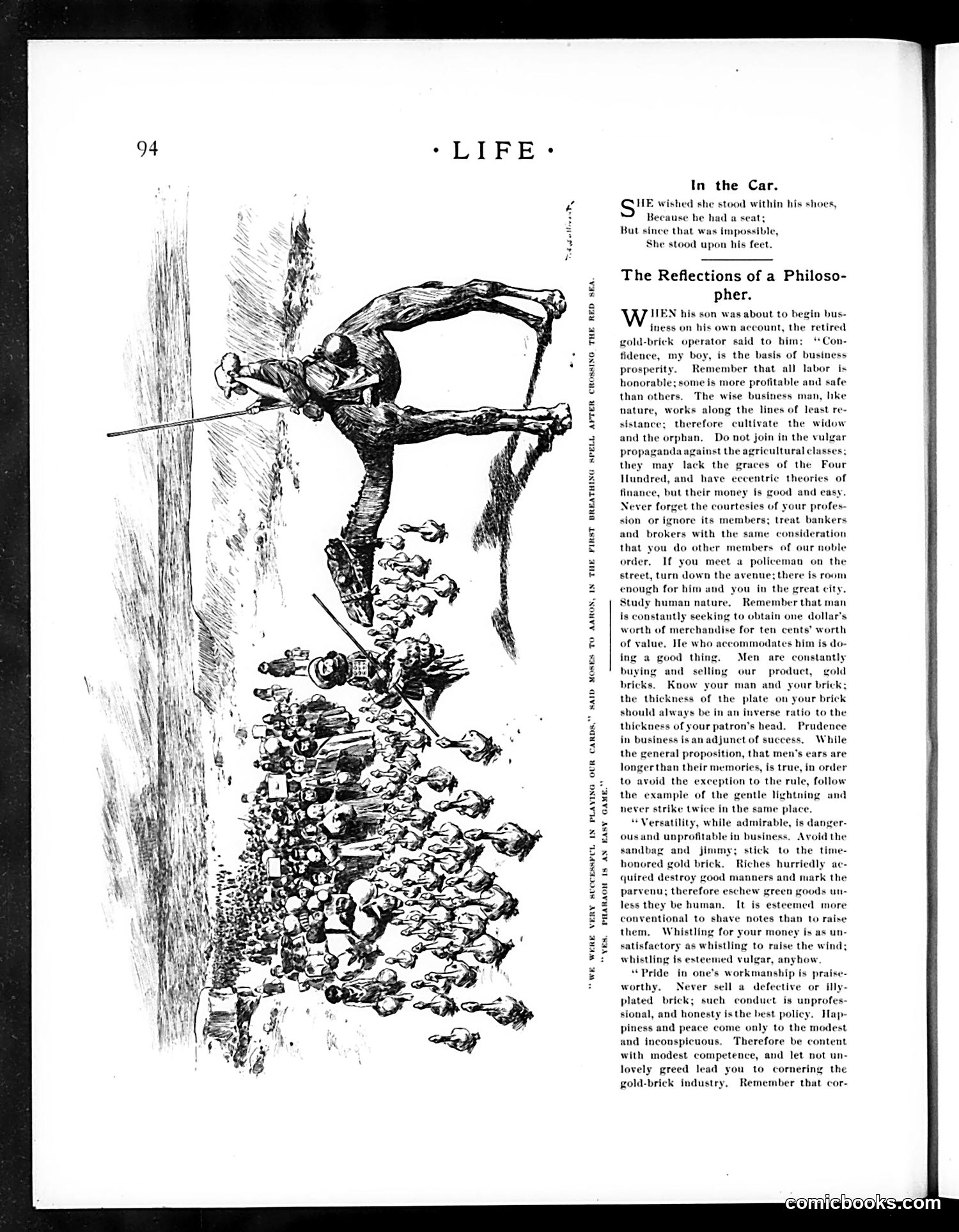
This page contains two satirical pieces mocking con artists and their ethics. **"In the Car"** is a brief joke about crowded public transportation, with a woman forced to stand on a man's feet since he won't surrender his seat—a commentary on urban rudeness. **"The Reflections of a Philosopher"** is the main satire: a retired "gold-brick operator" (confidence man/swindler) advises his son entering the same criminal business. The humor lies in the father dispensing cynical, immoral "business advice" while using respectable language—cultivating widows and orphans for their money, understanding that customers want to cheat themselves, using "gold bricks" (worthless counterfeits) on gullible marks, and timing cons to avoid repeat victims. The satire targets both con artists and their victims' stupidity. "Gold brick" was a common late-19th/early-20th-century scam involving fake precious metal bars. The piece satirizes how criminals rationalize dishonesty as legitimate "business" while mocking the public's willingness to be defrauded.
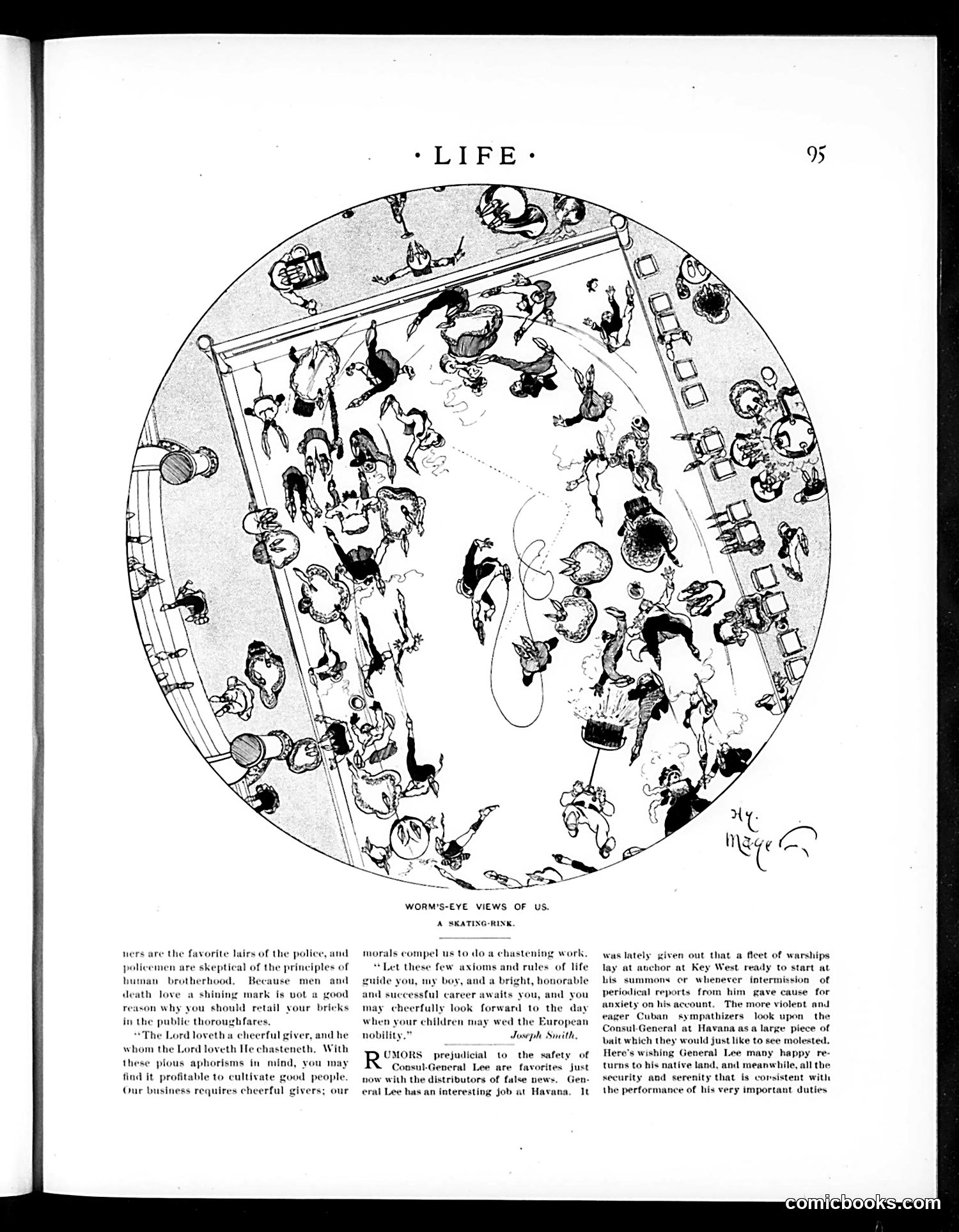
This *Life* magazine page contains a bird's-eye view cartoon of a skating rink, satirizing American social behavior and hypocrisy. The illustration shows numerous figures skating chaotically, viewed from above. The accompanying text critiques moral contradiction: the passage advocates cultivating "good people" and cheerful givers while acknowledging that enforcing morals requires "chastening work." It references **Consul-General Lee at Havana**, likely Fitzhugh Lee during the pre-Spanish-American War period, when tensions over Cuba ran high. The text mocks those spreading false rumors about Lee's safety and warships stationed at Key West, while noting that Cuban independence sympathizers treated him as "bait" to provoke American intervention. The satire targets both American moral pretension and sensationalism around foreign policy crises.
This page contains three humorous short stories satirizing everyday American life, plus book advertisements and product ads. **"A Dyspeptic's View"** mocks the disappointment of Christmas gift-giving—recipients receive useless or unwanted presents (history books instead of skates, cheap cigars instead of quality items). The satire targets both gift-givers' thoughtlessness and recipients' ingratitude. **"Sad Experience in a Hotel"** is slapstick comedy about a woman's pet monkey that learns to ring the electric bell by observing her, then escapes through a bathroom transom while being chased by bellhops, causing chaos. **The orphan boy anecdote** offers gentle humor: a child at a Methodist orphanage expresses gratitude for the care while joking his healthy parents prevent him from staying permanently. All three pieces reflect turn-of-century American domestic life, social anxieties about consumption and manners, and sentimental attitudes toward institutions like orphanages.
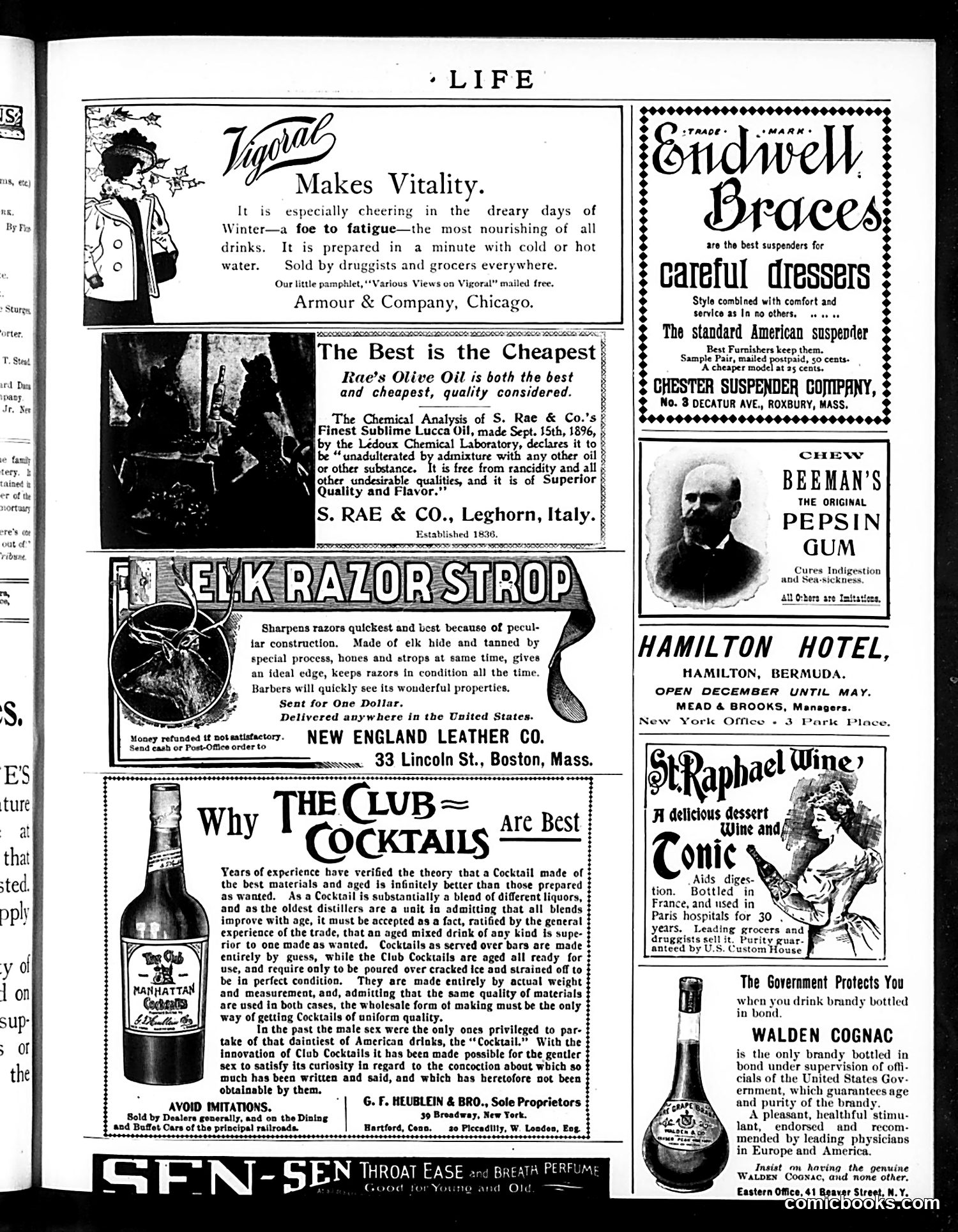
This page is **primarily advertising**, not political satire or editorial cartoons. It showcases various consumer products marketed to early 1890s Americans: **Notable ads include:** - **Vigorol** (Armour & Company): A drink claiming to combat winter fatigue - **Rae's Olive Oil**: Emphasizing purity and quality - **Elk Razor Strop**: A grooming tool for men - **Club Cocktails** (Heublein & Bros.): A significant advertisement noting that pre-made cocktails now allow women to safely enjoy drinks previously unavailable to them—reflecting changing gender norms - **Various medicinal products**: Beeman's Pepsin Gum (digestion), Sen-Sen (breath freshener) - **Spirits and wine**: Including Walden Cognac and St. Raphael Wine The **Club Cocktails ad is culturally notable**, explicitly addressing that cocktails were previously inaccessible to "the gentler sex" and celebrating their new availability—a subtle marker of shifting social conventions in this era.
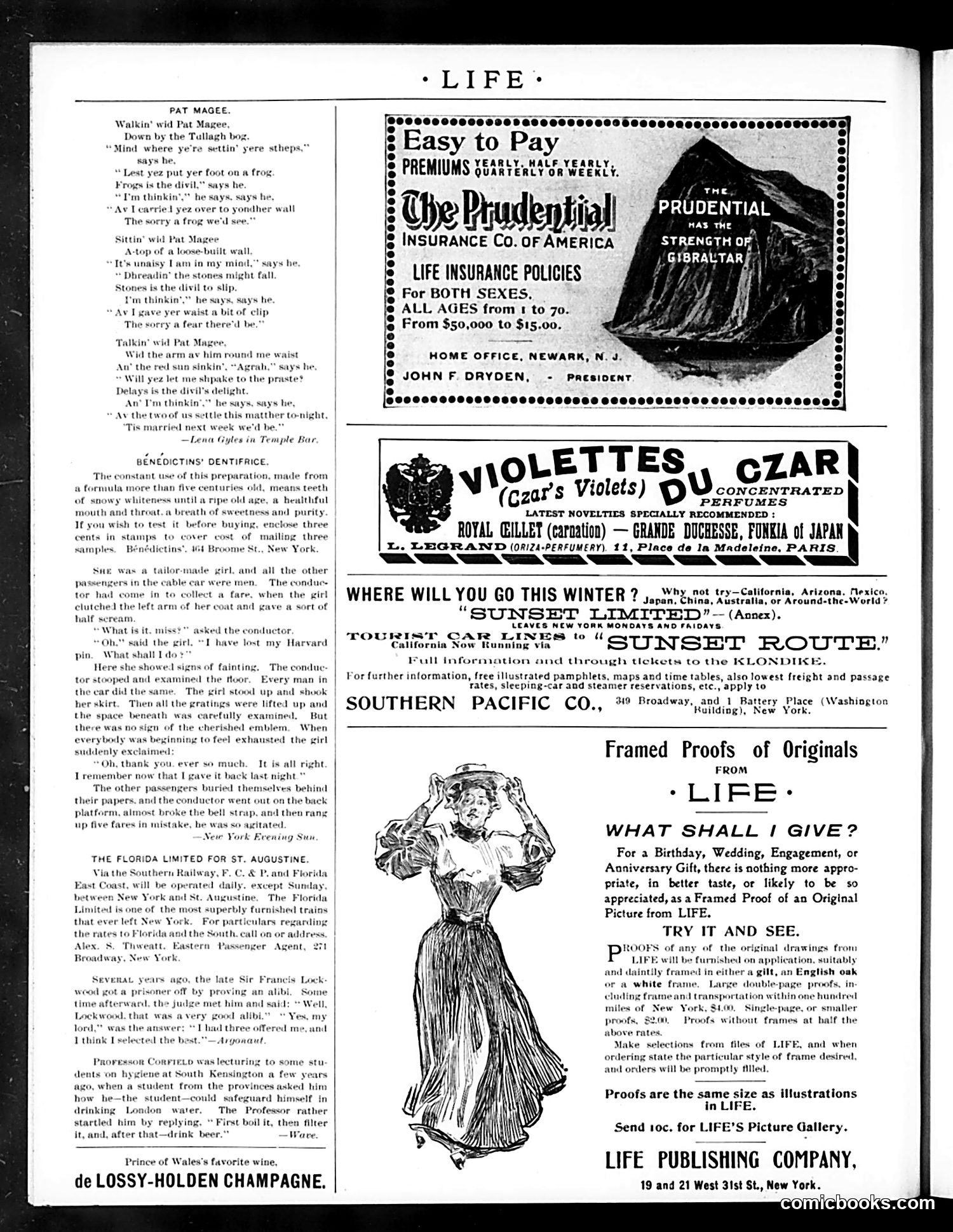
This page is primarily **advertising with some light satirical content**. The main elements: **"Walkin' wid Pat Magee"** (top left): A brief Irish-dialect comic sketch presenting romantic banter between two characters discussing marriage plans by a bog. It's gentle humor playing on Irish rural stereotypes—the sort of sentimental, folksy content Life published alongside its sharper satire. **Advertisements dominate**: The Prudential Insurance Company (featuring the Rock of Gibraltar as their strength symbol), violette perfume, Southern Pacific Railway's "Sunset Limited" tourist line, and de Lossy-Holden Champagne. **"Framed Proofs of Originals from LIFE"** (right): Life Publishing Company promoting prints of their editorial illustrations as gift items—a clever way to monetize their cartoons and drawings. The page reflects early 20th-century magazine publishing: mixing light entertainment, ethnic humor, luxury advertising, and self-promotion. There's no sharp political satire visible here—instead, it's commercial content aimed at affluent readers.
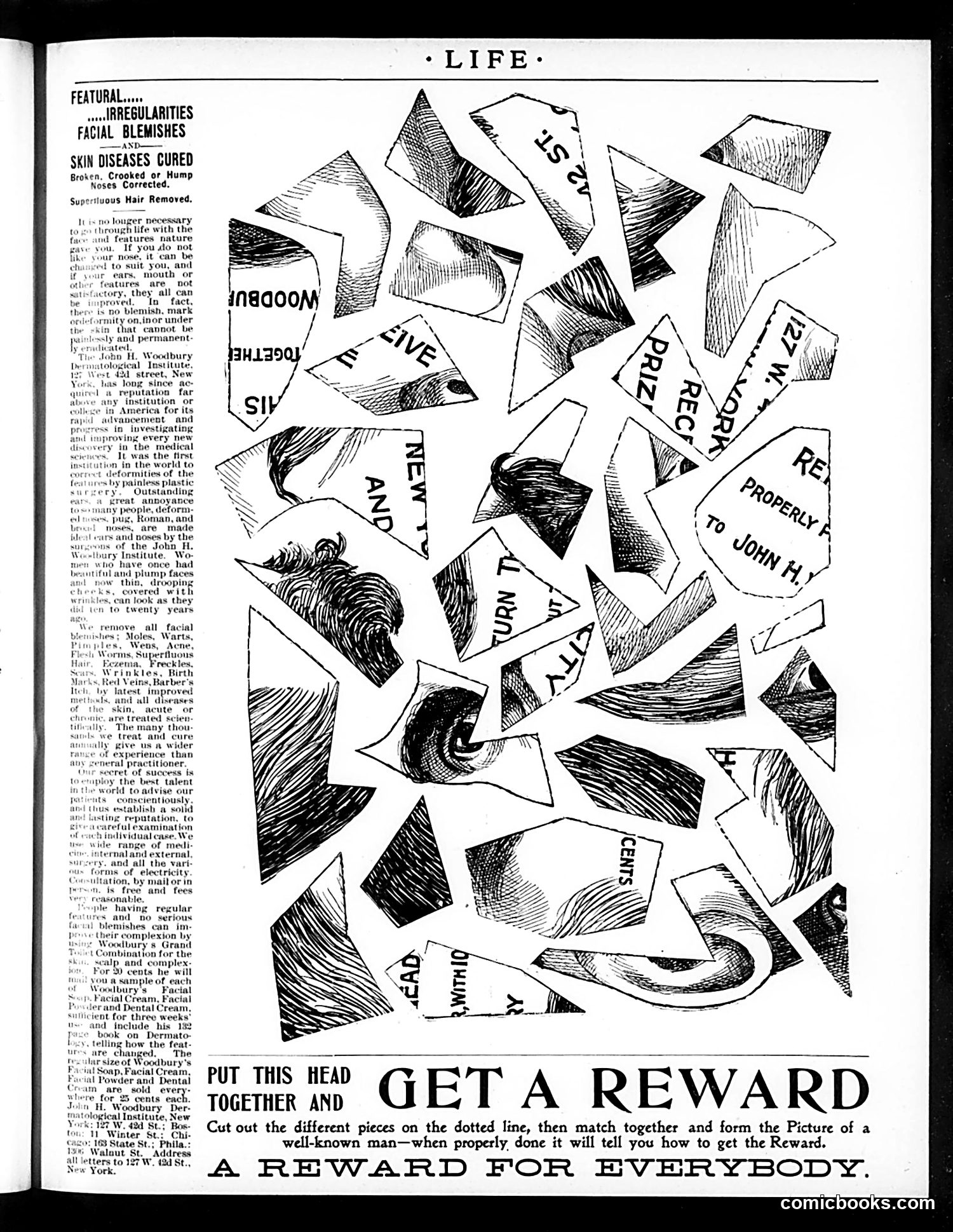
This page combines a medical advertisement with a puzzle game. The left column advertises the Woodbury Dermatological Institute's services for correcting facial "irregularities"—crooked noses, blemishes, unwanted hair, and other cosmetic concerns. It emphasizes their pioneering work and success. The right side features a "cut-and-paste" puzzle: readers must assemble scattered paper pieces to form a portrait of "a well-known man," which supposedly reveals how to obtain "a reward for everybody." The puzzle pieces are deliberately jumbled and fragmented. The satire appears to be **self-directed mockery** by Life magazine—the puzzle's hidden message likely jokes about the contradiction between the ad's promises and reality, or satirizes the desperation of people seeking cosmetic "fixes." By fragmenting the face and making assembly difficult, the cartoonist suggests that facial perfection itself is an illusion or that reconstructing one's appearance is fundamentally absurd. The "reward" is likely humorous or ironic rather than literal.
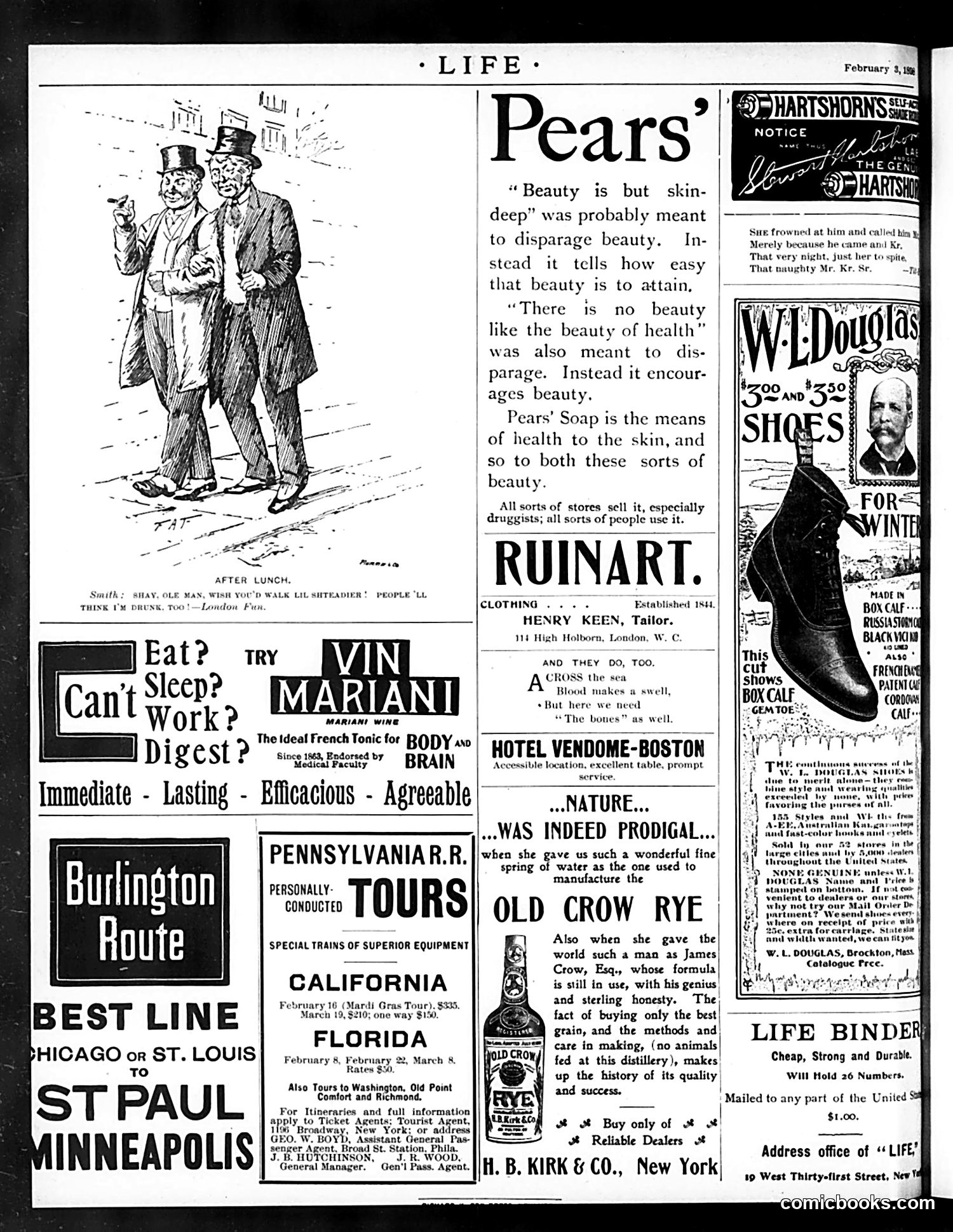
The cartoon "After Lunch" depicts two well-dressed gentlemen in conversation. One says to the other: "Say, ole man, wish you'd walk lil straggler! People'll think I'm press too!" This appears to be satirizing social pretense and class anxiety. The joke likely concerns two men of similar apparent status who fear being seen together publicly will lower their social standing—perhaps one is awkwardly avoiding an association or distancing himself from a friend to maintain appearances. The reference to London Fun (the credited source) suggests this is British social satire, mocking Victorian-era concerns about public reputation and the rigidity of class consciousness. The humor turns on the absurdity of such shallow social anxiety among seemingly similar peers.