
Life, 1898-02-03 · page 4 of 20
Life — February 3, 1898 — page 4: what you’re looking at
What you’re looking at
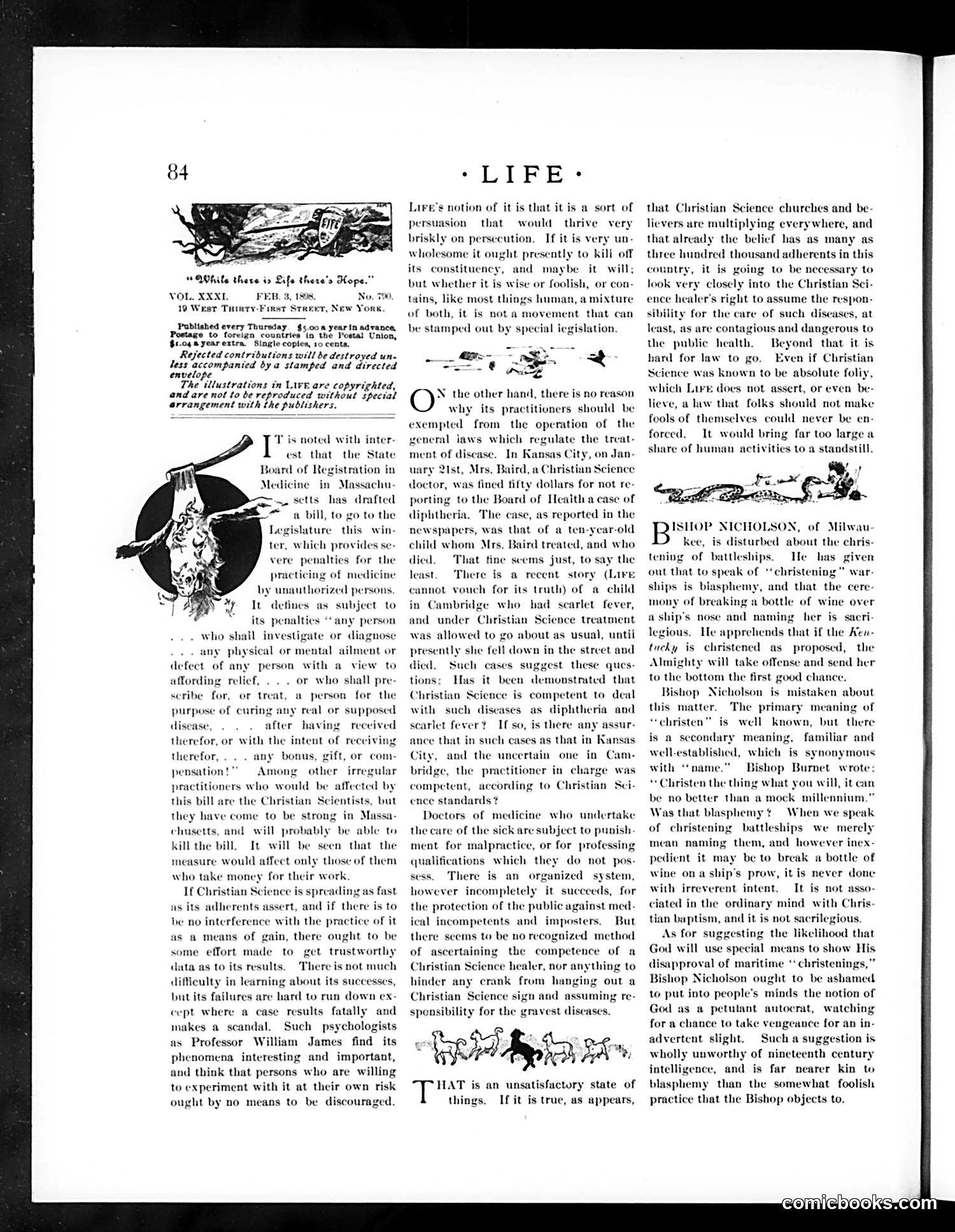
This page critiques **Christian Science** practitioners and their legal exemptions from medical regulations. The text discusses a specific case: a Christian Science doctor in Kansas City was fined for not reporting a child's diphtheria case to health authorities. The **anatomical illustration** (left side) appears to depict disease or medical conditions, likely emphasizing why medical oversight matters. The satire argues that Christian Science should not be legally exempt from standard medical practices, particularly regarding contagious diseases. The piece questions whether allowing untrained practitioners to treat serious illnesses serves public health, even if adherents believe in their faith's efficacy. Bishop Nicholson's objection to "Christening" ships (naming ceremonies) is presented as petty compared to the serious health dangers posed by unregulated Christian Science medicine.
📄 Transcribed text from this page (OCR, searchable)
Machine-transcribed from the original scan — historical spelling and the odd misread are preserved.
19 West Tuinry. T REET, Published every Thursday $5.00 yearin advance, Postage to foreign countries in the Postal Union, $t.c4ayear extra. Single coptes, 10 cente. Rejected contributions will be destroyed un- less accompanied bya stamped and directed envelope The illustrations in Live are copyrighted, and are not to be reproduced without special arrangement with the publishers. T is noted with inter- est th the State Board of Registration in Medicine in Massachu- drafted a bill, to go to the ~. setts 1 Legislature this win- tor. vere penalties for the which provides se- practicing of medicine by unauthorized persons *y It detines as subject to its penalties ‘any person who shail investigate or diagnose . . any physical or mental ailment or defect of any person with a view to affording relief, . . . or who shall pre seribe for, or treat, a person for the purpose of curing any real or supposed disease, . after having received therefor, or with the intent of reeciving therefor, . . . any bonus, gift, or com- pensation! Among other irregular practitioners who would be affected by this bill are the Christian Scientists, but they have come to be strong in Massa- chusetts, and will probably be able to kill the bi, It will be seen that the measure would affect only those of them who take money for their work If Christian Science is spreading as fast as its adherents assert, and if there is to be no interference with the practice of it as a means of gain, there ought to be some effort made to get trustworthy data as to its results. There is not much difficulty in learning about its successe but its failures are hard to run down ex cept where a case results ly and makes a ndal, Such psychologists as Professor William James find its phenomena interesting and important, and think that persons who are willing to experiment with it at their own risk ought by no means to be discouraged. * LIFE: Lire’s notion of it is that it is a sort of that) would thrive very briskly on persecution. If it is very un- wholesome it ought presently to kill off its constituency, and maybe it~ will; but whether it is wise or foolish, or con- tains, like most things human, a mixture of both, it is nota movement that can be stamped out by special iegislation persuasion the other hand, there is no reason why its practitioners should be exempted from the operation of the neral jaws w ulate the treat- ment of disease. In Kansas City, on Jan- uary Ist, Mrs, Baird, a Christian Science doctor, was fined fifty dollars for not re- porting to the Board of Icalth a case of diphtheria. ‘The case, as reported in the newspapers, was that of a ten-year-old child whom Mrs, Baird treated, and who died. That fine scems just, to say the least. There is a recent story (LIFE cannot vouch for its truth) of a child in Cambridge who bad scarlet fever, and under Christian Science treatment was allowed to go about as usual, untii presently she fell down in the street and died. ich re uch cases suggest these ques- tions: Has it been demonstrated that Christian Science is competent to deal with such diseases as diphtheria and scarlet fever? If so, is there any assur- ance that in such cases as that in Kansas City, and the uncertain one in Cam- bridge, the practitioner in char, competent, according to ¢ ence standards ? Doctors of medicine who undertake the care of the sick are subject to punish ment for malpracti qualifications which they do not pos- There is nized system, however incompletely it succeeds, for the protection of the public against med- ical incompetents and imposters. But there seems to be no recognized method of ascertaining the competence of a Christian Science healer, nor anything to hinder any crank from hanging out a ing re- Christian S sponsibility for the gravest diseases, lpi dpi HAT is an unsatisfactory state of things. If it is true, as appears, », or for professing SESS. an o ign and assum that Christian Science churches and be- lievers ure multiplying everywhere, and that already the belief has as many as three hundred thousand adherents in th country, it is going to be necessary to look very closely into the Christian Sci- ence healer’s right to assume the respon- sibility for the care of such diseases, at least, as are contagious and dangerous to the public health. Beyond that is hard for law to go. Even if Christian Science was known to be absolute foli which Lire does not assert, or even be: lieve, a law that folks should not make fools of themselves could never be en- forced. It would bring far too large a share of human activities to a standstill. Beer NICHOLSON, of Milwau. ki disturbed about the chris- ¢ of battleships. He has given out that to speak of ‘christening ” w ships is biasphemy, and that the cere mony of breaking a bottle of wine over nd naming her is sacri legious. He apprehends that if the Aeu- tucky is christened as proposed, the ity will take offense and send her to the bottom the first good chance. Bishop Nicholson is mistaken about this matter. The primary meaning of “christen” is well known, but there is a secondary meaning, familiar and well-established, which is synonymous with ‘‘name.” Bishop Burnet wrote: “ Christen the thing what you will, it can be no better than a mock millennium. Was that blasphemy ¢ When we speak of christening battleships we merely mean naming them, and however inex- pedient it may be to break a bottle of wine ona ship's prow, it is never done with irreverent intent. It is not asso- ciated in the ordinary mind with Chri: tian baptism, and it is not sacrilegious. As for suggesting the likelihood that God will use special means to show His disapproval of maritime “christe Bishop Nicholson ought to be ashamed to put into people's minds the notion of God as a petulant antocrat, watching for a chance to take vengeance for an in- advertent slight. Such a suggestion is wholly unworthy of nineteenth century intelligence, and is far nearer kin to blasphemy than the somewhat foolish practice that the Bishop objects to. D's nos