
Life, 1898-02-03 · page 12 of 20
Life — February 3, 1898 — page 12: what you’re looking at
What you’re looking at
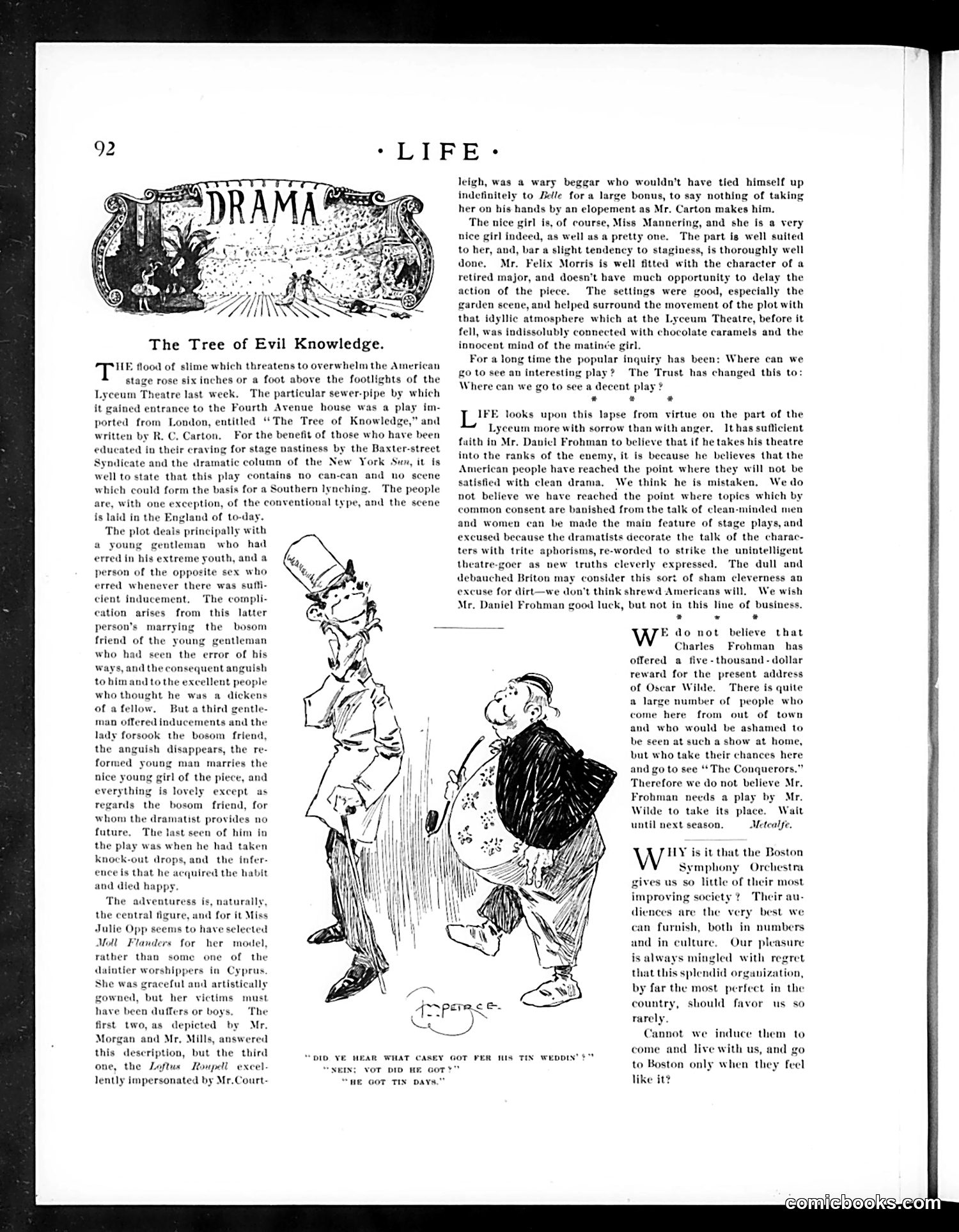
This page reviews a theatrical production at the Lyceum Theatre, criticizing a play imported from London about a young gentleman's moral corruption. The accompanying illustration depicts a caricatured figure in exaggerated dress—likely representing either the protagonist or a type of foolish gentleman—stumbling or falling, embodying the play's theme of moral degradation. The drama section's commentary suggests Life magazine dismisses the production as overly moralistic and containing "trite aphorisms" delivered by underdeveloped characters. The magazine advocates for cleaner American drama rather than relying on European imports with hackneyed cautionary tales. The cartoon visually reinforces this critique through physical comedy, suggesting the play's pretentiousness deserves ridicule.
📄 Transcribed text from this page (OCR, searchable)
Machine-transcribed from the original scan — historical spelling and the odd misread are preserved.
*LIFE: 7 HNN F/I iN The Tree of Evil Knowledge. THe flood of slime which threatens to overwhelm the American stage rose six inches or a foot above the footlights of the Lyceum Theatre last week. The particular sewer-pipe by which it gained entrance to the Fourth Avenue house was a play im- ported from London, entitled “The Tree of Knowledge,” and written by R. C. Carton, For the benefit of those who have been educated in their craving for stage nastiness by the Baxter-strect Syndicate and the dramatic column of the New York Sun, it is well to state that this play contains no can-can and uo scene which could form the basis for a Southern lynching. The people are, with on eption, of the conventional type, and the scene is laid in the England of to-day. The plot deais principally with gentleman who had erred in his extreme youth, and a person of the opposite sex who erred whenever there was sufti- cient inducement. The compli- ation arises from this latter person's marrying the bosom friend of the young gentleman who had seen the error of his ways, and the consequent anguish to him and to the excellent people who thought he was a dickens of afellow. Buta third gentle- man offered inducements and the lady forsook the bosom friend, the anguish disappears, the re- formed young man marries the nice young girl of the piece, and everything is lovely except as the bosom friend, for whom the dramatist provides no future, The last seen of him in the play was when he had take knock-out drops, and the infer- ence is that he acquired the habit and died happy The adventuress is, naturally, the central figure, and for it Miss Julie Opp seems to have selected Moll Flanders for her model, rather than one of the daintier worshippers in Cyprus She was graceful and artistically gowned, but her victims have n duffers or boy's. first. two, as depicted by Morgan and Mr, Mill this description, but the third the Laftux Roupell excel- lently impersonated by Mr.Court- a young regards some must answered “pip ve “NEIN; VOT DID HE We GOT TIN Days.” one, HEAR WHAT CASEY GOT FER 118 TIN WeDDIN’ t” poT +" leigh, was a wary beggar who wouldn't have tied himself up indefinitely to Belle for a large bonus, to say nothing of taking her on his hands by an elopement as Mr. Carton makes him, The nice girl is, of course, Miss Mannering, and she is a very nice girl indeed, as well as a pretty one. The part is well suite to her, and, bar a slight tendency to staginess, is thoroughly well done, Mr. Felix Morris is well fitted with the character of a retired major, and doesn’t have much opportunity to delay the action of the piece. The settings were good, especially the garden scene, and helped surround the movement of the plot with that idyllic atmosphere which at the Lyceum Theatre, before it fell, was indissolubly connected with chocolate caramels and the innocent mind of the matinée girl. For a long time the popular inquiry has been: Where can we go to see an interesting play? The Trust has changed this to: Where can we go to sce a decent play ? * * * IFE looks upon this lapse from virtue on the part of the Lyceum more with sorrow than with anger. thas suflicient fuith in Mr, Danicl Frohman to believe that if he takes his theatre into the ranks of the enemy, it is because he believes that the American people have reached the point where they will not be satisfled with clean drama, We think he is mistaken, We do not believe we have reached the point where topics which by common consent are banished from the talk of clean-minded men and women can be made the main feature of stage plays, and excused because the dramatists decorate the talk of the charac- ters with trite aphorisms, re-worded to strike the unintelligent theatre-gocr as new truths cleverly expressed, The dull and debauched Briton may consider this sort of sham cleverness an excuse for dirt—we don't think shrewd Americans will, We wish Mr. Daniel Frohman good luck, but not in this line of business. do not believe that . . * VV Charles Frohman has offered a five - thousand - dollar reward for the present address of Oscar Wilde. There is quite a large number of people who come here from out of town and who would be ashamed to be seen at such a show at home, Dut who take their chances here and go to see “The Conqueror: Therefore we do not believe Mr. Frohman needs a play by Mr. Wilde to take its place. Wait until next season, Metcalfe. V IY is it that the Boston Symphony Orchestra gives us so little of their most improving society? Their au- diences are the very best w can furnish, both in numbers and in culture. Our pleasure is always mingled with re that this splendid organizati by far the most perfect in the country, should favor us so we induce them to come and live with us, and go to Boston only when they feel like it? ‘annot