
A complete issue · 20 pages · 1898
Life — January 13, 1898
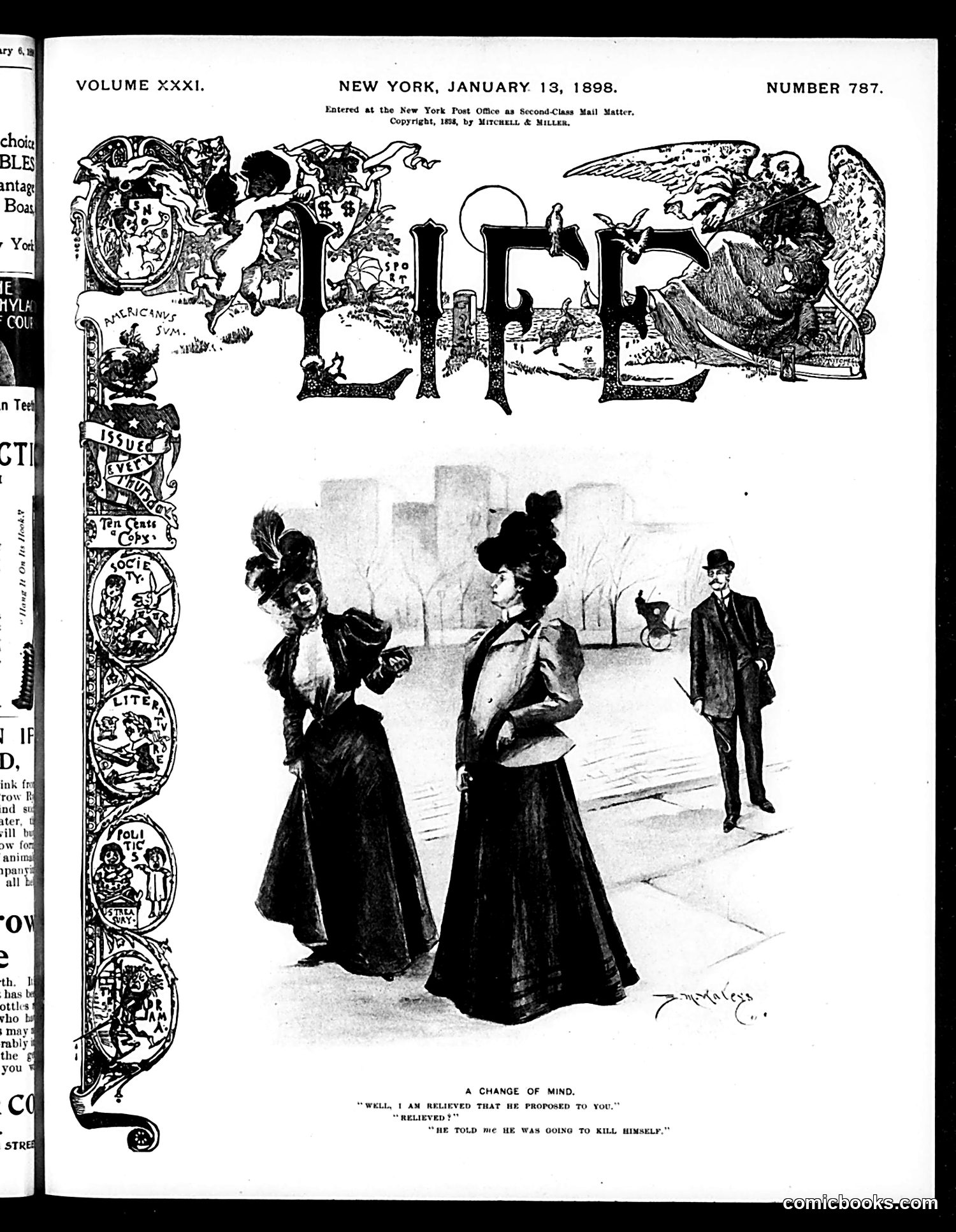
This cartoon depicts a domestic crisis, likely satirizing a broken engagement or marriage proposal gone wrong. Two well-dressed women stand in a winter street scene while a man departs in the background. The dialogue reveals the joke: A woman believed her suitor proposed marriage ("Well, I am relieved that he proposed to you"), but he actually proposed suicide instead ("He told me he was going to kill himself"). The satire likely mocks romantic melodrama popular in 1890s culture—the exaggerated emotional intensity of courtship and the threat of suicide as a romantic gesture. The woman's casual relief at the misunderstanding, combined with the absurdity of the mix-up, creates dark humor characteristic of Life magazine's satirical style during this period.
This page is **not a cartoon or satirical content**—it's an advertisement and announcement for a charitable fundraising event. The page announces "Musical and Dramatic Breakfasts" to benefit LIFE's Fresh-Air Fund, a genuine charitable organization providing outdoor experiences for underprivileged children. The text lists performers who volunteered to appear, including theatrical and musical artists of the era (Julia Arthur, Victor Herbert's Orchestra, and various actors). Below is an extensive list of society patronesses—wealthy women whose names lent prestige to the fundraising effort. This represents how early 20th-century magazines combined editorial content with philanthropy, using celebrity participation and social status to encourage donations.
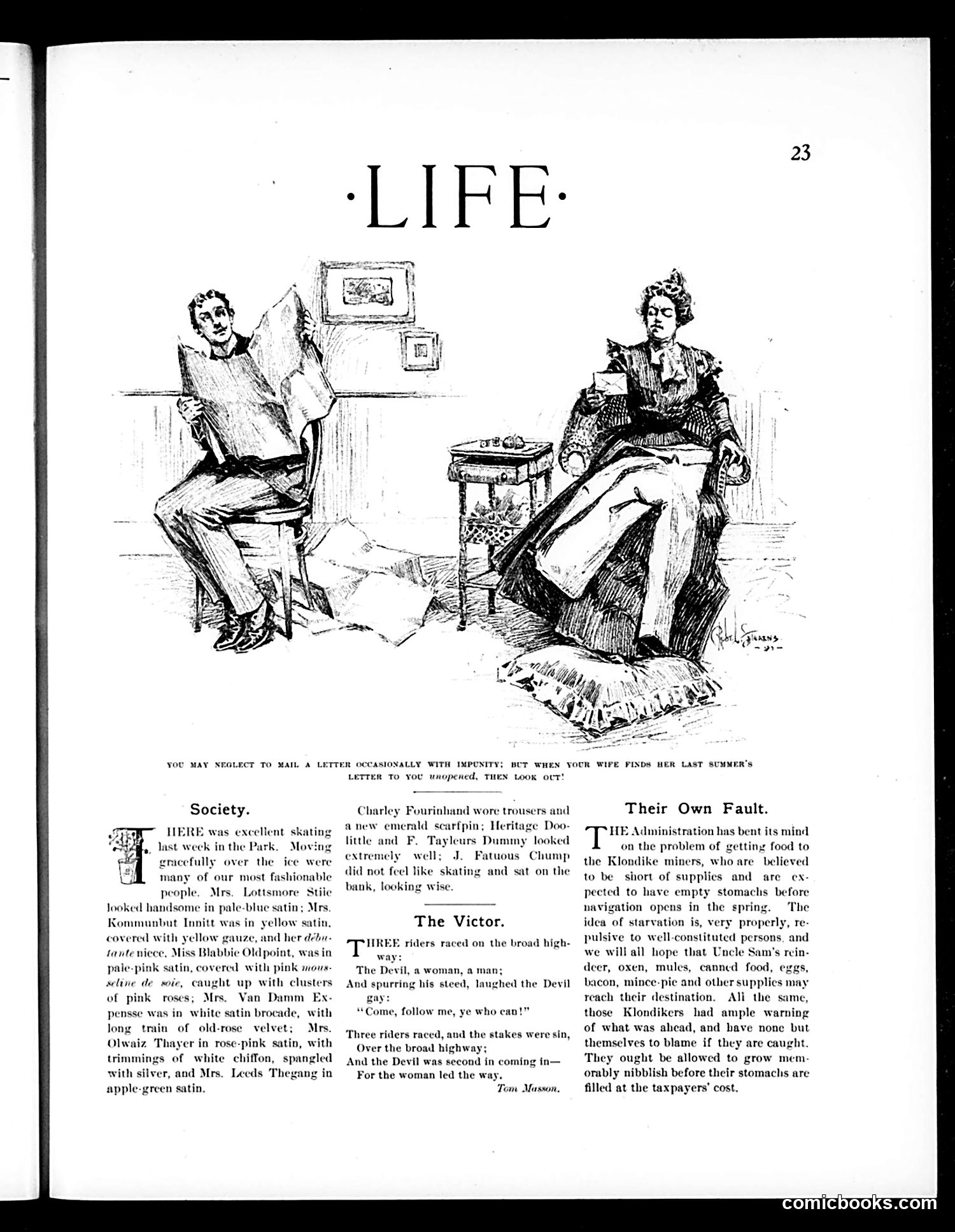
The main illustration depicts a couple in a domestic scene—a man reading papers while seated, and a woman in an armchair. The caption warns husbands about mailing letters "occasionally with impunity," but warns that wives finding their husbands' old letters will cause trouble. The page contains three satirical sections: "Society" mocking fashionable skating attire worn by wealthy New Yorkers; "The Victor," a poem about horse racing; and "Their Own Fault," criticizing food shortages in the Klondike gold rush region, arguing that prospectors themselves are to blame for inadequate supply planning before winter. The satire targets affluent society's vanity, gambling culture, and frontier settlers' poor preparation—typical Life magazine subjects mocking contemporary American follies.
The page features a large editorial cartoon showing a figure labeled "Bishop Potter" - apparently a prominent clergyman who gave a controversial sermon at the Church Club. The cartoon critiques Potter's remarks about England's governance. The text discusses a debate over whether America's rapid wealth accumulation (1873-1893) proves superior governance compared to Britain. John E. Ballaine, an American journalist in Tacoma, published a letter in the London *Chronicle* arguing New York represents American civilization while claiming undiluted Saxon stock makes Americans superior to Britain's "ruling classes." The satire targets both Bishop Potter's naïve England-praise and Ballaine's jingoistic American exceptionalism—mocking these competing claims of national superiority during this period of imperial rivalry.
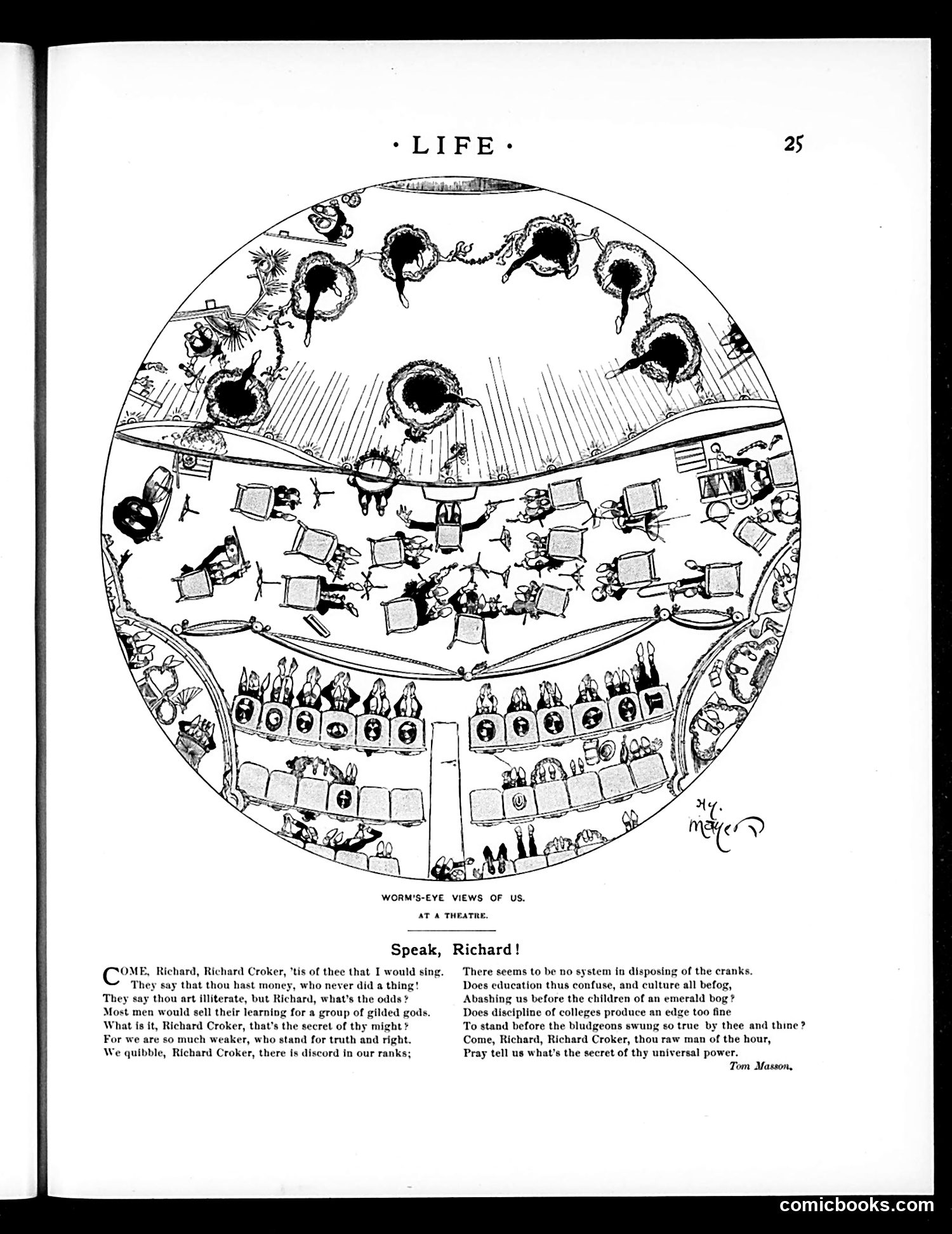
This satirical illustration presents a **bird's-eye view of a theater audience**, depicted as if seen by an insect or small creature from below. The circular composition shows the theater's interior with patrons seated in boxes and the orchestra pit, interspersed with lit chandeliers overhead. The accompanying poem "Speak, Richard!" (attributed to Tom Masson) critiques **Richard Croker**, a prominent Tammany Hall political boss, questioning his wealth, education, and authority despite lacking apparent qualifications. The satire questions whether money and political power should confer cultural legitimacy. The theatrical setting frames this as commentary on how society's "performance" masks underlying questions about merit and corruption in American politics during the Gilded Age/Progressive Era.
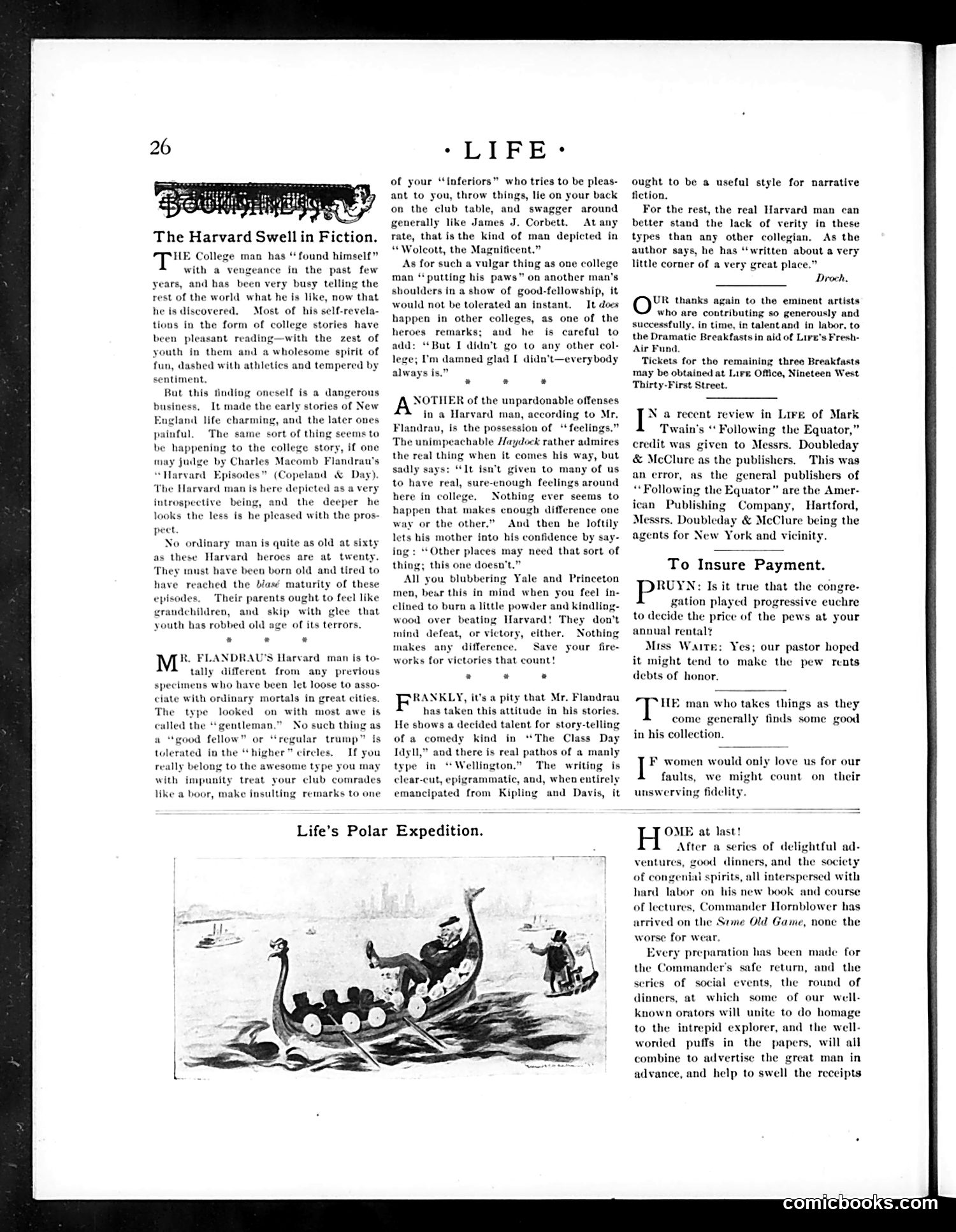
This page contains satirical commentary on Harvard University culture rather than political cartoons. The main articles critique Harvard men's pretensions and social attitudes, mocking their tendency toward self-importance and affected behavior. One section discusses how Harvard students adopt affected mannerisms ("regular trumps") and insult their college comrades, while another criticizes their obsession with "feelings" and emotional posturing. The cartoon at bottom, titled "Life's Polar Expedition," appears to be unrelated humor—a whimsical illustration of figures in a gondola-like vessel with swans, likely satirizing leisure travel or aristocratic expeditions rather than serious polar exploration. The page primarily targets upper-class college culture and social pretension rather than specific political figures or events.
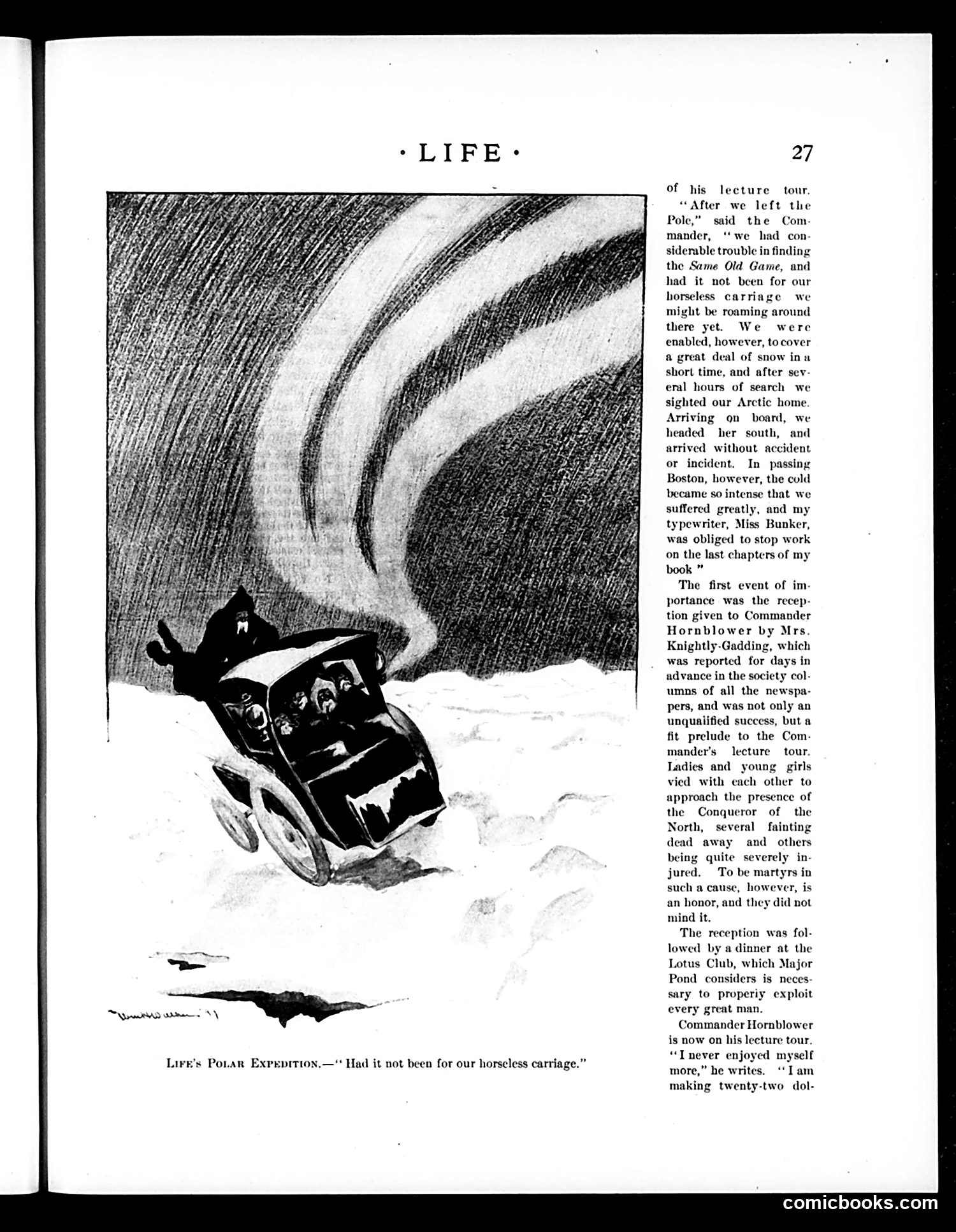
This illustration depicts Commander Hornblower's Arctic expedition, showing a dog sled traveling through harsh polar conditions with swirling snow. The caption reads: "Had it not been for our horseless carriage." The accompanying text describes Hornblower's lecture tour about polar exploration. The satire appears to target the contemporary fascination with both polar expeditions (then popular adventures) and the newly emerging automobile ("horseless carriage"). The joke seems to be that modern technology—the automobile—was somehow critical to surviving an Arctic journey traditionally dependent on dog teams and horses. The piece mocks either Hornblower's exaggerated claims about his expedition or society's tendency to credit new inventions for success in traditionally non-mechanical endeavors.
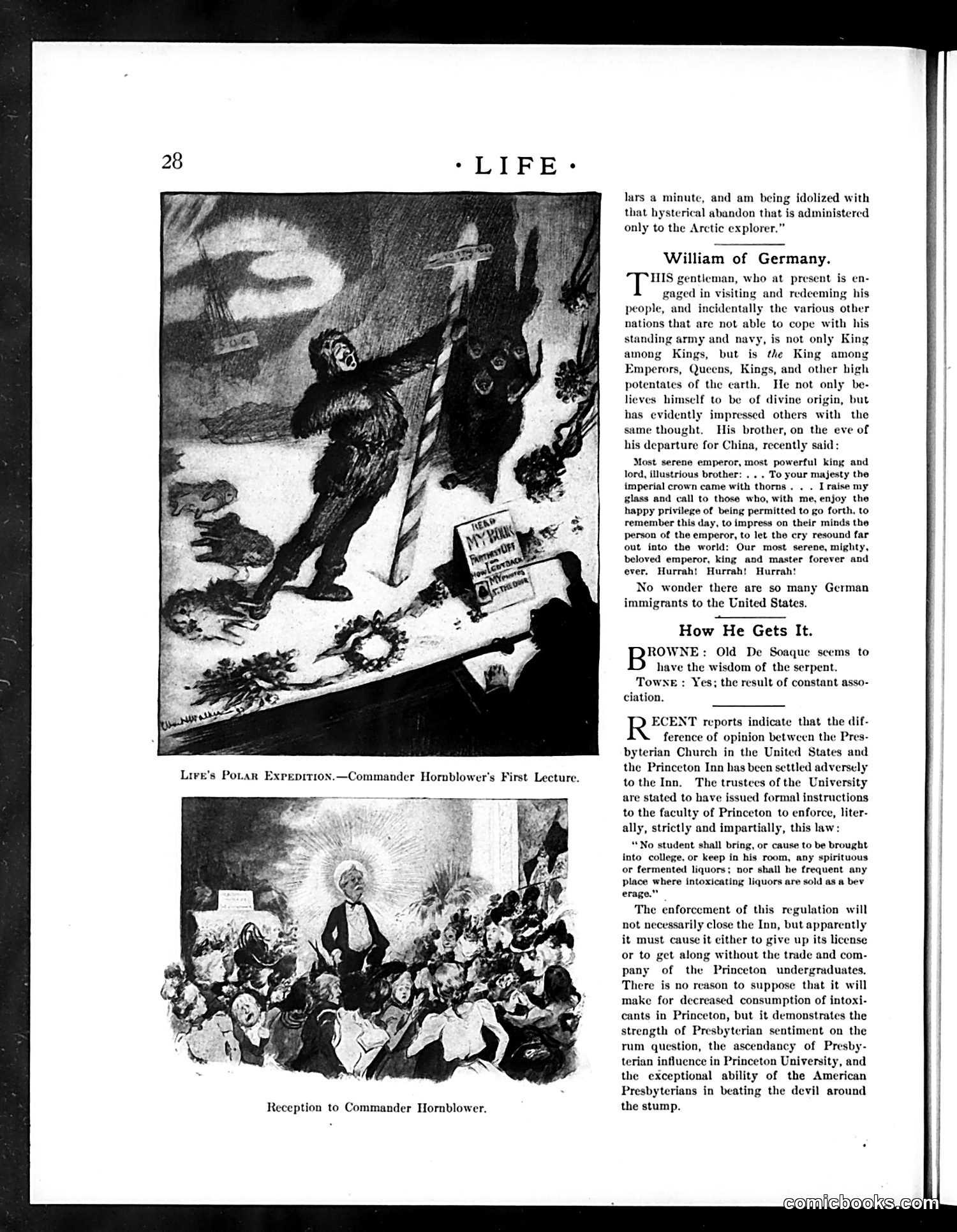
This page contains two distinct sections: **Upper illustration** ("Life's Polar Expedition—Commander Hornblower's First Lecture"): A satirical cartoon showing what appears to be an Arctic explorer addressing an audience. The figure is caricatured in exaggerated style, suggesting mockery of polar exploration lectures that were popular entertainment in the early 20th century. The satire likely targets the sensationalism and self-aggrandizement of such expeditions. **Lower illustration** ("Reception to Commander Hornblower"): Shows the same figure being celebrated by a large crowd, satirizing how explorers received hero's welcomes despite questionable accomplishments. The accompanying text discusses William of Germany and Presbyterian influence at Princeton University—unrelated topics suggesting this is a typical miscellaneous magazine page mixing humor, news commentary, and satire without unified theme.
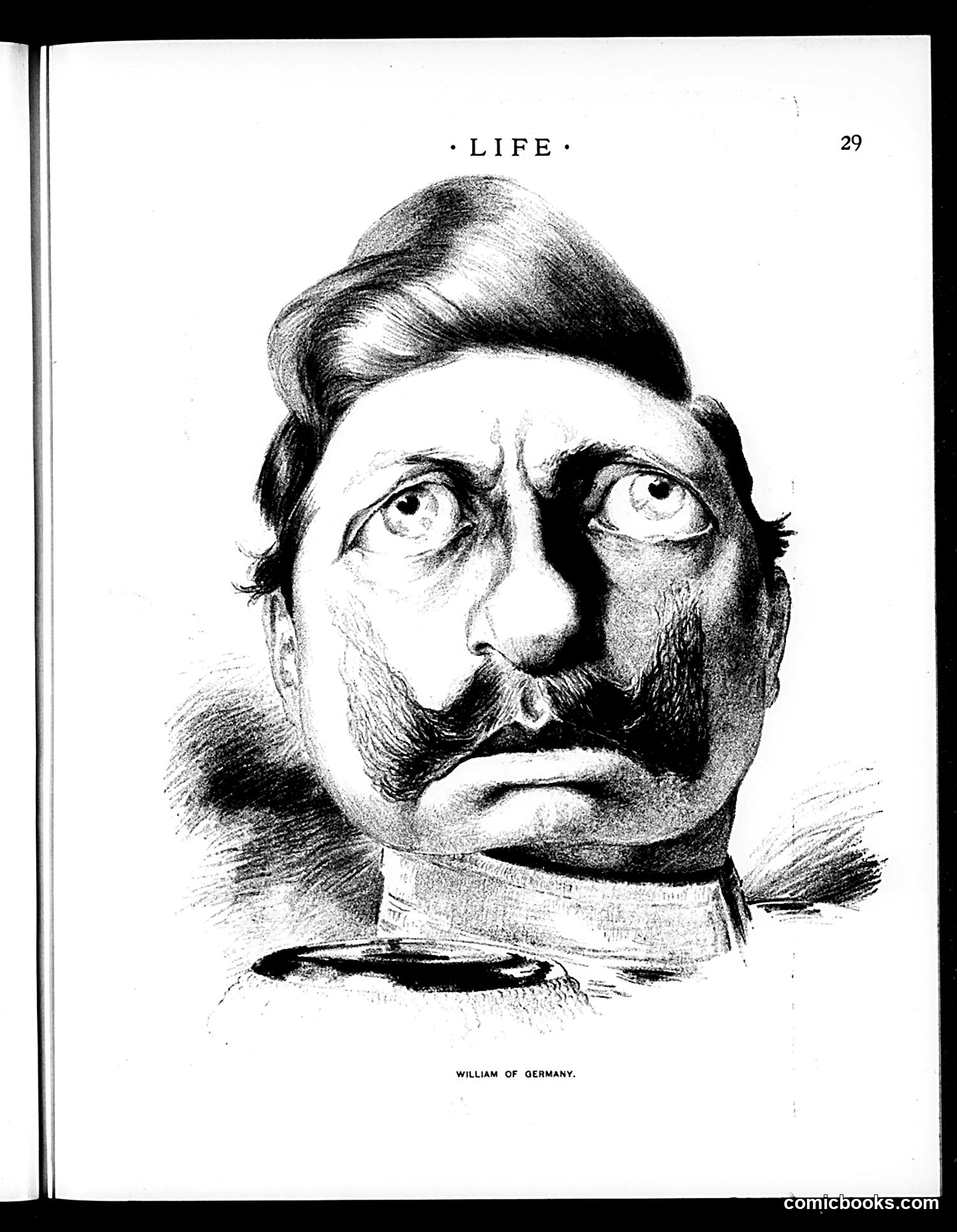
This page from *Life* magazine (page 29) presents a portrait sketch labeled "William of Germany." Based on the distinctive facial features—particularly the upturned mustache, intense eyes, and military bearing suggested by the collar—this appears to be **Kaiser Wilhelm II**, Germany's ruler during the early 20th century. The sketch's placement in a satirical American publication suggests this is likely political commentary, possibly relating to pre-WWI tensions or German militarism. The exaggerated rendering of facial features was typical of *Life*'s caricature style. Without additional context or accompanying text on this page, the specific satirical point remains unclear, though *Life*'s treatment of foreign leaders was typically critical.
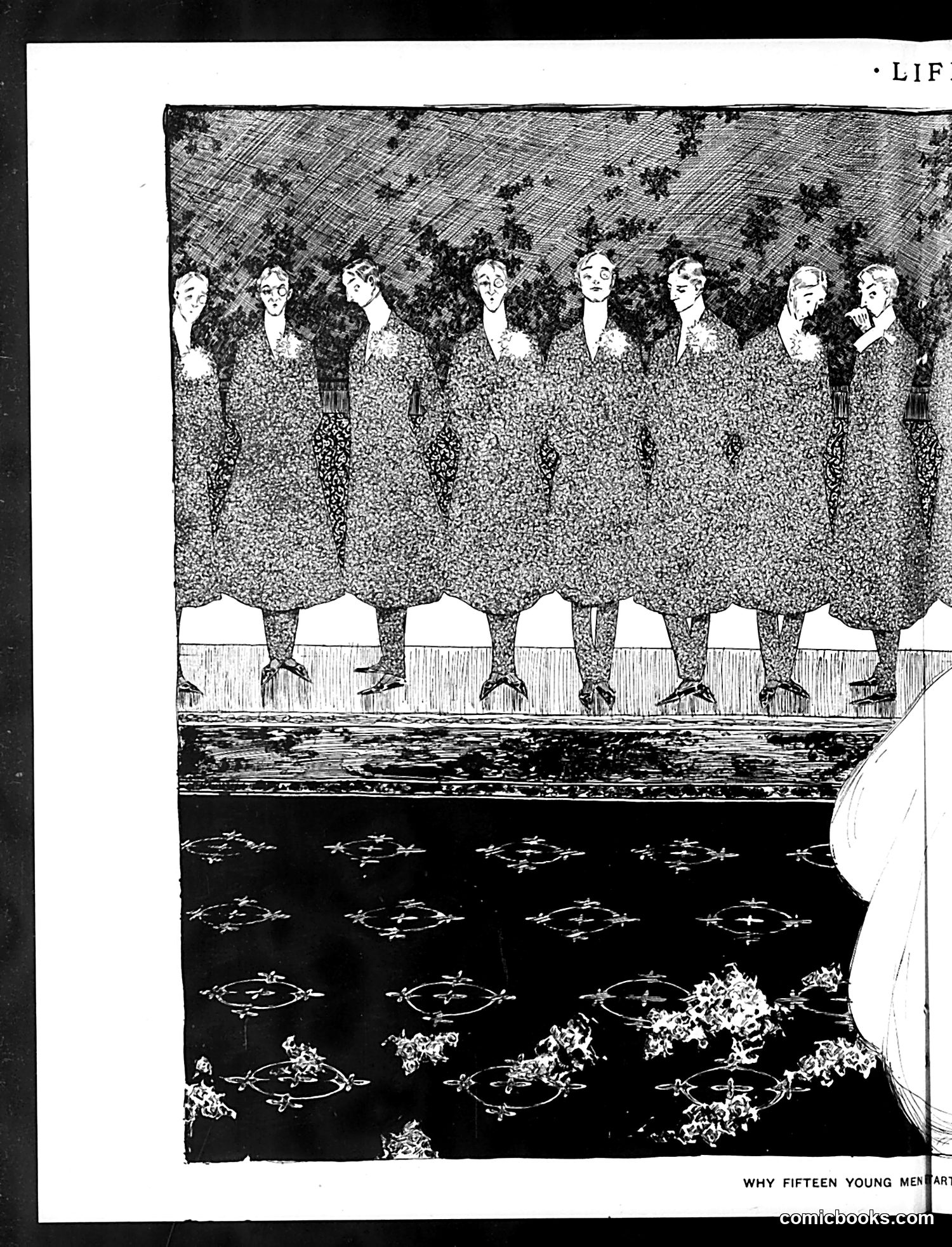
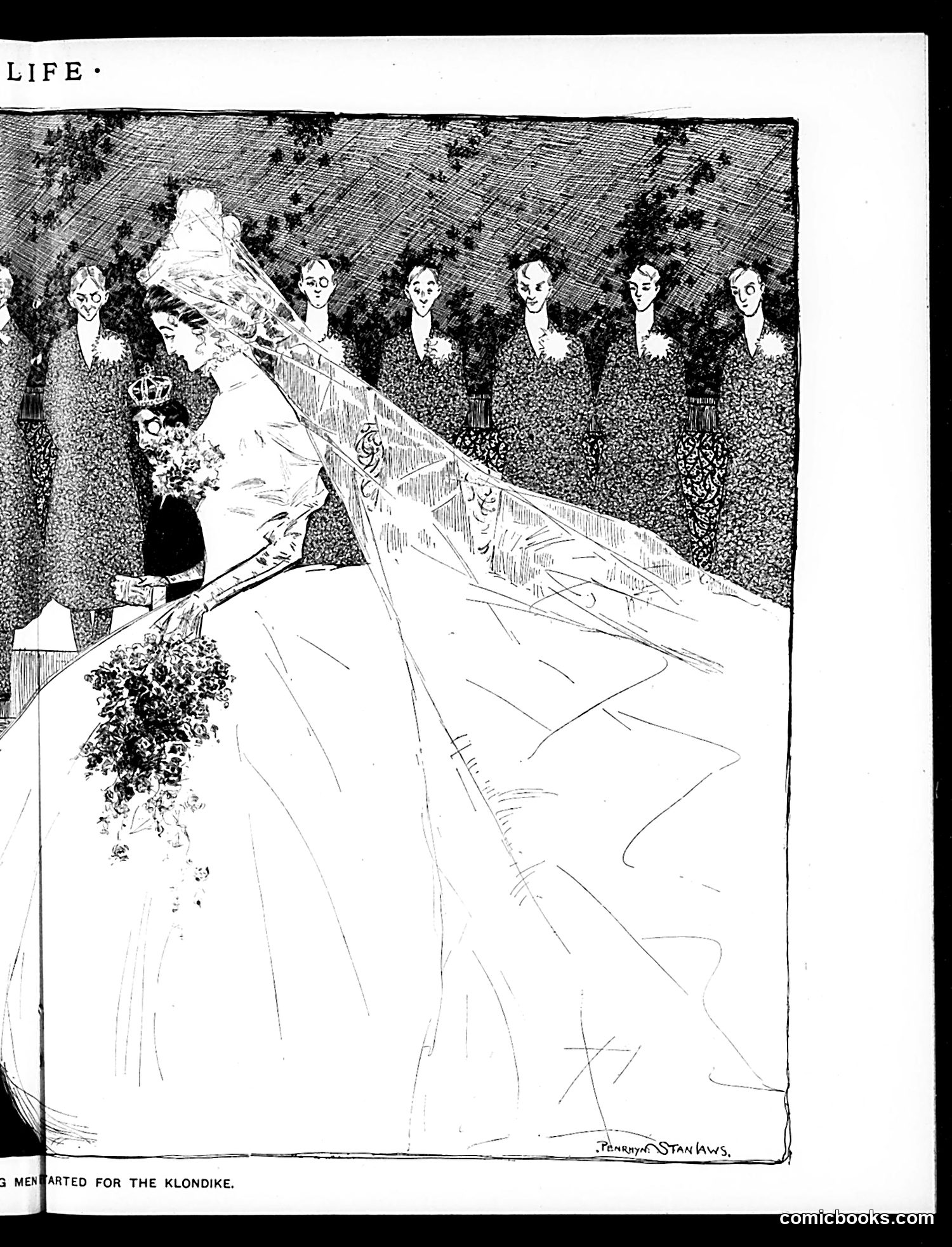
This appears to be a satirical illustration from *Life* magazine showing nine identical women standing in a line, wearing matching patterned dresses and white undergarments. The caption reads "WHY FIFTEEN YOUNG MEN ARE—" (text cut off). The cartoon satirizes conformity and uniformity, likely commenting on either: - Women's fashion trends that made young women appear interchangeable - The standardization of female appearance or behavior in early-20th-century society - Possibly the appeal or confusion caused by identical-looking women to suitors ("fifteen young men") The repetitive visual presentation emphasizes the lack of individuality, suggesting social commentary on how mass culture or expectations homogenized women's appearance and identity. The incomplete caption prevents us from knowing the specific punchline, but the satire targets conformist pressure on women.
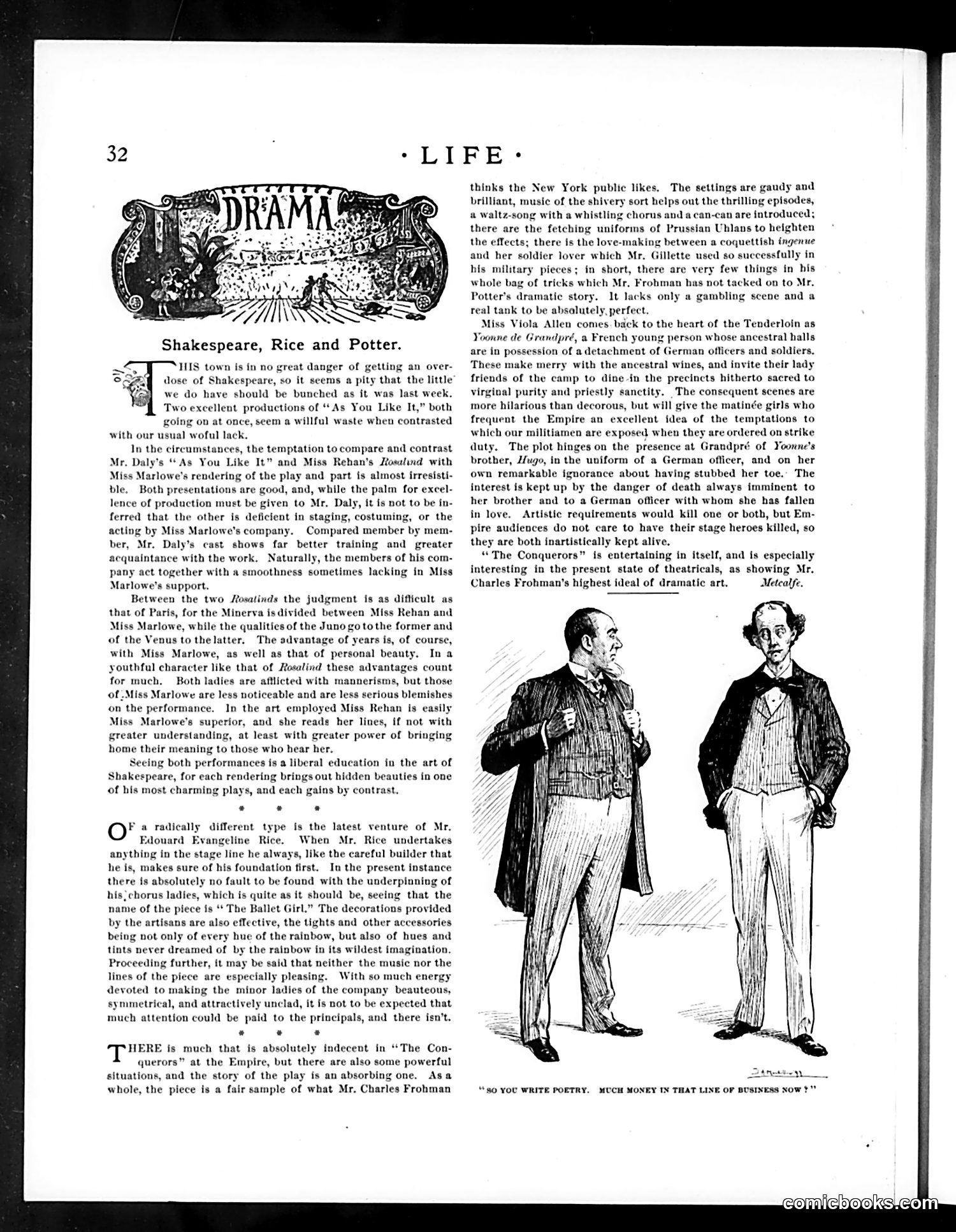
This page reviews contemporary theatrical productions. The illustrated cartoon below shows two men in Victorian dress with the caption: "SO YOU WRITE POETRY. MUCH MONEY IN THAT LINE OF BUSINESS NOW?" The joke satirizes the perceived impracticality of poetry as a profession. One figure appears skeptical or condescending toward the other's claim to be a poet, suggesting that writing poetry is not a lucrative career—a common 19th-century attitude dismissing literary pursuits as economically unviable compared to "practical" business. The page's main text discusses productions of Shakespeare and contemporary plays, evaluating performances by actors like Miss Marlowe and Miss Rehan, typical of Life's theatrical criticism during this era.
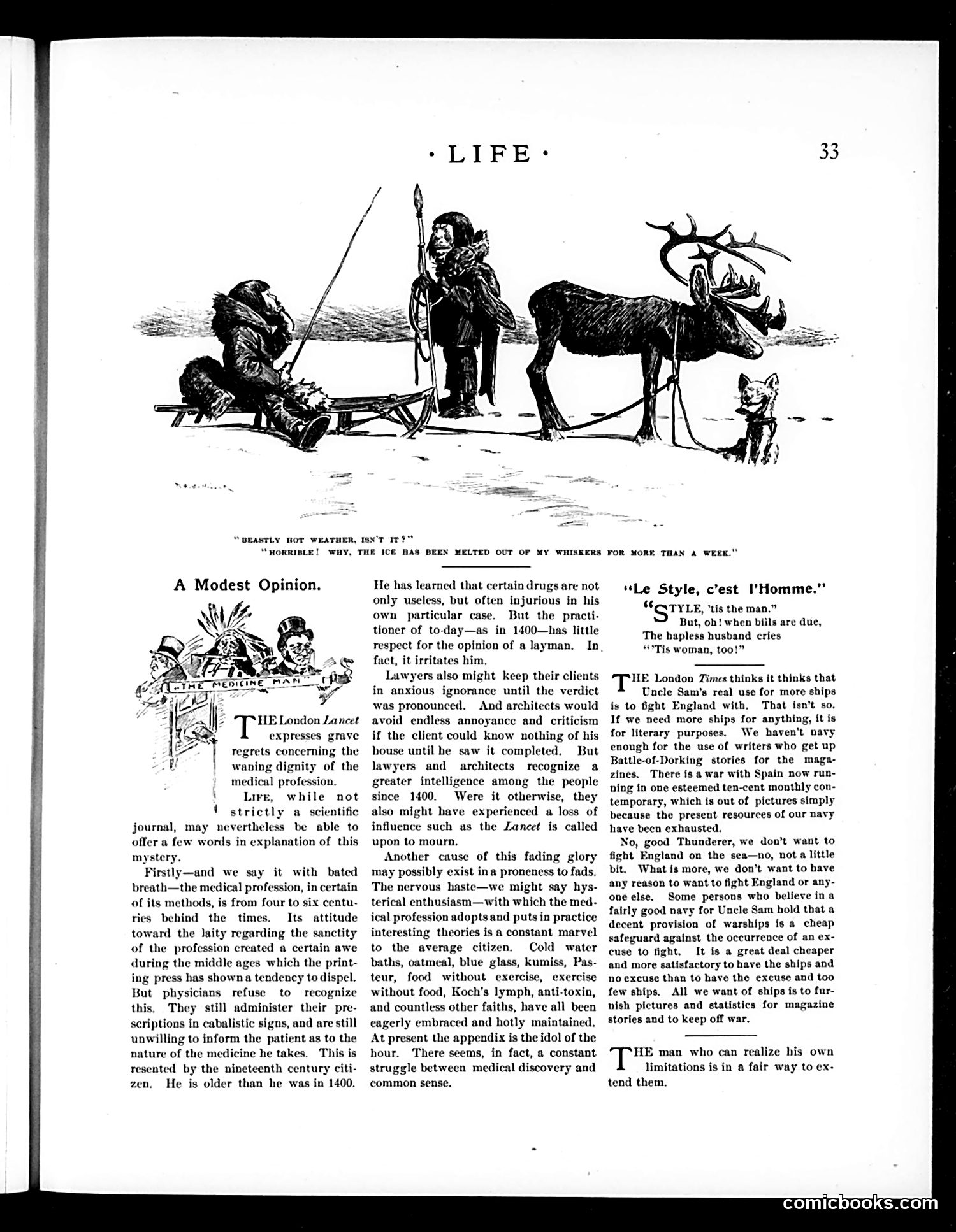
**Main Cartoon (Top):** Depicts Arctic explorers in harsh conditions. The caption satirizes British understatement—one complains about "beastly hot weather" while another notes ice melting from his whiskers, revealing the absurd disconnect between polite language and brutal reality. **"A Modest Opinion" (Left Column):** Critiques the medical profession for operating like it's still the Middle Ages—using cryptic prescriptions, dismissing patients' knowledge, and chasing fashionable fads (cold water baths, Pasteur treatments, appendectomies) without applying common sense. The piece contrasts doctors unfavorably with lawyers and architects, who've adapted to modern intelligence since 1400. **Right Column Sections:** Brief satirical items—one playing on the phrase "style is the man" to joke about how bills reveal a husband's true character; another mocking British fears of American naval expansion, arguing Americans want ships only for magazine illustrations about fictional wars with Spain, not actual conflict. The page represents Life's characteristic late-19th-century satirical approach: poking fun at professional pomposity, outdated practices, and jingoistic anxiety.
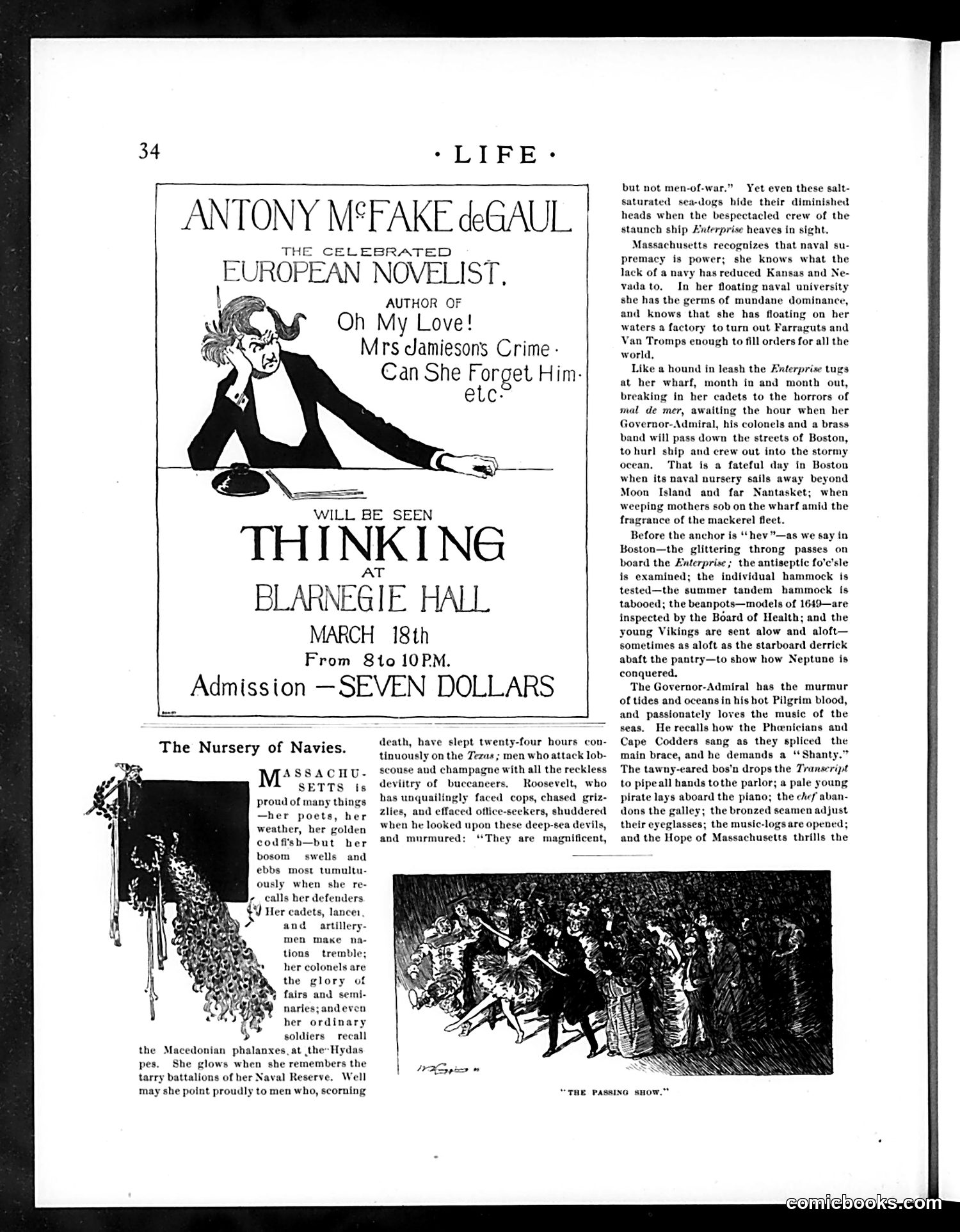
This page contains satirical commentary on Massachusetts's naval pride, particularly its Naval Reserve program centered on the USS *Enterprise*. **The Advertisement** (top): A mock promotion for "Antony McFake deGaul," a fictional European novelist, advertises a speaking event at Carnegie Hall. This appears to be satirizing pretentious European literary culture and American audiences' fascination with foreign sophistication. **"The Nursery of Navies"** (main article): The satire mocks Massachusetts's exaggerated pride in its naval tradition and reserve forces. It humorously contrasts the state's boastfulness about its military heritage (invoking Roosevelt and historical naval figures) with the reality: the *Enterprise* is primarily a training vessel for cadets, with comically mundane concerns like seasickness and hammock inspections. The piece ridicules both the grandiose patriotic language surrounding naval service and the gap between martial mythology and actual shipboard routine. References to "Farraguts and Van Tromps" (famous naval commanders) contrast with images of seasick trainees and bureaucratic health board inspections, emphasizing the absurdity of treating a training ship as civilization's defender.
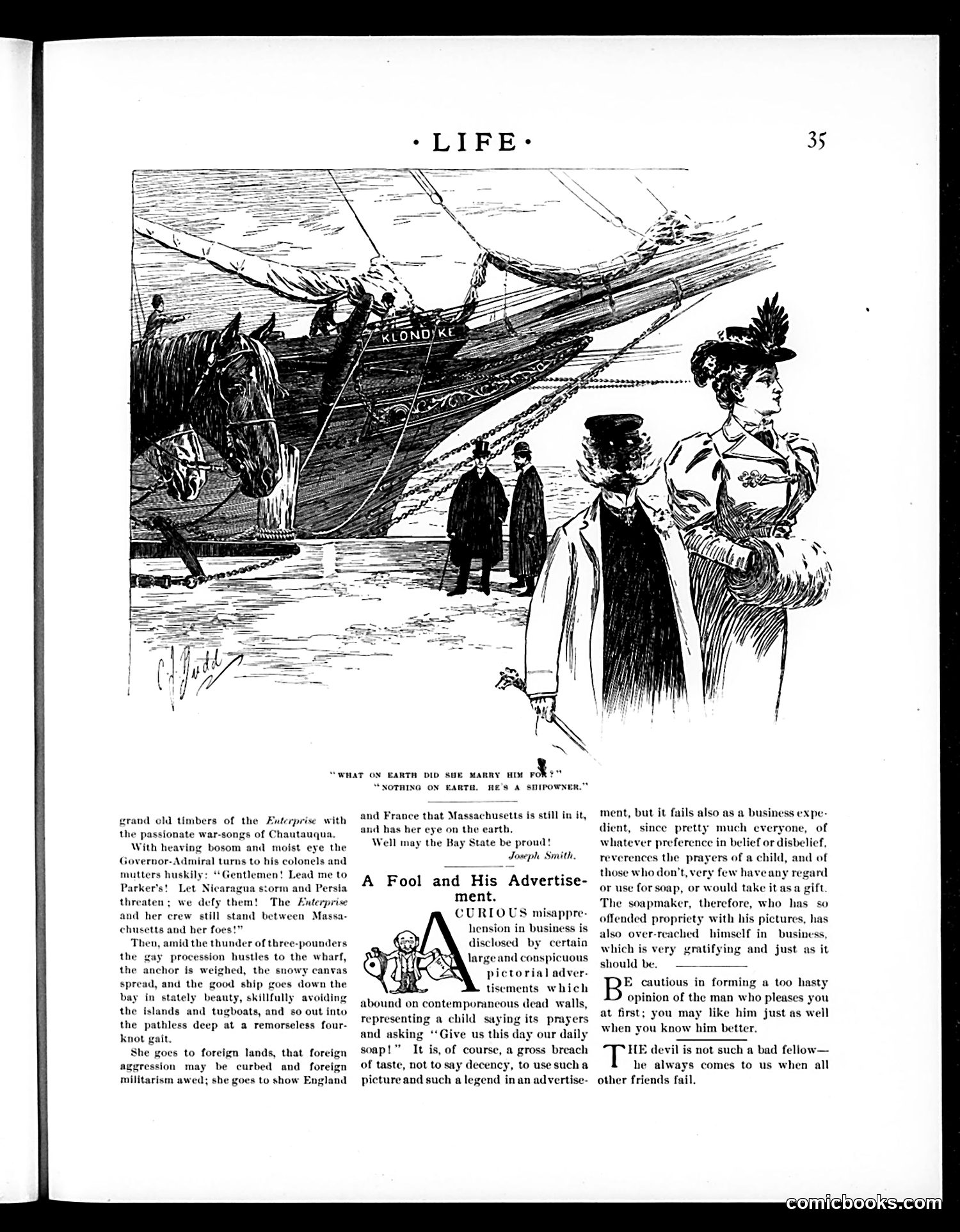
This page satirizes a soap company's offensive advertising campaign. The text criticizes a widespread advertisement showing a child reciting prayers with the caption "Give us this day our daily **soap**"—a blasphemous parody of the Lord's Prayer. The author argues this fails both morally and commercially. It offends religious sensibilities while paradoxically alienating customers: those who revere children's prayers won't buy soap advertised this way, and those indifferent to religion won't care either. The soapmaker has thus achieved the worst outcome—violating decency while harming sales. The accompanying illustration depicts a well-dressed woman near a ship, likely representing Maritime Massachusetts commerce, contrasting respectable society with the crass advertiser's poor judgment. The piece closes with gentle aphorisms about judgment and friendship, maintaining the magazine's satirical tone about foolishness in business and advertising ethics.
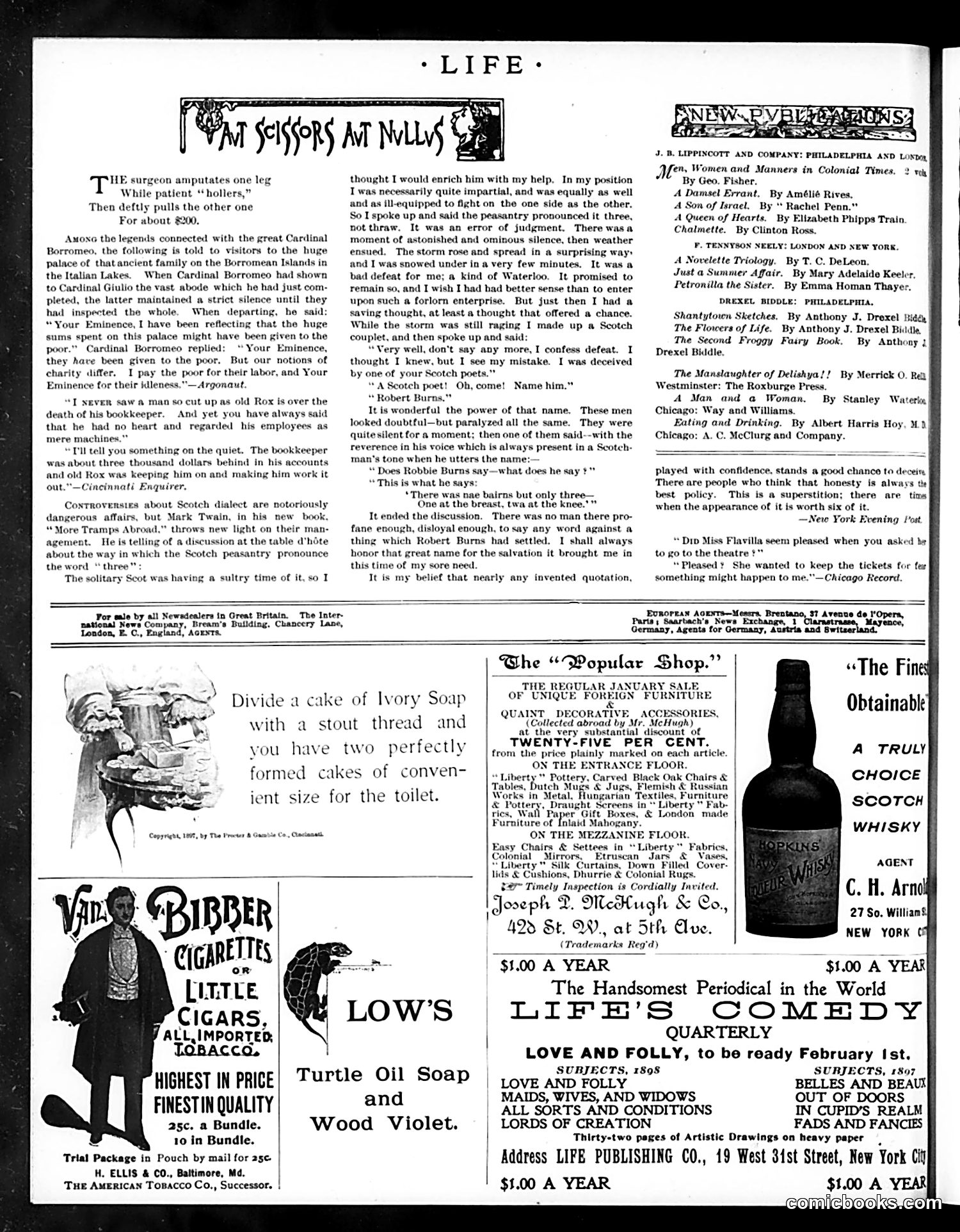
This page contains a humorous anecdote (attributed to Mark Twain) about a Scotsman defending his dialect against dinner-table critics. The joke's punch line relies on **Robert Burns' cultural authority**: when the narrator invents a quotation and attributes it to the Scottish poet, even skeptical Scots accept it without question, paralyzed by reverence for Burns' name. The broader satire targets how people substitute **blind deference to authority for actual judgment**—the dinner guests abandon logical debate the moment a revered name is invoked, regardless of whether the claim is true. The page also includes an earlier anecdote mocking **Cardinal Borromeo's self-serving logic**: he claims spending lavishly on his palace constitutes charity because he pays workers. The satire exposes how the wealthy rationalize conspicuous consumption as benevolence. Both stories target **intellectual dishonesty and the abuse of reputation or status** to win arguments and justify questionable behavior.
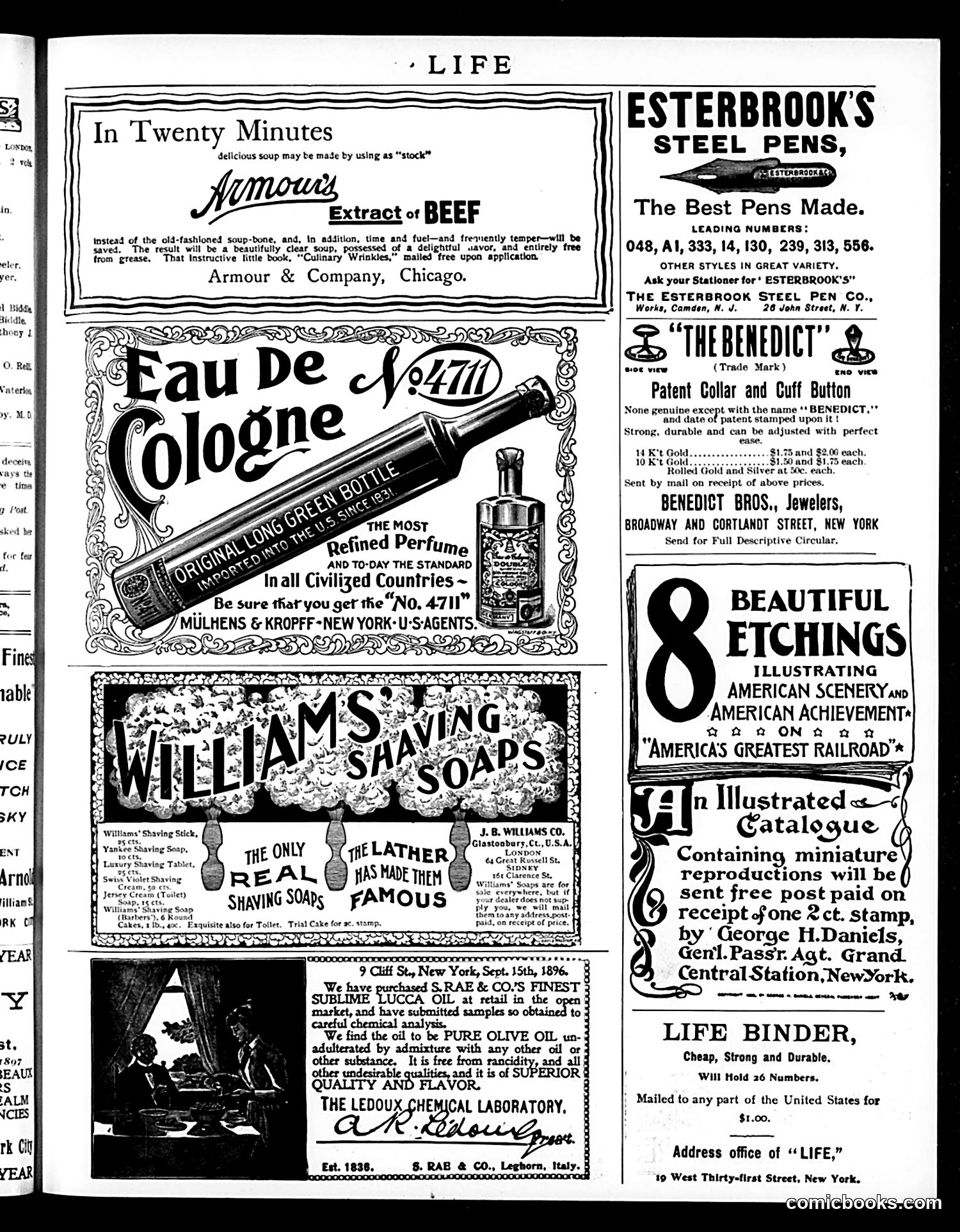
This page is **primarily advertisements**, not political satire or cartoons. It shows various commercial products marketed to late-19th-century consumers. Notable ads include: - **Armour Extract of Beef**: Kitchen convenience product emphasizing time-saving - **Eau de Cologne No. 4711**: Imported perfume marketed as "the standard in all civilized countries" - **Williams' Shaving Soaps**: Competing shaving products with emphasis on superior lather - **S. Rab & Co.'s Olive Oil**: Italian oil with chemical certification of purity - **Esterbrook Steel Pens**, **Benedict collar buttons**, and **Life Magazine's own binder** The only visual element is a small illustration accompanying the olive oil advertisement (appears to be workers or production-related imagery). The advertisements reflect **class aspirations and concerns of the era**: imported European goods, labor-saving devices for domestic work, and products emphasizing purity/authenticity—likely responses to food adulteration scandals of the period.
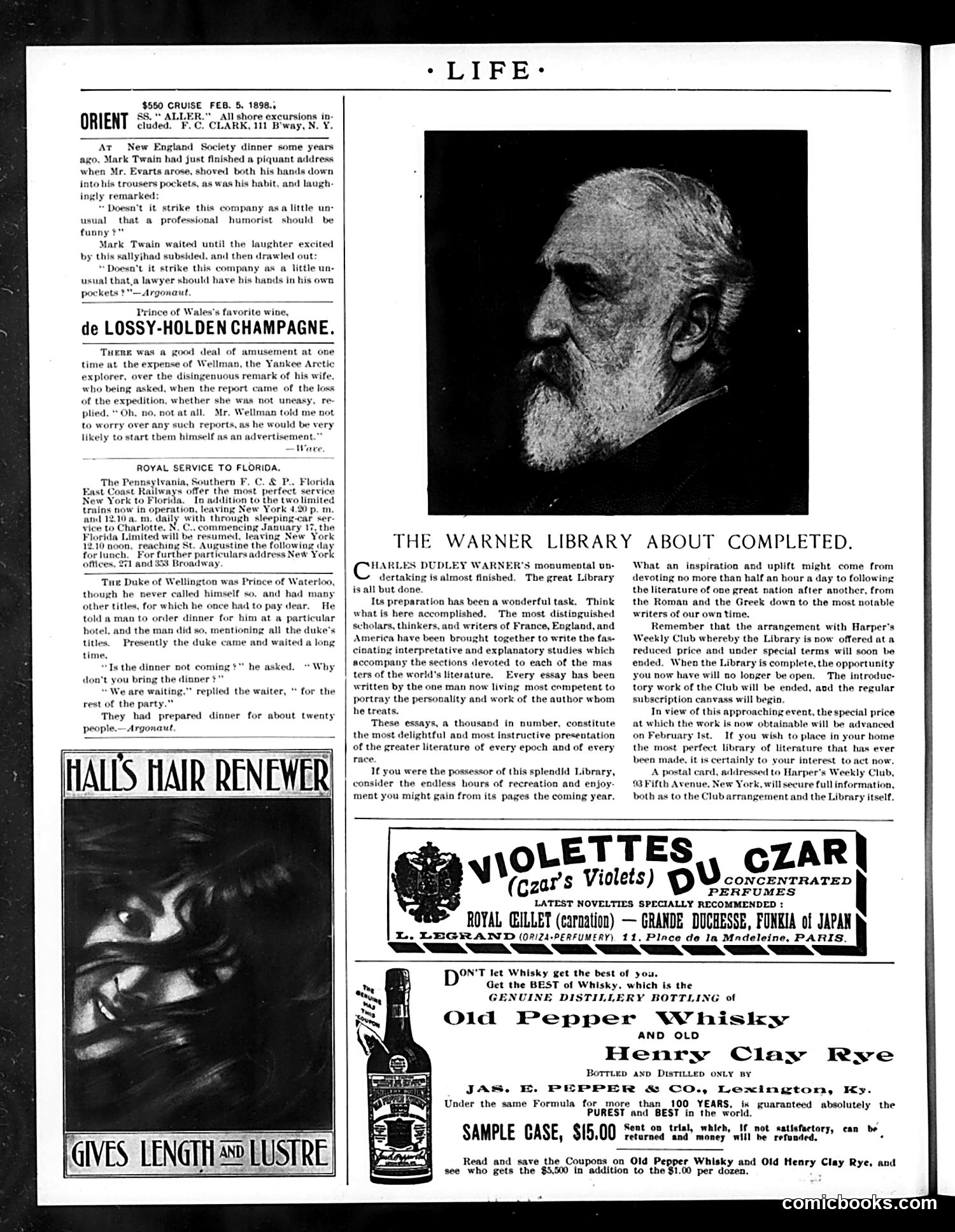
This page from *Life* magazine (February 5, 1898) consists primarily of **anecdotes and advertisements rather than political cartoons**. The main content includes humorous stories: Mark Twain exchanging witty insults with lawyer William Evarts about their respective professions; a tale of the Duke of Wellington's confusion over dinner preparation; and a story mocking Arctic explorer Wellman's wife for her suspicious lack of concern about his expedition. The page's significant feature is an advertisement for **Charles Dudley Warner's monumental literary encyclopedia**, "The Warner Library"—described as essays by the world's most distinguished scholars interpreting great literature from Rome to contemporary times. Harper's Weekly Club is offering it at reduced price and special terms before regular subscription sales begin. The remaining space contains product advertisements (champagne, whisky, hair product) typical of the era. No identifiable political satire is present on this page.
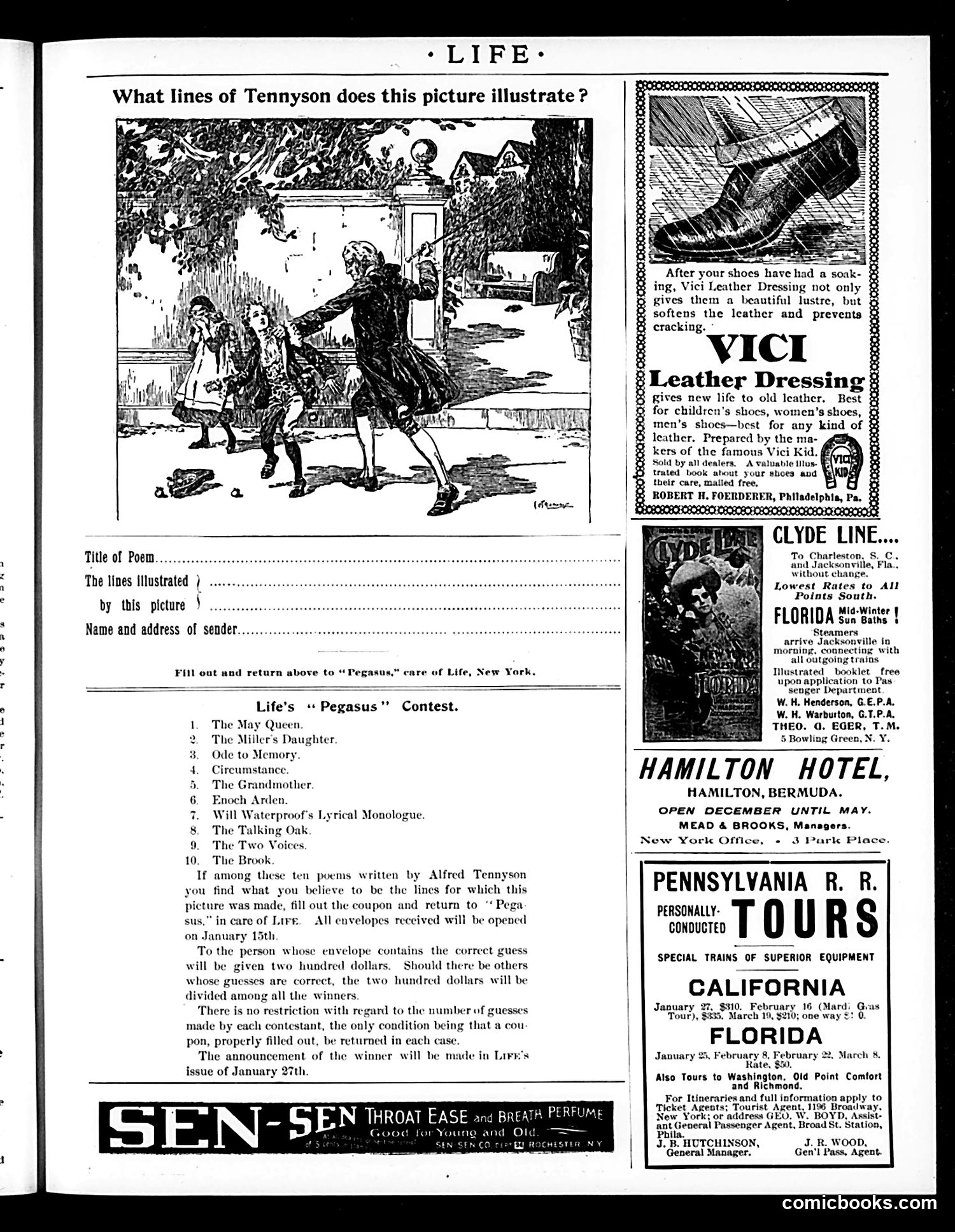
This page features a **literary guessing game**, not political satire. The illustration shows what appears to be an adult pointing at children in a garden or courtyard setting. Readers are challenged to identify which of ten Alfred Tennyson poems this image illustrates—options include "The May Queen," "The Miller's Daughter," and "The Brook." The contest offers **two hundred dollars** to the correct guesser (substantial money in this era), with prizes divided if multiple people answer correctly. Entries were due January 15th, with winners announced January 27th. The page is primarily **advertising**—for shoe polish (Vici), steamship lines (Clyde), hotels, and railroad tours—surrounding the literary contest. This reflects *Life*'s dual nature as both satirical magazine and commercial publication. The contest itself served as engagement strategy to boost readership and submissions.
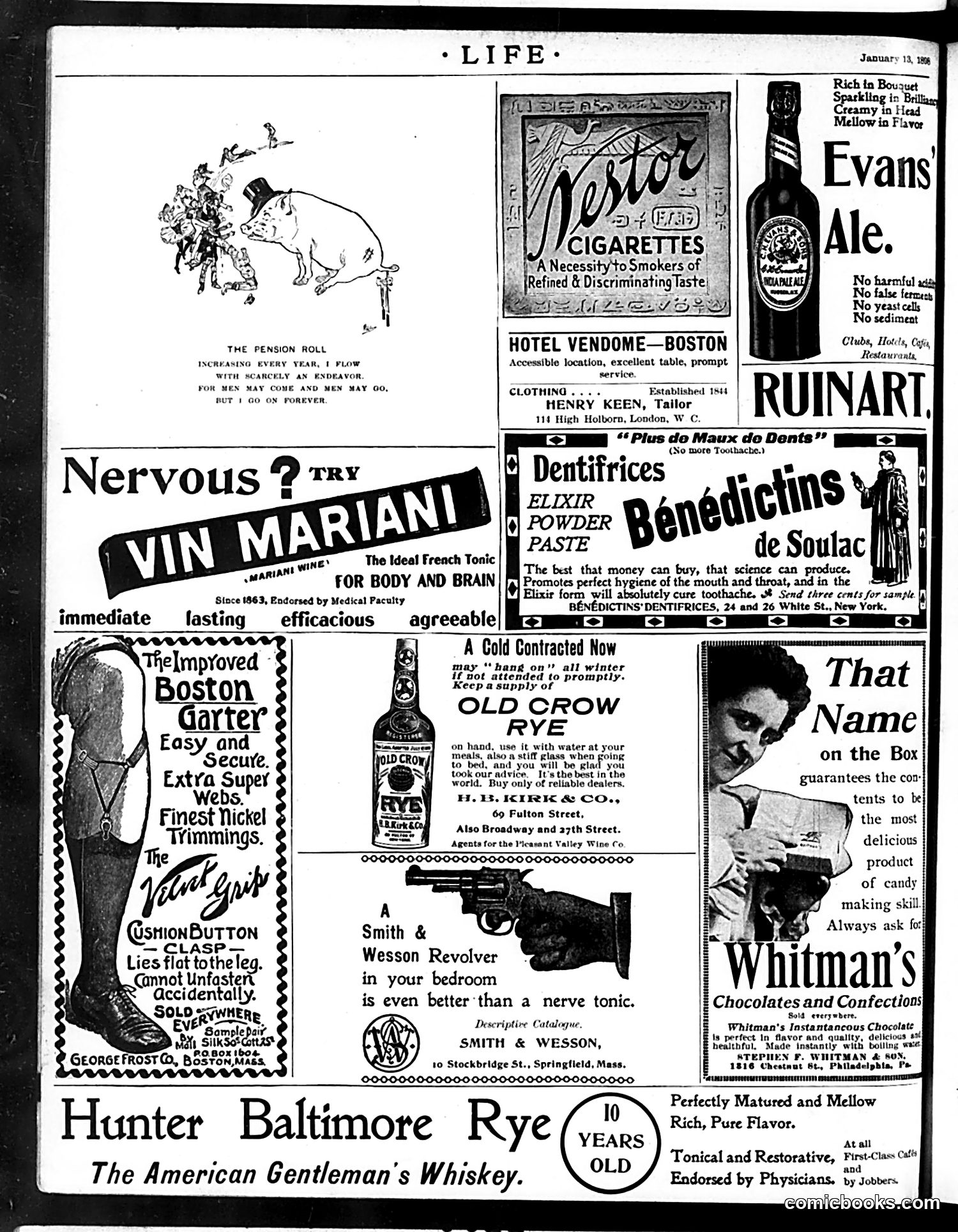
The single cartoon on this page depicts a pig in formal dress (top hat and tails) spraying flowers with a watering can, labeled "THE PENSION ROLL." **The Satire:** This critiques the expansion of government pension spending. The text below reads: "INCREASING EVERY YEAR, I PLOW WITH SCARCELY AN ENDEAVOR. FOR MEN MAY COME AND MEN MAY GO, BUT I GO ON FOREVER." The pig represents either a corrupt politician or the pension system itself—growing fat and prosperous without genuine labor ("scarcely an endeavor"), while watering something unproductive. The joke suggests pensions are wasteful entitlements that perpetually drain resources regardless of actual need or productivity. **Context:** Published January 13, 1903, this reflects Progressive-era anxieties about government spending and fraud in pension systems, particularly Civil War veteran pensions, which critics viewed as bloated and susceptible to abuse. The rest of the page contains period advertisements for alcohol, tobacco, and patent medicines—typical *Life* magazine content of that era.