
Life, 1898-01-13 · page 13 of 20
Life — January 13, 1898 — page 13: what you’re looking at
What you’re looking at
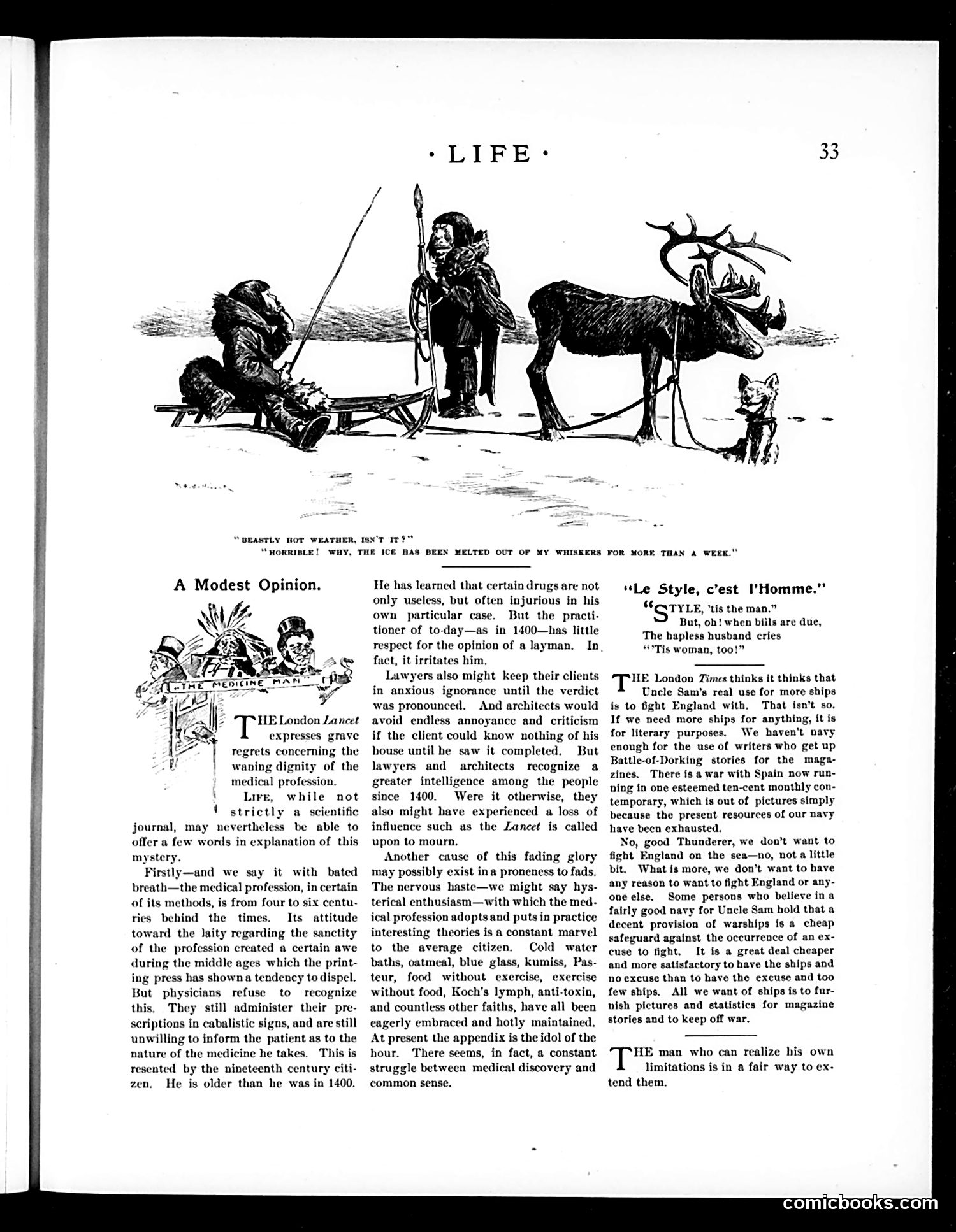
**Main Cartoon (Top):** Depicts Arctic explorers in harsh conditions. The caption satirizes British understatement—one complains about "beastly hot weather" while another notes ice melting from his whiskers, revealing the absurd disconnect between polite language and brutal reality. **"A Modest Opinion" (Left Column):** Critiques the medical profession for operating like it's still the Middle Ages—using cryptic prescriptions, dismissing patients' knowledge, and chasing fashionable fads (cold water baths, Pasteur treatments, appendectomies) without applying common sense. The piece contrasts doctors unfavorably with lawyers and architects, who've adapted to modern intelligence since 1400. **Right Column Sections:** Brief satirical items—one playing on the phrase "style is the man" to joke about how bills reveal a husband's true character; another mocking British fears of American naval expansion, arguing Americans want ships only for magazine illustrations about fictional wars with Spain, not actual conflict. The page represents Life's characteristic late-19th-century satirical approach: poking fun at professional pomposity, outdated practices, and jingoistic anxiety.
📄 Transcribed text from this page (OCR, searchable)
Machine-transcribed from the original scan — historical spelling and the odd misread are preserved.
“BEASTLY HOT WEATHER, ISN'T IT?" “HORRIBLE! A Modest Opinion. HE London Lancet expresses grave regrets concerning the waning dignity of the medical profession, Lire, while not strictly a_ scientific journal, may nevertheless be able to offer a few words in explanation of this mystery Firstly—and we say it with bated breath—the medical profession, in certain of its methods, is from four to six centu- ries behind the times. Its attitude toward the laity regarding the sanctity of the profession created a certain awe during the middle ages which the print- ing press has shown a tendency to dispel. But physicians refuse to recognize this, They still administer their pre- scriptions in cabalistic signs, and are still unwilling to inform the patient as to the nature of the medicine he takes. This is resented by the nineteenth century citi- zen. He is older than he was in 1400. He has learned that certain drugs are not only useless, but often injurious in his own particular case. But the practi- tioner of to-day—as in 1400—has little respect for the opinion of a layman. In fact, it irritates him, Lawyers also might keep their clients in anxious ignorance until the verdict was pronounced. And architects would avoid endless annoyance and criticism if the client could know nothing of his house until he saw it completed. But lawyers and architects recognize a greater intelligence among the people since 1400. Were it otherwise, they also might have experienced a loss of influence such as the Lancet is called upon to mourn. Another cause of this fading glory may possibly t ina proneness to fads. The nervous haste—we might say hys- terical enthusiasm—with which the med- ical profession adopts and puts in practice interesting theories is a constant marvel to the average citizen. Cold water baths, oatmeal, blue glass, kumiss, Pas- teur, food without exercise, ercise without food, Koch’s lymph, anti-toxin, and countless other faiths, have all been eagerly embraced and hotly maintained. At present the appendix is the idol of the hour. There seems, in fact, a constant struggle between medical discovery and common sense. WHY, THE ICE MAS BEEN MELTED OUT OF MY WHISKERS FOR MORE THAN A WEEK.” “Le Style, c’est I'Homme.” “OTYLE, ‘tis the man.” But, ob! when bills are due, The hapless husband cries ‘Tis woman, too!” HE London Times thinks it thinks that Uncle Sam's real use for more ships is to fight England with. That isn’t so. If we need more ships for anything, it is for literary purposes. We haven't navy enough for the use of writers who get up Battle-of-Dorking stories for the maga- zines. There is a war with Spain now run- ning in one esteemed ten-cent monthly con- temporary, which fs out of pictures simply because the present resources of our navy have been exhausted. No, good Thunderer, we don’t want to fight England on the sea—no, nota little bit. What is more, we don’t want to have any reason to want to fight England or any- one else. Some persons who believe ina fairly good navy for Uncle Sam hold that a decent provision of warships is a cheap safeguard against the occurrence of an ex- cuse to fight. It is a great deal cheaper and more satisfactory to have the ships and no excuse than to have the excuse and too few ships. All we want of ships is to fur- nish pictures and statistics for magazine stories and to keep off war, HE man who can realize his own limitations is in a fair way to ex- tend them.