
Life, 1898-01-13 · page 6 of 20
Life — January 13, 1898 — page 6: what you’re looking at
What you’re looking at
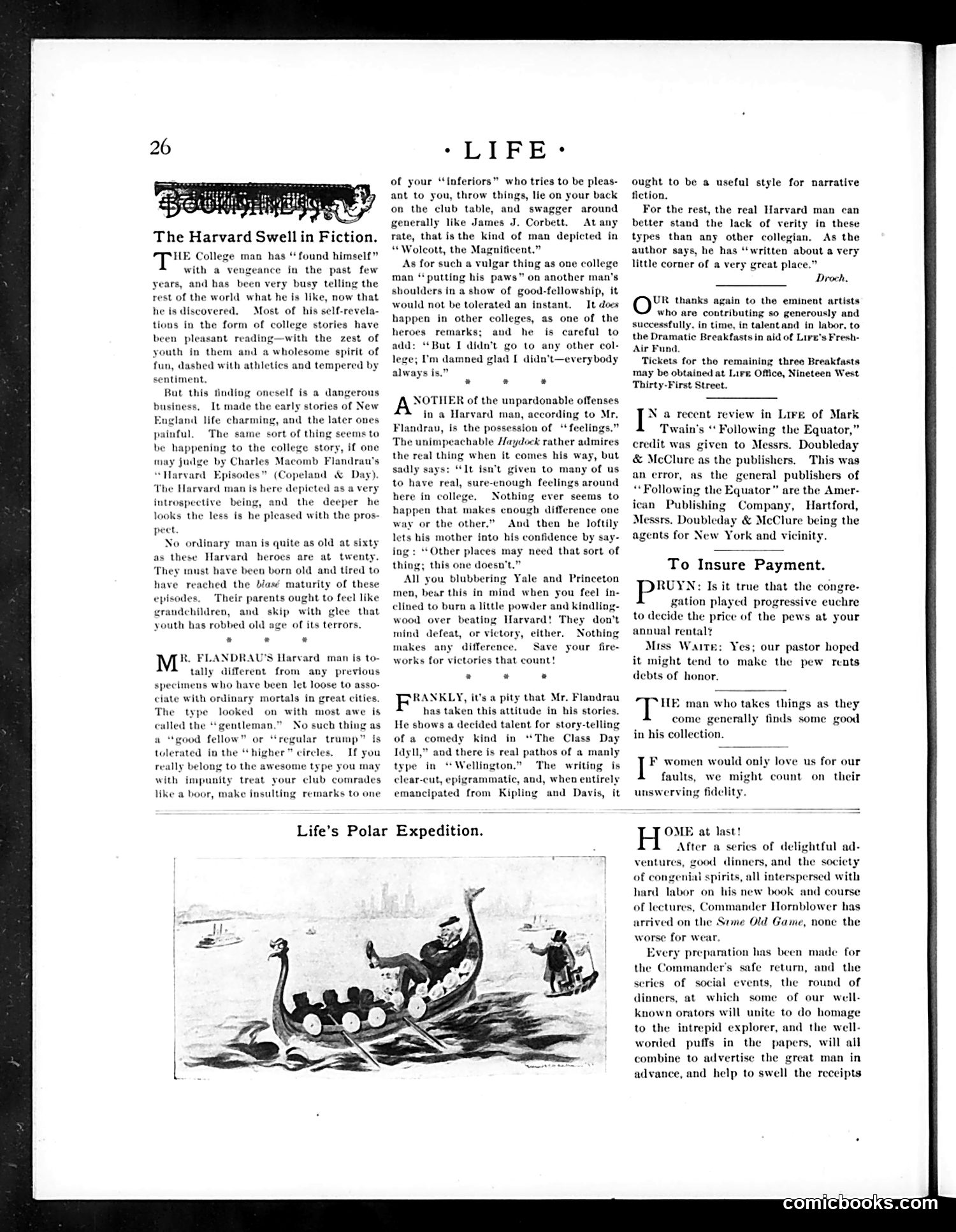
This page contains satirical commentary on Harvard University culture rather than political cartoons. The main articles critique Harvard men's pretensions and social attitudes, mocking their tendency toward self-importance and affected behavior. One section discusses how Harvard students adopt affected mannerisms ("regular trumps") and insult their college comrades, while another criticizes their obsession with "feelings" and emotional posturing. The cartoon at bottom, titled "Life's Polar Expedition," appears to be unrelated humor—a whimsical illustration of figures in a gondola-like vessel with swans, likely satirizing leisure travel or aristocratic expeditions rather than serious polar exploration. The page primarily targets upper-class college culture and social pretension rather than specific political figures or events.
📄 Transcribed text from this page (OCR, searchable)
Machine-transcribed from the original scan — historical spelling and the odd misread are preserved.
The Harvard Swell in Fiction. ILE College man has “found himself” with a ver in the past few years, and has been very busy telling the rest of the world what he is like, now that he is discovered, Most of his self-revela- tions in the form of college stories have been pleasant reading—with the zest of youth in them and a wholesome spirit of fun, dashed with athletics and tempered by sentiment, But this finding oneself is a dangerous business, It made the early stories of New England life charming, and the later ones painful. The same sort of thing happening to the college story, if one y judge by Charles Macomb Flandrau’s rvard Episodes” nd & Day) Harvard man is here depicted as a very introspective being, and the deeper he looks th pect. No ordinary man is quite as old at sixty as these Harvard heroes are at twenty. They inust have been born old and tired to have ed the blasé maturity of these episodes. Their parents ought to feel like grandchildren, and skip with glee that youth bas robbed old * ° * DM] & FEASDRAU'S Harvard man is to- ly different from any previous specimens who have been let loose to asso- ciate with ordinary mortals in great cities. The type looked on with most awe is called the “gentleman.” No such thing as “good fellow” or “regular trump” is tolerated in the “higher” circles, If you really belong to the awesome type you may with impunity treat your club comrades like a boor, make insulting remarks to one ems to less is he pleased with the pros- reac e of its terrors, *> LIFE: of your “‘inferiors” who tries to be pleas- ant to you, throw things, lie on your back on the club table, and swagger around generally like James J. Corbett. At any rate, that isthe kind of man depicted in “Wolcott, the Magnificent.” As for such a vulgar thing as one college man “putting his paws” on another man’s shoulders in a show of good-fellowship, it would not be tolerated an instant. It does happen in other colleges, as one of the heroes remarks; and he is careful to add: “But I didn’t go to any other col- lege; I'm damned glad I didn't—everybody always is.” * * * ‘OTHER of the unpardonable offenses in a Harvard man, according to Mr. Flandrau, is the possession of “feelings.” The unimpeachable Haydock rather admires the real thing when it comes his way, but sadly says: “It isn’t given to many of us to have real, sure-cnough feelings around here in college. Nothing ever seems to happen that makes cnough difference one way or the other.” And then he loftily lets mother into his confidence by say- ing : “Other places may need that sort of thing; this one doesn’t.” All you blubbering Yale and Princeton men, bear this in mind when you feel in- clined to burn a little powder and kindling- wood over beating Harvard! They don’t mind defeat, or victory, either. Nothing makes any difference. Save your fire- works for victories that count! * * * RANKLY, it’s a pity that Mr, Flandrau has taken this attitude in his stori He shows a decided talent for story-telling of a comedy kind in “The Class Day Idyll,” and there is real pathos of a manly type in “Wellington.” The writing is clear-cut, epigrammatic, and, when entirely emancipated from Kipling and Davis, it Life’s Polar Expedition. ought to be a useful style for narrative fiction, For the rest, the real Harvard man can better stand the lack of verity in these types than any other collegian. As the author says, he has ‘‘written about a very little corner of a very great place.” Droch, O TR thanks again to the eminent artists who are contributing so generously and successfully, in time, in talentand in labor, to the Dramatic Breakfasts in aid of Live's Fresh- Air Fund. Tickets for the remaining three Breakfasts may be obtained at Lire Office, Nineteen West Thirty-First Street. N a recent review in Lire of Mark Twain's “Following the Equator,” credit was given to Messrs. Doubleday & McClure as the publishers. This was an error, as the general publishers of “Following the Equator” are the Amer- ican Publishing Company, Hartford, srs. Doubleday & McClure being the agents for New York and vicinity. To Insure Payment. RUYN:: Is it true that the cor gation played progressive euchre to decide the price of the pews at your annual rental? Miss Waite: Yes; our pastor hoped it might tend to make the pew rents debts of honor. TM man who takes things as they come generally finds some good in his collection. F women would only love us for our faults, we might count on their unswerving fidelity. OME at last! After a serics of delightful ad- ventures, good dinners, and the soci of congenial spirits, all interspersed with hard labor on his new book and course of lectures, Commander Hornblower has arrived on the Srme Old Game, none the worse for wear. Every preparation has been made for safe return, and the seri of social events, the round of dinners, at’ which of our well- known orators will unite to do homage to the intrepid explorer, and the well- worded puffs in the papers, will all combine to advertise the great man in advance, and help to swell the receipts the Commander’ some