
Life, 1898-01-13 · page 12 of 20
Life — January 13, 1898 — page 12: what you’re looking at
What you’re looking at
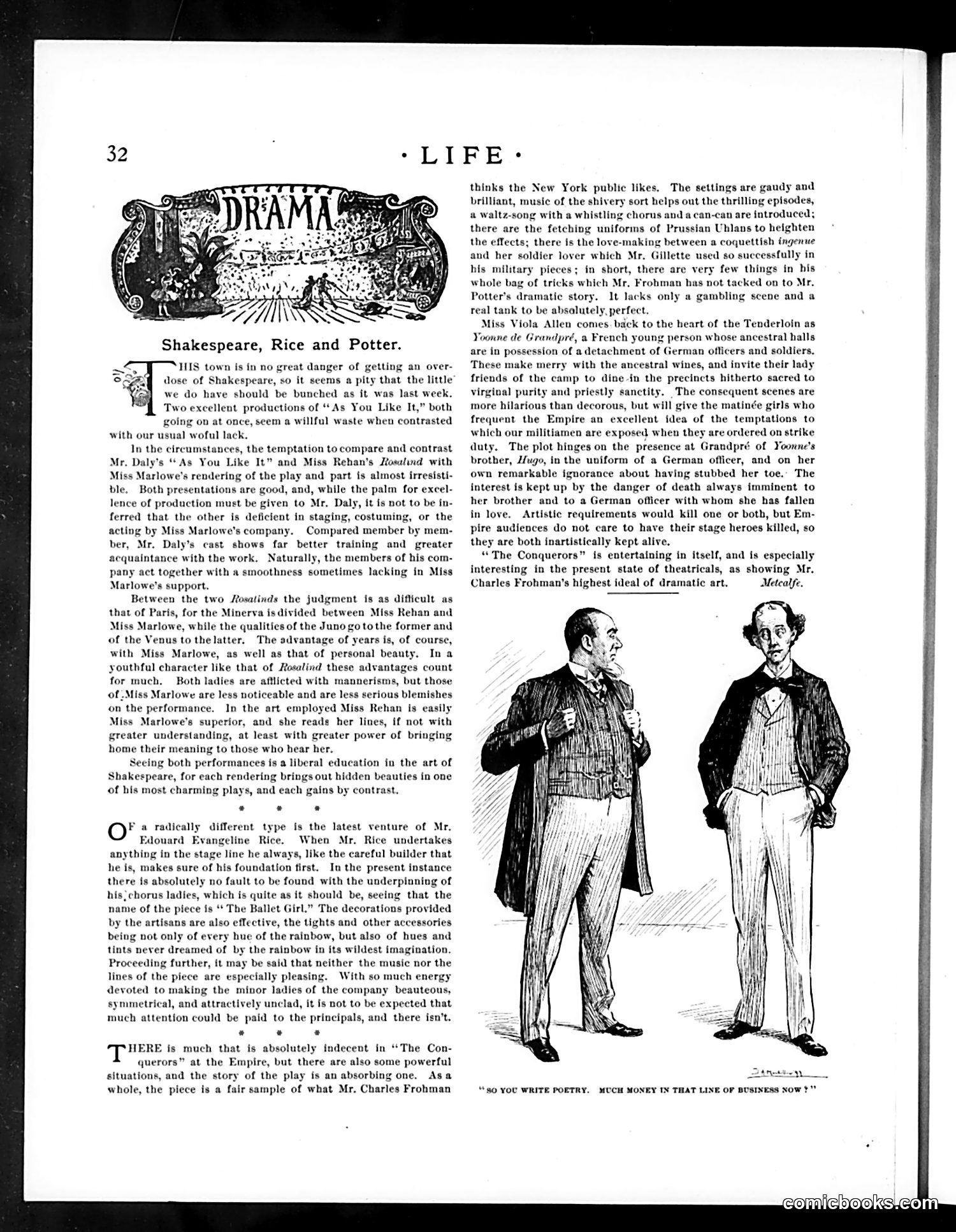
This page reviews contemporary theatrical productions. The illustrated cartoon below shows two men in Victorian dress with the caption: "SO YOU WRITE POETRY. MUCH MONEY IN THAT LINE OF BUSINESS NOW?" The joke satirizes the perceived impracticality of poetry as a profession. One figure appears skeptical or condescending toward the other's claim to be a poet, suggesting that writing poetry is not a lucrative career—a common 19th-century attitude dismissing literary pursuits as economically unviable compared to "practical" business. The page's main text discusses productions of Shakespeare and contemporary plays, evaluating performances by actors like Miss Marlowe and Miss Rehan, typical of Life's theatrical criticism during this era.
📄 Transcribed text from this page (OCR, searchable)
Machine-transcribed from the original scan — historical spelling and the odd misread are preserved.
* LIFE: Shakespeare, Rice and Potter. HIS town is in no great danger of getting an over- dose of Shakespeare, so it seems a pity that the little we do hi should be bunched as it was last week. Two excellent productions of As You Like It,” both going on at once, seem a willful waste when contrasted with our usual woful lack. In the circumstances, the temptation to compare and contrast Mr. Daly’s “*As You Like It” and Miss Rehan’s Hosalind with Miss Marlowe's rendering of the play and part is almost irresisti- ble. Both presentations are good, and, while the palm for excel- lence of production must be given to Mr. Daly, it is not to be in- ferred that the other is deficient in staging, costuming, or the acting by Miss Marlowe's company. Compared member by mem- ber, Mr. Daly's cast shows far better training and greater acquaintance with the work. Naturally, the members of his com- pany act together with a smoothness sometimes lacking in Miss Marlowe's support. Between the two osalinds the judgment is as difficult as that of Paris, for the Minerva isdivided between Miss Rehan and Miss Marlowe, while the qualities of the Juno go tothe former and of the Venus to the latter. The advantage of years is, of course, with Miss Marlowe, as well as that of personal beauty, In a youthful character like that of Rosalind these advantages count for much. Both ladies are afflicted with mannerisms, but those of .Miss Marlowe are less noticeable and are less serious blemishes ‘on the performance. In the art employed Miss Rehan is easily Miss Marlowe's superior, and she reads her lines, if not with greater understanding, at least with greater power of bringing home their meaning to those who hear her. Seeing both performances is a liberal education in the art of Shakespeare, for each rendering brings out hidden beauties in one of his most charming plays, and each gains by contrast, . . . F a radically different type is the latest venture of Mr. Edouard Evangeline Ric When Mr. Rice undertakes anything in the stage line he always, like the careful builder that he is, makes sure of his foundation first. In the present instance there is absolutely no fault to be found with the underpinning of his chorus ladies, which is quite as it should be, seeing that the name of the piece is “* The Ballet Girl.” The decorations provided by the artisans are also effective, the tights and other accessories being not only of every hue of the rainbow, but also of hues and tints never dreamed of by the rainbow in its wildest imagination. Proceeding further, it may be said that neither the music nor the lines of the piece are especially pleasing. With so much energy devoted to making the minor ladies of the company beauteous, symmetrical, and attractively unclad, it is not to be expected that much attention could be paid to the principals, and there isn’t. * . . HERE is much that is absolutely indecent in “The Con- querors” at the Empire, but there are also some powerful situations, and the story of the play is an absorbing one. Asa whole, the piece is a fair sample of what Mr. Charles Frohman thinks the New York public likes, The settings are gaudy and brilliant, music of the shivery sort helps out the thrilling episodes, a waltz-song with a whistling chorus and a can-can are introduced; there are the fetching uniforms of Prussian Ublans to heighten the effects; there {is the love-making between a coquettish ingenue and her soldier lover which Mr. Gillette used so successfully in his military pieces; in short, there are very few things in bis whole bag of tricks which Mr. Frohman has not tacked on to Mr. Potter's dramatic story. It lacks only a gambling scene and a real tank to be absolutely, perfect. Miss Viola Allen comes. back to the heart of the Tenderloin as Yooune de Grandpré, a French young person whose ancestral halls are in possession of a detachment of German officers and soldiers. These make merry with the ancestral wines, and invite their lady friends of the camp to dine -in the precincts hitherto sacred to virginal purity and priestly sanctity. The consequent scenes are more hilarious than decorous, but will give the matinée girls who frequent the Empire an excellent idea of the temptations to which our militiamen are exposed when they are ordered on strike duty, The plot hinges on the presence at Grandpré of Yoonne’s brother, Zugo, in the uniform of a German officer, and on her own remarkable ignorance about having stubbed her toe. The interest is kept up by the danger of death always imminent to her brother and to a German officer with whom she has fallen in love, Artistic requirements would kill one or both, but Em- pire audiences do not care to have their stage heroes killed, so they are both inartistically kept alive. “The Conquerors” is entertaining in itself, and is especially interesting in the present state of theatricals, as showing Mr. Charles Frohman’s highest ideal of dramatic art. Metcalfe. “80 YOU WRITE POETRY. MUCH MONEY IN THAT LINE OF BUSINESS Now ?"*