
Life, 1898-01-13 · page 14 of 20
Life — January 13, 1898 — page 14: what you’re looking at
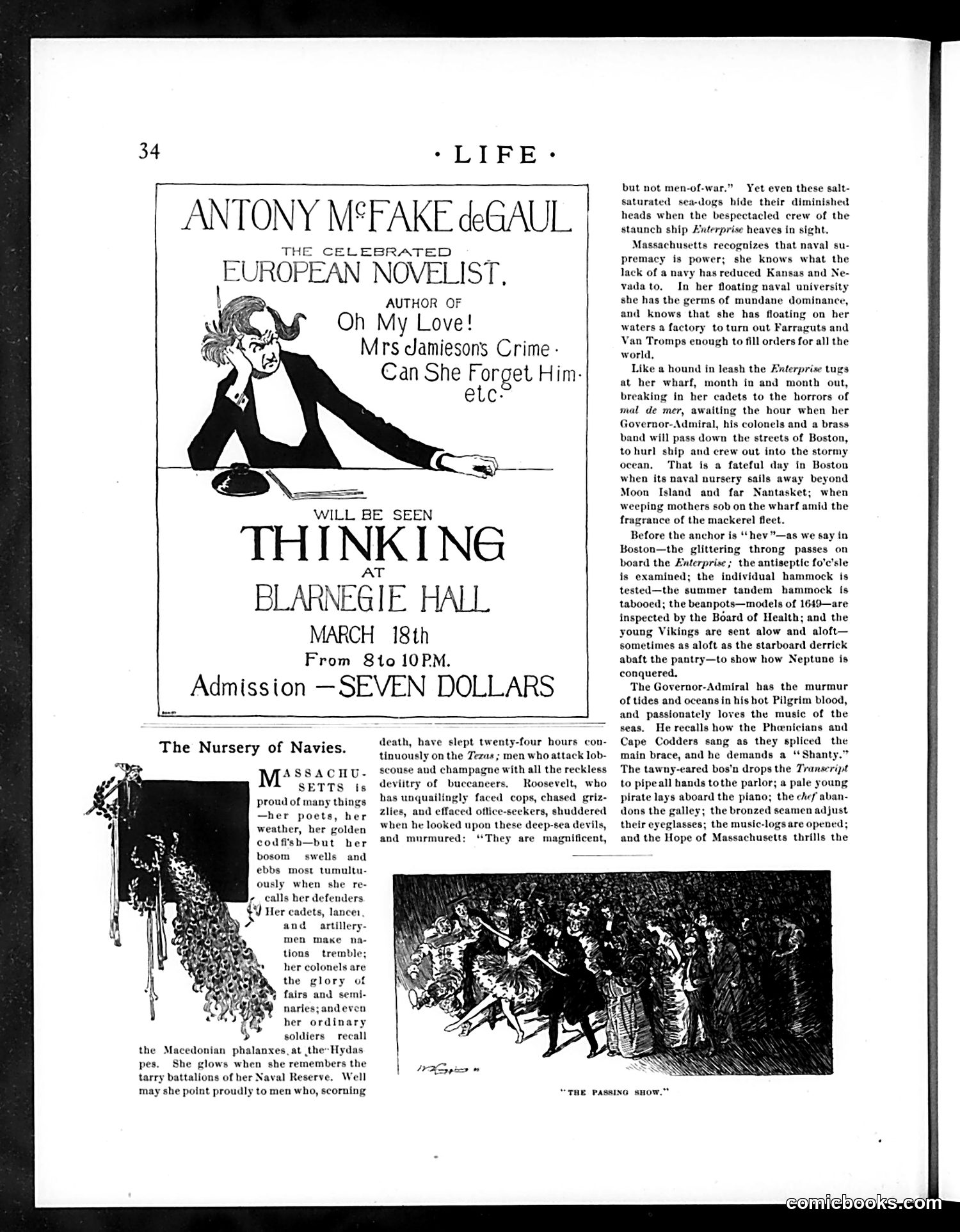
What you’re looking at
This page contains satirical commentary on Massachusetts's naval pride, particularly its Naval Reserve program centered on the USS *Enterprise*. **The Advertisement** (top): A mock promotion for "Antony McFake deGaul," a fictional European novelist, advertises a speaking event at Carnegie Hall. This appears to be satirizing pretentious European literary culture and American audiences' fascination with foreign sophistication. **"The Nursery of Navies"** (main article): The satire mocks Massachusetts's exaggerated pride in its naval tradition and reserve forces. It humorously contrasts the state's boastfulness about its military heritage (invoking Roosevelt and historical naval figures) with the reality: the *Enterprise* is primarily a training vessel for cadets, with comically mundane concerns like seasickness and hammock inspections. The piece ridicules both the grandiose patriotic language surrounding naval service and the gap between martial mythology and actual shipboard routine. References to "Farraguts and Van Tromps" (famous naval commanders) contrast with images of seasick trainees and bureaucratic health board inspections, emphasizing the absurdity of treating a training ship as civilization's defender.
📄 Transcribed text from this page (OCR, searchable)
Machine-transcribed from the original scan — historical spelling and the odd misread are preserved.
34 *LIFE: "ANTONY MFAKE deGAUL THE CELEBRATED EUROPEAN NOVELIST, \ Oh My Love! Mrs damiesons Crime - WILL BE SEEN THINKING BLARNEGIE HALL MARCH 18th From 810 10PM. Admission ~SEVEN DOLLARS 1 AUTHOR OF Can She Forget Him- ete: | The Nursery of Navies. Ma ssacuu- SETTS is proud of many things —her poets, her weather, her golden codfish—but her bosom swells and ebbs most tumultu- ously when she re- calls her defenders Pe Her cadets, lancer ¢ and artillery- men maxe tions tremble; her colonels are the glory of fairs and semi- narles; andeven her ordinary soldiers recall the Macedonian phalanxes, at ,the-Hydas pes. She glows when she remembers the tarry battalions of her Naval Reserve. Well may she point proudly to men who, scorning death, have slept twenty-four hours con- tinuously on the Tezas ; men who attack lob- scouse aud champagne with all the reckless deviitry of buccaneers. Roosevelt, who has unquailingly faced cops, chased griz- zlies, and effaced oflice-seekers, shuddered when he looked upon these deep-sea devils, and murmured: “They are magnificent, | 2ASpe but not men-of-war.” Yet even these salt- saturated sea-dogs hide their diminished heads when the bespectacled crew of the staunch ship Enterprise heaves in sight. Massachusetts recognizes that naval su- premacy is power; she knows what the lack of a navy has reduced Kansas and Ne- vada to, In her floating naval university she has the germs of mundane dominance, and knows that she has floating on ber waters a factory to turn out Farraguts and Van Tromps enough to fill orders for all the world, Like a hound in leash the Enterprise tugs at her wharf, month in and month out, breaking in her cadets to the horrors of mal de mer, awaiting the hour when her Governor-Admiral, his colonels and a brass band will pass down the streets of Boston, tohurl ship and crew out into the stormy ocean, That is a fateful day in Boston when its naval nursery sails away beyond Moon Island and far Nantasket; when weeping mothers sob on the wharf amid the fragrance of the mackerel fleet. Before the anchor is ‘‘hev”—as we say in Boston—the glittering throng passes on board the Enterprise; the antiseptic fo'e'sle is examined; the individual hammock is tested—the summer tandem hammock is tabooed; the beanpots—models of 1649—are inspected by the Board of Health; and the young Vikings are sent alow and aloft— sometimes as aloft as the starboard derrick abaft the pantry—to show how Neptune is conquered. The Governor-Admiral has the murmur of tides and oceans in his hot Pilgrim blood, and passionately loves the music of the He recalls how the Phenicians and Cape Codders sang as they spliced the main brace, and he demands a “Shanty.” The tawny-eared bos'n drops the Transcript to pipeall hands tothe parlor; a pale young pirate lays aboard the piano; the chef aban- dons the galley; the bronzed seamen adjust their eyeglasses; the music-logs are opened; and the Hope of Massachusetts thrills the “THE PASSING snow.”